Showing posts with label South Africa GDP. Show all posts

Wednesday, 6 September 2017

Reading GDP


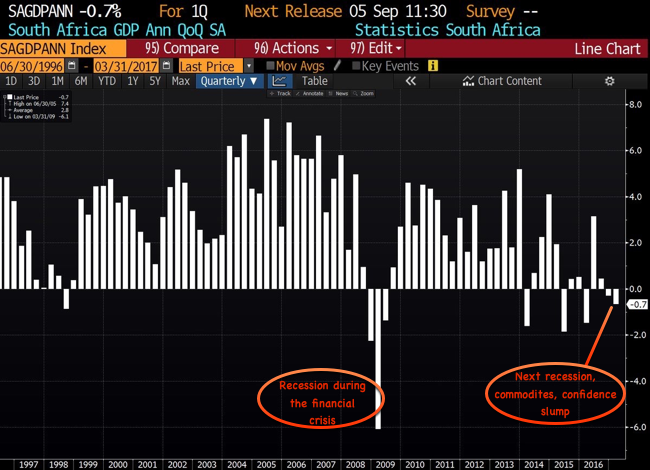
To market to market to buy a fat pig. To go with the new warmer season, the season of new life, our GDP read yesterday showed the economy has green shoots again. Hello growth. Goodbye recession. The headline read which is a quarter on quarter, seasonally adjusted and then annualized number (phew take a breath after that mouth full) came it at 2.5%. I personally prefer just to look at where we are today compared to where we were last year, there are less moving parts and you can very quickly see if we are better or worse 12-months on. The year on year number showed growth of 1.1%, below the 5% we need to make a dent in unemployment but much better than being in a recession.

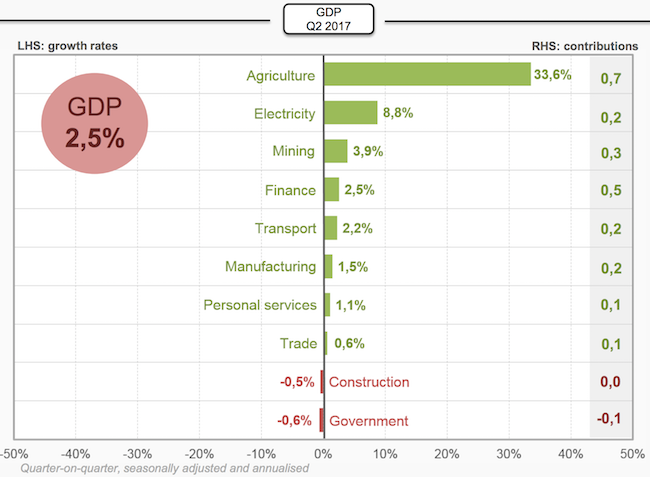
Have a look below at which sectors did well over the last quarter, Stats SA does a great job making the data easy to read. Agriculture has had a strong bounce back after last years drought, the extra you are paying for electricity is also making a positive impact on GDP growth and mining is enjoying the rising commodity prices.


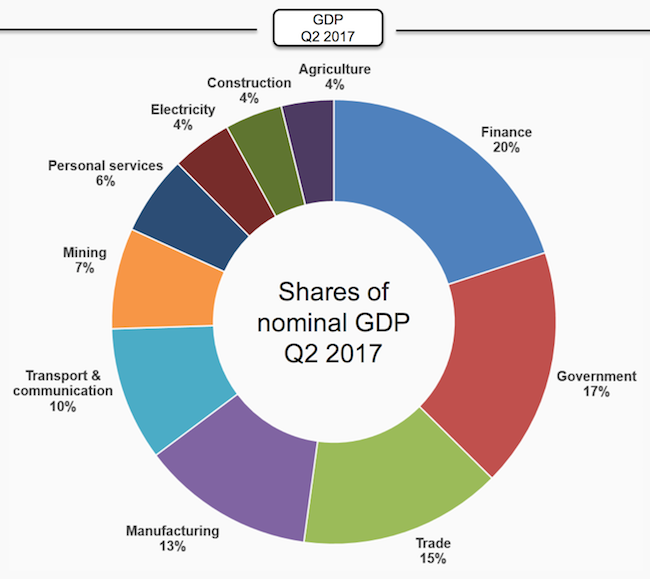
Part of the presentation from Stats SA is a breakdown of our economy. Long gone are the days when we were mining and little else, the economy has diversified into the territory and services sector, which is a good thing.


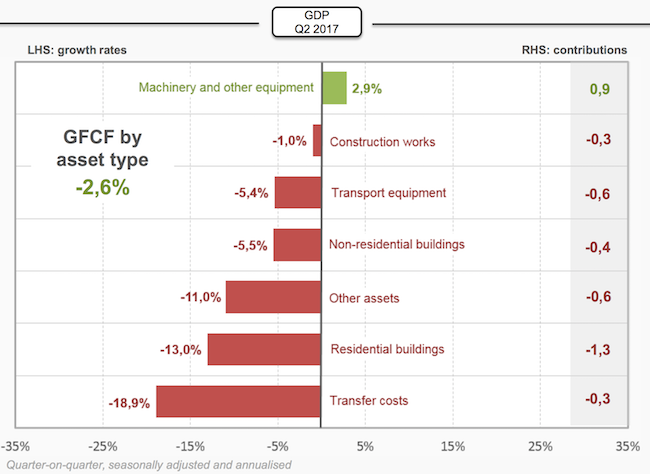
Then lastly, Gross Fixed Capital Formation (GFCF) which is a measure to some degree of the current confidence level in the economy. If you are low on confidence around the long term prospects of South Africa, your money is not going to be committed to costly long term projects. From the graph you can see that the residential housing market is under pressure, I suspect there has been an oversupply of properties built coupled with the slow upward movement of the family unit wealth. A Seeff report recently said they had 18-months worth of properties currently on the market.


After their break on Monday morning, US markets were playing catch up with the rest of global markets who had already sold off on Monday. Here is the scorecard, the Dow was down 1.23%, the S&P 500 was down 1.15% and the Nasdaq was down 0.93%. Our market was mixed yesterday but ended the day down 0.3%.


Linkfest, lap it up

One thing, from Paul

Conventional wisdom has it that change is accelerating, but economists studying productivity dispute this view. Robert Gordon, in his book the "The Rise and Fall of American Growth: The U.S. Standard of Living Since the Civil War" notes that electricity and the internal combustion engine were two key general purpose technologies which fundamentally changed humanity, and lead to a surge in productivity between the 1870s and the 1950s. This was aided by military innovation in the period of WW2.

Computers were another general purpose technology which accelerated workplace productivity in the 1990s, through the introduction of work tools like email, computer-aided design tools, relational databases, spreadsheets, word processors and the Internet.

Since then, productivity has slowed, paradoxically. Robots have only made marginal improvements to manufacturing output. Our households utilise much the same machines. Personal computers have become more powerful and smaller, but not allowed us to produce significantly more. This is counterintuitive. Perhaps the next surge lies around the corner? I think so. What a time to be alive!


Michael's Musings

Imagine having a highly sought after, high paying job and then only having the ability to rent a room of 30 square meters - Sky-High Rents Force Hong Kong Bankers Into Dorm Life. Space is something that I think South Africans sometimes take for granted.

Share incentive schemes don't always have the result of making management rich. I agree that if realistic targets are not met, bonuses should not be paid - No incentive payments for Woolworths executives. What is normally forgotten when top executive pay packages are analyzed is how much wealth has been created for shareholders in the process.

As a cricket fan, I am sad that Facebook didn't win their bid to stream the IPL. It does show that Facebook are going after the live sport market, we will have to wait to see which sport they will win the rights for - Facebook bid $610 million for the rights to streamIndian cricket matches.


Bright's Banter

Scott Galloway is one of the best human beings to follow on social media and to listen to on Barry Ritholtz's Masters in Business (a Bloomberg Radio Podcast available on iTunes). Watch his video on career advice, and tell me I'm wrong - Career Advice From Professor Galloway


Home again, home again, jiggety-jog. Our markets have opened deep in the red. Vodacom announced that Vodafone sold 90 million shares as part of the Safaricom deal. The sale was to bring Vodacom's free floating shares inline with regulations, the stock is still down 7% this morning. There is US trade data and manufacturing data out later today, which will give us a better idea of how their economy is running. Congrats to Kevin Anderson for winning his quarter-final match this morning, making him the first South African to reach the semi-final of the US Open.


Sent to you by Team Vestact.

Email us

Follow Michael, Byron, Bright and Paul on Twitter

078 533 1063

Wednesday, 7 June 2017

Howzit Recession

"So what next? More debt to GDP (as a result of lower GDP and more borrowing) and unfortunately less spend means lower tax collections. Which means lower revenues. Which leads to lower government spend. The other unfortunate part is, as Michael pointed out whilst he was listening to the wireless, is that radio stations are saying to Mr. and Ms. Consumer: "so now that we are in recession, what are you going to cut back on"? No, we were in it already, this was just the confirmation from all the way back to last October to now."


To market to market to buy a fat pig Whoa! That was ..... not good! A surprise read from StatsSA (who themselves have seen their budget slashed and may have less resources), has seen GDP for a second quarter in a row register contraction. Negative growth? That means the R word, R is for recession. There are a whole host of graphs that we need to pull out, including some really good ones from StatsSA, for historical context. So let us start with a Bloomberg graph that I managed to get via the Twitter thingie, that shows quarterly growth (and contraction). Here goes:


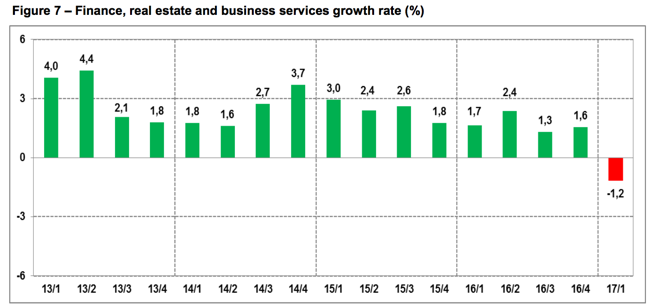
OK, so it is official. You can see the StatsSA release - Gross domestic product - First quarter 2017. Here is confirmation of "things are bad out there", in the form of the services sector, Finance, real estate and business services growth rate.


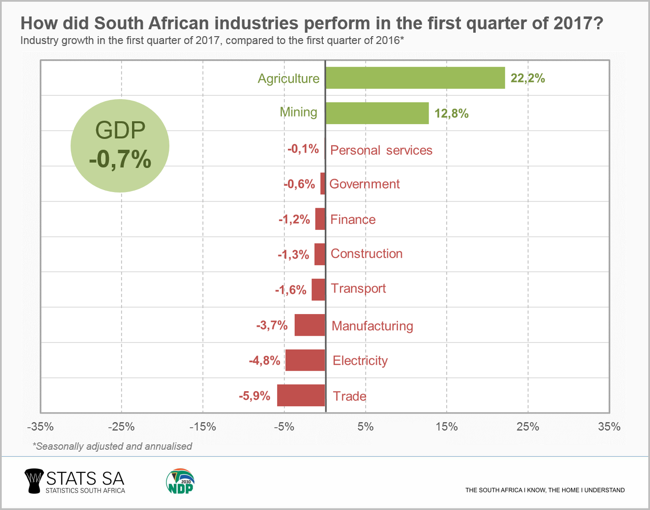
This is clearly a sign that people are "pulling back" and battening down the hatches. Another sign of lower activity is lower electricity usage, and there is no coincidence that manufacturing was lower. Whilst there are bright spots in the form of Agriculture and Mining, see below in what the major contributors are, the truth is that these sectors are both small, relative to the rest of the economy. Secondly, mining and agriculture are at the same levels (more or less) that they were back in 2012/2013. They have been going nowhere slowly for a while.


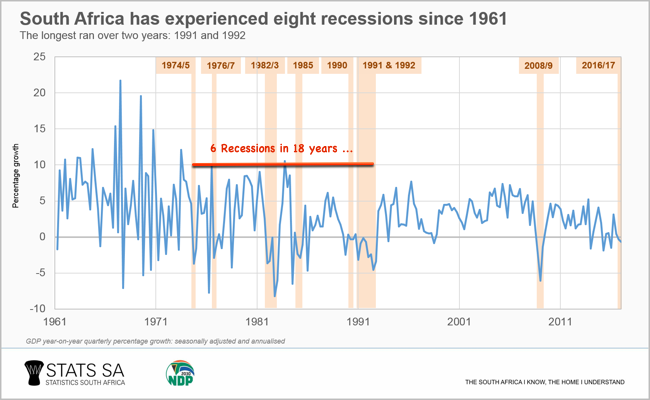
Insert sad face emoji. Before however you lose historical context, StatsSa had published a LONG dated graph, just to remind all of us that we had forgotten that this was a more regular occurrence than we think. We had forgotten. If you finished school over thirty years ago (OK, let us say 40), you would have lived through many of these recessions, thanks to StatsSA for all of these amazing graphs (and job well done, notwithstanding the pending job cuts there):


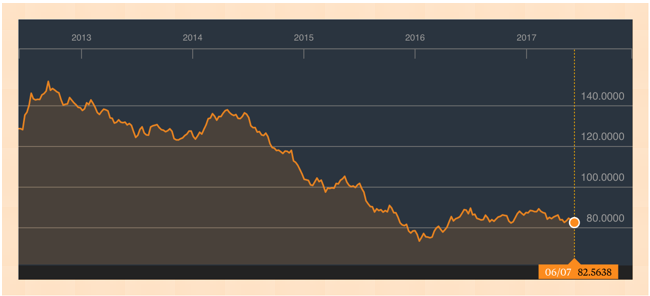
Through the end of the oppressive days of Apartheid, recessions were a regular thing. It turns out that attracting capital when you are a pariah state is nigh impossible (ask North Korea). As Paul mentioned yesterday, some of this is related to the lower commodity prices, this is confirmed with a five year DOLLAR commodities index from Bloomberg:


So what next? More debt to GDP (as a result of lower GDP and more borrowing) and unfortunately less spend means lower tax collections. Which means lower revenues. Which leads to lower government spend. The other unfortunate part is, as Michael pointed out whilst he was listening to the wireless, is that radio stations are saying to Mr. and Ms. Consumer: "so now that we are in recession, what are you going to cut back on"? No, we were in it already, this was just the confirmation from all the way back to last October to now. That is kind of reactionary. And with a very high unemployment rate (as per the release last week), we are unfortunately in a very sticky situation.

The ratings agencies will no doubt re-look their recent adjustments. The market locally reacted as you may have thought, the Rand was a whole heap weaker in a hurry, the SA inc. stocks were sold off too. Retailers and banks. Bidvest (local services business) sank nearly four percent, Standard Bank lost three and a half percent, Barclays Africa three and a half percent and Woolies sank three and one-quarter of a percent. At the other end of the spectrum were the likes of AngloGold Ashanti, South32 and Anglo America, all benefitting from a weaker Rand AND stronger commodity prices. By session end the story looked pretty one-sided, the Jozi all share down nearly one and two-tenths of a percent.

What should you as a holder of stocks do? Nothing. As you can see from past dips, these moments come and go. Revert to the ownership model, you own the company, and not their share prices. Whilst the political clouds resemble the Cape Town weather today, it brightens eventually.


Stocks in New York, New York ended the session lower after having been better earlier in the morning, and earlier in the afternoon. It isn't the best time, in-between company earnings and "eyes on the Fed" who are expected to raise interest rates next week. Yesterday was, believe it or not, D-Day, the Normandy landings that ended the second world war in Europe. 73 years ago yesterday, nowadays we have a relatively united Europe. Apart from the simple fact that we have UK elections tomorrow, right? The conservative's grasp on "things" may not be as wide as earlier suggested, we shall see. Apple had a decent enough day, after the multiple releases of products and software updates.

Session end the Dow Jones Industrial Average sank one-quarter of a percent, the broader market S&P 500 sold off by just over one-quarter of a percent, whilst the nerds of NASDAQ sold off one-third by the close. Energy stocks rose, as did basic materials, largely in response to a weaker Dollar.


Linkfest, lap it up

Byron found this great link, showing the top 10 success stories for SA tech start ups - Are these the 10 all-time biggest exit deals for SA startups? [Digital All Stars].

If you want to understand why Economics can be irrelevant in a normal world, this story about doughnuts will help explain why - The Doughnut Dilemma: What The Office Pastry Teaches About Behavioral Economics. The link also gives a hint as to why you struggle to stick to that new years diet you promised.

This is good news for Tencent and Naspers. - Alibaba Falters in Bid to Take Mobile Phone Control From Tencent. As we spoke about on Monday, Tencent's WeChat dominates Chinese smartphones which allows the company to divert shoppers to their shopping sites and away from Alibaba sites.

My goodness me! These fellows, you would think, have more exciting stuff to do. The truth is, they are just regular fellows. Around the Berkshire AGM, Buffett takes his mate Bill gates around the Nebraska Furniture Mart, where they get to experience "stuff" - Testing Mattresses with Warren Buffett. Lovely. This will make you feel warm and fuzzy inside, especially the part when they talk about their friendship and Bill's credit score.

You must have seen this before, here goes - The $35 Nike Logo and the Woman Who Designed It. According to the article though: "She was also given a generous amount of stock in the company (estimated to be worth upwards of $1,000,000), as well as a diamond and gold ring featuring the Swoosh design."


Home again, home again, jiggety-jog. Stocks are mixed here, there are results from Steinhoff that looked OK, perhaps not meeting market expectations. We will review those shortly.


Sent to you by Sasha, Byron and Michael on behalf of team Vestact.

Email us

Follow Sasha, Michael, Byron, Bright and Paul on Twitter

078 533 1063

Wednesday, 7 December 2016

Christmas Sale

"So what is the message here? Don't be reactive, don't get spooked, remember what you are trying to do here. You are trying to share in the long term profitability of businesses, and not timing share prices from tops to bottoms and bottoms to tops. Own it, buy more if the stock prices go lower."


To market to market to buy a fat pig Stocks locally sank to levels, as a collective, not seen since February of this year. It has been a tough old year for equities. We will analyse the human element and reaction to equity markets a little lower. The All Share closed nearly a percent lower to just below 49 thousand points, resources were down around two and one-quarter of a percent on the session. The Rand was the highlight of the show, trading now a couple of percent away from the best levels of the year. Notwithstanding the ructions, the pending downgrades and political machinations that have threatened to derail the chugging and creaking freight train.


We can all do better, the third quarter GDP numbers (from a long-long time ago, around 70 days ago) were more than a little disappointing. All we want is efficient use of resources. Easier said than done I guess. The drought has seen the agricultural sector contract seven quarters in a row. Although small in its overall contribution to the bigger picture, it is a very important part to us all. We all need to wake up and eat, and if we need to import food, that results in pressures on Joe Consumer as a result of imported inflation. And inflation eats into the pockets of those who have the least. It is not just agriculture, which can point fingers to weather patterns, the manufacturing industry has contracted for 7 out of the last 11 quarters, you could argue that the industry is in a protracted recessionary environment. No doubt, that is what the numbers reveal.


Equally, utilities (electricity, water and gas) have contracted for 10 out of the last 11 quarters. With all due respect to the trumpeting Eskom about the lack of load shedding, it is as a result of lower demand that the lights are staying on, the numbers of the economy suggest that. And I guess they have been trying harder to make sure we stay powered up. We live in a country with wonderful people, who have wonderful ideas. And capitalism is alive and well, the best visible example of South African capitalism is the taxi industry. No regulation whatsoever for routes, self regulation. Hustling all day long for an extra buck, bending the rules and regulations. We can all agree that the industry needs to be a whole lot safer, the consumers would shout louder at the drivers on that score. All I am saying is that if incentives are put in place, and there is less government meddling, the informal industrial sector can be hugely successful here in South Africa, becoming a bigger part of the economy. I encourage it.


Herewith a graphic from StatsSA showing who were the leaders and who were the laggards when it came to our economy in the third quarter of this year. Here goes, courtesy of StatsSA:


It is very important to remember that the market is not the economy and the economy is not the market. Remember the other day in the post titled The $10 Billion Club, we established that only 6 out of the top 15 stocks listed here had primary listings in Joburg/Jozi, and were part of the 10 billion Dollar market capitalisation club. As such, with a skewed stock market here locally (when BATS or AB InBev goes up or down, does that mean the economy is good/bad?), it cannot be a fair reflection of the economy. There are few, if any businesses that could be a pure proxy for the local economy, if you can think of any, it would be much appreciated.


Over the seas and far away, across the ocean (the Atlantic that is), stocks rallied towards the end of the day. The Dow Jones Industrial Average rallied nearly one-fifth of a percent to close up shop at 19251 points ...... that is another record. The broader market S&P 500 rallied over one-third of a percent, to be near their all time high, reached a couple of weeks ago. The nerds of NASDAQ closed at five triple three, we are still around 70 odd points away from the highs, up 0.45 percent on the day was pleasing. Financials again moved the needle, up over a percent by the close. In recent weeks, for the first time in half a decade, financials are outperforming the broader market. The majors there are of course Berkshire, JP Morgan and Wells Fargo as well as Bank of America are all huge businesses starting to see some of their stodgy earnings projections turn north with the benefit of higher rates being a positive for their business.


Nike took a knock, after being the top stock in the Dow the session before, they were the worst performer, by quite some margin. Nike are by far and away the worst performing stock in the Dow Jones this year, down 19 percent. The top performing stock in the Dow Jones Industrial average is Caterpillar, up an astonishing 40 percent YTD. Over five years CAT is flat (as a pancake), the stock is down 0.8 percent. Nike is up 110 percent over that time. Ten years, CAT is up 55 percent, Nike is up 314 percent. When I reverse and have a look at data from late 1980 to present day, Caterpillar is up 1140 percent, the shares of Nike (thanks Google Finance for this info) are up 29318 percent. The S&P 500 is up 1474 percent over that time, it would have been better to have owned the index over Caterpillar. What is the moral of the story? Hindsight is an exact science.


It is never *nice* to see the value of the shares that you hold sink to levels that make you feel uncomfortable. Feeling like you are close to sitting on a cactus plant. There are many analogies that people use for the declining value of their equities portfolios, most of these involve some sort of horror movie scene, with explosions, crashes and dismembered body parts everywhere. Part of investing is the ability to recognise your "fears". For instance, if you buy and own Walmart, you are never going to expect revenues to plunge or rise in the high teens.


It is a steady business that delivers year in and year out, people shop there for value. And there are always people looking for value. So ..... when the Walmart share price fell from nearly 90 Dollars a share in January of 2015 to 56 Dollars by November, down 35 percent for the year, did that mean that Walmart sold less, reported lower profits? No. Share price performance and actual reported numbers have a close correlation, they are not one and the same. In fact, when the share price was 35 percent lower, sales reported are not that different from the years prior.


The share price over the five year period saw a 17 percent increase. There have been multiple highs and lows. The dividends have added another 15 percent. The dividends have given you as much as the stock returns, more or less. Yet when "investors" talk of returns, they will not refer to these wonderful and incremental returns, that if reinvested, generate higher returns in time. It takes time, even in the face of increasing competition from online competitors, to realise that things change, they also stay the same.


I have written to clients who share the same concerns, that the value of their portfolios are obviously lower than the last high water mark. Our message has always been consistent. Here are a few excerpts that will no doubt help, in the same way that a visit to the doctor is helpful to tell you that everything is going to be ok.


    What you have complete control over as an investor is what you want to own, how you view their prospects over many years ahead. You have control over how long you are willing to own a business. You have control over your ability to stomach steep losses and equally to avoid temptations to sell when a stock does well. The longer you own a specific stock, the temptation arrives when you feel you must rebalance, when in truth you must use the dividend flow generated to rebalance over a few years.


And then an Old Mutual graph below went with another answer to concerns about the equities market. I think that it is pretty self explanatory and it takes all the events, global and local and puts in the returns over that time, of the overall market.


    ... these are companies that constantly evolve and are likely to continue to report higher revenues on sustained margins (or increased margins) in the years to come. Here is a fairly "dated" Old Mutual graph, you get the picture however, in amongst all those squiggles moving down and to the right, there are many more moving up and to the right. And we can count many events, both political, local and geopolitical (as well as financial) that can trash investments, the trick is to remind yourself you own companies, not share prices.


And then another:


So what is the message here? Don't be reactive, don't get spooked, remember what you are trying to do here. You are trying to share in the long term profitability of businesses, and not timing share prices from tops to bottoms and bottoms to tops. Own it, buy more if the stock prices go lower. As I told a younger, exceptionally bright Sandtonite (who is a saver and not a spender): "You should ironically as a youngster buying equities hope for lower prices over time, so that whilst you are adding, you get cheaper prices."


Linkfest, lap it up


Here is a look at what is in the pipeline from Facebook. There are some cool ideas and some gimmicks - Mark Zuckerberg reviewed the coolest stuff Facebook’s engineers are working on


I can see the value in having indoor mapping, particularly when you are traveling - Apple secretly acquired a Finnish company to help it map indoor spaces. Imagine going to a big sporting event, punching your seat number into your cellphone and then it directing you to it.


The minimum wage debate is something we are having in South Africa at the moment. Seattle has a different workforce composition to that of South Africa and a different growth rate but this is interesting data none the less - Seattle Minimum Wage Experiment is Over.


Home again, home again, jiggety-jog. Stocks have started better. What a surprise (Muriel's wedding, the old man), stocks in Europe are also indicated better. Steinhoff has opened up over three percent as their results have attracted the buyers. It certainly looks attractive at these levels. We will have a write up tomorrow on these numbers.


Sent to you by Sasha, Byron and Michael on behalf of team Vestact.

Email us

Follow Sasha, Michael, Byron, Bright and Paul on Twitter

078 533 1063