Showing posts with label Stenhoff. Show all posts

Thursday, 1 March 2018

My Banana is Bigger Than Your Cucumber


To market to market to buy a fat pig. I (Michael) am reading Thinking, Fast and Slow by Daniel Kahneman. I have been since December; a recent reading test told me that I read at the speed of a high school student, a few words a minute slower than the global average. Kahneman is a Nobel prize winner, for his work on behaviour economics (cognitive biases). Basically his work proved that people are irrational and economists need to come up with better models for how the world works.

One of the experiments spoken about in the book is how unhappiness can derive from comparing. Researchers took two chimps, in separate cages. First, they gave each one a cucumber and then observed. Both Chimps ate the cucumber and were content. Then the researchers gave one chimp a banana and the other chimp a cucumber again. As you can imagine, one of the chimps was happier than the other. The chimp with the cucumber went as far as throwing the cucumber at the other chimp.

It is amazing what happens when we feel that we are being treated unfairly. What the experiment demonstrates is that unfairness and unhappiness is relative. If the second chimp never saw the first chimp with the banana, there wouldn't have been a problem. Imagine if the first chimp got wilted spinach instead of the banana? Apply this to a very emotive subject, income inequality; has social media made the problem seem worse than it is? The graph below is one of the arguments presented for the rich getting richer and the middle class going sideways.
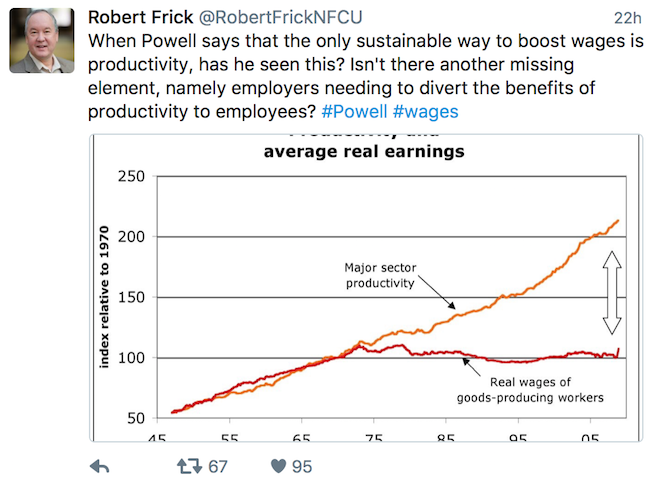


My argument is that focusing on real wages is the wrong metric. Surely what is more important is what you can do with what you earn? If your salary doesn't go up in real terms, but thanks to technology things get cheaper, that is progress? These below tweets show how far we have come in the last 100 years.
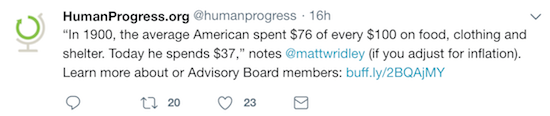
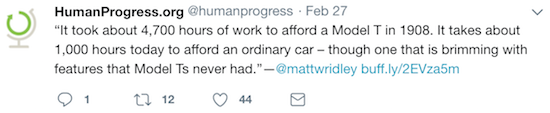


I agree that there is no point in having a society build tremendous wealth that only benefits a few, but at the same time, things probably aren't as bad as the media would have you believe?

Market Scorecard. Tuesday's tough time continued on Wednesday. The Dow was down 1.50%, the S&P 500 was down 1.11%, the Nasdaq was down 0.78%, and the All-share was down 1.19%.


Company Corner

Yesterday after the market closed, Steinhoff released its Quarterly update, for the three months ending 31 December. Meaning the post-implosion period only accounts for three weeks of these numbers. The first thing I looked for was an update of when PWC would release their findings.

    "It is not possible at this stage to provide any definitive timing for conclusion of the PwC investigation, but the company will provide regular updates on any material developments and clarity on timing as soon as possible"


Here is a look at their top line performance.
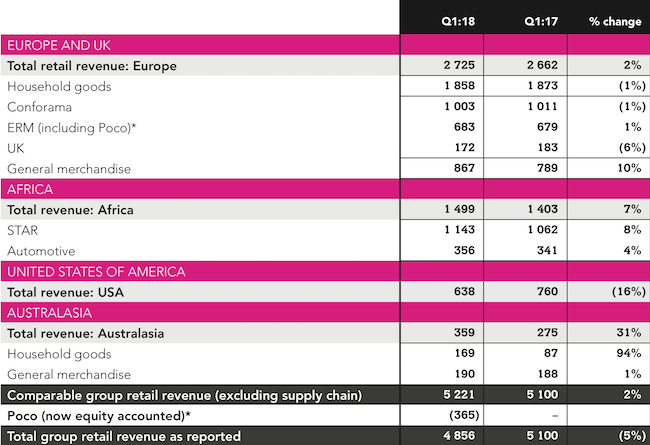


As you can see, Mattress Firm (US operation) is hurting while they are in the process of revamping the business. Here is what management had to say:

    "During the quarter under review, 99 stores were closed, while eight stores were opened. Management aims to close approximately 175 stores and open 75 new stores"

    "Furthermore, management has identified that the change in major supplier has resulted in gaps in the product range that are being urgently addressed."

    "Mattress Firm's like-for-like sales being down by 10% for the period under review, largely driven by lower average unit selling prices. Like-for-like unit sales for the group declined by 3%."


It all still looks rather ugly. To make matters worse, German media and Moneyweb are reporting that incriminating emails between Jooste and senior management have been uncovered (#SteinhoffLeaks Part 1: 'Some big mistakes'). If you are still holding the share, the end to this sh*t show doesn't look to be any closer.


Linkfest, lap it up

One thing, from Paul

Strikes by organised labour are on the decline (in developed countries at least). The collapse of unions in the private sector is the principal reason. Globalisation of manufacturing and services is also a factor, as enormous companies with worldwide operations simply adjust to avoid work stoppages.
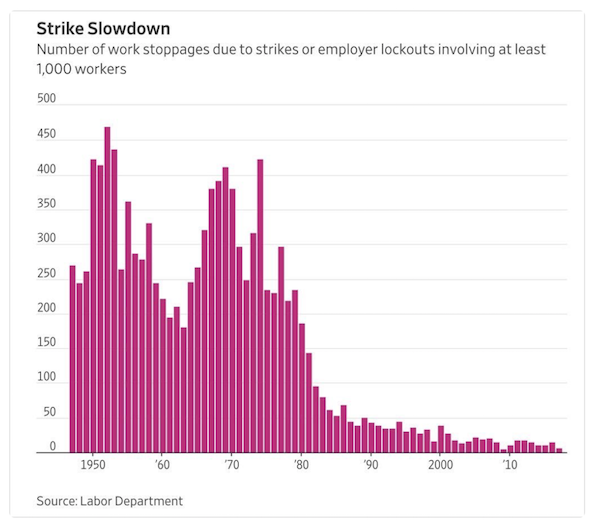


This trend seems true of South Africa too? We have high levels of unemployment, which further strengthens the hand of companies. Trade unions only really have much traction in the state sector, where their employer is a pushover?

Here is a link to the article (might require a WSJ subscription) which contains that graph:

Why Workers Are Striking Less Than Ever


Michael's Musings

If you are on Twitter you need to follow Wandile Sihlobo. His blog post from yesterday has a look at the unused land which can be used for agriculture, the low hanging fruit for land redistribution - These Provinces Have Unused Land Suitable For Agriculture.

Todays chart from Visual Capitalist fits perfectly with what I wrote above - These 6 Charts Show How the World is Improving.
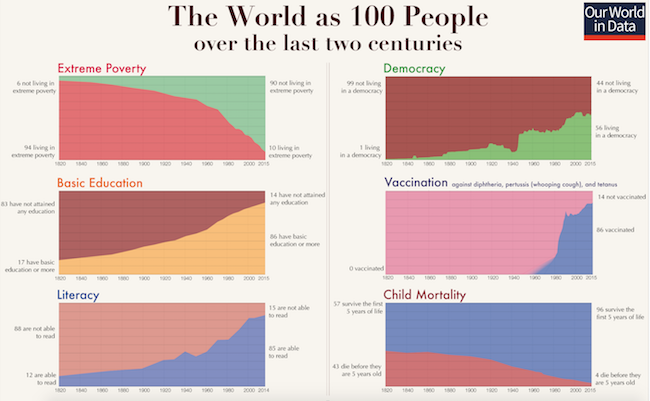


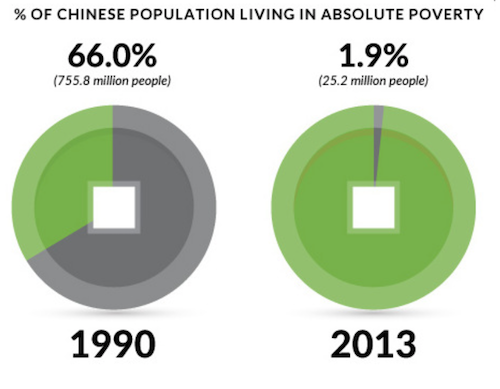
The mind still boggles a bit, when you think about how much China has changed over the last 30-years. It shows what can be accomplished when the government is focused on the people and not their own benefits.


Vestact in the Media

This an interesting question to think about. Michael gets a nice mention when talking about the impact of our currency on the stock market - Does South Africa really need a stronger rand?.


Home again, home again, jiggety-jog. Our market is slightly down on the open. A strong Dollar means the Rand is heading back to the $/R 12.00 level. Local data today, we have manufacturing PMI and vehicle sales numbers; how big will the impact of the renewed optimism be?


Sent to you by Team Vestact.

Email us

Follow Michael, Byron, Bright and Paul on Twitter

078 533 1063

Thursday, 2 April 2015

Coming through!


"I kid you not, a 2 percent difference in market capitalisation exists between Anglo American and Steinhoff at this point. Steinhoff as of last evening, have a market capitalisation of 243 billion Rand, Anglo American have a market cap of 254 billion Rand. And you will be more surprised to know that Anglo American have fallen out of the top ten companies by market cap in the South African market."


To market, to market to buy a fat pig. Resource stocks were slam dunked, mostly as a result of the falling iron ore price. Below 50 Dollars a ton. The worst level since May of 2009, that is a long time ago. From May the 8th, 2009 to present day, your return in Anglo American securities would be minus 3.82 percent. That is in Rand terms. In Pound Sterling that same return has been minus 31.5 percent, your Rands have been somewhat protected by a weakening currency. The yield in Pounds is around 5.6 percent, could that be right? A payment of 85 US cents last year (at around 12 Rand to the Dollar, that is 10.2, after tax that equals 8.67 Rand) translates to a post tax yield of 4.8 percent for Anglo American. Obviously that is dependent on commodity prices, Mr. Market is telling you that the company might struggle to meet that 85 US cent obligation this year.

I kid you not, a 2 percent difference in market capitalisation exists between Anglo American and Steinhoff at this point. Steinhoff as of last evening, have a market capitalisation of 243 billion Rand, Anglo American have a market cap of 254 billion Rand. And you will be more surprised to know that Anglo American have fallen out of the top ten companies by market cap in the South African market. They only represent 2 and a quarter percent of the entire market capitalisation, obviously not on a weighted basis where large parts of the market caps of SABMiller and BATS have foreign registers in London that are larger.

Lean in a little, you are going to find this even more surprising and this represents all the heavy lifting that Marcus Jooste has done at Steinhoff, in June of 2010, Steinhoff had a market cap of 25 billion Rand, much fewer shares in issue (1.4 billion then versus 3.184 billion shares now). Anglo, in December of 2010 had a market cap in Rand terms of 413 billion Rand (shares in issue have not changed that much), that has shrunk by 160 billion Rand as commodity prices have softened. The divergence of an old South African champion that is closely associated with the mining activity in this town of ours and a new champion of retail across the globe, in the form of Steinhoff has been nothing short of breathtaking. And if you had to ask me to stick my neck out as to who has the better prospects over the next half a decade, I would back Christo Wiese throwing in his lot with Steinhoff every single time.

As spectacular have been the vicious moves by Kumba Iron Ore and AngloGold Ashanti, southwards, in terms of moves to the bottom of the 40 biggest companies by market cap. Those companies find themselves in places 40 and 42 respectively, Redefine sandwiched between the two and Brait breathing down their necks. Again, if you had to stick a gun to my head I would rather choose Brait and Redefine over the iron ore and gold producer. I suspect that Mr. Market will continue to do the same too, the prospects just seem better. Paul did a show on Hot Stocks on the commodity producers, with a focus on iron ore and him and Wayne did not make an investment, even at these depressed prices. I am afraid that until something changes structurally, i.e. there is strong demand from either India, or a pickup in demand from the rest of the globe, the medium term looks like a hard battle. To let you know how "bad" it has been for producers, here is as long a graph I could get on the iron ore price from IndexMundi:


What becomes evident is that the price of iron ore, over 17 years up to 2002, "did nothing" for a long time. Demand was muted and it was unattractive to push volumes. The opposite changes. And now there is an enormous amount of volume being brought online and demand is softening from the Chinese. Yowsers. At the opposite end of the spectrum as far as poor performance was concerned on the day, was MTN, which was up over 6 percent, dragging the rest of the market higher. The favourable outcome in Nigeria, i.e. no violence with a political shift in power represents a new maturity with regards to African politics. I like it a lot.

Not a prank, quite simply put, as per the FT (subscription only, they have a free subscription option that lets you view a couple articles a month) article: Greece submits new list of reforms to eurozone. You can actually read the whole list of reforms on this document, which was "obtained" by the FT, titled: Greek Reforms. I read most of it. I was quite interested in the "VAT lottery", a system whereby if you insist on obtaining a receipt with the VAT amount from a retailer, you can enter that receipt into a lottery. i.e. By being a good citizen, you get a chance to win the lottery.

Another one of the points, and I think that spelling it out word for word, explains it all: "The initial goal for revenues from privatizations was 50 billion Euros between 2011 and 2016, with a 5 billion target for 2011, 10 billion for 2012 and 5 billion for 2013. In practice, proceeds from privatizations amounted to 1.6 billion in 2011, no revenues in 2012 and 1 billion in 2013. Seldom has a privatization program failed so spectacularly!" Wow. I guess practically speaking shifting government obligations onto the private sector means less government outlays.

There was also some cryptic explanation of how small business in Greece exists, a segment titled: Reducing undeclared work and reinforcing monitoring mechanisms: Undeclared work is prevalent in Greece, and it has risen alarmingly during the previous 4 years. The main reasons include the structural peculiarities of the Greek economy, dominated almost entirely by small and medium-sized businesses and an admittedly high degree of tolerance of shadow labor forms with fully undeclared labor at the extreme end of the spectrum. What does that sound like to you? Shadow labour forms? Man, I don't understand any of it, we cannot understand it, we don't live there. And guess what, early signs are that the new proposals have been rejected. Back to the drawing board, try harder.


Things we are reading

Ha, ha, ha. This is simply amazing, one of the best stories I have read in a long time. It starts badly when the guys iPhone gets stolen, he ends up travelling for nearly a whole day to find it and then is very surprised at some sort of culture that has developed between him and the chap who ended up with the stolen phone. Fun read: How I Became A Minor Celebrity In China (After My Stolen Phone Ended Up There). The second hand phone market in China is massive, the biggest in the world!

I know that you have always wanted to know, yet you have never quite found out where or who to ask, relax, here it is: 8 things worth knowing about eating sushi. I plan to do this too, to get to the Tsukiji fish market. The one in New York (new location Hunts Point) has annual sales of 1 billion Dollars and is second in size to the Tokyo one.

A big debate on the recovery has been where the jobs have been created - Duetsche Bank: No, This Is Not A Low-Wage Recovery. Having jobs growth in the higher paying jobs is good news for the economy, the data also highlights the need to upscale yourself.

This is not the first app to offer voice calls it is one of the biggest though which makes it far more useful - WhatsApp finally adds voice calls for all Android users, iOS coming soon. For companies like MTN and Vodacom we have already seen a shift in the number of voice calls and we will continue to see it. Data consumption is increasing at a faster rate than prices are falling, which means these companies can still see growth going forward.


Home again, home again, jiggety-jog. We are up one quarter of a percent today. Naspers got to 1900 ZAR a share. Turn down for what??


Sasha Naryshkine, Byron Lotter and Michael Treherne

Email us

Follow Sasha, Byron and Michael on Twitter 087 985 0939