Showing posts with label Woolworths. Show all posts

Friday, 23 February 2018

Bonding with your Shares


To market to market to buy a fat pig. At the start of the year, there are often clients asking if they should invest in the stock market or their bond. If the subsequent year had strong market returns, normally we have people saying they are dipping into their bond to send money. The opposite is also true, during lacklustre years, we see clients selling shares to pay down their home loan. So what is the best route to go?

If we don't take emotion into consideration, having money in the stock market is a much better long-term return than having money in your house. Having a look at the recent FNB House Price Index, if you bought property in January 2000, on average it is now worth just over four times what you paid for it. Over the same time period the JSE All-share is up over 11 times! See the graphs below of how each sector has done over the years.
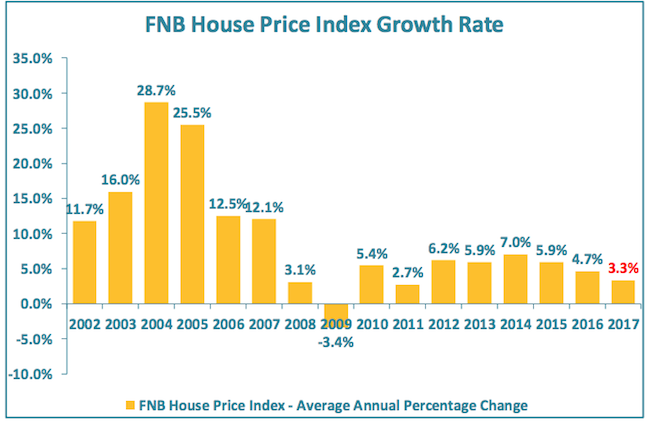
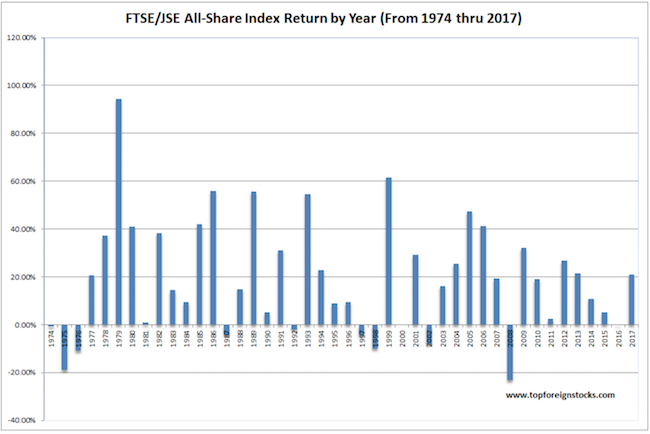
Found at South Africa's FTSE/JSE All-Share Index Returns By Year

We are not comparing apples to apples though. The real choice you need to make is - put spare capital into your home loan and pay less interest, or put it in the stock market and hope for superior returns. Do you remember the late 90's and early 2000's when interest rates were around 20%!? Between the period 1 January 2000 and 31 December 2008, it was better to have your money in your home loan than the stock market. Expanding the time frame though to 1 January 2000 until the 31 December 2017, stocks beat your bond. So when people say stocks are a good long-term investment, they mean LONG term.
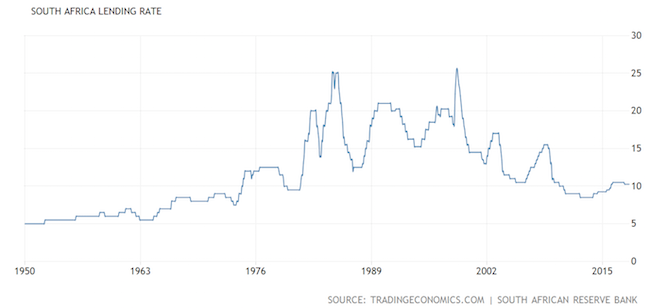


For many people, it is worth something knowing that they own their property. Knowing that if you hit a financial speed bump, the roof over your head is not going to be taken away by the bank. That is worth giving up a few percentage points of return. The ideal situation is having enough capital to pay a bit extra into your home loan and still have some money to top up your share portfolio. My strategy is to have spare funds sitting in my home loan that I can draw on during market pullbacks. I still put something into stocks monthly though; dollar-cost averaging is a very powerful weapon in the arsenal of long-term investors.

To conclude, generally keeping your life simple is the best strategy. Don't stress about where you will get the best return, rather focus on making sure that your budget leaves room for monthly saving.

Market Scorecard. New York kicked the day off, seemly forgetting all about the Fed minutes from the day before. The Dow was up 0.66%, the S&P 500 was up 0.10%, the Nasdaq was down 0.11%, the All-share was down 0.77%.


Company Corner

Michael's Musings

Yesterday Woolworths released their 6-month trading statement. Off the bat, you can see the company is in a transition phase. Locally they no longer have the luxury of taking market share from Edgars and Stuttafords, coupled with three years of poor economic growth. In Australia, the David Jones turnaround is still in full swing and still has another 18-months to go before tangible results will be seen.

The David Jones purchase is part of a string of poor international purchases by South African CEO's. Poor South African growth and cheap debt, were excellent reasons to spread their wings on the international stage. For Woolworths shareholders, the David Jones asset was bought for A$ 2.1 billion and has now been written down by A$ 712.5 million. Not to mention the R400 million odd spent on the rights issue needed to raise the funds.

Here are the headline numbers, Sales are up 2.5% to R38.8 billion, HEPS are down 15%, and the dividend is down 18.4% to 108.5c. The pain has come from 'Fashion, Beauty and Home' where sales were down 3.4%, this was compounded by operating profit margin dropping from 16.5% to 14.4%. In Australia, with all the changes being made, David Jones saw sales decline 3.3% and its operating margin drop from 9.6% to 6.9%.

The bright spot is the food offering. Sales were up 9.4% and operating margins grew from 6.9% to 7.4%. That is the beauty of the Woolies business model, there is some diversification. It is not like a TFG that is purely clothes or a Shoprite that is mostly food retail. In our view, the biggest short to medium term threat to the Australian business is the recent arrival of Amazon. Ian Moir on CNBC last year said he wasn't concerned about Amazon; maybe he was just putting on a brave face? In the next two years David Jones wants to have 10% of their sales coming from online, the company definitely acknowledges the importance of being online.

The stock was up 2% on these results. Going forward there is RSA optimism, which should be good news for retailers. Added to that the David Jones turn around should start showing in the Woolies share price in the not too distant future. The stock market is forward-looking, if profits are expected to rise in the next 18-months, it will be featured in the valuation today.


Linkfest, lap it up

One thing, from Paul

Chinese people really like fast cars. China accounted for almost 90% of sales growth at leading luxury automakers in 2017.

The top global luxury brands are BMW, Mercedes-Benz, Lexus (part of Toyota), Jaguar Land Rover, Volvo, Cadillac (part of General Motors), Infiniti (part of Nissan) Audi and Porsche (both part of Volkswagen).

According to a report by Nikkei, that group of companies increased sales by 5% to just under 10 million vehicles last year. All but Lexus logged their highest-ever annual sales, while the Japanese brand scored its second-best year on record.
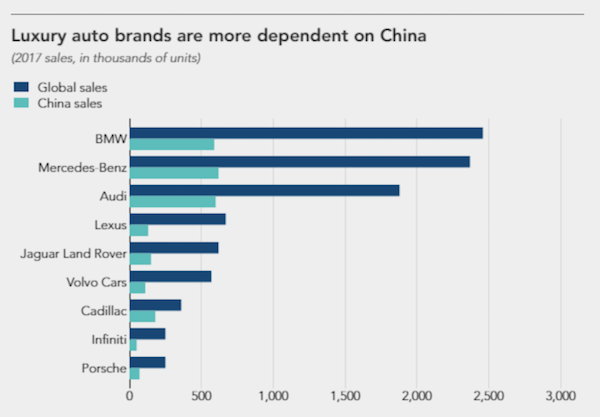


China made up 27% of overall global luxury vehicle sales. Growth in that country was 17% year-on-year, compared to a sputtering 1% rise in the rest of the world. German models did especially well.

They should call 2018 the year of the car, not the year of the dog!

Here is a link to the report summary: https://asia.nikkei.com/Business/Trends/Chinese-buyers-spur-rise-in-global-luxury-car-sales


Byron's Beats

If you read my recent commentary about Discovery's latest results you may have picked up my passion for preventative healthcare. This Business Day article titled Discovery offers aid in public health got me thinking about how this could be implemented.

Clearly, this needs to be targeted to the poor. It should be implemented along with the social grant's network. If you qualify for social grants, you qualify for a special Vitality programme. Discovery can offer their networks and manage it for a fee (they have shareholders, they cannot do it for free). It needs to be subsidised by the government as part of government's healthcare spend.

The first target should be consistent healthcare screening. Members can be rewarded with incentives for getting their blood screened for all sorts of potential ailments including diabetes, cholesterol and HIV.

Eating healthy should also be rewarded. A simple card swipe or phone scan can reward members for buying fruits and vegetables. Rewards can include Shopping vouchers and airtime. You can even get more specific like school uniforms or electricity vouchers. Incentivising people is easy.

Virgin has opened a few low-cost gyms. Subsided contracts that rewards exercise can also be implemented. In fact, any small gym can join the program whereby members can check in their workouts.

Judging by the data Discovery have gathered over the years, this will save much more money than it will cost over the long run. We just need private and public to cooperate.


Home again, home again, jiggety-jog. Byron is really excited about Super Rugby being in full swing this morning. The biggest data out today are CPI numbers from the EU, the expectation is that it will remain stable at 1.3%. Still well below the 2% target. The rumours are we will get a new cabinet next week? I have learnt that when it comes to politics, it will happen when it happens.


Sent to you by Team Vestact.

Email us

Follow Michael, Byron, Bright and Paul on Twitter

078 533 1063

Tuesday, 13 February 2018

Correcting the Correction


To market to market to buy a fat pig. This week marks the start of the biggest human migration of the year, the Chinese New Year. It is estimated that around 710 million people will be on the move! The holiday starts on Thursday and will last all the way through to next week Wednesday. Here are some interesting facts about the tradition - 21 Things You Didn't Know About Chinese New Year.

To give you an idea of the scale of this holiday, Statista has compared the numbers to the US's Thanksgiving weekend - How Chinese New Year Compares With Thanksgiving

Infographic: How Chinese New Year Compares With Thanksgiving | Statista You will find more infographics at Statista

Market Scorecard. It wasn't smooth sailing yesterday, but at least we finished in the green. The US market opened around 1% higher, then weakened to be flat an hour into trading. From there it was a steady rise to 2.3% higher, and finally finished off with a slight weakening. The action during the day shows that volatility is back; the bull and bear tussle continues. The Dow was up by 1.70%, the S&P 500 was up by 1.39%, the Nasdaq was up by 1.56%, and the All-share was up by 0.54%. Resilient was in the firing line again yesterday, down 7.42%. I can't say what the fair value of the company is, looking at the price action though I think that this is a case of sell first, ask questions later. Short-term the price is being driven by fear, long term though it will all come down to fundamentals.


Company Corner

Byron's Beats

It has been a tough few years for Woolworths. Their purchase of David Jones has not gone as planned. The global clothing retail market has been turned on its head by super fast retailers like Zara and online disrupters. The initial David Jones purchase was to access the Australian clothing market, but it seems that the strategy has also shifted to food more recently.

The Woolworths team have found a gap in that market for high-end grocers. It seems this gap also occurs in New Zealand. The following article talks about the new David Jones store in Aukland, how the business is growing its presence online and how they are opening standalone David Jones grocery stores. It is an interesting article from an Australian publication/perspective.

David Jones expands to New Zealand as commitment to food strategy stays strong.


Linkfest, lap it up

One thing, from Paul

Coverage of last week's stock-market mini-selloff was pretty excitable. One thing I have noticed over the years is that the prices move, and the explanation follows later. In other words, the market indices spike or tank, and then financial journalists scramble around finding reasons to explain the move.

To be fair, the news media has its own challenges. They operate in a competitive market for ears and eyeballs, so they like to crank it up a bit. Here's a good cartoon which makes that point, that's been circulating in the last few days.


Michael's Musings

As I write more, I have become aware of subtle (sometimes not so subtle) grammatical improvements I can make. I only learnt about the Oxford comma last year, lucky my ignorance didn't cost Vestact millions! - A lawsuit over the absence of an Oxford comma was settled for $5 million.

One of the best ways to combat poverty is quality education. It was interesting to see that the entrance exam to the one school was a blind test, so that any biases around the person or their family would not form part of the admittance decision - Russian Billionaires Are Building Mega schools to Rival Eton and Exeter.


Bright's Banter

According to a research firm called Canalys, 2017 was a year to remember for the Apple Watch. It had the best quarter ever in the history of all luxury watches. The company shipped around 8 million watches between the first day of October to the last day of December which led to a total of more than 18 million Apple Watch units sold for the year! This is more than the entire Swiss watch industry combined!

Infographic: Apple Shipped More Watches Than Switzerland in Q4 2017 | Statista You will find more infographics at Statista


Home again, home again, jiggety-jog. Our market is following the lead of the US and Asian stocks, the All-share is currently up 1.2%. Relevant data out today is; UK unemployment and CPI, and locally we have unemployment figures at 11:30 and then the ANC NEC has their press briefing at 14:00. Whatever happens, we need to remember that change is slow, even if the market's default reaction is to assume all the wrongs will be righted.


Sent to you by Team Vestact.

Email us

Follow Michael, Byron, Bright and Paul on Twitter

078 533 1063

Tuesday, 16 January 2018

Winning Formula


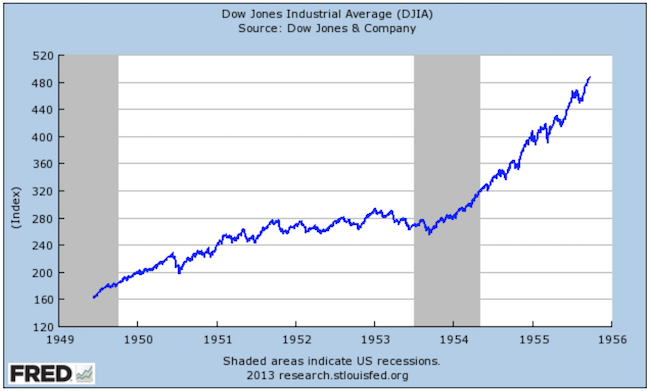
To market to market to buy a fat pig. Reading Eddy Elfenbein's Crossing Wall Street this morning, he talks about the bull market of the late 1940's. The Dow tripled in seven years, which is on par with the move of the market since the lows of 2009. Here is the graph:


The bull market starts during a recession, given that markets are forward-looking, this start is not surprising. Note that the US then goes into another recession during 1953. How does the market react? Well, there is a slight pullback, and sideways movement leading into the recession. Then still in the early phases of the recession, the market puts 'pedal to the metal' and zooms up the page, doubling in less than two years. The move shows how markets dance to a different tune versus the economy. Eddy's closing paragraph is also noteworthy:

    "But here's the important question: why isn't this bull market better known? My guess is because it never came to a crashing end. There's no way anyone can moralize about greedy bubbles when it never popped. The 1950s stock market continued to climb for several more years. We really didn't experience a major crisis until the 1970s."


Forecasting is a fools' errand, and saying that the market will correct soon just based on nine years of gains is a huge assumption! Here is the full blog post - The Forgotten Bull Market 1949-1955.

Market Scorecard. Nothing to report for the US due to their markets being closed. That leaves the All-share, which was up 0.26% I noticed this morning that during the December break Capitec now trades above R1 000 a share! As a Capitec customer, I can testify to their quality product. I can understand why they are growing so quickly. At the current share price, R100 000 invested in them during 2008 would be worth around R3.4 million today.


Company Corner

Yesterday Aspen announced that they received approval in China for their Alula brand of infant milk formula. The company indicated in their last set of results that they were on track to get the approval, it is still a huge step for the company. You may remember the 2008 Chinese milk scandal, where babies in China died and thousands were hospitalised due to poorly manufactured infant formula. The result of the scandal is that brands matter in China. You would rather pay up for a well know international brand than an unknown local brand.

In years gone by, Aspen's baby formula was purchased in Australia by tourists and then sold in China. Due to regulation changes in China, that changed and resulted in nutritional sales dropping by 8% during the last financial year for Aspen. Having a presence directly in China is an important stepping stone to future growth coming out of the country.


Byron's Beats

At the beginning of the year we always get trading updates from the retailers which tell us how well these businesses have done over the festive season. The years of 2016 and 2017 have been tough for our economy; expectations are certainly lower than previous years.

Yesterday Woolworths released their 26 weeks sales number for the period ending 24 December. Most people had done their Christmas shopping by then surely?

Group sales increased by a meagre 2.5%. In SA - fashion, beauty and home declined by 0.2%. Comparable store sales were down 3.4%. Food in SA increased by 9.4%, inflation contributed 4.4% to that growth though.

In Australia, David Jones increased 0.6% for the period. Country Road increased by 5.2%. Net retail space declined by 2.2% for David Jones as they continue to restructure their stores.

Due to lower sales and probably a drop in operating margins, Headline Earnings will drop 12.5%-17.5%.

All in all these numbers look stagnant. There is no point trying to put a shine on the tough environment in SA and the hard turn around in Australia. Food is doing well, the clothing is struggling. Ian Moir's strength is clothing; I'm sure he is working very hard at staying on top of that fast-moving sector. Let's remain patient.

More details when the full numbers come out.


Linkfest, lap it up

Michael's Musings

Lego and Tencent are teaming up! - Lego Plans Video Games, Social Network for Chinese Children

Michael Jordaan (FNB's ex-CEO) announced this morning that he is launching a new bank - Bank Zero. Having more competition and hopefully lower prices in the banking space is welcome!


Vestact in the Media

Bright chatted to PowerFM yesterday - Bright Khumalo - Who is Viceroy.

Byron chatted to Business Day about Aspen yesterday - Aspen wants trades audited.


Home again, home again, jiggety-jog. Our market is off to a green start this morning. The Rand is much stronger, suddenly strengthening by over 10c to $/R12.22. Later today, we have a UK CPI read and then a local mining production number.


Sent to you by Team Vestact.

Email us

Follow Michael, Byron, Bright and Paul on Twitter

078 533 1063

Tuesday, 21 November 2017

Groans over David Jones


To market to market to buy a fat pig. Yesterday we spoke about Naspers, today we will move onto the first derivative of Naspers, Tencent. The stock is up 126% this year, which has propelled it to become the first Asian company to break the $500 billion market cap milestone.

I remember reading about Tencent last year in US research notes, where the author was talking about them as an insignificant participant on the US market. Since the Alibaba listing, Jack Ma's company have been the go-to stock to take advantage of China's growth. I would say that is no longer the case, Tencent is firmly on the map and in play.


Market Scorecard. Green, everywhere I look I see green. The Dow was up 0.31%, the S&P 500 was up 0.13%, the Nasdaq was up 0.12% and the All-share was up 0.62%. Even though our market is sitting at record highs, I was interested to see that the list of stocks at a 12-month low is much longer than the list of stocks at 12-month highs. Good to see Mr Price on the 12-month high list, they had a solid set of numbers out yesterday. Another stock that is on the list, sitting at 12-month high and an all-time high is Capitec who is about to cross the R1 000 a share mark.


Company corner

Michael's Musings

Last week Woolies released their 20-week trading statement, which as expected showed that they are under pressure. Their most important division from a profit margin perspective is what used to be called 'clothing and General Merchandise' and now is called 'Woolworths Fashion, Beauty and Home'. The division declined on a like for basis by 2.4% for the period.

Their food division, which I am a huge fan of, had a positive period with like for like sales increasing 5.3%. Unfortunately for the group, the operating profit margin in the food division is around 7%, and the operating margin for clothes is around 17%.

David Jones had a tough time as they transition to their new business model, like for like sales were down 5.3%. A key contributor to the drop in sales is the revamp of the David Jones flagship store. The pictures I have seen look amazing; the goal is to make shopping there an experience.

The second most profitable division, Country Road, had mixed results. They saw like for like sales down 0.4% but they gained market share and overall sales were up 8%. I will be interested to see if they have given up margin to gain market share. In their full-year results, Country Road had an operating margin of 10% with management pegging their medium-term target at 12%.

All in all, David Jones contributes 28% of Woolies profits, it's their biggest division. The newly named 'Woolworths Fashion, Beauty and Home' coming in second with around 24% of the profit. Because David Jones is struggling to turn around, the market is feeling down on Woolies, only giving it a P/E of 13. Compare that to Shoprite on a P/E of 21 and Pick'n Pay on a P/E of 25. There is no doubt that the Woolies share price going forward is very much tied to the fate of David Jones. If management gets the turnaround right you will see Woolies re-rate to a P/E around 20, which would mean the share price going up 50% without any increase in the underlying profit number. For now, the share price probably won't do much in the short term.


Linkfest, lap it up

One thing, from Paul

Vestact is an asset manager, so we don't actually offer advice about setting financial goals, taxes, retirement or estates. We just try to protect and grow the surplus capital that our clients bring to us.

Having said that, conversations about money often stray into those related topics. I enjoyed this Humble Dollar blog post by Jonathan Clements. He makes the point that the most important determinant of the quality of our financial lives is containing our fixed living costs (those are our regularly recurring expenses such as bond, rent or car payments, rates and taxes, insurance premiums and groceries). The lower those are, the easier it is to save. Living within one's means is the key to a stress free life.

Read the whole thing here: Number One Number


Byron's Beats

The theory of investing can get very complicated and philosophical. That is why Warren Buffett is so great to read, he manages to keep things simple in his explanations.

At the moment we are going through a very interesting period. Tech stocks are soaring, making everything else look bad. Many people feel it is necessary to sell out of other sectors and follow the momentum. The FOMO is real.

Others feel the opposite, they want to sell the high fliers and buy into shares that have done badly. These people have a more contrarian nature.

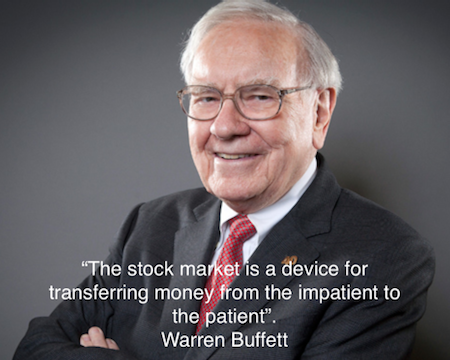
We feel it is important to stick with quality companies but diversify the sectors you have exposure to. Sectors go through cycles. Tech is doing well and justifiably so. We are heavily exposed here and are very pleased with the way things have gone. But we are maintaining exposure to other areas where we feel growth is imminent like healthcare and retail. Their time will come. Remember the Buffett quote which we repeat so often. "The stock market is a device for transferring money from the impatient to the patient."


Bright's Banter

Since Amazon bought Whole Foods, they have slashed most of their prices on 'cool kid' grocery staples such as apples, bananas, eggs, avos, kale, almond butter etc. The company is now offering up to 20% off on turkeys for Thanksgiving - but there's a catch! You see, if you're not an Amazon Prime member you'll have to sign up for the 12 month $99 membership to enjoy this Thanksgiving deal.

Current Amazon Prime members have a lot to be thankful for this Thanksgiving! However, we wonder how Amazon is going to integrate Prime successfully into Whole Foods without leaving non-Prime members feeling excluded in the process - Amazon is ruining the Thanksgiving spirit.


Vestact in the Media

Here is Michael talking about Naspers being A Whisker Away From R4000, on CNBC Power Lunch.

Bright gets a mention in this IOL piece on the Vodacom numbers last week - Vodacom pushes government for allocation of high demand spectrum.


Home again, home again, jiggety-jog. Tencent is up around 3% this morning, which means Naspers will probably open with a '4' at the front of its share price! Asian markets are well in the green which means our All-share will be aiming to break 61 000 points for the first time.


Sent to you by Team Vestact.

Email us

Follow Michael, Byron, Bright and Paul on Twitter

078 533 1063

Monday, 28 August 2017

It's Tough for Woolies


To market to market to buy a fat pig. Things were mostly flat on both sides of the pond on Friday. The Dow was up 0.14%, the S&P 500 was up 0.17% and the Nasdaq was down 0.09%. Super Mario's speech from Jackson Hole resulted in the Euro reaching 2 year highs (strengthening) against the US dollar, ECB's Mario Draghi says global recovery is firming up, euro climbs. He recognises that the EU is not at the same stage of growth as the US but they are on the path to growth.

Janet Yellen's speech at Jackson Hole didn't give too much of a hint of what the FED plans to do next but the thing most people are focusing on are her comments about her support of the implementation of post crisis banking regulations, Fed Chair Janet Yellen pushed back against Trump's agenda of financial deregulation. Remember that Janet Yellen's comes from mostly an academic background, so her point of view is more about financial stability and safeguarding against banks over extending themselves. Trump and Cohn, the likely Trump candidate to replace Yellen, are both business men who are more focused on growth. So from their point of view, less regulation might increase the risks in the financial system but it will also increase growth.


Company corner

Michael's Musings

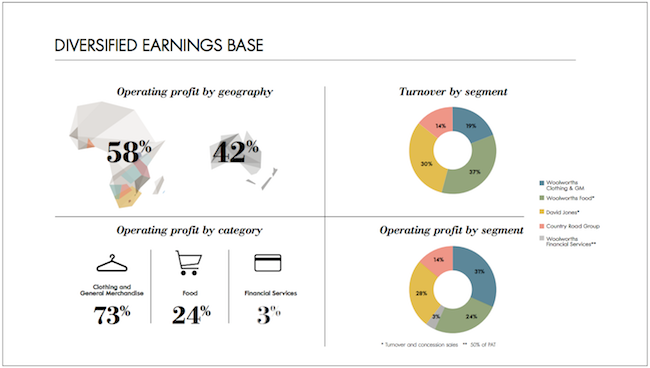
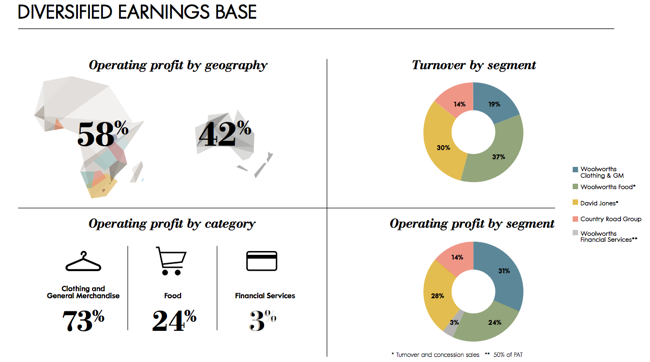
On Thursday morning Woolies released their 52 week or full year numbers for the period ending 25 June 2017. The stock has lost around a quarter of its value over the last 12 months, so the market knew the results were not going to show the strong growth that we had become accustomed to with Woolies. Turn over for the period was up 3%. Considering that inflation is higher than that, sales volume went backwards. HEPS were down 7.6% and then some good news, management maintained the dividend at R3.13 per share. See below how and where the company makes their money.


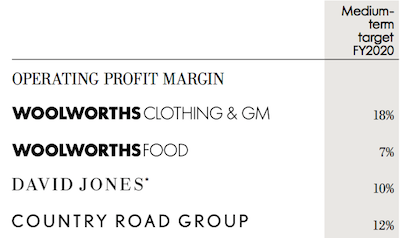
Notice how food is a very big chunk of their turn over but significantly smaller part of profits. Then notice how small "Woolworths clothes & GM" is on the turn over graph but it is the biggest segment on the profits graph, showing that selling clothes and house accessories is far more profitable than selling food. Although more cyclical. For reference purposes here are management's goals for the operating profit margins in each segment. The only division basically at the target already is food, with current operating margins of 6.9%, down from 7.1%.


The most important division, Clothes and general merchandise saw sales increase 1.4% but they had product inflation of 6.6% , so a negative result for the year. It is not a surprise given current low consumer confidence in South Africa and the lack of economic growth. People don't splash out on new wardrobes when bank balances are low (no bonuses) and when they don't feel secure about their job. Tougher trading conditions meant the operating profit margins dropped from 17.9% to 16.5%. Going forward the plan is to introduce international beauty brands like Chanel, Estee Lauder and Clinique to their stores. Beauty products traditionally have high margins but more importantly the hope is that the beauty products increase foot traffic to the stores.

David Jones is the core of the Australian operations, where performance was mostly flat. There are many moving parts in the division as they move toward selling more of their own brands and introducing new merchandise, planning and finance systems. More exciting is the introduction of their David Jones food division, currently only in one store but planning to roll out country wide in the years going forward. David Jones Food is only expected to be profitable in 2019, reaching full scale around 2020.

Lastly Country Road, the division with the highest gross profit margins at 60.3%, had sales growth of 5.1%. What was interesting is that even though they have the highest gross profit margins, the cost of making the shopping experience world class and the cost of advertising is that much higher than their other divisions, thus brining their operating profits in at 9.9%. For comparison purposes the Woolworths Clothing & GM division has gross profit margins of 47.9%.

All in all, the retail landscape in South Africa is going to be tough at least for another year but the good news is that Australia is expected to grow their GDP by around 3% for the next couple of years. Going forward though, until the revamp of David Jones in Australia is complete and South Africa gets back on an economic growth track, I don't see much lift off in the share price. A major benefit of buying Woolworths currently is that they sit on a 5% dividend yield, something to keep you happy until their growth path picks up again.


Linkfest, lap it up

Did you miss the eclipse last week because you were not in the US? Here is a map of where all the eclipses will occur until 2040, the southern part of Africa will have one in 2030 - Animated map shows every total solar eclipse around the world until 2040.

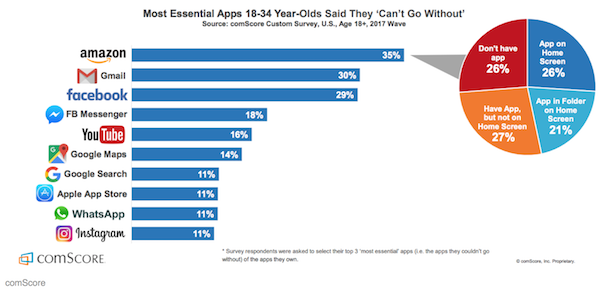
Amazon, Facebook and Google dominate on the 'must have' list of apps - There's one app millennials can't live without, and it's great news for Jeff Bezos


Due to the Andes mountain range along the West cost of South America no moisture reaches the Atacama desert, so rain is a very rare occurrence - The "driest place on Earth" is blooming with flowers after surprise rainfall


One thing, from Paul

This weeks blunders, Pet dog rug for sale for GBP 100, is the US Navy off course?, firemen saved piglets then got sausages, and Germans fooling with their gold - Blunders: Episode 70


Home again, home again, jiggety-jog. Thanks to a weak Dollar, the Rand is threatening to break below $/R 13.00 level. Asian markets are mostly flat this morning with ourselves and European markets in the red. We are still in full swing of RSA earnings, this week we have numbers out of Steinhoff, Sibanye and Cashbuild to name a few.


Sent to you by Team Vestact.

Email us

Follow Michael, Byron, Bright and Paul on Twitter

078 533 1063
Friday, 4 August 2017

All Time Why's


To market to market to buy a fat pig. A new record high for the local market, we are now closer to 56 000 than we are to 55 000. Last night our market closed up 0.9% to finish at 55 685. The 12 month high list is growing in companies which is always nice to see. Not only does it contain two South African focused retailers, Clicks and Dischem, it now also includes two banks! Capitec and Standard Bank. The two most SA Inc sectors, retailing and banking have a showing on the 12 month high list, despite our recession and not great growth prospects for at least the next few years.

Standard Bank makes some sense to me, the market is re-rating the company to now trade on a P/E of 11, still lower than First Rand but higher than Nedbank and Barclays Africa. Clicks trades on a P/E of 30 and Dischem even higher at a P/E 40. Granted that Dischem had many moving parts in their only set of numbers so far, the market is still pricing in some big growth for both companies. If we have zero/ negative growth in South Africa, the only growth will be coming from taking market share from other retailers. Who though?

For comparison, Woolies trades on a P/E of 15. They have a loyal rich customer base and half the business is based in Australia who are not in a recession (GDP: Australia grabs record for longest time without a recession). Woolies are also launching their food offering in Australia, which looks amazing. See picture below. The photo comes from Zeenat Moorad, there are more great pictures on her Twitter timeline, go have a look.


New York, New York was mostly lower yesterday; the S&P 500 was down 0.22%, the Nasdaq was down 0.35% and the Dow slightly up 0.08%. Just before the market close news broke that the investigation into Russian interference in last years US election has changed gear, with the lead investigator upping the ante (Mueller's latest move in the Trump-Russia probe may foreshadow a 'large-scale series of prosecutions'). US markets had a very noticeable drop on the news. Political uncertainty is not good for markets short term but in a month day they will have forgotten about it and be back on their very way.


Linkfest, lap it up

One thing, from Paul

As a Barcelona fan, I'm saddened by Neymar's move to PSG. No man! Here is an interesting analysis of trends in player remuneration in European football. The Brazilian wizard will earn EUR 600 000 a week (after tax) - Neymar Is Less Greedy Than He Looks


Byron's Beats

How cool is this building that has just been built in Taiwan. 23 000 trees growing off the side of it will absorb 130 tons of carbon a year. There is also a lot of excitement about growing food on the sides of skyscrapers. Although it is still early days, urban forests and farms are becoming more and more a reality - A smog-eating twisting tower that features luxury apartments will soon open in Taiwan - take a look inside

For all you athletics fans, Mo Farah will be racing in the 10 000-meter and 5000-meter in London tomorrow for the last time. Nike have made a special addition Nike Air Zoom Pegasus to celebrate this amazing athlete. But don't despair, he wants to give long distance running a go. I wouldn't be surprised to see him on the podium at a few big marathons - Mo Farah takes on the London track one last time


Michael's Musings

Here is a look at what it takes to be in the top 1% in the US by income, what I found most interesting is to see how quickly incomes rise while you are in your 30's - How much money you need to earn to be in the top 1% at every age. Remember that to be in the top 50% by wealth globally you only need an NAV of around $2 000.

Have you have ever wondered what our cities will look like after we are gone? Now you can get an idea - Nature is Reclaiming Fukushima's Abandoned Areas. All that is missing is a few zombies now?

Newspapers are one of the industries hit by the emergence of the internet. The New York Times is showing that surviving in the digital age can be done - The New York Times Passes 2 Million Digital Subscriptions. See the strong up tick in 2016? That is when Trump started criticising them, showing that even bad publicity is good publicity.

Infographic: The New York Times Passes 2 Million Digital Subscriptions | Statista You will find more statistics at Statista


Bright's Banter

A Ritholtz Wealth intern by the name of Tommy Tranfo wrote an interesting article on Barrons basically outlining why millennials are afraid of the stock market compared to previous generations. This triggered a rebuttal by his colleague Mike Batnick, giving us millennials lots of empirical evidence to why we should invest in the stock market and why we should start now - A Millennial's Rebuttal


Home again, home again, jiggety-jog. The Rand has been weakening during the week, going from $/R 12.96 last week to currently $/R 13.37 and from EUR/R 15.31 to EUR/R 15.90. A weaker Rand has been good for our dual listed stocks and large multinationals that dominate our Top 40. The market moving news today is the monthly Nonfarm Payrolls and unemployment number from the US. The unemployment rate is forecast to drop further to 4.3%. The all share is off to a green start this morning, hopefully the Proteas later today will have the same weekend. We haven't lost a test series in England in 19 years, no need to start now.


Sent to you by Team Vestact.

Email us

Follow Michael, Byron, Bright and Paul on Twitter

078 533 1063

Friday, 24 March 2017

Incorrect about Corrections

"He (Peter Lynch) also said: "Far more money has been lost by investors preparing for corrections, or trying to anticipate corrections, than has been lost in corrections themselves". It seems that if you look back from a distance and zoom out, ten percent down and the subsequent recovery is hardly a blip of any sort. The S&P 500 is up, without dividends, over the last 40 years 2268 percent."


To market to market to buy a fat pig Markets were a mixed bag here in Jozi, Jozi. Stocks started down (as a collective), sneaking into the green around lunchtime and then ended the session around where they started, a little lower. Around ten percent lower on the day, resources were a little lower, financials a smidgen off. AngloGold Ashanti and Amplats were the two biggest losers, down over three percent apiece, whilst Bidvest was the biggest winner, up three percent on the day.

Ahhh, I see an announcement from Woolworths this morning about their Aussie business, Country Road and David Jones, John Dixon will assume this role:

    "Consistent with the desire to create a single entity benefitting from economies of scale and an aligned culture, the company is now creating a single regional corporate structure. The region will be headed by a Chief Executive Officer with a team of regional executives covering the core operational functions plus the Chief Executive Officer of Country Road Group, and Managing Directors of David Jones Food and David Jones Clothing and General Merchandise."


Woolworths of course has been a great and a terrible investment, depending on where you draw the lines in the sand. Over five years the stock is up 60 percent and it is also an excellent dividend payer. Over three years it is only up three percent. Over ten it is up 251 percent. Over three months it is up nearly six percent. Over one year the stock is down 15 percent. See what I mean? It always (always) depends on where you draw your line in the sand. I suspect that you have to have a serious view on organic and premium offering and whether or not the consumer is going to be receptive to it or not. I suspect that the more affluent consumers will be happy to continue to "pay up" for quality. We continue to hang tough on what has been an average stock price for a wonderful company.


Across multiple time zones and the oceans, in New York, New York, stocks were reacting to Washington DC events and "negotiating" on healthcare repeal. The thinking is pretty simple, if Trump does not have the majority of Republicans on his side, what is the chance of more being pushed through. As Paul said, why did they start with the hardest thing first? Why not go for tax reforms first, I am sure that more people agree that more needs to be done there. Session end all the major indices were marginally lower, the S&P 500 down by nearly one-tenth of a percent, the nerds of NASDAQ off by 0.07 percent, whilst the Dow Jones fell 0.02 percent by the close.

Snap rallied nearly six percent, it seems perhaps all the early "stagging" may be gone. To stag, the definition (as per Investopedia): "A stag specifically refers to a speculator who buys and sells stocks in short time frame's to make quick profits. A stag investor assumes that the price of a stock will rapidly increase over the short-term, within the first few hours or days, and adopts an investment strategy that is the opposite of a long-term buy and hold strategy."

Nike (Nigh-Key) rallied over two and two-thirds of a percent, recovering some of the losses after poorly received results. Alphabet, the parent company of Google, and by extension YouTube, is experiencing some serious bad media over adverts being pulled from YouTube. By some pretty high profile advertisers. Why? How? See a Google apology a number of days back - Improving our brand safety controls:

    "We've heard from our advertisers and agencies loud and clear that we can provide simpler, more robust ways to stop their ads from showing against controversial content. While we have a wide variety of tools to give advertisers and agencies control over where their ads appear, such as topic exclusions and site category exclusions, we can do a better job of addressing the small number of inappropriately monetized videos and content. We've begun a thorough review of our ads policies and brand controls, and we will be making changes in the coming weeks to give brands more control over where their ads appear across YouTube and the Google Display Network."


I suspect that the advertisers will definitely return. You know what they say about once bitten, right? This may be an opportunity to grab a few more. Last year YouTube removed 2 billion bad adverts from the system and 100 thousand publishers. With 400 hours of video uploaded every minute to YouTube, there is unfortunately going to be a whole lot of content that is not generally accepted by the community. Enough said, I think. YouTube are doing something.


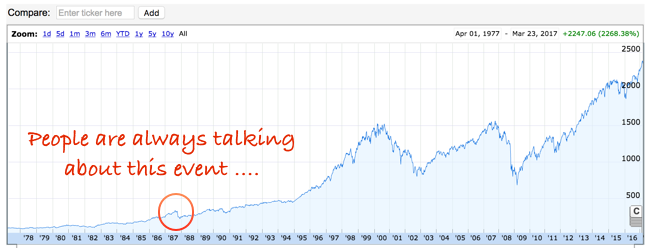
We always hear about doom and gloom in our profession, how the next market crash is coming. Historically, and I uncovered this from an ancient Peter Lynch piece, there is a draw down in markets of around ten percent every two years or so, that is on the S&P 500. From 1970 to 2008, there were 21 such events, a "bear" market by technical definition. He (Peter Lynch) also said: "Far more money has been lost by investors preparing for corrections, or trying to anticipate corrections, than has been lost in corrections themselves". It seems that if you look back from a distance and zoom out, ten percent down and the subsequent recovery is hardly a blip of any sort. The S&P 500 is up, without dividends, over the last 40 years 2268 percent.

Why do we spend ALL of our time worrying about infrequent events? To illustrate this point, I have taken what should be a normal investing period for investors and circled that horrible no good day. 19 October 1987, the machines went berserk and the Dow Jones was down 22.61 percent in a single day. It happened. The next worst single percentage down day was 15 October 2008, down 7.87 percent. December the first 2008 was the third worst day, down 7.7 percent. And then October 9th 2008 was the fourth worst, down 7.33 percent. We can see all of these up close and personal, we remember some of these. Here goes, 40 year graph of the S&P 500 (not the Dow Jones), courtesy of Google finance.


You are going to say to me, "yeah sure Sasha, you picking such a long period, what happened in the moment isn't easy to 'forget'". And you would be right. However, the S&P 500 closed 0.06 percent up in 1987, from the beginning to end. From the beginning of 1987 to the end of 1989 the S&P 500 was up 43 percent. Stretch that out, five years on, the S&P 500 was up nearly 65 percent. Yet ..... people will talk about 1987 as if it was the bubonic plague or the 100 year war, or the dark ages or some other such thing. A fellow by the name of Charles Lieberman (chief investment officer at Advisors Capital Management) writes for Bloomberg View in an article titled: There's Always a Bull Market in Fearmongering. This paragraph is pretty telling:

    I would care little about these Chicken Littles and their desire to instill fear in the hearts of investors for their purposes, except that they inflict enormous harm on individual investors. How often do retail investors read such warnings and decide that to be safe, they should reduce their exposure to the market? Some pull out entirely. It happens far too frequently. I know of one individual, a close friend of a client, who converted his entire portfolio into cash late in 2008 and has been unable to bring himself to buy back in to this very day! For years now, he thinks he's missed the recovery, because he's read warnings that stock prices are high and vulnerable.


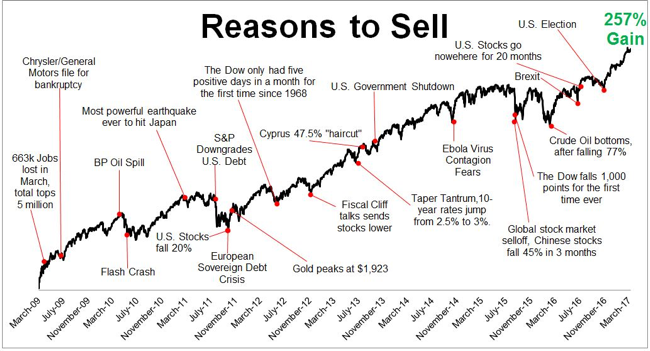
Oh dear. To bring that closer to home, the 2008 nightmare on Elm street market version, Michael Batnick had this piece on his blog "The Irrelevant Investor": Gradual Improvements Go Unnoticed. He points out all the reasons why NOT to have invested in the market, some of them fresher in our memories than before. I have taken calls on all of them. I have had long conversations with people on why not to sell, that is part of our job. I am sure for the same purpose (of continued education of ourselves), he won't mind if I borrow his graph:


I can think of multiple other reasons, as he lists there below. I wondered smugly if I should tweet (like a real troll) at "The Nouriel" and ask when he expects the double dip recession to arrive? The market will humble you. Never ..... like never, ever be smug about your investment decisions and outlook, and how the market looks now. Keep it real, stay humble. You will be humbled. Anyhow, the slow advances that humanity makes are not celebrated. The collective chooses to be anxious and nervous. As long term investors we should embrace this.

Peter Lynch said this in an interview once:

    "A lot of people think long-term investing is three weeks from next Wednesday, but when I talk about long-term investing I mean 5, 10, 20 years. During that length of time the market can experience ups and downs due to what I call "background noise." Events occur - hurricanes, wars, political instability, currency and bank crises - that makes investors nervous and cause market volatility. It does get nasty at times, but it shouldn't cloud investors' judgments about thinking long-term. The key organ here is your stomach. Everyone has the brainpower, but not everyone has the stomach for it."


If everyone, like I told a client yesterday, was a pure investor and not a consumer, there would be nothing to buy, right? Choices mean you can get a new vehicle, finance it and end up with an asset one fifth of the original price five years later, or ..... you could invest that in the equities market. You would eventually end up with enough to buy the car cash. That is another story entirely about what is risky and what is NOT. Keep saving. If stocks go sideways or down, and you have money to add, you should. As is the famous line from that excellent movie, the Best Marigold Hotel in the World (It is actually a John Lennon quote): Everything will be okay in the end. If it's not okay, it's not the end.

Or, as we say around these parts: Keep on keeping on.


Linkfest, lap it up

Facebook has a 'secret lab' where they are trying to design the hardware of tomorrow. The ability to do these moonshot projects is thanks to having a cash pile of around $30 billion, if they come off it is good for humanity and shareholders - Facebook's secretive and ambitious hardware group is preparing for its debut next month

What is the right amount to tax? From a government perspective, you don't want to over tax, decreasing the incentive to work and invest and essentially crowding out the more efficient private sector. As Barry points out many of our tax models are designed for homo economicus instead of homo sapiens - How Much Can You Cut Taxes? Don't Ask Kansas

A big factor in differentiating yourself from competitors in the e-tail space is trust. Given that you can't touch the product before you buy it and that you are giving the suppler your credit card details, trust is important. Here is another step that Amazon is taking to build trust - Amazon Has a New Tactic to Fight Counterfeits

This is awesome, Bright loves this guy so much that his WhatsApp avatar is Howard Marks. Do you have half an hour this weekend to watch this, Howard Marks is in India - Howard Marks: ET Now -- "The Global View with Howard Marks".


Home again, home again, jiggety-jog. Stocks across Asia are higher, the US futures are around one-third of a percent higher. This is the best level for the Rand since the middle of 2015!


Sent to you by Sasha, Byron and Michael on behalf of team Vestact.

Email us

Follow Sasha, Michael, Byron, Bright and Paul on Twitter

078 533 1063
Monday, 20 February 2017

David Jones is Hungry

"I for one am most excited about the David Jones strategy in Australia. Fewer outhouse brands, the roll out of the in-store brands and most importantly (for me), a premium food offering for Australians."


To market to market to buy a fat pig Stocks in Jozi slipped Friday, again, a stronger Rand held us back a fraction. Financials were down over a percent, resource stocks sank, it was pretty much a broad based sell off. Whilst stocks as a collective have started the year better than before, the going has been tough over the last month, mostly as a result of the firming Rand. In the stocks up and down department, Amplats surged over four and a half percent, post their recent results. Aspen, ahead of a trading update (it should come this week or the next), had a couple of really poor days, both Thursday and Friday. Like I said, the only two pieces of information that I could find, were one, a downgrade from Zacks and two, Spanish authorities were investigating Aspen and a few of their peers. Anyhows, let us wait for the trading update. That will reveal all.

There were double the losers than winners, with no real clear indication that it was this sector or that leading or lagging. We are going to get into the guts of earnings season soon, this week and the next being a particularly busy one for our stocks. Discovery, Bidcorp, MTN and Aspen would have all reported by next Friday. All through the weeks and next month we will keep you up to speed on the ones that you need to know about.

Across the seas, stocks in New York, New York, closed better on the day, if only just for blue chips. The Dow Jones Industrial Average added 0.02 percent on the session, the broader market S&P 500 added nearly one-fifth of a percent, whilst the nerds of NASDAQ added just over four-tenths of a percent. Apparently Mr. Market is waiting for tax reforms and a little more clarity, that may be why Asian markets are selling off. Poor Swedes are under attack, I saw that on Fox. Oh no, that wasn't me - Sweden has no idea what Trump meant when he said, 'You look at what's happening ... in Sweden'

The biggest news of the day was that Kraft-Heinz was making a move for Unilever. Such massive companies looking to "promote synergies". All you have to know is that by Sunday, the folks at Kraft-Heinz (remembering the 3G "Brazilian guys" and the Buffett connection) and Unilever put out a joint statement that is so short that we can copy and paste it:

    "Unilever and Kraft Heinz hereby announce that Kraft Heinz has amicably agreed to withdraw its proposal for a combination of the two companies.

    Unilever and Kraft Heinz hold each other in high regard. Kraft Heinz has the utmost respect for the culture, strategy and leadership of Unilever."


That is it. Over the years we have always let news items "settle" first before taking any sort of view, one way or another. I can imagine the reams and reams of pages written on what this would mean, what it would likely be if the competitions authorities looked at the deal, etc. And in the end, the Kraft-Heinz folks took a hard look (and possibly invested many, many hours in this), only to have what looks like a cheeky opportunity disappear. Nothing ventured, nothing gained I suppose. Both stocks rallied hard on Friday, Kraft-Heinz ended the US session up 10.74 percent, the Unilever ADR in New York (Dollar price) was up 14 percent. I suspect that both of them will give some of that back, Mr. Market will be mindful that there is "always a chance".


Company corner

Woolworths reported 26 week numbers to end 25 December 2016 on Thursday, Ian Moir the CEO put on a brave face. There is no Boxing Day for Woolies in here, before you say, what is that about, the boxing day sale for David Jones in Australia is the single biggest shopping day for the business. Must be a "thing", like Black Friday. Country Road after a few rough years is starting to show "green shoots", the company has a new CEO, no prizes for guessing that it is a Scotsman, Scott Fyfe. What is interesting is that the Scott has a lot of experience in Marks & Spencer.

Let us face it, the consumer both in Australia and South Africa have been impacted by both consumer confidence having ratcheted (global and local politics putting a lid on "things") as well as lower economic growth. Seeing as both economies are reliant to a certain extent on commodities, the levelling off of China, and now subsequent return to growth in demand for commodities. The good news for both Australia and South Africa is that commodity prices have improved markedly from last year. Some prices may look top, who are all of us to know where they will end up. The company talks about consumer confidence in Australia being low, despite record low interest rates, mostly as a result of the change in the mix of the labour market, more part time jobs. In South Africa, consumer confidence continues to be under pressure, for obvious reasons I guess.

Better value for their customers in both food and clothes is what the company said. They invested heavily in their "customer". Woolworths food business is pretty incredible, they really have evolved and continue to grow ahead of the market. They had a "system change" in the middle of last year, chief Ian Moir reckons that this will help dramatically in the coming year. So I guess, as Ian Moir puts his best foot forward, the company is a little better poised than in years gone by. Of course, there needs to be renewed optimism and renewed economic growth in both their territories.

By geography and segment, the company has a *nice* slide at the analyst presentation, which I am going to share here:


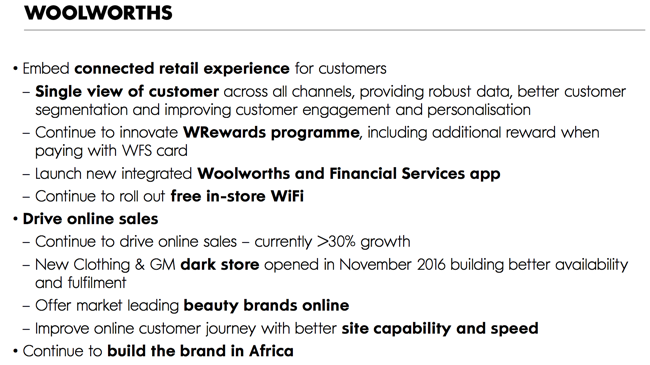
The company is going to continue to invest in their business heavily. They are also looking to take market share in the beauty product space. They are going to stock all of the leading brands, bar for L'Oreal, so there will be Chanel, Bobbi Brown, Clinique and Estee Lauder. I am wondering what this means for their competitors, most notably Edgars and Red Square. The company will also move some of their classic and premium merchandise and rebrand under the David Jones brand. There will also be a launch of a new private label brand. I suspect that the strategy is to improve the retail experience, including in store wifi and to encourage consumers to buy more general merchandise, soft luxury and their newer clothing labels (David Jones). This is a good slide for Woolworths (best known to us South Africans):


I for one am most excited about the David Jones strategy in Australia. Fewer outhouse brands, the roll out of the in-store brands and most importantly (for me), a premium food offering for Australians. There is little competition in that space, I suspect that the new Scottish signing (even though at Country Road) will have some input. Convenience, exclusivity and most importantly, quality, which trumps all. They are basically going to use the model that worked here, to implement that with David Jones. So you are going to have to give them a while. There is a food partnership with a fellow by the name of Neil Perry, I am afraid that I have not heard of him.

That is all very good and well, the truth is that the earnings and sales growth is positively anaemic. The dividend was unchanged at 133 cents for the first half. The stock price has acted accordingly, down since the results. The business trades on a less demanding multiple for obvious reasons. There is little to no growth, top line or bottom line, the stock deserves to trade on a mid to low teens multiple. The dividend underpin, as the business has traditionally always been generous, is likely to put a floor at some level. We continue to accumulate on weakness in what is a wonderful business, and whilst disappointed by the current performance, maintain that quality is important in this segment. The company will continue to innovate and continue to gain market share in all key segments. You have to own this one for the long run.


Nestle, one of the biggest food businesses in the world, certainly one who holds the gold standard for a large part of their offering, reported full year numbers recently. We recently did a deep dive at their nine month numbers, you will recall the message Nestle 9 month numbers - slow and steady. There we covered the company history in detail, which is important in terms of where to next, most especially in the new CEO era, the first non Nestle insider to run the business. Ulf Mark Schneider has been at the business since the beginning of the year, 45 odd days in, I am sure that he is getting his footing. What often happens with fresh blood is that they "feel" their way around and find a way to inject new energy into this business. Which it desperately needs.

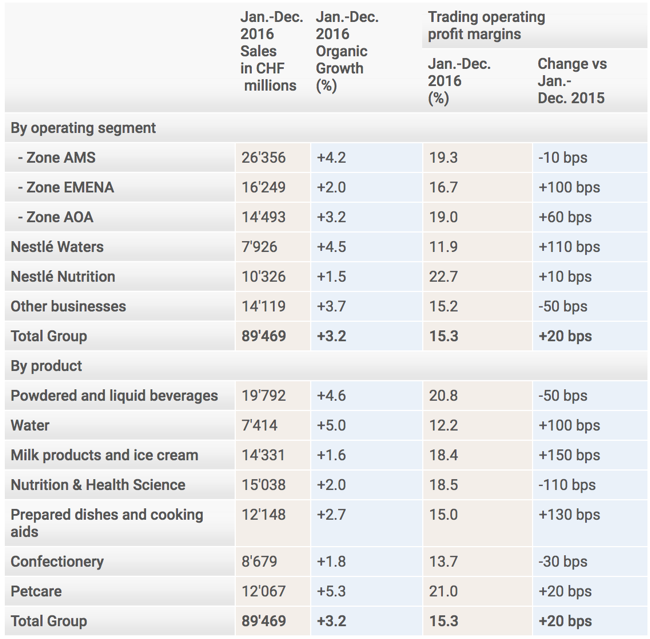
Group sales for the full year grew ever so modestly, only up 0.8 percent in Swiss Francs, experiencing serious currency headwinds of minus 1.6 percent. Still, at 89.5 billion Swiss Francs, this is a beast and a half. Developed markets still account for 52.1 billion Swiss Francs of that, the rest is emerging markets, which have far greater sized populations, many of which are finding their way through the maze of economic tiering. The company reported net profit of 8.5 billion Swiss Francs, reported earnings per share grew 4.8 percent to 2.76 Swiss Francs, whilst the underlying earnings per share grew by 3.4 percent.

They have a well diversified business as you can see below, from pet-care to water, confectionary to nutrition. Equally, the AMS zone is the Americas, Zone EMENA is Europe (East, West and Central), as well as the Middle East and North Africa. AOA is Sub-Saharan Africa, Asia and Oceana:


A well diversified business with some fantastic brands. It does have pedestrian growth and is unlikely to ever return 5 to 10 percent revenue growth. What may well happen is that the chief, the new fellow, may take the knife to the underperforming business units and look ahead to higher margin and higher growth businesses, the company spoke of selling their stake in L'Oreal, which I think is a win for both businesses. I suspect that we should give the chief a little more time, this is an incredible business that has superb brands. It may well be a case of having to hold for two to three years to see the giant ship change course, you may be well rewarded in the aftermath of slow sales growth between now and then.


Linkfest, lap it up

Finally. Good for Alphabet, not the best for the YouTube users, get used to it, as the article says. I suspect that the art of the 6 second advert is going to be in focus - YouTube to stop 30-second unskippable ads. Hey, who doesn't have 6 seconds to spare before a YouTube clip, if someone paid, watch it?

I have often thought about this - Why Social Commerce Isn't Exploding Yet. People trust their friends on social media. When it gets there however, it will be, "yeah, why didn't I do that before?" I suspect this is where Naspers is teeing themselves up at the moment.

This is bizarre, yet not unexpected. The elites of finance find themselves in the same place in the US, why not China then? China's Hedge Fund Elite Live in Their Own Private Village.

We might not be able to own Dropbox but we do own Google (Alphabet). The article demonstrates the value in having a seamless system, where all your apps work off of the same ecosystem and talk to each other without much effort on your behalf - I don't need Dropbox anymore, and it's all Google's fault. The only thing Google needs to do now is launch their Pixel phone in South Africa.

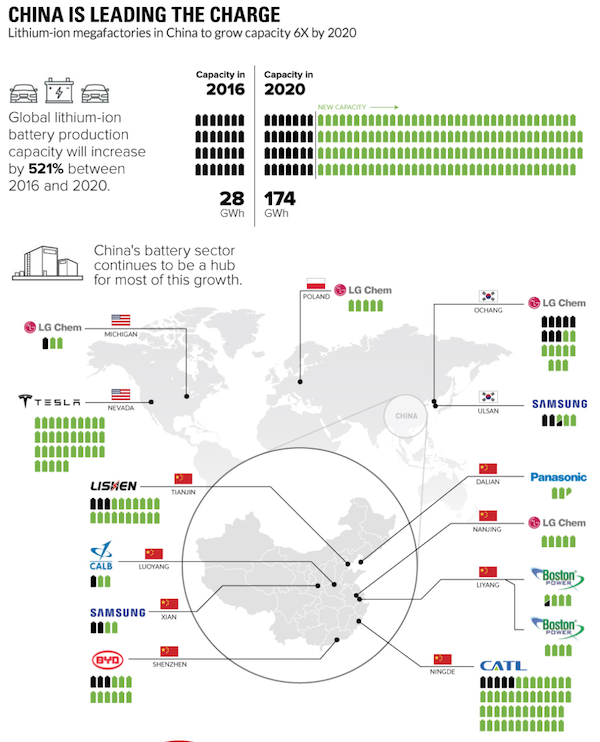
Renewable energy will probably be bigger, sooner than most people think. Mass production will bring down the cost of batteries, lower cost meaning that more people will use the technology - China Leading the Charge for Lithium-Ion Megafactories


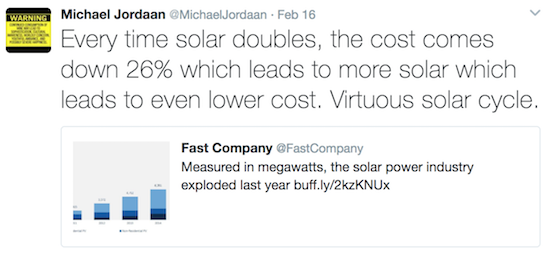
This ties into a tweet that I saw last week about how the cost of solar is plummeting.


Home again, home again, jiggety-jog. US Holiday today. George Washington birthday, and all the presidents past, are celebrated. I suppose some of them did watch the news authority on all things factual. That real tax plan, the one that Mr. Market is waiting for, could not happen quick enough. I hope that it is tremendous, I know a lot of people (a lot, a huge number) who are waiting for this. Sweden? Can you believe Sweden? Talking of which, thank goodness for the internet and fact checking, CNN suggested that the Ukraine is a NATO member. They have a partnership, they are not a member.


Sent to you by Sasha, Byron and Michael on behalf of team Vestact.

Email us

Follow Sasha, Michael, Byron, Bright and Paul on Twitter

078 533 1063