Showing posts with label Oil. Show all posts

Wednesday, 21 June 2017

OPEC Oil Slick

"To finish off, OPEC or any such cartel will lose to human innovation. US rigs continue to rise, OPEC members due to budgetary pressures cannot stick to the weak and loose production cuts agreed upon. As we said back in March: 'Funny that, a cartel can work until real competition sends them packing. By that time they are so inefficient, they lose market share.' "


To market to market to buy a fat pig Oil prices have been slipping over the last half a year, energy stocks in the US last night fell around one and two-thirds of a percent. West Texas Intermediate, which is also know as Texas light sweet crude, as a result of a lower sulphur (sulfur to others) content, is referenced in the US, where the delivery point is a town in Oklahoma called Cushing. For such an important commodity that is used for practically all transportation, the town itself is pretty small. All 8000 odd citizens. The town prides itself as being the pipelines crossroads of the world. It pretty much is in the centre of the US, Cushing.

At the beginning of last year, there was a direct correlation between the oil price and equity markets. I am not too sure if you recall that time? Let me remind you with a five year graph (for perspective), of both the price of WTI and the S&P 500. At first glance, you can see that there is very little correlation. At all. And then there was that period, where for roughly 45 days we were stressed that the banks, who have huge exposure to the oil and gas industry, were going to come undone. And as such, the whole market sold off. I have circled the period. But for the most part, there is little correlation between the price of oil and equity markets.
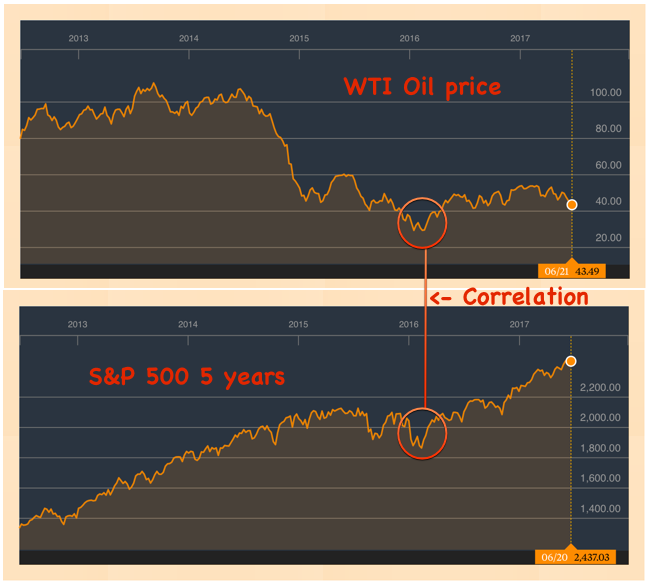


These graphs are courtesy of Bloomberg, absolutely magnificent, thanks for these. Oil prices, at least WTI, is now technically in a "bear market" which indicates more than 20 percent correction from the previous last high point. Huh? I really care very, very little for technical indicators, it means nothing other than a representation of the past. See the WSJ article titled Oil Returns to Bear Market.

We were talking in the office yesterday about the share price of US homebuilder Lennar. As you can imagine, in the housing boom/bust that was one of the causes of the financial crisis, the Lennar share price went from around 6 Dollars in mid 1997 to 66 Dollars in mid 2005, all the way back to 6 Dollars in late 2008. Back to 54 odd Dollars now. Looking at any ordinary graph, it looks like it may have been more mellow to engage in "Wingsuit flying". My point about technical analysis is that it is only obvious in hindsight, and therefore a useless indicator of the future. That is my opinion, you may think otherwise.

To finish off, OPEC or any such cartel will lose to human innovation. US rigs continue to rise, OPEC members due to budgetary pressures cannot stick to the weak and loose production cuts agreed upon. As we said back in March: "Funny that, a cartel can work until real competition sends them packing. By that time they are so inefficient, they lose market share." As the WSJ reports, US production is up 7.3 percent since OPEC announced their November cuts. Funny that ....

Session end the Dow Jones Industrial Average closed three-tenths of a percent lower, the broader market S&P 500 lost two-thirds of a percent, whilst the nerds of NASDAQ were the most sold off stocks as a collective, down a little more than four-fifths of a percent. The likes of Microsoft and Apple found themselves as losers in the same column as the expected Royal Dutch Shell and Exxon Mobil. As well as BP, down nearly three percent on the session for that stock.


Locally markets were driven by sentiment surrounding political interference and the currency continued to weaken through the session. It often feels like two steps forwards and back and it is like watching Bakkies Botha trying to do the tango with Schalk Burger. A whole lot of muscle and little finesse. I may be completely wrong, and I apologise in advance to the two of those fine rugby players, they were the best in their respective positions, perhaps not so much in tango vests and shiny salsa shoes strutting their stuff.

Resource stocks took another beating, down nearly two and a half percent on the day. Industrials and financials sold off less than the overall market, which by the close had lost nearly nine-tenths of a percent. And in fact is now lower for the year, after having been as much as 3500 points higher in mid May this year. For three years, and I know that we sound like a stuck record, stocks in Jozi in Rand terms have "gone nowhere". In the same time period the S&P 500 in Dollar terms is up nearly 26 percent. And that is in hard currency.

The Rand has lost nearly 19 percent of the value to the Dollar over the same time period. And inflation has been around 5 and a half percent. You do the quick math in real terms to see what the JSE has lost in Dollar terms over the last three years, and that may be an accurate reflection of the economic quagmire we find ourselves in presently. The likes of Glencore, BHP Billiton and Anglo American were at the bottom of the pile (or the top of the losers leaderboard), there were 12 month lows for Basil Read, Spur, Sun International, Tsogo and Spar, as well as Harmony and Arcelor Mittal. Steel, retail, gaming, eating out and construction.

Outgoing CEO of Tsogo, Marcel van Aulock is quoted as saying: "People are so discouraged they're even cutting back on wagering" in this Bloomberg article titled The President Who Caused a Recession. If you needed reminding that part of the crisis of confidence is as a direct result of political uncertainty, this article will enforce that thinking.


Linkfest! Lap it up

It looks like supersonic flight might be back on the cards in the next decade - Supersonic flight promised by 2023 as Boom announces airline orders. If I was the Australian and New Zealand governments I would be the top funders of these research projects, making their nations 'less far' and increasing tourism and business?

Since the 'Great Recession' savings rates have been on the rise. The same trend was seen after the Great Depression, having better looking personal balance sheets and less exuberant spending should also act as a buffer to major calamity down the road - Millennials Are Helping America Save More Money

The assumption here is that people continue to move to the city to find jobs. Another theory is that thanks to remote working and the ability to work while in self driving cars, there will be a shift back to less populous areas - These will be the world's 10 biggest cities in 2030 - and none of them are in the US or Europe.


Home again, home again, jiggety-jog. It is international Yoga Day my friends. Whether you can do the Mountain Pose (Tadasana) or the Wounded Peacock (Pungu Mayurasana), give it a go, it may be good for your soul. Don't forget your Pranamasana, the gesture with the one word that Yoga lovers know, Namaste. There is a little bit of a greeting for both the bulls and bears across the Asian seas, some Chinese stocks have been included in the MSCI index, leading to a slight boost in Shanghai, stocks in Hong Kong and Japan are lower. US futures are on balance a little lower .... we could start that way. Another celebration, Video on Instagram turns 4 today. How times have changed.


Sent to you by Sasha, Byron and Michael on behalf of team Vestact.

Email us

Follow Sasha, Michael, Byron, Bright and Paul on Twitter

078 533 1063

Thursday, 20 April 2017

Bank with the Yanks


"Lean in here, just to hear an amazing number. Total average deposits clocked 1.3 trillion Dollars (in a low rate environment), up 7 percent relative to the first quarter of 2016. Total loans ticked up 4 percent to 958 billion Dollars, again, an eye popping number."


To market to market to buy a fat pig The All Share went from green to red yesterday shortly after lunch, closing down 0.24%. The movers and shakers were Kumba Iron Ore up around 5%, clawing back some of the huge drop the day before. On the other end though we had Pick n Pay down around 4.5% after publishing their full year numbers. The numbers themselves didn't look too bad, HEPS and Dividend were up 18% but the top line number is what was the problem. They increased turnover by 7% or only slightly more than inflation. The stock is priced as a turn around story, meaning there is a high expectation for solid growth. You can only improve operating costs so much before you need strong sales growth to be the driver of increased profits.

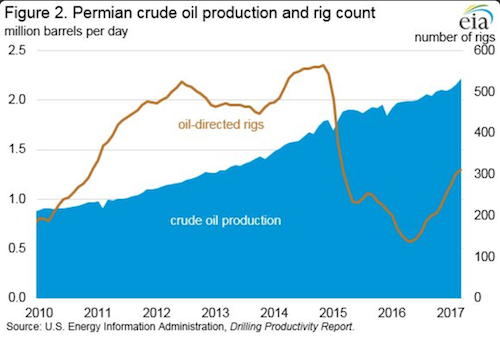
Good news for consumers, oil dropped by over 3.5% after data out of the US showed that oil inventories were decreasing much slower than forecast. The implication is that the OPEC deal to cap production has sprung a few leaks, continued support for the production cap may be limited, what a twist. Even as global demand for oil has risen the impact of production caps from OPEC have become less and less significant thanks to the Frackers. Here are two graphs about how things have changed for the frackers over the last few years. First, here is what production numbers have been over time. Note how even though rig numbers fell at one point the production output didn't.


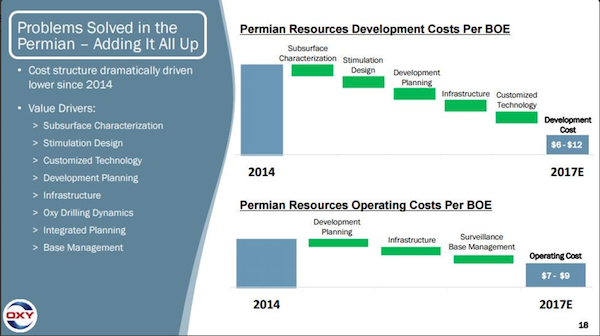
A more significant graph is how the costs relating to fracking have plummeted. Remember that OPEC's original strategy was to push oil prices down thus causing the frackers to go out of business? Thanks to technology, less and less producers will be impacted if that strategy is implemented again. If anything OPEC member nations will sink first with lower oil prices.


Company corner

Wells Fargo reported numbers last week. At the same time, Berkshire, the biggest shareholder, sold down shares to below 10 percent. Reason being is in part that the shares in issue have reduced, as a result of buybacks from the company. Fewer Wells shares in issue means higher holding by Berkshire, as they are not a seller. Regulations then forced Berkshire to sell down its position. The numbers themselves were OK. The company of course has been in the news for all the wrong reasons, recent executive clawbacks of shares are a step in the right direction of normalising the behaviour of the staffers in question. Of course the stink associated with the scandal meant that the chief was axed and the board moved swiftly to restore credibility.

To the numbers for Q1 2017! Net income was flat at 5.5 billion Dollars on revenues of 22 billion, relatively light for what the market expected. Earnings per share registered a Dollar exactly, the market consensus was three cents lower than that. Lean in here, just to hear an amazing number. Total average deposits clocked 1.3 trillion Dollars (in a low rate environment), up 7 percent relative to the first quarter of 2016. Total loans ticked up 4 percent to 958 billion Dollars, again, an eye popping number.

Credit quality improved, provisioning expenses were lower by 44 percent. Good news! Consumer balance sheet repair continues. What is more interesting is that online and secure sessions (what we know as internet banking) continues to gain momentum at the expense of the branch visits. I am sure that when people eventually come around to being less interested in the physical interactions, and more at peace with the online transaction, that costs can be further curtailed. Branch interactions are actually up from Feb to March, down heavily year-on-year though.

The real question arises, why own this company? And is the stock fairly priced at these current levels? Firstly, the USA is where animal spirits are encouraged. The USA is a place where capitalism and risk taking is encouraged, and has been for the last 250 odd years. The champagne socialists will tell you otherwise, the real hardcore two-piece short sleeve Mao suit wearing socialists will believe otherwise. The truth is, more people have been lifted out of poverty by forward economic momentum of the capitalistic kind than at any other point in humanity. The US continues to have a growing population, forward momentum in terms of household formation, and a growing economy. Wells Fargo is a good proxy for housing in the US, it is a good proxy for the economy in the US. Until recently, they were a good proxy for the gold standard in risk free banking ownership (of the stock).

What about the price? The stock fell in response to the earnings. Recently the chair and the CEO bought shares in the business after the price fell, around 5 million Dollars worth. I suppose that is as good an endorsement as it gets. This is Stephen Sanger (chair) and new CEO, Timothy (Tim) Sloan. The stock trades on 13x historic earnings, with a pre-tax dividend yield of close to 2.9 percent and around 12.2x forward. It is hardly expensive, yet lower rates may well mean that interest earned may be lower than anticipated. i.e. the idea that the Fed won't raise rates as much as anticipated. We own the stock as a stable part of the portfolio, reliable, yet a proxy for the US economy. We continue to be patient, the share price should expand later into the year as the US economy improves, and interest rates rise.


Linkfest, lap it up

A current topic that has grown momentum over the last few years is the level of global inequality. One part of the discussion that many people forget is how quickly the global pie has grown over the last century - 2016: the "Year of the 1%" or the Year Poverty Fell to a New Low?

When cars crash, wealth is destroyed in society even if it wasn't your car in the accident. An increase in accidents means higher insurance cost for you, higher cost of the materials that go into cars and increased time in traffic - Study confirms we all use our phones while driving. With a phone addicted population self driving cars can't get here fast enough?

    "It is estimated that a 2-second distraction increases the risk of a collision by 20 times."


I'm not sure if my wife would be keen to stay here, it looks like a huge opportunity for Disney though - Disney wants to launch a 'Star Wars' starship luxury resort, and it looks like a fan's dream.


Home again, home again, jiggety-jog. The Rand is having a strong morning, getting closer to that $/R 13.00 level and below the Pound/Rand 17.00 level. With the UK parliament green lighting an early election expect some Pound volatility for the next few months as political parties woo voters with promises about the future.


Sent to you by Sasha, Michael and Byron on behalf of team Vestact.

Email us

Follow Sasha, Michael, Byron, Bright and Paul on Twitter

078 533 1063
Monday, 12 December 2016

Frack on Tap

"The problem for those folks is that the frackers of North America are standing by to pump like crazy, since the lows of May 2016, the rig count (those pumping) has risen over 50 percent."


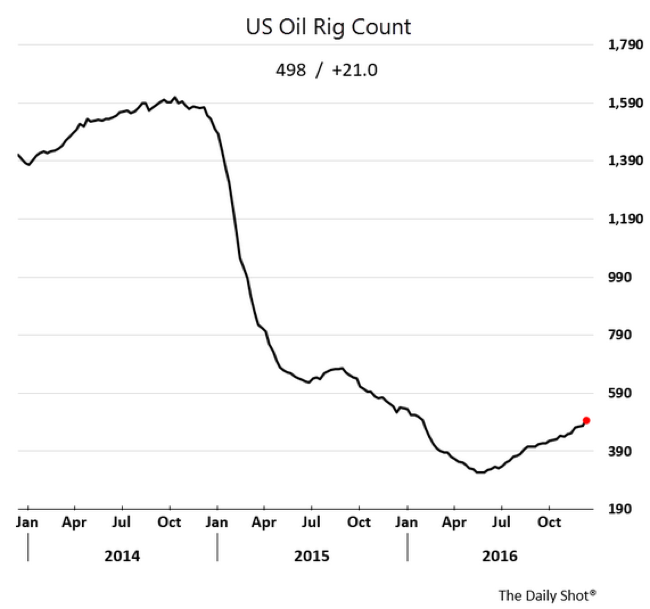
To market to market to buy a fat pig The oil price is barreling along, getting a lift from non-Opec members getting ready to cut production in order to shore up prices. The problem for those folks is that the frackers of North America are standing by to pump like crazy, since the lows of May 2016, the rig count (those pumping) has risen over 50 percent. The higher the price goes, the more favourable for private enterprise. So whist recent events may be back slapping in the halls of national oil ministries, corporate America, Harold Hamm and his mates have been high-fiving just as much. The oil price is now double from the lows of the year. Wow. See - Oil prices soar on global producer deal to cut crude output. That is today.

That Daily Shot (which now belongs in the WSJ) has this take on it - America Defeats Saudi Arabia. The oil rig count may have spiked a lot, it is still a long way off the all time highs, as you can see from this graph below, courtesy of the Daily Shot -


Stocks in New York, New York, closed higher Friday to set another record again. The Dow Jones Industrial Average added nearly three-quarters of a percent to close at 19756 points. 20 thousand on the Dow is looking like a distinct reality. So not too much has changed other than confidence and many business types feeling excited that the Republicans control the lot. And that means a lot, that means that if people feel things are going to be better, then people are going to invest more, spend more, hire more. It may seem strange to you and I that with the recovery in the labour market, the general business people don't feel it, and as such, the new dispensation may feel better from their perspective. And confidence, as we know, is a very powerful thing.

The broader market S&P 500 closed at 2259, up 0.59 percent, whilst the nerds of NASDAQ added half a percent to 5444. Basic materials were lower whilst non cyclical consumer goods (food and toiletries and stuff like that) were the big winners on the day. Healthcare finally caught a bid too, some good and some bad since the US elections. Hospitals, and services around the sector have not had the best time, a repeal of part of "Obamacare" may impact heavily. Hospital group HCA is down 8 percent since the US elections. Fewer people with healthcare insurance equals fewer people visiting US hospitals. The company looks cheap at face value, it trades on an 11 multiple historic and less than that forward. Just as you may think a sector falls in a sweet part of the economy (hospitals do not really have cycles, one way or another), does not mean that the market gives it the same multiple. HCA is huge, on a revenue basis is bigger than Merck. Therein may actually be an opportunity, a very big long term one.


Where local was happening, stocks ramped up nearly three-quarters of a percent on Friday. The All share index closed out at 50900 points (a fraction shy of that), with industrials and financials leading the charge, resources were lower by just over a percent, stinking up the joint. Resources as a collective (and these are the top ten by market cap) are up 41 percent over the last 12 months. Over five years, unfortunately it is still a bum investment, down 37 percent. The law of make up percentage numbers. In other words, what will it take in percentage terms to make that up. If a stock goes down 50 percent, you need it to double (100 percent gain) to get back to break even.

The main news on the day was that resource company Sibanye (no longer a gold business) were buying the only real US based PGM business for 2.2 billion Dollars, a company called Stillwater. Not everyone sees the synergies. Neal Froneman, the CEO is quoted as saying the following: "The Transaction represents a transformational opportunity for Sibanye to acquire high-quality, low-cost, PGM assets at a favourable point in the cycle." I guess by favourable he means lower price. Still, reactive market types sent the stock much lower, possibly as a result of a dilution in the pipeline, i.e. a rights issue. Whilst the gearing will also rise, for many this represents some sort of opportunity. Over a single year, the stock, Sibanye is down 1 percent. Since August the 2nd, the highs of the year, the stock is down a whopping 66 percent. Since being unbundled from GoldFields the stock is up 48 percent. As ever, and is always the case, it depends where you draw your line in the sand.


A lot of people don't get it. Being on the Richest list does not necessarily mean that you are liquid, and by extension, very rich. I am pretty sure that if Stephen Saad announced that he was leaving Aspen, his net worth would plunge. If he sold it, or placed them, he would have to sell them at a discount, heck, he may no longer be a Dollar billionaire. I am pretty sure that with his energy and the way that he speaks about the growth of the business, equally he is young by modern day corporate standards, he may not want to retire any time soon.

Equally, whilst Saad is liquid, some folks would never find buyers for stakes of businesses that they are invested in, you know who I am speaking about. Famous Brands announced that the salary measures were also messed up. They stuck out a SENS this morning - Announcement relating to significant error contained in Business Times' rich list "The Big Earners" table. An incorrect decimal place in there. It said that Group strategic advisor and ex CEO, who drove the business from a family business (essentially) to a now powerful branded company, earned 45.991 million Rand last year. When in fact, he earned 4.591 million Rand. A whole lot less than an England cricket contract, which is 700 thousand Pounds a year, excluding match fees (12 thousand Pounds a test, 5 thousand Pounds a 50 over match and 2500 Pounds per T20). Is Hedderwick worth it? Hell yes, every single cent.

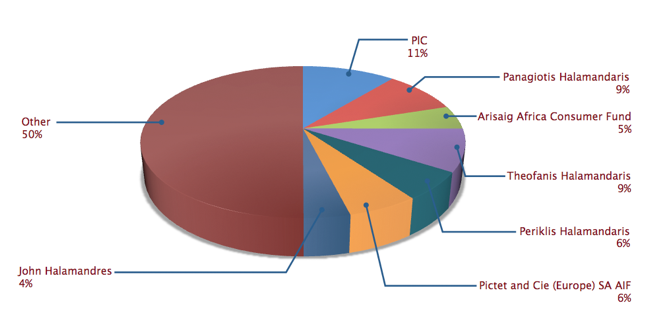
If you had searched in the last annual report, you would have found all the details that you need, for what really matters in wealth creation, and that is ownership. Hedderwick has been a board member for over 15 years. These shareholders below, most of whom have stayed constant have much of the guidance of Hedderwick to thank for their wealth:


In the middle of this year there were sales of around 120 to 180 million Rand for some of the bigger shareholders. At the same time, Hedderwick himself has all and sundry around him (including himself), to thank for making his personal wealth a larger pot now than at any other time. Even if he owned (I tried to scratch here and there) 2 percent of the shares in issue (I think that may be the number, I am very open to correction, it is harder to find than you may think), it is worth over 300 million Rand. The dividends, which have been suspended for now, would be worth a lot more than he earns in a year. So ..... forget what someone is worth on paper, if the cash flows from the business give you huge dividend payouts, then it is worth more. And you know who (not Lord Voldemort), is worth a lot on paper, can neither transact or get dividend payouts. Understood?


Linkfest, lap it up I have never used Snapchat but as their list of features grows I am continually thinking about joining - Snapchat will show more exclusive TV shows with the help of Turner

A big chunk of charity's funds are spent on salaries. A friend of mine who audits charities says a good charity "only" spends 70% of the funds given to them on salaries (can anyone else confirm or deny this based on their experience?). Reducing the complexity of getting money to people under the poverty line will mean that less people need to be employed and more money will get to the people who need it - Definitive data on what poor people buy when they're just given cash. Interesting that when just giving cash it results in lower alcohol and tobacco consumption for the average person.

Diet sugary drinks have had falling sales over the last number of years. It looks like if people want to be a bit healthier they rather go for something like water instead of a diet version of Coke/ Pepsi which doesn't taste as good as the original - Diet soda has fallen out of vogue in the US


Home again, home again, jiggety-jog. Stocks are mixed here, mostly higher as Chinese and Hong Kong stocks took an almighty whack (China stocks fall by most in months amid crackdown on insurers), US Futures are higher, thanks for the higher oil prices people. Inflation no doubt will be stoked again, which may mean higher rates, which is not necessarily bad for financials and banks. Which also equals a better future for alternatives, higher energy costs focus the mind.


Sent to you by Sasha, Byron and Michael on behalf of team Vestact.

Email us

Follow Sasha, Michael, Byron, Bright and Paul on Twitter

078 533 1063
Thursday, 1 December 2016

The $10 Billion Club

"Here we are in our market down at the Southern tip of Africa, and we believe that we have deep and liquid capital markets. We did a quick scan through of all of the stocks that have a local listing and have a market capitalisation of more than 10 billion Dollars (over 140 billion Rand). There is a grand total of 6. That is it sports lovers. Makes you think."


To market to market to buy a fat pig Yesterday was a funny old day with a whole lot going on. Analysis here on the political front, there was analysis of the SARS and Treasury release. I still am amazed that notwithstanding the economic quagmire, total taxes collected have increased by high single digits. If the economy was to turn and fire on all cylinders, a smaller and more efficient government were in place and we were getting bang for our buck, we would definitely not attract the negative attention of those ratings agencies. Pesky things, advising people on whether or not the ability to repay debt is "all good". Some may view them negatively and reactionary, I am sure that their internal structures were forced to have a deep and dark look in the mirror post the financial crisis.

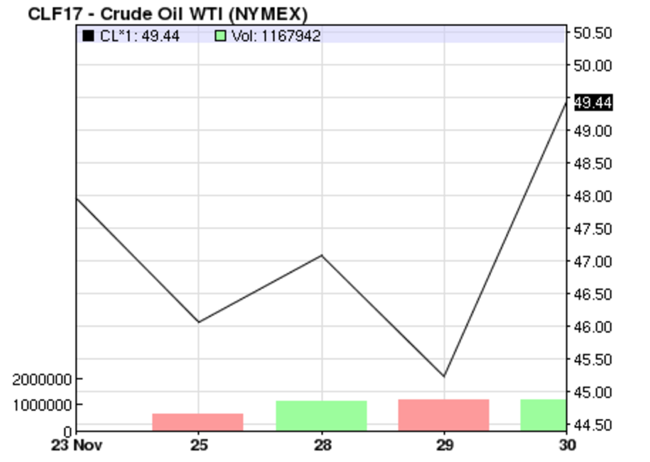
Yet that was not the main story of the day, by a long, long shot. It was all about the oil cartel folks meeting in Vienna (Austria is not an OPEC member) to discuss output cuts. And the moves then in oil prices were something to behold, perhaps the shorts were being squeezed out of sight, who knows, right? The story broke when the Iranian oil minister was jostling his way through tens of journalists at a hotel or convention centre and suggested a deal was close. In the ensuing scrum, oil traders scrambled for direction, and it was one way traffic! Herewith an average looking (hey, it is free!) graph of all the action on the day, relative to the last 7 days, from the NYMEX website - WTI (NYMEX) Price


Here is the official announcement that came a little later in the day, sending the oil price up ten percent at some stage, the presser note is simply titled - Agreement. It sets out all the targeted cuts for the members, all but Iran, who can increase production marginally. It is an agreement to cut production by 1.2 million barrels (the release actually says "by around") for a period of six months. It could be extended by another six months, if needs be. What is also important here is that the Russians are working with OPEC - "This agreement has been reached following extensive consultations and understanding reached with key non-OPEC countries, including the Russian Federation that they contribute by a reduction of 600 tb/d production."

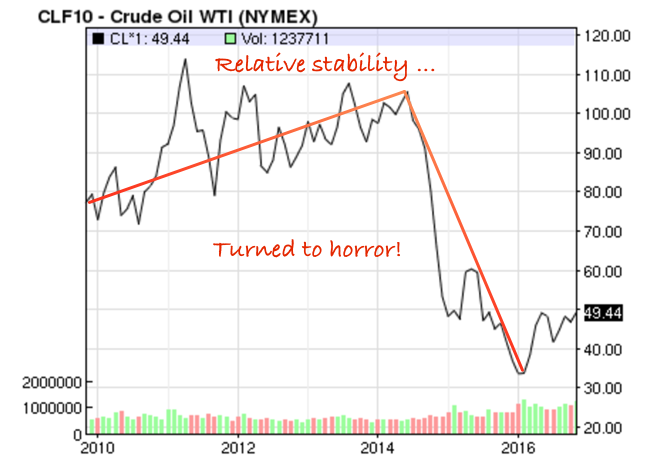
So why is all of this being done? Why is OPEC deciding that they must cut production? It is best summed up in a single graphic, a seven year oil price graph -


When these countries of OPEC, hugely reliant on oil exports to balance budgets and provide essential services to their people suddenly watched a horror show unfold, they were essentially powerless. Private enterprise, the frackers and the Russians had ramped up production significantly. Equally, some of the OPEC members themselves would not stick to production levels. And therein lies the answers to whether this works or not, budget constraints.

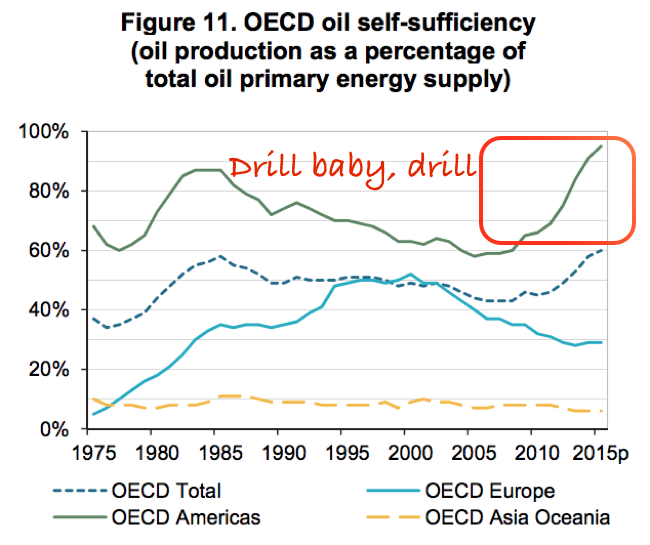
A bit of background, from the International Energy Agency - Key Oil Trends. Excerpt from: Oil information. So first, this is the OECD countries by region that are self sufficient, as you can see, North America as a result of alternative extraction methods (fracking) are becoming increasingly able to fill any void:


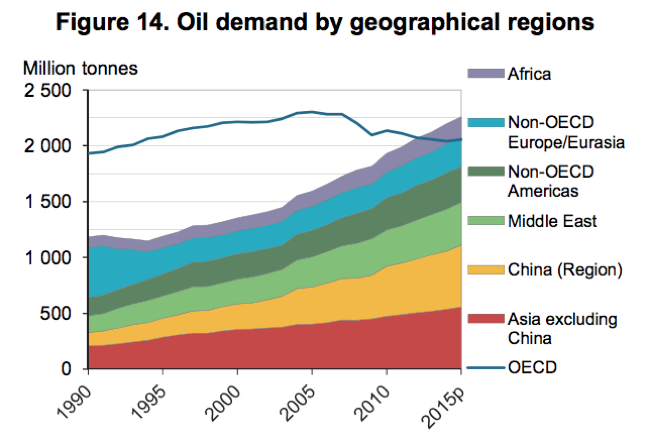
Lastly, this may not matter too much, the US is a huge user of oil, the biggest users have emerged as China and the rest of Asia over the last 25 years. The other regions have become less relevant to the overall mix.


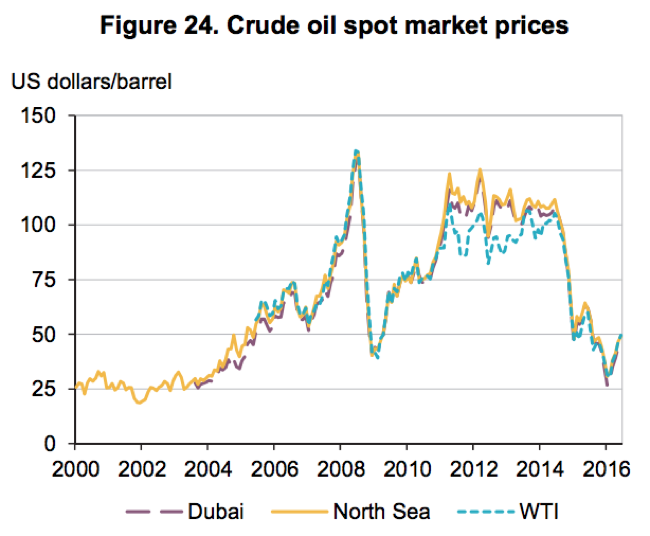
Whilst this is a HUGE story yesterday, perhaps all of this is best put into context with a longer dated oil price graph. This is from way back when oil prices were half of what they are now, and just represents how hard it has been for these countries, that are extremely reliant on elevated prices to deliver meaningful change to their people. Diversification is key, and more people like Harold Hamm will be big benefactors as these countries cut production.


By the way, Harold Hamm on paper added 3 billion Dollars yesterday. This Bloomberg story confirms what we have been suggesting - Texas Shale Is Big Winner as OPEC Deal Brightens Oil Outlook.


Stocks in New York, New York, armed with this big news (and the selection of new Trump administration finance people) saw stocks as a collective down one quarter of a percent (the broader market S&P 500), with the Dow Jones Industrial Average up 0.01 percent. Tech stocks sank, the nerds of NASDAQ lost over a percent on the day. Facebook, Alphabet and Microsoft as well as Amazon all fell pretty sharply, all the oil businesses ramped up sharply. Petrobras was up over ten percent, Royal Dutch Shell ramped up over four and a half percent. Banks also "did well", Bank of America was up four and a half percent too. Wells Fargo added just over two percent. Energy as a collective added nearly five percent, with some huge moves in some minors, businesses with huge losses. Seems like a big knee jerk trade last evening.


Locally we had another mixed bag. There is an interesting pattern (humans are great at picking that up) in that we start well and then the EM trade comes later in the day here, we sell off. Yesterday stocks locally ended one-tenth of a percent higher. Understandably Sasol was at the top of the pile in the majors, up nearly 5 percent. Here is an amazing statistic. Here we are in our market down at the Southern tip of Africa, and we believe that we have deep and liquid capital markets. We did a quick scan through of all of the stocks that have a local listing and have a market capitalisation of more than 10 billion Dollars (over 140 billion Rand). There is a grand total of 6. That is it sports lovers. Makes you think.


Linkfest, lap it up

It seems that politics is moving towards the extreme edges, where to solve problems one camp is arguing that governments are the solution and the other camp is arguing that free markets are the way (but only behind trade barriers, walls and labour flow restrictions?) - Capital and Capitalism. The reality is that governments are inefficient, so less is normally better. Having said that, we don't live in a perfect world, we don't have perfect information and perfect flow of capital and labour. The result is that governments are needed to help fill the gaps and help level the playing field of opportunities. I think like most things in life, a balance normally works best.

The one item that is synonyms with Mc Donald's is their big mac, which almost never made it out of one franchises kitchen - Jim Delligatti, Big Mac Inventor at McDonald's Chain, Dies at 98

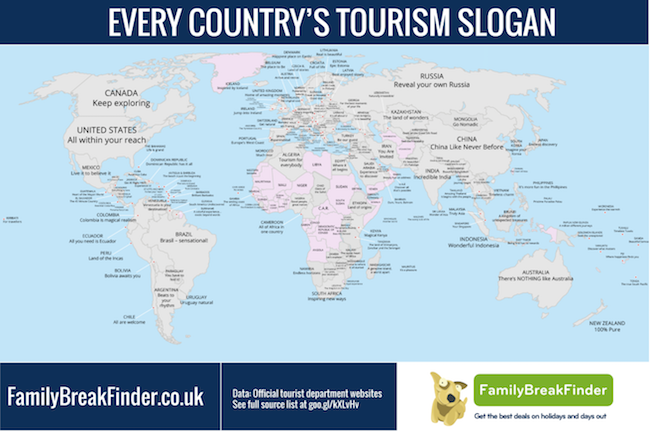
Here is a cool map - Map Shows Every Country's Tourism Slogan


Home again, home again, jiggety-jog. Stocks across Asia are better, stocks here have started better, how many times have we said that over the last couple of weeks? We certainly haven't been the benefactor of the new president elect in the US, emerging markets have been under loved.


Sent to you by Sasha, Byron and Michael on behalf of team Vestact.

Email us

Follow Sasha, Michael, Byron, Bright and Paul on Twitter

078 533 1063
Monday, 15 August 2016

Jack is Back

"Mr. Market really liked the numbers, the stock soared over 7 percent to close just above 98 Dollars, a 52 week high. And seeing as all things China have been under pressure, the stock is up really smartly from the 57 Dollar low reached last October, and 60 Dollars in February this year. The company has an amazing network now, 427 million monthly mobile users in China."


To market to market to buy a fat pig Some fellow said on the wireless this morning, whilst I was listening on my way to work that if life throws you lane 8 on a Monday, do not despair, just Wayde van Niekerk your way through it. Ha-ha. That is a good one. Friday was a while back, a few medals for Mzansi and some great performances from the folks around these parts. We punch above our weight globally, I am reminded that the USA has bigger resources than most, when it comes to most things, be it Wall Street, Main Street or in this case Fleet Street.

It was a fleet footed performance from the local stock market Friday, stocks closed the session up just over nine-tenths of a percent, financial stocks continued the charge northwards. The year performance, i.e. the last 12 months, has been minus seven percent, the last three months have shown a positive 7 percent return. In large part the inflationary outlook has improved somewhat, with the stronger Rand. Strong emerging market inflows have masked other overhangs, I am mindful that our credit rating is due for another long and hard look towards the end of the year. Stand by there. The Dollar index (a basket of currencies versus the greenback) is down nearly three percent YTD. We are in a holding pattern, with regards to rates globally. Europe and the US stuck at record low levels, the English have just joined that club.

There is some talk about rates coming down in places like South Africa. I would say that you should watch the inflation numbers closely, if that starts to level out, or drop, that may well give the Reserve Bank some scope to indicate that they are closer to taking a step backwards. Perhaps that wouldn't be a "bad" thing. It would mean that Joe Consumer is probably in a position to be better placed in the coming months. And that is why financials, banks, and geared retailers have caught a bid. An improving outlook locally and an improving outlook in general for emerging markets.

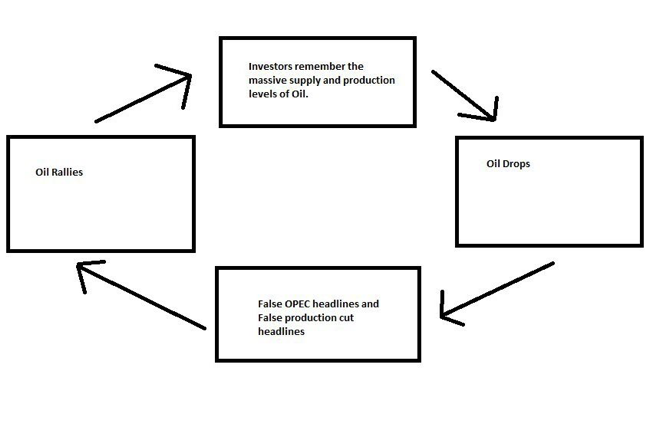
Over the seas and far away, across the oceans vast and wide, stocks closed mixed in New York, New York. The Dow Jones Industrial Average lost one-fifth of a percent, the broader market S&P 500 closed down a smidgen, whilst the nerds of NASDAQ nearly eked out a one-tenth of a percent gain on the day. Energy stocks actually ruled the roost, there was a very funny chart via the inter webs which we all had a proper chuckle about here Friday:


Exactly! Everyone is threatening to make cuts to production, unfortunately human nature is responsible for two things. First, when the oil price went and stayed beyond 100 Dollars a barrel for a long time, governments got used to the revenues generated from state oil production. The ones that were most reliant, Saudi, Russia and then the smaller economies like Nigeria, Angola, Venezuela (the list goes on and on) might well talk about diversification away from the oil price, this wasn't visible in terms of their national budgets. So now, when the price of oil came crashing down, various scramble meetings of OPEC and other producers talking about production cuts led to naught. In the words of Sarah Palin (who was once nearly a single heart beat away from the most important political job in the world) - "Drill, baby, drill!"

This is good for global consumers, being awash with oil. This is not so good for the purveyors of alternative energies. The economics needs to make sense. According to the US Energy Information Administration via this recent document - Annual Energy Outlook 2016 by 2040 renewable energy usage will be 14 percent of all US consumption. Coal will still be at 10 percent (from 16 percent nowadays). Now that does not account for what we know now about Solar Panel technology.

For all we know, Solar might be the cheapest (it certainly is abundant) form of electricity generation in ten years time. Being off the grid may be better from a costs point of view rather than being on the grid. Obviously this is very important for all of us, and warrants watching this very closely. I think Musk is right, it is the storage thing and a social conscience that will make it work. i.e. When you become rich enough that you have a social pact with humanity, that will happen more and more. The more rich people that adopt these technologies, the cheaper they get and more affordable for middle income groups. It is going to be a very interesting couple of decades on the global energy front. I am going to back commercial innovations and technological advances from capitalist tendencies over the ability of governments to evolve, i.e. I am backing Musk and co. over big oil.


Company corner

Ali Baba might have fought off the 40 thieves, the founder and CEO of the Alibaba group certainly had bigger hurdles to overcome. The story goes that Jack Ma invited 24 friends to his house and presented his ideas for the business to them, they listened for two hours. Only 1 out of the 24 folks there thought that the idea of the marketplace that Ma put to them would be a commercial success. Ma is known for his pithy quotes, saying stuff like "if you are not rich by 35, then you only have yourself to blame". In fact he was harsher than that, he suggested that you were poor because you have no ambition. Which is a little harsh. Like most entrepreneurial types, he is more than a little crazy and a whole lot quirky. He is in many ways not too different to Musk, to Bezos, those types of people who relentlessly put their ideas into action.

Enough about the man, people and their ideas are as good as customer adoption. I remember first coming across the business around ten years ago, it seemed like a wonderful idea. A business to business portal, putting you in touch with a business somewhere else around the world and being able to get the goods directly to your front door, no matter where you are and where the goods are. This business is as dominant in China as Amazon is in the US, they are pretty much to online retail as Google are to search, one and the same in consumers minds. A quick squiz at the Tmall website sees that you can pretty much buy anything you want. I am still surprised in 2016 that shopping isn't dominated by online. We will get there, young people just need to become richer, that will happen too. I can imagine that the malls of the future will become more entertainment destinations. Last week we saw Macy's closing 100 stores, all unprofitable no doubt. JC Penney and Sears have also been closing stores.

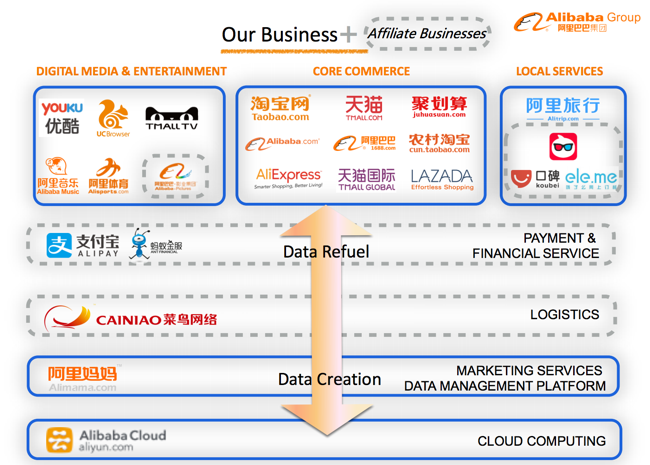
OK, to the results from the other night, we all have a fair idea of the history of the business and the founder, and we all understand that future retail will continue to take place online. It has to. Here is the press releases of the results themselves - Alibaba Group Announces June Quarter 2016 Results. I am amazed that revenues for the quarter continue to clock such huge increases, most especially now that the group revenues for the quarter are 4.838 billion Dollars. Adjusted EBITDA increased by 43 percent to just over 2 billion Dollars. On a per share basis EPS clocked 74 US cents. The group continued to make progress across all brands. Here is the structure, looks a little Naspers, not so?


Mr. Market really liked the numbers, the stock soared over 7 percent to close just above 98 Dollars, a 52 week high. And seeing as all things China have been under pressure, the stock is up really smartly from the 57 Dollar low reached last October, and 60 Dollars in February this year. The company has an amazing network now, 427 million monthly mobile users in China. And remarkably, off an ever increasing base, the revenue growth is not the fastest since the company IPO'ed in September 2014. Whilst you cannot own everything, and one owns loads of Naspers in the local environment, if you need direct access to a Chinese consumer that is in the next phase of growth, consumer focused, look no further than this business. New York listed and US audited, I reckon trust will eventually arrive for Chinese companies, the stock trades on 23 times earnings. The chattering classes may think that you can fudge the national numbers, you can't fudge these numbers.


Linkfest, lap it up

It is very interesting to see how central the capital cities of European nations are to their growth. As international business becomes more central to growth, global organisations normally have their offices in the capital cities of countries, to sit along side other organisations offices - The Capital Effect

Infographic: The Capital Effect | Statista
You will find more statistics at Statista

Taking the long term view on equity investing, it can be very difficult to sit on your hands and do nothing at times of great uncertainty - Distractions Cost Investors 115%. The recovery since 2009 has not been without its bumps in the road but it paid to do nothing when things looked bleak. There will be times though when sitting on your hands and doing nothing will result in a 20% fall in stock prices over a 12 month, 18 month or 24 month period. Doing nothing and adding to the quality is still the best strategy though.

It seems like babies learn their native tongue before they are even born. Research also shows that learning how to speak more than one language improves the brains cognitive functions - This is the best time to become bilingual, according to brain science


Home again, home again, jiggety-jog. Japanese GDP reported this morning was flat, quarter-on-quarter. Chinese stocks both in Shanghai and Hong Kong were much stronger, on the local front stocks have started mixed to better really. There are some numbers from the likes of Massmart and AngloGold Ashanti, a trading statement and sales update from the retailer and actual numbers from the gold producer. Olympic glory awaits sports lovers! Remember we spoke about the Olympics of investing last week, I am starting to think that we should view investing like growing and nurturing a bonsai rather! It takes time and constant attention, sometimes you can't speed up the result. And if you meddle, you may well fall flat on the result.


Sent to you by Sasha, Byron and Michael on behalf of team Vestact.

Email us

Follow Sasha, Michael, Byron, Bright and Paul on Twitter

078 533 1063
Monday, 18 April 2016

OPEC prisoners dilemma


"Pushing prices up to protect those exposed to the industry is likened to someone calling for a restriction on the supply of computers to protect those exposed to the typewriter industry. Artificially inflating prices means that the market will find alternate ways to get back to more efficient clearing prices, pushing oil prices over $100 meant we saw the rise of the frackers."


The very new blunders video is out: Blunders - Episode 10. This week: a shocking new A$5 banknote, Berlin airport spokesman gets fired, GoFlow in Alaska and China's GDP at 6.7 percent. To never miss an episode, subscribe to the Blunder Alert!, and get the mail delivered to your inbox.


To market to market to buy a fat pig Big news for the weekend was the meeting of the top oil producing countries, around half of the worlds oil production was represented at the meeting. Rewind a couple of weeks and you will remember that the oil price started to climb due to this meeting being announced, with the possibility of a production freeze. The outcome of the meeting was that nothing is going to happen. Saudi Arabia doesn't want to be involved in any deal unless Iran is involved in the production freeze as well, which makes sense. Why would Saudi Arabia curb production, push the oil price up, only for Iran to benefit from the increased price as they ramp up their production by around 20%. The impact on the oil price this morning is a drop of 4%, still trading above the $40/barrel level though. Asian markets are in the red and so are US futures thanks to these lower prices.

As a consumer I have no problem with the oil price dropping. What I don't get though is why many people think it is okay for the oil producers to be gathering to discuss curbing production. If that happened in any other industry, regulators would be all over the producers and imposing fines. There is no scenario where a higher oil price is a good thing for the majority of the globe. Yes if you work in the oil industry or have lent money to the industry a higher price is good but your losses are minimal compared to the losses the consumer faces because of a higher oil price. Pushing prices up to protect those exposed to the industry is likened to someone calling for a restriction on the supply of computers to protect those exposed to the typewriter industry. Artificially inflating prices means that the market will find alternate ways to get back to more efficient clearing prices, pushing oil prices over $100 meant we saw the rise of the frackers and renewable energy projects find capital backers.

On to the markets for Friday, even though more stocks were red in the TOP 40 than green our market still finished up 0.36%. Most of our dual listed stocks were in the green thanks to a weakening Rand, most of which are big contributors to the ALSI. New York, New York was another day of very little change, S&P 500 was down 0.1%, Dow Jones down 0.2% & the Nasdaq down 0.2%. US Futures as I write are down around 0.5%, so it looks like a red start to the week.


Company corner

This is not a stock that we actively hold but the "Boere Buffett" needs a mention. Just before the market close on Friday Psg Financial Services Limited - Trading Statement came out, their sum of the parts value is up 14% since last year Feb. The share price is up 388% over the last 5 years, great to see.


Linkfest, lap it up

The Gigafactory is what is going to allow Tesla to reach new levels of economies of scale and also allow them to build those 320 000 Model 3's on preorder - 8 awesome innovations in Elon Musk's Gigafactory

Rewind the clocks 14 years and we get to a period where the SARS virus was on the prowl. One of the industries to benefit from this was technology companies, more people started connecting their homes to the internet, SMS numbers climbed and probably most importantly e-commerce numbers increased. Due to people being afraid of going outside, they took the hard first step toward ordering online - China's internet got a strange and lasting boost from the SARS epidemic

Cullen Roche is having a rant about how misguided and flawed the argument is relating to the US having more debt than it can sustain - Say America's Bankrupt One More Time!. Interesting read and puts big numbers thrown around into perspective.

Here is the reason why Facebook and Google make so much money - The online universe belongs to Facebook and Google - the rest of us are just living in it. Getting customers to your site is a big component of making sales and is only getting more important.


Here is a fun video to kick off your Monday - The US Navy is catapulting trucks off aircraft carriers


Home again, home again, jiggety-jog. Expect our market to open in the red thanks to the big drop in oil prices. The Rand is also slightly weaker, trading in the R/$14.70's, maybe traders are in a "risk off" mood? Not much in the way of global numbers today. This week is going to be busy on the earnings front, after the US market closes we have Netflix numbers (expect a very volatile share price) and then the bigger, slower moving IBM.


Sent to you by Sasha and Michael on behalf of team Vestact.

Email us

Follow Sasha, Michael, Byron, Bright and Paul on Twitter

078 533 1063

Monday, 11 April 2016

Oiling the market


"The biggest move on Friday was the 6.6% move Northwards of WTI Crude all thanks to a drop in inventories of crude, traders were expecting an increase in inventories. Why do inventories matter? A drop in inventories means that more oil was used in the period than was produced, good needs on the demand side of things."


To market to market to buy a fat pig Markets finished off Friday in the green but still down for the week, with Monday and Tuesday last week being the worst 2 days since the lows we saw in Feb. The biggest move on Friday was the 6.6% move Northwards of WTI Crude all thanks to a drop in inventories of crude, traders were expecting an increase in inventories. Why do inventories matter? A drop in inventories means that more oil was used in the period than was produced, good needs on the demand side of things. Given the relatively large drop in crude prices over the last 18 months we have seen onshore storage fill up as trading & production companies store the oil with the hope of selling it later at a higher price. The oil price just needs to go up by more than the storage costs and you have made yourself a profit. Inland storage costs according to Google are in the range of 40 USc - 75 USc per barrel per month and with inland storage facilities have maxed out their capacity, traders have now resorted to using idle super tankers to store oil out at sea, the cost there seems to be $1 - $1.20 for this service. I have even seen reports where trading companies are using oil train cars to store oil, basically oil is being stored in anything that will take it. All this stored oil is also the reason that we will probably see oil prices stay around these levels for the foreseeable future. A drop in inventories is significant then.

Another surprise came from golf's biggest weekend, The Masters where Jordan Spieth gave up a 5 shot lead to end the tournament in second place. Have a look at 17 Things You Never Knew About The Masters. As Bright wrote on Friday, Spieth is one of Under Armours big names and his performances last year in the majors had a direct impact on the UA share price on the following Monday. We will have to see if the UA share price drops at 15:30 today due to Spieth finishing second.


Company corner

Sibanye signed a revised wage offer with AMCU over the weekend, which is better than the wage agreement reached with the other unions at the end of last year. The agreement means that strike action is avoided which is good for the short term. The precedent set though may be a problem down the road, these negotiations did not follow the old format of going through the chamber of mines and came after a wage agreement was reached at the end of last year. Sibanye also did a complete 180 after previously saying that they would not be giving a revised wage offer. What will the reaction be from other unions and will there be any value in signing 3 year wage agreements if renegotiation is on now on the table?


Linkfest, lap it up

I can't imagine spending 17 hours on one flight but given a lower fuel price, long haul flights are coming back - Long-Haul Flights Get Longer. The flight is Auckland to Dubai and is operated by Emirates.

This graph highlights why the Twitter share price has been struggling of late. Added to problem that people are not on Twitter as much as other social media apps, Twitter's growth numbers have also stalled at around 300 million mark - Twitter Falls Behind in Terms of Mobile Engagement

Infographic: Twitter Falls Behind in Terms of Mobile Engagement | Statista
You will find more statistics at Statista

Speaking of Twitter, here is a fun and humours way to kick off your week - My addiction to Twitter parody accounts. Exploring one of the greatest pockets of Twitter.

On the local front one of my favourite parody account is WoolWorst SA, always good for a chuckle.


Home again, home again, jiggety-jog. After starting in the red our market is up a quarter and the Rand is looking good sitting under the R/$15 level. On the marco side of things it is a rather quiet week but after the US market close tonight we have Alcoa reporting their 1Q numbers, which unofficially launches the last quarters results. Phew, I feel like the last set of earnings has barely finished.


Sent to you by Sasha and Michael on behalf of team Vestact.

Email us

Follow Sasha, Michael, Byron, Bright and Paul on Twitter

078 533 1063
Monday, 4 April 2016

Jobs jibber jabber

"Will the Fed raise rates? Not sure! I am very sure that as investors we have absolutely no control over what the Fed does now, next week, next month, next year or ever actually. Not a single iota of control. So best we stop worrying about the next move and what to do around the Fed. And best we worry about the only thing we have control of, ownership of stock of a business."


The very new blunders video is out: Blunders - Episode 8. It includes Reuters, McDees and a young hedge fund manager. To never miss an episode, subscribe to the Blunder Alert!, and get the mail delivered to your inbox.


To market to market to buy a fat pig Them jobs. Everybody wants a job, needs one actually. It is the modern day equivalent of hunting and gathering, the industrial revolution changed all of that, advancing all technologies simultaneously and throwing the old world out of sync. To a certain extent we (the collective we, humanity) are grappling with technological advances that see us enter the age of information and machines. Driverless cars, self check in, electronic this and that. All this means is that labour intensive jobs are going to become harder to come by, the machines will do more. We will need people to fix the machines, repair them, most importantly invent new ones. The service economy is going to be huge, there will of course be jobs a machine can't do. Give me a haircut like Jennifer Aniston, I'm having problems from my childhood, those sort of jobs.

There was a dated interview in which Johann Rupert compared a diagnostics medical machine and the expertise needed yesteryear to interpret incoming data, how that required well trained humans to do that. Nowadays machines can do that. Yet cutting hair, babysitting, those jobs have to be done by humans, for now I guess. Anyhow, for the time being whilst the world evolves around us, we continue to watch the most highly anticipated data release monthly, the US Employment Situation Summary. Friday saw another shouting match between CNBC hosts Rick Santelli and Steve Liesman (their most famous moment -> Steve Liesman Issued A Devastating Line To Rick Santelli Live On Air), this time I guess about the quality of the jobs added to the US economy.

That is right sportslovers, it was jobs day Friday, normally the first Friday of the month sees the US labour (spell it whichever way you want) department release these numbers. They are volatile, they are prone to revisions, they are some big moving numbers. They are for Mr. Market the most important numbers monthly, across the globe. And that is whether you like it or not. Taking a glance at the scoreboard first, and then the market reactions, the headline numbers included a higher monthly additions to payrolls across the US than anticipated, an unemployment rate that ticked higher as a result of the labour force participation increasing, and an average hourly wages increasing. Over the last year wage growth has been average, average hourly earnings have increased 2.3 percent. In a global context that is not bad, bearing in mind that the Dollar has been king, average Americans can buy more globally with their money.

The upshot of it all was that this report was seen as a sign of continued strength in the US economy. Will the Fed raise rates? Not sure! I am very sure that as investors we have absolutely no control over what the Fed does now, next week, next month, next year or ever actually. Not a single iota of control. So best we stop worrying about the next move and what to do around the Fed. And best we worry about the only thing we have control of, ownership of a business. The greatest creator of wealth known to mankind, I think of course for the ordinary retail customer.

If you think about it, in capital markets it is the only "field" that you can be alongside Buffett, Soros, Gross and all the giants of the investment world, as well as ownership alongside Gates, Rupert, Saad, name them, you can own shares of the same company they own shares of. You may never get invited to participate in a round of golf at Augusta, or serve and volley on centre court at Wimbledon, or bowl an over at Lords, you can own the same ordinary shares as the giants of the business and investment world. Your one ordinary share is equal to one ordinary share of those giants. Except that Warren Buffett (according to Yahoo! Finance) owns 26,675,175 shares of Berkshire Hathaway. At 215740 Dollars a share, even owning one of these is a stretch for most investors. You can of course own the B shares, they are more reasonable (from a normal person portfolio construction point of view) at 143.78 Dollars each. Point made about ownership and participation I guess.

Mr. Market reacted in a positive fashion, good news is after all good news. Stocks rose across the board, the Dow Jones Industrial average added 0.61 percent, the S&P 500 was up a fraction more than that, the nerds of NASDAQ added 0.92 percent after all was said and done. Locally, we didn't really get the benefit of the rally in New York, even though we have the extra hour here now, as well as the extra hour at the beginning of the day, thanks to the clocks being turned back in Europe and North America. Stocks lost a little over one and one-quarter of a percent. It was pretty much broad based weakness, resources having a bad time of it, down just over two percent as a collective. The stronger Dollar (good jobs report) equalled a weaker Rand, naturally. Emerging markets concerns. What, again?

Across the seas and to where the sun rises, stocks are mixed, Japanese stocks are lower by around one-quarter of a percent, stocks in Hong Kong are over one and one-third of a percent off. You would have expected after that rally on Wall Street for stocks to perhaps be better, oil prices are falling. The Saudi's suggesting that they would freeze their output only if the Iranians did. There was of course much bigger news on the oil front.

The announcement that Saudi Aramco (valued at 2.1 trillion Dollars) looking to float 5 percent of the company on the Riyadh stock exchange, Al Arabiya reports: Saudi Aramco IPO signals serious economic reform prospects. Unfortunately as is often the case, sales happen at depressed prices relative to before. This article suggests that the company is worth 1.25 trillion Dollars. I am guessing the market will determine the value of the company. The Saudi's need to diversify their economy in a serious way.

They may well only have a ten to twenty year horizon, depending on how it goes with that fellow Elon Musk. The demand for the new Tesla has been so overwhelming that Elon Musk tweeted that the company is going to have to rethink production planning, this as the pre-orders nearly topped the 200 thousand mark. Yowsers. Orders have (in Dollar terms) passed 10 billion Dollars by Saturday, check it out (the number of vehicles multiplied by the selling price):


Absolutely astonishing! This still doesn't scratch the surface, it just tells you that there is very strong demand out there for affordable electric cars. And if you think about it, these are not really cheap, in the same league as the BMW 3 series. A pre-owned 2016 2 series with very little on the clock costs around 40 thousand Dollars.


Linkfest, lap it up

Here is a bit of fun for a Monday morning. Can you picture our JZ, doing what the other JZ does? - China's churning out hip-hop propaganda videos to win over young people

It looks like good genes and a good diet are what is needed to live past 100 - In One Italian Village, Nearly 300 Residents Are Over 100 Years Old. The peoples diet also included a healthy dose of wine.

Talking of wine - Why Italy is mulling wine classes for schoolchildren

The dividend yield is a good measure of how underlying companies are doing. Dividends are paid with cold hard cash, which you can't pay unless the business itself has that cash - Dividends Rose 4.6% in Q1.


Home again, home again, jiggety-jog. UK markets are set to open lower, futures are pointing to around one-fifth lower. It may be an interesting day for all concerned.


Sent to you by Sasha and Michael on behalf of team Vestact.

Email us

Follow Sasha, Michael, Byron, Bright and Paul on Twitter

078 533 1063