Showing posts with label Retail. Show all posts

Thursday, 18 January 2018

JP Morgan in a Sweet Spot


To market to market to buy a fat pig. Wow! Do you remember the frenzy around Black Friday last year? How you couldn't go near anything that resembled a shop and how all the online retailers made you queue!? Yesterday, Stats SA released their Retail trade sales report for November. Retail sales were up 8.2% thanks to the Black Friday (24 November) boost. The last time retail sales were up over 8% was in 2012.

Here is a table from the report showing where the growth came from:
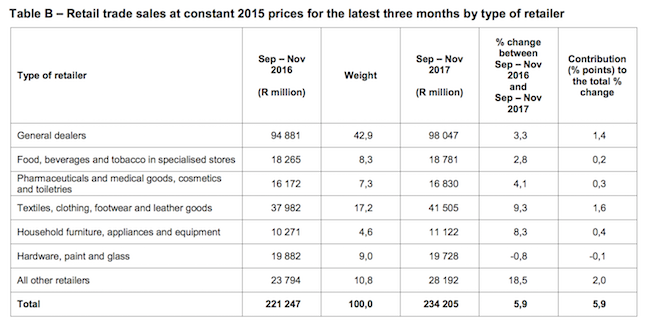


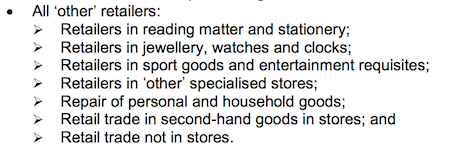
You may be thinking, what is 'All other retailers'? Well, here is the definition from Stats SA:


In the numerous trading updates from retailers, none of them have mentioned Black Friday. Maybe they will when they release their half-year numbers? For many South Africans (and the global population in general) we don't have spare cash saved specifically for these sales. A steep increase in sales is probably coupled with an increase in credit card debt; not good for retailers long-term.

Consumers may have used the specials at the end of November to buy Christmas gifts a month early? Given how full the shops were on the 24th December, I doubt many people thought that far ahead. Time will tell if there are any long-term negative impacts on the retailers. For now though, trading updates are positive and business confidence is on the rise.

Market Scorecard. Potential government shutdown, what potential government shutdown! US Stocks surged last night with both The Dow and S&P 500, closing above 26 000 and 2 800 respectively, for the first time. The Dow was up 1.25%, the S&P 500 was up 0.94%, the Nasdaq was up 1.03%, and the All-share was up 0.45%.


Company Corner

Byron's Beats

Last week Friday we received fourth quarter and end of year results from JP Morgan. This is the first results release since we put JP Morgan on our buy list. US companies usually disclose more details on the quarterly movements. I will therefore give a summary of the annual results and then focus more on the quarterly numbers in detail.

For the financial year 2017, revenues came in at a whopping $103.6bn; $51.4bn of that was net interest income and $52.2bn was non-interest income. After all costs, net income for us common shareholders equated to $22.6bn. That equates to R278bn in profits, bigger than the entire market cap of MTN (R252bn)!

Per-share this equated to $6.87 excluding once offs. Trading at $112 a share the company affords a historic PE of 16.3. This is lower than the general market but historically high for a bank. The price is factoring in the higher interest rates as well as the tax cuts. Earnings for next year are expected to be substantially higher (up 25%) at $8.60. Putting the stock on a forward multiple of 13.

Another important measure for banks, is their return on equity (ROE). For the quarter, JP Morgan reported an ROE of 13%, well above the average of around 10%.

Segmental analysis for the quarter.

I have plugged the numbers from the report into a spreadsheet to make things simpler (I hope).
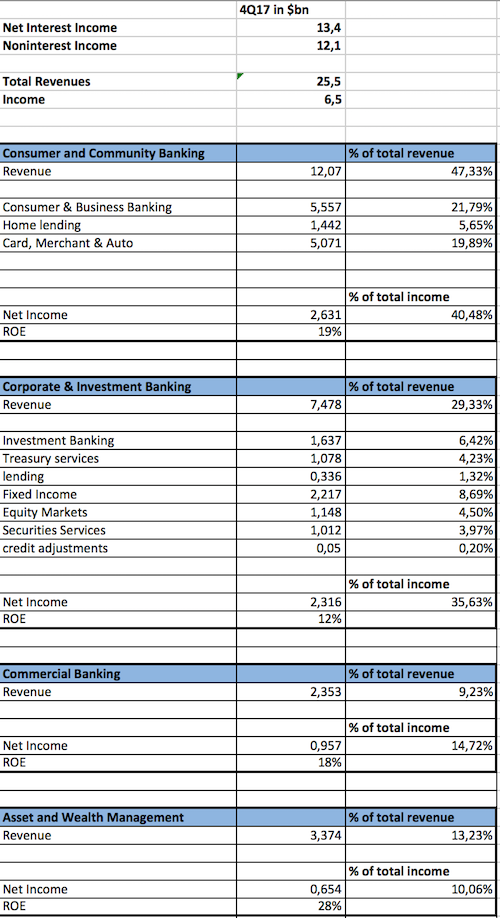


As you can see, the business is very well diversified across everything and anything a bank can make money from. It is not too reliant on Investment Banking, but it still makes a big chunk of cash from that division. Investment Banking can be volatile; those profits should be taken as an added bonus. They even mention a $143m loss within their Equity Markets division from a single client margin loan, AKA Christo Wiese.

The cream of this business for us is the retail banking division (consumer banking). This division equates to 47% of revenues and 40% of net income. It stands to benefit from three major factors.

    1) A growing US economy
    2) Slowly rising interest rates
    3) The ability to cut costs through new technologies.


The tax reform is also an added bonus.

We are strong buyers at these levels because we believe that these three factors are underestimated by the market, especially factor three.

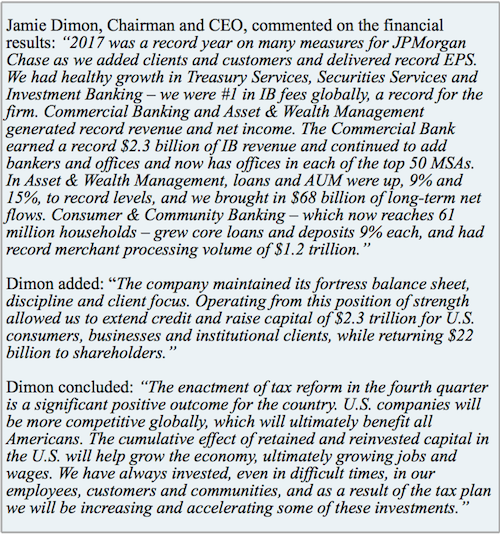
I will leave you with what CEO Jamie Dimon had to say about 2017.


Linkfest, lap it up

One thing, from Paul

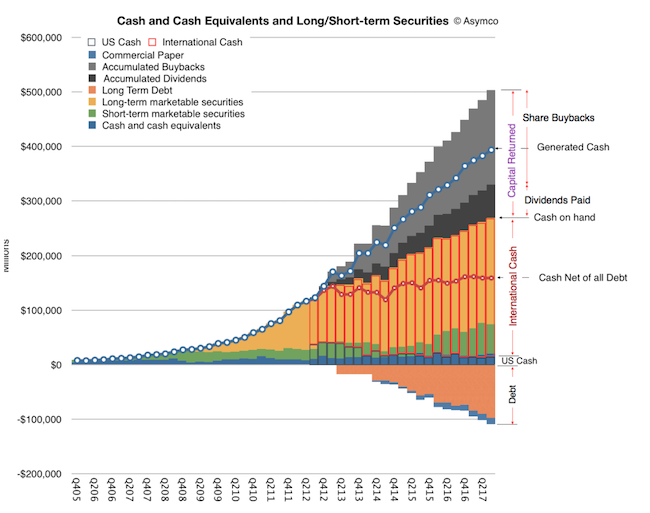
Vestact has held Apple shares for clients in New York portfolios since November 2008. That was before they introduced the iPhone! At that time they traded on a (split adjusted) price of $13.70. Now they trade at $179.10 per share. That's a lovely "tenbagger" for those early investors.

Over this period, the company has grown into the giant that they are today, the world's most valuable corporation. Apple only started to pay dividends in August 2012. Interestingly, they mostly paid those each quarter from the proceeds of debt raised in US capital markets, and retained a giant pile of cash offshore. Of course that offshore cash came from selling iPhones, MacBooks and Apple Music subscriptions to people like you and me, outside of America. Here's how that capital structure looks in a cute graph:


If you want to dive into the details, check it all out on Asymco:

The Apple Cash FAQ

Last night's news was that Apple will now repatriate the bulk of those non-US cash savings, an amount of over $250 billion. This is because within the Republican tax package passed in December was a special provision to reduce the tax rate on repatriation transfers to a flat 15.5%. Apple is expecting to cough up about $38 billion to the US Treasury in the process.

It looks like Apple is bringing back home nearly all of its $250 billion in foreign cash


Michael's Musings

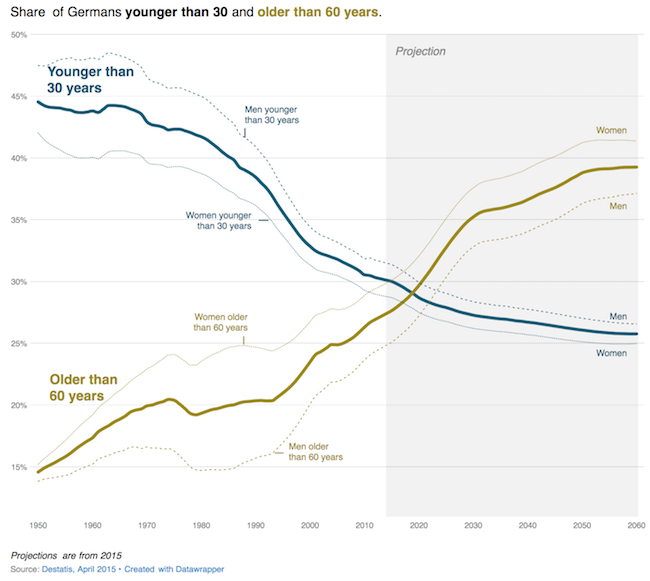
It is not new news that in developed countries, population pyramids are starting to invert. I didn't realise how quickly was happening though - Over the Next Year, Germany Will Hit a Scary Demographic Milestone. The key problem here is that the older the people get, the more they cost the state. If these people have retired, they aren't paying income tax.


Vestact in the Media

Byron chats to Business Day about South Africa's great retail sales update - Black Friday boosts November retails sales to 8.2% - surprising economists


Home again, home again, jiggety-jog. Asian markets all started off much higher but during the course of trading have slipped. We have also just received Chinese GDP data, which showed growth of 6.8%, slightly better than expectations. Then later today, the MPC tells us if our bond repayments have changed.


Sent to you by Team Vestact.

Email us

Follow Michael, Byron, Bright and Paul on Twitter

078 533 1063

Wednesday, 23 August 2017

Grey on Executive Pay


To market to market to buy a fat pig. Hello retail! The General Retailers index was up 2.7% yesterday thanks to Shoprite being up 8% after better than expected results. The surge from Shoprite spurred the rest of the retailers on; Woolworths up 3.6%, Massmart up 4.4%, Pick 'n Pay up 3.5%, Truworths up 3.5%, Mr Price up 2.8% and TFG up 2.6%. My theory at the moment is that despite the recession, Shoprite managed to grow sales by more than inflation and they managed to expand margins just a touch, reminding investors of the defensive nature of grocery retailers. Let's see what happens to those stocks today and then tomorrow after the Woolies full-year numbers come out. Maybe they won't be as bad as expected.

The All Share ended up 1.05% yesterday, finishing off at 56 034 points. Will we have a strong finish to the year and have a very appealing '6' at the beginning of that number? I hope so! US markets had an equally good day out, with the Dow posting its best day since April. Here is the scorecard, the Dow was up 0.9%, the S&P 500 was up 1% and the Nasdaq was up 1.36%. Think about that for a minute, a 0.9% rise on the Dow is its best day in around 4 months, showing just how 'calm' markets have been this year.

Executive pay is always a touchy topic. If they do their jobs properly they can create massive amounts of value for shareholders and the economies their companies operate in, so paying them millions ends up being a small price to pay. On the other hand, they could be coasting thanks to the groundwork laid by their predecessors or their dominant market position, then the millions being paid for them to be on the golf course is rather expensive. There was a study done on the performance of fortune 500 companies and the number of times their CEOs teed it up. As I am sure you have already guessed, more golf equalled poorer corporate results on average.

Executive pay is a shareholder issue because at the end of the day it's shareholder money they are managing. The problem comes in how fragmented shareholdings are, making it very difficult for shareholders to make a coherent stance on what pay should be at a particular company. The result has been that shareholders don't say much and just let the board decide what the man sitting next to them should get paid. You can see the problem, if you work along side someone regularly (maybe family holidays together too) and it is your job to decide their salary, you are probably going to err on the side of overpaying than underpaying.

Let us compare football player salaries and top executives, remember that footballers are employees and their salaries are decided by the clubs and not a fellow board member. Which in my book makes their salary very 'fair' based on free market mechanisms. Now, do you think a footballer or a CEO contributes more value to society? If you said CEO that would mean you think they should earn more than footballers? How many CEOs earned more than Neymar, who will earn EUR 40 million before endorsements - PSG is about to make Neymar the highest-paid footballer in the world and Top 10 Highest Paid CEO's in The World.

On Monday Naspers executive pay was in the spotlight, Naspers investor Allan Gray to vote against executive pay policy. I agree with Allan Gray's argument that Naspers current management should have incentives separate to that of what Tencent does. If they had a significant say in how Tencent was run, then yes be rewarded for it but from the way I see things, it is Pony Ma and his team driving Tencent. It was Koos Becker's genius to buy into Tencent and he has been handsomely rewarded for it and rightfully so. Current management has inherited the crown jewel of Tencent, let's see what other jewels they can create. I'm glad to see shareholders are starting to ask the hard questions to boards globally.


Linkfest, lap it up

One thing, from Paul

Brazil is a country very similar to South Africa (great climate, lovely beaches, commodity oriented economy, corrupt politicians, etc). That country was winning yesterday, announcing that the Federal Government will relinquish board control of the national electricity utility Eletrobras, and sell down its 51% equity stake. In response the share price of the company rose by over 45% in one day!

Brazil's move to privatize Eletrobras sparks investor euphoria

The excitement spread to other parts of the market, as it signaled that the dead hand of government might be withdrawing from other parts of the economy. The Bovespa stock index cruised past 70,000 points for the first time in almost seven years.

Do you think that our leaders might see the light and pursue the same path here in South Africa? I'm not holding my breath, but imagine the enthusiasm that would be unleashed here if Eskom, SAA and the SABC were turned loose?


Byron's Beats

This article has a nice interactive map showing how expensive (or cheap) each country's stock market is at the moment - Mapped: the world's cheapest stock markets. Of course your country needs to have a stock market to feature. As you can see, the more stable your economy, the higher the valuation of your market. Makes sense.


Michael's Musings

Car companies and home builders were getting worried that demand would drop as millennials become the dominant generation. As with marriage, having children and a full time job, millennial's get there slower than previous generations - Millennial Americans Are Moving to the 'Burbs, Buying Big SUVs. I suppose that with longer life expectancies, doing things later in life makes sense.

Sticking with millennial spending habits - 'Psychologically scarred' millennials are killing countless industries from napkins to Applebee's - here are the businesses they like the least. I can relate with some of the trends, I think the only time I have had fabric softener in my house was the day I moved out of "home" and it was a departing gift from worried/caring parents.

After the eclipse on Monday, Google saw a spike in searches for 'eyes hurt', still not as bad as the spike of 'What is the EU' post the Brexit vote. More impressive though was people leaving their TV and computer screens to see the eclipse - The solar eclipse caused a 10% drop in Netflix viewing.

    ' "Hey, just wondering why 10% of you chose to watch a giant rock cover a giant ball of gas when I HAVE ALWAYS BEEN THERE FOR YOU," Netflix tweeted. The account added, "but really, there was a 10% drop in plays during the eclipse today. Well played, Moon." '


Bright's Banter

Everyone needs a spiritual leader in life and my friends say Nicholas Nassim Taleb is my spiritual leader (half true). Here's what he had to say about rationality in the real world. What stood out for me is his argument on being a contrarian. He says that being a contrarian doesn't mean disagreeing with everyone but to have independence of mind - How To Be Rational About Rationality


Home again, home again, jiggety-jog. Later today South African CPI numbers are released. The forecast is for inflation to be 4.6% so well with in the 3%-6% SARB target range. A good read probably means an interest rate drop at the MPC meeting in September, good for consumers and retail stocks. Green across the board in Asia and a green start for us, good times.


Sent to you by Team Vestact.

Email us

Follow Michael, Byron, Bright and Paul on Twitter

078 533 1063