Showing posts with label JP Morgan. Show all posts

Thursday, 1 February 2018

These Big Names need Vitality


To market to market to buy a fat pig. As expected Janet Yellen announced no change to the US interest rate last night. Inflation over the next 12-months is expected to get to the target of 2%, which signals we are still on for three small rate raises this year.

During the Fed's 105-year history, Yellen is the first woman to lead the organisation. She was at the Fed for 14-years, four of which was as the Chair, where under her watch the US unemployment rate dropped from 6.7% to the current 4.1%. Many factors are at play when unemployment drops; business friendly interest rates are a key cog. Running the economy 'hot', which prolonged a low-interest rate environment has not been everyone's preferred path. It is the path Yellen and Bernanke chose, time will tell if it was the correct one.

Market Scorecard. US markets bounced back from three days of losses, with some very modest gains. The Dow was up 0.28%, the S&P 500 was up 0.05%, the Nasdaq was up 0.12%, and the All-share was down 0.07%. Capitec had another tough day out, dropping 13%, now trading at R800. It is now down 27% since the start of the year. Regardless if the allegations are true or not, the problem for shareholders is that the company was trading at comparative values of two or three times that of other South African banks. The more stretched your metrics, small hiccups can have a big impact on the share price. A problem for the company itself is that depositors are worried to use them now. Their amazing record of opening around 100 000 new accounts a month has probably come to an end, impacting future growth potential.

The only stock currently sitting at a 12-month high, is former JSE star, Mr Price. Since the start of November last year, the stock has surged 67%! South African's are feeling positive about South Africa again. A market commentator pointed out that yesterday Amazon became the most valuable listed company in the world. In this case he is not talking about the market cap but enterprise value (EV). To calculate EV, you subtract cash on hand from the market cap and then add on the debt. The logic is that if you bought 100% of the company, cash sitting in the company's bank account would be yours, effectively reducing what you paid for the company. In other words, the market is valuing Amazon's actual business excluding cash more than Apple's actual business excluding cash.


Linkfest, lap it up

One thing, from Paul

US equity markets have had a terrific year. In the last 12 months, the S&P500 is up 23%. That is not normal. You have to be fully invested to benefit from such moves. That's one of the most important things that we do here at Vestact – keep our clients optimistic and in the market. Don't get distracted by the naysayers and all the noise!

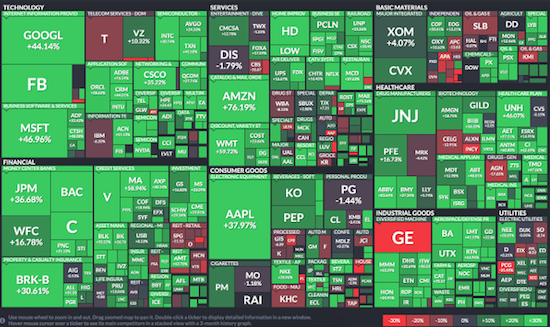
Of course, not every single stock has delivered equal performance. A few tanked, most advanced, and then some did exceptionally well. Take a look at this graphical representation from Finviz. The size of the block is correlated to market capitalisation, and the deeper the green the better the increase. Amazon stands out, with a 76.19% rise since February 2017. The biggest loser is General Electric, with a decline of 45.56% over the last calendar year.


Follow this link to check it all out for yourself: Finviz - Financial Visualizations


Byron's Beats

Jeff Bezos, Warren Buffett and Jamie Dimon. What a powerhouse team! On Tuesday they came out saying that they were exploring a joint venture which would try and fix the US healthcare system. Warren Buffett, in particular, has been very vocal about how expensive healthcare is in the US and how that expense creates a lag on the economy. When these guys speak, people listen. Healthcare stocks as a collective have dropped two days in a row since the announcement.

Preventative healthcare is all the rage these days. It makes sense. It is far cheaper to prevent a disease than to cure it. I may be biased here as a proud South African and Discovery shareholder but these guys should seriously contact Vitality and implement the incentive-based, preventative health insurance model.

Berkshire Hathaway, Amazon and JP Morgan have a million employees combined, who can immediately be put onto the Vitality system. It get's people exercising, eating correctly and constantly screened. That is how you bring down the cost of healthcare. They already have the data to prove it.

Someone please tell Adrian Gore that these guys need him!


Bright's Banter

I'm a not here to discuss how amazing an investor Warren Buffett is. I think we all agree on that and his track record tells a story. All I wanted to do is share these amazing timelines by the Visual Capitalist on how he processes information; maybe we can learn a thing or two. Buffett is still one of the most studied individuals because people are genuinely interested in what sets him apart from all the other investors.

Inside Warren Buffett Brain Part 2

Courtesy of: Visual Capitalist


Home again, home again, jiggety-jog. Capitec is up this morning, along with the broader market. It is 'Big Tech Thursday' this evening, where amongst others, Amazon, Alphabet, Apple, Alibaba (To have a successful tech company does the name need to start with an 'A'?) and Visa all report earnings. Stay tuned, we will give all the updates in the coming days.


Sent to you by Team Vestact.

Email us

Follow Michael, Byron, Bright and Paul on Twitter

078 533 1063

Tuesday, 30 January 2018

A Dimon is for 5 more years


To market to market to buy a fat pig. Today Granny Janet Yellen chairs her last FOMC meeting. Leading into the meeting, the US 10-year yield broke 2.73% for the first time since 2014 as investors start to contemplate a few rate raises for the year. Despite the spike in bond yields, market participants don't expected a rate raise tomorrow night. The key focus will be on the tone the Fed uses.

The impact on stocks is two fold. Firstly, higher interest rates means it costs more for companies to borrow for future expansion. Secondly, a higher interest rate means a bigger discount is applied to future company profits, resulting in generally lower share prices. The key here though is the speed of interest rate changes. With slow changes, which is expected, the market can take in its stride, with limited noticeable impact on share prices.

Market Scorecard. Markets globally yesterday spent the day in the red, I've heard the words 'Profit taking' mentioned. In truth, on an average day there are many reasons for market moves. We like to come up with simple reasons for daily moves because it gives us a greater feeling of control. Does it matter if our after the fact reason for the market move is correct or not? The Dow was down 0.67%, the S&P 500 was down 0.67%, the Nasdaq was down 0.52%, and the All-share was down 1.28%. Locally, banks and life insurers were crushed, being down 4.5% and 3.3% respectively.


Company Corner

Yesterday, Aspen released a SENS announcement saying that an unsolicited offer for their Nutritionals division, has prompted them to do a strategic review of the business (Aspen - Strategic Review). One of the options being explored is the "introduction of a strategic partner that could unlock appropriate value".

What that probably means is that they are thinking of selling part of the business to a company that can positively contribute to growing the nutritional business. It would also mean a nice upfront cash boost for Aspen, which they can put toward reducing the debt pile everyone was talking about earlier this month. We will probably get some more information at the company's interim results on the 8th March.


Linkfest, lap it up

One thing, from Paul

How important is a superstar CEO? Can one make a case for owning a company just because it has a hero at the helm? Should we blindly back entrepreneurs who start, build and then run great companies?

In my experience, when a company does really well, the media puts the chief on a pedestal. When a company falls on hard times, the converse happens. The boss guy must be an idiot!

Here at Vestact we are inclined to pick great businesses operating in promising parts of the economy, and to assume that they will be run by good people over time.

Highly visible CEOs who are fully engaged are great, but there is always a risk of them retiring or falling ill and leaving abruptly? Jeff Bezos, Elon Musk, Johann Rupert, Stephen Saad and Adrian Gore are amazing, but without them at the helm what will happen? Warren Buffett has done an amazing job at Berkshire Hathaway, but he is 87 years old and will be winding down soon.

Losing an inspirational leader can be tough and dent a company's rating, but usually shareholders should just be patient and wait for new management to come to the fore. Apple has been a good case in point. When Steve Jobs died, the naysayers moaned that the company "was no longer able to innovate". Since then its gone from strength to strength under Tim Cook.

I was thinking about this topic overnight, because one of our recommended companies JP Morgan, announced that its CEO Jamie Dimon would stay on for another five years.

Dimon is one of the most respected corporate CEOs in the world of business. Extending his contract is like Leo Messi announcing that he's going to stay on at FC Barcelona for the next five seasons!

He has been CEO since 2005. He's charismatic and opinionated, and is sometimes mentioned as a possible US presidential candidate. He's a pro-business centrist who once described himself as "barely a Democrat".

The succession plan at JP Morgan was clarified yesterday too. Daniel Pinto and Gordon Smith, currently the heads of the corporate and investment bank and its consumer bank have been elevated to the role of co-chief operating officers.


Byron's Beats

I know I harp on a bit about Nvidia but the avenues for this business are so wide and exciting that I have to share them. This TechCrunch article talks about how the oil and gas industry can benefit from AI (Artificial Intelligence). Anticipating new drill spots, dealing with seismic activity and avoiding malfunctions from wear and tear are all potential value adds.

I suppose anything and everything that requires image processing could essentially use a GPU chip (which is what NVIDIA make). In simple terms, it gives smart devices eyes. And that is a pretty powerful tool!

Nvidia and GE's Baker Hughes team on AI for oil and gas.


Michael's Musings

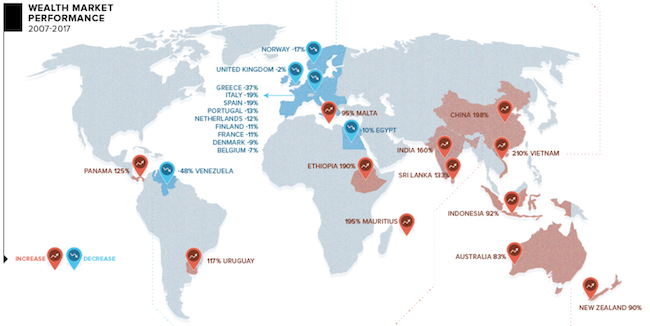
When thinking of years gone by and history, 2007 doesn't feel that far away. Since then however, countries like China have tripled in size, Australia has almost doubled in size, and closer to home, Ethiopia has also tripled in size - Visualizing a Global Shift in Wealth Over 10 Years.


Like many things in life, the more you pay for something, the better it is? - 'Expensive' placebos work better than 'cheap' ones, study finds


Vestact in the Media

Byron chatted to Business Day about Aspen's nutritionals division - Aspen Pharmacare seeks new formula for its global nutritionals business.


Home again, home again, jiggety-jog. It is another red start to our trading day. The only significant data out today is from the EU, at mid-day our time they release their latest GDP read, lets hope it doesn't disappoint like the US last week. Then on the company front, Stryker reports their 4Q and FY numbers this evening. Then lets not forget the US SONA tonight, I'm sure social media is going to love it! It is going to be yuuuuuge!


Sent to you by Team Vestact.

Email us

Follow Michael, Byron, Bright and Paul on Twitter

078 533 1063

Thursday, 18 January 2018

JP Morgan in a Sweet Spot


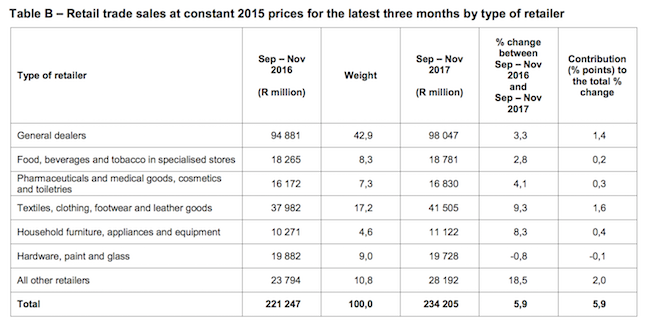
To market to market to buy a fat pig. Wow! Do you remember the frenzy around Black Friday last year? How you couldn't go near anything that resembled a shop and how all the online retailers made you queue!? Yesterday, Stats SA released their Retail trade sales report for November. Retail sales were up 8.2% thanks to the Black Friday (24 November) boost. The last time retail sales were up over 8% was in 2012.

Here is a table from the report showing where the growth came from:


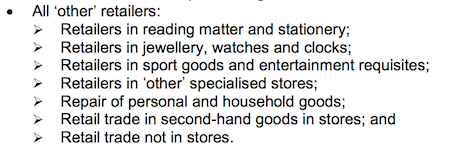
You may be thinking, what is 'All other retailers'? Well, here is the definition from Stats SA:


In the numerous trading updates from retailers, none of them have mentioned Black Friday. Maybe they will when they release their half-year numbers? For many South Africans (and the global population in general) we don't have spare cash saved specifically for these sales. A steep increase in sales is probably coupled with an increase in credit card debt; not good for retailers long-term.

Consumers may have used the specials at the end of November to buy Christmas gifts a month early? Given how full the shops were on the 24th December, I doubt many people thought that far ahead. Time will tell if there are any long-term negative impacts on the retailers. For now though, trading updates are positive and business confidence is on the rise.

Market Scorecard. Potential government shutdown, what potential government shutdown! US Stocks surged last night with both The Dow and S&P 500, closing above 26 000 and 2 800 respectively, for the first time. The Dow was up 1.25%, the S&P 500 was up 0.94%, the Nasdaq was up 1.03%, and the All-share was up 0.45%.


Company Corner

Byron's Beats

Last week Friday we received fourth quarter and end of year results from JP Morgan. This is the first results release since we put JP Morgan on our buy list. US companies usually disclose more details on the quarterly movements. I will therefore give a summary of the annual results and then focus more on the quarterly numbers in detail.

For the financial year 2017, revenues came in at a whopping $103.6bn; $51.4bn of that was net interest income and $52.2bn was non-interest income. After all costs, net income for us common shareholders equated to $22.6bn. That equates to R278bn in profits, bigger than the entire market cap of MTN (R252bn)!

Per-share this equated to $6.87 excluding once offs. Trading at $112 a share the company affords a historic PE of 16.3. This is lower than the general market but historically high for a bank. The price is factoring in the higher interest rates as well as the tax cuts. Earnings for next year are expected to be substantially higher (up 25%) at $8.60. Putting the stock on a forward multiple of 13.

Another important measure for banks, is their return on equity (ROE). For the quarter, JP Morgan reported an ROE of 13%, well above the average of around 10%.

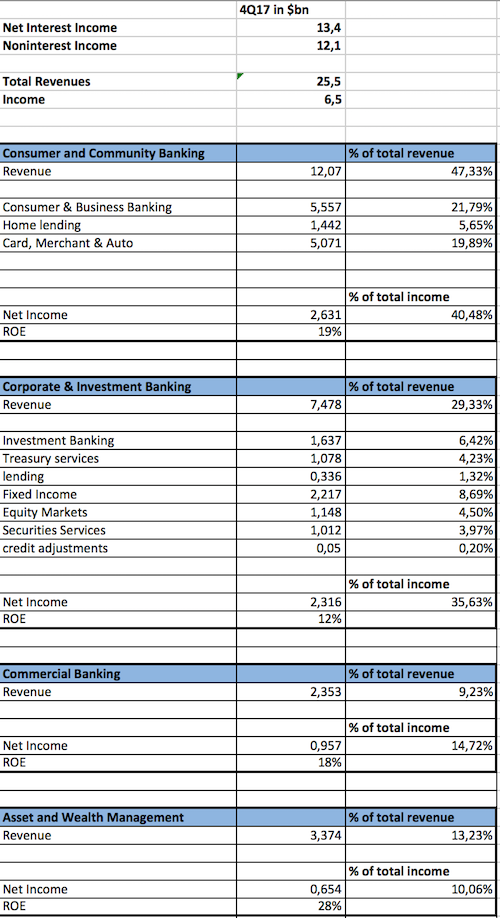
Segmental analysis for the quarter.

I have plugged the numbers from the report into a spreadsheet to make things simpler (I hope).


As you can see, the business is very well diversified across everything and anything a bank can make money from. It is not too reliant on Investment Banking, but it still makes a big chunk of cash from that division. Investment Banking can be volatile; those profits should be taken as an added bonus. They even mention a $143m loss within their Equity Markets division from a single client margin loan, AKA Christo Wiese.

The cream of this business for us is the retail banking division (consumer banking). This division equates to 47% of revenues and 40% of net income. It stands to benefit from three major factors.

    1) A growing US economy
    2) Slowly rising interest rates
    3) The ability to cut costs through new technologies.


The tax reform is also an added bonus.

We are strong buyers at these levels because we believe that these three factors are underestimated by the market, especially factor three.

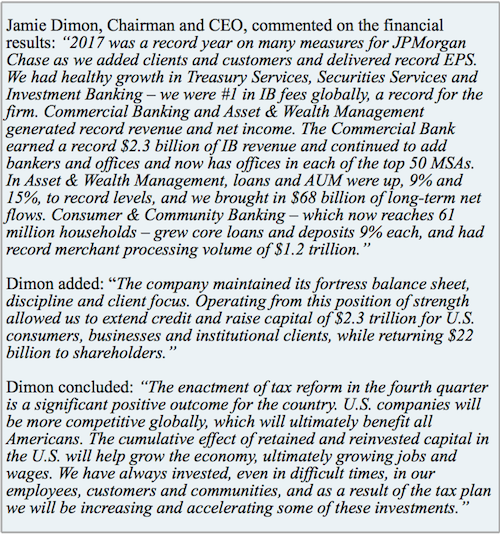
I will leave you with what CEO Jamie Dimon had to say about 2017.


Linkfest, lap it up

One thing, from Paul

Vestact has held Apple shares for clients in New York portfolios since November 2008. That was before they introduced the iPhone! At that time they traded on a (split adjusted) price of $13.70. Now they trade at $179.10 per share. That's a lovely "tenbagger" for those early investors.

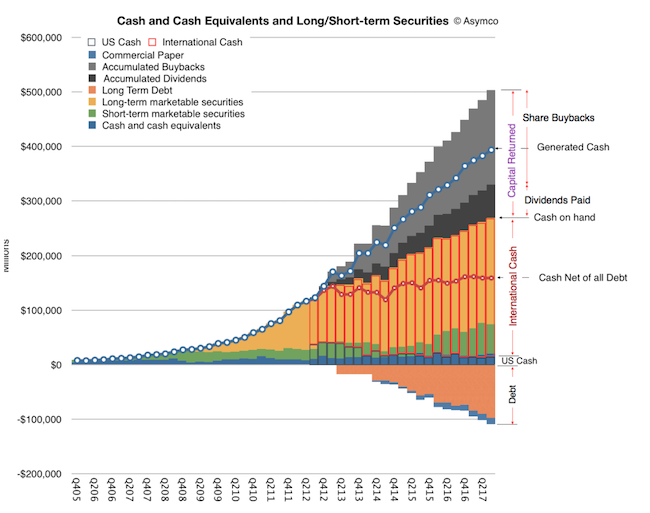
Over this period, the company has grown into the giant that they are today, the world's most valuable corporation. Apple only started to pay dividends in August 2012. Interestingly, they mostly paid those each quarter from the proceeds of debt raised in US capital markets, and retained a giant pile of cash offshore. Of course that offshore cash came from selling iPhones, MacBooks and Apple Music subscriptions to people like you and me, outside of America. Here's how that capital structure looks in a cute graph:


If you want to dive into the details, check it all out on Asymco:

The Apple Cash FAQ

Last night's news was that Apple will now repatriate the bulk of those non-US cash savings, an amount of over $250 billion. This is because within the Republican tax package passed in December was a special provision to reduce the tax rate on repatriation transfers to a flat 15.5%. Apple is expecting to cough up about $38 billion to the US Treasury in the process.

It looks like Apple is bringing back home nearly all of its $250 billion in foreign cash


Michael's Musings

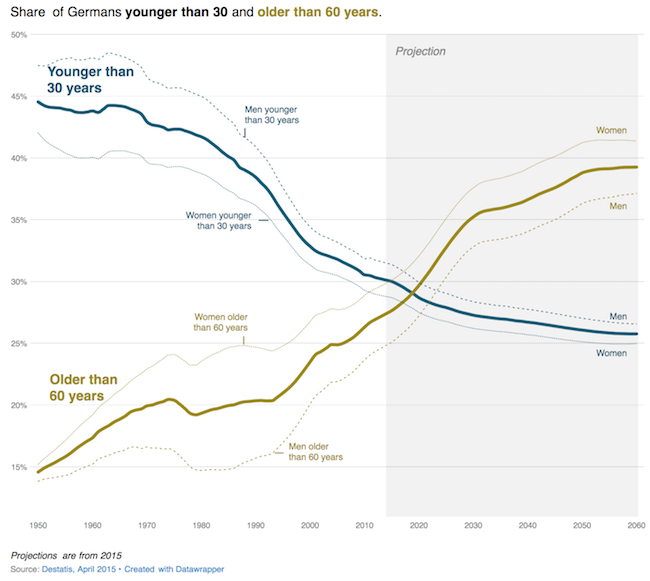
It is not new news that in developed countries, population pyramids are starting to invert. I didn't realise how quickly was happening though - Over the Next Year, Germany Will Hit a Scary Demographic Milestone. The key problem here is that the older the people get, the more they cost the state. If these people have retired, they aren't paying income tax.


Vestact in the Media

Byron chats to Business Day about South Africa's great retail sales update - Black Friday boosts November retails sales to 8.2% - surprising economists


Home again, home again, jiggety-jog. Asian markets all started off much higher but during the course of trading have slipped. We have also just received Chinese GDP data, which showed growth of 6.8%, slightly better than expectations. Then later today, the MPC tells us if our bond repayments have changed.


Sent to you by Team Vestact.

Email us

Follow Michael, Byron, Bright and Paul on Twitter

078 533 1063

Tuesday, 14 November 2017

Stay away from M&A


To market to market to buy a fat pig. When speaking to clients recently, the following companies normally come up; Brait, Famous Brands, Mediclinic, Steinhoff and Woolworths. The client's question goes along the lines of, "why has this stock gone backwards over the last year"? My answer goes along the lines of, "well they bought a company, and the merger isn't going as well as hoped".

Reading a headline yesterday from just one lap (probably the best free personal finance, investing and trading webpage in RSA), I was reminded that statistics show that more than half of M&A activity ends badly. After some googling, the internet tells me that M&A doesn't increase shareholder value for between 50% to 90% of deals. My guess for why there is such a massive gap in research results, is that it comes down to the assumptions and time periods used in the studies. In the 50's and 60's many conglomerates traded at less than their NAV, so even if you operated the acquired business badly you could sell off the parts and still make money for your shareholders. Never the less, let us assume that one in two deals ends badly for shareholders.

Looking at Brait, their purchase of New Look has been nothing short of a disaster. Last year this time, New Look was valued at around R35 billion and accounted for 30% of their NAV. From their trading statement last week, management is now valuing New Look at zero! Famous Brands recent purchase of GBK in the UK, is the reason they haven't paid a dividend recently and have piled on debt. Unfortunately GBK is currently loss-making. In Mediclinic's case, their share price has been sliding basically since the day they merged with Al Noor. For Steinhoff, they went on a spending spree last year; the jury is still out on whether all their deals were successful. Of particular importance is their move into the US through Mattress Firm, which is in a transition phase as they revamp the brand. Lastly, in the case of Woolies, management increased debt levels and issued a massive amount of shares to buy David Jones in Australia, which is taking longer than expected to turn around.

For all these companies, maybe except Brait, we could look back in five or ten years and say that things were a bit rough while the acquired assets were integrated but it turned out well in the end. For all these companies, management was using historically low-interest rates to expand the business and diversify their client base. I think in all the cases management overpaid for their respective assets but, overpaying in the short run to secure a better long-term asset is worth it? Time will tell if those acquisitions were duds or not, statistics are not on the side of management though.

Market Scorecard. Markets were back to their green ways yesterday, despite political noise on both sides of the Atlantic. The Dow was up by 0.07%, the S&P 500 was up by 0.10%, the Nasdaq was up 0.10% and the All-share was up 0.08%. Those moves higher are hardly noticeable, but green is green! The worst performer in the Dow this year, GE, had a terrible day yesterday. A turnaround plan was announced yesterday morning, which includes cutting the dividend in half and scaling back the size of their board. The stock initially rallied by 3% but as the market digested the plan from the company, the stock slipped and closed down by 7%.


Linkfest, lap it up

One thing, from Paul

From an investment perspective we are in favour of free trade, open financial markets and the free movement of people around the world. This is not some lefty, liberal instinct. Its well-grounded in economic theory and evidence. Barriers to the free flow of capital and labour are silly and inefficient.

So, if we want markets to go up, we should be against events like Brexit, and against Trump's immigration controls, and against those imposed on immigrants by our own department of Home Affairs. I'm against visas, in general. What a pain. In my view, too much is made of national identities and national boundaries. We are all human, remember? The differences between us are trivial, we are all the same species.

In the same vein, we should be suspicious of ethno-nationalism and separatist movements around the world. Sorry Cape Town, you can't form your own country down there. So, I was pleased to read that the Catalonian separatist movement seems to be running out of steam - Spain Sees Signs That Tide Is Turning in Catalonia


Byron's Beats

JP Morgan is the latest addition to our core recommended list. One of the primary reasons we invest in the sector is because we believe the adoption of new technologies will help these banks become a lot more profitable.

JP Morgan specifically has made some big investments in the fintech world. This article talks about a recent acquisition they made and their plans for it going forward.

The world of payments and banking is very exciting and ripe for disruption. However the disruption is reliant on the adoption of the banks who have already built up the brands, clients and trust - JP Morgan Chase Acquires WePay: What investors Need to Know.


Bright's Banter

Uber's founder and former CEO Travis Kalanick and Uber's largest shareholder Benchmark have agreed to take a $10 Billion investment by a consortium led by none other than SoftBank's Masayoshi Son. Masa, the man obsessed with singularity raised $100 Billion for SoftBank's Vision Fund which will focus on futuristic investments in BlockChain Technologies, Ride Hailing, Chip Makers, Artificial Intelligence, Augmented Reality, Machine Learning etc.

The Vision Fund has already invested in companies like design & chip maker ARM Holdings, WeWork, SoFi, Fanatics, Improbable, Slack etc - Uber Reaches Deal to Sell Stake to SoftBank


Home again, home again, jiggety-jog. Big data out today are GDP and CPI numbers for most European countries, including the EU zone. Our market is off to a red start this morning.


Sent to you by Team Vestact.

Email us

Follow Michael, Byron, Bright and Paul on Twitter

078 533 1063

Monday, 2 July 2012

Forget the yields, check the goals!

" Accountability is key for shareholders, lawmakers, employees and Joe public alike. So whilst I think that this is a step in the right direction, I am not too sure what it means about the culture of the bank itself and the perception by politicians at large."

Jozi, Jozi. 26o 12' 16" S, 28o 2' 44" E. The stuff online, on twitter, on the box, that I saw on Friday, ranged from this is very good, "the Europeans had gone a long way to solving their integration issues", all the way through to the usual "this solves nothing". Question, is Greece still in the Euro zone? The answer is yes. The decision by the Europeans to not lend the money to Spain, but rather directly to Spanish banks sent the borrowing costs of Spain and Italy markedly lower on the day, but had the opposite effect for Germany, their borrowing costs climbed, but admittedly we are not really that far off record low levels for the German Bund. So, I am guessing that it is fair to say that bond investors in Europe were either scrambling to cover their tracks, or genuinely believe that the Europeans were closer to a banking union, which is the first full step towards fiscal integration. I think that it is important that the Europeans have a central banking authority. If not Euro Bonds immediately, because the statistics (and Angela Merkel's not in my lifetime comment) leads me to believe that we should see these late 2036. By which time most of us will have forgotten this crisis. But I am pretty sure that we might be able to recall the wonderful football of Euro 2012, poor Italy last evening, but Spain were just too majestic. Now time for the tour de France.

Friday we had stocks rocking, resource stocks benefited from a lift off in commodity prices, the copper price, the oil price, the precious metal prices all steamed ahead in a rally alongside the equity market, and alongside falling sovereign yields for the peripheral bonds. At the end of the session resource stocks had rallied a whopping 2.54 percent, it could have been more if it were not for a surge in the Rand to almost all the major currencies. It was a clear sign of risk back on again. The Jozi all share index closed at 33708, up 455 points on the day, or a gain of 1.37 percent. Gold stocks slipped, but that probably was the currency, the Rand which had been trading at 8.40 plus the US Dollar earlier in the week, traded at the best level in weeks, down to 8.19 to the US Dollar. Mr. Risk-on was shooing Mr. Risk-off away from Mr. Markets house. There were a couple of downgrades, from the day prior where ABSA and FirstRand were both given the 'unlike' button, with a ratings change from buy to hold. Not that I care too much about 12 month target prices and estimates, because our time frames are a lot longer than that, but they matter.

When a scandal rocks, you expect someone to take the fall, not so? Accountability is very important in the way the world works, saying sorry is a hard but necessary part of life. In South Africa I get the sense that we are not good at this. The story that I am referring to is the Barclays Chairman having resigned overnight. He said sorry. And then he went his own way. No wait! He is staying until the company finds a replacement.

Is it a good thing that Marcus Agius took the fall? I reckon yes. According to the Barclays CORPORATE GOVERNANCE document that I dredged up: "The Chairman's main responsibility is to lead and manage the work of the Board to ensure that it operates effectively and fully discharges its legal and regulatory responsibilities. The Chairman will lead the Board to ensure its effectiveness in all aspects of its role, including setting its agenda to ensure that adequate time is available for substantive discussion on strategy, performance and key value issues."

Accountability is key for shareholders, lawmakers, employees and Joe public alike. So whilst I think that this is a step in the right direction, I am not too sure what it means about the culture of the bank itself and the perception by politicians at large. Only bad things for the bank. In CEO Bob Diamond's letter to a Member of Parliament Andrew Tyrie (who is also the Chairman of the Treasury Select committee) he makes it clear that this sort of behaviour is out of line: "The first issue is that Barclays traders attempted to influence the bank's submissions in order to try to benefit their own desks' trading position. This is, of course, wholly inappropriate behaviour. Barclays submissions should reflect the cost of interbank borrowing rather than individual traders' positions."

And then Diamond says something even more interesting, that will leave you saying a multitude of things, these days expressed through short hand in text messages and social media: "It is also important to note that these traders had no way of knowing whether or not their actions would ultimately benefit or detriment Barclays overall. They were operating purely for their own benefit. This inappropriate conduct was limited to a small number of people relative to the size of Barclays trading operations, and the authorities found no evidence that anyone more senior than the immediate desk supervisors was aware of the requests by traders, at the time that they were made. Nonetheless, it is clear that the control systems in place at the time were not strong enough and should have been much better."

Undoubtedly the way that Libor functions now is kind of silly, as John Cleese in a Monty Python act might say. It is rather silly. How can the banks send their rates to Thomson Reuters, who then aggregate and slice and dice and then come to a number. Surely the process itself, of which hundreds of trillions of Dollars globally depend on a rate, should be refined. The WSJ (in an article titled Barclays's Agius Is Stepping Down) puts the silliness into perspective, or perhaps it is just me: "Libor - or the London interbank offered rate benchmark - is supposed to measure the interest rates at which banks borrow from each other. It is based on data reported daily by a 16-bank panel."

And then the reason why I think it is silly appears in the next part of the explanation of how Libor is set: "By 11:10 a.m. London time, the banks on the Libor panels submit to Thomson Reuters, as an agent for the British Bankers' Association, their estimated borrowing rates. Thomson Reuters discards the highest and lowest submissions. The remaining 50% of the submitted quotes are averaged to work out the Libor rate. By about 11:30 a.m. London time, Libor rates are published."

Discards the high and the low rate? And then averages? What is the point, if the importance is for tens of trillions in swaps, securities and loans depend on a few reported bank rates and then the aggregating by Thomson Reuters, is the only benchmark. That has to change. And no doubt will. Expect Bob Diamond to appear in front of the politicians.

Byron's beats covers a pretty poor trading update from Angloplats and shifting PMI.

    This morning we had a very disappointing trading update from Anglo Platinum. This industry cannot catch a break with the biggest global producer announcing a more than 20% decrease in earnings compared to the 6 month period ending June 2011. The stock is down 2.7% while the whole index is down 1.7%.

    "Anglo American Platinum's earnings for the period is expected to decrease by more than 20% from that reported in the six month period ended 30 June 2011. However, in view of volatility in exchange rates and metal prices, Anglo American Platinum cannot, with reasonable certainty, quantify the extent of the decrease in expected earnings other than that the decrease is expected to be more than 20%. The expected decrease in earnings is primarily as a result of lower sales volumes and lower metal prices achieved compared to the comparative period."

    So not much info given but I can tell you now that reasons include lower production due to labour issues, increasing costs due to electricity tariff and wage increases. The Platinum price, as we spoke about a while ago is not actually that cheap when you compare it to oil. I wouldn't say that is an excuse for a 20% decrease in earnings. Last year the company made 1236c per share for the period. Assuming best case scenario, earnings are down only 20%, the company will make 988c. At R468 the company looks pricey for an industry that is struggling. I can't say in decline because I do feel the platinum price will pick up. We will await the full release on the 23 July for all the explanation.

    In other news we had a whole lot of PMI numbers released today which paints an interesting picture. For the record PMI measures activity in the Manufacturing sector. Any number above 50 shows expansion. Any number below 50 shows a contraction. As expected the average for the Eurozone was not good, 45.1. But, there is light at the end of this tunnel. Ireland which was one of the first countries to be bailed out and have had a torrid time showed their best improvement in manufacturing for the last 12 months. The read came in at 53.1. The Irish are still being funded by bailout money but the yields on their bonds have decreased exceptionally. If they can do it, so can the rest.

    Elsewhere India showed their best month on month increase since August 2011 with a healthy looking read of 55 while locally we had a negative read of 48.2. China also came in with a read of 48.2 as their economy shifts to one of higher wages and stronger consumers. I am not trying to sugar coat this read. It is not good that Chinese exports are decreasing. Lower demand from Europe is taking its toll on both our economy and the Chinese. No one said it would be easy.

New York, New York. 40o 43' 0" N, 74o 0' 0" W. Lift off. Stocks surged through the session, closing at the highs, with the nerds of NASDAQ rising a whole three percent on the optimism that the Europeans had finally done something concrete, or moved in the right direction. Forward is a good direction to move. The broader market S&P 500 added two and a half percent to 1362, whilst the Dow Jones added a more modest (relatively speaking) 277 points or 2.2 percent to close at 12880. This was the single biggest rally and day for markets since last October, so I guess it is worth a serious mention then.

The rally was pretty broad based and across all sectors, energy, materials conglomerates all clocking huge gains, only one stock went backwards in the Dow Jones Industrial Average (out of 30), and that was JP Morgan. The size and scale of their hedge gone bad is just being predicted at this point. The London Whale finds his position at a parish called Kemble, the source of the Thames River. I beg your pardon, the River Thames is the correct way to name the river. If you are interested the FT has a whole lot of articles on how and why the London Whale trades have not yet all been unwound, meaning what, I am not too sure. So, JP Morgan still have serious problems on their hands.

Currencies and commodities corner. Dr. Copper was last at 346 US cents per pound, the gold price is slightly lower at 1592 Dollars per fine ounce. The platinum price is also slightly lower at 1434 Dollars per fine ounce. The oil price is also lower at 83.66 Dollars per barrel, but had a huge rally late last week from prices that we have not seen for the last 18 months. The Rand is firmer at 8.17 to the US Dollar, 12.79 to the Pound Sterling and 10.37 to the Euro. We are firmer here today, just a little bit, after having been lower initially.

Currencies and commodities corner. Dr. Copper was last at 346 US cents per pound, the gold price is slightly lower at 1592 Dollars per fine ounce. The platinum price is also slightly lower at 1434 Dollars per fine ounce. The oil price is also lower at 83.66 Dollars per barrel, but had a huge rally late last week from prices that we have not seen for the last 18 months. The Rand is firmer at 8.17 to the US Dollar, 12.79 to the Pound Sterling and 10.37 to the Euro. We are firmer here today, just a little bit, after having been lower initially.

Sasha Naryshkine and Byron Lotter

Email us

Follow Sasha and Byron on Twitter

011 022 5440