Tuesday, 12 July 2016

Cars and Guns


"There are roughly 92 people killed on US roads each and every day. There have been, since records have been kept on such matters, over 3.6 million fatalities on US roads. That is since 1899, a year in which there were 26 deaths. Would you believe me if I told you that gun violence accounts for about the same amount of deaths in the US every year. Barking up the wrong tree? Maybe."


To market to market to buy a fat pig What a twist. Who would have thought that we are at an all time high for the S&P 500 last evening. The broader market printed 2143.16 during the session, pencil that in as your all time high. So much for Brexit anxiety and so on, so much for the biggest negative event, so much for the naysayers and doomsday scenario planners (there are too many) telling us that this is now it. In the end all that matters to the equities that we invest in is earnings. And the quality thereof of course, a low quality set of numbers would be dealt with in the manner you would when accepting low quality anything. Toss aside. That said, don't be that person that suffers from quarteritis. Earnings season is upon us, it is going to, as always, be fun.

Bloomberg, in this article - Year of Pain Erased for Bulls as S&P 500 Surges Back to Record, says that this is the 109th record since the S&P 500 rose above the October 2007 level a few years ago. Yet there is still an enormous amount of scepticism towards this rally back from the depths of despair in March 2009, when the index touched 666 points. I suspect the reasons that there are still "haters" of the rally is simple, the memories of those dark days are so powerful that everyone suddenly recognises something bad and heads for the hills. It may well take another half a generation for the participants of that time to move on, either retire and be gone, or have time to heal their pain. Our mantra here at Vestact always remains the same, hold the line and most importantly, hold the quality.

Our market here locally is still some distance away from the all time highs, the Jozi all share closed last evening above 52 thousand points on a ripper of a day, up one and three-quarters of a percent. Led in large part by resources and financials. Anglo American is back at 150 Rand a share, amazing. South 32 is back at 20 Rand a share, around the level that it was unbundled. It was pretty much a broad based rally. Most of the recent moves (the last couple of sessions) have been as a direct result of the enormous jobs number last Friday, the health of the biggest economy in the world no longer in dispute really, and that is a good thing. The one thing that I suspect may happen in the next jobs report is that there may well be a slight Brexit pause from employers, one could expect the report released in a few weeks time to be perhaps a blip. As ever, who knows, we don't invest for the report. Ever. They are what they are. If you are following this strategy of flipping and flopping, dare I say it, you may be doing it all wrong.


Company corner

I have been thinking about the "fallible" Tesla technology for a few days now. First the fact that it is 2016 and we have driverless cars is pretty cool. The fact that a big fan of the technology met his untimely end in a car he loved, that is not too cool. Being in his favourite car, that perhaps was the only good thing about the incident. I thought one thing of the whole accident, and laid it out last week, what if the truck with the trailer had the self driving technology? Would it have turned at that moment, sensing the oncoming traffic? Possibly not. And as discussed last week, we wouldn't be having this conversation. I was struck in my reading that the very "inventor" of modern flight, one of the Wright brothers was involved in the very first flying fatality known to man. We didn't stop evolving now, did we? Otherwise I wouldn't have actually been able to write this very paragraph whilst sitting on a commercial airline in the sky.

I encourage the authorities to engage with the company and make sure that the software is up to scratch, see - Fatal Tesla Crash Draws In Transportation Safety Board. Amazing that one crash, which was in theory the OTHER drivers mistake that led to the downfall, gets so much airtime. There are roughly 92 people killed on US roads each and every day. There have been, since records have been kept on such matters, over 3.6 million fatalities on US roads. That is since 1899, a year in which there were 26 deaths. Would you believe me if I told you that gun violence accounts for about the same amount of deaths in the US every year. Barking up the wrong tree? Maybe.

Elon Musk tweeted this article, written by a Tesla driver, and I think that this article nails it, the Upside of Tesla's autopilot. A few excerpts from the blog: "Prior to this first unfortunate death (my sincerest condolences to the family), Tesla's Autopilot had successfully, safely driven owners and their families 130 million miles. Among all vehicles in the U.S., there is a fatality every 94 million miles. Worldwide, there is a fatality approximately every 60 million miles."

And then the lines that make you think powerfully about the implications of letting the software improve, quoting Elon Musk here: "the system's capabilities "will keep improving over time, both from the standpoint of all the expert drivers ... training it," he said, "but also in terms of the software functionality" -- which will add new features." The author of the piece, Dr. Peter H. Diamandis (the Americans love their second name initials thing), makes the best conclusion thus far: "This is so important I need to restate it: With every single mile driven, the cars get safer and safer."

So why in your wildest dreams would you, as he says, trust a 17 year old kid with 20 hours of driving experience in control of a 5000 pound (2267kg) vehicle speeding at 65 miles per hour (104.6 km per hour) and debate whether learning software is safer. Dumb when you think about it. I agree with Peter's last line: "I'll take an ever improving machine learning algorithm over kid with a learners' permit any day."

What also amazes me is that the SEC is having a go at Tesla for not disclosing to shareholders that there had been a crash. Excuse me for batting for the company a while, when I read this WSJ article (SEC Investigating Tesla for Possible Securities-Law Breach), this line again: "The May 7 accident killed the driver, Joshua Brown, a 40-year-old Tesla owner who collided with an 18-wheel semi-truck that pulled in front of him on a Florida highway." See that, the truck pulled in front of him. It is like McDonald's not disclosing that a chronically overweight individual had a heart attack whilst eating a supersize meal. My goodness, if ever a bunch of people could rather highlight stricter gun control or safer driving by first timers, this is it!

At the core of this argument is that Tesla is expected to be perfect. And that is a good thing. We should have very high expectations of a company that is transforming the future. The future in which transportation is different than now. As I often tell my kids, you may never need to get driving lessons from me, and they are less than a decade away from that age. The driving age. Tesla is not for everyone, the stock is volatile and the company is not quite "there" yet from being profitable at all. Tough at best really to say with major conviction that Musk is going to meet and beat his targets. A 20 fold increase in market capitalisation in a decade? In the classics they say, from your lips to the markets ears.


Linkfest, lap it up

As the Chinese middle class grows, so may the calls to have a more democratic and open country - 225m reasons for China's leaders to worry. The interesting numbers from the article are:

    "In 2000, 5m households made between $11,500 and $43,000 a year in current dollars; today 225m do. By 2020 the ranks of the Chinese middle class may well outnumber Europeans."


and then

    "An inward-looking nation has grown more cosmopolitan: last year Chinese people took 120m trips abroad, a fourfold rise in a decade."


There are many reasons why people buy and sell shares, putting fund managers on notice due to a recent period of underperformance can create wrong incentives for the managers - Double Secret Probation.


Home again, home again, jiggety-jog. Stocks across the globe are following the Wall Street hurrah. Earnings, man, I am very excited. The old "traditional" kick off to Wall Street earnings began last evening, Alcoa reported numbers that were a beat. Revenues fell however. It is hardly the litmus test for what is to come. Stand by, we will cover all our investments as they come at us, not getting caught up in the disease that impacts the investor markets and perceptions, quarteritis. Avoid that at all costs, remember that it is not contagious, it is just a mindset.


Sent to you by Sasha, Byron and Michael on behalf of team Vestact.

Email us

Follow Sasha, Michael, Byron, Bright and Paul on Twitter

078 533 1063

Monday, 11 July 2016

T+3 = More Liquidity


"Today the JSE aligns itself with international stock exchanges and goes to what is called T+3. What that means for the man on the street is that when you sell your stock, it takes 3 working days for your cash to come free. It used to be T+5."


To market to market to buy a fat pig The so called biggest data point for this year did not disappoint on Friday. The number in focus is 287 000 new jobs added in the US in the month of June, smashing the expected number of 180 000. Remember the May number of only 38 000 new jobs, which is the reason markets think the FED won't raise rates this year? That number was lowered further, to only 11 000 jobs added in May. The other important numbers in Fridays data release (Employment Situation Summary) was that unemployment increased by 20 basis points to 4.9% from 4.7%, this was due to more people coming into the work force. One of the interesting data points that does not get much attention is the number of part-time workers, wanting full-time work (involuntary part-time workers) dropped by 587 000, which also indicates the strength of the labour market. More on the positive data front, average hourly wages grew the most since 2008 with growth of 2.6% compared to last years wage. That might not sound like much but remember that the inflation rate in the US is very low, so in real terms workers are still going forward.

On the topic of the middle working class seemly going sideways. Would you rather be middle class in the developed world now or the top 0.1% 150 years ago?. As much as it is nice to be the top of the pile and the ego boost that comes along with it, the quality of life is probably better for a middle class American today than a King from 200 years ago. Antibiotics, air travel, cars, air-condition, TV, computers, internet and well the field of medicine in general.

How did markets react to the better than expected data? The S&P 500 closed up 1.5% just below an all time high, the Dow finished up 1.4% and the nerds of the NASDAQ finished up 1.6%. Good news is good news again. I say this because the market has been so obsessed with the Fed lately that the interpretation of data has been a bit strange. Normally when equity markets go up (risk on trade), the bond market goes down. On Friday after the jobs number the bond market also went up because the market still thinks that a FED rate hike is off the table for this year. Based on futures, the market is pricing in a 74% chance that the FED will do nothing this year. Around this time last year, market participants were pulling money out of equities because a FED rate hike in September was almost certain (with 4 more hikes on the cards over the next 12 months) and a rate hike meant that people would look to other asset classes to get some yield on their money. That hasn't happened and interest rates seem set to stay low for a number of years (maybe now that everyone thinks this, things will change?). The point I am making is that as an investor central banks should not be the focus of your investment strategy.


Today the JSE aligns itself with international stock exchanges and goes to what is called T+3. What that means for the man on the street is that when you sell your stock, it takes 3 working days for your cash to come free. It used to be T+5, the long period was due to all the paper work involved before computers and electronic share certificates. Great news for equites as an asset class in general. Compare this to a house that takes you months and a big fee towards estate agents or transfer fees. Equities you can sell tens of millions in value in minutes and then have it in your bank account 3 days later, with costs very unlikely to be higher than 2%.


Linkfest, lap it up

Apple is building one of this generations iconic buildings. As a shareholder here are some interesting facts about the $5 billion building - 18 incredible facts about Apple's new 'spaceship' campus

Scientists have found a planet with an orbit twice that of Plutos. What makes this planet unique though is it orbits 3 stars - Strange exoplanet found

The first crop of the season is considered to bring you good luck, hence the high price for a bunch of grapes - A Japanese supermarket paid $11,000 for a bunch of grapes, and is giving them out for free. The value of the bunch of grapes is up more than 5 times since 2009, if fruit didn't go off this would be a very good returning investment.

It is amazing to see how big Airbnb has become. As the service grows the daily listing prices will drop which will encourage more people to list - Which Cities Have The Most Airbnb Listings?.

Infographic: Which Cities Have The Most Airbnb Listings? | Statista
You will find more statistics at Statista


Home again, home again, jiggety-jog. Our market is nicely in the green today following the strong day in the US on Friday, currently up around 1%. The Rand is also looking stronger today, with $/R 14.50 well in sight! This week also marks the kickoff to US earnings season, we will update on the stocks you own over the next few weeks.


Sent to you by Sasha, Michael and Byron on behalf of team Vestact.

Email us

Follow Sasha, Michael, Byron, Bright and Paul on Twitter

078 533 1063

Friday, 8 July 2016

Going for Gold


"Conclusion, you don't want all your assets sitting in one country and one economic sector. Buying gold as insurance for the dips, covering yourself for that once or twice event every decade, it is like buying insurance for a car that repairs itself (stock prices do recover after dropping)."


To market to market to buy a fat pig A better day for stocks yesterday, with Aspen finishing up 3.3% breaking the R380 a share mark for the first time in over a year. On the red side of the scales were gold stocks, that index down a little over 3% for the day. WOW, the gold index has been very volatile this year. I suppose gold captures the extremes of our emotions, where the silky, warm glint of the metal plays to our greed emotion and then the 'run to safety' reaction that normally occurs when purchasing gold. Playing on our worse fears. Stronger emotions = stronger volatility. The index as a whole has done very well this year, up 146% year to date. Which is even more impressive when you consider that the TOP 40 is down 2% for the year and the ALSI is only up 0.8%.

Having a look at Anglo Gold, one of the bigger players in the index, the stock is up 176% YTD, up 81% over a 3 year period but flat over a 5 year period. When looking at the company's performance in USD, it is up 180% YTD, up 10% over 3 years but down a huge 50% over 5 years. Your views of the sector will be very influenced by when you got in and when you sold out.

I don't fully understand the allure of gold as a safe haven asset. What makes it safe? The only reason I can come up with is because other people think it is a safe haven. What happens when other people stop viewing gold as a safe haven? To get to the core of the reason we need to strip away all the layers that have been built over centuries of monetary evolution. Cash is safe until there is inflation. Often due to a government printing huge amounts to cover tax short falls, so inflation is the risk. Gold doesn't have the problem of inflation but it has the problem of storage and transport costs. Okay, so buy a gold ETF then, no transport problem and economies of scale on the storage front (safer and cheaper then storing it in a safe at home). When economic crisis hits though, will you be able to cash in the ETF? If you are able to cash in the ETF it is then paid in cash, which you were trying to avoid in the first place. Back to gold being stored at home then. Are you able to use gold to buy food and toilet paper though if things get really bad? Venezuela showed that during a crisis the value of gold doesn't hold up (Venezuela carries out $1 bln gold swap), the transaction applied around a 40% discount to the value of the gold.

What is your reason to buy gold then? Are you buying it because other people think it is a good idea? As a trader great, your job is to profit off of peoples emotions. As an investor not great. Conclusion, you don't want all your assets sitting in one country and one economic sector. Buying gold as insurance for the dips, covering yourself for that once or twice event every decade, it is like buying insurance for a car that repairs itself (stock prices do recover after dropping). Ride out the dips and if things get so bad that you need to start paying with gold, the value of your assets are the least of your problems. Buy baked beans and toilet paper instead, it is easier and safer to store at home!


New York, New York had a relatively quiet day, both the Dow and the S&P500 were down 0.1% and the NASDAQ up 0.4%. The appetiser for todays big jobs number was the initial jobless claims for last week, coming in lower than expected (this is a good thing) and then the ADP private payrolls number which came in higher than expected, so both numbers showing strength in the US job market. Non-Farm payrolls is released at 14:30 our time, an hour before the markets open in the US, giving traders some time to process the information and plan their strategy for the day. The number also has an impact on what the FED may do later this year, which is why the number has such a big impact on the market movements over the short term.


Linkfest, lap it up

As a Facebook and Naspers shareholder, you own the top six apps listed here - Facebook Inc. Dominates the Social Media Landscape. Qzone is a Chinese website which seems to be a mix between Facebook and Myspace, do you still remember that site?

Infographic: Facebook Inc. Dominates the Social Media Landscape | Statista
You will find more statistics at Statista

Live streaming sport will be on of the future revenue streams for Twitter - Twitter is live-streaming Wimbledon right now, and it's a glimpse into the company's future. I enjoyed the conversation aspect where you can see what people are saying about the match live on twitter, giving you access to some cool stats along with a lot of other useless information. They need to start somewhere and from here they will continue to improve the users experience.

As part of the Amazon value proposition to customers they offer music streaming as part of their Prime package - Why Amazon's music service has quietly become a huge hit. At some point you will probably find that Amazon spins off this segment to generate extra revenue.


Home again, home again, jiggety-jog. Our market is slightly down today, Brait continues to get pummelled down another 2% today meaning that stock is down over 15% for the week! I am starting to see more news articles about wage demands Employers and employee not seeing eye to eye on what remuneration should be again. For the sake of GDP growth lets hope that strike action is limited. GDP growth is essential to bringing down our unemployment rate.


Sent to you by Sasha, Michael and Byron on behalf of team Vestact.

Email us

Follow Sasha, Michael, Byron, Bright and Paul on Twitter

078 533 1063

Getting a Pounding


"For Brait on the other hand, the market is expecting the British shake up to hurt the growth from New Look and Iceland Foods. With a compounding factor being the weak Pound, which means when those earnings are translated into Euro's there are less of them."


To market to market to buy a fat pig BOOM! WALLOP! It was ugly on our local market yesterday, the TOP 40 finishing down 1.8% being lead by stocks with exposure to Britain. It would seem that the market forgot about the Brexit vote last week and this week (after a long weekend in parts of the world) realised that there may be a real impact on asset prices as politicians wrestle with how to "Brexit". There is no real road map for a nation to leave, so this process will not be quick and will probably include a couple missteps along the way. The current tally is 7 property funds who have closed their doors to withdrawals, I'm sure that this is bringing back 2008 flashes for many.

Two of our more widely held stocks who currently have different fortunes are Brait and Mediclinic. Both have significant operations in Britain but Brait is down 10% over the last 2 days and Mediclinic is up around 2%. Why the differing fortunes if they both have British operations? The Pound has acted as a buffer for Mediclinic, being listed on the London Stock Exchange means that all their offshore operations (in this case Switzerland, South African & UAE) have their profits converted to Pounds. Weaker pound means more profits for Mediclinic when those offshore earnings are brought home. For Brait on the other hand, the market is expecting the British shake up to hurt the growth from New Look and Iceland Foods. With a compounding factor being the weak Pound, which means when those earnings are translated into Euro's there are less of them.

Having a weak Pound is not all bad though, Online holiday queries spike after Brexit vote. Having a weaker currency means that things get cheaper for tourists and in particular tourists looking for luxury products (Now is the time for tourists to grab bargains on UK luxury brands like Burberry). Why not, holiday and shopping all with a 15% discount. Talking of a weaker currency, where is the Barmy Army now after singing 23 Rand to the Pound, at the Wanders stadium last year? As I write it is 18 odd Rand to the Pound.


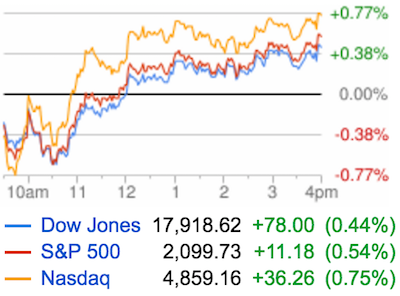
As you can see above, The US markets started their trading day with red on the scorecard but then did an about turn thanks to some better than expected manufacturing data and the release of minutes from the last FED meeting. The minutes indicated that the FED is cautious to raise rates due to the last jobs number. Do you remember what the figure was for May? The economy only added 38 000 jobs, which was a HUGE miss on, estimates and what a healthy looking job market resembles. What all of that means though is that interest rate hikes for this year have been put on the back burner. Well at least until June's jobs number comes out this Friday. There will be some revisions to the May number which might be material and we will get a look to see if the May number was a once off or not. I have seen reports saying that the data out Friday is this years most important data point, but I remember reading the same thing about the previous number just before reporting day. Make no mistake, the data out Friday will move markets but after a bit of volatility attention will move to the next 'biggest data point for the year'.


Company corner

One stock that divides people is Tesla, mostly because either you think the company is worth holding or you think it is vastly over valued and you should short it with all you have. They have been getting a large amount of press recently because of their autopilot function in the car where one of the drivers died in May and then a number of other accidents have surfaced in the media since then (none resulting in a death though). These two articles capture most of the aspects in the debate (Tesla's Autopilot Vexes Some Drivers, Even Its Fans and Tesla blasts Fortune reports about fatal crash of Model S on autopilot).

I think the media is blowing this out of proportion, something going wrong at a company that many people know and love sell newspapers I suppose. Byron made the point yesterday, imagine if there was a news article and company statement every time someone was killed in a Toyota? As Tesla points out, there has been one death in the car in over 130 million hours driven on autopilot, much much safer than normal cars. If the truck that turned in front of the Tesla, resulting in the death, had an autopilot mode the accident probably would have been avoided. Basically as the number of self driving cars increase, the safer the roads will become and the more data is collected to improve the current systems. Tesla's autopilot system is collecting data which will make it possible to have fully autonomous vehicles on the road. A win for humanity.


Linkfest, lap it up

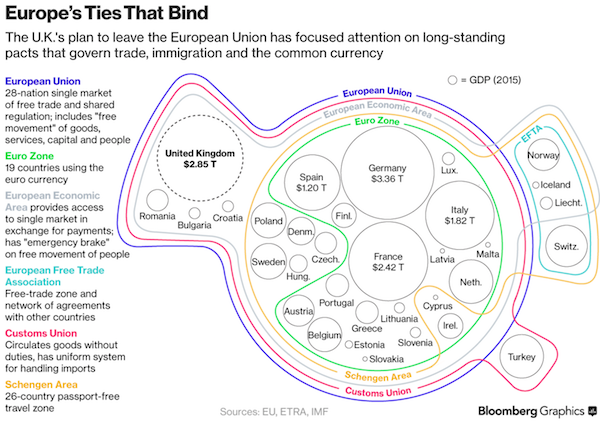
If you are wondering why a Brexit will takes years to hammer out, have a look at the complex web of relationships in the area - QuickTake Q&A: How U.K. and Europe Might Relate After Breakup. How many voters understand this relationship? Also what outcome was envisaged by the out camp?


It is no surprise that robots are being built to take over very repetitive jobs. I'm sure that in developed markets where labour is more expensive you will in the not too distant future place an order on a computer and then have a robot in the back prepare your order and only have one person around to make sure the system functions - This robot-powered burger joint could put fast food workers out of a job


Home again, home again, jiggety-jog. Our market is off to a great start this morning, up over 1% being lead by resources. The Rand is also catching a bid this morning, stringing to the USD.


Sent to you by Sasha, Michael and Byron on behalf of team Vestact.

Email us

Follow Sasha, Michael, Byron, Bright and Paul on Twitter

078 533 1063
Wednesday, 6 July 2016

Clooney is not Rooney


"And all the while the George Clooney lookalike will be forced to act quickly, whilst Italian banks look like they are on their wobbly walking stick that needs some sticky tape. Rooney is home early to get his Irish passport (he could if he wanted to), Clooney has no time to enjoy a Nespresso with Jack Black (with Lake Geneva in the background, I think) and the mantra might well be from Carney just 'What Else?' rather than 'double what else?'"


To market to market to buy a fat pig Do you know the Bank of England Governor? He is nicknamed George Clooney by the market masses, he does have that look about him. He is actually Mark Carney, a Canadian fellow with a pretty quick marathon time and the first non-Englishman to run the joint in their history. A brief history by English standards of course, Stonehenge and all that. Having said that, a little snooping reveals that the Bank of England is actually the second oldest modern reserve bank in the world and eighth oldest out of all banks. It is only recently an independent public organisation, that change taking place back in 1998. Carney is, according to Wikipedia, going to serve a 5 year term (he is three years in) and will then seek UK citizenship in order to complete the balance of a normal term, 8 years.

Another bank is in the news, this one being the Banca Monte dei Paschi di Siena (or just Monte Paschi), which also happens to be the oldest surviving bank in the world, founded way back in 1492 when the idea of a helicopter was being formed, by a strange resident of Florence, Leonardo da Vinci. Leonardo to his friends. I have actually seen a "branch", in a little town I drove through on a Sunday afternoon in Tuscany, without having to use the wayback machine (the one from Mr. Peabody and Sherman). Why then is Monte Paschi in the news? It turns out that, if you read the Bloomberg artifice, that Italy Considers Capital Injection in Monte Paschi.

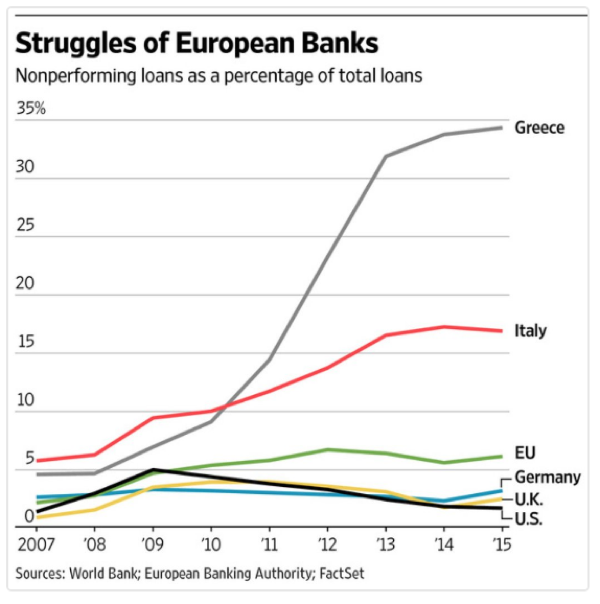
Why? Italian banks are looking shaky, a rise in non-performing loans. The number of impaired loans have risen fourfold since the financial crisis. As much as around 16 percent of all loans outstanding. Phew. In Greece it is higher at nearly 35 percent. These two sick old Mediterranean empires of yesteryear have the most fragile of all the banking systems in Europe. Italian banks are old school (real old school) and have been struggling in an environment where interest rates are so low, and the economy so sluggish. They don't have other businesses like asset management and investment banking, it really is old school (or old skool if you are a RocoMamas fan). So when there is a crisis of confidence, as there has been with the "Brexit" event, the weak areas close to home are exposed. When the ground rumbles, the weakest walls are exposed.

Not only is there the Brexit event to deal with for the people of Europe, there is now a borderline crisis in the Italian Banking system, some could argue that it has been there all along. The banking system has been recapitalised twice, a third time is not seen by the masses favourably. And with a pending constitutional reform referendum in October, this may not be the best of timing. According to the Borsa Italiana website, the bank employs over 28 thousand souls and has a customer base of 5.6 million, as well as 215 billion Euros in assets. Time to split up and bad bank/good bank it, you think? Yesterday the stock fell nearly 20 percent, for those holding the company since the financial crisis, it has nearly gone to zero, down 99 percent and some change. Bloomberg has it as from January 2008 to present as being down 99.52 percent. Sis. A fellow by the name of Tommy Campbell tweeted this not so good looking graph via the WSJ -


So what does the George Clooney lookalike suddenly have to do with an ancient Italian bank, that possibly needs to update their reality, and how does this all fit into one discussion? Call it post Brexit blues, call it post the event remorse, call it unintended consequences. At the same time as Governor Carney was speaking yesterday, warning that there would be a slower economy, a tougher outlook, there were stories starting to emerge that several property funds in the UK were unlikely to pay out any time soon. It may not be "big", it is 11.9 billion Dollars in assets that have seen withdrawals by investors "frozen". A suspension in trading of three commercial property funds which tally the above amount will spook Mr. Market without a doubt. The three parties are M&G Investments, Aviva Investors and Standard Life Investments, all of whom have paused redemptions. Mark this down as "unintended consequences".

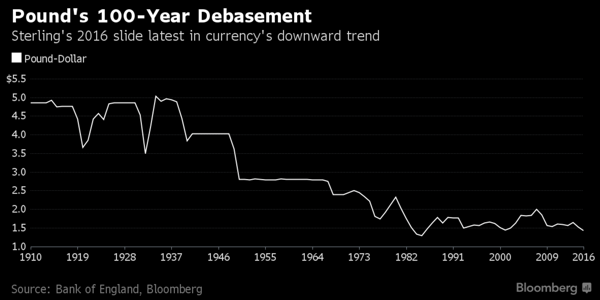
And whilst a Canadian tries to put on a brave face (not too dissimilar to a brave Italian fellow, by the name of Draghi) and suggest that he will also do whatever it takes, you get the sense that the stink left by uncertainty and the complete absence of political leaders is sending pound based assets into the bogger. And the Pound too, which sank to levels last seen pre-internet. To the Dollar that is, levels now sit at a 31 year low. Bloomberg actually has an incredible graph, titled the Pound's 100 year debasement -


I am not too sure where on the chart, should you have removed the Great from the Great British Pound? The fact of the matter is, that in terms of recorded history, the empire has lost economic prowess to the fellows from over the Atlantic. And more recently back to the East. The moral of the story is that great grandpapa should have sold his Pounds, bought Dollars and invested in General Electric 100 years ago. He should have reinvested the generous dividends over the years and now you would spend your days wondering about whether or not you should go watch Wimbledon tomorrow, or the test cricket at Lords in a week or so. Remembering that the Dollars you have now are a whole lot more in Pound terms.

So a stable income trust, which is getting redemption requests and unable to meet liquidity, casting negative ructions across the whole commercial real estate across the UK. Which may mean some distressed sellers. Domestic investors "brexiting" themselves, looking for other assets, which may lead to a further down on property prices. They (the commercial property funds) can lever up and match the redemptions, the main problem will arise in when the value of the properties itself is worth less, the banks may be loathe to lend the investors more. Cycle complete means investors want out in a hurry. Ooops, didn't see that coming now, did you Nigel and Boris? And apparently Liz Hurley and Ian Botham. The value of your assets, at a global level, are worth less. Put this in the drawer of unintended consequences.


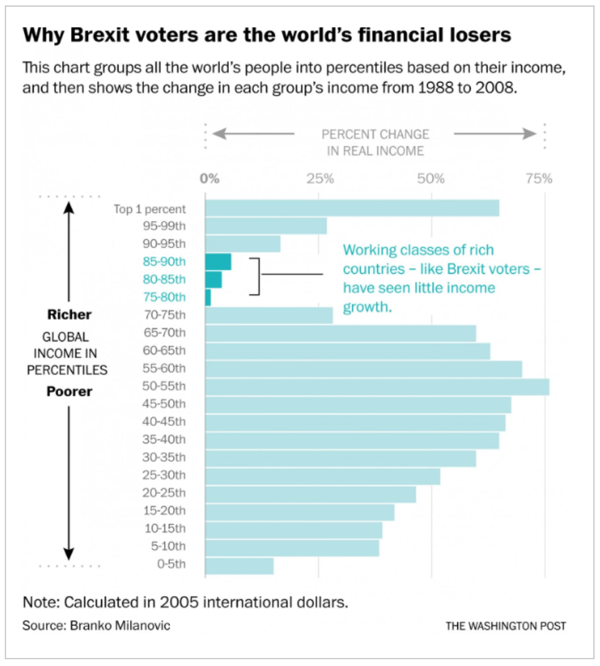
By no means worthless, I am pretty sure that if Britain is open for business, as they continue to suggest that they are (hints of dropping the corporate tax rate to 15 percent), there are many people across the globe who would salivate at the prospects of cheaper assets in what is still a big economy. I am pretty sure that there are some Chinese investors who want assets in the UK, Nigel or no Nigel and his bigotry. Money has no colour. Sorry, money is only one colour, and that is green. Lastly, remember last week when I was trying to explain why older people in the UK had voted so spectacularly for a Brexit, and had seen a table of a lack of income growth. I found it!!! By jove, here it is, actually via a positive story Twitter account and website, called Human Progress - Globalization's So-Called Winners and Losers, via the Washington Post -


What this graph shows is that the old school rich people of the developed world, by global standards that is, have not been winning as much as top of the pile people, lower middle income and low income groups over the last 30 years. The big winners globally have been class upliftment out of relative poverty. And of course those darn pesky rich people. Slippage in the world economic order has meant that old school European banking and old school wealth in the UK is being left in the dust. It doesn't meant that there hasn't been global progress. Focus and attention is always directed towards misery, less so to stories of innovation and upliftment that happens over decades (as the graph above tells you).

Whilst as shareholders of businesses are trying to make progress globally across multiple territories, we can't and will never expect a smooth ride, these types of events come along every so often. The trick is to say that whilst the value of the assets on paper may be marked down by Mr. Market, and that feels incredibly bad at the time, stay the course inside of the quality. Make sure that you "do nothing", don't get spooked and stay invested. If anything, look for bargains. And all the while the George Clooney lookalike will be forced to act quickly, whilst Italian banks look like they are on their wobbly walking stick that needs some sticky tape. Rooney is home early to get his Irish passport (he could if he wanted to), Clooney has no time to enjoy a Nespresso with Jack Black (with Lake Geneva in the background, I think) and the mantra might well be from Carney just "What Else?" rather than "double what else?"


Quick scoreboard check. Local was not so lekker yesterday, stocks in Jozi, Jozi were impacted by the continued anxieties across the globe in the Brexit fallout, we ended the day down one point five percent, financials and resources both down over two percent, in fact as a collective both indices were down 2.16 percent apiece. Unusual, like the Bryan brother twins, left and right handed combination. Except in this case Bob and Mike (Bryan) come from the same mother, investors and industry participants in mining and finance live separate worlds altogether. Shares making twelve month lows with the falling Pound were Capital and Counties (down over four and a half percent) and Intu (down nearly six percent). Remember that these two stocks used to be the Liberty International properties combined. Oh, and the Rand to the Pound? Nearly 19 Rands flat. You may well be able to afford that cup of coffee when you stop over at Heathrow on your way somewhere!

Across the seas and far away in New York, New York, stocks lost a fair amount on the day, off the worst levels though. Blue chips, in the form of the Dow Jones, dropped just over three-fifths, the broader market lost just over two-thirds of a percent, whilst the nerds of NASDAQ were beaten a little lower than that, down just over four-fifths. Energy and basic materials sold off heavily, the oil price sank heavily. In part as a result of the US letting everyone else know that they had larger reserves than Saudi or Russia. According to a new study. The report was highlighted in the FT and was produced by a Norwegian consulting group, Rystad Energy. See the Bloomberg story - U.S. Holds More Oil Than Saudi Arabia or Russia, Rystad Energy Says.

Is this good or bad news for Elon Musk and Tesla? The higher the supply of oil, the lower the price, the less receptive people are to adopting alternate energy / future technology. How far has social consciousness already shifted? The move is already afoot and as a result, the cost of Solar energy has been driven markedly lower. And simple economics will dictate ultimately that the cheaper solar storage gets (it will happen), it will cause consumers to adopt cheaper technologies. It would then mean that the dreams of Musk actually comes true, to be independent of fossil fuels. The other argument is just as valid. The greater the reserves and the greater the abundance of fossil fuels (as is the case) the less likely there is to be a rush to renewables, unless you are richer and happy to pay a premium for the green technology. I suspect we are in-between the two scenarios currently. An unstoppable renewables generation is afoot. As is motor vehicle adoption and new consumers. Check back in five years! Musk will be right is my best guess.


Linkfest, lap it up

As the globe gets richer, more money can be spent on things like space exploration. This telescope looks very impressive - China has built a radio telescope the size of 30 soccer fields


Very interesting to see the solutions that we come up with for some of our pressing global issues - How Vertical Farming Works. Vertical farms address the issue of having to bring food to cities (costly) from far off and depending on their setup can be more environmentally friendly. Going forward, people will make the farms even more efficient and find ways to lower the start up costs.

When I think of Guyana, I think of cricket not oil. That may be changing though - With Second Big Oil Discovery, Exxon Puts Guyana On The Map. Back to our discussion above, more oil means lower prices and more big 'trucks' being bought


Home again, home again, jiggety-jog. Stocks are getting paddy-whacked across to the East. Although Chinese stocks in Shanghai are up just a little. Who would have thought? The Nikkei is down 1.85 percent in Japan and the Hang Seng is down one and two-thirds of a percent. Expect equity markets to continue this bumpy ride until there is some "certainty".


Sent to you by Sasha, Byron and Michael on behalf of team Vestact.

Email us

Follow Sasha, Michael, Byron, Bright and Paul on Twitter

078 533 1063
Tuesday, 5 July 2016

Harry Potter and the Evolution of Travel


"And his death would probably not be in vain, it will not stop the evolution of travel. If the trailer and the truck had seen the Tesla, and not turned, we would not be having this conversation about the safety of self driving cars. If the truck and trailer had been a self driving vehicle, it possibly would never have made the turn, seeing that the car was coming down the road (too fast or not)."


To market to market to buy a fat pig With the US closed yesterday, it felt a little weird being without a mid afternoon opening, from the financial capital of the known universe. Stocks did manage to eke out a gain here, mostly resources stocks. They are being buoyed by the idea that we are stuck with lower rates for longer. The first half of this decade is likely to be remembered as a decade when it became very hard for fixed income. Mind you, with bond yields globally in the developed world plumbing new lows, it looks OK in the short run. Some of the yields defy belief.

These are all 10 year equivalent bond yields, in other words, I give my money to that government, they pay me an annualised yield of X (paid twice a year), and then give me my money back after 10 years. The principal. That is the simplest way of explaining it. Currently, according to Bloomberg's Rates & Bonds, the US treasury yields all of 1.41 percent. In other words, I will earn between 32 and 33 Dollars (over and above the initial $100) for the duration of the time that I have invested. Germany, that is currently a negative yield, minus 0.14 percent. In other words, for securing my every Euro that I get back from the European Central Bank for a period of ten years, as it currently stands, I have to pay them 0.14 percent per 100 Euros I park there. It sounds nuts, right?

And I guess at some level it is, it is a return of capital rather than return on capital. Countries, major ones anyhow, with negative rates also include Japan and Switzerland. Over in Brazil I am afraid that the market is telling you something else, the 10 year yields 12.01 percent. India, that is a country that offers investors a yield of 7.42 percent in Rupees. Here? Our ten year equivalent yesterday saw the yield drop to 8.69 percent. It also explains why the Rand has been strong, the eternal search for yield. We have some, there are risks for sure.

What is startling however is that there are some basket case economies where investors still plug away, as long as they understand the risks involved - Venezuela Refuses to Default. Few People Seem to Understand Why. The Dollar denominated bonds of Venezuela are yielding 26 percent, they trade at less than 50 cents on the Dollar, their issue price.

The article points out that since Hugo Chavez took over 17 years ago (and the bus driver Nicholas Maduro assumed the role when Chavez died), Venezuelan bonds have returned 517 percent. Not bad! The human misery that trumps the commitment and insistence of paying bond holders makes even a hardcore capitalist like me sick. With nearly 90 percent of the country borderline starving, this may be a case of a repeat of The French Revolution. The moral choice (bond holders versus basic foodstuffs), as the Harvard economist Ricardo Hausmann points out, is odd. The country has to deal with 116 billion Dollars of debt in the next two decades (one-fifth due over the next two years), on their knees and life is a daily struggle. Thanks Socialism for destroying human fabric.

OK, so with rates lower for longer that might well mean that we could see flows in this direction and that could equally drive inflation lower. There is a lining of silver sorts in the Brexit moment, even if just for us. And many other emerging markets. Or Paris for that matter. Or Frankfurt. Those may benefit as clearing houses for Euro trades. Meanwhile, having trashed the place, all the advocates for Brexit are leaving the scene, suggesting that their job is done. Thanks for that chaps! Didn't expect that now, did you? The other reason for rallying markets over the last little while is that the expectations are for more central bank response. From the Fed and the Bank of Japan, Mr. Market's expectations are for another round of intervention.

Possibly little will be revealed in the Fed minutes from the last meeting (due for release tomorrow evening), other than the highlighting of concerns around a potential fall out from a let us exit vote in the UK. And there is also likely to be not so much impact on hiring when the next set of "jobs numbers" come out on Friday. Expect a knock on impact, if any, to be felt in the coming months.

As ever, as a private individual investing in equities, what should I do? Very little actually. If anything, these events spook markets into acting first and then trying to figure it all out much later. We are part owners of businesses. Not owners of "the stock markets". The prices of the individual securities reflect the price that the collective participants (whatever their agenda) are prepared to pay, or sell, today, based on how they see the future. You sell for one reason, you buy for one reason. Perhaps not, Bill Gates doesn't worry about balancing his portfolio now, does he?

Stand by for what will continue to be a battling through session. Until we are sure, which we will never really be, about the future. Expect humans to act irrationally, expect both exuberance and despair. Equity investing is not for the faint hearted at any point in history. Remind yourself and repeat, this is growing wealth and ownership. Doing the same thing over and over again, day after day is what makes people successful. Recognising when to act is also an art form, yet doing very little is exactly the right thing to do, very often. View yourself as an owner of a business that has a securities price attached to it, rather than an owner of a security that has a business attached to it. That mindset shift will change almost everything that you view about investing.


Company corner

Tesla has been in the news for the wrong reasons over the last few days. Firstly the mangle of the driverless vehicle not distinguishing the background of a trailer against the sky, and causing a vehicle to smash through it, killing the driver, is bad news in itself. It means that the self driving mode is not 100 percent yet. And regardless of how many minor or major accidents humans may have in their life, the fact that the self driving mode is not 100 percent safe is cause for concern. This is regardless of the fact that the driver may not have been paying attention, and may have been watching Harry Potter on his device.

Check the NYT article - Joshua Brown, Who Died in Self-Driving Accident, Tested Limits of His Tesla. The irony is that, as a lover of the product, he may well in his untimely demise have advanced driverless car technology to push to heights not seen. With every accident in aviation, there are normally improvements that we don't see as ordinary people. Science advances in the face of disasters. Amazingly, as you see in the article, a video that prevented an accident that Mr. Brown posted, to which Tesla co-founder Elon Musk tweeted the link, led Mr. Brown to say to a neighbour: "For something to catch Elon Musk's eye, I can die and go to heaven now." Wow.

And his death would probably not be in vain, it will not stop the evolution of travel. If the trailer and the truck had seen the Tesla, and not turned, we would not be having this conversation about the safety of self driving cars. If the truck and trailer had been a self driving vehicle, it possibly would never have made the turn, seeing that the car was coming down the road (too fast or not). See the same publication - Inside the Self-Driving Tesla Fatal Accident.

And then the second bit of bad news is that the last quarterly production numbers were not good. A decent enough website on all things Tesla (and electrical), Electrek, has the story - Tesla Model S deliveries hit an almost two-year low globally, but Tesla is keeping its cards close to the chest. It is not as if the demand is not there, the price and economics are possibly a deterrent at current levels, those dynamics are set to change in the coming years. Again, as we have often pointed out, don't bet against human innovation and in particular innovators like Elon Musk. He may be an egotistical obsessive stickler for detail, that may be terrible for his social life, it is excellent that humanity has people like this. He is trying to change the future. One Model S or X or 3 at a time.


Linkfest, lap it up

As we spoke about yesterday, the economy is shifting and as it shifts so do the demand and supply requirements of the labour market - College-Educated Workers Now Dominate the Labor Market

NASA's Juno spacecraft entered Jupiter's orbit yesterday to get the closest look at the planet to date - Juno

Sticking with Jupiter, have a look at how great the planet's "Northern Lights" are - NASA unveils the bewildering beauty of Jupiter's enormous polar light show

In investing and particularly trading the market can reward you for making mistakes and because money is normally the scorecard we get an overinflated view of ourself. Basically a short term successful track record can be due to just as much luck as skill - The Downside of Past Performance.


Home again, home again, jiggety-jog. Markets are selling off across the globe after the recent decent trot that we have experienced. There will be those people that will constantly be looking for reasons as to why this is happening, be mindful that many different people transacting in markets at all times means that the prices cannot stay the same. Ever. So get used to the fact that stocks can go up and down on news that may not be related to the company (and often is not) at all. The economy does not equal the market and the market does not equal the economy, you know that part too, right?


Sent to you by Sasha, Byron and Michael on behalf of team Vestact.

Email us

Follow Sasha, Michael, Byron, Bright and Paul on Twitter

078 533 1063
Monday, 4 July 2016

Sauces for Courses


"Famous Brands, relatively ungeared, i.e. not much by way of borrowings, plan to fund this through cash resources. This will fit really, really nicely into the manufacturing part of the business. Tomato paste is used in the manufacturing of their sauces. As the press release points out, they have 2600 odd restaurants across all the brands, this will fit. Perfectly. "


To market to market to buy a fat pig Markets across the seas and far away are closed, at least in the "financial capital of the universe" as the late Mark Haines used to call it. It is with amazement that I looked up how long he had been gone for, it has been over half a decade now. Markets there are closed for Independence celebrations, happy 4th, their own Brexit vote, all of 240 years ago. You will recall that piece that Michael posted last week about which jobs have declined in the US and which jobs have become more sought after - How Machines Destroy and Create Jobs.

If you follow the link to the NPR, you get a fleshed out bunch of graphs, 4 Graphs which cover how mechanisation meant less farm jobs and more blue and white collar jobs. And then how jobs like bookkeeping are less sought after, thanks in part to the office environment being automated. Excel and all the associated powerful software programs. Fewer secretaries (thanks to automated calendars and email), fewer factory workers with greater automation. Factories with no more people in them, just the ones looking after the machines. Surely there must be jobs that are growing like gangbusters? It turns out that the likes of cooks and bakers (people eat in less and less), nurses, police and firemen, doctors, barbers and beauticians, all services related jobs are growing.

The jobs that have absolutely crashed are professions like Blacksmiths (Bright even asked for a second, what is that). Carpenters, sailors, cabinetmakers and shoemakers and the like. Why? Those things have all gotten dirt cheap, as a result of globalisation, automation and continued productivity, sweating what you have a whole lot harder. Shoes made in Indonesia (or any where else) can be shipped across the globe to be sold for 50-100 Dollars. And there are many more people who can afford it than at any time in history.

People make a habit of telling you how much better "things" were back then, how stupid we are now, how disastrous this or that policy is. Being pessimistic sounds far smarter and the morbid in us all sits and takes notice, this person bearing bad news must have the secret sauce. We rubberneck when we see an accident, after all, it could happen to us. We know how safe flying is, we know that you are more likely to die from food poisoning than an airline crash. You have a greater chance of dying falling off your bed or a chair than in an airline crash. Perhaps this misses the point that the bearers of bad news always attract the headlines more than those that tell you everything is going to be OK. That is left for the health professionals and religious leaders. Bet against humanity at your own peril. Bet against human innovation at your own peril.

Scoreboard check here quickly. Markets "stateside" are closed today, Friday Wall Street closed a little higher, the Dow was up 0.11 percent (it had touched 18000 points again, for the first time since the "Brexit" vote. So it turns out that the best thing to do was nothing. See in the links below that Michael has inserted. The broader market S&P 500 is back over 2100 points, and only a percent and a half away from the all time highs now. So much for disaster, doom and gloom. The nerds of NASDAQ closed just over four-tenths of a percent better on the day, nearly 8 odd percent away from the highs though.

On the local front the story of the day was the Rand, continuing to gain momentum. Emerging market currencies and bonds were #winning as yields across the globe plunged, some to all time lows. In the search for yield, as long as you can maintain a decent enough currency hedging strategy, that is not too expensive. If you have obligations to your pension holders, they may need to be massaged lower in a world of next to no inflation (at least in the developed world). Our market closed a little over one quarter of a percent up on the day. Resources were the main drivers again!


Company corner

News from Famous Brands this morning, they are buying a tomato paste manufacturer down in the Windy City. That is Port Elizabeth to you and I. The factory was bought in liquidation, Famous Brands also points out that the facility was manufactured for a total cost of around 200 million Rand. There is a shortage of tomato paste in the country, a pretty significant one at that. The country imports between 30 to 35 thousand tons of tomato paste, the company itself is responsible for 1500-2000 tons of that. Michael asked the best question. Sitting here next to me he said, then why did the company go bankrupt? Indeed. Good question, it must have been a pretty nasty experience.

Famous Brands, relatively ungeared, i.e. not much by way of borrowings, plan to fund this through cash resources (Kevin Hedderwick was on TV this morning saying that they paid around R35 million). This will fit really, really nicely into the manufacturing part of the business. Tomato paste is used in the manufacturing of their sauces. As the press release points out, they have 2600 odd restaurants across all the brands, this will fit. Perfectly. This is not their first business down there, the company bought the Coega Cheese Factory in 2013 in PE, changing the name to the Famous Brands Fine Cheese Company (FBFCC). As Kevin Hedderwick (former CEO and now Group Strategic Advisor) reminds us, the production at that facility has grown sharply. It has taken in more than double the amount of milk since they bought it.

The new plant will provide jobs for the community, partnering with local growers of tomatoes. As Hedderwick is quoted as saying: "As soon as possible, we will actively recruit previously disadvantaged farmers in the area for our supplier network. We will also tap into our existing FBFCC farmer base to gauge their interest in this new opportunity." Good work Famous Brands, I would love to know how and why the venture did so poorly before. Expect this to continue to drive manufacturing costs for Famous Brands lower, and that is an excellent thing for all shareholders of the business.

This trend is going to continue. Food preparation and making things easier for consumers is increasingly a big investment theme. The most amazing closed WhatsApp group in the world (called the Vestact Superheroes) was discussing food trends over the weekend, with reference to this piece - Whole Foods Is Getting Killed by Aldi. Is a Millennial Grocery Chain the Fix? The conclusion from Paul was as follows: "That Whole Foods article makes me wants to buy more Starbucks, Amazon, Bidcorp and Famous Brands shares. Why bother to buy groceries? Just buy healthy prepared foods." Got that sportslovers?


Linkfest, lap it up

Like many things in life, keeping things simple is normally the best route to take - 3 Ways to Make Money in the Markets. When it comes to the markets, saying that your competitive edge when investing is "being patient", seems very boring and unglamorous.

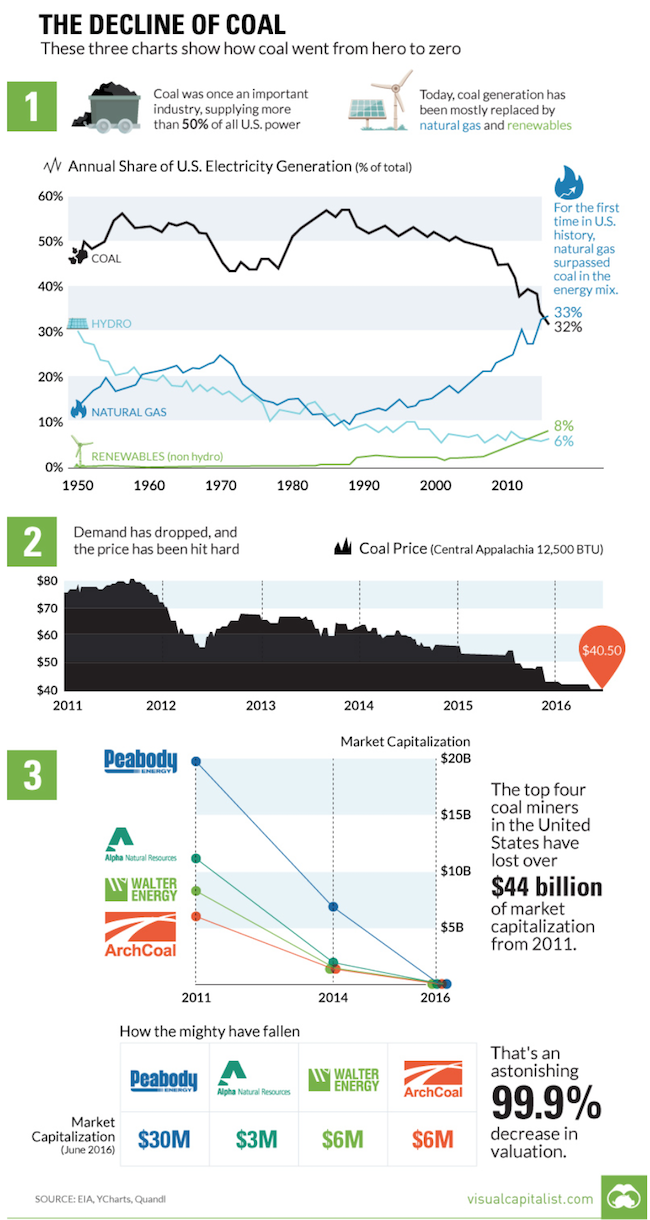
The fracking boom lead to a dramatic drop in oil prices, another commodity was also hit hard, Coal. Lower natural gas prices means that more and more people are generating energy through natural gas instead of coal - The Decline of Coal in Three Charts


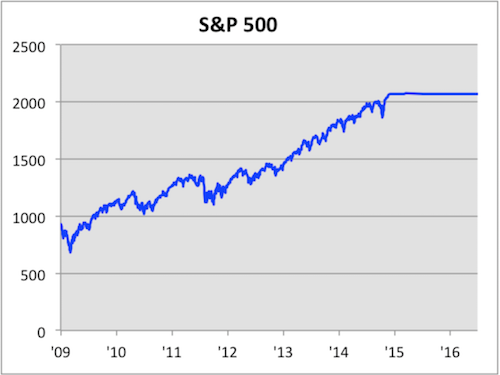
Equity markets have gone sideways since 2014, one of the only ways that you have made money over that time period has been to buy during market pullbacks - How It Looks With Partial Data. This is what the graph looks like if we ignore the temporary market corrections.


Home again, home again, jiggety-jog. It is going to be one of those very quiet days, the networks will show some rehashed magazine content. Happy 4th y'all. Australia is struggling to find a government, too many prime ministers in a short period of time. Meanwhile, markets across the rest of the world and most noticeably China (Hong Kong is actually in China) is higher. It is also a holiday in Zambia today and tomorrow. The saddest part of humanity continues to put their agendas forward, at the expense of ordinary lives that are extinguished. Sigh. And the rest of us have become conditioned to just shrug our shoulders, that might be the worst part of it.


Sent to you by Sasha, Byron and Michael on behalf of team Vestact.

Email us

Follow Sasha, Michael, Byron, Bright and Paul on Twitter

078 533 1063