Showing posts with label Gold. Show all posts

Tuesday, 5 September 2017

Self-made Wealth


To market to market to buy a fat pig. There has been a tussle at the top of the globe's rich list, the top spot has changed a number of times over the last month. First with Jeff Bezos briefly dethroning Bill Gates and then Amancio Ortega also briefly dethroning Gates.

Having a look at the Bloomberg Billionaires Index this morning, I decided to see who how far down the list you needed to go until you reached the first person who inherited their wealth. In days gone by, you didn't have to go too far down to reach the Walton siblings who inherited the Walmart empire. Today though you need to go all the way down to number 15 in the form of Liliane Bettencourt who inherited the L'Oreal empire.
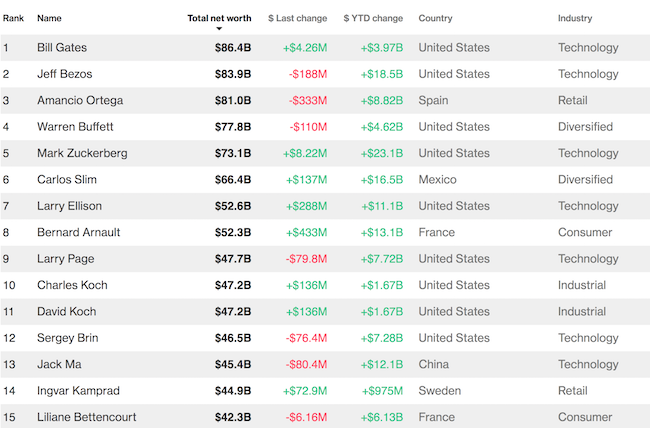


You could argue that the Koch brothers and Bernard Arnault, inherited a few million so they shouldn't be considered self-made. Turning millions into billions is no small task though. Also, neither of them took the money/ businesses they inherited and did nothing, they set to work expanding operators, making things efficient and most importantly creating value. So I am happy to keep them in the self-made column.

Over the last couple of years, partly due to middle-class stagnation, it is an increasing topic of conversation to bemoan the NAVs of the world's richest people. If you have a look at the below pyramid, you can see why the natural reaction is to be shocked by wealth inequality. If you are reading this, there is a good chance you are in the top 25% globally, do you feel you earn too much and some of your wealth should be distributed to the other 75%? The next question would be, how do you then distribute that wealth to the poor? The how part is a highly emotive subject and in truth society hasn't really found a solution.
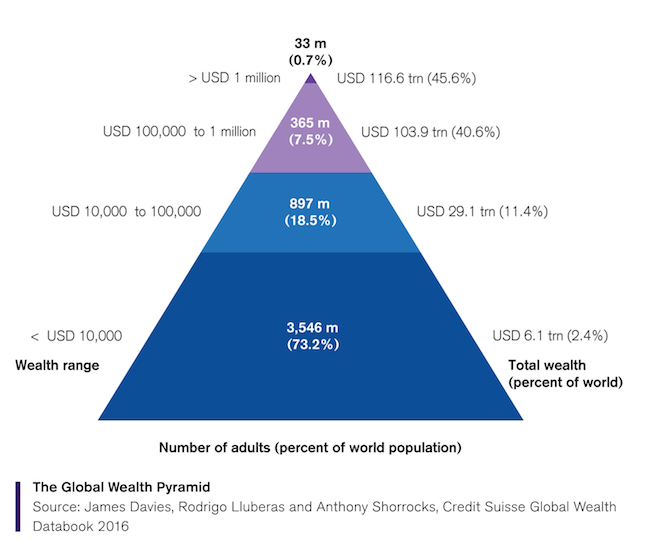


How much value has Gates created for society through MS Office and then his efforts to eradicate polio (which is on track to be eradicated by 2020)? How much value has Bezos created by allowing consumers to find products cheaper on Amazon than anywhere else? How much value has Ortega created through Zara's affordable fast fashion? These guys do have a large portion of the globe's wealth but how much poorer would the globe be without their innovations? A paraphrase of Buffett, as a society we know the best way to create wealth but we don't yet know the best way to distribute that wealth.


A quick look at our market yesterday. Thanks to the tensions on the Korean peninsula our market, along with global markets, stayed in the red all day to close down 0.34%. As you can imagine, in the current 'risk-off' environment, gold mining companies have done well. Yesterday the gold mining index was up 4.6% and the platinum mining index was up 1.6%. Having a look at how the gold miners have done over a 12-month period, I was surprised to see how much they are down. AngloGold was up 5.2% yesterday, is down 9.8% since the start of the year and down 43% since last year this time. Looking back a bit further, the stock is down 47% over a 5-year period and over 10-years it is down 51%.

Over the last 10-years, the stock didn't just gradually drift lower to close down 51% for the period, it has been up and down. Let's assume you bought AngloGold shares, 10-years ago today. Looking at the graph, you were up for the start of 2008 and then gold mining stocks crashed with the rest of the market, yes they went down when the 'world was ending', not up. Then after the Fed announced their QE program gold prices shot up and so did the mining shares, so from 2009 till the end of 2012 you were up. Only in the middle of 2016 were your AngloGold shares higher than their September 2007 price again, but since then the share price has gone from R30 and has slumped more than 50% to be around the R14 mark today. Those moves characterize owning commodity companies, they move in cycles, which makes the ride very bumpy and makes your purchase timing very important.

Looking at the graph it may seem easy, with the benefit of hindsight, when to buy and sell. Remember though that when the share price was at its top, the future looked bright for gold and even brighter for the miners. Conversely, when the share price was at its lows, gold miners were going to go out of business and the gold price was going to drop because the Fed was going to raise rates. It is for that reason we avoid commodity companies for clients, too volatile and generally no long term growth.


Linkfest, lap it up

One thing, from Paul

I'm turning 51 in December, so I'm coming to terms with the idea that I won't live forever. Sad!

So I've found myself clicking on more links about keeping ones life in order. This blog post struck me as a good reference. It lists the four estate planning documents you need to get on file, regardless of your age, health, or wealth - Key Estate Planning Documents

Spoiler: the four are a durable power of attorney for when you lose your marbles, a letter setting out your medical directives once you are on your last legs, a will (of course), and a more general letter of instruction.


Bright's Banter

Your favourite song by Luis Fonsi and Daddy Yankee "Despacito" is the most-watched YouTube music video ever (sorry Gangnum Style). The skeptics say it could've made so much money had people listened to it on a different platform. YouTube's rate is $0.0007 cent per play, Fonsi and his team made a pedestrian $3.2million from its 2.7billion YouTube views compared to $38.6million approximately if it were on Spotify alone with a similar hit rate, and thats nothing compared to a potential of $193million in iTunes sales if it were exclusively on iTunes and the track went for $1.29 - Descpacito Could Have Made So Much More Money If It Weren't On YouTube

How can anyone consider cryptocurrencies to be safe haven assets (as an accountant I hate to even use the term asset when describing these alternative currencies) when the price of Bitcoin got pummeled over the last few days? Gold, Yen and other major currencies actually outpaced Bitcoin in the latest bout of global tension - Bitcoin Fails As A Haven Amid Fears Of Nuclear Conflict Between US And North Korea


Home again, home again, jiggety-jog. Despite Asian markets being in the red this morning, our market has opened in the green. As geopolitical tensions subside, gold and platinum prices have also dropped, pulling the precious metal miners down with them. Then later today 2Q GDP number is released by Stas SA, the forecast is for South Africa to be back in growth mode, leaving the short recession behind.


Sent to you by Team Vestact.

Email us

Follow Michael, Byron, Bright and Paul on Twitter

078 533 1063

Thursday, 29 June 2017

Bank on not stressing

"Across the oceans vast and wide, stocks were better on the session, in particular a large bounce back by technology counters. Apple, Alphabet Facebook and Amazon all led the charge, in the end the nerds of NASDAQ closed 1.43 percent better. The broader market S&P 500 added nearly nine-tenths of a percent, whilst the Dow Industrial Average managed to tack on around two-thirds of a percent by the close. The biggest news of the day was however amongst the financial stocks."


To market to market to buy a fat pig The wireless led with the main story that AngloGold Ashanti was to restructure their South African operations and in particular their loss making operations, and unfortunately that may lead to over 8500 jobs being lost. In South Africa mining jobs feed many mouths. Many. The repercussions are to be felt far and wide. Read -> AngloGold Ashanti to restructure South African Operations to ensure their viability. That is one in four jobs in their South African operations.

When you read the report, it is very easy to see why this is the case, the two operations are operating at costs far above the current gold price - "The cost performance of certain operations, notably TauTona and Kopanang, has been a clear demonstration of these challenges, with all-in sustaining costs in the first-quarter of this year of $1,737/oz and $2,399/oz respectively. This compared with an average gold price over that period of $1,216/oz. Both mines also sustained significant operating losses through 2016."

Whilst it is a bitter pill to swallow for all and sundry, if there is no action on the part of the company, then it is likely that all of the operations are put at risk. It is the stark truth, mining and energy assets have a timeline to them. Once the assets are mined out and sold onwards, then I am afraid you cannot make any more. The rock and land we sit on, that has produced vast sums of gold, is over three billion years old, according to science. According to science, there were no fish back then, forget dinosaurs! Single cell organisms back then. Back to the point, the mines are out of their productive phase and hold no more extractable profitable ounces. As such, in order to keep the rest of the business around, these mines have to be shut.

AngloGold Ashanti sold off, down 4.29 percent by the close and now at the lowest point (nearly) in the last 12 months. Sadly for shareholders, the Rand return in the last ten years has been minus 50 percent, if you bought in the middle of 2007, you would still have to double your money from here to break even. In Dollar terms, the ADR in New York is down 74 percent. In Dollar terms, the stock needs to go up 284 percent to break even. It really is a sad state of affairs and another reminder that anyone who thinks mining is easy and these businesses are worth "billions" are misguided, if not just plain delusional.

As for the rest of the market, collective the Jozi All share index was up around one-third of a percent by the close, the rest of the resources complex was up nearly a percent by the close. Industrials were off a smidgen, most of the heavy lifting outside of the resources complex was being made in the financial sector, up over four-fifths of a percent by the close. South32, Mediclinic and Bidcorp were all in the winners column, the last two being lifted by some positive commentary by the Bank of England governor, Mark Carney. Rates may go up, he said, giving a slight boost to the Pound, and in return, all the businesses listed here with a UK bias. In the negative column was a mixed bunch, Tiger Brands, Woolies, Amplats and Naspers, along with AngloGold Ashanti.

There were new 12 month lows for the likes of Omnia (poorly received results earlier in the week), Pioneer Foods and Spur Corporation, as well as housing group Balwin and "miner" Pallinghurst. In the positive, and trading at 12 month highs, were the likes of Capitec and a handful of others, go figure there!


Across the oceans vast and wide, stocks were better on the session, in particular a large bounce back by technology counters. Apple, Alphabet Facebook and Amazon all led the charge, in the end the nerds of NASDAQ closed 1.43 percent better. The broader market S&P 500 added nearly nine-tenths of a percent, whilst the Dow Industrial Average managed to tack on around two-thirds of a percent by the close. The biggest news of the day was however amongst the financial stocks.

This comes hot on the heels of Janet Yellen suggesting that we wouldn't have another financial crisis in our lifetime. To which I turned to Bright and asked him, Janet Yellen is 70 and he is 25, does she mean his life or her life? Which one? Check it out - Banks 'very much stronger'; another financial crisis not likely 'in our lifetime'. I am not going to agree with her, there is always a crisis beyond your control which is being cooked up right now. Something that is going to take us all by surprise, yet be completely obvious all of the time.

A pass is a pass, and in this case this is hurrah for owners and shareholders of banks and financials. I am talking about the latest stress tests and the results released by the Fed, many banks have increased their payouts (i.e. their dividends) immediately. In fact, this means that the banks in the US are on balance well capitalised and that they can proceed with buying back shares and paying extra capital out to their shareholders. See the release - Federal Reserve releases results of Comprehensive Capital Analysis and Review (CCAR).

This has been a long time coming, as many of the headlines suggest though, the payouts are quite high - Banks Unleash Surprisingly Big Payouts After Fed's Stress Tests. The upshot of it all is that bank dividends are going to be higher, and buybacks are going to be stoked by shareholders looking for superior returns in a low rate environment. We hold the most conservative of the bunch, Wells Fargo, and as on cue with their nature, the dividend was increased by three percent, hardly a kings ransom.


Linkfest! Lap it up

Cash is still king in most parts of the globe. Key to that is the ATM, which turned 50 this year - World's first ATM machine turns to gold on 50th birthday. Fast forward another 50 years will the ATM be a thing of the past?

TV content providers are still trying to figure out how to set up their business model so that they can give content to people over the internet but not cannibalise their current products - NBC has a new sports streaming service, but it's kind of a mess for fans. This NBC product offering still seems to miss the mark, who wants to watch delayed sport? Sport needs to be live!

Two numbers here that are too big to get your head around, from Apple. From the post of Asymco - Defining the 21st Century: "1,162,796,000 iPhones sold (to end of March 2017) and $742,912,000,000 in revenues. $1 trillion will be reached in less than 18 months." Simply mind blowing.


Home again, home again, jiggety-jog. It looks like the rest of global markets like the fact that US banks are all "fine", Europe, not so much. They may plod through it for the next few years, I am not too sure that the political will exists to reform and restructure there. It is the European way! Hopefully we will start a little better here today, as a result of this "good news".


Sent to you by Sasha, Byron and Michael on behalf of team Vestact.

Email us

Follow Sasha, Michael, Byron, Bright and Paul on Twitter

078 533 1063

Sunday, 18 December 2016

Drones and moans

"We are down 50 percent to the Dollar in ten years, the Brazilian Real is down nearly 37 percent and they have had their fair share of problems when it comes to politics and their economy. India, being less reliant on commodity exports (in fact as an importer they hope for weaker prices), have weakened by 34 percent to the US Dollar over the last decade. The Russian Rouble? Well, there is one worse than us, down 57 and a half percent over the last ten years. Dollar to the Yen? Flat over ten years."


To market to market to buy a fat pig We closed up shop Thursday with another almighty emerging market sell off, stocks here in Jozi were down over two percent by the time the bell rung time to go home for the long weekend. Concerns about the interest rate differential, money flowing and trying to get the "right" mix between risk and return. In other words, a yield in an emerging market becomes less attractive as rates in the US go higher. With a stronger Dollar, last week the greenback reached a 14 year high to the basket of currencies. Parity to the Euro? Perhaps likely in the coming months as more rate rises in the US become reality and not possibility.

That is also bad for gold, a stronger US Dollar, the price of the shiny metal has been under pressure. I noticed that GoldFields was trading at a 52 week low, down nearly 45 percent from three months ago, the Gold price is down nearly 12 percent in Dollar terms since then. The Gold mining index as a collective is down nearly 42 percent. That is incredible, the pattern is almost exactly the same as last year. Gold stocks were out of the blocks in a hurry and being up over 100 percent for the year at one stage, in early August. Those stocks were the most beaten down Thursday (in Jozi), off over eight and a half percent by the end with nearly ten percent losses for Harmony and GoldFields.

It may be a little more "even" today, the gold price has stopped tumbling as a result of the Dollar giving a little back. As a result of tensions around an underwater drone belonging to the US that was captured by the Chinese late Friday, the Chinese have vowed to return it. The upshot was a Dollar that found itself weaker from before, oil price up, gold price a little firmer is the result there. To end off with, to show that whilst there are ups and downs and extreme volatility, it is just too hard to call. Over the last ten years the gold mining index has returned minus 60 percent. About exactly the same return (minus 60) over the last five years. If you were able to call it twice, you can seemingly make a lot of money in the ups and downs.

So, the Dollar is trading at levels last seen 14 years ago, the Rand to the Greenback has had their fair share of volatility this year, politics and all. A year on from the three roll finance ministers in a week, the Rand is around 7 percent stronger to the US Dollar. Here is an interesting one for you. Over the last ten years, the Jozi All Share index has doubled, up 103 percent. Over the last ten years, the Rand has gone from 7 to 14 to the US Dollar, you do not need to be a genius to work out that the value of your Randelas has halved to the Greenback. Admittedly the US Dollar is trading at the best levels in 14 years and South Africa has much higher inflation, so perhaps it is not too bad over that time.

How do we stack up against some of the others? We are down 50 percent to the Dollar in ten years, the Brazilian Real is down nearly 37 percent and they have had their fair share of problems when it comes to politics and their economy. India, being less reliant on commodity exports (in fact as an importer they hope for weaker prices), have weakened by 34 percent to the US Dollar over the last decade. The Russian Rouble? Well, there is one worse than us, down 57 and a half percent over the last ten years. Dollar to the Yen? Flat over ten years. The Dollar is 25 percent stronger the Euro over that time period, ten years ago the "mark" was 1.30 Dollars to the Euro, in the summer of 2008 we were staring at a number of around 1.60. Today, this morning, the rate is below 1.05. Over 15 years ago, just after the dotcom era, in October of 2000 less than 83 US cents bought a Euro. So you see, currencies do halve and go all the way back, even amongst the majors.


Stocks across the oceans and far away have had two trading sessions since we closed up shop, an assault by the Santa rally chaps on Dow 20 thousand has fallen flat twice. I guess it is just a matter of time before we reach those lofty levels. Seeing as the Dow Jones clocked 10 thousand in early 1999, 20 thousand a double in nearly two decades hardly sounds like a compelling return to me, now does it? Nope. So, whilst there are some who get all anxious about levels and stock prices, I don't. There is always that niggling feeling that history provides us with periods where markets didn't reach previous records for decades, the S&P 500 took around 25 years to get from the pre Great Depression stock index levels, back to those levels, 1929 to 1954.

At session end energy and utility stocks both gained, as did healthcare and non-cyclical consumer goods (food and the essentials, apparently cigarettes, soda and beer fit the bill too for that index), whilst the laggards were basic materials and technology, Oracle lost over four percent on the session, a wonderful performance from their cloud computing division in results, Mr. Market, as always was looking for more. Hardware sales inline with their peers was lower, as were software sales. Whilst we are on the business of ten year returns, Oracle stock has returned 121 percent to their shareholders over that time. And like some of the more mature types, like Cisco, Oracle have started paying dividends in 2009. It almost became "time", as a tennis chair umpire would say. Would Djoko still sit in the chair though?

Financials were also amongst the losers, perhaps some tapering off post the Trump rally which has seen Goldman Sachs rally over 20 percent since the Trumpster fell inline to be the next president of the US. Over ten years? Goldman Sachs stock is up just 19 percent. The S&P 500 is up 60 percent. Owning the Street's smartest minds has delivered a positively mild return, most of that has come in the last 40 days. Again, as is always the case, it depends where you draw the line in the sand.


Linkfest, lap it up

Uber certainly has changed the way that we commute in the modern world, on demand transport goes along with on demand streaming services, an app to tell you when to eat, what to eat, the weather and so on. It is hard to believe that Uber would just be of school going age. Yet, as this article points out, they are just getting started. It makes sense, in the end it depends on pricing point, simple economics. What the consumer is willing to pay - Uber wants to take over public transit, one small town at a time.

I made a comment that I had been on Twitter for a number of years now and that I was used to fake news all of the time. People on Facebook are just catching up now. You need to be able to filter, think carefully and then make comments as you see fit. Barry Ritholtz points out that the market has been strewn with fake news - Napoleon Is Dead! Wait. That's a Stock-Market Scam.

Private equity is misunderstood I think, it is a little more complex than buy with leverage, rip the cash and sweat the assets harder, ramp up debt and then list again on a higher valuation when the market is hungry again. Surely not as simple as that, Edgars is a good example of how that could all go wrong, although you could definitely argue about the timing of the purchase. This New York Times article from a week and a bit back (such old news) shows that the execs over in PE are far richer than their normal run of the mill investment banking friends, of course it is all relative - How the Twinkie Made the Superrich Even Richer


Home again, home again, jiggety-jog. Stocks across Asia are lower on account of . The futures market indicates that both Europe and the US are likely to open marginally better, of course there is loads of wriggle room between now and then. Did you see that day/night test match end in a tight for Australia, what an advert for test cricket. Can you imagine a day night match at Newlands as the sun sets. Glorious, bring it on! And the Titans, from just up the drag are the T20 champs, sorry PE.


Sent to you by Sasha, Byron and Michael on behalf of team Vestact.

Email us

Follow Sasha, Michael, Byron, Bright and Paul on Twitter

078 533 1063

Friday, 8 July 2016

Going for Gold


"Conclusion, you don't want all your assets sitting in one country and one economic sector. Buying gold as insurance for the dips, covering yourself for that once or twice event every decade, it is like buying insurance for a car that repairs itself (stock prices do recover after dropping)."


To market to market to buy a fat pig A better day for stocks yesterday, with Aspen finishing up 3.3% breaking the R380 a share mark for the first time in over a year. On the red side of the scales were gold stocks, that index down a little over 3% for the day. WOW, the gold index has been very volatile this year. I suppose gold captures the extremes of our emotions, where the silky, warm glint of the metal plays to our greed emotion and then the 'run to safety' reaction that normally occurs when purchasing gold. Playing on our worse fears. Stronger emotions = stronger volatility. The index as a whole has done very well this year, up 146% year to date. Which is even more impressive when you consider that the TOP 40 is down 2% for the year and the ALSI is only up 0.8%.

Having a look at Anglo Gold, one of the bigger players in the index, the stock is up 176% YTD, up 81% over a 3 year period but flat over a 5 year period. When looking at the company's performance in USD, it is up 180% YTD, up 10% over 3 years but down a huge 50% over 5 years. Your views of the sector will be very influenced by when you got in and when you sold out.

I don't fully understand the allure of gold as a safe haven asset. What makes it safe? The only reason I can come up with is because other people think it is a safe haven. What happens when other people stop viewing gold as a safe haven? To get to the core of the reason we need to strip away all the layers that have been built over centuries of monetary evolution. Cash is safe until there is inflation. Often due to a government printing huge amounts to cover tax short falls, so inflation is the risk. Gold doesn't have the problem of inflation but it has the problem of storage and transport costs. Okay, so buy a gold ETF then, no transport problem and economies of scale on the storage front (safer and cheaper then storing it in a safe at home). When economic crisis hits though, will you be able to cash in the ETF? If you are able to cash in the ETF it is then paid in cash, which you were trying to avoid in the first place. Back to gold being stored at home then. Are you able to use gold to buy food and toilet paper though if things get really bad? Venezuela showed that during a crisis the value of gold doesn't hold up (Venezuela carries out $1 bln gold swap), the transaction applied around a 40% discount to the value of the gold.

What is your reason to buy gold then? Are you buying it because other people think it is a good idea? As a trader great, your job is to profit off of peoples emotions. As an investor not great. Conclusion, you don't want all your assets sitting in one country and one economic sector. Buying gold as insurance for the dips, covering yourself for that once or twice event every decade, it is like buying insurance for a car that repairs itself (stock prices do recover after dropping). Ride out the dips and if things get so bad that you need to start paying with gold, the value of your assets are the least of your problems. Buy baked beans and toilet paper instead, it is easier and safer to store at home!


New York, New York had a relatively quiet day, both the Dow and the S&P500 were down 0.1% and the NASDAQ up 0.4%. The appetiser for todays big jobs number was the initial jobless claims for last week, coming in lower than expected (this is a good thing) and then the ADP private payrolls number which came in higher than expected, so both numbers showing strength in the US job market. Non-Farm payrolls is released at 14:30 our time, an hour before the markets open in the US, giving traders some time to process the information and plan their strategy for the day. The number also has an impact on what the FED may do later this year, which is why the number has such a big impact on the market movements over the short term.


Linkfest, lap it up

As a Facebook and Naspers shareholder, you own the top six apps listed here - Facebook Inc. Dominates the Social Media Landscape. Qzone is a Chinese website which seems to be a mix between Facebook and Myspace, do you still remember that site?

Infographic: Facebook Inc. Dominates the Social Media Landscape | Statista
You will find more statistics at Statista

Live streaming sport will be on of the future revenue streams for Twitter - Twitter is live-streaming Wimbledon right now, and it's a glimpse into the company's future. I enjoyed the conversation aspect where you can see what people are saying about the match live on twitter, giving you access to some cool stats along with a lot of other useless information. They need to start somewhere and from here they will continue to improve the users experience.

As part of the Amazon value proposition to customers they offer music streaming as part of their Prime package - Why Amazon's music service has quietly become a huge hit. At some point you will probably find that Amazon spins off this segment to generate extra revenue.


Home again, home again, jiggety-jog. Our market is slightly down today, Brait continues to get pummelled down another 2% today meaning that stock is down over 15% for the week! I am starting to see more news articles about wage demands Employers and employee not seeing eye to eye on what remuneration should be again. For the sake of GDP growth lets hope that strike action is limited. GDP growth is essential to bringing down our unemployment rate.


Sent to you by Sasha, Michael and Byron on behalf of team Vestact.

Email us

Follow Sasha, Michael, Byron, Bright and Paul on Twitter

078 533 1063

Monday, 20 July 2015

Google Doodle should be Dollar Signs


"With Google soaring 16 percent plus on Friday to have a market capitalisation of 459 billion Dollars now, the NASDAQ boat was floated to the tune of 0.91 percent, the broader market S&P 500 was up 0.11 percent whilst the Dow Jones was off nearly one-fifth. It is not often that you see a day like that, when one really big company has such a marked impact. As we had pointed out on Friday however, this was a relief for all the (short) suffering Google shareholders, the stock has still underperformed the index over the last 12 months"


To market to market to buy a fat pig. The securities of Google do not appear in the Dow Jones Industrial Average, a 30 constituent price weighted index that is chosen by employees of McGraw Hill Financial. They decide what the American economy looks like and what the future is likely to look like, choosing the companies accordingly. So there is careful consideration with regards to what represents the American economy in an index of 30 shares. I guess they do a pretty good job, the rest of the market participants in stocks choose companies in the S&P 500, those companies importance and relevance on the index is based on their market capitalisation, i.e. what they are worth. If you want to find out currently which company has the biggest impact on the Dow Jones, then look here -> Sorted by % Weight in the Index. Goldman Sachs' share price is currently very important, as is IBM and 3M on the overall Dow Jones moves.

With Google soaring 16 percent plus on Friday to have a market capitalisation of 459 billion Dollars now, the NASDAQ boat was floated to the tune of 0.91 percent, the broader market S&P 500 was up 0.11 percent whilst the Dow Jones was off nearly one-fifth. It is not often that you see a day like that, when one really big company has such a marked impact. As we had pointed out on Friday however, this was a relief for all the (short) suffering Google shareholders, the stock has still underperformed the index over the last 12 months. True story. Year to date, it is one of the very best performing stocks out of the big caps.

I missed it, darn, the nerds of NASDAQ on Thursday passed their prior intraday high (5132.52 on the 10th of March 2000), settling at the close of 5210 on Friday evening. That took a decade and a half to get to!

2000. That was a while back, early 2000 saw those terrible floods in Mozambique, who will forget the pictures of the woman being airlifted, she gave birth to a child in a tree, I saw reference to the story on the web, who followed up a decade later: Baby born in tree now a 10-year-old girl. I am guessing that when she finishes school there will be more excitement, rightfully so. That just goes to show how long ago that is, if you had religiously continued to buy the NASDAQ index month after month, following the theory of Dollar cost averaging, you would have been able to buy the NASDAQ at 1139 points in October of 2002, over 2800 points in November 2007, back at 1380 points in March of 2009, it has been wild and rough, investing rather than chasing your tail (like a Jack Russell I told a I client this morning), you would have found yourself well rewarded.

Interesting fact about the Google price spike, it was the single biggest move higher in market cap for one company, ever.

For all the issues and problems of Greece and their citizens, their indebted nation and all the problems of Chinese stock investors, I do not know a single person who owns mainland listed Chinese stock, do you? And Greek stocks, do you know a person who owns those? I suspect that all the mainland European people that I know, indirectly they own European debt, Greek debt at that. What each and every Greek person advocating and pushing for debt relief must remember is that assets belong to someone else, that person will have to actually take the loss. Most of the money that Greece owes is to the European Financial Stability Facility (The EFSF), around 131 billion Euros, 53 billion to Eurozone governments, 27 billion to the ECB, with over 20 billion owed to the IMF. Other peoples money, right? And the terms given are pretty good, 2 percent bonds with maturities of as much as 30 to 40 years.

Anyhow, Greek citizens will see the banks open today, they will be able to withdraw the daily amount in one weekly amount, i.e. visit the ATM only once. Let us presume that people withdraw their amount each and every week for the whole year, 420 Euros times 52 weeks equals 21,840 Euros a year. Which at the current exchange rate of 13.46 = 294 thousand Rand. And this would be after you have serviced all of your bills, that monthly amount is 24 and a half thousand Rand. That is a rather big amount, wouldn't you say? How many South Africans would be in a position to stand in front of an ATM with capital controls and withdraw 24 thousand Rand a month? Very few. I think that the Greek government missed the best social experiment in eliminated money forever here, by encouraging everyone to use electronic methods of transferring money, thus creating a receipt on each and every transaction. No more cash, who cares, right? It may be the same pain as trying to eliminate the check in the US however. Too hard for ordinary people to wrap their heads around. M-Pesa is a necessity to those in rural East Africa who have no access to ATMs and they seem to thrive just fine, no queues for ATMs, as there are none.


Locally the market closed down one quarter of a percent, the resource stocks dragging the rest lower. Anglo American is now in the listed environment in Johannesburg worth less than Standard Bank and Sasol. Steinhoff and FirstRand are bigger. True story, the market cap of Anglo American is now 236 billion Rand, whilst seemingly the asset management community here seem to think that this is still the go-to investment. No sir. Old Mutual and Vodacom are breathing down the neck of Anglo American and if ever you needed a reminder of how the South African business landscape has changed, this was a city built on the gold mining industry, the first gold miner appears at 48th place on the market cap ranking tables. AngloGold Ashanti is roughly the same size as Truworths, smaller than Life Healthcare. And it is not just the gold companies, Amplats is now the same size as Brait, who would have thought?

The platinum price is below 1000 Dollars an ounce. 970 Dollars an ounce currently. Wow, that is completely awful. And what is more astonishing is that this is against the backdrop of European motor vehicle sales being at a five and a half year high. The gold price, all metal prices have been beaten up. The upshot of it all is that in the top 100 companies listed on the local exchange, there are 6 precious metal businesses. That is all. These are the pure gold and platinum companies, 6 apiece. I read the Harmony annual report last week after reading the news that Graham Briggs had resigned, skimmed it is a better word, that business sadly has a market cap of 6 billion Rand. The share price in New York, the ADR as quoted on Google finance goes back to October 1996, nearly 19 years worth of data shows that the stock in Dollar terms is down 86 percent since then. Simply astounding.

As per the Harmony annual report of 2014, 40 percent of costs are salaries and wages, and only 2 percent taxes and royalties. 12 percent is spent on electricity. Think about that for a second, nearly 55 percent of your costs before you have even budgeted for mine maintenance, exploration or paying a single supplier. It is more than that, I found this little pie chart on page 49 of the annual report from last year:


And to think that with the current round of wage negotiations a way away from being completed, it seems like the most costly item, labour, could increase substantially. And the current mining environment, with the much lower gold prices (at a five year low) is hardly great for the company. And their 34 thousand employees and contractors. One third of Harmony shareholders are US based, (as at June last year), 13 percent the UK and 42 percent here. As at the end of June 2014, African Rainbow Minerals owned 14.62 percent, the PIC 6.75 percent and Allan Gray 11.11 percent. Big and respected names in there. As per the Harmony annual report, another image, the all in costs from last year are as follows:


The current Gold, Rand per kg is 444,195 thousand Rand. So that yellow line is basically unchanged, if labour costs (the biggest) increase, that has a market impact here. There is a reason why we do not own these companies, I wish them all the best, it is hard at these current prices to not see something crack, and in a bad way currently. Mine shaft closures and job losses are inevitable, if the hard decisions are not taken now then it is a possibility that all "stakeholders" could end up losing here. Sigh.


Linkfest, lap it up

Where do you fit on the global income spectrum? This interesting piece will tell you and put things into perspective - Are you in the global middle class? Find out with our income calculator

The title of this article will already get people's emotions going. Either you think CEO's are paid what they deserve or you think CEO's get paid too much because of their ability to get tonnes of share options - Is a CEO really worth R28 million per year?. I think that the market is the most efficient way of allocating resources, so if demand and supply have determined the salary of a CEO, who am I to say the market has got it wrong? Rather the market allocating resources as opposed to government policies. I also think that investors need to pay closer attention to the remuneration policies of top management.

This trend seems set to continue, which will create opportunities in the advertising arena - Mid-year report: The newspaper industry's billion dollar challenge


Home again, home again, jiggety-jog. Oh no, the single commodity stocks, specifically the gold and platinum (precious metals stocks) are taking an absolute whipping. Platinum stocks down 4.5 percent and as a collective at the get go (the index) is at its lowest levels in over a decade. Better off than the gold stocks as a collective, in Rand terms down 45 percent over the last decade. The outlook is clouded, avoid. The rest of the market is OK, stocks as a collective up one third of a percent.


Sent to you by the Vestacters, Sasha, Michael, Byron and Paul.

Email us

Follow Sasha, Byron and Michael on Twitter

087 985 0939