Showing posts with label Apple. Show all posts

Wednesday, 28 February 2018

Loud and Cloud


To market to market to buy a fat pig. Chatting with many clients, most people hate buying at all-time highs. The feeling is that a correction is coming or at the very least, you have already missed the opportunity. Their proposed solution, keep your gunpowder dry and sit on cash. Ready to deploy at a moments notice, during the next correction.

Kicking off this year, markets went into correction territory; "A stock market correction is when prices fall 10 percent from the 52-week high". If you were on the sidelines, sounds like a perfect time to buy right? What happens in reality though, is that when the market is down 10%, it looks certain that the market will drop further in the coming days. Then a few days later, when things have settled and the market is only down 8%, you promise yourself that you will buy when the market gets back to being down 10%.

Yes, you guessed it. While you were worrying about how far the market will fall, the market dropped and then recovered all without you deploying a single cent. We have seen it many times, where clients have cash on hand to buy the dips, but when it comes time to buy the dip nothing happens. This Tweet from Byron sums things up nicely.
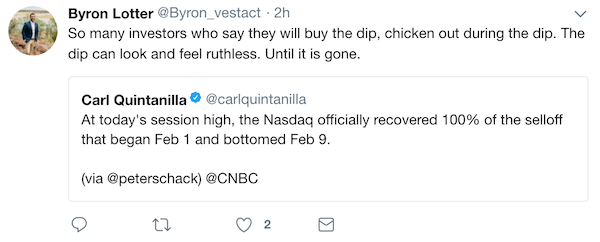


Its far easier to accept that you can't predict where the market will go tomorrow; just buy when you have long-term capital available. As the market adage goes, "It is time in the market, not timing the market".

Market Scorecard. The market didn't like what Jerome Powell had to say to Congress yesterday. The Dow was down 1.16%, the S&P 500 was down 1.27%, the Nasdaq was down 1.23%, and the All-share was up 0.27%. Unless US markets have a rip-roaring day this afternoon, February will be the first down month in 13-months! It has been good to be an equity investor.


Linkfest, lap it up

One thing, from Paul

I've heard that getting divorced can be really bad for your finances? That makes sense, since usually a couple's savings are split and immovable assets have to be sold in a hurry. Setting up two new homes can be really expensive.

The problem is, marriages seem to be ending sooner. Here's a chart which shows the percentage of people who are divorced, separated or in a second or later marriage in America in 1960, 1980 and 2016. In other words, these are people who are probably trailing a number of financial "ex-dependents". That number now peaks at over 40% of the total population.
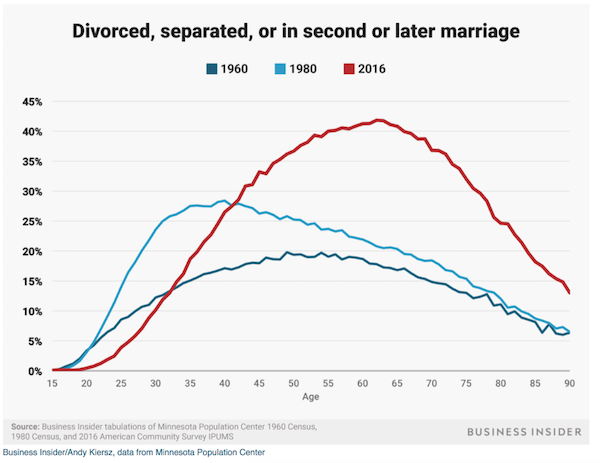


Here is a link to the the article which contains that graph:

Here's when you're probably getting divorced


Byron's Beats

Imagine the billions of photos, videos, songs and files that get stored on Apple devices. These days, not even 256GB phones can handle all this content. Then this needs to get backed-up onto a computer which duplicates the storage requirements. Step in Apple iCloud. I cannot even comprehend the amount of storage capacity iCloud requires.

I was always under the assumption that iCloud was done in-house. Apple has the capital available. But this CNBC article titled Apple confirms it uses Google's cloud for iCloud suggests that Google has secured a massive cloud storage deal with Apple. The details in the article are a little "cloudy" because these businesses tend to be secretive about their deals with each other. They are supposed to be fierce rivals after all. It seems that Amazon Web Services and Microsoft's Azure used to be the cloud providers, but Google has replaced Azure over the last two years. AWS still seems to be involved.

I recently spoke about Google's cloud business as the next big thing for the business. This is certainly a step in the right direction.


Michael's Musings

Eddy Elfenbein has a great piece this morning in his blog post called, Crossing Wall Street. He speaks about how market guru's make forecasts that they can not be held accountable for. At the start of each year there are a set of people who get wheeled in-front of the cameras to talk about all the reasons the market is going to do badly. Their claim to fame is calling the 2008 crash. As the saying goes, even a broken clock is right twice a day - "A 40% Chance"


Home again, home again, jiggety-jog. Following the path set by the West, our market is down this morning. Added to that, the idea of interest rates rising this year has resulted in a stronger Dollar, currently at $/R 11.74. International data out later today is EU CPI and then US GDP.


Sent to you by Team Vestact.

Email us

Follow Michael, Byron, Bright and Paul on Twitter

078 533 1063

Monday, 15 January 2018

Luxurious Profits


To market to market to buy a fat pig. Another day, another record for US stocks. For new investors, the current low volatility and record high moves are probably creating the wrong expectations about the risks involved in equity investing. As we wrote about last week, if you are in the equity market long enough, there will be a period where stocks go down instead of up. Despite those down periods, owning equity is still one of the best long-term investments you can make. Definitely less admin than having to check up on a tenant the whole time.

Market Scorecard. US markets were on the up thanks to strong earnings from US banks on Friday. Strong earnings point to a strong underlying economy. The Dow is up 0.89%, the S&P 500 was up 0.67%, the Nasdaq was up 0.68% and the All-share was up 0.80%.


Bright's Banter

Scott Galloway was asked how the cult of Apple developed. This is what he had to say:

So if we have our religion, Steve Jobs is our god. We no longer worship at the altar of kindness or character, but we worship the altar of innovation and shareholder value. This is the individual who's vision and genius created more shareholder value than any company in history. Which is effectively how we decide who our Jesus Christ is in a capitalist society.

The iPhone has become the new object of power. They shouldn't call it the iPhone X they should call it the iPhone Cross. It has a special place in our lives because we deem it holier than any other object in the world at this point. We take it everywhere we go. When it flashes we jump frantically to see what is going on.

Apple is a company that decided "we no longer wanna be the best house in the worst neighbourhood. Computer hardware appeals to a rational organ which is the brain; when the brain is a terrible competitor and startles all the margins. We wanna appeal to the reproductive organs which are irrational decision making organs." And as a result people will decide they wanna look cool, they wanna communicate success and innovation, and that they have good genes to mate. You end up with a business with margins somewhere between Hermes and Ferrari!

Today, the iPhone accounts for just under 20% of all the smartphones shipped globally, but it accounts for approximately 92% of the smartphone industry's profits. I am sure you're asking yourself how is this kind of dominance is possible.

Apple has pulled off the impossible in business, through a focus on appealing to our desire to be attractive to others and becoming a luxury brand. They are the first technology company to become a luxury brand that is a low-cost producer, the most popular phone in the world, outstanding supply chain since they can secure their components at the lowest price, and at the same time sell a premium priced product. No company has been able to pull this off in history. The motor vehicle equivalent would be a motor vehicle company with the margins of Ferrari and production volume of Toyota.

As a result, this quarter Apple has made double the profits that Amazon has made in its entire history. Apple will make more than the profits of the other three competitors namely Samsung, Xiomi, and Huawei combined. You'd need to get Toyota, Daimler, Unilever and P&G wrapped up in the mix before we begin talking about the profits of Apple. We really do not have the sense of the scale of what an unbelievable profit machine Apple is.

The components of a luxury brands company, is literally play for play what Apple has done. The board sat down in some room at some point and said we are a luxury brand. What do luxury brands have in common? They have an iconic founder, we have that. They have a sharp focus on artisanship and design, and we have that. They have a focus on vertical retail. Apple is much more like a Louis Vuitton store than it is a Best Buy.

And here is the genius move, the crazy irrational decision of forward integrating the stores which I think is the one decision that created more shareholder value than any other decision in the history of the business. Can you imagine Steve Jobs going to his board in the early 2000s and saying "you know I have an idea…we are doing ok but not great…I have an idea... STORES!!!" This is a time when stores were beginning their march downwards. Fast forward to today, Apple spends around $5 Billion to $6 Billion in leases on stores per annum.

Why Samsung is always behind Apple when it comes to brand equity and as a result, not generated as much in shareholder value? It is not because of their technology. Samsung has more engineers than Microsoft. Fanatics would argue that the Samsung galaxy is a better phone. It's because they do not have vertical distribution! Apple has decided to control the full experience and become a luxury brand like a Vuitton, a Bottega Veneta, or Gucci; you have to control the moment of contact with distribution.

During their product launch, Apple puts super models on stage, they put Christy Turlington! It's not a product launch, its a fashion show. They buy pages in Vogue magazine, they have literally stolen the luxury playbook and it has been the most enormously value creating decision in history. Low cost producer, premium priced product, no other business in the history of business has been able to pull this off.


Linkfest, lap it up

Byron's Beats You may have noticed that Facebook fell 4.5% on Friday. This was because Mark Zuckerberg released a post stating that Facebook would go back to basics and prioritise original posts from your friends and family as opposed to paid for content. This is probably his reaction/solution to all the fake news being created which seems to have influenced certain political outcomes.

The market's initial reaction was negative because paid for content is Facebook's bread and butter. But over the long-term, I think this is a good result. The long-term sustainability of the Facebook model is based on the user experience. Getting fed too much paid for content dilutes that.

Mark Zuckerberg Post


Michael's Musings

Are you qualified to be a 'Time Ninja' or a 'Distilled Spirits Guru'? How about a 'Security Princess' or a 'Galactic Viceroy of Research Excellence'? - Weird Job Titles: The Year in Review

If you are having a bad Monday here is something to cheer you up - LG's Built-In Voice Assistant Repeatedly Refuses To Work During Excruciating CES Demo

Steinhoff saga extends further than our shores, JPMorgan's Equity Traders Took a $143 Million Loss on a Single Client, we don't have exact details but JP Morgan confirmed the loss was tied to Steinhoff.


Home again, home again, jiggety-jog. It will probably be a slow day with US markets closed for Martin Luther King Jr day. The MPC meets this week to decide if your bond repayments will change, probably a bit soon to hope for a rate drop after rates looked to be going higher last year. Yes, the Rand has strengthened but the oil price has also increased.


Sent to you by Team Vestact.

Email us

Follow Michael, Byron, Bright and Paul on Twitter

078 533 1063
Wednesday, 15 November 2017

Even Kings Fall


To market to market to buy a fat pig. The downgrade that many people have been calling is scheduled for next week Friday, after our market closes. Having a look at our current bond yields and the currency, I'm not so sure that a downgrade is a foregone conclusion. There is no doubt that the current trajectory of our budget deficit is horrible given our anaemic growth, but if confidence returns and GDP growth spikes, our deficit situation looks very different.

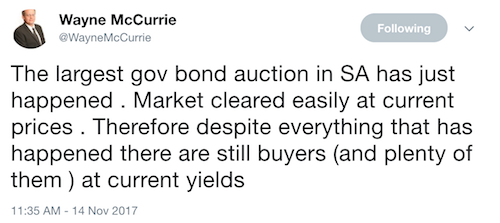
Wayne McCurrie's tweet from yesterday shows that investors still want our bonds at current levels; the yields on our bonds were much higher last year than they are currently. We were saying in the office yesterday, that our current saving grace is that global interest rates are at historical lows, meaning our risky debt attracts an interest rate of less than 10%.


Market Scorecard. GE had another painful day, down a further 6% which didn't help US markets in general. The Dow was down 0.13%, the S&P 500 was down 0.23%, the Nasdaq was down 0.29% and the All-share was down 0.51%. Brait released their 6 month numbers this morning, which seem inline with market expectations. We will have a breakdown of them tomorrow.


Company corner

Bright's Banter

Bidcorp had a markets day on Monday where the management spoke to shareholders and analysts like us and analysts get to ask management some tough questions.

The company said that trading in the first quarter has been reasonably positive in their core foodservice business. All their businesses performed well in their local currencies. Management is putting efforts to down scale in non-core, underperforming Logistics businesses in the U.K. as trading remains tough. The U.K. logistics business is not a material player in the groups overall business.

The company continues to see organic growth in the Foodservice business and opportunities for bolt-on opportunities in all their different geographies. This is on the back of increasing inflation in some of their product categories such as dairy.

In my last meeting with David Cleasby, one of the things he said was that the company will focus more on increasing the basket of goods purchased by its customers. If they can convince the customer to add more products to their basket, that becomes pure margin as the delivery truck was coming in that direction anyway. In the update the company makes reference to this point where it emphasises the fact that they have been focusing on the correct segment of the markets (growing segments I'm guessing), adding value to the clients offering through innovation and improved service delivery. This is when they use their system to help chefs improve their menus for example.

The main takeaway here is that Bidcorp bought a few businesses to expand into new territories, which is their preferred strategy. These acquisitions cost the company R608 Million in aggregate and the company expects earnings of R104 Million from these business if they continue to perform as planned.


Linkfest, lap it up

One thing, from Paul

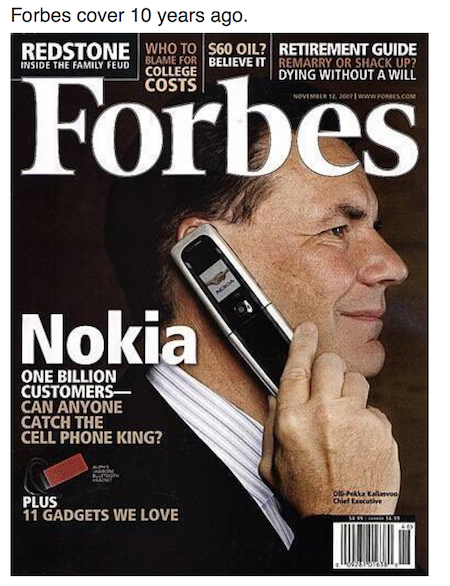
This Forbes magazine cover from 10 years ago has been going around the world, because it is a good example of corporate hubris. A big, dominant product provider that seemed to have an unassailable lead over its competitors. See what it says there: "Can Anyone Catch the Cellphone King?". I guess that they did not see Apple and Samsung coming!


We actually held Nokia in New York client portfolios until June 2010, when we sold Nokia and switched everybody into Apple. At that point Apple was about to launch the iPhone 4 and Nokia was already taking strain. As I said in my year-end message in December 2010.

"During the year we finally made the switch from Nokia which did poorly for some years (and was also down 19.9 percent in 2010), into Apple which continues to go from strength to strength. In retrospect, we should have made the transfer much sooner."

Turns out it was not too late. From that date to now, Nokia fell another 42% and Apple is up 350%.


Michael's Musings

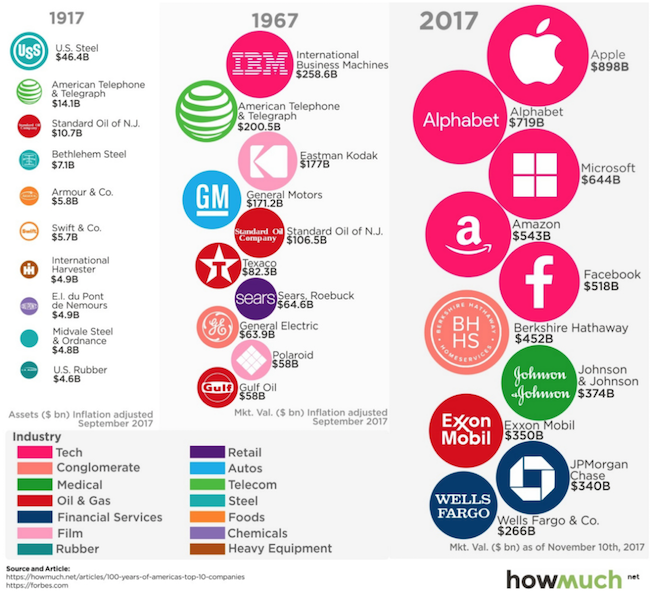
If I have the choice between reading fiction or the history of markets, companies and the people who built them, the latter generally wins - Most Valuable U.S. Companies Over 100 Years. Having a look at the list, only Standard Oil (Exxon) appears on all three; Exxon happens to be the only stock on the 2017 list that I don't own.


Until Elon Musk can crack using rockets to travel around the globe we will have to make due with the A380's and Dreamliners. The current tough decision for airline execs, is whether to go for the dreamliner which is more cost effective or do you go with the A380 which allows you to transport more people to airports where there are limited parking spaces. Going forward that decision might be made for them - We may have just witnessed the end of the Airbus A380 superjumbo. It is interesting to me that the airline industry has not had a major change since the 747 first took off in 1969.


Home again, home again, jiggety-jog. Asian markets are all well in the red this morning, and Tencent is down around 1%. Expect a red open for the All-share. Very big news out today, we will find out if we are hosting the 2023 Rugby World Cup at around 15:00. Holding thumbs!


Sent to you by Team Vestact.

Email us

Follow Michael, Byron, Bright and Paul on Twitter

078 533 1063
Wednesday, 8 November 2017

Sweet Apple Juice


To market to market to buy a fat pig. This week marks 100 years since the Bolsheviks seised control of Russia in the October Revolution. Depending on what calendar you use it either took place on the 25 October or the 7 November. Part of the process to consolidate power included a 5-year Russian civil war and the basic eradication of the bourgeoisie class through what was known as the Red Terror. The irony is that Lenin came from a wealthy middle-class family.

The Wall Street Journal had this to say (100 Years of Communism-and 100 Million Dead):

    "If we add to this list the deaths caused by communist regimes that the Soviet Union created and supported—including those in Eastern Europe, China, Cuba, North Korea, Vietnam and Cambodia—the total number of victims is closer to 100 million. That makes communism the greatest catastrophe in human history."


I'm not sure if I would go as far as saying 'the greatest catastrophe in human history', there are a number of contenders for the title. History has shown though that communism has not worked and the system generally ends up spreading misery instead of lifting people out of poverty.

Market scorecard. The Dow set another intra-day high on the open yesterday, which thanks to daylight saving is at 16:30 our time instead of last week's 15:30. The Dow was up 0.04%, the S&P 500 was down 0.02%, the Nasdaq was down 0.27% and the All-share was up 0.35%. Brait released a trading statement after the market closed, showing that their NAV sits in a range of R65.50 and R67.50, representing a 12% decrease since their last NAV release. The New Look asset, which is the main reason for the shareholder pain recently, now has a zero value on their books. We will get the exact number next week Wednesday. The share is up around 5% this morning.


Company corner

Byron's Beats

It was a good year for Apple according to the stock market. The share price is up 60% from precisely 1-year ago. When those full-year results were released in November 2016 there were big concerns about a lack of innovation and how the jewel of the crown, the iPhone, was losing its shine. On the 2nd of November this year Apple released its full-year numbers for the year ending 30 September 2017, which painted a very different picture to these "expectations" from a year ago.

It sure was a busy year. Sales in China were disappointing, however everywhere else seemed to flourish. A stronger dollar had a negative impact on the numbers. Numerous fines and legal battles also took its toll on the biggest listed company in the world. The company announced an increase in its capital return program to $300 billion through to March 2019. Share repurchases will be responsible for $210 billion of that.

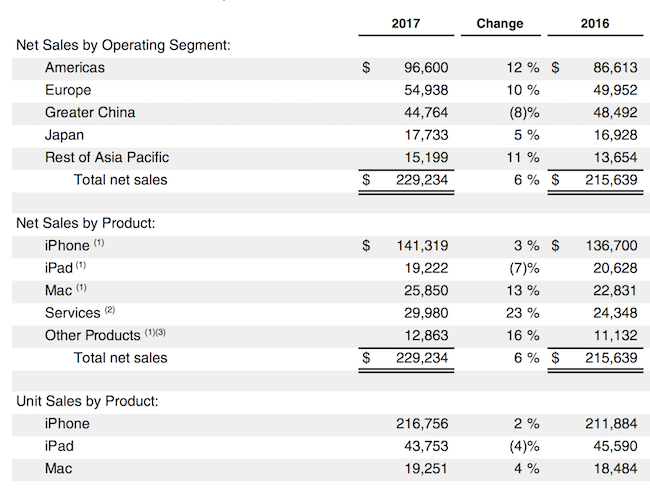
Sales increased by 6% to $229 billion. The graphic below shows you the geographic and product mix of these sales.


As you can see, sales in the Americas were solid (42% of sales), China not so much. Africa doesn't even get a mention. The iPhone was stable (nearly 217 million units sold) while 'services' and The Mac had a great year. The Other Products division which includes the watch also showed good progress.

From those $229 billion in sales the company made an incredible $48.4 billion in net income. Those margins are juicy! This equated to earnings per share of $9.27. Next year that number is expected to rise to $11.50. Trading at $175 a share, the stock trades at 15 times forward earnings. That is well below the market average, even before you consider the $260 billion in cash they are sitting on.

That was the year gone by, what does the future hold for Apple? The hype over the iPhone X is as heated as ever. Expect record sales when these go mainstream into the festive season. That vital part of the business is in good hands.

I am also excited about the services business that is slowly becoming more influential. Music, tv shows, movies, games, apps. That world is enormous, and Apple has over 1 billion activated devices in circulation with access to these services.

The watch also has huge potential. I am looking forward to seeing all the health benefits they can implement into that wearable device. There is still a long way to go to bring the watch up to standard, but we can afford to be patient while Apple churns out billions in its other divisions.

The Mac continues to steal market and profit share. Even more crucial is that it keeps bringing more people into the Apple network. Once you are in, it is hard to leave.

The future looks bright for this incredible company. Even after a 60% rise in the share price, we see massive value in the stock. This is a must-have in every portfolio.


Linkfest, lap it up

Michael's Musings

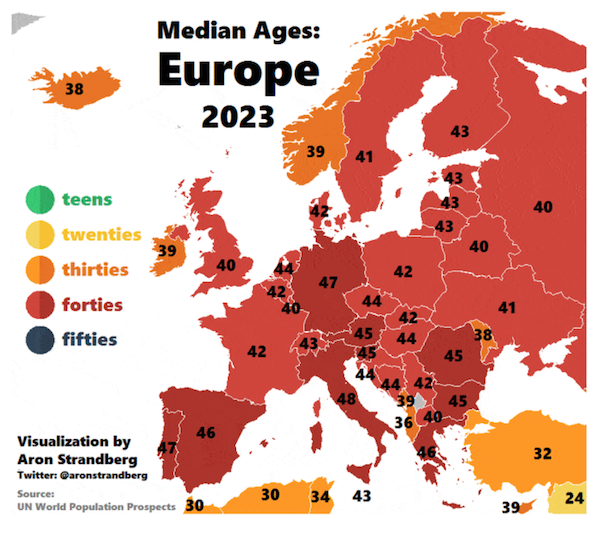
The problems of an ageing population is not a new topic. Visual Capitalist has two great infographics, showing the changing population age for Europe, and then North and South America - Animation: The Rapidly Aging Western World. As investors, healthcare is one of our main investment themes because of this trend of an ageing population.


Tencent's recent spin off China Literature Ltd soared on its IPO. It shows how valuable the Tencent ecosystem is - China Literature Soars inHong Kong Debut After Tencent Spinoff. The company can be compared to Amazon's Kindle division.


Home again, home again, jiggety-jog. Tencent in Honk Kong continues to set all-time highs, expect Naspers to do the same locally. Things are rather quiet today on the news front, the only thing on the cards is Oil Inventories from the US. Hopefully, for the consumer, they indicate supply is up and demand is down; current price for a barrel of Brent Crude is $63.38.


Sent to you by Team Vestact.

Email us

Follow Michael, Byron, Bright and Paul on Twitter

078 533 1063
Tuesday, 7 November 2017

Apple in Paradise


To market to market to buy a fat pig. The Paradise Papers will be a talking point for the coming weeks as more details emerge. The latest big name revealed is Apple, who went 'tax haven shopping' after their setup in Ireland ran into issues - (Apple had five burning questions about the best tax haven for its billions). These multinational companies spend millions to ensure that they are structuring their tax affairs legally. The problem is that tax codes can be open to interpretation, as seen with Apple and Ireland. The EU feels that Apple pushed things too far and should pay Ireland $13 billion, Ireland is appealing the decision. When a country doesn't want $13 billion in tax revenues, you know how subjective tax codes can be.

As I said on CNBC yesterday, it is management's job to pay as little tax as possible legally, and it is government's job to decide what the tax codes should be. The problem for governments at the moment is the ambiguity in the way tax codes and treaties that have been drawn up. Loop holes are being closed and standardisation of definitions are being implemented. We have also seen that large financial institutions have had pressure put on them not to do business with entities linked to tax havens. If you want to read further about the initial names linked to the papers, here is a brief summary - Here's a guide to the major revelations in the Paradise Papers. What is interesting to me is how many of the 'big guns' are intertwined in many business deals.

Market Scorecard. Our market powered through the 60 000 mark yesterday on the open, meaning it has taken just under 3-years to climb 20% from 50 000 points to 60 000. The Dow was up 0.04%, the S&P 500 was up 0.13%, the Nasdaq was up 0.33% and the All-share was up 0.57%/. Lonmin was down another 5.9% yesterday, but after being one of the best-performing stocks for October it is still trading higher than it was in September.


Company corner

Byron's Beats

Last week we received third-quarter numbers from Cerner which disappointed the market. The share dropped 9% on the news as forward guidance was revised down. We should put that drop into perspective. Even after that fall, the share price is up 38% so far this year. It all depends on where you draw the line in the sand. Having said that, this has been a volatile ride. This business is a high margin software company with high expectations. A volatile ride usually comes with that package.

Bookings for the quarter came in at $1.1bn. This was much lower than expectations because a few large contracts will now only be included in the fourth quarter numbers. When these bookings reflect, it should result in an all-time high bookings for the full year. It has been a good year with some big government institutions signing up for their healthcare software services.

Revenues came in at $1.276bn which was 8% higher than the comparative quarter; $928 million of that came from support, maintenance and services. You can see that this is a retention business. Once you have signed up a hospital or an institution, their annuity business is a key driver of Cerner's future profits.

Another important factor to note is that only $142 million of these revenues came from outside the US. The potential to expand globally is massive.

Earnings for the year are expected to come in at around $2.42 per share, putting the company at 27 times forward earnings. The business does have gross margins of 83% and very impressive cash flows which explains the high multiple somewhat.

We remain buy rated on this stock as it continues to secure solid government contracts in the US. We will do a more detailed analysis of the full year when those numbers come out next quarter.


Linkfest, lap it up

One thing, from Paul

The biggest aggregate client position in our New York business is Apple. Not surprising really, because it is a must-own stock and has done really well in recent months. The total value of our Apple holding at Fidelity Clearing & Custody Solutions (where the shares are held in safe custody) is $15.1 million.

At its current share price of $174.25, Apple has a market value of just a whisker over $900 billion. That makes it the most valuable listed company in the world. It is the first time that any listed company has breached that mark. Well done Tim Cook. Onwards to $1 trillion!

The reason that the stock is trading so well is that this coming holiday season will probably be the biggest ever, as shoppers go mad for its new iPhone X. Those have the new larger OLED screens and cost over $1,000 each. They are selling out as they hit the stores, but Apple's formidable production system will soon have them available for sale around the world.

This article provides some updates on the opening iPhone X weekend - Apple iPhone X draws lines, and some activation errors on AT&T and Verizon services


Michael's Musings

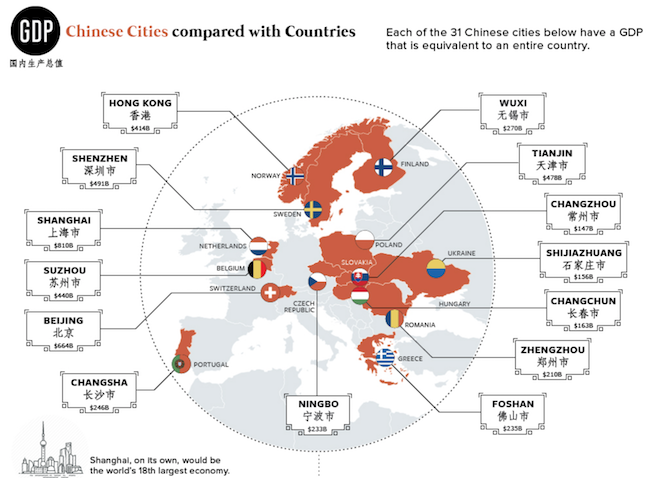
We sometimes forget how massive China really is. The following graphic shows how China's biggest 31 cities are a similar size to certain countries - 31 Chinese Cities With Economies as Big as Countries.


A question that is as important as when to buy is when to sell. Given that we are not market timers, and don't try jump in and out of the market, we look to sell when something has fundamentally changed at the company - The Question of When to Sell Isn't So Simple. The last point that Barry makes is important, even a well-timed sell and then corresponding buy can be break-even at best due to taxes and transaction costs. How much does a stock need to drop before your losses would be more than the taxes and costs incurred in selling?


Bright's Banter

One of my favourite quotes from Howard Marks taken straight from his book The Most Important Thing

    "When people say flatly, 'we only buy A' or 'A is a superior asset class,' that sounds a lot like 'we'd buy A at any price; and we'd buy it before B, C or D at any price.' That just has to be a mistake. No asset class or investment has the birthright of a high return. It's only attractive if it's priced right.

    Hopefully, if I offered to sell you my car, you'd ask the price before saying yes or no. Deciding on an investment without carefully considering the fairness of its price is just as silly. But when people decide without disciplined consideration of valuation that they want to own something, as they did with tech stocks in the late 1990s---or that they simply won't own something, as they did with junk bonds in the 1970s and early 1980s---that's just what they're doing.

    Bottom line: there's no such thing as a good or bad idea regardless of price!"


In the following article, Howard Marks explains why passive investing is not the silver bullet you have been looking for! - Howard Marks On Passive Investing


Home again, home again, jiggety-jog. Tencent is up over 3% in Hong Kong, expect a raging Naspers when the bell goes at 9:00 our time! There is CPI data out of the EU around lunch time and then this afternoon, the JOLTs number from the US. As the US reaches full employment, the JOLTs data becomes more important.


Sent to you by Team Vestact.

Email us

Follow Michael, Byron, Bright and Paul on Twitter

078 533 1063
Wednesday, 13 September 2017

Apple gets a 10


To market to market to buy a fat pig. The Apple event didn't disappoint last night. Even before the product unveiling, we got the first glimpses of the Steve Jobs Theatre. The sunken theatre has a ground level cylindrical entrance, where the roof floats as it sits above reinforced glass. Unfortunately, many of the products being unveiled were leaked before the event, where one commentator joked that the only thing we don't know is if the new iPhone X will be pronounced as 'ten' or 'X'.

The product most people wanted to see was the new iPhone X (pronounced ten), which is the phone celebrating the ten year anniversary of iPhone. The first thing you will notice about the iPhone X is that the screen goes all the way to the edge of the phone and there is no 'home' button. Probably the coolest upgrade from a tech point of view is the use of facial recognition to unlock the phone. The likes of Facebook have been using facial recognition for a while now but given that the iPhone has sensitive data and can be used to make payments, the software needed to be more accurate. The new phone builds a 3D image of your face, which means a photo of you won't be able to unlock the phone.

The other new features in the phone include; wireless charging, upgraded cameras, much faster chips and an OLED screen. The screen is 5.8 inches, which is bigger than the current iPhone Plus at 5.5 inches. Given that the screen goes right to the edge of the phone, the overall size of the phone will be smaller than the Plus sized phones. It is only shipping on the third of November, later than the other products released but still in time for the end of year holiday season. The price point for the phone, as expected will be $999.


They also launched the iPhone 8 and 8 Plus, which will look basically the same as the current iPhones, except for having a glass back. Apple says they have increased the strength of the glass, to make the phone more durable. The 8 will also have wireless charging, improved cameras and the improved chip set.

Next on the line up is the new Apple Watch series 3, which at first glance is a huge step forward on older models. The big improvement is the ability to put a sim card into the watch, meaning that the watch and phone no longer need to be with each other. It comes with an improved battery and improved processing power, which now allows you to stream music without needing a phone connection. The Apple watch and AirPod's, used together looks like a potent combination. Tim Cook also announced that the Apple watch grew sales by 50% and they are now the number one selling watch brand in the world.

Apple stock was up for most of the event but sagged after the announcement that the iPhone X has the slightly delayed shipment date. It closed down 0.4% but is still up 39% for the year. If you want to watch the whole event or get more specific details on any of the products, click through here, Apple Special Event. September 12, 2017 - The first-ever event at the Steve Jobs Theater..


It was another green day for global stock markets yesterday as the S&P 500 moved further into uncharted territory by extending its record high number. Here is the scorecard, the Dow was up 0.28%, the S&P 500 was up 0.34%, the Nasdaq was up 0.34% and the All-share was up 0.64%. Richemont released a 5-month trading statement this morning, which beat expectations thanks to growth in all the markets they operate in. More on that tomorrow though.


Linkfest, lap it up

One thing, from Paul

I'm definitely getting a silver iPhone X. I'll probably have to scramble to find one before year-end in New York or London (South Africa is not on the early distribution list).

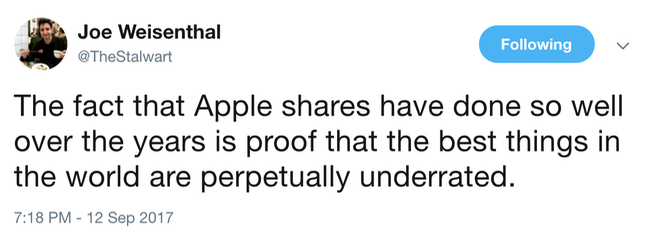
Anyway, this tweet by our friend Joe Weisenthal summed up our view of Apple, the great company that makes these devices


Byron's Beats

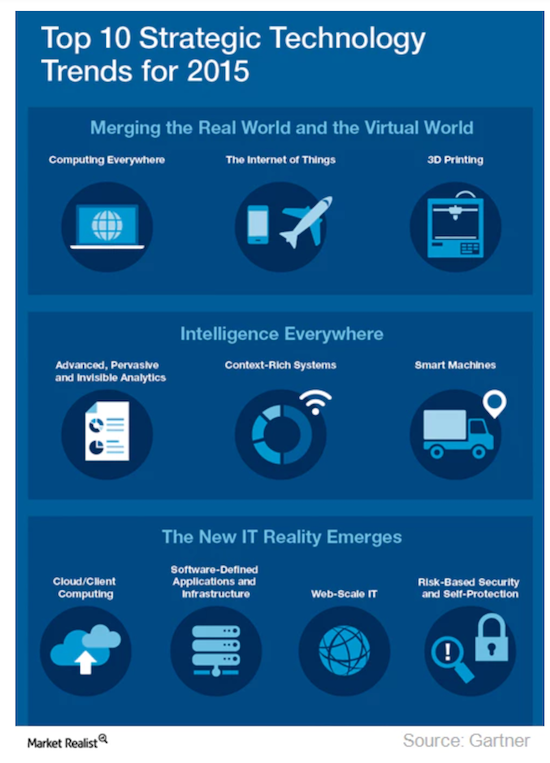
The Marker Realist is a great platform which aggregates analyst reports on many US listed stocks. Here is a piece on Nvidia and it's growth opportunities. Why Nvidia Leads in AI and Autonomous Vehicle Growth Opportunities. Back in 2015 a 'top 10 technology trends' list was made (see image below) which falls right into Nvidia's realm. GPU chips are basically required for all of these exciting technologies. Nvidia are especially dominating in cloud computing which is flying in demand all over the globe.


Michael's Musings

Even paying a small amount extra into your home-loan can have a huge impact on your long term wealth creation - The benefits of paying an extra R100 on your bond.


Home again, home again, jiggety-jog. Asian markets are mixed this morning. At 13:00 today the RSA Retail sales number will be out for July, given how our GDP has shifted toward the tertiary sector, retail sales number is an important read.


Sent to you by Team Vestact.

Email us

Follow Michael, Byron, Bright and Paul on Twitter

078 533 1063
Wednesday, 2 August 2017

Cerner's Healthy Margins

To market to market to buy a fat pig. Another green day for both our market and the US market, the S&P 500 was up 0.24% to just short of an all time high. Thanks to the strong surge in the Apple share price after hours, the S&P 500 is set to open at a record high today. Good times.

An interesting rule change from the S&P on which companies will be allowed into the index in the future (The S&P 500 is making a new rule). The rule will exclude new companies being included that have multiple share classes, with the first casualty being Snap Inc. Does this mean going forward that the S&P will start removing companies already in the index who have multiple share classes? Big hitting companies who have multiple share classes includes Alphabet (Google), Berkshire and Under Armour. Imagine saying that you want to buy the US market but the EFT you buy doesn't include the first 2 companies?

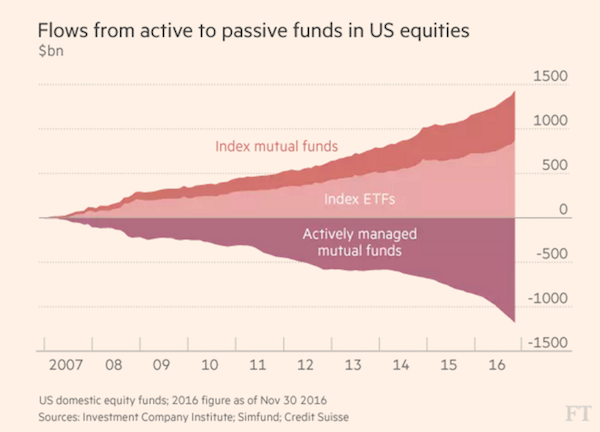
With the big move towards index trackers, the rules determining the index start to hold more significance (ETFs are eating the US stock market).


Companies that don't make the cut will most likely trade on lower multiples as their shares are left dry from the flood of index tracking ETFs. Distortions like this creates opportunities for more active investors, which is good news for you and I. The growing passive space should result in more room to move for active investors because a passive investor buys a company due to it being in an index and for no other reason. So an over-bought stock could be bought up more, creating the opportunity for active investors to short the stock. Or as we have spoken about, some companies may be left out in the cold even though they are cheap and a great buying opportunity.


Company corner

Byron's Beats

The third quarter is usually the most boring in Apple's cycle. That is because it is the quarter before new product releases are announced which also coincides with the festive season. Not much was expected of last night's results. I must say, I was expecting a disappointment because I personally know a few people who are holding out on renewing their contracts until the new Apple phone is released, hopefully in September.

But that was not the case and the results smashed expectations, pushing the share up 6% pre market. Quarterly revenue came in at $45bn compared to $42.4bn this time last year. The company's cash balance now sits at a whopping $261.5bn. Just Wow!

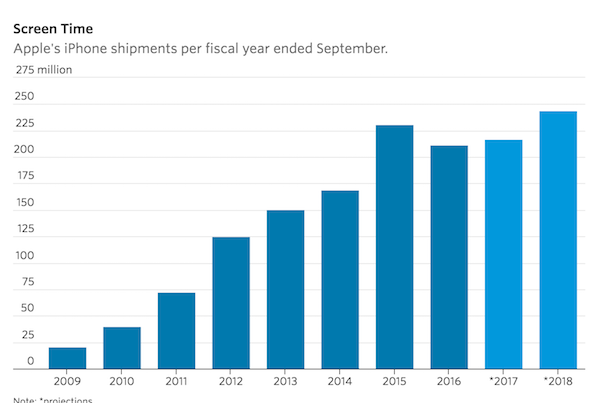
Profits for this quarter came in at $8.72bn, up 12%. Guidance for the next quarter indicated some exciting product launches. See the image below from Wall Street Journal which shows the magnificent rise of the greatest product of all time. More records are expected in 2018.


Pleasant surprises included a rise in the iPad business for the first time in 4 quarters. Mac sales rose 6.7%, the third quarter of gains in a declining notebook market. Services grew 22% to $7.27bn as it becomes more and more significant. Lets hope for more exciting content coming to iTunes subscribers.

Apple continues to be one of our favoured stocks in New York. For a company of this quality, trading at 17.5 times earnings, we think it is a no brainer. Expect more news from these guys soon when those product releases come out.


Michael's Musings

Last week Cerner released their 2Q numbers which were largely inline with what the market was expecting. Revenues were up 6% to $1.29 bn, with the more important numbers of Bookings, up 16% to an all time high of $1.64 bn. Revenue Backlog was up 11% to $16.65bn. On the profit side of things, Adjusted Net Income was up 3% to $206 million, which translated into EPS of $0.61, 5% higher (thank you share repurchase program).

Two noteworthy new customers signed up during the last quarter were, LifePoint Health and the Department of Veterans. LifePoint Health operate 72 hospitals, the rollout is only in a handful of their hospitals for now but in time you would imagine all the hospitals will be running on Cerner systems. For the Department of Veterans, they were elected as lead in "next-generation electronic health record system". Things are still in the planning phase and contracts are still being signed. Of significance though is Cerner beating out the competition to be chosen by a large government department.

Going forward the company gave guidance that their Full Year(FY) Revenue should be around 8% higher and that FY EPS should be around 6% - 11% higher, meaning that the current P/E ratio of 32 isn't cheap. The market gives Cerner this premium due to the long term steady growth potential from the company, where they have a very healthy operating margin of 19.3%. Also, only 10% of their revenues comes from outside of the US, once they are done conquering the US the rest of the globe will be ready for the taking.


Linkfest, lap it up

A note from Paul

Bitcoin is splitting in two? What does this even mean? Too complicated. I'm out! (Bitcoin splits in 2)

Tesla batteries to be used by power utilities? This could be big! (Tesla Batteries May Back Up Wind Farm Off Massachusetts Coast)


Bright's Banter

Failed In Loans Trying High Yield (FILTHY) - A perfect example of pro-risk behaviour by Pension Fund Investors in Europe where FOMO and the low interest rate environment forces these investors to over reach for returns without any risk consideration (European loan fund boom sparks concerns over risk taking)


Home again, home again, jiggety-jog. Numbers to be on the look out for later today are, the ADP Nonfarm Employment change and then probably more significant to us in South Africa, the Crude Oil Inventory number from the US. The change in inventory will give an indication of what the demand picture looks like in the US, having a knock on effect on the oil price which has found a new home above the $50 a barrel mark.


Sent to you by Michael, Byron and Paul on behalf of team Vestact.

Email us

Follow Michael, Byron, Bright and Paul on Twitter

078 533 1063
Monday, 3 July 2017

iPhone is 10

"Loads of Apple articles last week, Michael and I have put together all the links that we think you need (you are welcome), in order to see how far the product has come. There are some suggestions that the smartphone of the future may be glasses, or more augmented reality. The fact is that the iPhone is the most successful consumer product of all time."


To market to market to buy a fat pig I learnt something new this morning, and perhaps it is an age thing. Michael did not know what Rick-rolled was, even though there is a Wikipedia entry. Old Rick Astley went along with the flow, it is better than hiding away. The song was covered in layers of cheese, somehow we were caught up in the things that Rick was never going to do. The song (Never gonna give you up) may have won best British single at the Brit awards in 1988, by 2004 it was voted 28 on the worst 50 songs of all time by VH1. A bit like the Macarena, fun at the time, completely cringeworthy now. I have never been one for crowd dancing, I think I hid around the corner during the c'mon locomotion (without me).

Friday market was more inclusive for the bulls, stocks as a collective were up half a percent by the close. The long and meandering train of three years in the ALSI doing nothing continues, however. We need something meaningful to spur confidence, for the time being political scandals and flip-flopping on policy = a complete lack of confidence. Over three years, the ALSI is down nearly a single percent. That return does not account for inflation either, nor does it account for the weakening Rand over that same time. Equally, SABMiller would have boosted the exchange with their huge buyout at the hands of AB InBev.

A quick look at some of the majors reveals a tale of two markets. Notwithstanding the heavy handed selling of the Pound Sterling, British American Tobacco is up 34 percent over 36 months (and they pay a great dividend). Naspers's share price over the three years is up 89 percent. Richemont stock on the other hand is down 3.3 percent over the last three years. The share price of Glencore is down 22 and a half percent over the last three years, BHP Billiton is down 46 percent over that time period.

Steinhoff shares (lots of stuff going on in that time) are up 20 percent in three years, FirstRand are up 15.6 percent. Anglo American are down 37 percent over 36 months. Lastly, making up the top ten is Vodacom, that stock is up nearly 25 percent over that time. If one had avoided resource stocks over three years, it seems that you would mostly be ahead. It has mostly been a drag by commodities, as a collective the Resource 10 index has halved in three years.

The Industrial 25, mostly the majors as per above, is up 16 and a half percent over that time. It definitely feels like a case of two markets. Paris to London style (Charles Dickens "A Tale of Two Cities") with investors stuck in the English Channel (the French call it "the Sleeve"). Rowing their boats based on the currents and tides of emotion, politics and the tides of confidence. It is fair to say that currently we are in a spring tide of low confidence. Spring can be confusing when explaining tides and confidence, there are few green shoots currently and more shallows.


Ahead of what is a really short week in the US (halfway today and market closed tomorrow), stocks sank by the close of business. The Dow Jones Industrial Average may have ended off the highs, by the close the oldest blue chip index was up three-tenths of a percent. The broader market S&P 500 closed 0.15 percent higher on the day, healthcare and financials gave up a little ground, as well as technology stocks. That led the nerds of NASDAQ to close lower on the session, down 0.06 percent by the close. Not that much lower, right? The one stock that stood out was Nike, up nearly 11 percent by the close to 59 Dollars a share. Good news for investors that have seen the stock "stuck" for the last 20 months or so. North America is not the rest of the world, it seems that the analyst community (which is mostly US based) is coming around to that.

Like we said earlier, the market is only open until 1pm New York time, closing three hours earlier than usual today. And then the rest of the day off tomorrow for Independence Day (fighting aliens and all that), the US would have their "freedom" and independence from the United Kingdom for 241 years. Whilst fireworks may be the order of the day tomorrow, there is likely to be subdued trading all day long today. One strange factoid about Independence Day and the American Revolutionary War which was ongoing, the Treaty of Paris was only signed in 1783. It concluded that the USA was a sovereign state and came into effect May 12 1784.

Many "Loyalists" to the Crown (and the Empire), fled to neighbouring British North America, which in turn became Canada. Canada itself gained independence from the British Empire in 1867, and celebrated 150 years over the weekend, 1 July. Happy birthday to the largest parts of North America, Mexican Independence Day is 16 September.


Company corner

Loads of Apple articles last week, Michael and I have put together all the links that we think you need (you are welcome), in order to see how far the product has come. There are some suggestions that the smartphone of the future may be glasses, or more augmented reality. The fact is that the iPhone is the most successful consumer product of all time. Last week marked the 10 year anniversary of the iPhone, here are a couple of links to celebrate the occasion. First off here is Steve Jobs introducing it - Steve Jobs' iPhone 2007 Presentation.

Here is a re-take on the very first iPhone, the version one of the iconic smartphone. A WSJ staffer decided to put it all to the test, her daily life cast back to the future with an iPhone 1 -> iPhone Review Redux: 10 Years Later, So Slow, So Small. Getting a sim card that is compatible is a problem. The battery sucks. There is no front facing camera. There are no apps on the iPhone 1. You have to access Facebook and Twitter via the internet. 2 megapixel camera. And how many did they sell? 1,389,000 ..... The 3G (which was the first one that I had), sold 12 million units. The iPhone 4S propelled Apple through 100 million. It was the 7 (and the Plus model, that came along with the 6) that saw the company sell 1 billion products, inside of a decade. Read the article, see how archaic the phone was you (may have) used a decade ago.

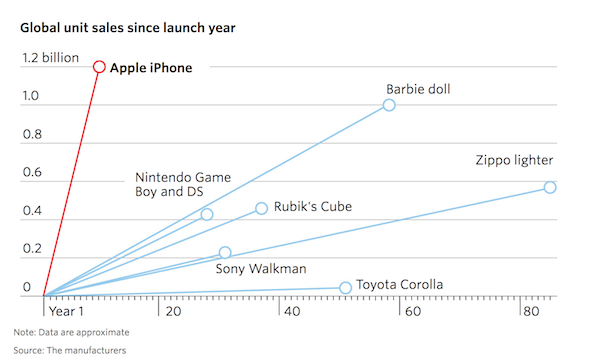
The iPhone is also the fastest to one billion units sold, and most units sold for a consumer product. Barbie is the only other product to break the 1 billion units sold.


Another one here, connected to the above, the very good (and you should sign up for the newsletter) Horace Dediu. Born in Romania, schooled in the US, lived in Helsinki (he was an analyst for Nokia), he is now a full timer at his business, called Asymco, which is around 7 years old. Horace often writes about the iPhone, we included this in links last week, it is worth another take - Defining the 21st Century. Horace reckons that Apple will have sold one trillion Dollars worth of iPhones by the end of 2018. The many things that we can do with the device amazes him, as should it you. The defining paragraph (for me) after Horace praises the device, was as follows: "That all this happened while the product itself was always perceived as fragile, vulnerable, copyable, doomed to early demise. That imitators outnumber it 10 to 1. That it somehow found ways to become better even though we exhaust what we can ask of it."

The Verge has an excerpt from the book The One Device: The Secret History of the iPhone, in an article titled: The secret origin story of the iPhone. It is a very long article, perhaps you are reading half a chapter of the book, I haven't got there yet I am afraid. One misstep in this whole process and perhaps we wouldn't have this incredibly successful product.

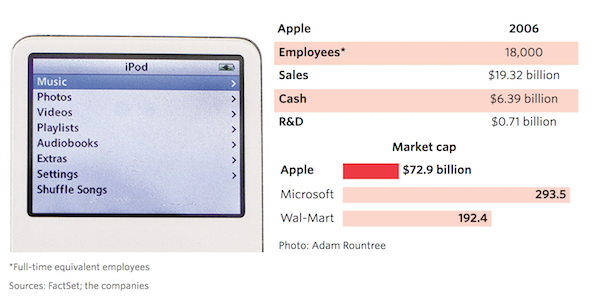
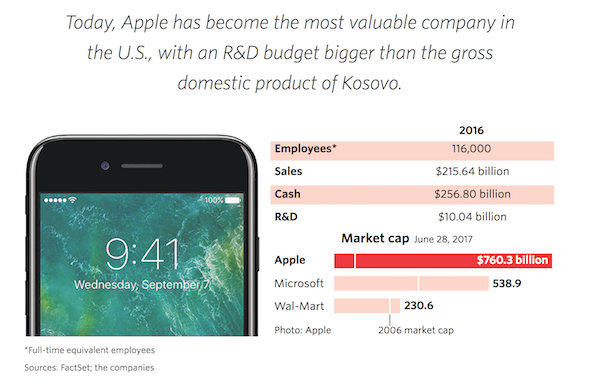
Having such a successful product has dramatically reshaped Apple from a Mac/Macbook/iPod company to cellphone company - How the iPhone Changed Apple in 10 Years

Infographic: How the iPhone Changed Apple in 10 Years | Statista You will find more statistics at Statista

Look at how the employment numbers for the company have grown over the last decade, The iPhone Decade in 12 Charts.


With the rise of the smartphone other consumer products have become obsolete, when was the last time you bought a video camera? (The Losers of the Smartphone Boom)

Infographic: The Losers of the Smartphone Boom | Statista You will find more statistics at Statista


Home again, home again, jiggety-jog. The G20 meetings take place this week in Hamburg. The city in which the Beatles spent large amounts of time in the early 60's. Around 2 years on and off as residents of Hamburg! The ANC Policy Conference meeting continues through to the middle of the week.


Sent to you by Sasha, Byron and Michael on behalf of team Vestact.

Email us

Follow Sasha, Michael, Byron, Bright and Paul on Twitter

078 533 1063

Thursday, 29 June 2017

Bank on not stressing

"Across the oceans vast and wide, stocks were better on the session, in particular a large bounce back by technology counters. Apple, Alphabet Facebook and Amazon all led the charge, in the end the nerds of NASDAQ closed 1.43 percent better. The broader market S&P 500 added nearly nine-tenths of a percent, whilst the Dow Industrial Average managed to tack on around two-thirds of a percent by the close. The biggest news of the day was however amongst the financial stocks."


To market to market to buy a fat pig The wireless led with the main story that AngloGold Ashanti was to restructure their South African operations and in particular their loss making operations, and unfortunately that may lead to over 8500 jobs being lost. In South Africa mining jobs feed many mouths. Many. The repercussions are to be felt far and wide. Read -> AngloGold Ashanti to restructure South African Operations to ensure their viability. That is one in four jobs in their South African operations.

When you read the report, it is very easy to see why this is the case, the two operations are operating at costs far above the current gold price - "The cost performance of certain operations, notably TauTona and Kopanang, has been a clear demonstration of these challenges, with all-in sustaining costs in the first-quarter of this year of $1,737/oz and $2,399/oz respectively. This compared with an average gold price over that period of $1,216/oz. Both mines also sustained significant operating losses through 2016."

Whilst it is a bitter pill to swallow for all and sundry, if there is no action on the part of the company, then it is likely that all of the operations are put at risk. It is the stark truth, mining and energy assets have a timeline to them. Once the assets are mined out and sold onwards, then I am afraid you cannot make any more. The rock and land we sit on, that has produced vast sums of gold, is over three billion years old, according to science. According to science, there were no fish back then, forget dinosaurs! Single cell organisms back then. Back to the point, the mines are out of their productive phase and hold no more extractable profitable ounces. As such, in order to keep the rest of the business around, these mines have to be shut.

AngloGold Ashanti sold off, down 4.29 percent by the close and now at the lowest point (nearly) in the last 12 months. Sadly for shareholders, the Rand return in the last ten years has been minus 50 percent, if you bought in the middle of 2007, you would still have to double your money from here to break even. In Dollar terms, the ADR in New York is down 74 percent. In Dollar terms, the stock needs to go up 284 percent to break even. It really is a sad state of affairs and another reminder that anyone who thinks mining is easy and these businesses are worth "billions" are misguided, if not just plain delusional.

As for the rest of the market, collective the Jozi All share index was up around one-third of a percent by the close, the rest of the resources complex was up nearly a percent by the close. Industrials were off a smidgen, most of the heavy lifting outside of the resources complex was being made in the financial sector, up over four-fifths of a percent by the close. South32, Mediclinic and Bidcorp were all in the winners column, the last two being lifted by some positive commentary by the Bank of England governor, Mark Carney. Rates may go up, he said, giving a slight boost to the Pound, and in return, all the businesses listed here with a UK bias. In the negative column was a mixed bunch, Tiger Brands, Woolies, Amplats and Naspers, along with AngloGold Ashanti.

There were new 12 month lows for the likes of Omnia (poorly received results earlier in the week), Pioneer Foods and Spur Corporation, as well as housing group Balwin and "miner" Pallinghurst. In the positive, and trading at 12 month highs, were the likes of Capitec and a handful of others, go figure there!


Across the oceans vast and wide, stocks were better on the session, in particular a large bounce back by technology counters. Apple, Alphabet Facebook and Amazon all led the charge, in the end the nerds of NASDAQ closed 1.43 percent better. The broader market S&P 500 added nearly nine-tenths of a percent, whilst the Dow Industrial Average managed to tack on around two-thirds of a percent by the close. The biggest news of the day was however amongst the financial stocks.

This comes hot on the heels of Janet Yellen suggesting that we wouldn't have another financial crisis in our lifetime. To which I turned to Bright and asked him, Janet Yellen is 70 and he is 25, does she mean his life or her life? Which one? Check it out - Banks 'very much stronger'; another financial crisis not likely 'in our lifetime'. I am not going to agree with her, there is always a crisis beyond your control which is being cooked up right now. Something that is going to take us all by surprise, yet be completely obvious all of the time.

A pass is a pass, and in this case this is hurrah for owners and shareholders of banks and financials. I am talking about the latest stress tests and the results released by the Fed, many banks have increased their payouts (i.e. their dividends) immediately. In fact, this means that the banks in the US are on balance well capitalised and that they can proceed with buying back shares and paying extra capital out to their shareholders. See the release - Federal Reserve releases results of Comprehensive Capital Analysis and Review (CCAR).

This has been a long time coming, as many of the headlines suggest though, the payouts are quite high - Banks Unleash Surprisingly Big Payouts After Fed's Stress Tests. The upshot of it all is that bank dividends are going to be higher, and buybacks are going to be stoked by shareholders looking for superior returns in a low rate environment. We hold the most conservative of the bunch, Wells Fargo, and as on cue with their nature, the dividend was increased by three percent, hardly a kings ransom.


Linkfest! Lap it up

Cash is still king in most parts of the globe. Key to that is the ATM, which turned 50 this year - World's first ATM machine turns to gold on 50th birthday. Fast forward another 50 years will the ATM be a thing of the past?

TV content providers are still trying to figure out how to set up their business model so that they can give content to people over the internet but not cannibalise their current products - NBC has a new sports streaming service, but it's kind of a mess for fans. This NBC product offering still seems to miss the mark, who wants to watch delayed sport? Sport needs to be live!

Two numbers here that are too big to get your head around, from Apple. From the post of Asymco - Defining the 21st Century: "1,162,796,000 iPhones sold (to end of March 2017) and $742,912,000,000 in revenues. $1 trillion will be reached in less than 18 months." Simply mind blowing.


Home again, home again, jiggety-jog. It looks like the rest of global markets like the fact that US banks are all "fine", Europe, not so much. They may plod through it for the next few years, I am not too sure that the political will exists to reform and restructure there. It is the European way! Hopefully we will start a little better here today, as a result of this "good news".


Sent to you by Sasha, Byron and Michael on behalf of team Vestact.

Email us

Follow Sasha, Michael, Byron, Bright and Paul on Twitter

078 533 1063