Wednesday, 18 October 2017

Patient on Mediclinic


To market to market to buy a fat pig. The Dow broke through 23 000 points yesterday. Even though it is just a number, which has no real difference from 22 999 or 23 001, it is nice to have milestones. Having markers allows us to see where we have come from and the progress made; celebrate the small victories. I'm sure that market watchers get a shot of dopamine when we break through key levels, just like we get that high from likes on social media.

What is amazing to me is that in August 1987, the Dow crossed 2 000 points for the first time. If we keep at the same run-rate, the index should be above 230 000 in the next 30-years. The human mind struggles to compute the power of compounding. The question is, do you have the patience and the staying power to go along for the ride?

In November last year, the Dow broke through 19 000 for the first time. Since then it broke through 20 000 in January, 21 000 in March, 22 000 in August and now 23 000 in October. More interesting is that on its trip from 22 000 to 23 000, it was only down on six occasions. For more interesting facts about the market, follow Robert Hum on Twitter. Here is what he had to say about yesterday's close.



Market Scorecard. US markets continue to power ahead, our market unfortunately wasn't able to do the same. The Dow was up 0.18%, the S&P 500 was up 0.07%, the Nasdaq was down 0.01% and the All-share was down 0.48%. Our market was slightly in the red following the cabinet re-shuffle but from there onwards it just steadily drifted lower. We also saw weakness in the Rand immediately after the announcement but after a couple of hours, our currency was back at its previous trading levels.


Company corner

Bright's Banter

Private hospital provider Mediclinic International released their interim trading and operational update yesterday. This is the first trading update after the Thiqa regulations in Abu Dhabi on co-payments by citizens had been repealed by the King.

The group now has 75 hospitals and 29 clinics across its operations in Mzansi through the Mediclinic brand, Abu Dhabi and Dubai in the United Arab Emirates through the Al Noor/Mediclinic Middle East brand, and Switzerland through the Hirslanden brand. Mediclinic also has a 29.9% stake in Spire Healthcare Group in the United Kingdom.

Mediclinic said that on the group level, revenues were flat in constant currencies but up 9.5% in pounds to GBP1.4billion compared to £1.3bn in the prior year. Earnings before accounting items were up 5% to GBP231million compared to GBP 220million in the prior year. Earnings per share are expected to be 10% lower at around GBP0.115 compared to GBP0.128 in the prior year. As you can see, these aren't exactly blockbuster numbers. Shareholders pushed the share price down 3.2% yesterday extending the weekly losses to 7%.

Switzerland operations are still the powerhouse with 48% contribution to revenues with Mzansi operations coming second at 28% and Mediclinic Middle East contributing the remaining 24%.

The company reported that the Swiss operations were hit by the timing of the easter holidays and a subdued market during summer months. As a result revenues per bed day were flat. The Mzansi operations saw revenues increase by 4.1% to R7.6billion with a 7.7% increase in revenue per bed day in what management describes as a weak macro-economic environment that we are facing here at home.

The Middle East revenues were down by 4.7% and after once-off items they were pretty flat, but what caught my attention here was the huge improvement in Thiqa patient activity after the repeal of the co-payment requirement in Abu Dhabi. The quality of revenues should improve and the Dubai operations continue to do well.

Spire's earning were hit by Ian Peterson a surgeon nicknamed "the butcher" who apparently was jailed for performing unnecessary surgical procedures on patients. Spire made a provision of GBP27.6million before taking into account any potential recoveries from insurers, a potential cost of settlement relating to a civil litigation said the company.

It has been a very tough couple of years for Mediclinic and thats reflected on the share price which is down 27% over a one year period. We think the best times lie ahead for this business and long-term investors will be rewarded for their patience here, excuse the pun.


Michael's Musings

The graph below shows the power of a brand and nostalgia. Disney's huge lead is due to its appeal to multiple generations, from Frozen for the young to Star Wars for older folk - Licensed Merchandise Is a Billion-Dollar Business. As the article points out, Netflix is quickly building many hit shows and brands that will be used for merchandising further down the road.

Infographic: Licensed Merchandise Is a Billion-Dollar Business | Statista You will find more statistics at Statista

It was only a matter of time until Uber became the king of New York city. July was the first time that more rides were done with Uber than with a yellow cab - New York City yellow cabs have taken a back seat to Uber. As a tourist to New York I found using Uber much easier, I didn't have to navigate the minefield of hailing a cab on a busy street and there was no pressure around, "How much should I tip the driver?". I even asked a New Yorker what the tipping guideline was, he just said "tip what you feel is fair"; which didn't help much.


Home again, home again, jiggety-jog. Our market is flat this morning, inline with most of the Asian markets. South Africa's CPI for September has just come in at 5.1%, higher than the 4.9% expected, edging back to the top of the SARB's range. The MPC next meet at the end of November, so there is time for one more CPI read before then, but as it stands I wouldn't be expecting a rate cut just in time for your December holiday.


Sent to you by Team Vestact.

Email us

Follow Michael, Byron, Bright and Paul on Twitter

078 533 1063

Tuesday, 17 October 2017

Tell Me About Black Monday


To market to market to buy a fat pig. Yesterday was the 30-year anniversary of Black Monday, which stands as the biggest one-day percentage drop for the Dow. The index fell 22.6% in one day! Imagine going to bed tonight with your portfolio, your hard earned cash, being worth 22% less.

One of Bright's favourite thinkers, Nassim Taleb, was on Bloomberg yesterday talking about what he had learned, having been in the market during the turmoil. He said many things but the one thing he said, and then many guests after him, was that these things happen and investors need to accept that big drops are part of equity investing.

The main component to investing is ensuring that the money invested in the market is long-term capital, money that you don't need in the next few months. Having only long-term capital invested allows you to ride out these pullbacks. As far as possible you need to prepare yourself mentally for drops and then try to remove as much emotion as possible from your decision-making process. When emotion gets involved, your decision becomes hijacked by either fear or greed, which more often than not leads to a bad outcome.

Barry Ritholtz has a brief piece on the events leading up to Black Monday and the correlations between now and then - Echoes of the Black Monday Crash of '87.

    "George Santayana's great maxim was that those who do not learn from history are doomed to repeat it. Perhaps there should be a corollary about learning the wrong lessons from history as well."


Market Scorecard. Nothing to see here, just your usual slow creep higher in record territory. The Dow was up 0.37%, the S&P 500 was up 0.18%, the Nasdaq was up 0.28% and the All-share was up 0.50%. Aspen closed yesterday higher by 0.16%, despite the investigation and having started the day down almost 2%. It looks to me like the market has rerated Aspen's earnings higher, thanks to them weathering the growing pains of becoming an international company. Netflix's 3Q numbers showed more subscriber growth than expected and higher revenue than expected, the stock was up 1.6%. We will have a more detailed breakdown for you in the coming days.


Linkfest, lap it up

One thing, from Paul

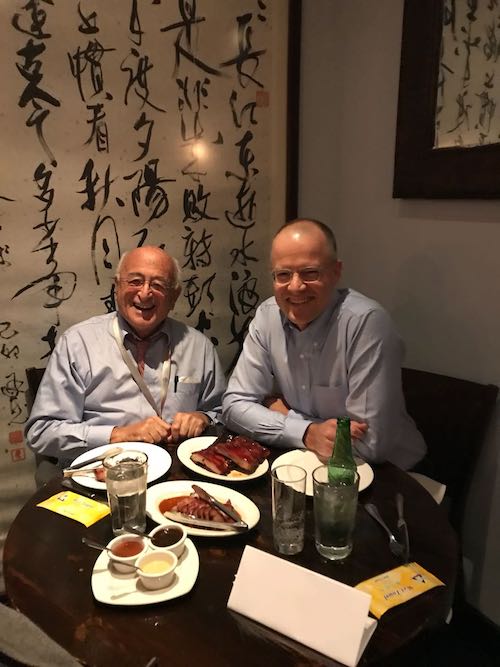
Paul is spending the week in New York, with our broker Seaport Securities. In the picture below are Paul and Ted, the principle of Seaport.


Byron's Beats

Blockchain is best known as the fundamental system behind cryptocurrencies. But it's potential is far-reaching. This article explains how blockchain can be used to redistribute renewable energy.

Think about it, if each house starts producing its own excess electricity, it can provide power to other homes that need it. The problem is that the current redistribution system is clunky and inefficient. Imagine Eskom trying to facilitate such a task? I don't think so; especially considering that these systems will result in a loss of clients for Eskom.

Blockchain is undoubtedly the answer. This technology will continue to develop, and as more houses leave the grid, the beast just becomes bigger, better and more efficient - How Blockchain Could Give Us a Smarter Energy Grid


Michael's Musings

The age of fighting robots has finally arrived. Can you see this taking off as a sport? With over 7 billion people on the planet, I'm sure this sport will find a niche - US vs. Japan: Giant robots are about to face off, fighting for their country

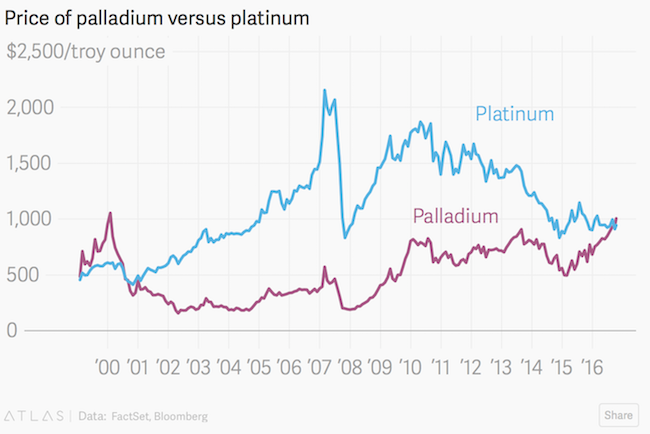
The platinum price has remained under $1 000 for most of the year, which is not great news for our local miners. The good news though, palladium which is part of the PGM group, is up around 50% this year - Curbing car emissions has made palladium the most precious of metals


Bright's Banter

We consume information in many different ways here at the Vestact Head Quarters; we read financial statements, books (autobiographies) and we listen to podcasts, to name a few. I enjoy listening to podcasts because you can use the time that you spend stuck in traffic, sitting in the Gautrain or spinning at the gym to borrow the brains of the investment greats, entrepreneurs, and founders; learning from the source, which is very rare if you ask me. As Warren Buffett put it, "its good to learn from your mistakes but its better to learn from other people's mistakes".

Podcasts allow you to consume a lot of content in a very short period and they remove the broken telephone effect because all the material comes from the source and not from a blogger or a ghostwriter.

Here are my top three podcasts that I am subscribed to and listen to daily:

1. Masters in Business

2. The Knowledge Project

3. The Tim Ferriss Show


Home again, home again, jiggety-jog. Asian stocks are mixed this morning; our market has opened in the red though. Mediclinic came out with a trading statement this morning which was a bit worse than the market expected, the stock is down 3%. There are many moving parts in the business, so we will have to wait until the 16 November to see more detail. Later today, the EU releases their CPI number for September; the key consideration of 'Super Mario's' monetary policy going forward.


Sent to you by Team Vestact.

Email us

Follow Michael, Byron, Bright and Paul on Twitter

078 533 1063
Monday, 16 October 2017

No Capital Needed


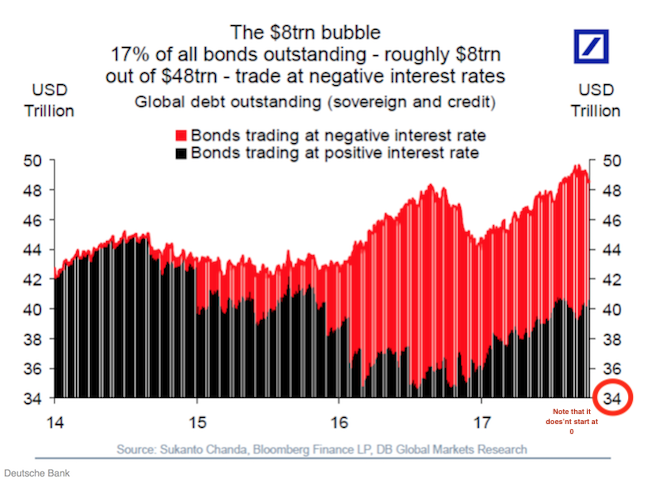
To market to market to buy a fat pig. Imagine going to your bank to apply for a home loan and the bank tells you that they will pay you to take out the loan. Up until 2014, it was generally thought that interest rates had a floor at zero; in economics class, negative interest rates was talked about in the same breath as unicorns and Bigfoot.

Here is how the mechanics work for governments, Country G goes to the markets saying they want to borrow EUR 100 million for a year. The market comes back to them saying, thanks to the significant amount of cash sloshing around and low inflation rates, we will give you EUR 102 million now, and in a years time you pay us back EUR 100 million.

Some people are blaming central banks for the current situation, but the reality is that, if central banks were out of step with underlying economic forces, inflation would be spiking. Given that inflation has been nowhere in developed economies, shows that demand and supply forces for cash are still heavily overweight supply. Around 17% of all government debt currently has a negative yield; hard to believe.


The best argument I have heard for the current situation is that due to new companies not needing as much capital to grow, there is a much higher supply of cash than there is a demand for it. In the last century, your largest corporations where capital-hungry industrials, who were building cars, aeroplanes, power stations and oil rigs. Now your most valuable companies are high margin, low capital requirement companies. Take Facebook for example, even though they are a very young company, it has $35 billion in cash. Even with revenue growth of 60%, they can't spend the cash coming in fast enough!

Market Scorecard. Markets inched their way forward again on Friday, to close at fresh record highs. The Dow was up 0.13%, the S&P 500 was up 0.09%, the Nasdaq was up 0.22% and the All-share was also up 0.22%. Reporting their 3Q numbers today is the high flying Netflix, the stock is up 61% YTD.

Moving closer to home, after the market close on Friday Aspen reported an investigation by the UK Competition and Markets Authority. The investigation is still in its information-gathering phase and may not go further than that; depending on what they find. From where we sit it looks like governments are just jumping on the 'investigate Aspen' bandwagon, score a few political points. The drugs in question had revenues of around GBP 11.1 million (around R185 million) out of group revenues of R42.1 billion, making them less than 1% of group revenues. Even though it is minimal for them, it is still frustrating to have this cloud hang over the company.


Linkfest, lap it up

One thing, from Paul

This week on Blunders: Kobe Steel not up to scratch, Kaspersky anti-virus software sends your files to the KGB, SAA has sucked in R50bn of our cash, and McDonalds screws up launch of "Rick and Morty" Szechuan sauce - Blunders - Episode 76.


Byron's Beats

Corporate America is obsessed with Amazon at the moment. Many businesses are worried that Amazon will come after their sector and completely dominate. This Quartz article titled These are the businesses still immune to Amazon covers a Morgan Stanley survey which looked at which consumer sectors would be most resilient to the online giant.

I was especially interested to see home furnishings fairly high on that list. Steinhoff is a big holding of ours and could fall in the firing line. Although I believe online retail will feature in this sector, buying such items is a big decision and most often requires you to see and feel the product before making a purchase.


Michael's Musings

Visa recently completed a research paper on what value moving away from cash would be worth to the global economy - Cashless Cities: Realizing the benefits of digital payments. Their conclusion was, going mostly cashless could add $470 billion to the global economy. Not bad considering that all you are doing is changing a method of payment. The gains come in the form of easing the ability to transact, lowering crime numbers and increased tax revenues.

Imagine paying R6 500 a month to rent 18 square meters! As more of the globe's population becomes urbanised, these micro-apartments will increasingly become the norm. Expect people's hobbies to move toward those that don't take up storage space; golf is probably out then - 28 crazy pictures of micro-apartments around the world

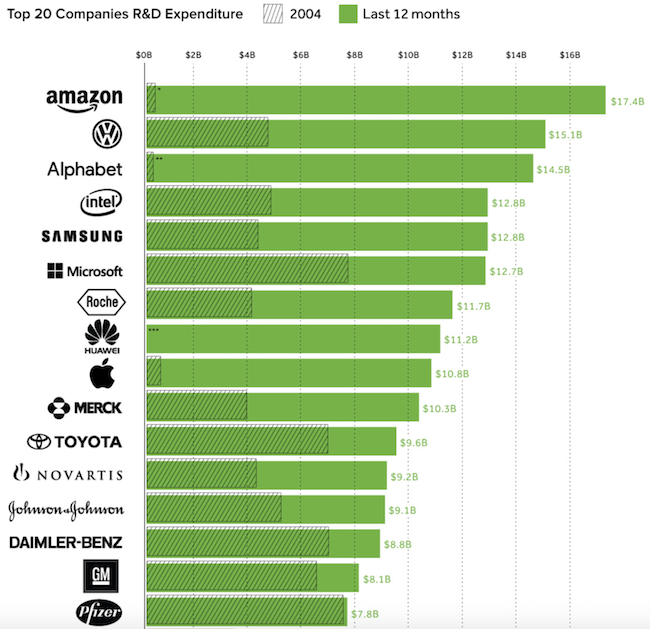
Having a large budget for R&D helps build a moat between you and your competition - The Global Leaders in R&D Spending, byCountry and Company.


Bright's Banter

The publication, Institutional Investor, has a really cool video series edition called "War Stories Over Board Games" where different investment managers play their board game of choice and talk about markets, their careers, experiences etc. over the years that they have been in the game.

My favourite so far has been Howard Marks where he talks about what to do in times of turmoil as an investor. He's famed for investing $500 million a week, from June 2008, right in the midst of the financial crisis, all the way to January 2009.

Marks says in retrospect, all you had to do to make money in the financial crisis is to have money to spend and the nerve to spend it. You didn't need caution, conservatism, risk control, patience, selectivity, discipline or any of those things; all you needed was money and nerve! He does emphasise the fact that you do not need these all the time because money and nerve will get you killed.

Here is the brie 4-minute video on a few lessons on contrarianism from Finance Royalty: Howard Marks Confronts The Nightmare


Home again, home again, jiggety-jog. Thanks to a weaker Dollar, Gold is back above $1 300 an ounce, and platinum is heading back toward the phycological $1 00 mark. Aspen has opened down around 1% this morning, hopefully this week doesn't reverse the strong gains made last week.


Sent to you by Team Vestact.

Email us

Follow Michael, Byron, Bright and Paul on Twitter

078 533 1063
Friday, 13 October 2017

A Plumber and an Investor


To market to market to buy a fat pig. Yesterday JP Morgan posted better than expected numbers. Following results is the customary conference call by management. On the call things looked to be turning toward a bitcoin conversation instead of a JP Morgan conversation, the CEO Jamie Dimon had to make things clear 'I'm Not Going to Talk About Bitcoin Anymore'.

Sticking with Bitcoin, the price surged over 10% yesterday breaking $5 000 for the first time and currently sits at around $5 500 a coin. You know my view on it, I think it is a bubble. While searching for reasons to defend my opinion, I was reminded that Alan Greenspan, the Fed Chair in the 90's spoke about 'Irrational Exuberance' in stocks (tech stocks) around three years before the bubble finally burst. Given the passion of those buying bitcoins and the current momentum in the price, I can very easily see that price climbing for the next year or two. I wouldn't be surprised to see the price double from here.

You might say, if I'm so sure it is a bubble why don't I short Bitcoin? I'm currently reading a book about Charlie Munger, and the central theme of the book is stick to your expertise and avoid things that are too complicated. I'm going take their advice and stay out of the Bitcoin market. It is fascinating to watch the price movements from the sidelines because I have no money riding on what happens.

Market Scorecard. Unfortunately, yesterday wasn't a green day; it was a very light shade of red across the board. The Dow was down 0.14%, the S&P 500 was down 0.17%, the Nasdaq was down 0.18% and the All-share was down 0.04%. The stock market is on the verge of making history, if the total return (capital growth plus dividends) for the S&P 500 is positive in October, it will be the first time since records have been kept that the first 10-months of the year have had positive total returns.


Linkfest, lap it up

One thing, from Paul

Here is some weekend listening for you.

Ray Dalio is the founder of the world's largest hedge fund, Bridgewater Associates. They have about $160 billion under management, and are based in Westport, Connecticut, in the US.

I have always thought that Dalio was a nutcase, based on his rambling, disconnected public statements. He runs Bridgewater like a religious cult, promoting an odd theory of "radical transparency". He is the author of the new book, Principles: Life and Work which discusses this concept, amongst others.

This is from Wikipedia: "According to Bloomberg, Bridgewater uses an investing system that combines traditional diversification with wagers on or against markets around the world and attempts to invest in instruments and markets that do not "move in lock step" with each other.

Huh? I have been waiting for the fund to blow up for years, to no avail. They continue to do well.

Anyway, here is a 90-minute long interview with Dalio, conducted by Shane Parrish of the Farnham Street blog - Life Lessons from a Self-MadeBillionaire: My Conversation with Ray Dalio


Byron's Beats

Over 1.2 billion iPhones have been sold since Steve Jobs introduced them to the world in 2007. Of course, the iPhone has transformed and evolved over the last ten years. These devices are quite incredible and we probably take them for granted. This article takes a closer look at what these phones actually look like inside. I find the battery component very interesting, especially how much bigger they have become since the iPhone 3. Rumour has it that the iPhone X is going to take longer than expected to get to market. I cannot wait to get my hands on one of those, hurry up Apple! - What's Inside All the iPhones


Michael's Musings

You don't want to be blacklisted in China! Interestingly, the unintended consequences here might be that people take less risks and start fewer businesses - China to create national name-and-shame system for 'deadbeat borrowers'.

    "Meanwhile in Jiangsu, Henan and Sichuan provinces, the courts have teamed up with telecoms operators to create a recorded message – played every time someone calls – for those who fail to repay their loans. The message tells the caller: 'The person you are calling has been put on a blacklist by the courts for failing to repay their debts. Please urge this person to honour their legal obligations.' "


Thinking of taking a sabbatical or moving? Here is how far your cash will go when looking to rent - Where Renters Get the Most and Least Space. Imagine spending R20 000 a month to rent a space big enough for a bed, shower and nothing else!

Infographic: Where Renters Get the Most and Least Space | Statista You will find more statistics at Statista

The race is still on for the first listed company to reach a market cap of $1 trillion dollars. The main contenders are Apple, Amazon and Alphabet (Google) - Google has 'the right pieces inplace to win the race' to a $1 trillion valuation. That is assuming that Saudi Aramco doesn't list before any of these companies can cross the finish line; the Saudi oil giant could have a market cap of as much as $10 trillion!


Bright's Banter

Joel Greenblatt is a hedge fund manager and founder of Gotham Asset Management. He is also a writer of a few books on value investing and special situations investing including "The Little Book That Beats The Market". He's had many successful investments, however he's famed for not backing Dr. Michael Burry's strategy of shorting the housing bubble during the lead up to the financial meltdown of 2008. Joel had invested a lot of capital in Burry's business and even features in a scene in the movie "The Big Short" where he disagrees with Burry's thesis. I personally prefer the book as always.

His investment philosophy is simple, he's from the same school of thought as Warren Buffett on trying to jump over one foot hurdles instead of looking around for ten foot hurdles to jump over.

He believes in looking in the right places and the right sectors. He makes an example in his book where one of his kitchen pipes get sblocked and he calls in a plumber to come fix it. The plumber comes in and bangs on the pipe once and says thanks that'll be $200, furious he replies "surely that can't be $200 you just banged the pipe" the plumber replies "no you're right, it's $5 for the bang and $195 for knowing where to bang".

Here's an article on what he thinks about diversification - Joel Greenblatt Secret Diversification Not Owning Stocks


Home again, home again, jiggety-jog. Next week is the Chinese National Congress, which happens every five years. The congress will layout the goals and plans for the next five years in China, so it is a big deal. On Monday, Netflix reports, those numbers are always fun to read. Asian markets are green this morning, unfortunately our market hasn't followed suit, we have opened in the red on the back of a stronger Rand.


Sent to you by Team Vestact.

Email us

Follow Michael, Byron, Bright and Paul on Twitter

078 533 1063
Thursday, 12 October 2017

Earnings Season Baby!


To market to market to buy a fat pig. Earnings season is now open! Blackrock kicked things off yesterday with a top-line and bottom-line beat, hopefully a sign of things to come over the next few weeks. Today the big names are Citigroup and JPMorgan, and tomorrow the first Vestact stock reports in the form of Wells Fargo.

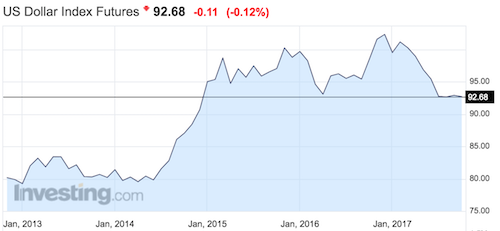
The expectations for this earnings season is something along the lines of, most companies should beat their guidance. Generally management set guidance at the low end, to manage expectations and give themselves a fighting chance to beat expectations. The Dollar is weaker than it was this time last year, which for multinationals means their foreign profits are worth more in Dollars. Do you remember in 2015 when most US companies were missing their profit numbers because of the strong dollar? See below the movements of the Dollar over the last 5-years; you can see why 2015 reporting numbers struggled.


Market Scorecard. More green and more records across the the board, albeit small gains, gains none the less. I am reminded of the market adage, 'The bull takes the stairs and the bear takes the lift'. When things go up, our human instinct is to be sceptical and wait a bit to see if we can buy it at yesterdays price, meaning we generally don't see pricing rapidly increasing. When prices drop though, our survival instinct kicks in; 'sell now ask questions later' leading to prices dropping quicker. The Dow was up 0.18%, the S&P 500 was up 0.18%, the Nasdaq was up 0.25% and the All-share was up 0.24%.


Linkfest, lap it up

One thing, from Paul

Blackrock has more assets under management than Vestact. Its true, we only have R3.2 billion of aggregated client funds to look after, and they have almost $6 trillion.

They are the world's largest asset manager, with headquarters located in midtown Manhattan. A big part of that is the money they run for the US government, the US Federal reserve and other bond investors. They also offer lots of pension funds, and retail equity funds. In addition, they own the iShares exchange traded funds (ETF) business, which Barclays stupidly sold to them just before ETF investing really took off. That's bringing in lots of money now - BlackRock closes in on $6 trillion in assets as index funds boom


Byron's Beats

It's all about content! Yesterday Apple really stepped up to the challenge by announcing the remake of Steven Spielberg's science fiction series Amazing Stories. The company plans on spending $1bn on original productions next year after hiring a few big hitters in the industry. A far cry from the $7bn Netflix plan on spending but still a start. Apple have over $250bn in cash and over 1 billion devices online. If this starts to take off, expect more amazing tv shows available that you never have the time to watch - Apple's Steven Spielberg deal shows it's going big in it's original programming push.


Michael's Musings

I think this is a great idea from Microsoft. For Microsoft these firms will be future customers and for us, technology is being pushed along - Microsoft is holding a $3.5 million competition to find the next great garage startup - 'like American Idol'

If you own a tax free investment account, make sure that your funds are going into the lowest cost ETFs - ETF: TER wars. For retail investors, increased competition has been a great thing.

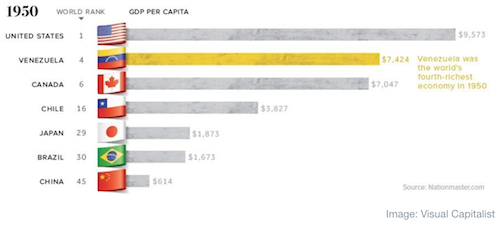
I didn't realise how far Venezuela has fallen. Money was easy because they had large oil reserves, there was no need to be prudent with spending and no incentive to diversify the economy - Venezuela was once twelve times richer than China. What happened?. The final paragraph of the article sums things up nicely:

    "And while the current condition of Venezuela is a tragedy in itself, the country's inability to live up to its true economic potential is nearly just as devastating."


Bright's Banter

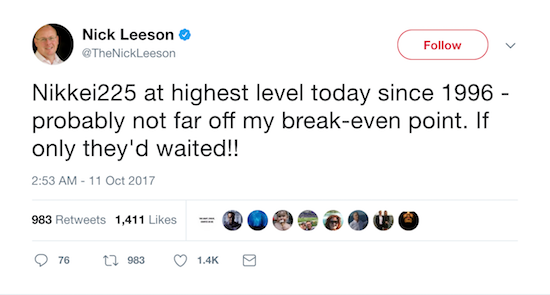
On my "Beers & Small Caps" WhatsApp group this morning someone posted the tweet below by Nick Leeson. Those who do not know who Leeson is, he's the trader that single handedly sent the Barings Bank straight to purgatory when working for a division of the bank in Japan. For more info on how he did it you can read the book Rogue Trader and for those who hate finance jargon (snorefest) you can just watch the movie Rogue Trader which wasn't that bad if you ask me. Here is the trailer .

The joke on the tweet is of course that had Barings Bank held its positions, they still would've broken even at the Nikkei's most recent all time highs.


Home again, home again, jiggety-jog. Asian markets are green this morning along with our market. The gold price is just shy of the $1 300 mark, currently at $1 297; later today South Africa's gold mining production number is released.


Sent to you by Team Vestact.

Email us

Follow Michael, Byron, Bright and Paul on Twitter

078 533 1063
Wednesday, 11 October 2017

Robotaxi, Write That Down


To market to market to buy a fat pig. Yesterday the IMF released their World Economic Outlook report, which gives an update on their forecasts of growth for this year and for next year. For the globe as a whole, the report was positive. Last year global growth came in at 3.2%, the IMF forecasts that for 2017 it will be 3.6% and for 2018 it will be 3.7%. Added to that, 2017 is on track to be the first time in a decade that every region grows. Growth solves a multitude of global problems, it is good to see the engine is ticking over smoothly.

Unfortunately, the South African growth forecast was lowered from 1% to 0.7% for 2017 and for 2018 it was lowered to 1.1% from 1.2%. With global growth on the up, blaming the rest of the world and financial crisis of 2008 for our lack of growth isn't remotely a valid excuse anymore. Our lack of growth is a home grown problem and until we accept that fact, things can't change. When you think that 17.2 million South Africans go to bed hungry every night, I feel a mixture of anger and sadness around all the own goals that we score. If history has taught us anything though, it is that us South Africans are a resilient and resourceful bunch.

Market scorecard. After the blip of red on Monday, US markets were back to their green ways on Tuesday. The Dow was up 0.31%, the S&P 500 was up 0.23%, the Nasdaq was up 0.11% and the All-share was up 0.17%. Reading a report on Naspers this morning, generated by a major US investment bank, their estimate is that the Naspers share price will rise between 20% and 120% over the next 12-months. The focus of the report was that Naspers is currently trading at a 42% discount to their NAV. The price target is an educated guess at best and these guys are wrong all the time, so don't take it to heart. What is not a guess is the current discount to NAV though.

Mark Mobius of Franklin Templeton was saying, forget about selling/unbundling the Tencent stake, rather the company should just buy back shares to take advantage of the massive NAV discount. If Naspers went down that route, the NAV gap should close over time, and not to mention that the return on their own shares could be better than many of the other companies they are looking at investing in.


Company corner

Byron's Beats

Nvidia, the graphics chip maker, is soaring to all time highs. Yesterday it closed at $188.93 a share, up 77% year to date. Over 5 years it is up 1320%. The reason for this? Gaming, Artificial intelligence, self driving vehicles, data centres and cryptocurrencies all require graphic processing chips. Nvidia is one of the leaders in a sector that is booming. Yesterday Nvidia released a statement titled Nvidia Announces World's First AI Computer to Make Robotaxis a reality. Robotaxis, is that even a word? I am sure it will be soon! Here is an extract from the release.

    "NVIDIA DRIVE PX Pegasus will help make possible a new class of vehicles that can operate without a driver -- fully autonomous vehicles without steering wheels, pedals or mirrors, and interiors that feel like a living room or office. They will arrive on demand to safely whisk passengers to their destinations, bringing mobility to everyone, including the elderly and disabled."


Linkfest, lap it up

One thing, from Paul

What really makes older people happy? Is having a lot of money the most important thing? Or is being healthy and having good relationships with those around you more important?

To find out, researchers at the University of Michigan ran a survey of over 26,000 Americans over the age of 50, interviewing them every two years, starting from 1992. The results suggest that having good spousal and friend relationships have the greatest impact on creating life satisfaction during retirement. However, being physically and mentally healthy comes before everything else (those in poor health can't concentrate on much else). As for money, having enough to indulge in leisure spending leads to higher satisfaction, but other types of spending are less significant. Also interesting was that relationships with grown-up children are not really that indicative of happiness amongst older people.

You can read the summary paper here - Spending, Relationship Quality, and Life Satisfaction in Retirement


Michael's Musings

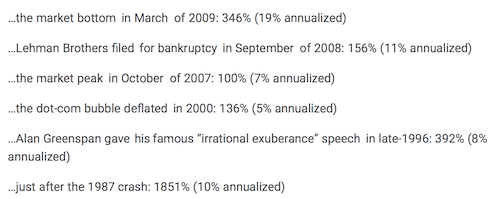
With regards to the market and statistics in general, the point where you draw a line in the sand has a very big impact on the results that you generate - Reference Points.


With the surge in the price of bitcoin, it is becoming more profitable for hackers to gain access to computers for their computing power instead of the potential data they can steal - Forget stealing data - these hackers hijacked Amazon cloud accounts to mine bitcoin.

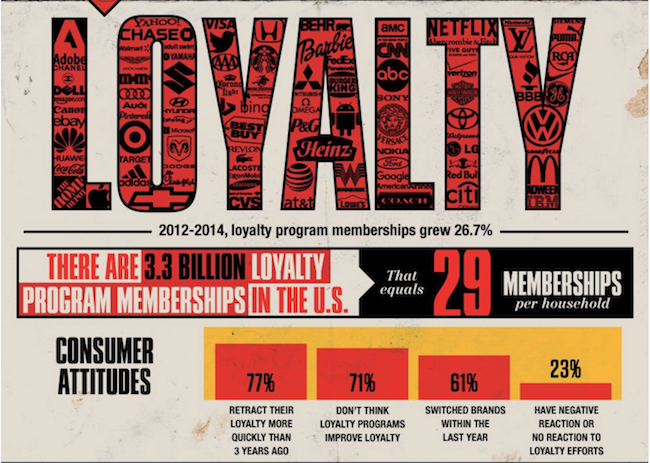
A brand signifies a quality standard, a set of values or a lifestyle association. With the number of brands increasing and competition heating up, companies are having to work harder to get their brand to stand out from the pack; good news for the consumer, not so good news for company's bottom line - Is Brand Loyalty Dead?


Home again, home again, jiggety-jog. Asian markets are flat to green this morning, with the Nikkei reaching a 21-year high. Data out of the US today includes, FOMC minutes and JOLTs (Job Opening and Labor Turnover) numbers. Dischem was up over 8% yesterday after a favourable trading statement, lets see how they go today.


Sent to you by Team Vestact.

Email us

Follow Michael, Byron, Bright and Paul on Twitter

078 533 1063

Tuesday, 10 October 2017

Burnt Burgers


To market to market to buy a fat pig. Behavioural Economics is a relatively new branch of the economics field. In economics there are many assumptions made in our models, the main assumption is that people/agents are rational. The first thing Behavioural Economics tells us is that people are far from rational.

Yesterday's winner of the Nobel Prize in Economics was Richard Thaler, one of the leaders in Behavioural Economics. You might remember him from the movie The Big Short (Before winning the Nobel Prize, Richard Thaler cameoed in an Oscar-winning film - with Selena Gomez). Here is a cool article about some of the irrational decisions you make, most of the time unknowingly - The flaws a Nobel Prize-winning economist wants you to know about yourself.

One of the things Thaler pointed out is how changing the way a pension plan is presented makes a huge difference. Going from, 'do you want to opt-in for pension' to 'pension is the default, do you want to opt-out' has made a significant difference in the US. Thaler estimated that over $7.6 billion extra is saved annually thanks to that small change.

Another irrational behaviour picked up is that we generally think we are better than the average. For example 92% of drivers think they drive better than the average. If you think that you don't make the same mental mistakes as the average person, you are probably wrong (your first mistake). Investopedia has a 12-part blog post on the different errors we make, Behavioural Finance. Some of the topics include 'Gamblers Fallacy' and 'Confirmation Bias'.

Market Scorecard, the Nasdaq's 9-day streak of record highs came to an end yesterday. The Dow was down 0.06%, the S&P 500 was down 0.18%, the Nasdaq was down 0.16% and the All-Share was up 0.52%. I would say that as long as Naspers continues to charge higher, our market should stay in record territory. Naspers is now above R3 200 a share. This week marks the start of US earnings season, if all goes according to plan, earnings will be higher which could spur a 'Santa Clause rally' going into the end of the year.


Company corner

Byron's Beats

Yesterday after the market closed, Famous Brands released an ugly looking trading update. The main focus was on GBK, their recent acquisition in the UK. That business produced a loss of 872 000 pounds. Here is what they had to say about GBK.

    "Disappointingly, GBK recorded a PBIT loss of GBP872 000 for the period. This loss is primarily attributable to the prevailing adverse trading environment in the UK, however, as noted in the update, the Board of Directors ("the Board") is confident that innovative interventions currently being implemented in the business by management will have a positive impact on future performance. These measures include intensified focus on the management of new restaurants opened, improving operational efficiencies, and enhancing cost controls - including curtailing the opening of further restaurants in the short term given the high pre-opening capital costs, averaging GBP1 million per store."


Another South African company hurting in the post Brexit British environment. The problem for Famous Brands is that they used to be debt free and a good dividend payer. After this acquisition they now have financing costs of R138 million. Usually an acquisition like this would at least be earnings accretive. GBK is making a loss.

Because of this, headline earnings per share are expected to be down between 54%-63%.

Famous Brands have an incredible track record at making restaurant chains successful. We should give management more time to implement what they set out to do when they made this acquisition. The stocks is down heavily today, we do not think it is a good idea to sell after a knee jerk reaction. Let's be patient here.


Linkfest, lap it up

One thing, from Paul

I liked this blog post by David Merkel, about the virtues of keeping things simple when investing.

These are his top points: keeping things simple (like in a portfolio of direct equities) means that your holdings will be understandable and explainable. You will avoid crazy fads, so there is less risk of something blowing up, and you being accused of being "too smart for you own good". If you own well selected companies you don't need to trade them. So your tax returns will be straightforward (and you'll pay less tax). Last but not least, simple investments don't have expensive, hidden asset management charges.

You will be happy to know that your Joburg and/or New York portfolios with Vestact checks all these boxes!

Go and read the whole post here - The Many Virtues of Simplicity


Michael's Musings

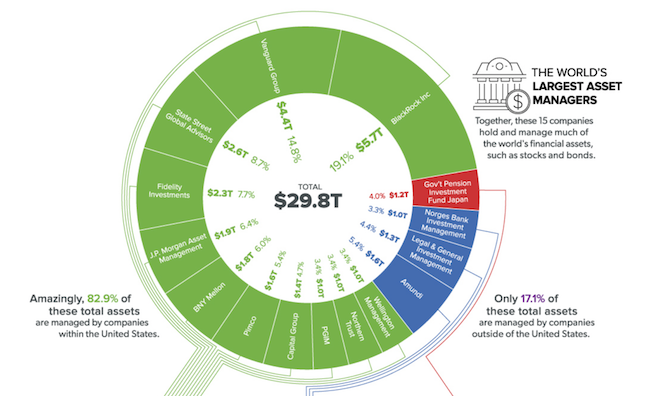
It is rather mind boggling that not one but fifteen companies have more than $1 trillion under management. Depending what exchange rate you are using, that is around 4 South Africas! - The Trillion Dollar Club of Asset Managers


Sticking with the tricks our brains play on us, I had never heard of the 'nocebo' concept but it does makes sense - Meet the nocebo effect, the placebo effect's evil twin that makes you feel pain


Bright's Banter

A friend of mine wrote this beautiful piece on transformation and feminism lite with regards to KPMGs new CEO Nhlamulo Dlomu. The gist of the story is that one of two extremes is inevitable. We will remember her as the knight in shining armour that came and saved KPMG from a near death experience or she'll go down in history as the woman who was assigned to save KPMG and failed dismally. I had the pleasure of meeting her last night, she's amazing and I wish her everything of the best in life - KPMG SA The Fallacy Of Feminism And Black Women In Leadership


Home again, home again, jiggety-jog. Asian markets are all well in the green and Tencent over in Hong Kong is up around half a percent, so expect a green start. Significant data for today is a Manufacturing Production read for South Africa.


Sent to you by Team Vestact.

Email us

Follow Michael, Byron, Bright and Paul on Twitter

078 533 1063