Showing posts with label Dow. Show all posts

Wednesday, 18 October 2017

Patient on Mediclinic


To market to market to buy a fat pig. The Dow broke through 23 000 points yesterday. Even though it is just a number, which has no real difference from 22 999 or 23 001, it is nice to have milestones. Having markers allows us to see where we have come from and the progress made; celebrate the small victories. I'm sure that market watchers get a shot of dopamine when we break through key levels, just like we get that high from likes on social media.

What is amazing to me is that in August 1987, the Dow crossed 2 000 points for the first time. If we keep at the same run-rate, the index should be above 230 000 in the next 30-years. The human mind struggles to compute the power of compounding. The question is, do you have the patience and the staying power to go along for the ride?

In November last year, the Dow broke through 19 000 for the first time. Since then it broke through 20 000 in January, 21 000 in March, 22 000 in August and now 23 000 in October. More interesting is that on its trip from 22 000 to 23 000, it was only down on six occasions. For more interesting facts about the market, follow Robert Hum on Twitter. Here is what he had to say about yesterday's close.



Market Scorecard. US markets continue to power ahead, our market unfortunately wasn't able to do the same. The Dow was up 0.18%, the S&P 500 was up 0.07%, the Nasdaq was down 0.01% and the All-share was down 0.48%. Our market was slightly in the red following the cabinet re-shuffle but from there onwards it just steadily drifted lower. We also saw weakness in the Rand immediately after the announcement but after a couple of hours, our currency was back at its previous trading levels.


Company corner

Bright's Banter

Private hospital provider Mediclinic International released their interim trading and operational update yesterday. This is the first trading update after the Thiqa regulations in Abu Dhabi on co-payments by citizens had been repealed by the King.

The group now has 75 hospitals and 29 clinics across its operations in Mzansi through the Mediclinic brand, Abu Dhabi and Dubai in the United Arab Emirates through the Al Noor/Mediclinic Middle East brand, and Switzerland through the Hirslanden brand. Mediclinic also has a 29.9% stake in Spire Healthcare Group in the United Kingdom.

Mediclinic said that on the group level, revenues were flat in constant currencies but up 9.5% in pounds to GBP1.4billion compared to £1.3bn in the prior year. Earnings before accounting items were up 5% to GBP231million compared to GBP 220million in the prior year. Earnings per share are expected to be 10% lower at around GBP0.115 compared to GBP0.128 in the prior year. As you can see, these aren't exactly blockbuster numbers. Shareholders pushed the share price down 3.2% yesterday extending the weekly losses to 7%.

Switzerland operations are still the powerhouse with 48% contribution to revenues with Mzansi operations coming second at 28% and Mediclinic Middle East contributing the remaining 24%.

The company reported that the Swiss operations were hit by the timing of the easter holidays and a subdued market during summer months. As a result revenues per bed day were flat. The Mzansi operations saw revenues increase by 4.1% to R7.6billion with a 7.7% increase in revenue per bed day in what management describes as a weak macro-economic environment that we are facing here at home.

The Middle East revenues were down by 4.7% and after once-off items they were pretty flat, but what caught my attention here was the huge improvement in Thiqa patient activity after the repeal of the co-payment requirement in Abu Dhabi. The quality of revenues should improve and the Dubai operations continue to do well.

Spire's earning were hit by Ian Peterson a surgeon nicknamed "the butcher" who apparently was jailed for performing unnecessary surgical procedures on patients. Spire made a provision of GBP27.6million before taking into account any potential recoveries from insurers, a potential cost of settlement relating to a civil litigation said the company.

It has been a very tough couple of years for Mediclinic and thats reflected on the share price which is down 27% over a one year period. We think the best times lie ahead for this business and long-term investors will be rewarded for their patience here, excuse the pun.


Michael's Musings

The graph below shows the power of a brand and nostalgia. Disney's huge lead is due to its appeal to multiple generations, from Frozen for the young to Star Wars for older folk - Licensed Merchandise Is a Billion-Dollar Business. As the article points out, Netflix is quickly building many hit shows and brands that will be used for merchandising further down the road.

Infographic: Licensed Merchandise Is a Billion-Dollar Business | Statista You will find more statistics at Statista

It was only a matter of time until Uber became the king of New York city. July was the first time that more rides were done with Uber than with a yellow cab - New York City yellow cabs have taken a back seat to Uber. As a tourist to New York I found using Uber much easier, I didn't have to navigate the minefield of hailing a cab on a busy street and there was no pressure around, "How much should I tip the driver?". I even asked a New Yorker what the tipping guideline was, he just said "tip what you feel is fair"; which didn't help much.


Home again, home again, jiggety-jog. Our market is flat this morning, inline with most of the Asian markets. South Africa's CPI for September has just come in at 5.1%, higher than the 4.9% expected, edging back to the top of the SARB's range. The MPC next meet at the end of November, so there is time for one more CPI read before then, but as it stands I wouldn't be expecting a rate cut just in time for your December holiday.


Sent to you by Team Vestact.

Email us

Follow Michael, Byron, Bright and Paul on Twitter

078 533 1063

Friday, 8 September 2017

Pricey Dow


To market to market to buy a fat pig. Yesterday stocks were all over the place. Locally the All Share sat in the red for most of the day and then around two o'clock started to tick up. The move up the page was supported by a weaker than expected jobs number in the US, which meant money flowed out of the Dollar and into other markets. US markets opened in the green, then fell in earning trading, recovered, fell again and finally finished mixed. Here is the scorecard, the Dow was down 0.1%, the S&P 500 was down 0.02% (flat?), the Nasdaq was up 0.07% and the All-Share was up 0.72%.

We talk about the above indexes daily but how many people know how they are compiled? Did you know that the S&P 500, is composed of 505 companies at last count and not 500? The Dow Jones Industrial Average, or just 'the Dow' consists of only 30 stocks. Something I didn't know until this morning, the JSE All-Share index has 165 shares, which covers 99% of the full market cap of all the stocks listed on the main board of the JSE.

A bigger difference between the Dow and the S&P 500 is how the index is compiled. In the S&P 500, as with the All-Share, the size of the company determines the weighting/influence a company's share price has on the index. The Dow, on the other hand, is weighted based on the share price of the company. So the higher the company's share price, the more influence it has on the index. For example, Apple is the biggest company listed, so it has the biggest impact on the S&P 500, a weighting around 3.2%, which is significant bearing in mind 505 companies are influencing the index. In the Dow though, the biggest influence comes from Boeing with a 7.47% weighting, Apple is 5th on the list with a weighting of 5.1%. A monster like Walmart has a weighting of 2.5% and GE, the first company that comes to my mind when people say 'blue chip', only has a weighting of 0.76%.

The low company count and price weighting system is thanks to the age of the index. It was first created in 1896, compared to the S&P 500 which was created in 1957, way before the days of computers which could do complicated computations to come up with an accurate index. For the first three decades of its existence, the Dow only had 12 stocks, and in 1928 it was increased to 30 stocks. Having only 12 or 30 stocks in the index, made it easy to update the index as prices were fed through by the ticker. Not having to worry about market caps for weightings allowed for simpler computation.

Through legacy, the one index most people have probably heard about is the Dow. Even though the Dow is very focused and has a weird weighting system, its performance, surprisingly is almost the same as the S&P 500. Over 10-years the Dow is up 66% and the S&P 500 is up 69%.


Linkfest, lap it up

One thing, from Paul

According to this Bloomberg article, Apple's corporate bonds are acting more and more like government debt. I'm not surprised. - Apple's Bonds Are Acting More andMore Like Government Debt

Which issuer do you feel is more reliable? A long-term bond issued by a global technology giant selling the world's most popular product at a premium price, and run by a whip-smart humanist (Tim Cook). Or sovereign paper issued by an over-indebted government becoming more unpopular by the day, and run by a weapons-grade narcissist (Donald Trump)? I'm not a bond investor, but I think that I'd take the former, thanks.


Why are we still holding Wells Fargo, didn't they have a have major PR and governance disaster?

We started buying Wells Fargo for New York clients in 2012 because we believed (as we do now) that US banks would improve margins as they went digital, and as they adjusted to tighter compliance levels. Wells Fargo was the best retail and corporate bank, in our view, as it had fallen least during the 2008/09 crisis. They don't really do any proprietary trading, derivative structuring or fancy investment banking deals.

We were certainly taken by surprise by the customer account ghosting debacle! Although few clients suffered any losses, and all have been repaid, there has been some loss of confidence. The CEO, head of retail banking and chair of the board have all been fired. Big executive bonuses were clawed back. Any staff member guilty of gaming the internal incentive programme has been fired. The cross-selling scheme has been dropped.

Our view now is that the worst is past them, and the upside from here is even more substantial. In time this unhappy chapter will be forgotten.


Michael's Musings

It was Buffett's birthday a few weeks ago, with birthdays comes some reflection and generally a longer term outlook - An amazing lesson from Buffett on his cake day. Josh Brown has a look at how Buffett's long term thinking has saved him from panicking when markets drop 30% - 40%.

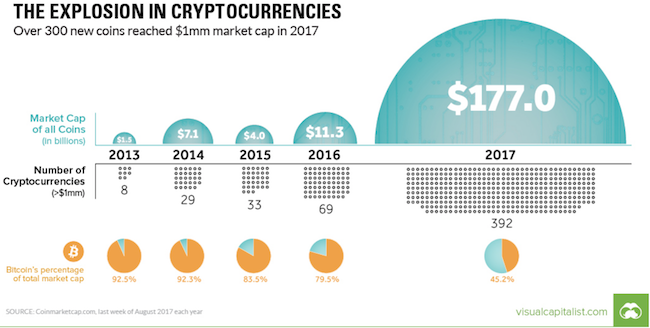
Thanks to the explosion in the price of bitcoin, everywhere you look people are talking about crypto currencies. I drove past a 'bakkie' the other day that had a sticker on it saying, "Ask me about Bitcoin" and gave a link to his new web page - The Unparalleled Explosion in Cryptocurrencies. I think there is only one certainty with crypto currencies at the moment, they are either wildly under-valued or wildly over-valued but not fairly valued.


If Elon Musk was not busy enough running two companies. He now has another project on the cards, underground tunnels - Elon Musk has ambitious plans for his tunneling company - here's what we know


Home again, home again, jiggety-jog. Our market is in the red again this morning but the good news is that Dollar weakness has pushed our currency to now trade around the $/R 12.70 to $/R12.80 range. It is rather quiet on economic news today, the most important thing to watch though, is Kevin Anderson's semi-final at 22:00. He is the underdog according to the bookies but he is only one step away from a Grand-slam final.


Sent to you by Team Vestact.

Email us

Follow Michael, Byron, Bright and Paul on Twitter

078 533 1063
Thursday, 26 January 2017

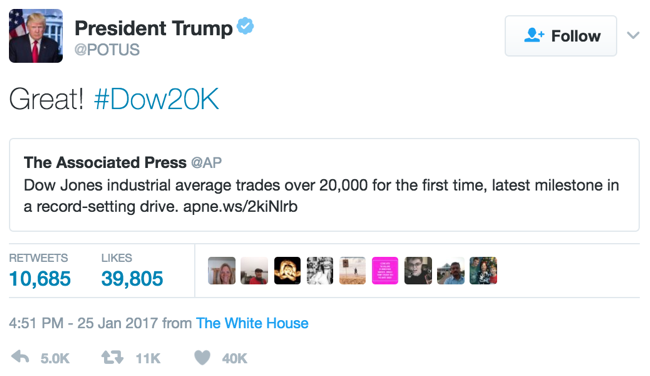
20 000!

"You can check out another *nice* milestones piece, from the first time the Dow crossed 1000 points in 1972 to present day. 1000 point milestones of The Dow, and then a table for ease of use The Dow's milestones. Just inside of 15 years to double from 1000 to 2000 points. From 2000 to 4000 took less than 8 years. From 4000 to 8000 took only two and a half years, those were the go-go days my friends. From 8000 to 16000 took over 16 years."


To market to market to buy a fat pig It is YUGE, it is amazing, everyone is amazed. I have a lot .... a lot of friends who think this is the biggest, the best and the greatest milestone of equity markets. This is tremendous, I have seen thousands (of points) of milestones, this is unbelievable. We are not weak, stupid or losers, nor are we morons, we are smart, very, very smart. Amazing, huge, tremendous. 20 thousand finally arrived for the Dow Jones Industrial Average, the index of 30 of the chosen stocks has more than tripled from the dark days of March the 6th 2009. That is right, tripled from then. To double from when the index first crossed the 10 thousand mark, on the 29th of March 1999 took 6513 days (including the starting and ending day). That is not tremendous.


Who else other than the people who are responsible for the data to celebrate and give you a whole lot of facts - The Dow and the world around it, then and now. Cher was a believer, Justin loved himself, like Cher. What a coincidence! The best fact of all is that Bill gates was the richest on the Fortune 400 back in 1999, he still is. What is hardly believable is that he is worth less on paper today than he was back then, in part as he has given some of that wealth away. To needy causes.

You can check out another *nice* milestones piece, from the first time the Dow crossed 1000 points in 1972 to present day. 1000 point milestones of The Dow, and then a table for ease of use The Dow's milestones. Just inside of 15 years to double from 1000 to 2000 points. From 2000 to 4000 took less than 8 years. From 4000 to 8000 took only two and a half years, those were the go-go days my friends. From 8000 to 16000 took over 16 years.

See how the components have changed over time - Ins & Outs. The last shuffle was done March the 19th 2015. What I find most incredible however is that there was a single fellow, by the name of Arthur "Pop" Harris, who spent 40 years on the job as an employee of the Dow Jones News Service, calculating the level of the index, on the hour every hour. From this section on the special of Dow 20 thousand - How the Dow Works:


Whilst GE has been in the Dow most of the time since 1896, Pop Harris was more synonymous with the Dow for four decades. We all learnt something new today, at least I did. Lastly, scroll through the Sizzlers and Fizzlers. If you have been invested for a decade or more, scroll through the Top Daily % Losses and also Gains, see if you recognise those 5 moments, out of 40 in total. 12.5 percent of all the top highs and lows happened in that post Lehman period, another reminder that those were dark (very) days. 2008 was also the third worst year, percentage wise, on record. That bleak year saw the Dow sink 33.84 percent. The S&P 500 had a shocker that year too, down 38 and a half percent. 2008 was bad, very bad.

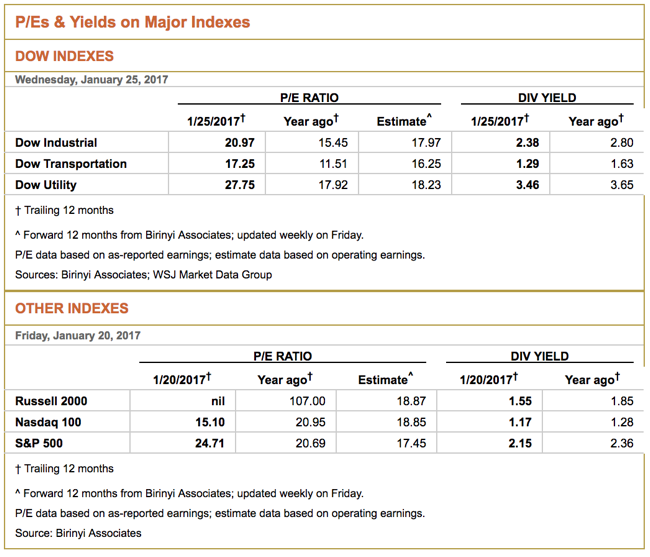
OK, history lesson over. Dow 20K has been reached, breached and is now a new level. 20068.51 was the closing level last evening, the intraday all time high is 20082. 2 minutes into trade was when the milestone was reached. As some dumb graph pointed out, each 1000 points added from here will reflect a smaller percentage gain. Last question, is it cheap or expensive? It does not matter what the level is, what are the valuations? Well, luckily there are resources for that - P/Es & Yields on Major Indexes.


The "other" indices also hit all time highs. True story. The nerds of NASDAQ closed up nearly a percent to 5656, the broader market S&P 500 added four-fifths of a percent to 2298, which is two points away from the Goldman Sachs 2017 target. Which means very little to me, market strategists. Eish, one shouldn't be like that.


Company Corner

JnJ reported their full year and 4Q numbers on Tuesday before the US market opened. Off the bat the market wasn't impressed with the forecasted numbers for the coming year, with the stock dropping 2%. The drop highlights how stock prices are current expectations of future profits.

Onto the numbers, sales grew by 2.6% to $71.9 billion for the FY, most of the growth came from the US where sales grew by 6%. On the international side, sales dropped by 0.9% mostly due to a stronger dollar. Earnings grew 7.6% to $18.8 billion for the FY. Thanks to less shares in issue EPS was up 8.5%. So not a small company by any measure. The reason for small top line growth but stronger bottom line growth is due to cost cutting on the "selling, marketing and administrative costs" segment.

The main thing that I think is attractive about the company is that it is 3 businesses in one company. Their main business is their Pharma division which had sales of $33.5 billion, growth of 7.4% and profits of $13.1 billion. Next in line is their Medical Devices business which had sales of 25.1 billion, small growth of 0.9% and $8.1 billion in profits. Then lastly is their consumer division which had sales of $13.3 billion, growth of 1.5% and profits of $2.6 billion. The strongest growing segment of the consumer division was Beauty which grew at 9.4%.

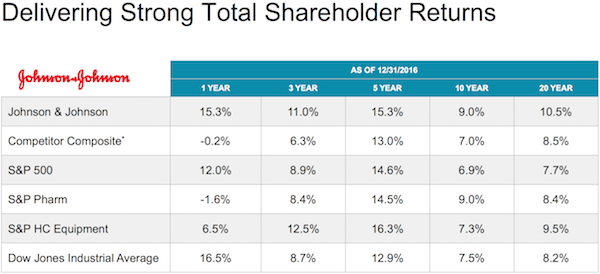
JnJ is one of those companies that ticks all the boxes. It covers healthcare, it covers new technology, it covers consumer products and it is an international player. Given its huge size the growth rates are never going to be eye watering but its size brings diversity and stability. Courtesy of the company here is how shareholders have done over the years. Still a buy in our books.


There was an industry insider who answered our message two days ago - Expect Analysts to Expect

    "The reason for the beat/miss part that makes all the big headlines is that as you know valuation is ultimately driven by expectations of future cash flows, of which future earnings estimates is a driver (well at least a proxy). The "market's expectations" of earnings estimates will hence drive the share price. The market's expectations are a function of analysis, discussion with management and debate within the industry (for example between the sell side and the buy side) hence while far from perfect, are as close as the collective can get to future expectations based on "reasonable" assumptions.

    I think the point is that the market is pricing in the average of expectations, whether the company likes it or not and whether they are right or not and therein lies the relevance of actual vs expected. Therefore I think it's fair to define the actual result as a beat or a miss because that's what it is, relative to expectations (because expectations, like it or not, are effectively "in the price").

    I think where I agree with you strongly is on a lot of market commentators relying just on whether it's a beat or a miss and not looking at the underlying reason which is obviously way more important. If Apple miss earnings because a one off drought in China that hurt disposable income in a big region or something i.e. a one-time impact this would be irrelevant (despite the big headline MISS) vs. if volumes are in what looks like a structural decline clearly the tone of the story/headline should be different.

    As a disclaimer I am in the industry hence do the excel earnings rodeo. And I'll be the first to admit getting it 100% right is a rare experience!


To which I replied:

    1) Your profession is one that requires exceptional insight, you cannot be in your position without being at the top of your game. Your skills in actually picking the stocks is underutilized in the investment game, more research analysts should be portfolio managers is what I am trying to say.
    2) I know that ultimately it depends on what the market is willing to pay today, based on the news we have, and the ability to predict (as much as three years forward) what sales, margins and earnings are likely to be, that is how the price is set.
    3) Some stock prices are perpetually cheap or expensive, and applying one earnings litmus metric across the board is wrong. Luckily in recent years I have seen a change away from this practice. This then makes it harder to predict which stock in which industry is relatively cheaper or more expensive.

    You are amongst the smartest people in the industry and are forced to stick your proverbial member on the block, and all the industry cares about is what price you set. I would prefer a third party independent view of what they think the company is likely to do over a longer period of time, thus setting yourself up for fewer potentially embarrassing moments, that need not arise.

    Some stocks that the industry gets wrong almost all of the time include (by no means comprehensive), Amazon, Facebook, Capitec, Tesla ... there are many. Anglo recently? Naspers? The market gets it right and wrong almost all of the time. Setting yourself a target price over 12 months seems more like a lottery to me. Smart people forced to conform to a norm, with a multitude of unknown factors.


Enjoy, these too and fro emails are always useful to the general public! He replied, I shall leave it there:

    "Agreed re:12 month targets and I think most of our clients largely look past these anyway and are generally more interested in long term thematic views. In fact the feedback we're getting as an industry is that we shouldn't even bother with results notes but focus on long term thought pieces, which makes more sense to me as well. The 12 month target obviously does try and capture the long term themes as most of us use a DCF for valuation (well we do certainly) rather than multiples but clearly trying to pinpoint an exact price on an exact date is going to be more than a little tricky. I think it's more the media that likes the beat/miss story which I guess is what a lot of Vestact's client base see (and panic over I'm sure!) hence all the more reason for your explanation in today's newsletter I suppose."


Linkfest, lap it up

Tired of traffic? If you are Elon Musk, commuting sucks so much that you plan to build a tunnel - Elon Musk says he's going to tunnel under his SpaceX factory soon. Does this fellow ever stop? Does he have large adrenal glands? One thing is for sure, he plans to continue to mix it up.

We have talked often about lower paying, labour intensive jobs under pressure from technology, this is another example - Is This Sewing Robot The Future Of Fashion? Fanuc are reportedly the largest seller of industrial robots, a Japanese listed business with a market cap of 4.6 trillion Yen, 39 billion Dollars nearly. Interesting, yes or no?

Do you use Facebook Messenger a lot? If so, expect ads like Instagram coming to your phone soon - Facebook begins showing sponsored posts in Messenger with small test in Australia and Thailand. We like Facebook a lot and continue to believe that they will monetise all of their platforms.

This happened so quickly, it almost takes your breath away. What are malls likely to look like in developed countries over the coming decades? Mall Owners Rush to Get Out of the Mall Business. We typically avoid these businesses for our clients.


Home again, home again, jiggety-jog. All we need now is a Roger vs. Rafa final (Venus and Serena are head to head Saturday)! T20, don't want to talk about that.


Sent to you by Sasha, Byron and Michael on behalf of team Vestact.

Email us

Follow Sasha, Michael, Byron, Bright and Paul on Twitter

078 533 1063
Tuesday, 20 December 2016

Nike swishes back

"Whilst some of the anxieties around losing market share to rivals, like Under Armour and a resurgence of competitor Adidas have been real, I think that they are a little overdone. Nike is still comfortably a solid growth business, having recorded now the 28th straight quarterly increases."


To market to market to buy a fat pig Stocks were up again. You remember the book from your childhood titled "The Little Engine That Could". Various versions are over 100 years old, and involves a much smaller train engine that pulls a long bunch over a steep hill, saying all the way to the top "I-think-I-can, I-think-I-can." Once the little train engine crests the hill and heads down, it says "I thought I could, I thought I could." You know the story as "The Little Engine That Could".

The Big Dow Jones that Could is still in I-Think-I-Can Mode. In other words, not quite there yet. And by there, I mean 20 thousand points. Whilst new levels are fun to reach, breach and stay there and beyond, they are really just a function of long term profits exceeding the past and inflation over time. There is nothing psychological or otherwise about a level. The old index of blue chip industrial stocks that are said to reflect the landscape of industrial American got close, no cigar though - 19,987.63 was the intraday high reached at the get go.

The index fell back a little over the course of the day, ending the session at 19,974, up 0.46 percent on the day. I suspect that all things being equal, and with the decent results overnight from the biggest laggard in the Dow, Nike, that the index may assault that level. What? These are not Normandy landings or any other such event, it is a level people!!! Wiki has a *nice* entry for Closing milestones of the Dow Jones Industrial Average. 1000 was first reached in November 1972, 2000 in January of 1987. 10,000 of course in May of 1999, when everyone was fearless. 15 years to double from 1000 to 2000, more than that (we are nearly there) this time around. From 4000 to 8000 took a mere two and a half years, the roaring 90's.

There is something called the "theoretical" all time high (if you scroll to the end of the article above), in which all the components are measured against their 30 stock component intraday highs. i.e. If Microsoft and Apple, Nike and Caterpillar, Home Depot and Cisco, Coca-Cola and Goldman Sachs were all trading at their day highs (during trade yesterday), the index would actually have breached the mark, and been at 20 thousand and 65 points. Alas, not everything goes up in a straight line together, winners and losers are kept separately on different boards.

CNN Money has a very useful Dow 30 Constituents board. Caterpillar the best this year, Nike the worst this year with Coke the only other noticeable loser. Anything on that list that is under 14.63 percent up for the year is an index underperformed, AMEX, Apple, Boeing, Cisco, Disney, Du Pont, GE, Home Depot, Intel, JNJ, McDonald's, Merck and Microsoft (just), Pfizer, Procter & Gamble, Travelers and Visa. All Dow Jones under-performers. More than half of the index prices have underperformed, as the index was led higher through the year by oil stocks and financials (and associated), Caterpillar, Chevron, Goldman Sachs, JP Morgan Chase and then one outlier, UnitedHealth (diversified healthcare and insurance business), are all above 30 percent up YTD.

So there goes, a summary of what could have been, what has happened and what may be today. As it stands, as I write this, the Dow futures are a fraction higher, we will just have to wait for now. The other indices? Well, they also closed in on record territory (a few points away now), the broader market S&P 500 added just over one-third of a percent to end out the session at 2270 points, the nerds of NASDAQ clocked an intraday all time high, up nearly half a percent to 5483. You see, the numbers are meaningless unless you can associate with them, 20 thousand has a nice ring to it, 5500 less so.


Back where home is, stocks were nowhere near the all time highs, emerging markets have lagged US markets. Rates and growth prospects have seen to that. Stocks did rally nearly a percent as a collective in a broad based rally, only the precious metal stocks lagged, both the gold and platinum mining indices were the noticeable losers on the day. There really was not much corporate news to speak of really, I guess the time of the year has everything to do with it.

Sappi and Aveng reached new 52 week highs, Sibanye was trading at a 52 week low, the stock has more than halved in just over three months, it certainly has been the worst of times for them. Growthpoint, Bidvest and Mediclinic were at the top of the majors pile, all up over 2 percent, whilst there were only a handful of stocks down in the Top40, in any meaningful way, Kumba, South32, Hammerson and Investec down three-quarters of a percent and beyond. For the record, stocks closed at 50,343 points, up 0.93 percent on the day. Our all time highs are from late April 2015, another 9 odd percent to get there I am afraid, and that is in Rand terms.


Company corner

Nike reported numbers last evening, for their second quarter, after the bell had rung for the close. It was a beat by most metrics that matter for folks that look at the headlines. I learned something new (which is always a good thing) yesterday, the chief executive, who is essentially a Nike lifer, Mark Parker was on the design team with Tinker Hatfield. So? Both of them actually were considerably good track athletes at university (college), where Tinker actually held the pole vault record at University of Oregon, where he was coached by Phil Knight's mentor and co-founder of Nike, Bill Bowerman.

Ah-ha. So, there is a theme here, all these fellows were once quality athletes at a regional level. Nike founder Phil Knight himself was coached by Bowerman and boasted a 1 mile best of 4 minutes and 10 second. Put that in your waffle shoe and run it. If Bowerman were still alive, he would be 106 next year, alas his time was up way before the tech bubble burst, he was much older and helped shape the Knights and Parkers, the Hatfields and co., the people that are Nike today.

Back then it was Blue Ribbon Sports (you must read the book Shoe Dog: A Memoir by the Creator of Nike), and they sold other shoes, a company that would eventually become Asics. My point is that the company management have all lived as athletes in the business, and have seen it grow sharply over the years to a 30 billion Dollar plus annual revenue company.

Nike has a slightly different cycles to many other businesses, their second quarter ended at the end of November, rewind 6 months and you come up with an April year end. Revenues for the quarter were 8 percent higher to 8.2 billion Dollars, diluted earnings per share rose 11 percent to 50 cents for the quarter. The company was pretty aggressive in their buyback in the quarter, buying 900 million Dollars in stock, as part of the 4 year 12 billion Dollar repurchase program.

So far, the company is at 3.1 billion Dollars, just over one-quarter of the way to the buyback target. For a reference point, at the market close last evening, the market capitalization of the business was 86 billion Dollars. So they are looking to, when the program ends, buy back around 10 percent of the company market cap as it exists now. That is pretty phenomenal, and what it does (provided all the shares are retired) is boost the earnings per share on the ones that remain behind. The same company earnings on fewer shares in issue.

The group does around 27 percent of all their sales in footwear in North America, 15.5 percent in apparel in North America (a little equipment sales) for a grand total of 44.6 percent North America. So, essentially it is easy to see why the analyst community see this as a home base company. Meanwhile (back at the ranch as they said in the old days), total sales in China exceeded 1 billion Dollars in quarterly revenue, up 19 percent on same currency sales across that territory. Western Europe was also strong, reporting same currency sales of 11 percent more than this time last year. Good strong growth in their two next biggest territories, which is encouraging, I am pretty sure that there has to be some currency headwinds at some stage.

From a profits point of view, Europe was hit by currencies, a strong Dollar definitely impacting on group margins too. Currencies are almost impossible to manage, damned if you do, damned if you don't is the sense I get, at least from the viewpoint of the analyst community. Whilst some of the anxieties around losing market share to rivals, like Under Armour and a resurgence of competitor Adidas have been real, I think that they are a little overdone. Nike is still comfortably a solid growth business, having recorded now the 28th straight quarterly increase.

Not only that, I suspect that some of the gizmos that we see (no shoelaces need to be tied ever again) will become more mainstream. Wearable tech. The technology really does change, just look at your latest and older shirts, shorts and shoes, and you will see that this is definitely the case. We continue to accumulate what is a well priced stock of an incredible business with great runway ahead, buy!

The anxieties over future orders seem to have dissipated a little, I suspect that there will be a little momentum for the stock in the coming days and weeks. And who knows, the laggard of the Dow Jones may well be the best catalyst for an assault on 20 thousand points for the Dow Industrials.


Linkfest, lap it up

Looking for places to go, with your hard earned cash? You may have to shell out more than usual here, some beautiful pictures over at Bloomberg - Best Photography of 2016. Ha ha, you have to love the rich people playing croquet in Napa Valley!

We take so many meaningless photos nowadays as the cost is relatively zero, and we can delete as many as we want. It wasn't always so, photos were a fine art back when the digital era didn't exist. So ... the WSJ explores The Best New Ways to Scan Your Old Photos. What you waiting for, get cracking during the holidays.

Bummed that your internet speed is not what you want it to be? South Korea wins again - Average internet speed by country as of 1st quarter 2016 (in Mbps). If you are rich enough to have a fibre line, you are better than most of the average speeds around the world, there is always an upside, right?


Home again, home again, jiggety-jog. Stocks across Asia are mixed, stocks locally have started mixed. Hey, who cares, the main focus will be the Nike numbers and Dow 20K later today. Or tomorrow. Or next week. And hey, there is a UK GDP read tomorrow!


Sent to you by Sasha, Byron and Michael on behalf of team Vestact.

Email us

Follow Sasha, Michael, Byron, Bright and Paul on Twitter

078 533 1063