Showing posts with label Bidvest. Show all posts

Tuesday, 31 May 2016

Famously well Branded


"When you own this business, you are leveraging off their ability to learn from the prior years of experience in manufacturing at scale and their ability to deliver timeously to their franchise owners. In other words, whilst the strength of their front end businesses is paramount and most importantly continuing to attract new (and retain existing) customers, the margin expansion in manufacturing continues to be more important."


To market to market to buy a fat pig Stocks had little or no guidance from either of the big markets globally, an unusual event in which we traded and no FTSE or no Wall Street. I suspect that there is possibly only one of these days per year. I found a rewind of five years back when the Bulls, Barca and the Bucs won on the same weekend, the good old days. I have converted to the Lions rugby team a while back, the highveld teams still have my heart however. A quick update for the record, now that Nike have thrown their weight behind Chelsea, I am liberty to say that I am now a returned supporter after years of being in the wilderness (and missed titles to boot). Special one or not, the blues now have an extra shirt wearer.

Who cares about my sports teams. I was thinking the other day, the players are allowed to change their teams, surely the fans should be allowed to? Or are you supposed to be married to the idea? Pfff .... enough of that. Recap from yesterday, stocks as a collective ended the session up just over two-thirds of a percent. Financials lower, pre-empting a ratings downgrade of sorts (or not) in a couple of days. In Germany stocks rallied a little, following a better Asian showing earlier in the day. The US futures market, which trades independently from the spot market during holidays, pointed to a greener opening through the day.

Nedbank, FirstRand, RMB and Investec were amongst all the losers, Aspen too (the Venezuelan situation is looking grim) had a day where the stock sold off over a percent. Remember that in their interim results "Revenue was unfavourably affected by R836 million due to the devaluation of the Venezuelan contribution." As far as I understand it, the opposition is getting a seat at the table with the bus driver. In the words of Merv Hughes to Javed Miandad (who called big Merv a fat bus driver, too un-athletic for cricket), tickets please! Socialist ideas may start with noble intentions, yet fail each and every time, they discount the human element. Tickets for the Venezuelan left, we wish. The collective capitalist we I use in this context.


Company Corner

Good news, Famous Brands results for the full year hit the screens yesterday morning. The same cycle over and over, the longer you do this, the more you get used to the fact that the company is going to report on the last Monday in May. These of course were for the full year to end 29 February - Famous Brands Reports Impressive 15th Consecutive Year Of Record Results. It is a pretty impressive track record and most especially against the backdrop of a consumer that was supposed to be under tremendous pressure. They are opening two stores a week here in South Africa, three a week across the group, and they refurbished four stores across the group per week of the financial year.

When you own this business, you are leveraging off their ability to learn from the prior years of experience in manufacturing at scale and their ability to deliver timeously to their franchise owners. In other words, whilst the strength of their front end businesses is paramount and most importantly continuing to attract new (and retain existing) customers, the margin expansion in manufacturing continues to be more important. If you can produce at scale, cheaper product to then on-sell to your franchise owners, that feeds straight through to the bottom line. Franchise owners have strict instructions in order to meet the lofty standards (that counts for all brands), which is why they have to buy everything from buns to serviettes from the company itself. In essence you are buying a logistics (huge network) business that services 2614 restaurants.

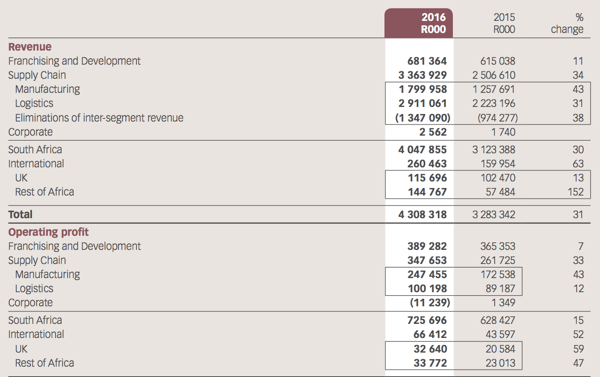
Herewith the divisional revenues and operating profits, equally across the different geographies. See that whilst Franchising and development profits grew only 7 percent, notice that the supply chain division (manufacturing and moving goods around) grew at a whopping 33 percent. Also quite noticeable was that the rest of Africa segment grew at an incredible pace. More importantly for shareholders, it is now bigger than the UK, in terms of revenues and profits. Still, the business is very South African, which isn't necessarily a bad thing:


If you recall last week the manufacturing division was dealt a shot in the arm, Famous Brands bought a french fries processing plant from Oceana. It is called Lamberts Bay Foods and currently processes 24 thousand tons of potatoes per annum. Of course remember that through their franchises such as Steers and Wimpy, the group sells a monster amount of french fries. There are over 600 franchised Wimpy's in South Africa, Steers has a similar number just below 600, there are 227 Fishaways, as you can see, nearly half of their brand presence needs french fries all the time.

The one that rich people talk about all the time is Tasha's, the founder Natasha Sideris still is very much operational. There are only 16 Tasha's, one in Dubai, one in Durban, one in Pretoria, four in Cape Town and the balance, the other half, here in Jozi. One in fact here in Melrose Arch where we are. I have been to 5 I think, including the one here. Yes, five. None outside of Joburg, as of yet. I recall seeing Tasha at the Sandton store, she was at the store on a Saturday morning being highly in tune with the restaurant. Getting staff to make sure presentation was perfect. I remember some plants were not quite up to scratch, there was a little dust on the top of a shelf, that sort of thing. Heck, I guess you don't get to be a highly driven entrepreneur without perfection. I wonder if she retained the 49 percent stake as per the 2008 deal, I guess she may have the finance backing of the banks if Famous Brands is the partner.

I think that is the other part of the model, recently Famous Brands have been looking for more casual dining experiences, fine dining without the pomp and ceremony. That is why they have been acquiring controlling stake in the likes of Salsa Mexican Grill (I have been there too, the single branch in Fourways is awesome), I think that one is going to be a massive hit. Lupa Osteria, the three branch spot in KZN, if any of you have been there, please let me know. Catch, there seems to also only be a single branch (as far as I can tell) in Bedfordview, my friends from the East, have you been there? And of course French bakery concept PAUL will be hitting our shores soon. A school dad will be running that business, I have had the time to chat to him and get insight, equally I have been to their bakery outlets in Paris, pretty darn awesome places.

What I find pretty amusing is that whilst the general rhetoric points to a gloomy outlook, the company suggests that they are opening 292 franchise restaurants this year. How bad can it be? They are adding in the next year over 11 percent to the existing base. Those stores will continue to require a strong manufacturing presence. As they say in the prospects column: "Famous Brands will continue to pursue further upstream manufacturing prospects and explore opportunities to grow the Group's presence in the casual evening dining segment, as well as outside of the traditional food service sector"

Howard Schultz was recently in South Africa for Taste Holding's opening of the Starbucks in Rosebank (I still haven't been), and being there a week after the actual opening, suggested that this market could be really strong in accepting of their brand. We like all the entrants in this space, Taste will have to execute carefully, they have the energetic management to do that, of that I have no doubt. The casual dining market, notwithstanding the current environment, looks in good shape.

As an investment, Famous Brands always looks (perpetually) expensive trading on (at the close yesterday of 121.45 Rand) a 22.5 multiple. Growing at that pace means that the PEG ratio (Price to earnings over the growth in earnings, which is 16 percent over the last 6 years) is 1.4 times. There is a very generous dividend policy of 1.3 times, the dividend for the year clocked 405 cents, after the 15 percent DWT (dividend withholding tax) the yield is 2.83 percent. Not a kings ransom, progressive nevertheless. We continue to own and accumulate the shares on weakness.


Big news, Bidvest and Bidcorp started trading independently of one another yesterday. This was well telegraphed, and you should have seen it coming from quite a mile away. It always catches one by surprise however, we luckily have built systems to be able to do this real time. The only thing unknown, and will be revealed on June 1 is the ratio, i.e. the price paid of the two respective businesses. We could see already that the there was a substantial rerating of both stocks, perhaps natural buying from funds and indices, perhaps a better understanding of the separate businesses and the value unlock that everyone has been waiting for.

For each 1 share of Bidvest that you held on Friday, where the stock closed up 4 percent to 370 Rand a share, you got one Bidcorp and one Bidvest, which effectively spun the offshore foodservice business off. The Bidcorp shares traded around 300 Rand a share (closed at 304) and the Bidvest (the South African assets) traded at 118 Rand, closing at 118.59. Add them together and you get around 422 Rand. Which is a WHOLE lot higher than the 300 Rand at the Nenegate event in December, a serious uplift of value.

The shares, based on the back of the matchbox ratio that I figured (0.292 for Bidvest and the balance 0.708 for the Bidcorp) closed higher. Much higher. Bidcorp closed up around 17 percent to 304 Rand and Bidvest at 118.55 Rand, up 7 percent. Together the stock added 52 Rand from the prior close, which means as a "whole", the market gave the different divisions a collective 14 percent higher. Yowsers. Is that for real, does Mr. Market really think that the two separate companies can operate that much better from one another? We will advise shortly on what we should be doing here!


Linkfest, lap it up

A similar study was done in England, the study is not too scientific due to them just comparing surnames from back then to surname's of the top tax payers - The richest families in Florence in 1427 are still the richest families in Florence

This is a nice problem to have and after seeing the images in this article I want to visit Iceland now too - Iceland plans Airbnb restrictions amid tourism explosion.

Due to low infrastructure spend in most African countries in the past, newer technologies are taking hold. Mobil operators for internet instead of fixed line operators and renewable energy instead of large powers stations that require power line infrastructure to transport the electricity - There's a logical reason why Africa's renewables landscape is better than a lot of much richer places.


Home again, home again, jiggety-jog. Markets across Asia are cooking, European markets are set to open higher. There is the small matter of non-farm payrolls this Friday, ADP data on Wednesday as the precursor to Friday and Fed anxiety is omnipresent.


Sent to you by Sasha, Byron and Michael on behalf of team Vestact.

Email us

Follow Sasha, Michael, Byron, Bright and Paul on Twitter

078 533 1063

Tuesday, 1 March 2016

Joffe and Buffett

"And then the all important Foodservice business, which grew revenues by 14.6 percent to 68.2 billion Rand, 30.3 billion Rand of that is the UK (up 27.3 percent increase on the comparable half), 14.4 billion Rand is Europe (up 13.4 percent), whilst Australasia was disappointing, revenues falling 2 percent to 14.5 billion Rand. The balance is the emerging market segment, which includes China."


To market to market to buy a fat pig Leap day finished, I don't know any leapers, those are folks that have their birthday on the 29th of February. A friend of mine got close, a couple in fact are born on both the 28th of Feb and 1 March. Nothing on the 29th. It is a problem when you have very few real life and even fewer Facebook friends. Poor me. My rule of thumb on Facebook is to make sure that you must go out of your way to at least wish your "friends" happy birthday. Yes.

Stocks in New York, New York slipped from their best levels in the middle of the session, where they were around four-tenths of a percent higher to slip into the close, down around three-quarters of a percent. Dragged lower unfortunately by healthcare stocks, namely one big biotechnology stock in the form of Valeant Pharma, that companies share price sank 18.44 percent on the day as news arrived that the company was restating results, plus the CEO had returned from medical leave. They had also canceled their conference call to discuss their results. And then the bombshell -> Valeant Under Investigation by SEC. I wonder what is going to happen now. Valeant on a price to sales metrics looks cheaper than many of their competitors, this may well be a defining moment in their history. Eish. Unfortunately this had a negative impact on all the stocks across the sector.

Fun arose during the course of the afternoon yesterday, Warren Buffett following on from the Berkshire results gave an exclusive to CNBC from his home town. Him and Charlie called politicians on both sides of the fence crazy. Warren Buffett CNBC Transcript, Feb 29, 2016. It is long and fragmented, it is however always worth a read. He always has some juicy pieces in there, and always takes his history into the equation:

    "And-- just take the 20th century. Stocks went from $66, the dollar average, $66 to $11,497 and-- and you were getting three times as much in dividends as the whole average were selling for at the start. And you had-- you had two world wars and you had a Great Depression, flu epidemics, all kinds of things. Yeah."


It is always going to look average in the moment, when you take a longer date timeline, which you should, returns are always more significant than they were. Buffet is amazing, the clout that he has over ordinary people quite simply when he says the same thing. It is funny like that, loads of people might say it, when Buffett says it, it is almost gospel.

Locally, in Jozi, Jozi stocks ended about flat. Barclays Africa Group have been under scrutiny from the market yesterday, that rolls into today, where the parent company have said that they are going to be selling their stake. In the Barclays (Parent) company's results this morning: "Intention to sell down stake in Barclays Africa Group Limited (BAGL) to a level which permits accounting and regulatory deconsolidation over the next two to three years" I guess that means that they are going to sell them to suitors, or to sell them in the market. Which explains why Barclays Africa (the old ABSA) was down nearly 6 percent yesterday. Jumping all over the place today, R141 a share as we write. On nearly 17 Rand worth of earnings and a dividend (pre tax) of 10 Rand a share. Wow. Makes you wonder where the floor is. Time will tell.


Company corner

Bidvest reported numbers yesterday morning before the market opened. We laughed in the office, there are supposedly so many similar characteristics when comparing arguably the best allocator of capital ever, Warren Buffett and Bidvest founder Brian Joffe, one of the best allocators of capital this country has seen. At least for the last generation, he has certainly done an amazing job, Joffe. The two companies reported on the same weekend, that can't be a coincidence, it was meant to be, hence the fact that we were having a good chuckle, Joffe often is called South Africa's Buffett.

Some of the numbers quickly, this was for the first half of their 2016 financial year, ending 31 December. Turnover for the half was 114.5 billion Rand, an increase of 9.6 percent, headline earnings per share increased 13 percent to 1001.5 cents. The dividend increased by marginally more than that, up to 482 cents per share. Net asset value (NAV) climbed 22.2 percent to 128.97 Rand a share. The Buffett metric that he always uses is that if the share price of Berkshire falls to less than 120 percent of book value, he is happy to buy shares back. NAV and book value are two very different things. It is however not unusual for quite a few holding companies to trade at a premium to their NAV. In this case, with the Bidvest share price closing at 357.29 Rand, the stock trades at a significant premium to their NAV.

Segmental breakdown quickly, firstly in terms of sales from South Africa, which contributes 45.2 billion of group turnover, automotive had understandably a tough year, registering a fall of 1.1 percent to 12.149 billion Rand. That division includes dealerships for almost every brand South African motor vehicle enthusiasts could ever think of, from Alfa Romeo to Toyota, Ford to BMW. It also includes Burchmores and McCarthy. The biggest business in terms of revenue contributions on South Africa is Freight, again this business had a real tough year, up only 1.7 percent when measured against the prior half year. As a separate division, the South African business managed to increase revenues by only 3.1 percent for the first half.

And then the all important Foodservice business, which grew revenues by 14.6 percent to 68.2 billion Rand, 30.3 billion Rand of that is the UK (up 27.3 percent increase on the comparable half), 14.4 billion Rand is Europe (up 13.4 percent), whilst Australasia was disappointing, revenues falling 2 percent to 14.5 billion Rand. The balance is the emerging market segment, which includes China. This business is going to be separately listed on the JSE after being unbundled from Bidvest, shareholders and the regulators have to give it the stamp of approval. From a profits point of view, the South African business, as you can see has lower revenues, higher trading profits. Here is the segmental breakdown of trading profit. It is important to note that the overseas businesses were flattered by the Rand weakness, relative to the Euro, the Pound and of course the Dollar (Asia).


The first thing I noticed is that relative to some of the other foodservice businesses, the Australian one is very profitable. It has higher trading profits than the UK business on less than half of the turnover. Equally the emerging market segment is quite profitable. So is the South African business. Which one has better growth prospects, however? Obviously the global Foodservice business, and I think that as a separately listed entity it may garner a higher multiple.

Does Bidvest however have peers in the global foodservice business? In the US there is a business that is roughly three and a half times bigger than Bidvest, Sysco, which trades on quite a demanding multiple of above 30 times historic, that unwinds to 22 in the current financial year. The yield is not bad at 2.8 percent currently. And forward to next year the multiple unwinds even further to less than 20 times. There is an unlisted business called Dot Foods, revenues of more than 5.5 billion Dollars makes them bigger than Bidvest. Unlisted however. There is another business called Houston's Inc. in the US that is also a competitor. Unlisted again. Equally, another business called Lagasse, Inc. the same applies, in the US and no listing. Wow. Makes you wonder whether or not Bidvest can do this expansion, if they want to have a go in the US. Big market though!

There is a big business in Europe (it is quite global too) called BRF, it is a Brazilian business in terms of its roots. The ADR listing according to Google finance says that the company trades on a 18 multiple, the market cap is over 10 billion Dollars, it is bigger than Bidvest. The share price in Dollar terms for BRF is down 44 percent over the last 12 months. I guess all of these businesses compare favourably to Bidvest, they do have on their side the ability to grow in Europe and Asia, which are different for two reasons. One, formal food services businesses have loads of room to grow, and secondly, perhaps there are cheaper businesses in Europe that are up for grabs. i.e. Cheaper prices, as Bidvest have demonstrated they can obtain.

Brian Joffe is however going to step down as CEO of Bidvest, he no doubt will be there in the background in a Jannie Mouton is to PSG type mould. Lindsay Ralphs who is head of the South African business is going to lead the new company, he is not that much younger than Brian Joffe, less than a decade. Joffe will stay on as an executive chairman in the foodservice business (and a non-exec in the Bidvest local assets), dealing with acquisitions as and when they arrive. Here goes a CNBC interview, where Bronwyn Nielsen interviews Brian Joffe -> Bidvest's founder Brian Joffe explains his future role in the group. Our first instinct is to hold the Foodservice business when it is unbundled and scrutinise the local business, seeing what value unlock there could be in the short to medium term.


Linkfest, lap it up

Africa is leading the way with mobile banking, Kenya already does 1/3 of their GDP over mobile money platforms. Somalia is the next African country to go mobile - More phones, few banks and years of instability are transforming Somalia to a cashless society. Data collected indicated that 40% of adults have a mobile money account. I was shocked to see that the GDP of Somalia was only $5.7 billion, to put that into context RSA has a GDP of around $300 billion and Buffett just reported a profit of $24 billion.

Information security is a growing space, with one of the big problems being insecure passwords. Biometrics allows us to bypass passwords (so no need to remember them or have weak passwords) and goes straight to your unique features - MasterCard Wants You To Pay For Stuff With Selfies. I think I will stick with a fingerprint scan for now.

I remember when Android came out it was a bit of a non-event due to the dominance of Blackberry - Android and iOS Are the Last Two Standing. Even though iOS only has around 16% of the market, Apple makes over 90% of the profits in the smartphone industry.

Infographic: Android and iOS Are the Last Two Standing | Statista
You will find more statistics at Statista

Google's self driving car got into an "accident", or a scrape really. Nobody was hurt or injured. The car did all that was asked of it, trying to get into a space that easily complied with the algorithm, the bus driver behind just had no manners and bumped it. The FT explains in this post: Google driverless car in road accident. Google said that they had updated their code to more deeply understand that buses and other large vehicles are less likely to yield to the driverless car than other ordinary passenger vehicles. Be nice out there, see!


Home again, home again, jiggety-jog. We will cover Steinhoff, their results were favourably received yesterday, "things" are going just fine for the time being. Stocks are mixed at the open here, stocks across Asia have done far better, Chinese PMI data was the worst in around half a decade. Yesterday the PBOC was in the business of easing, by cutting the Reserve Ratio Requirement. For the time being, a little wobble here, I do think that global confidence is returning a little.


Sent to you by Sasha and Michael on behalf of team Vestact.

Email us

Follow Sasha, Michael, Byron, Bright and Paul on Twitter

078 533 1063

Monday, 8 February 2016

Banks Stank

"And she may give some insight as to the path of their trajectory based on the data that they see. I was reading a Bloomberg article that suggested that the rate hike probability in March has gone from 50 percent at the beginning of the year (that is 40 days ago) to around 2 percent now."


To market to market to buy a fat pig. Another stinker of a session I am afraid, stocks slid across the seas and far away on the concerns around global growth and rising rates in the US. Again. And whilst the real groundhog day was actually last week (love that movie), this was another look at the same thing. Heavy volume and heavy selling through the session, until the last hour and a half of trade. Michael said to me this morning, this is the lowest the Dow Jones has been in 22 months, I swear that I had to look at a graph to believe him. Whilst the indices during the washout last year were lower on the day, stocks have not closed at these levels for that long.

April 2014 is the last time we were at these levels, happy year of the monkey everybody. Year to date the blue chip index is down over 8 percent. Tech stocks have been dished a beating, down nearly 14 and a half percent year to date and now trading at levels last seen in May 2014. The broader market S&P 500 was last at these levels at about the same time, the lowest close since 2014, of course there have been 52 week lows that have been worse. Year to date the S&P 500 is down around nine and one-third of a percent year to date.

Adding fuel to the fire is the fact that European banks (starting with Credit Suisse last week) are under pressure, stories that Deutsche Bank is facing, ummmmm .... problems, manifested over the weekend. If you read through this BusinessInsider article titled Deutsche Bank is at a record low and investors are once again scared of European banks. It seems like the Deutsche Bank ADR has been available for investors to buy since October 2001.

Since then, Deutsche stock is down 72.65 percent, the stock has lost nearly three quarters of their value, closing at 15.57 Dollars last night. At the height of the market in 2007 when financials were being fuelled by the subprime market (and the Dollar was in the toilet relative to the Euro), the stock traded at nearly 160 Dollars, 10 times higher than it is now. Lest you forget, when we were talking about Bulge Bracket Banks a while back, Deutsche is the only German bank of that category.

Two Swiss banks, the aforementioned Credit Suisse and UBS make up the European contribution, one London bank in the form of Barclays completes that side of the Atlantic, New York based banks, Bank of America Merrill Lynch, Citigroup, Goldman Sachs, JP Morgan and Morgan Stanley finish the grouping off. And such, the liquidity of Deutsche Bank is of paramount importance to the global economy, I am pretty sure that central banks and all these banks have been talking. Information being articulated timeously and "hey" we are in charge is needed at a time like this.

Federal Reserve chair Janet Yellen delivers testimony to the lawmakers of the US in Washington DC this week, starting tomorrow. And she may give some insight as to the path of their trajectory based on the data that they see. I was reading a Bloomberg article that suggested that the rate hike probability in March has gone from 50 percent at the beginning of the year (that is 40 days ago) to around 2 percent now. Jeepers, "things" change quickly in interest rate markets. For this year, the only meeting that is likely to yield a better than even chance of rates going up (according to the same market) is the December meeting. Chances of a rate hike according to the market are lower than 50 percent for June and September, as well as being barely non-existent in March now. Wow.

So I guess for settling the jitters, this testimony is important, even as I often hold the view that it is a waste of her important time. I suspect that Janet Yellen will highlight the obvious worries that monetary policy makers have to deal with currently, European banks no doubt will be there for the first time, I am pretty sure that Mario Draghi and the European Central Bank are about to unleash some program. They cannot and will not be idle whilst there is a whiff of uncertainty in the banking sector. Not this time. I for one am expecting something pretty soon, most especially if anxiety through the likes of the less transparent end of the market are showing stresses, as the BusinessInsider article points out, the Credit Default Swaps (cost of insuring against Deutsche debt) has spiked, their own collateral (that of Deutsche) being called into question. Stand by, it is going to be a "process".

Locally, unless you were in gold or platinum stocks, it was not exactly plain sailing. Gold prices have been going nuts this year, the stocks locally which are geared to slight moves have been going bonkers. Harmony Gold is up a whopping 155 percent year to date. You could be forgiven for thinking that you read that wrong, it is however right. Over five years however, the stock is down 50 percent, certainly lately the company has been (as per their release last year) "proving their critics wrong".

There is always someone making money! In fact, on the list of stocks making 52 week highs appeared none other than AngloGold Ashanti, Harmony, Sibanye, GoldFields, as well as some odd ones too, Afrox was there. Headwinds continue to buffer emerging markets and by extension their listed entities, we are mere pawns in the global investing Chess. Not to mean that we can't be masters of our destiny, there is plenty to like in the South African investment space. Just seemingly not now, stocks are soft, at the end of the session, the All Share had lost around two-thirds of a percent. Keep calm and carry on, judging from where futures are pointing and stocks over in Asia (Japanese stocks are down over five and a half percent right now), we are in for a sharply lower opening.


Company corner

Bidvest announced that they were going to spin off and separately list their Food Services business on the JSE. This of course is not completely new news, an announcement in October last year about a restructuring plan had been telegraphed to the market. No time frames are given, shareholders are made aware that various obstacles and hoops need to be cleared and jumped through (poor, apologies grammar police) in order for this to happen. When we wrote about this the first time last year, in a message titled: Bidvest restructure, we pointed out that the FoodService business was around 116 billion Rand of revenues and just short of 4 billion Rands worth of trading profits.

We approve and continue to hold the company on the basis that the sum of the parts is worth more than the whole business. We continue to hold the stock, the stock has been one of the few good performers so far this year (outside of the resources space), up just over 10.5 percent year to date. Most of the recent heavy lifting may well have been done, whilst at one stage the stock was trading at an all time high of nearly 380 Rand, it settled lower, only up 0,43 percent on the day after all was said and done. I suppose we wait for more clarity on the timing, as we said, hold the stock until we have further news.


What happened to Mediclinic yesterday? Effectively the old Mediclinic as you know it, the listed entity here, stopped trading. And as such, the code for Mediclinic, MDC, will return you currently a flat price at the close of trade Friday. What you end up with, as per our explanation from November titled Mediclinic, Al Noor update, is 0.625 shares in the new entity, currently called Al Noor. The share code tells you that the name change will take effect shortly, MEI is no doubt short for Mediclinic International. The share price here in Johannesburg will trade as a function now of the primary listing in London. Although as you know, most of the shares appear here on the share register, which is very different to say for instance, British American Tobacco or Glencore, those are different entities.

So don't freak out when next you look back and see a couple of things. One, as you have been stopped out the base price (i.e. your purchase price) will be much higher than where you bought them, you have effectively injured a gain of a capital nature, the good news is that your base price is now higher. The next thing to look out for is that your share quantity has changed, the ratio of 0.625 per one has now been applied. Lastly, the share price is nowhere near 120 Rand, the Mediclinic International/Al Noor share price closed last evening at 196.60 Rand. Be on the lookout for the change!


Linkfest, lap it up

In investing, missing the land mines is almost more important than finding those stocks that shoot the lights out. That is where diversification comes in, it helps keep your regrets at a minimum and ensures if a "VW event" happens you still have enough dry powder to stay in the game - When Diversification Works

Google knows what we are thinking by looking at our search history - What the world googled during Beyonce's Super Bowl performance. Another trend picked up was a 3800% spike in people searching for tickets of live events for Coldplay, showing that playing for free in front of 120 million viewers does have its perks.

Cullen Roche asks a good question - Why Do Corporations Pay Dividends?. It is a good question to ask considering that the likes of Berkshire doesn't pay one. I think at the end of the day, investors like the flexibility of having cash flow from the shares that they own.


Home again, home again, jiggety-jog. As we mentioned, Japanese stocks are getting smoked, US futures look ugly and all we have to look forward to today is a cricket match up the drag in Centurion. Although, on current form we may well have nothing to look forward to! And of course, for the Constitution watchers, today is a very important day in South African history, no doubt most of the week will be taken up by number 1 and the pressures on him, remembering that the State of the Nation is on Thursday.


Sent to you by Sasha and Michael on behalf of team Vestact.

Email us

Follow Sasha, Michael, Byron, Bright and Paul on Twitter

078 533 1063

Thursday, 8 October 2015

All foam and no beer


"Phew, I don't know, the board might be putting on a brave face here, the main shareholder, Altria, have told the board they support the take over. Perhaps this is just grandstanding, trying to eke out a little more. It could end badly however."


To market to market to buy a fat pig. Another day of gains for the local exchange, this time it was led largely by the resources, those company share prices were flying. Admittedly off a lower base. Anglo American was up over 11 percent, Glencore up over nine and a half percent, BHP Billiton up nearly five percent, it was all happening for the mining houses. Year to date however, the picture is still looking pretty bleak, Anglo down 36 percent, Glencore has had their fair share of problems, down 51 percent year to date and lastly of those stocks, BHP Billiton the best of the bad bunch, down only 7.6 percent. If only really were only.

Lonmin shares were up an astonishing 27 percent, yet amazing (and true) they are still down 78 percent. Why were these stocks up so much yesterday? Particularly in light of worse than anticipated German numbers? Is it really as simple as the US Fed keeping interest rates on hold? If that is the case, that hardly seems like something has fundamentally changed overnight and someone has flicked a switch. Supply is plentiful, demand remains, it is however not growing at the same rates as in the past. I saw Glencore urging the competition to close uncompetitive mines. I wish it was that easy, for the sake of price stability and price discovery. Nobody wants to turn off the taps, it is only when "things" get desperate that this is likely to happen. And until such a time, we will remain in a lower-for-longer price environment.

Impala Platinum referred to this yesterday, as they revealed that their placement of 102 million shares had raised 4 billion Rand, at a low price of 39 Rand. I guess when they first announced it, the lowest price was somewhere in the region of the mid twenties. I wonder who participated in the 16.2 percent new shares? The money will be used to complete shafts 16 and 20 at the Impala Lease Area. These shafts are part of the future of the business, known as the "triple build-up" and include shaft 17, these are not too far north of Rustenburg. Headwinds from all directions have forced the company to raise money at depressed prices, something all of their competitors have had to deal with. They have to press on regardless, even if the future of the diesel motor is being questioned.

The main news of the day however was the announcement of the Rejection of proposal from Anheuser-Busch InBev SA/NV by the SABMiller board. Quite simply the board said "it still very substantially undervalues SABMiller, its unique and unmatched footprint, and its standalone prospects." You know what happens when the bid falls away? Remember Syngenta and Monsanto? Since the bid fell away, the stock is down about 18 percent. And Syngenta trades on a 21 multiple, at the higher bid price, SABMiller would be trading on a nearly 30 multiple with volume growth of 2 percent. Phew, I don't know, the board might be putting on a brave face here, the main shareholder, Altria, have told the board they support the take over. Perhaps this is just grandstanding, trying to eke out a little more. It could end badly however.

Over the seas and far away in New York, New York, stocks enjoyed a surge from energy and materials, that sent the broader indices all comfortably higher. General Electric had another great session, the bluest of blue chips, lean in a little here, is up 11.32 percent over the last five sessions. At the opposite end of the spectrum, deep in loser territory (on the day, for stocks) Yum! Brands were absolutely crushed, the main problem was that their KFC brand in China showed only 2 percent growth, Pizza Hut was marginally lower in terms of sales. Ouch, the stock down 18.88 percent. This does raise concerns about the broader concerns around Chinese growth, consumption was supposed to lead us higher. Although, Nike were amazing in their recent sales update from China, could it be part of some of the issues that the brand has had with their chicken? Not sure, we will just have to wait and see.


Company corner

A pretty innocuous announcement from Bidvest yesterday that possibly has longer lasting implications for the future of the business is definitely worth dissecting. I for one, at a separate level, am so glad that the succession arguments have gone away. For one, Buffett and Munger have a collective 175 years between them, Brian Joffe is only 68. And whilst Berkshire is 50 years old, Bidvest is "only" 27 this year, having started with food businesses Chipkins and Sea World. Yet the team, led by Joffe has managed to build an empire that is now worth 115 billion Rand, something that is really sizeable, with annual revenues in excess of 200 billion Rand.

As long as the board want Brian Joffe, as long as he wants the job, we should expect him around for a few more years at least. You could argue that any of the lieutenants could do a good job, David Cleasby, the financial director has been there for nearly a decade and a half, he is in his early 50's. Bernard Berson has been at Bidvest for nearly 2 decades, he is just 50. There is also Anthony Dawe, his is nearly 50 and will have run the Bidvest Freight division for 10 years next year. Plenty of talent around.

That also includes Mpumi Madisa, a rising star at Bidvest, she is in her mid thirties, she has only been at the group for a couple of years. Another lifer at the business Lindsay Ralphs is possibly around 60 (he runs the South African business) too old, with all due respect. What do I know, the release suggests that Lindsay and Bernard can express their "entrepreneurial flair and take direct responsibility and accountability for the performance and growth of their companies" Perhaps Lindsay gives it horns day in and day out.

The announcement I am referring to is titled The Bidvest Group Limited formalises internal restructuring. It is simply splitting the business into three segments, Bidvest Industrial Holdings (BIH), which houses the current Bidvest South Africa and the Namibia interests. At the full year stage this business as a collective would have revenues of 91.3 billion Rand and trading profits of 5.546 billion Rand.

Then there is the more sizeable Bidvest Foodservice International Limited (BFI), which has all the foodservice businesses, local, Europe, UK and Asia Pacific, as well as recent South American forays. Total revenue at the full year stage for the Food Services business was 116.5 billion Rand, with trading profits of 3.986 billion Rand. Lastly, there is a business called Bidvest Capital Proprietary Limited (BC) which are the South African properties and all the companies that Bidvest does not have a majority stake in. Adcock, Comair, Cullinan and Mumbai Airport.

What is all this for? For the past few years the company has been reporting almost in this manner. Is this part of a bigger push and a chance to be more aggressive in defined areas? Some changes are just cosmetic, I suspect that this is the complete opposite, a re-energised Bidvest board, more focused strategies and more responsibilities for what has been one of the greatest entrepreneurial South African company stories of our time. We continue to accumulate Bidvest.


Linkfest, lap it up

Having a look at photos from days gone by helps us put things into perspective - Yale just released 170,000 government photos of the Great Depression.

This is why regulators and tax authorities will always be one step behind - The inaugural Luxembourg tax-avoidance power rankings. There is currently a big push from the international community to standardise tax codes around the world, which will make many of these tax structures ineffective. Loopholes exist because tax codes for each country were developed in isolation of other countries. This has resulted in mismatches of clarification and treatment of many things.

As an Apple shareholder, headlines like this naturally catch my eye. The analyst has gone into some detail about the watch and what its future may look like. I have no doubt that wearable tech will start to play an ever increasing role in our lives, especially when it comes to health data being collected by the device. The big test for the Apple watch going forward will be its longevity, spending $350 on a watch that can last 5 years seems a bit more reasonable than spending $350 on a watch that only lasts 2 - Apple Watch Is Being Severely Underestimated

One of the reasons that dividend yields have kept up with share prices is because of the increase in profits. Having a look at profit margins for the US economy in aggregate they have been on the rise - Why Are Corporate Profit Margins So High?


Home again, home again, jiggety-jog. Chinese stocks are up like crazy, Japanese stocks are down a percent, as are the stocks in Hong Kong. There is a small matter of the Federal Reserve minutes release a little later this evening, for the markets that is far more important than the Springboks advancing to the next round of RWC. Well done to KES' finest, Bryan Habana, who equalled Jonah Lomu's record of WC tries. The purists will argue that Habana has had an extra World Cup, they can also go and see how many world cups Lomu has won, whilst they are at it, ok?


Sent to you by Sasha and Michael on behalf of team Vestact.

Email us

Follow Sasha, Byron and Michael on Twitter

087 985 0939

Monday, 31 August 2015

Melrose Arch magician magnifies


"Whilst a few years ago many were talking about a successor for Brian Joffe, that thinking has been proven old school in modern times. As long as the Magician of Melrose Arch continues to be given their stamp of approval by the board of Bidvest, I think he has the energy and gumption to continue to allocate capital prudently and in the interests of long term shareholders. I also think that there are many quality people who could run that business, we are blessed with the brilliance of Brian Joffe currently."


To market to market to buy a fat pig. Last week was horrible at the beginning and much better towards the end. A much better than anticipated US GDP number Thursday did a lot to settle things, I guess. I was a little bemused by two stories that essentially are the same thing at face value, worlds apart for many other people who are equally observers of the markets. One, the Chinese attending to their market slump by actively buying securities, lowering rates in order to again be settling frayed nerves. I saw many on Twitter (or is that, The Twitter thingie?) suggest that Chinese government intervention in markets was absurd and this will end in tears.

At the same time I saw an un-newsworthy report that said that the Norwegian sovereign wealth fund was down 5 percent for the month. Yes, and? So were many money managers I bet, from those supposedly hedged to those who are long only. The idea that Norway can own stocks on behalf of their citizens (third time lucky it seems), China however cannot, is something I find strange and very old school (olde worlde) in thinking. I will concede that the 5 odd million people in Norway are far richer on a per citizen basis (per person the fund is around 170 thousand Dollars), aren't the objectives the same for the state? The richer your citizens are, the more resources you can raise in order to maintain the high levels of medical standards, educational standards, the infrastructure and so on. I know that Norway is not China and equally China is not Norway to borrow a line from Spanish Prime Minister Rajoy, the state owning assets on behalf of citizens trying to achieve the same objectives, is that not the same thing? Or am I missing something?

A quick wrap of markets from Friday, New York, New York, the S&P 500 closed marginally higher in a choppy session, the nerds of NASDAQ ended up one-third of a percent, whilst the Dow Jones lost just over a handful of points to close up shop nearly 10 percent adrift of the year highs. The S&P 500 is still 3.4 percent down for the year, notwithstanding the heroic second half of the week, last week. Chinese stocks, a worry about the slowdown of Chinese growth, off admittedly a much higher base and of course worries about emerging markets are all mixed in with a pending rate hike in the US, will the Fed raise in two and a bit weeks or will they raise towards the end of the year. Or raise at all this year. Will they stand pat? Who knows, you should not let it impact on your decisions to own stocks, what the Fed does.

Jozi, Jozi. The overall market roared ahead and into the green for the year Friday, the Jozi all share added over 1.7 percent to end 33 points short of 50 thousand. We are ten percent off our highs for the year, resource stocks may have had a better second half to the week, for the year as a collective the commodity index is down nearly 14 percent. Wish. Slim pickings. Anglo American stock in Johannesburg is down 30 percent for the year, BHP Billiton in Joburg (in Rands) is down 8.6 percent. I am guessing that is before about that same amount in South32 distributions (8 odd percent of the value), so I am guessing out loud that BHP is flat in Rand terms for the year. Glencore in Rand terms is down 44 percent. Yech. Sasol is flat for the year.

In London, in terms of their respective listings there and measured of course in Pound Sterling, Glencore is down 50 percent. What that means is that the companies share price has to double in order to get back to break even from where they started the year. BHP Billiton is down 18.4 percent in London, Anglo American is down 38 percent in London. It has been a torrid year for the global producers of commodities, from bulk commodities to the oil majors, projects aplenty have been shelved and billions of Dollars in exploration shelved as the current prices dictate that the purse strings are kept tightly shut. I guess that means that future supply will be impacted with less investment, that goes without saying. Whether or not we can utilise the same resources (or less) more effectively with technological advances I guess remains to be seen.

Amazingly Warren Buffett sold all of their Exxon Mobil stock in the fourth quarter last year. At an average price of somewhere in the region of 93 odd Dollars. Exxon Mobil trades at 75 Dollars, down 18 percent for the year. Well done Berkshire, Warren and Charlie and I am sure a whole host of other people when making this decision to sell. Of course one of the big holdings that Berkshire have been adding to, IBM, is down 7.77 percent year to date. This is however a longer dated investment call on oil, its abundance relatively to usage and current oversupply, the shift to alternatives and more importantly the ability for these businesses to operate at the same margins as before.

Exxon Mobil trades on a 13.3 multiple currently, with a yield (pre tax) of 3.9 percent. IBM trades on a 9.9 times multiple and has a yield of 3.5 percent, also pre-tax. For the time being, "old tech" companies are stuck in a funk, unable to grow revenues as they respond to the new world of tech. I am pretty sure that they will all adapt and evolve as they have before, and by they I mean SAP, Oracle, Microsoft, HP, Cisco and the like. I have however seen stories that Microsoft will have to borrow money in order to meet their dividend obligations. No worries, lots of cash there, most of it is offshore, that is somewhat of a problem. A nice problem to have. For the record, a growth business like Apple (at least I think so), trades on a multiple of 13 times and has a dividend yield of 1.9 percent. I still love that story that Warren Buffett read the annual report of IBM for 50 years in a row before he actually made a single investment in the company. That is what you call tenacity, investing like Gary Kirsten. Sometimes you don't have to look flashy to outperform.


Company corner

You know that I am not the biggest fan of quotes and that I believe that you should make your own, this is more a statement from Brian Joffe, the CEO of the Bidvest Group, who reported results for their full year this morning: "We strive to turn ordinary companies into extraordinary performers, delivering strong and consistent shareholder returns in the process. We understand that people create wealth and that companies only report it."

That sounds pretty simple, what it takes is extreme skill, patience and capital allocation second to none. Sweat each and every Rand. I did notice that Bidvest had taken down the sign in their foyer: "We refuse to participate in the Recession" and they had given it (the foyer) somewhat of a revamp. It looks nice, next time I go past I will take a picture and post it to Twitter. So here are the numbers, follow the link as per their website to get to the earnings number.

I agree, these were tough operating conditions and the group certainly has delivered. Bidvest Namibia a laggard, come on the Welwitschias, pull up your socks. I remember that company used to have the most incredible margins in that country. Small market, great operator, delivering, the fish in the sea are harder to fish (82 percent of profits in Namibia are derived from Bidfish, obviously their fishing operations). When you do a detailed read through the results you can see that it was not only the South African business that had troubles, the currency "wins" in the UK and more specifically European businesses mask how tough it is there. Some of the emerging market reporting segment (around 8 percent of group sales) tells you what you know already, China is shifting to a services based economy, Brazil is in a whole heap of you know what, the Middle East is moving forward notwithstanding the obvious problems (lower oil prices and regional violence).

Numbers, HEPS increased to 1882 cents per share, up 8.6 percent on last year, the dividend for the second half declared is 483 cents (after tax that equates to 410.55 cents), payable on the 28th of September. The interim dividend paid was 4.26 ZAR, add the two together you get to 9.09 ZAR. After 15 percent dividend tax, on a 305.02 ZAR share price (close Friday), the stock trades on a yield of 2.53 percent. The price to earnings multiple is 16.2 times. Is that expensive to pay that many years worth of current earnings for a company that has one of South Africa's best allocators of capital? Yes? No? I certainly think not, the company is well positioned to take advantage of a global upturn after a long period of muted growth.

The acquisitions are well thought out, "things" seem to be going better at Adcock, which I think has been overstated in the bigger context of the company. Although as the release points out: "the impact of the acquisition of Adcock has been a negative 2,7% on HEPS." That is not a lot, not nothing equally. The 37.7 percent stake in Adcock (current market cap of 8.86 billion Rand) equals 3.34 billion Rand, relative to the Bidvest market capitalisation of 102.23 billion Rand is 3.26 percent. Hardly worth talking about all the time in the context of this business, yes? I suppose that the products that Adcock produce are household names, like Panado, Compral, Corenza, Bioplus, Vita-thion and Citro-soda, it is no wonder we think it is a "big deal".

In the current financial year, two purchases were made in the UK and Italy, announced last year in July, remember we wrote about it: 2 not so small acquisitions. In aggregate the purchases were 95 million Pounds, or around 1.95 billion Rand at current prices. That is around 1.9 percent of the entire value of the Bidvest Group and yet, how many times do you hear about this one? Very few.

So what to do? Do you still carry on holding your Bidvest shares? I am going to go one further and say that they are still a buy on any weakness. Whilst a few years ago many were talking about a successor for Brian Joffe, that thinking has been proven old school in modern times. As long as the Magician of Melrose Arch continues to be given their stamp of approval by the board of Bidvest, I think he has the energy and gumption to continue to allocate capital prudently and in the interests of long term shareholders. I also think that there are many quality people who could run that business, we are blessed with the brilliance of Brian Joffe currently. As long as he stays in good health, no reason to believe contrary, we should continue to reap the rewards as shareholders.


Linkfest, lap it up

Some fun for a Monday morning - How Cartoonists Covered the Market Crash

If you drive really slowly and accelerate at a snails pace you can drive a Tesla around 500 miles (728 KM to be exact) - Two guys drove a Tesla almost 500 miles on a single charge

Textbooks don't follow the normal supple and demand model, your lecturer says "buy this one" and you have little choice but to get your hands on it some how - Are Savvy Students Sabotaging Big Textbook?

I always enjoy Josh Browns humour and insight. This time he is talking about how rigid systems have a tendency to blow up when markets don't act 'normal' - Computers are the new Dumb Money. The one quote he points out from Buffett is worth a reminder: "Paradoxically, when 'dumb' money acknowledges its limitations, it ceases to be dumb."

This was pretty amazing to see a very young Mark Zuckerberg talking about what Facebook is likely to be in years to come, this in 2004. Let us just say, that with the benefit of hindsight, he was very wrong in a very good way. CNBC video, July 2004.


Home again, home again, jiggety-jog. Markets is Asia are mixed to mostly lower, US futures are pointing lower for their start in the afternoon. In fact as a collective, this has been the worst month for stocks in Asia for over three years. Our market may be buffered a little bit by a weaker currency here.


Sent to you by the Vestacters, Sasha, Michael, Byron and Paul.

Email us

Follow Sasha, Byron and Michael on Twitter

087 985 0939