Showing posts with label South African CPI. Show all posts

Wednesday, 18 January 2017

The Rich & famous talk, "The middle class"

"Interesting commentary too from Lagarde, the middle class is growing in the developing world, shrinking in the developed world, more wealth at the top and some people even moving down. Summers feels that the middle class in developed countries have this idea that their government is not fighting for them, and are fighting for minorities and the developing world's middle classes."


To market to market to buy a fat pig Local, where another set of kids went back to school, all rather late, the weather was cool and breezy. Stocks as a collective were a little warmer than that. At the get go we clocked 53 thousand points on the all share, by the close we had managed just over one-fifth of a percent gain on the day. The Rand to the Euro and Dollar was marginally weaker through the day, financials and banks, as well as some selected retailers were the winners on the day.

The reason was half attributed to the fact that inflation, as far as the closer watchers of these things are concerned, is thought to have peaked. With the firmer currency and a steadying (and lower on the day) oil price, we might be through the worst. The last inflation read saw some basic foodstuffs like sugar register monster gains in price year on year. Tiger, Amplats, Woolies and Shoprite, as well as Aspen found themselves at the top of the leaderboards, at the opposite end of the spectrum was Remgro, Steinhoff, Old Mutual and MTN.

The publication can be downloaded here - Consumer Price Index, December 2016. Food and non-alcoholic beverages prices rose nearly 12 percent year on year, this carries a nearly 15 and a half percent weighting in the Stats SA basket. Depending on where you sit in terms of living standards measure (LSM), food can be more or less of your monthly spend. The less you earn, the more it is. Bread and cereals registered a 17.4 percent gain year on year, fruit a 19.2 percent gain, and the aforementioned sugar a 21.3 percent increase from December 2015. Your meat "only" cost 7.6 percent more, milk, eggs and cheese was 10.5 percent higher and vegetables clocked a 8.9 percent increase. If you are living a more hand to mouth existence, you can see how things certainly got tougher through 2016.

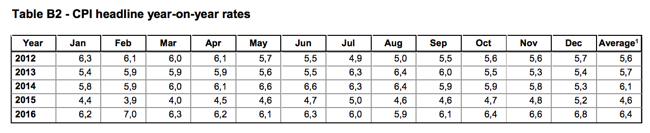
Transportation and housing, which form a 40 percent plus weighting in the basket collectively, registered lower than the headline rate, good news for consumers. The other good news is that rains have come, if not enough to please everyone. The crop is expected to be far better, more will be revealed in the coming months. Tiger and Pioneer were the two biggest beneficiaries of the CPI release, Stats SA is to be commended for their shorter turnaround time in publishing fresher stats. It is fair to say that Pali Lehohla, the Statistician-General for Statistics South Africa, runs a very tight ship over there. Best known for that yellow suit! For the record, herewith an interesting table going back to 2012, revealing the "base" and subsequent rise in headline inflation since then:


Stocks in New York, New York were mixed, the Dow Jones Industrial Average was dragged lower by cooling energy prices, the IEA chief in Davos stating what is "out there" already, suggesting that the frackers (US onshore producers) would provide a "significant" boost to production. Meaning that there would be more supply from the US. Meaning that no matter how hard the special cartel that is OPEC tried, private enterprise was better, hands down. Fancy that, capitalism beating state intervention!

The big names in oil came under pressure, energy collectively was down six-tenths of a percent, causing the blue chip index to slip by just over one-tenth of a percent. Earlier in the session the kings of Wall Street, Goldman Sachs, had reported numbers ahead of expectations, thanks in part to late year volatility. By session end the early excitement around Goldman had dissipated and an assault on Dow 20K is just going to have to wait a little longer. The reason why I put Goldman and the Dow in the same sentence is that GS has the highest share price of all the constituents and price is what matters, and not market capitalization. The Dow divisor! The current Dow divisor is 0.14602128057775. Huh? The value of the Dow jones Industrial Average is worked out as follows = (price of stock 1 + price of stock 2 .... + price of stock 30) / Dow Divisor.

See why for most people who look for a clearer reflection of the broader market of are automatically drawn to the broader market S&P 500, which has many more stocks and the index is determined by market cap instead of price. That index, the S&P 500 rose 0.18 percent to 2271, whilst the nerds of NASDAQ rose nearly one-third of a percent to 5555 (point 65). The record high the latter lies last Friday, the 13th, Freddie and all. Earnings season is starting to get some momentum, GE results will be this Friday and then some of the technology stocks will also start reporting, Alphabet this time next week is always a big favorite of Mr. Market. Apple is on Tuesday after market, those will of course be closely watched for global subscriber numbers. And then Facebook is in February.


I really enjoyed a panel discussion hosted by Bloomberg at Davos yesterday, there was hedge fund manager Ray Dalio (just outside that top 8 on Forbes's list), academic and policy legend Larry Summers and IMF chief Christine Lagarde, who were joined by the finance ministers of Italy and Brazil - The Crisis of the Middle Class: Davos Panel. Larry Summers gave his two cents worth on Donald Trump and the "rise of the middle class" as was the discussion, and it went something like this: "The United States has just elected the worlds most visible symbol of conspicuous consumption" (at around 13:30 in the video). He continued, "that is a bizarre manifestation about a concern of inequality". He also made some good points about inequality: "A lot of the people who voted for Donald Trump and a lot of people who voted for Brexit, think too much is being done for the poor."

Interesting commentary too from Lagarde, the middle class is growing in the developing world, shrinking in the developed world, more wealth at the top and some people even moving down. Summers feels that the middle class in developed countries have this idea that their government is not fighting for them, and are fighting for minorities and the developing world's middle classes.

Summers has an incredible way of trying to explain how this has all transpired, and he really nailed it, in my opinion. An old pal who has just moved back from the UK to sunny ZA, suggested that a 75 percent hurdle rate should have been set for the exiting Europe vote by the UK. Agreed. How this is all unpicked, 40 years of trade agreements, in a hurry, remains to be seen. Great discussion on who the middle class is, and what the anger is. Being left behind is something that we often associate with poor people, not middle class people. If you have 49 minutes and 6 seconds to spare, you could do worse than watch this piece. If only to see Ray Dalio squirm when Summers is talking about closing tax loopholes, and the cameras focusing on him. Ai shem, don't feel sorry for Ray, he is "worth" tens of billions of Dollars.


Linkfest, lap it up

Oh dear. I guess not unexpected, this was always going to be complicated. Bloomberg reports - Amazon Said to Walk Away From $1 Billion Souq.com Takeover Talks. I guess as shareholders of both Amazon and Naspers, one is torn on who one wants to own these assets. Meanwhile, Naspers announced that they had closed the Allegro transaction and that they were now in possession of the 3.253 billion Dollars. Yowsers, that is a lot of money!!

Talk about strange jobs in the modern economy, these, via Bloomberg Mermaid Instructor? Canine Masseuse? The Oddest Hotel Jobs on Earth. Perhaps with the rise of the "home stay" economy, hotels have to get a little more inventive? In this space we continue to recommend Priceline and have at the fringes been long time holders of City Lodge.

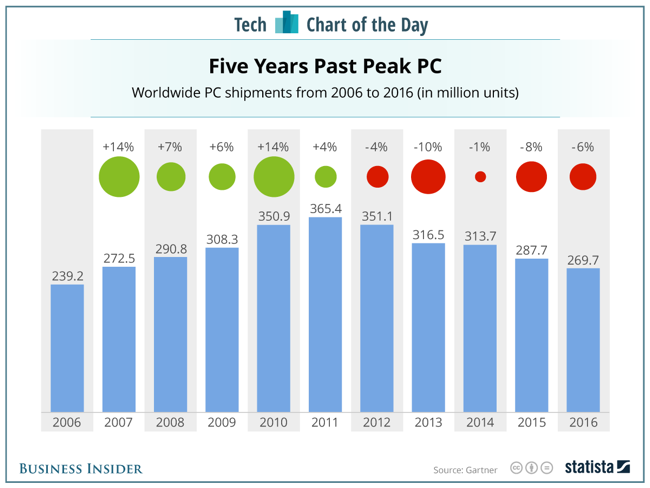
The only "hardware" company that we own is Apple, this is a pretty interesting - PC sales in 2016 were the lowest they've been in a decade. See the associated graphic, which brings it home. The rise of the smartphone and tablet, which means that you can take your "pc" in your packet and bag, no matter where it is that you go has been partly to blame. Perhaps the focus should be on that, rather than falling PC sales. Courtesy of the BusinessInsider


Home again, home again, jiggety-jog. Netflix had blowout numbers last evening, the stock is up nearly 8 percent after hours. You can't own it all, I guess. We will do a deep dive and revert on what is a company that has certainly changed things up over time, from DVD drop boxes to their own content watchable on a smart phone, the company has always kept relevant.


Sent to you by Sasha, Byron and Michael on behalf of team Vestact.

Email us

Follow Sasha, Michael, Byron, Bright and Paul on Twitter

078 533 1063

Thursday, 24 March 2016

Eat meat


"The weaker currency and the drought are starting to feed through to Joe Consumer. Petrol prices, bread and cereal prices, oils and fats, fruit, as well as vegetables (up nearly 22 percent year on year) are all way more expensive in this environment. Food forms 14.2 percent of the inflation basket, transport forms 16.32 percent of the basket, the biggest input is housing and utilities at 24.52 percent. All of those segments collectively are comfortably outside of the band the central bank thinks is acceptable (3-6 percent)."


The new blunders video is up, you must watch it sports lovers: Blunders - Episode 7. It includes Donald Trump, a sports management business in East London with no events and big budgets, as well as Salmon ingesting bad stuff. In order to subscribe to the Blunder Alert!, follow the link to get the mail delivered to your inbox.


To market to market to buy a fat pig It was not a good day yesterday for equity markets, it has been a great recovery since early February. Over the last month the S&P 500 is up 6 percent, the Jozi all share is better by 4500 points, the high single digit gains. In fact, Bloomberg stuck up a chart of markets around the world back in a bull market. What kind of technical nonsense is that, measuring where you are from the highs and lows and then labelling it? One of the mostl widely owned trackers of markets globally is the code SPY in the US, there is nearly 180 billion Dollars in that one alone, which I guess is not THAT much, it is a lot. According to Wikipedia, index funds have only really been around for four decades, let us just say that investors are still working this out.

I think that Buffett's will leaving his surviving spouse 90 percent of his assets to be in an index tracker tells you a lot. It tells you that for folks who are not really interested in stocks, the better option over retirement savings is definitely an investment of this sort. If you have a friend, or family member that isn't in the interest of owning a spread bunch of equities in a stock portfolio, then low cost index tracking is definitely the way forward. Rather than complicated products. Of course I could argue that the meatier end of the market is owning single stocks. Legendary investor Peter Lynch always pointed out that you only really needed one ten bagger to guarantee outperformance.

Perhaps the index tracking fund space has become too crowded. I remember back when people still used to read newspapers (OK, they still do), I used to tell them to go and have a look at the Unit Trust segment, which took up many more lines than the actual listed equities. Why would there be tons and tons of mutual funds over listed equities, surely that is too many. Or are they money making machines for the institutions that collect savings month in and month out. According to the Investment Company Institue, as per their website: "As of December 2014, the total number of index-based and actively managed exchange-traded funds (ETFs), including commodity ETFs, domiciled in the United States stood at 1,411. Total net assets of these ETFs were $1.974 trillion and accounted for 13 percent of total net assets managed by long-term mutual funds, ETFs, closed-end funds, and unit investment trusts at the end of 2014."

Bear in mind that the number of listed companies in the US has actually been shrinking in this time too. In 2014 however, there was 33.4 trillion Dollars invested in mutual funds and ETFs. More than half of which was in the US, topping 18 trillion Dollars for the first time. By the end of 2014 (all the data that I could find, sorry), there was 15.8 trillion Dollars in mutual funds, 101 billion Dollars in unit trusts, 1.974 trillion Dollars in ETFs and 289 billion Dollars in closed end funds (the original), represented in a total of 16660 investment vehicles.


Unit trust numbers have halved over 20 years, there used to be nearly 12 thousand of those in the mid nineties, a total of 18 and a half thousand options rose (and possibly peaked) in 2000, at 19 thousand. ETFs have been the recent benefactors. There were (according to that data, follow link above) only 19 ETFs in 1997 in the US, there are now as you can see, nearly 1500. It makes life both easier and harder for retail investors. In the same way that there is an app for that, there is no doubt an ETF for that too.

In August last year, where we had another massive sell when stocks were sold off heavily, part of it was as a result of a lack of liquidity and a rush for the exits. It was Carl Icahn who said to Larry Fink that he thought the ETF community would spark a big sell off at some stage, blaming the ETF industry for the volatility mostly in the bond market, to be fair. Anyhow, it takes many to make a market, one bunch of investors rushing for the door are another set of investors opportunities. The rise of the ETF market is good, it attracts more entrants. With more entrants, there are more opportunities, more crowded trades. It is what it is, you can't stop the momentum. What I think is quite telling is the fact that a rise and fall of different investment options could come and go again, the underlying, being the equities that one holds, remains the same. Which is why we prefer the direct method.


Stocks locally sank over one and a half percent, mostly some selling amongst the resource stocks, and in particular the single precious metal producers. Gold and platinum stocks were hit hard, it has still been an incredible rally for those as a collective since the beginning of the year. The biggest concern in the local market however was no doubt the inflation read, which breached the upper end of the Reserve Bank's expectations and possibly puts in place more scope for raising rates sooner rather than later. Bear in mind that at the last meeting there were split views on raising rates, in the end the South African Monetary Policy Committee raised rates by 25 basis points.

Herewith the CPI data for February from StatsSA -> Consumer Price Index - February 2016. The weaker currency and the drought are starting to feed through to Joe Consumer. Petrol prices, bread and cereal prices, oils and fats, fruit, as well as vegetables (up nearly 22 percent year on year) are all way more expensive in this environment. Food forms 14.2 percent of the inflation basket, transport forms 16.32 percent of the basket, the biggest input is housing and utilities at 24.52 percent. All of those segments collectively are comfortably outside of the band the central bank thinks is acceptable (3-6 percent). Herewith a comment below that I stuck out on Twitter, seeing as meat inflation is low:


The upshot of it all meant that banks, financials, and retailers are likely to come under more pressure as Mr and Mrs. (and Ms and Master) consumer comes under pressure in the current higher rates environment. I suspect that the SARB is mindful that demand is low and weak. So perhaps a pause, and a wait and see would be advisable. Who wants to be a a central banker with tons of armchair critics and almost always a case of you are damned if you do, damned if you don't scenario. In the US, things are looking so much better that another rate hike may come sooner. Ah, how things can shift so very quickly.


Linkfest, lap it up

Josh Brown gives a quick look at how markets have responded in the past to crisis events. It would seem that markets were less rattled by the bombs in Brussels than previous terrorist events - The Market's Response to Crisis


The next big battle ground in business will take place in the cloud. As we shift toward a more digital world and as the Internet of Things (IOT) grows, the need to store data on the cloud becomes ever increasing - Google's cloud business nabs Home Depot as client.

Here is a look at the unbelievable growth that Facebook has had, even since listing their top line numbers have more than tripled - Facebook


Home again, home again, jiggety-jog. Stocks are off globally, there is of course the small matter of a four day weekend here. What? Again? Hong Kong stocks are down over a percent and one quarter, in Shanghai stocks are down half a percent, Japanese stocks are off two-thirds of a percent. Here, we should unfortunately expect another day of selling.


Sent to you by Sasha and Michael on behalf of team Vestact.

Email us

Follow Sasha, Michael, Byron, Bright and Paul on Twitter

078 533 1063

Thursday, 21 June 2012

Ben and Oliver twisting

"I often think that not enough credit is given to the FOMC for their work in negotiating the mine field, most folks have an Oliver Twist porridge yearning and always want more."

Jozi, Jozi. 26o 12' 16" S, 28o 2' 44" E. Wow. Another day, another record close for the Jozi all share index. Financials led the charge, collectively up nearly four fifths of a percent, the overall market closed marginally in the green, up 74 points or 0.21 percent better on the day to 34788 points. There was news in the form of the Greeks actually forming a government, but that was expected, the fellow that you need to know now is Prime Minister Antonis Samaras. Who actually warned more than a year and a half ago that the austerity measures were going to have a dire impact on the Greek economy. Samaras is 61 years old, he is an economist by trade, but has been in politics for over three decades, so it is fair to say that he is a politician. If nothing, at least we have learnt about the Greek political landscape and know that there are crazies in all politics with harebrained ideas about the way the world should work. More worrying I suppose is the fact that there are people out there that seem to think that they are right. I am talking about the far left, who seem to want everything, isn't that how you got here in the first place? Probably.

There was something interesting yesterday in the form of South African inflation numbers, which fell back into the comfort zone (5.7 percent was the headline CPI annual inflation rate for urban areas) and in fact beat economists predictions. Here is the full release: Consumer Price Index - May 2012. Excellent, fresh numbers, I know that they are from 21 days ago, but StatsSA used to take slightly longer to release these numbers, back slaps are in order. Well done and stuff to Statistician-General Pali Lehohla and team! The food and non alcoholic beverages index decreased 0.2 percent month on month. Did you get that sense in your basket? Cheaper food is a good thing, in particular fruit and meat got cheaper, but not sweets and desserts nor cold beverages. Well, you should not be buying that sort of stuff. But don't let me stop you from enjoying yourself, eat those awesome Woolies deserts!

Year on year though, you are paying 6.6 percent more for your food. That is mostly being driven by fish, which has clocked an astonishing 11.2 percent increase. Turns out there are not plenty of fish in the sea. I am happy to report that for vegetables you are only paying 2.2 percent more. Food is a pretty big component in the CPI basket, 15.68 percent in total. Alcohol beverages and tobacco sadly makes up 5.58 percent of the basket, LESS than clothing and footwear, which make up 4.11 percent of the overall basket. Housing and utilities make up the largest part of the basket at 22.56 percent, it will come to you as no surprise that the electricity (and other fuels) component has risen 17.1 percent since this time last year. And since 2008, when the base was 100, has risen to 196.8. In other words, in the last four years your electricity bill has about doubled. The single biggest item in the sub sector, Housing and Utilities is Owners' equivalent rent, which makes up 12.21 percent of the overall index. Since the beginning of 2008 (base of 100) this has risen to 117.8. Which I guess is not bad at all.

The other big component of the CPI basket is transport, which has as much as 18.8 percent weighting overall, with the biggest part (of that sub set) being purchase of motor vehicles, 11.25 percent of the OVERALL Index. That has decreased month on month, but for the last four years, again the base of 100 being applied, the index is at 102.6. Which basically means that the price that you are paying now is the same as you paid four years ago, but that obviously consists of a different motor vehicle mix in 2012 when compared to 2008. Probably because of cheaper motor vehicles in the market. Good news for the consumer I guess.

The other big component in the overall basket is "Miscellaneous goods and services" which is a pretty wide measure of "stuff" makes up 13.56 percent of the overall basket. Insurance is in there, and makes up 7.71 percent of the bigger basket, which means of course you are covering that house and motor vehicle, as well as life insurance of course. "Education" sadly makes up a small portion of the overall basket, a mere 2.19 percent, less than "restaurants and hotels" at 2.78 percent.

It is pretty simple I guess, Home, motor vehicle and then food. It is good to see the rate back inside of that 3-6 percent range, although as far as I can see from what I have been hearing and reading, the Reserve Bank is unlikely to budge rates from here. I guess caution remains the watchword. Yeah, let's watch it!

Oh dear. Not again Joe, oh no Joe, not again. There was a song that went something like that, I think it was a comedian who sang it, I could not find it online with my internet skills. Slippage. But this unfortunately is of absolutely no laughing matter, this morning Aquarius Platinum have announced that they are placing their Everest mine on care and maintenance. It is happening people, Aquarius are not going to be in the position of running mines that are unprofitable. The official announcement does not make for pretty reading:

"The ramp-up at Everest has encountered challenges resulting from poor ground conditions and on-going disruptive industrial relations over an extended period and these issues, coupled with the present low PGM price environment, have rendered the mine uneconomic."

It makes me feel a little nauseous really. The company goes on to say that they think that the market will be in surplus by around half a million ounces this year, and point fingers squarely at the issues in Europe. And the official announcement also says that rising costs and lower labour productivity have not helped matters at all. So, how big is Everest. Bigger than you think, this represents 21 percent of the total groups PGM production. 100,252 PGM ounces produced in their 2011 financial year. Check out from their website: Everest. I think if that we were outraged about a painting we should be more outraged here. 1681 folks without a job now, waiting for things to improve. And all we do is talk.

New York, New York. 40o 43' 0" N, 74o 0' 0" W. Markets were pretty wild yesterday, even though the point where we ended was basically flat, that does not really tell the days story. Waiting for the Fed, and when they came, a selloff, and a repeat of that again. I suppose that the hot short term money knows that the nearly five percent rally in a month has been nothing short of very good. I just checked it out, if you sold in May and went away, you looked clever, but you probably missed this rally back and now are only three percent better on the S&P 500. So now what? Paul said yesterday something that I liked, when you hear people say things like, the market looks overbought, oversold, waiting for Europe to sort their stuff out, waiting for a confirmation of higher global growth rates, that is nonsense. The market is the aggregation of buyers and sellers in different sectors and companies, and the level today is what it is. And those levels are not likely to be at the same levels tomorrow, or next week. So, don't try and fight it, or think that the collective are right, or wrong, the levels are what they are. End of story.

I caught the second half of the press conference last evening, with Fed chairman answering the questions shot at him from the press. Man, the guy is an incredible articulator, and although there is lots of Fedspeak in the answers, a lot of it makes complete sense. For the record, here is the statement firstly from the FOMC meeting: Press Release - Release Date: June 20, 2012. There is nothing too new in there, growth is not quick enough, there are risks, they will act, unemployment not falling fast enough, rates are most likely to stay at these levels all the way through to late 2014. So expect rates to be here for a while still. I often think that not enough credit is given to the FOMC for their work in negotiating the mine field, most folks have an Oliver Twist porridge yearning and always want more. There is not too much more that the Fed could do, they indicated that they were continuing to employ operation Twist to the tune of 267 billion Dollars.

What is operation Twist? Well from the statement: "...the Committee intends to purchase Treasury securities with remaining maturities of 6 years to 30 years at the current pace and to sell or redeem an equal amount of Treasury securities with remaining maturities of approximately 3 years or less." So, in simple English, the Fed will sell the shorter term debt, and buy the longer term debt and look to flatten the curve. And by doing that, they are trying to making longer term borrowing more attractive. And at the same time the short term yields less attractive to folks parking their funds somewhere, forcing those same folks to invest more to get a higher return.

Of course Euro land still looks like a problem for everyone, and this has forced the Fed to downgrade their growth forecasts. Check out the table hacked from the release Economic Projections of Federal Reserve Board Members and Federal Reserve Bank Presidents, June 2012.

As you can see, the projections from the last meeting have been lowered which suggests that the Fed did not see this current bout of weakness. Which brings me to the last point I wish to make on the smartest economic policy makers in the world, if their view of the future is as clouded as ours, then what is to say that they cannot be surprised to the upside too? I suspect of course they can, and invariably the future always turns out better than you think. I unfollowed a fellow on twitter yesterday because he compared 1931 conditions in Europe to the current. Hogwash. Did they have the incredible efficiencies of mobile phones, the internet, global air travel via jet engines, cable and satellite TV, the BRIC's as contributors to the global economy (still small really, but growing fast), microwave ovens, fuel efficient and safe vehicles, broad home ownership, as there is now? No. And are monetary policy makers better advised with all the information that they have available, in order to make better decisions? Yes!! So, what would you say now? Asleep at the wheel, or being the best folks to steer? No, not asleep, and yes, yes, yes, the best people to steer!!! Sit down all you armchair Fed members.

Currencies and commodities corner. Dr. Copper is last at 335 US cents per pound, the gold price is also lower at 1597 Dollars per fine ounce. The oil price is also lower, in fact the lowest level since January 2011, in the time before the Arab Spring, 80.49 Dollars a barrel for NYMEX WTI, 91.65 for Brent Crude oil. The Platinum price is last at 1456 Dollars per fine ounce. The Rand is weaker in the face of some selling pressure here today, last at 8.21 to the US Dollar, 12.96 to the Pound Sterling and 10.45 to the Euro. We are slightly weaker here at the start.

Parting shot. A Chinese Flash HSBC PMI number has come in below 50 again, indicating that Chinese manufacturing continues to contract, but I guess with the European issues that continue to dominate the headlines this is likely to dampen demand. Check it out here: Manufacturers report modest deterioration in operating conditions during May. Not good, and this has been the trend. But, there is no sign of it falling hard, hard landing or whatever you want to call it, but again this morning we are seeing folks talk about landings and a weaker global economy. True. But markets are predictors of the future, not the present.

Sasha Naryshkine and Byron Lotter

Email us

Follow Sasha and Byron on Twitter

011 022 5440