Showing posts with label US Federal Reserve. Show all posts

Wednesday, 20 September 2017

Quantifying Quantitative Easing


To market to market to buy a fat pig. Today is Fed day. Later this evening the Fed will probably announce no interest rate increase, but more importantly, they will give details around how they will unwind their $4.5 trillion balance sheet. Rewind a couple of years, the short-term interest rate was already very low at 0.5% but long-term rates were much higher because people were scared. Ben Bernanke's Fed came up with the idea of Quantitative Easing (QE), to bring down longer-dated rates.

Economics 101; higher demand means higher price and conversely a higher supply means a lower price. The Fed stepped into the bond market to create extra demand, pushing up the price of bonds, which results in a lower interest rate attached to those bonds. At QE's peak, the Fed was buying $85 billion worth of new bonds a month, with one of their main focuses on the housing market, where they currently own $1.77 trillion worth of mortgage-backed securities. The Fed slowly reduced the value of bonds they bought a month until November 2014 when they stopped buying new bonds.

Given that bonds have set maturities, the question then becomes, what to do with the money from the mature bond? When QE was first thought up, their exit plan was to buy bonds for a short period, creating confidence and financial support, and then just let them runoff, which would reduce their balance sheet again. QE 1 then expanded into QE 2 into QE 3 and then QE 4, lasting longer and becoming bigger than anyone had originally imagined. There is a fear that the Fed, just stepping out of the bond market will result in a sudden shock to the financial system. As a result, instead of just letting bonds runoff, the Fed has been rolling over bonds that reach maturity.

Today Janet Yellen will give us an idea of how quickly they intend to shrink their balance sheet. Full steam ahead will be them not rolling over any of the bonds and baby steps will be them only letting a small percentage of the bonds runoff. I expect it to be somewhere in the middle. The Fed will always err on the side of caution; they won't do anything unless they are sure the US economy is strong enough to handle it. Basically, whatever the Fed announces today around their balance sheet, will be a non-event to most people, apart from economists and academics.

New York, New York Yes, you guessed it, another day another record. Here is the scorecard, the Dow was up 0.18%, the S&P 500 was up 0.11%, the Nasdaq was up 0.1% and the All-share was up down 0.07%. Unfortunately, the list of stocks at 12-month lows is growing and the list of stocks at 12-month highs is shrinking.


Linkfest, lap it up

One thing, from Paul

What on earth is Kim Jong Un thinking?

Experts disagree with Donald Trump (no surprise there). 'Rocketman' is not suicidal, they say. North Korea's nuclear missile program is best understood as an emulation the Chinese strategy of the 1960-70s. China was a rogue nuclear state and economic backwater, but became a military and economic giant and undid the US-Taiwan alliance. Kim Jong-Un hopes force concessions from the US, win reunification with South Korea and become a global power. This plan will likely fail though, since North Korea is economically decrepit. Here's Max Fisher on the topic, in the New York Times - North Korea's Nuclear Arms Sustain Drive for 'FinalVictory'


Michael's Musings

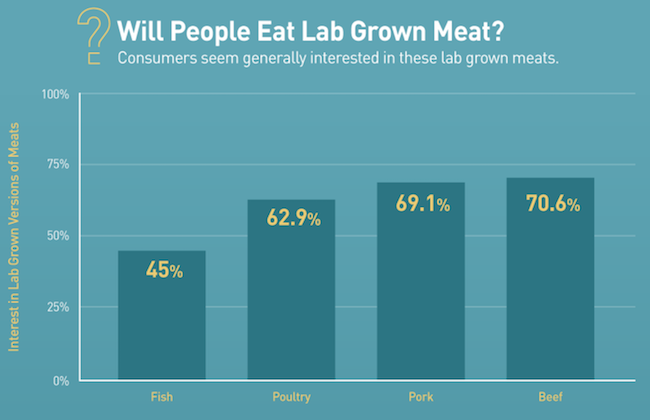
Would you drink milk that was created in a lab? How about eating beef that was created in a lab? Animals have a negative environmental impact due to all the resources needed to sustain them - Infographic: The Future of Food.


Positive and negative responses from cities, over Amazon's new HQ is interesting. The fear is that Amazon will increase the population density, which increases property prices and increases wages. Surely more economic activity is always better than less though? - The $5 billion battle for Amazon's new HQ is getting even more heated


Bright's Banter

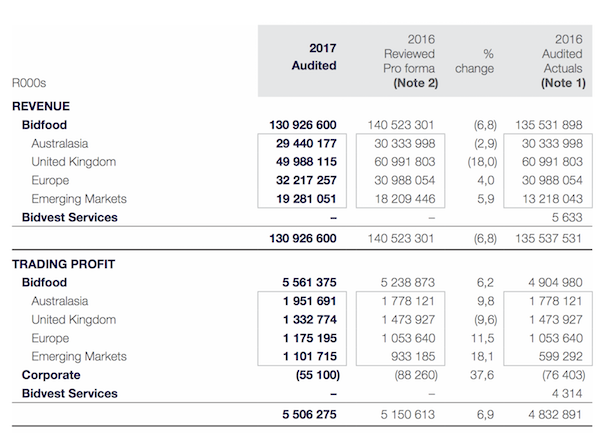
On Monday the 18th of September I had the pleasure of meeting with Bidcorp's CFO David Cleasby at their head office in Sandton. Bidcorp as you may know is our largest holding in the food sector.

The business has presence in over 30 countries and are market leaders in countries like Australia and New Zealand. Bidcorps offshore businesses account for 90% of earnings and RSA is only 10% making them the perfect Rand hedge.


Bidcorp's typical customers are the owners of restaurants, who happen to be chefs most of the time. Bidcorp's growth will come from increasing their 'Routes To Market' (selling more things to the same customer), from entering a new market organically and through small bolt-on acquisitions, where Bidcorp can bring in their 'Know-How' and systems to the table. They focus is on increasing the basket of goods purchased by chefs; since the truck is already heading that way, any additional items purchased is pure margin. In the near future, there is big margin growth to come as a result.

The food industry is very fragmented and this translates to plenty of opportunities for Bidcorp. Their reps have their ears on the ground and they help spot gaps in the market. This kind of attention to detail allows Bidcorp to see exactly what the needs of the customers are and fulfill them. If the customer is happy with the service, they will ask for repeat business, and the income becomes annuity in nature. As long as the eating out trend persists and the middle class emerges, we expect Bidcorp to benefit handsomely and are happy to own this one for our clients for the long term.


Home again, home again, jiggety-jog. Our market opened slightly in the red this morning, being pulled down by Sasol who are down 3.5% on the news that they have had to take a $900 million hit on their BBBEE scheme. STAR who listed this morning, are off to a strong start, opening at the top end of their expected range.


Sent to you by Team Vestact.

Email us

Follow Michael, Byron, Bright and Paul on Twitter

078 533 1063

Thursday, 16 July 2015

Go Private, save the state


"It seems like there is a whole lot more room to grow. I for one would much prefer it if the government outsourced all schooling to private entities, which set themselves really high standards. As Curro points out (just after this table in their 2014 Annual Report), them building schools saves the state 70-120 million Rand initially and then 50 million Rand a month. People pay for private education after they have paid their taxes."


To market to market to buy a fat pig. Agreekment done. At the "money moment", the Greek parliamentarians, for all their noise voted for the money. In fairness however to Syriza, the governing party, much of the members voting against the package were part of the ruling party. Were or are, it is difficult to say. Whilst there were heated debates inside the Greek parliament, there were the 'no to austerity' protestors throwing molotov cocktails at police. Question, if there were to be a cut in Greece's debt that is owed to the Troika, who would ultimately be hurt as their asset is written down? Is it the pensioner of France, Italy and Germany, Spain, Portugal and the Netherlands? Debt to one is an asset to another.

The bigger picture is that the IMF are right, even if there were incredible terms imposed on Greece and they were told that there was a 30 year interest holiday, they were told that there was more debt reduction, it needs to happen sooner rather than later. Investors of Europe need to know. Even if this is not exactly a deal breaker for opening a business elsewhere in the common currency area, it has captured the imagination of the networks for the better part of five years. Greece needs to grow their economy, that is the only way that tax receipts will rise and that the government will easily be able to service the debt more aggressively.

There needs to be political will power and I am afraid as long as there are far left wingers feeling that the only way to do things is more government intervention, and less private sector, I do not see that happening soon. The Golden Dawn (one of their members tore up the agreement in parliament yesterday) are borderline cases to be institutionalised. No, that is rude, as I said to my eldest last night, people get what they vote for. And do not ever question why someone voted X or Y, that is immediately suggesting that their political views are inferior to yours. That is exactly why each and every person has a single vote, it may not be perfect, it is however better than having no choices.

So that is done and dusted, expectations are for a fall out of sorts in the ruling party. Resignations, perhaps even new elections. If Tsipras comes through this wiser and better as a leader then thumbs up to his leadership skills, well done to him. If he firmly believes that what he is doing is the best interest of Greece long term and not scoring political points (even though he suggested that there was a knife held to his throat), then I admire that. It shows some maturity that was possibly lacking beforehand. Read the NYT piece: Greece, Its Back to the Wall, Adopts Austerity Steps.


The other "thing" capturing markets yesterday was Fed chair Janet Yellen delivering testimony in front of the House Financial Service Committee, see the NYT story: Janet Yellen Warns Congress Against Adding to Fed's Oversight. What I find really funny about the story, and perhaps it deserves a copy paste is the following paragraph in that story: "Ms. Yellen provided few new indications about the Fed's plans for the next few months, and she was not pressed on the issue. Lawmakers in Congress evidently do not share Wall Street's obsessive interest in the exact timing of interest rate increases." Ha-ha! A Wall Street obsession is definitely not a worry of the person on the street.

I expect that we will see rate rises different to those in the past, the trajectory will be slow to begin with, I reckon a range adjusting in smaller increments that the street is used to, like 10-15 basis points at a time. i.e. Moving the band slowly higher until you can hike by 25 basis points, why not, the way down was unconventional, why should the way up be anything ordinary? And expect the high end of the next interest rate cycle to be lower, i.e. not 6.5 percent, rather somewhere between 3.5 and 4, that is my best guess. Markets on Wall Street? Not too much action if you look at the scoreboard, the Dow and broader market S&P 500 were a whisker lower. Earnings, those continue to filter in and through, Bank of America was the standout, the stock was up 3.3 percent. It is still down 61 percent over ten years however, the "great recession" saw to that.


In the local market, Jozi, Jozi, stocks rallied across the board, obviously there strong Chinese GDP number buoyed commodity stocks. Both Anglo and BHP have recorded big write downs in the last two days, the Anglo production report from this morning does not look encouraging. Lower prices, lower demand is not a perfect cocktail for shareholder returns.

Less commodity exposure, I still am struck by that comment I read earlier this year that said an investment in commodities was a bet against humanity, I think that it was our old pal Cullen Roche who said it. I think what he is trying to say is that humanity keeps doing more with less of the same resource. That is not too dissimilar to that graph from yesterdays piece with more than double the number of people on earth eating food that is roughly the same price, farming technology has improved significantly over fifty year, without ordinary people noticing. When something changes slowly and constantly, it is called a Mesofact says our old pal Samuel Arbesman. Of course none of these people are really our pals, as a result of the awesomeness of Twitter, we fell we actually know these people. Including folks like Novak Djokovic and Serena Williams who we can (and do) follow on platforms like Instagram.

After all was said and done, the local market closed at 52 and a half thousand points. That looks like the best level in around one month to me. However it has been a tough old year, stocks have not really moved, the JSE all share index is up an uninspiring 5.55 percent. Although, that is around what inflation is, and on an annualised basis you would be double that. That is a decent enough long term return, remembering the rule of 70. i.e. how long does it take to double your asset base. Is it 70, or 72 or 69.3? Read Wiki: Rule of 72. Divide the annualised returns by 70, that is your number. Working the other way around, what return would you have to get in order to double your money in 5 years. Divide 70 by 5, you get to 14 percent. 6 years, that number falls to 11.66 percent, per annum. In other words, the consistent return matters. As Warren Buffett says however, he would rather have "lumpy" (read outsized) returns than solid and consistent ones.


Company corner

Curro and AdvTech confirmed yesterday that they are in talks. Obviously it was Curro who initiated the talks, they want to buy AdvTech. It makes sense that as the bigger competitor by market cap that they use the momentum and big shareholder to buy another business that the market has not taken so kindly too. As Michael pointed out yesterday however, and lean in a little closer to your screen here, Curro has a market cap of 12.1 billion Rand, turnover of just on one billion Rand for the financial year to end February. AdvTech has a market cap of 5.2 billion Rand, turnover of 1.93 billion Rand. Curro's turnover grew at 51 percent last year, AdvTech at less than ten percent.

Even at elevated share price levels, AdvTech trades on a 27 multiple, Curro has recently started making a profit, it trades on a multiple of nearly 200 times. Is the market bonkers? Perhaps not. There may be expectations from the market that the PSG magic could work again here, as it did for Capitec, PSG own 57 percent of the shares. And of course PSG have underwritten all the rights issues along the way, Curro has grown exceptionally fast. I doubt that there will be a massive PE unwind for Curro in a hurry, the goal is to continue to roll out as many affordable private institutions as possible. Where the perception is that paying for education means that the quality offered against the alternative (the government) equals a better outcome for the child, that is all that parents worry about. Curro have recently been in the news for all the wrong reasons, I truly hope that (for the sake of our nation) that this is dealt with swiftly. Racism is narrow minded and plain dumb, we should be all turned inside out, we would all look the same. Not very good "same" though, I love diversity and different.

Not too dissimilar to many success stories, and often what the ordinary person on the street misses, Curro started with a small school, all of 28 pupils in 1998. They started this year with 42 schools and 36 thousand scholars, learners, pupils, whatever you want to call them. So are they going to triple the number of scholars (or are they customers?) in the next three years?


It seems like there is a whole lot more room to grow. I for one would much prefer it if the government outsourced all schooling to private entities, which set themselves really high standards. As Curro points out (just after this table in their 2014 Annual Report), them building schools saves the state 70-120 million Rand initially and then 50 million Rand a month. People pay for private education after they have paid their taxes. I still like to think that the modern schooling system needs a serious shakeup, more responsibility needs to be given to the child. To get real life readiness, you have to be responsible for your actions. Elon Musk is right to start his own school, that is however for super rich kids. Sadly here in South Africa there are limited resources.

Whether or not a formal offer is made, or a merged entity appears at the other end when these talks between the two private education providers appears on the other side (or even if the competitions authority allows it), progress is being made shaping the minds of the youth. And that is something to celebrate, after all, the founder of the nation, Nelson Mandela was quoted as saying: "Education is the most powerful weapon which you can use to change the world." That will always be right, the only problem with that is that the more you know, the more you realise there is to know.


Linkfest, lap it up

I enjoy peanut butter, I buy the sugar and salt free one from Woolies. Not everybody can eat nuts, 1.4 percent of kids have a nut allergy in the US and this is rising. There is always capital looking to solve this problem, Mr. Picketty should take note that it is a French firm raising money in the US to solve the problem of nut allergies: Progress in peanut allergy trials raises hopes. Darn one percenters looking to solve problems of ordinary people.

Yesterday Amazon turned 20 many people didn't think it would get past its first birthday, it has survived start up phase, the dot come bubble and a host of new competitors - At 20, Amazon Continues to Defy Predictions.

Where there is a will there is a way! Many young people that I speak to are struggling to get jobs in the industries that they hope to have long careers in. This CV highlights the possibilities that are out there if you are willing to do what it takes, very inspiring! - Hey, I'm Nina!


Higher cash levels with asset managers may point to people preparing for an interest rate hike? Where funds want to own a couple more bonds but can only purchase them after the rate hike - Fund Managers Holding Highest Cash Percentage Since Lehman. This isn't pointing to a bear market because cash is also flowing into financial stocks which can be seen as a proxy for the economy and one of the sectors that do a bit better with higher interest rates.


Home again, home again, jiggety-jog. Mixed Asian markets this morning, I saw an interesting comment from Blackrock's Larry Fink that suggested that the reason why Chinese markets are so volatile is that capital markets are immature. There was an awesome interaction between Carl Icahn (who is nuts) and Larry Fink, you might see footage during the day. Back to the real grind of earnings today. Google, Ebay, Goldman Sachs, Mattel, Philip Morris, UnitedHealth and of course an interesting one Schlumberger. That is why we invest in markets, for companies, not for Jannet Yellen comments or Greek debt issues.


Sent to you by the Vestacters, Sasha, Michael, Byron and Paul.

Email us

Follow Sasha, Byron and Michael on Twitter

087 985 0939
Thursday, 19 March 2015

Yellen's Tencents worth


"Going forward there is going to be a bigger push to increase advertising, which is still small given the size of their user base. The danger of course is that as you increase adverts your user base starts to drop because adverts decreases the user experience. I don't think that they have to reinvent the wheel when it comes to advertising though because over the last few years we have seen how Facebook, Snapchat, Twitter and other big social network companies have been able to include adverts but not diminish the user experience."


To market, to market to buy a fat pig. Patient, impatient and confident are words which have probably never got as much attention as they have over the last 12 hours! The reason? Janet Yellen and the FED's statement following their policy meeting. The FED removing the word patient from their statement was such big news that I got an alert from the WSJ and CNBC on my phone. Yellen said,"Just because we removed the word patient from the statement doesn't mean that we're going to be impatient." They will only begin to raise rates when they are confident.

The basic message from the FED was that they will increase rates at a slower rate than previously forecast partly due to lower growth forecasts and very low inflation. There is a bit of a catch-22 when it comes to raising rates because of the dollars influence on the the US economy. As traders have been anticipating an increase in interest rates, they have been buying dollars and other US assets, the result is a stronger dollar. The dollar is up 27% against the Euro over the last year. The impact of a stronger dollar though is to keep inflation down, hurt exports and dampen growth. Low inflation and lower growth means that interest rates need to stay lower for longer. If you are a trader the news is important and trying to get every bit of information that you can from the FED statement counts. For us though as investors it inconsequential. In 10 years time the companies that you own will still be doing their thing and this FED statement, the dollar move and impact on stock prices will be a distant memory. The only annoying thing is that you will have to pay a bit more for some of the companies now.


Company corner snippets

Yesterday the big news on the company front was the 4Q and full year results from Tencent. Given the high multiple that the stock trades on the results always lead to big moves of the share price; it is always hard to price a company that grows at 50% a year and then try to forecast what the company will look like in one or two years time.

Here are the numbers: Revenue is up 31% YoY to U$ 12.899 billion (4Q up 24% to U$973), operating profit is up 59% YoY to U$ 4.991 billion (4Q up 51%) and margins grew YoY from 32% to 39%! These numbers are generated from their huge user base across their different platforms, QQ has 815 million Monthly Active users (MAU) up 1% YoY. The big growth for QQ came from a 33% increase in MAU on smartphones and tablets, these users are the "next generation" and are the users that you want. WeChat grew its MAU by 41% to 500 million and Q-zone grew its MAU by 5% to 654 million. All in, across those three platforms they have a whopping 1.969 billion users or customers! Granted there will be over laps between users but even if you have the same user across the 3 platforms, you still have them looking at their smartphone for 3 different apps (more eyeball time).

Tencent are an e-commerce company but their current revenue breakdown puts them more into the entertainment/ gaming category, with 82% of their revenue coming form online gaming and only 13% from advertising. The remaining 5% comes from other divisions like their mobile banking operations or online retail. In the 4Q their online gaming revenue grew by 41% mostly driven by smartphones, which shows the value in the growth from the smartphone user base. There was bigger growth from online advertising, with growth of 75% for the 4Q, showing the bigger push to get advertising to the current users.

Going forward there is going to be a bigger push to increase advertising, which is still small given the size of their user base. The danger of course is that as you increase adverts your user base starts to drop because adverts decreases the user experience. I don't think that they have to reinvent the wheel when it comes to advertising though because over the last few years we have seen how Facebook, Snapchat, Twitter and other big social network companies have been able to include adverts but not diminish the user experience. The company has huge growth potential and as long as the Chinese government keeps the likes of Facebook out of China, there will be very little competition.

This morning the company was up 5% on the results which puts their P/E at a solid 44. When a company is growing profit by 50%, I don't think that P/E is the correct measurement of the cost of the stock. Another year of 50% growth (which isn't hard to imagine) puts the P/E at 22 forward. Looking forward two years it is completely possible that the stock will have a P/E in the teens, using todays share price. As a Naspers shareholder you get access to the stock at a discount! An update on the value of Naspers stake in Tencent works out to around R 711 billion, which when compared to Naspers market cap of R753 billion, either values Naspers' other businesses at almost nothing or you get a discount on the Tencent share price! Either way I think that Naspers still has legs both from growth in Tencent and from the growth in their other businesses. Definitely still a buy as it crosses the R 1 800 mark this morning.

Another company making waves, Anchor Group Limited, released their results after the market closed yesterday. The company had a lot to live up to with the share price going from R4 in September (with their IPO at R2) to over R10. They didn't disappoint so to speak with their HEPS up 301% and assets under management up 207%. They still have a large amount of growing to do to fit into their share price. The market likes the results with the stock up 4% today. It is great to see small companies making waves!


We're reading this, you should too.

We focus regularly on solar energy and how it is booming - 2014 Was the Biggest Year For Solar Power Ever. Given that solar is still less than 1% of the power generated in the US, this is a huge growth sector.

This is another piece from one of my favourite bloggers. In this piece he talks about the problem of sitting on cash and waiting for the next correction - The Psychology of Sitting in Cash. The best way to get solid long term returns is to be always adding. By doing this you average your price in and you are less worried about what prices are going to do because you know that you will be adding next month as well.

Given how prevalent the interest rate topic is at the moment here is a view that is slightly off from the main stream view - The weird way people talk about zero interest rates.


Home again, home again, jiggety-jog. The market is flying this morning, up 1.9%. Thanks to dollar weakness the Rand/ dollar dropped from R12.40 to R12. Gold stocks are up 5.3%, Naspers is up 7% and Sasol is over the psychological R400 level. All in all, we live in a global village and when something big happens in the US the ripples are felt throughout the "village".


Sasha Naryshkine, Byron Lotter and Michael Treherne

Email us

Follow Sasha, Byron and Michael on Twitter

087 985 0939
Thursday, 21 June 2012

Ben and Oliver twisting

"I often think that not enough credit is given to the FOMC for their work in negotiating the mine field, most folks have an Oliver Twist porridge yearning and always want more."

Jozi, Jozi. 26o 12' 16" S, 28o 2' 44" E. Wow. Another day, another record close for the Jozi all share index. Financials led the charge, collectively up nearly four fifths of a percent, the overall market closed marginally in the green, up 74 points or 0.21 percent better on the day to 34788 points. There was news in the form of the Greeks actually forming a government, but that was expected, the fellow that you need to know now is Prime Minister Antonis Samaras. Who actually warned more than a year and a half ago that the austerity measures were going to have a dire impact on the Greek economy. Samaras is 61 years old, he is an economist by trade, but has been in politics for over three decades, so it is fair to say that he is a politician. If nothing, at least we have learnt about the Greek political landscape and know that there are crazies in all politics with harebrained ideas about the way the world should work. More worrying I suppose is the fact that there are people out there that seem to think that they are right. I am talking about the far left, who seem to want everything, isn't that how you got here in the first place? Probably.

There was something interesting yesterday in the form of South African inflation numbers, which fell back into the comfort zone (5.7 percent was the headline CPI annual inflation rate for urban areas) and in fact beat economists predictions. Here is the full release: Consumer Price Index - May 2012. Excellent, fresh numbers, I know that they are from 21 days ago, but StatsSA used to take slightly longer to release these numbers, back slaps are in order. Well done and stuff to Statistician-General Pali Lehohla and team! The food and non alcoholic beverages index decreased 0.2 percent month on month. Did you get that sense in your basket? Cheaper food is a good thing, in particular fruit and meat got cheaper, but not sweets and desserts nor cold beverages. Well, you should not be buying that sort of stuff. But don't let me stop you from enjoying yourself, eat those awesome Woolies deserts!

Year on year though, you are paying 6.6 percent more for your food. That is mostly being driven by fish, which has clocked an astonishing 11.2 percent increase. Turns out there are not plenty of fish in the sea. I am happy to report that for vegetables you are only paying 2.2 percent more. Food is a pretty big component in the CPI basket, 15.68 percent in total. Alcohol beverages and tobacco sadly makes up 5.58 percent of the basket, LESS than clothing and footwear, which make up 4.11 percent of the overall basket. Housing and utilities make up the largest part of the basket at 22.56 percent, it will come to you as no surprise that the electricity (and other fuels) component has risen 17.1 percent since this time last year. And since 2008, when the base was 100, has risen to 196.8. In other words, in the last four years your electricity bill has about doubled. The single biggest item in the sub sector, Housing and Utilities is Owners' equivalent rent, which makes up 12.21 percent of the overall index. Since the beginning of 2008 (base of 100) this has risen to 117.8. Which I guess is not bad at all.

The other big component of the CPI basket is transport, which has as much as 18.8 percent weighting overall, with the biggest part (of that sub set) being purchase of motor vehicles, 11.25 percent of the OVERALL Index. That has decreased month on month, but for the last four years, again the base of 100 being applied, the index is at 102.6. Which basically means that the price that you are paying now is the same as you paid four years ago, but that obviously consists of a different motor vehicle mix in 2012 when compared to 2008. Probably because of cheaper motor vehicles in the market. Good news for the consumer I guess.

The other big component in the overall basket is "Miscellaneous goods and services" which is a pretty wide measure of "stuff" makes up 13.56 percent of the overall basket. Insurance is in there, and makes up 7.71 percent of the bigger basket, which means of course you are covering that house and motor vehicle, as well as life insurance of course. "Education" sadly makes up a small portion of the overall basket, a mere 2.19 percent, less than "restaurants and hotels" at 2.78 percent.

It is pretty simple I guess, Home, motor vehicle and then food. It is good to see the rate back inside of that 3-6 percent range, although as far as I can see from what I have been hearing and reading, the Reserve Bank is unlikely to budge rates from here. I guess caution remains the watchword. Yeah, let's watch it!

Oh dear. Not again Joe, oh no Joe, not again. There was a song that went something like that, I think it was a comedian who sang it, I could not find it online with my internet skills. Slippage. But this unfortunately is of absolutely no laughing matter, this morning Aquarius Platinum have announced that they are placing their Everest mine on care and maintenance. It is happening people, Aquarius are not going to be in the position of running mines that are unprofitable. The official announcement does not make for pretty reading:

"The ramp-up at Everest has encountered challenges resulting from poor ground conditions and on-going disruptive industrial relations over an extended period and these issues, coupled with the present low PGM price environment, have rendered the mine uneconomic."

It makes me feel a little nauseous really. The company goes on to say that they think that the market will be in surplus by around half a million ounces this year, and point fingers squarely at the issues in Europe. And the official announcement also says that rising costs and lower labour productivity have not helped matters at all. So, how big is Everest. Bigger than you think, this represents 21 percent of the total groups PGM production. 100,252 PGM ounces produced in their 2011 financial year. Check out from their website: Everest. I think if that we were outraged about a painting we should be more outraged here. 1681 folks without a job now, waiting for things to improve. And all we do is talk.

New York, New York. 40o 43' 0" N, 74o 0' 0" W. Markets were pretty wild yesterday, even though the point where we ended was basically flat, that does not really tell the days story. Waiting for the Fed, and when they came, a selloff, and a repeat of that again. I suppose that the hot short term money knows that the nearly five percent rally in a month has been nothing short of very good. I just checked it out, if you sold in May and went away, you looked clever, but you probably missed this rally back and now are only three percent better on the S&P 500. So now what? Paul said yesterday something that I liked, when you hear people say things like, the market looks overbought, oversold, waiting for Europe to sort their stuff out, waiting for a confirmation of higher global growth rates, that is nonsense. The market is the aggregation of buyers and sellers in different sectors and companies, and the level today is what it is. And those levels are not likely to be at the same levels tomorrow, or next week. So, don't try and fight it, or think that the collective are right, or wrong, the levels are what they are. End of story.

I caught the second half of the press conference last evening, with Fed chairman answering the questions shot at him from the press. Man, the guy is an incredible articulator, and although there is lots of Fedspeak in the answers, a lot of it makes complete sense. For the record, here is the statement firstly from the FOMC meeting: Press Release - Release Date: June 20, 2012. There is nothing too new in there, growth is not quick enough, there are risks, they will act, unemployment not falling fast enough, rates are most likely to stay at these levels all the way through to late 2014. So expect rates to be here for a while still. I often think that not enough credit is given to the FOMC for their work in negotiating the mine field, most folks have an Oliver Twist porridge yearning and always want more. There is not too much more that the Fed could do, they indicated that they were continuing to employ operation Twist to the tune of 267 billion Dollars.

What is operation Twist? Well from the statement: "...the Committee intends to purchase Treasury securities with remaining maturities of 6 years to 30 years at the current pace and to sell or redeem an equal amount of Treasury securities with remaining maturities of approximately 3 years or less." So, in simple English, the Fed will sell the shorter term debt, and buy the longer term debt and look to flatten the curve. And by doing that, they are trying to making longer term borrowing more attractive. And at the same time the short term yields less attractive to folks parking their funds somewhere, forcing those same folks to invest more to get a higher return.

Of course Euro land still looks like a problem for everyone, and this has forced the Fed to downgrade their growth forecasts. Check out the table hacked from the release Economic Projections of Federal Reserve Board Members and Federal Reserve Bank Presidents, June 2012.

As you can see, the projections from the last meeting have been lowered which suggests that the Fed did not see this current bout of weakness. Which brings me to the last point I wish to make on the smartest economic policy makers in the world, if their view of the future is as clouded as ours, then what is to say that they cannot be surprised to the upside too? I suspect of course they can, and invariably the future always turns out better than you think. I unfollowed a fellow on twitter yesterday because he compared 1931 conditions in Europe to the current. Hogwash. Did they have the incredible efficiencies of mobile phones, the internet, global air travel via jet engines, cable and satellite TV, the BRIC's as contributors to the global economy (still small really, but growing fast), microwave ovens, fuel efficient and safe vehicles, broad home ownership, as there is now? No. And are monetary policy makers better advised with all the information that they have available, in order to make better decisions? Yes!! So, what would you say now? Asleep at the wheel, or being the best folks to steer? No, not asleep, and yes, yes, yes, the best people to steer!!! Sit down all you armchair Fed members.

Currencies and commodities corner. Dr. Copper is last at 335 US cents per pound, the gold price is also lower at 1597 Dollars per fine ounce. The oil price is also lower, in fact the lowest level since January 2011, in the time before the Arab Spring, 80.49 Dollars a barrel for NYMEX WTI, 91.65 for Brent Crude oil. The Platinum price is last at 1456 Dollars per fine ounce. The Rand is weaker in the face of some selling pressure here today, last at 8.21 to the US Dollar, 12.96 to the Pound Sterling and 10.45 to the Euro. We are slightly weaker here at the start.

Parting shot. A Chinese Flash HSBC PMI number has come in below 50 again, indicating that Chinese manufacturing continues to contract, but I guess with the European issues that continue to dominate the headlines this is likely to dampen demand. Check it out here: Manufacturers report modest deterioration in operating conditions during May. Not good, and this has been the trend. But, there is no sign of it falling hard, hard landing or whatever you want to call it, but again this morning we are seeing folks talk about landings and a weaker global economy. True. But markets are predictors of the future, not the present.

Sasha Naryshkine and Byron Lotter

Email us

Follow Sasha and Byron on Twitter

011 022 5440