Wednesday, 14 February 2018

Google's Head in the Clouds


To market to market to buy a fat pig. Yesterday Stats SA released our labour stats for the last quarter in 2017. The headline number compared to last year is marginally worse, but compared to last quarter it is one percentage point better at 26.7%. It is never nice reading that we have 5.9 million unemployed people and a further 2.5 million people who are classified as discouraged work seekers but not unemployed. To be classified as unemployed you have to have looked for a job recently.

In total there are 16.2 million South African's employed, which includes Stats SA's estimate of 2.8 million people in our informal sector. Here is how they are employed:
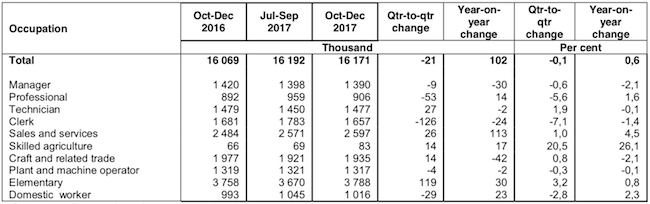


The stat I enjoyed the most was that over the last year, employment in Gauteng dropped by 121 000, but employment in the Western Cape was up by 106 000. What! Does that reflect people were leaving the city of gold for the mountain and no water?

Market Scorecard. Yesterday was another day when US markets were both red and green at some stage, to a lesser extreme though. The Dow was up 0.16%, the S&P 500 was up 0.26%, the Nasdaq was up 0.45%, and the All-share was up 1.78%.Our market had a strong day, which included a surge during the home stretch. MTN was up 3.2%, Tiger Brands was up 3.5% and Naspers was up 2.9%.


Linkfest, lap it up

One thing, from Paul

I'm a big fan of holding steady and carrying on doing what works. This is definitely a good idea in markets, where over-reacting to the latest headline is generally a bad idea.

So I enjoyed this snippet in a blog post I read recently. An analysis of football goalies facing penalty kicks revealed that they dive to the right or the left 94% of the time. They guess correctly 40% of the time and save about a quarter of the correct guesses. It turns out that if the goalkeepers didn't move at all their chances of saving the penalty increase from 13% to 33%.

So they pick a strategy which looks good, and feels right, because "at least I'm doing something", but that strategy ensures they have a lower success rate. Apparently this is called "action bias" by behavioural experts.


Byron's Beats

Much is spoken about Amazon Web Services but Google Cloud does not get nearly as much airtime. According to estimates AWS revenues are about four times that of Google Cloud which is the third biggest cloud services provider. AWS is the biggest and Microsoft's Azure is a close second.

According to reports however, Google Cloud is the largest driver of increased headcount at the parent company, Alphabet. They also have established partnerships with big names such as Salesforce, SAP, Dell and Cisco.

Because the Google search business is so profitable, the potential of the cloud business sits in the cloudy shadows. This should not be underestimated. Cloud services are still coming off a low base and are essential creators of efficiencies for businesses all over the world. Not to mention the explosion of AI. Google has the brand strength (a lot of trust is required) and the capital to turn this into their second big trick pony.


Michael's Musings

Iceland is a great country to host crypto-mining operations. The electricity is cheap and is mostly clean, and the weather outside is cold, reducing the need for cooling - Iceland will use more electricity mining bitcoins than powering its homes in 2018.

5G will be a game changer for consumers, it is 100 times faster than current 4G technology! At this rate, fibre is going to be obsolete by the time it is fully rolled out - 5G Is Making Its Global Debut at Olympics, and It's Wicked Fast.


Home again, home again, jiggety-jog. Politically, the changing of the guard seems to have reached its climax today. The JSE is also in the green this morning, which is good to see after a rough few weeks for equities. At 13:00 today, we will get the retail figure read for South Africa. Remember our last read shot the lights out thanks to South Africans embracing Black Friday.


Sent to you by Team Vestact.

Email us

Follow Michael, Byron, Bright and Paul on Twitter

078 533 1063

Tuesday, 13 February 2018

Correcting the Correction


To market to market to buy a fat pig. This week marks the start of the biggest human migration of the year, the Chinese New Year. It is estimated that around 710 million people will be on the move! The holiday starts on Thursday and will last all the way through to next week Wednesday. Here are some interesting facts about the tradition - 21 Things You Didn't Know About Chinese New Year.

To give you an idea of the scale of this holiday, Statista has compared the numbers to the US's Thanksgiving weekend - How Chinese New Year Compares With Thanksgiving

Infographic: How Chinese New Year Compares With Thanksgiving | Statista You will find more infographics at Statista

Market Scorecard. It wasn't smooth sailing yesterday, but at least we finished in the green. The US market opened around 1% higher, then weakened to be flat an hour into trading. From there it was a steady rise to 2.3% higher, and finally finished off with a slight weakening. The action during the day shows that volatility is back; the bull and bear tussle continues. The Dow was up by 1.70%, the S&P 500 was up by 1.39%, the Nasdaq was up by 1.56%, and the All-share was up by 0.54%. Resilient was in the firing line again yesterday, down 7.42%. I can't say what the fair value of the company is, looking at the price action though I think that this is a case of sell first, ask questions later. Short-term the price is being driven by fear, long term though it will all come down to fundamentals.


Company Corner

Byron's Beats

It has been a tough few years for Woolworths. Their purchase of David Jones has not gone as planned. The global clothing retail market has been turned on its head by super fast retailers like Zara and online disrupters. The initial David Jones purchase was to access the Australian clothing market, but it seems that the strategy has also shifted to food more recently.

The Woolworths team have found a gap in that market for high-end grocers. It seems this gap also occurs in New Zealand. The following article talks about the new David Jones store in Aukland, how the business is growing its presence online and how they are opening standalone David Jones grocery stores. It is an interesting article from an Australian publication/perspective.

David Jones expands to New Zealand as commitment to food strategy stays strong.


Linkfest, lap it up

One thing, from Paul

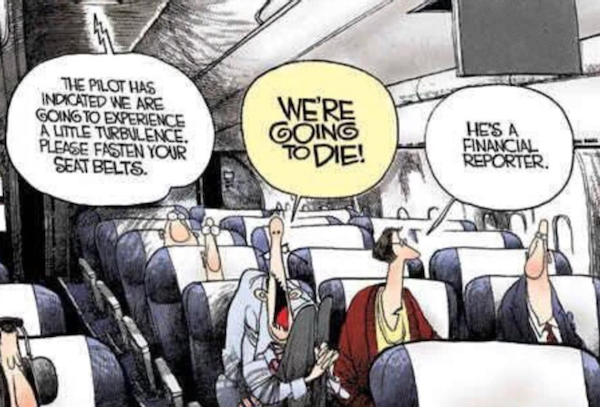
Coverage of last week's stock-market mini-selloff was pretty excitable. One thing I have noticed over the years is that the prices move, and the explanation follows later. In other words, the market indices spike or tank, and then financial journalists scramble around finding reasons to explain the move.

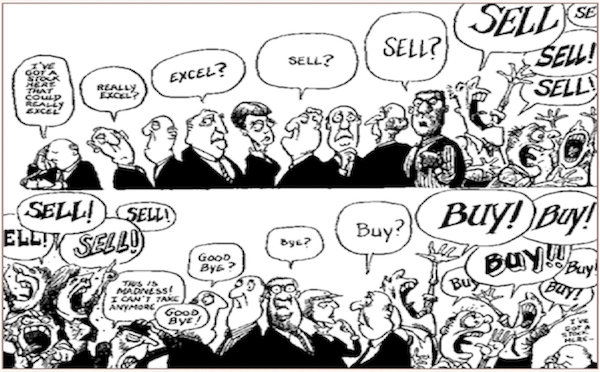
To be fair, the news media has its own challenges. They operate in a competitive market for ears and eyeballs, so they like to crank it up a bit. Here's a good cartoon which makes that point, that's been circulating in the last few days.


Michael's Musings

As I write more, I have become aware of subtle (sometimes not so subtle) grammatical improvements I can make. I only learnt about the Oxford comma last year, lucky my ignorance didn't cost Vestact millions! - A lawsuit over the absence of an Oxford comma was settled for $5 million.

One of the best ways to combat poverty is quality education. It was interesting to see that the entrance exam to the one school was a blind test, so that any biases around the person or their family would not form part of the admittance decision - Russian Billionaires Are Building Mega schools to Rival Eton and Exeter.


Bright's Banter

According to a research firm called Canalys, 2017 was a year to remember for the Apple Watch. It had the best quarter ever in the history of all luxury watches. The company shipped around 8 million watches between the first day of October to the last day of December which led to a total of more than 18 million Apple Watch units sold for the year! This is more than the entire Swiss watch industry combined!

Infographic: Apple Shipped More Watches Than Switzerland in Q4 2017 | Statista You will find more infographics at Statista


Home again, home again, jiggety-jog. Our market is following the lead of the US and Asian stocks, the All-share is currently up 1.2%. Relevant data out today is; UK unemployment and CPI, and locally we have unemployment figures at 11:30 and then the ANC NEC has their press briefing at 14:00. Whatever happens, we need to remember that change is slow, even if the market's default reaction is to assume all the wrongs will be righted.


Sent to you by Team Vestact.

Email us

Follow Michael, Byron, Bright and Paul on Twitter

078 533 1063

Monday, 12 February 2018

Caught by the Shorts


To market to market to buy a fat pig. Activist short sellers are something that we are not used to in South Africa. In a market like the US, it is commonplace thanks to all the capital looking for a home, and the large number of listed companies.

Just to make sure that we are on the same page, a short seller is someone who profits from share prices dropping. Here is the 101 on how the mechanics work. A short seller will identify a stock (Company X) that they think is overvalued, they will then approach long-term holders like ETF providers or pension funds and ask to borrow some stock of Company X. In exchange for the stock, they pay the pension fund or ETF provider a small fee. Once the short seller has the stock, they then sell it, hoping that when they repurchase it in the future the stock price has dropped.

We do have short sellers in South Africa; generally it is part of what is called a long/short strategy. For example, a hedge fund might go long Shoprite and short Pick n Pay, based on the assumption that Pick n Pay is overvalued for the sector. Activist short selling is a completely different beast though. Activist short sellers go after companies where they feel the company has something systematically wrong with it. Due to the limited number of stocks on the JSE, and the general high regard we hold for our business leaders, activist short selling hasn't been a feature on the JSE.

With the Steinhoff saga and Viceroy going after Capitec, the age of big short sellers has arrived. Toward the end of last week, the Resilient group of companies came into the spotlight again, this time from local company 36ONE. You might remember that they were rumoured to have been the target of the Viceroy report before Capitec. Moneyweb have a nice breakdown of the allegations - What is the Resilient stable accused of?.

People sometimes bemoan short sellers because they profit off of other people's loss. The argument can be made that due to short sellers the share price of defunct companies won't rise as high, meaning that when it comes crashing down to earth it doesn't fall that far. Short sellers take the same risks as ordinary buyers, normally more risk. They have a role to play in keeping management honest and helping prevent bubbles from forming.

Market Scorecard. Friday epitomised the market over the last week. It first started up over one percent, then dropped to be down over two percent then bounced to be up over two percent and finally closed up one percent. The Dow was up 1.38%, the S&P 500 was up 1.49%, the Nasdaq was up 1.44%, and the All-share was down 1.29%.


One thing, from Paul

Stephen Pinker is a Professor of Psychology at Harvard University. He wrote a book in 2011 called "The Better Angels of Our Nature" where he made the case that violence in human societies has steadily declined with time.

He is out with a new book now called "Enlightenment Now: The Case for Reason, Science, Humanism and Progress". This weekend the Wall Street Journal ran an excerpt from the book in a longish article. It's well worth a read:

The Enlightenment Is Working

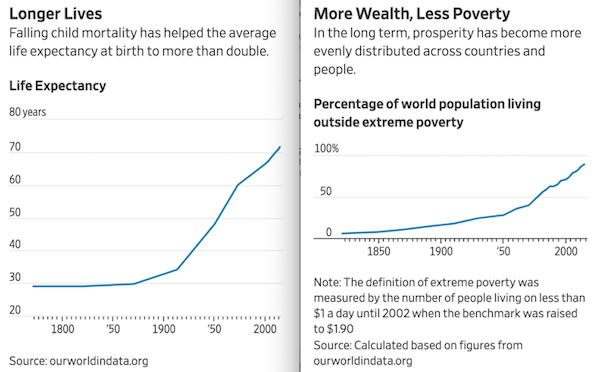
Pinker notes that through most of human history a newborn was expected to live around 30 years. Now its 71 years globally, and 81 in the developed world.

Poverty is also declining rapidly, a point that deserves more attention (despite the ongoing fixation with income and wealth inequality). Progress has been relentless, and it's not farfetched to suggested that it will be eradicated altogether in the years ahead.


Pinkers' key point: "To what do we owe this progress? The Enlightenment is working. Our ancestors replaced dogma, tradition and authority with reason, debate and institutions of truth-seeking. They replaced superstition and magic with science. And they shifted their values from the glory of the tribe, nation, race, class or faith toward universal human flourishing."

Of course, its to be expected that major global corporations would do well against this backdrop.


Michael's Musings

It is the week of love. Valentine's day is on Wednesday, have you bought something yet? The below infographic shows what the average spend is! - Valentine's Day 2018 - The Cost Of Love

Infographic: Valentine's Day 2018 - The Cost Of Love  | Statista You will find more infographics at Statista


Home again, home again, jiggety-jog. The question of who will lead South Africa should be put to rest by the end of today? We will have to wait and see. It is a rather quiet day on the data front, both locally and internationally. Out of the gate, our market is up, Naspers is back into the R3 000's and the Rand is below $/R12.00 again.


Sent to you by Team Vestact.

Email us

Follow Michael, Byron, Bright and Paul on Twitter

078 533 1063
Friday, 9 February 2018

Tesla Shoots for the Stars


To market to market to buy a fat pig. The US has just missed their deadline to pass a new debt ceiling bill. It is currently 00:05 in Washington, where the Senate is expected to vote at 02:00 and then the House is expected to vote between 04:00 - 06:00. Assuming both sides of Congress vote in favour of the new bill, Trump can roll out of bed at 07:00 to sign it into law, just in time for federal workers to be at work on Friday morning. At the moment, there isn't any noticeable impact from the shutdown.

You may be asking why there are these shutdowns? At the heart of the matter is the current US deficit, where they are spending more than they collect in taxes. Roughly speaking the US federal government spends $4 trillion a year and only collects $3.5 trillion from taxes. As they keep racking up deficits, the debt reaches self-imposed limits, the debt ceiling. Below is a table of the deficit over the last few years, note how huge it was during the financial crisis!


Found at US Government spending

I have been asked before, why does it seem like investors care more about South Africa's deficit and less so about the US deficit? As it stands, the US 10-year yield is 2.8%, and the RSA 10-year yield is 8.4%. Roughly speaking our debt is 3.5 times more expensive, so even a small deficit costs us much more!

Market Scorecard. It was one-way traffic for the US market yesterday. The Dow was down 4.15%, the S&P 500 was down 3.75%, the Nasdaq was down 3.90%, and the All-share was down 0.44%.. Asian markets are down over 2% this morning, with Tencent down 3%. Market slumps like this only matter if you are planning to sell your stocks in the near term, which is why you should never have money in stocks that you will probably need in the next 12-months. If you plan to only need the money in the next five, ten or twenty years, what the market does today is largely inconsequential.

If you are someone who has a few decades to go until retirement, dips like these are good things. I would much rather be putting my retirement savings into the market when it is lower rather than higher. Due to dips like these being insignificant for long-term holders, there is no need to look at my portfolio regularly. Watching your investments go through the gyrations of volatility creates unnecessary stress. Below is one of my favourite cartoons for when the market goes through periods of uncertainty. Are we up or are we down?


Company Corner

Byron's Beats

Tesla reported fourth quarter and full year numbers two days ago which always sparks excitement. At the same time, Elon Musk had just launched his Roadster into space and images like this were floating around the internet.


He really is a marketing genius!

2017 was a busy year for the company. They started delivering the model 3, unveiled the Semi truck, launched the new Roadster (and one into space), installed the world's largest battery in Australia and delivered 101 312 Model S and X vehicles.

Revenues grew 55% for the year to $11.8bn. For the full year, the company lost $2.2bn. But because so many people believe in the story, the company has access to a lot of capital. Currently, the company is sitting on $3.4bn in cash which should keep it flush for at least another year.

It is very hard to look at fundamentals for this business. I saw some report that suggested if Tesla meets all it's production targets it could be making $20 a share in 2020. The share currently trades at $315. I can almost guarantee they won't meet their targets but it still has the potential to become very profitable in the future.

Having said that, I wouldn't be surprised if Elon Musk constantly launches new products and constantly expands in new regions (Jeff Bezos style). Which means this company won't be profitable for a long while to come.

But once they manage scale, as the best electric, mainstream car in the world, they could be absolutely massive. I haven't even mentioned the energy supply side of the business.

It is volatile and is still pinned up by faith in the story. We like the share but only as a small allocation to a well-diversified portfolio.


Linkfest, lap it up

One thing, from Paul

This week on Blunders: Volpocalypse - the trend is your friend until the bend at the end, El Chapo promises not to murder his jurors, US Treasury uses Forbes magazine to complete its homework assignment, and man vs. dog eating contest in China: Blunders - Episode 87


Michael's Musings

It is amazing what we can do when we put our mind to something - A memory champion has memorised 10,000 digits of pi.


Vestact in the Media

Bright chatted to PowerFM about Twitter and MTN - PowerFM - MTN listing in Nigeria.


Home again, home again, jiggety-jog.Our market is down 1.5% on the open, following global markets. The US Senate has just approved the budget bill, so it moves onto the House now. The Winter Olympics opening ceremony is today, I see that some of the events kicked off on Wednesday already. We currently have curling on the in the background to get into the spirit of things; and people call cricket boring? Instead of watching the market and your portfolio today, watch that.


Sent to you by Team Vestact.

Email us

Follow Michael, Byron, Bright and Paul on Twitter

078 533 1063

Thursday, 8 February 2018

Double Tap


To market to market to buy a fat pig. Markets are all over the place at the moment; volatility is on the up. There are not many days when you see so many companies in the Top 40 moving higher by more than 3%. Some of the big movers yesterday were, NEPI Rockcastle up 16.8%, STAR up 10.9%, Investec PLC up 7.5%, MTN up 4.5%, Tiger Brands up 4.2%, and Discovery up 3.5%. In total, 16 companies in the top 40 were up over 3%!

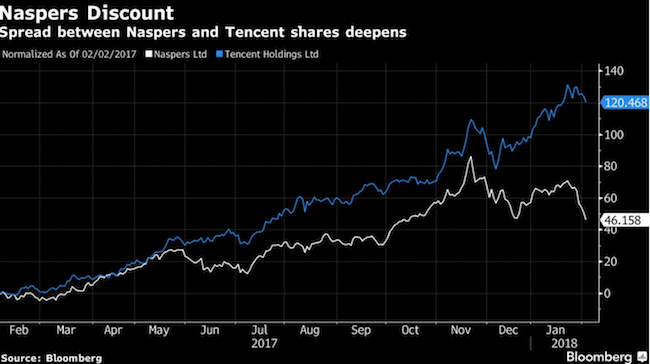
Our large dual-listed companies haven't been fairing as well, partly due to their primary listing coming under pressure but also our strong Rand. Over the last three months, Richemont is down 16% on the JSE and only down 5% in Switzerland. Looking at Naspers, the gap between its value and Tencent continues to grow. I suspect the reason has to do with Naspers's complex holdings structure, coupled with the Multichoice saga and a stench hanging over South African business because of Steinhoff.


Market Scorecard. On US markets, the bulls and bears were in a constant fight for supremacy. On the open, the bears were winning. The bulls then banded together to push the market into the green by 1%. From lunch until around 40 minutes before the market close, things bumbled along. Then just before the market close, the bears staged their counter-attack. The Dow was down 0.08%, the S&P 500 was down 0.50%, the Nasdaq was down 0.90%, and the All-share was higher by 0.90%.


One thing, from Paul

If your investing strategy involves funds with strange names or letters of the Greek alphabet, there is a strong chance that you don't know what you are doing. Or that you are playing with firecrackers!

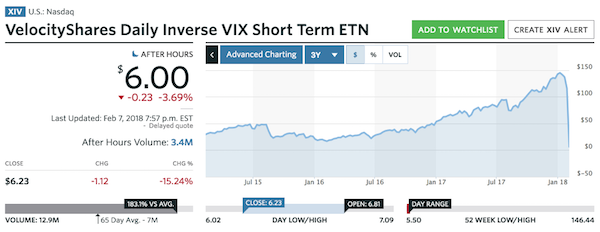
We saw an amusing example of this on Monday, where a Frankenstein financial product called the Velocity Shares Daily Inverse VIX Short-Term ETN (code: XIV) literally exploded. XIV is an exchange-traded note underwritten by Credit Suisse that gives "investors", roughly speaking, negative 1 times the return on the CBOE Volatility Index (the VIX) each day.

Wait what? Ok, slowly. The CBOE Volatility Index is a measure of the stock market's expectation of near-term volatility implied by S&P 500 index options, calculated and published by the Chicago Board Options Exchange (CBOE). It is sometimes referred to as the fear index or the fear gauge. Volatility has the greek symbol σ. That's the lower case of Sigma. You still with me?

All you need to know is that recently, the VIX has been low and declining. Markets had been very calm. So people made lots of money owning the XIV, because it delivered the opposite of the VIX, and went up almost every day. Plus, people owning it got to say cool sounding things like "I'm killing it right now, 'cos I'm short vol". The fund had almost $2.0 billion in units in issue at the start of the week.

See the chart of what happened next:


Company Corner

Bright's Banter

Facebook had a stellar 2017 year when it comes to earnings as they have managed to beat expectations relentlessly without fail. Here's is what the Zuck had to say about the year:

"2017 was a strong year for Facebook, but it was also a hard one," He went on to say: "In 2018, we're focused on making sure Facebook isn't just fun to use, but also good for people's well-being and for society. We're doing this by encouraging meaningful connections between people rather than passive consumption of content. Already last quarter, we made changes to show fewer viral videos to make sure people's time is well spent. In total, we made changes that reduced time spent on Facebook by roughly 50 million hours every day. By focusing on meaningful connections, our community and business will be stronger over the long term."

We saw the shares go down around 5% when the news above was made public, but the shares then recovered sharply to be up around 2% during the earnings call when management gave more information on how they are going to make the platform more meaningful to the users.

Now lets take a look at their final quarter and full year numbers:

    - Revenues: grew by 47% for the quarter to $12.97 billion bringing the total revenue for the year to $40.65 billion.
    - Net Income: grew by 20% for the quarter to $4.27 billion bringing total net income for the year to $15.9 billion.
    - Monthly Active Users: 2.13 Billion, up from 2.07 Billion last quarter.
    - Daily Active Users: 1.40 Billion, up from 1.37 Billion last quarter.


However, the reduction in Facebook's net income fell $3.19 billion from Q3 to Q4 due to a once off charge tied to changes in the US tax system. This comes as no surprise at all as we have seen other companies reporting similar tax charges.

Infographic: Facebook's You will find more infographics at Statista

We like the fact that Facebook is going back to first principles by revamping the News Feed and prioritising posts from friends and family over advertised viral videos/content from publishers with an agenda. This will help avoid hurtful content that goes viral from time to time and dilutes the user experience. Most importantly, it'll help curb the invisible hands that have been swaying election results all over the world by perpetuating fake news on the platform. This move could see Facebook's advertising revenues grow slower in the interim, but it'll boost the company's growth long-term, as advertisers/brands will trust the platform more, and engagement will be more meaningful for users.

We are not really worried about the slowing user growth on Facebook itself. Instagram is becoming more relevant; since it introduced Stories, which was the feature Snapchat was created around (RIP Snap). Engagement keeps increasing and advertisers are recognising this, joining in on the action. Corporate accounts are growing by high double digits per month, especially those which trade directly to consumers. They do product deals with influencers to promote their product, a strategy that has helped the likes of Adidas flourish in recent times.

For the first time, Facebook admits to dragging its feet in response to the Russian hacking reports. This is wonderful news as it is what ultimately led the company to revamp its news feed to prioritise friends and family. This is reassuring to the people of the U.S.A and the rest of the world; that this will never happen again as they're finally regulating themselves as the media company that they are! We think this will help ease the regulatory scrutiny and management can focus more of their time exploring other growth avenues.

Let's not forget the fact that this machine still has more relationships than Islam, Capitalism, and Communism. These relationships are proving to be more and more meaningful as they're not going to be spammed with viral videos and unnecessary content that's targeted to change the way they perceive certain political candidates for example. With WhatsApp now being Facebook's second-biggest property followed by Messenger and Instagram, we think the company is finally doing the right thing in society and as a result we hold and buy more!


Linkfest, lap it up

Michael's Musings

Imagine going to the supermarket and then freshly picking the herbs that you want? With urban/vertical farming, you can now do just that - Balderton Capital leads $25M Series A in 'urbanfarming' platform Infarm

When Jobs made his comeback to Apple, the company was weeks away from going bust. I stumbled across this article which reminded me that it was Microsoft who threw them a lifeline. I wonder if Microsoft regrets helping Apple? - Aug 6 1997: Apple Rescued - By Microsoft


Home again, home again, jiggety-jog. Our market is slightly down on the open, rather boring compared to how the rest of the week has gone. Tesla's numbers last night showed that they burnt through $675 million during their last quarter, not much of a reaction from the stock though. We will have a more detailed breakdown of the numbers in the next couple of days. Then later today, it is the weekly initial jobless claims read from the US. Considering how the market was spooked last week by a strong labour market, the data this afternoon might have a bigger impact than normal.


Sent to you by Team Vestact.

Email us

Follow Michael, Byron, Bright and Paul on Twitter

078 533 1063
Wednesday, 7 February 2018

Clouds Raining Cash at Amazon


To market to market to buy a fat pig. Whoa, we are going to need a neck brace after that market whiplash. Yesterday was carnage for global markets, Asian stocks were down over 2%, our All-share opened down over 3%, and the US markets opened down 1.5%. By the time I went to bed though US markets were handsomely in the green!?

Market Scorecard. Thanks to the indecisive market, the VIX, a measure of volatility, was at its highest level since the middle of 2015. The Dow closed up 2.33%, the S&P 500 closed up 1.74%, the Nasdaq closed up 2.13%, and the All-share closed down 1.29%. The best reason I have seen for the market recovery is, "buy the dip" rhetoric from many brokerage firms. Even with this bounce, many stocks can still be thought of as being on sale. We can't control or even predict the short-term movements of the market. We can control what companies our money is invested in, and make sure that we are regularly saving.

I had a good chuckle this morning, reading a few articles on yesterdays market movements. You can see many of the articles were written before the market opened, while futures were still pointing toward a very red open. The bulk of the article is about why the market will continue to drop, they then do an abrupt turn, talk about a bottom being formed and then say the market is bouncing. The truth is that most reasons given for market movements are thought up after the fact. It will be something that can explain movements in one sentence, and fits into our mental need to create easy to imagine stories.


Company Corner

Byron's Beats

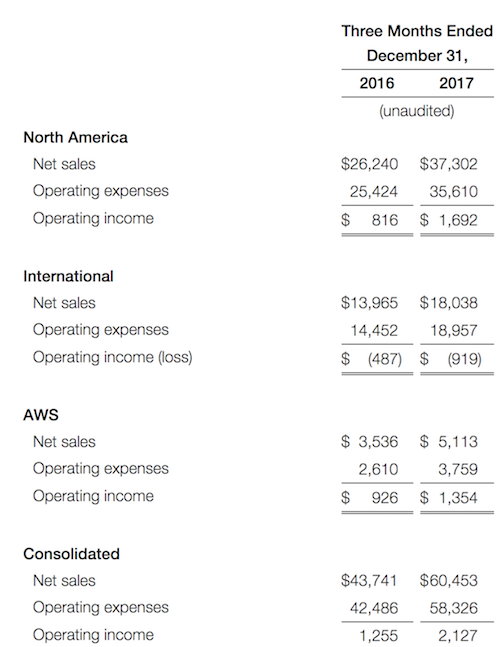
I remember a time when Amazon used to stumble on to a profit every once in a while. These days, with Amazon Web Services (AWS) printing cash, profits are becoming the norm. Amazon reported 4th quarter and full year numbers last week Thursday which pleased the market and smashed expectations.

The image below paints a decent picture of what happened in the quarter. It also indicates how the more mature North American online retail business is now starting to make money. After all those years of growing scale and reinvesting profits, Amazon is finally reaping the rewards.


For the full year, the group recorded a whopping $178bn in sales. This showed an increase of 31% from 2016. Net income came in at $3bn which equated to $6.15 a share. It is still not about earnings just yet for Jeff Bezos. Amazon dominates 40% of the US online retail market, but they won't stop there. India, Australia, Europe and South-Eastern Asia are in their sights. Please come to South Africa?

Operating cash flow is probably a better number to look at. It came in at a healthy $18.4bn. The AWS division has been incredible for this business. It has a 40% market share of the global cloud business and is extremely profitable. It has allowed Amazon to expand the rest of its businesses even quicker than even they ever expected.

The results report included some 2017 highlights. Below are a few that stood out to me.

- In 2017, more than five billion items shipped with Prime worldwide.
- Fire TV Stick and Echo Dot were the best-selling products in 2017 across all of Amazon. Customers purchased tens of millions of Echo devices last year.
- Amazon hired nearly 130,000 employees globally in 2017, excluding acquisitions.
- Amazon announced that the Prime Video app is now available on Apple TV in over 100 countries. Prime members now have more ways to stream award-winning and critically-acclaimed titles, including Amazon Original Movies and Prime Originals.
- NFL Thursday Night Football on Amazon Prime Video saw a total of 18.4 million views in 11 games. Prime members in more than 200 countries and territories streamed games on living room devices, including smart TVs and Fire TVs, as well as the Prime Video mobile app and the web.
- Amazon acquired the global television rights to The Lord of the Rings, based on the novels by J.R.R. Tolkien, with a multi-season commitment.
- Amazon launched two furniture brands: Rivet, offering affordable and versatile mid-century modern furniture ideal for smaller spaces; and Stone & Beam, offering durable and stylish furniture for the modern household.
- Amazon Go, a new kind of store with no checkout required, is now open to the public in Seattle. The checkout-free shopping experience is made possible by the same types of technologies used in self-driving cars: computer vision, machine learning, and sensor fusion.
- Amazon launched its retail and third-party marketplace offering in Australia with fast delivery on millions of products, including items from thousands of small and medium-sized businesses.
- Prime selection in India now offers members more than 25 million local products from third-party sellers.
- Amazon Web Services (AWS) announced several enterprise customers during the quarter: Expedia, Ellucian, and DigitalGlobe are going all-in on AWS; The Walt Disney Company and Turner named AWS their preferred public cloud provider; Symantec will leverage AWS as its strategic infrastructure provider for the vast majority of its cloud workloads; Expedia, Intuit, the National Football League (NFL), Capital One, DigitalGlobe, and Cerner announced they've chosen AWS for machine learning and artificial intelligence; and Bristol-Myers Squibb, Honeywell, Experian, FICO, Insitu, LexisNexis, Sysco, Discovery Communications, Dow Jones, and Ubisoft kicked off major new moves to AWS.

It is a lot to take in but you get why there is so much excitement and hype around this business. They are growing in the right areas. Still targeting markets in sectors that are coming off a low base. Their scale and expertise allow them to dominate within these sectors. We continue to hold and buy Amazon as a core holding in our portfolios.


Linkfest, lap it up

One thing, from Paul

So, after a shocking sell-off on Wall Street on Monday, we had a brilliant bounce last night. After a session full of wild movements, the Dow Jones Industrial Average ended up 567 points (or a move up of 2.33%). What a mug's game! Who is driving this bus?

Well, exactly. Everyone is clueless. As I said yesterday, the best thing to do is to watch from the sidelines. Or buy the dips, if you are brave.

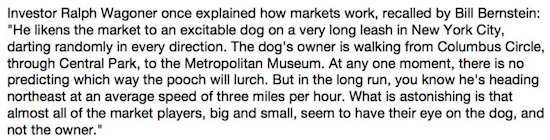
I saw a fun analogy of the randomness of all this in a tweet by Morgan Housel. It's about a man walking a dog across the southern part of Central Park in New York City. I liked it because I know that area very well, having run around those roads many, many times.


Michael's Musings

I wasn't around during the space race, but watching Musk's rocket launch this morning, I got a small taste of the excitement. The goal now is to get to Mars! - SpaceX's Falcon Heavy Rocket Launch. Maybe the reason for the market recovery was due to the excitement around humanity going deeper into space?

This is a big for Tesla. Homeowners love making home improvements, so having a presence in stores where there is large foot traffic is a good thing - Tesla will sell its solar power products at 800 HomeDepot stores.


Bright's Banter

The lesson from that last few trading days is that markets don't go up in a straight line, there will always be gyrations in the process. Howard Marks is known for his famous mantra that "Trees don't grow to the sky, and not everything goes to zero. And if you take care of the losers, the winners take care of themselves".

This chart below shows how some of our model portfolio favourites performed on this said "Flash Crash".

Infographic: You will find more infographics at Statista


Home again, home again, jiggety-jog. As expected our market is off on the front foot this morning. The business confidence read yesterday was the highest it has been for two and a half years; confidence leads to growth! Company data out today, Tesla releases their FY numbers. All eyes will be on their cash burn and projected figures - or just the roadster cruising through space!


Sent to you by Team Vestact.

Email us

Follow Michael, Byron, Bright and Paul on Twitter

078 533 1063

Tuesday, 6 February 2018

Blood on the streets!


To market to market to buy a fat pig. You know that it was a tough day out when CNBC showed the top 5 'gainers' of the S&P 500 for yesterday, as stocks who lost the least! Not even cryptocurrencies have survived the current market sell-off, Bitcoin is down 24% to $6 200 a coin, ouch!

Market Scorecard. After the carnage on the market yesterday, US indexes are now red for the year. The Dow was down 4.60%, the S&P 500 was down 4.10%, the Nasdaq was down 3.78%, and the All-share was down 2.63%. Having a look at Asian markets this morning, our market is going to open very deep in the red! Tencent in Hong Kong is down 6%, which means Naspers will be down a similar amount too. If that happens Naspers will be trading around R2 900 a share, a far cry from the R4 000 plus a share in November last year.

Why is it so 'easy' for the market to fall 4% in a day, but it is almost unheard of for it to gain 4% in a day? You can blame our cave-dwelling ancestors for the irrational thought process of Loss aversion. In simple terms, a loss hurts more than the pleasure you get out of a gain. Roughly speaking, to balance out the potential of a 5% loss, the other side of the equation needs to be the potential to gain 10%.

Added to that, our minds are generally lazy, so they latch onto the stories that are easiest to imagine. What is more natural to imagine, the stock market dropping to levels it has been at before or it pushing higher into uncharted territory? When people talk about stock market history, the landmarks are usually the periods of stock market crashes, not the periods of record highs. As such, after a small drop in stocks, it is not hard to jump directly to the 'this is a crash' scenario.

Add those two mental tendencies together and 'Sell first, ask questions later' becomes our go-to strategy.

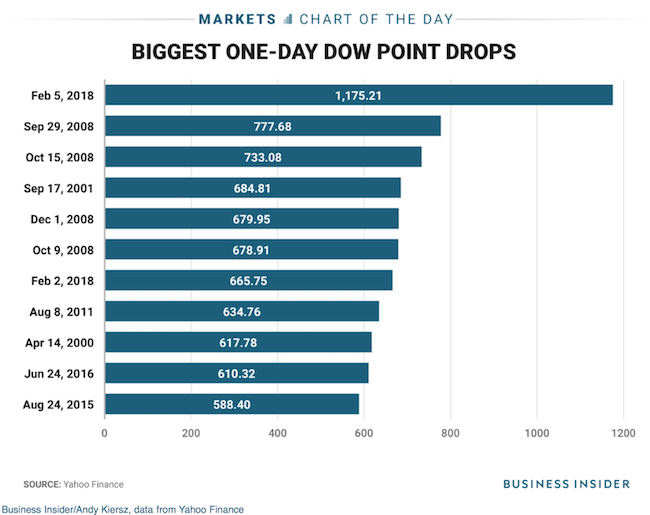
The following graphs from mainstream media don't help the situation either! (Here are the biggest one-day point drops in the Dow's history)


As Paul points out below, when ranking yesterdays drop in percentage terms, it would be lower than Bafana Bafana on FIFA's global ranking.


One thing, from Paul

Well, last night was a tough trading session on Wall Street. As you will have read above, the Dow saw it's biggest points decline (1175 points) in history. However, at 4.6% off, it was only the 108th worst percentage drop of all time. So there were lots of days that were worse.

According to Josh Brown, the last time we had a Dow drawdown this big in a single day was in August 2011. He notes that the Dow was at 10,700 points then and today it closed at 24,345. That puts things into perspective.

The intraday slump was even worse, almost 1,600 points before a slight rally into the close. Again, big numbers (the rally of the last eight years) begets big numbers (the slump in nominal terms).

If you feel bad about all this, I wonder how poor Jay Powell is feeling? It was his first day on the job as Federal Reserve chair. Mind you, one of the reasons advanced to explain the sell off was that strong US employment numbers on Friday last week might lead the Fed to hike rates too fast this year. Well, that's easy to fix! No inflation, no need to hike rates aggressively, right?

So the market went lower because people think that the global economy is too strong? We shall see what happens next, but I 'd rather that we were complaining about a strong economy, than one which was too weak.

The right thing for you to do at this time is nothing. Ride it out! Equity markets do this sort of thing from time to time. Its part of the deal. I have been in this business for most of my adult life, and I've lived through many similar dramas. If you jump ship now you lock in poor exit prices and are out of the market when the rally comes. If you feel like being brave, it can be a good idea to buy these dips.


Company Corner

Bright's Banter

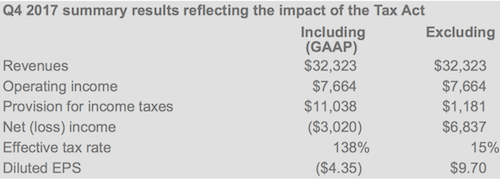
On the 1st of February, Alphabet/Google blessed us with financials for the last quarter of the year, as well as the full-year numbers for the year ending on 31 December 2017. The company missed earnings expectations, with $9.70 per share coming in just under the $9.98 forecast. Shares were down 5% in after-hours trading when those numbers came out.

The amazing and not so new Ruth Porat, CFO of Alphabet, opened by saying the following on the earnings call:

    "Our business is driving great growth, with 2017 revenues of $110.9 billion, up 23% year on year, and fourth quarter revenues of $32.3 billion, up 24% year on year. Our full year operating income growth continues to underscore our core strength, and on top of this, we continue to make substantial investments for the long-term in exciting new businesses,"


Now in English, "The business is growing from strength to strength. 2017 was our record year and record quarter, and we will continue to seek out more complimentary opportunities to continue to grow our business."

This amazing one-trick pony posted an all-time record for advertising sales which is now 85% of revenues. These ads are the ones we see on our smartphones and at the beginning of a YouTube video. The only problem with the smartphone ads is that they bring home less bacon than the traditional desktop/laptop ads. This will change over time as engagement increases on mobile due to larger screens. Google's cost-per-click, what advertisers pay each time someone clicks on an ad, declined 14% for the quarter, this will stabilise over time.

However, Alphabet posted a net loss of $3 billion for the quarter due to a $9.9 billion once off charge tied to changes in the US tax system. This is not a surprise at all as we have seen banks reporting similar tax charges. Thank you Trump?

Google is still the largest, most dominant search-engine by miles thanks to its positioning as the default search engine on Chrome and on mobile phones. Sometimes Google has to pay the likes of Apple to be the default search engine on their Safari browser and this payment is referred to as traffic-acquisition costs or TAC. TAC was 24% of Google's advertising revenues, which was up 33% year-on-year. According to the lovely Ruth Porat, Mobile Search and something called "Programmatic advertising" carry the highest TAC.

"Other revenues" which include sales from Google's Cloud Business, The Pixel Phone, YouTube Red, Google's Smart Speaker, Google Play Music etc. came to $4.7 billion for the 4th quarter, up 37% year-on-year and was 15% of Google's overall revenues thanks to the strong holiday sales.

Alphabet's "other bets" which include their self-driving car business Waymo, smart-home hardware provider Nest, and their fibre-to-home business Fiber, are still loss-making businesses.

Alphabet's shares were up just over 30% for the year of 2017, they're up 6.5% year-to-date at time of writing, valuing the company at $775 Billion. The company continues to buy back more shares, the board has authorised to buy-back a further $8.6 billion worth of its Class C shares. If you strip out the once-off tax item, the historic price-to-earnings ratio of 35 and a forward price-to-earnings ratio of around 29 is still relatively cheap for a high-growth technology company.


Linkfest, lap it up

Michael's Musings

Putting the market crashing aside. Today humans get one step closer to going to Mars, Elon Musk's Falcon Heavy rocket is scheduled to launch this evening - SpaceX has received permission from the US government to launch Elon Musk's car toward Mars.


Home again, home again, jiggety-jog. Our market is down 3% this morning on the open. The morning after Brexit is the last time I can remember such a poor start to the day. Later today, is the South African business confidence number; given all the positive chatter around I expect it to be smartly up.


Sent to you by Team Vestact.

Email us

Follow Michael, Byron, Bright and Paul on Twitter

078 533 1063