Monday, 20 June 2016

The Larry and Sergey show


"Google is not a conventional company. We do not intend to become one. Throughout Google's evolution as a privately held company, we have managed Google differently. We have also emphasized an atmosphere of creativity and challenge, which has helped us provide unbiased, accurate and free access to information for those who rely on us around the world"


To market to market to buy a fat pig Bump and grind Friday, we hugged the thin red line all the way through to the close, in the end a nearly one-quarter of a percent gain on the day wasn't the best outcome. Joburg was quiet, a long weekend essentially. We should really make some holidays on Fridays and Mondays rather than outside of that, productivity plumbs new lows is my sense. If anyone has a labour intensive business, let me know what these holidays do to you. Not that I don't think that celebrating these special events in our history are wrong, we could do a whole lot worse in honouring the legacies of those gone before us by working extra smart and extra hard, looking to build a better society.

Of course the most important event of the week, at least as far as Mr. Market's sheep are concerned, is the Brexit or more likely Bremain. Hype sells, ordinary doesn't really sell that much. In other words, not once have I heard anyone put out a note suggesting what will happen if the UK remains in the EU. Which is what the bookmakers are putting the odds at 4-11 for a remain. Or in other words, as a percentage, 73.33 percent. Not much has changed in that regard. And then in terms of the exit crowd, Paddy Power is giving you odds of 9-4, or in percentage terms, 30.77 percent. So ignore the news headlines, the bookies have more to lose than the headline makers. Tell that to the sheep and the herders however. It does however seem that the market is settling to the idea that there will not be a shock vote. Suddenly stocks are going up!

Across in Asia this morning stocks are up, unless of course you are in Shanghai, or participating in that market. Year to date stocks in Shanghai are down nearly 19 percent. Stocks in Japan are up over two and one-third of a percent, the Japanese Yen is weakening again. Let us simply suggest that Mr. Market refers to this as risk on. Again. Stocks in New York (New York) on Friday were sold off, both the S&P 500 and the Dow Jones Industrial Average ended the session down one-third of a percent, whilst the nerds of NASDAQ were sold off a little more aggressively, down 0.92 percent.

Apple stunk up the joint again, that stock was off over two percent, so was Alphabet (Google) though, down nearly two and three-quarters of a percent. Citigroup suggested that Alphabet could miss their second quarter revenue estimates. I was reading the founding letter (again) on Saturday, as well as the references made to the same letter to shareholders by Larry and Sergey. The company refers to these as the founders letters. There are a couple of sentences that are worth sharing from both of those letters, first the last one - 2014 Founders' Letter:

    "We shared a profound belief in the power of technology to make life better for people everywhere and imagined what life could be like 10, 15, 20 years down the road. Nevertheless, now that we are here, I am amazed at the progress and opportunities. For example, I could not have imagined we would be making a computer that fits in a contact lens"


We often sit here and get caught up in the day to day machinations of the market and too often discount those trying to (and doing it) change lives. I often tell my youngish kids that they won't need to learn to drive, perhaps not quite yet. Larry and Sergey continue in that letter:

    "The increasing power of computation extends well beyond the Internet. One example close to my heart is our self-driving car project. The goal is to make cars capable of driving themselves entirely without human intervention. We hope to make roadways far safer and transportation far more affordable and accessible to those who can't drive."


This continues to be a big investment theme. A trip back down to the listing IPO founders letter has An Owner's Manual for Google's Shareholders:

    "Google is not a conventional company. We do not intend to become one. Throughout Google's evolution as a privately held company, we have managed Google differently. We have also emphasized an atmosphere of creativity and challenge, which has helped us provide unbiased, accurate and free access to information for those who rely on us around the world."


And then lastly, they nail it:

    As a public company, we will do the same. In our opinion, outside pressures too often tempt companies to sacrifice long term opportunities to meet quarterly market expectations. Sometimes this pressure has caused companies to manipulate financial results in order to "make their quarter." In Warren Buffett's words, "We won't 'smooth' quarterly or annual results: If earnings figures are lumpy when they reach headquarters, they will be lumpy when they reach you."


So I give two you-know-whats about what Citi think about the upcoming quarter. That is their opinion and whilst it counts, it certainly gives us another opportunity to add to what is likely to continue to be an iconic company of our time. Google is down nearly 10 percent year-to-date, let us just say that this might be a huge blessing for all of those wanting to add to the business. Based on the same analyst predictions, Google trades for the next full year earnings at 18.5 times earnings. Sounds dirt cheap for a company with so many amazing opportunities!

And then Apple sold off as the Chinese authorities decided that the iPhone 6 and 6 Plus are too close to a local competitor, in shape and feel and the like. No worries, as far as I understand it, the company hasn't been selling that model for a few months now, remembering that they sell the one model up. The iPhone 6 is so last year. Again, price targets slashed and earnings estimates downgraded for this coming quarter. In the classics, this is a horse has bolted type scenario.

One client, in a WhatsApp conversation said: "market is behaving like a sulky teenager. Making me mad. If Apple drops any further the cash balance will exceed the market cap!" In other words he is saying this company is dirt cheap and the market is wrong on the stock. Lastly, I can't get enough of the Google founders letter. As they say:

    "If opportunities arise that might cause us to sacrifice short term results but are in the best long term interest of our shareholders, we will take those opportunities. We will have the fortitude to do this. We would request that our shareholders take the long term view."


We should always think the same. Take the long view. 15 years is hardly a lifetime in investing. It is about as long as it takes to pay off your house, for many people their largest asset. Let your equity portfolio far outsize your property asset, keep saving all you can. It is far easier to spend money and not save it.


Linkfest, lap it up

As department stores struggle thanks to more people moving online, so too are the shopping malls that the retailers are based in - America's Dying Shopping Malls Have Billions in Debt Coming Due. Given how many shopping malls we have in South Africa, how long is it until something similar starts to happen?

Earth has a new rock that orbits us, it is only around 100 meters wide though - Earth's New 'Quasi' Moon Will Stick Around for Centuries

Ladies you now have another reason to buy that Chanel Bag that you have been eyeing out - Chanel Bag value increased 70 percent in the last 6 years. As the globe gets richer, the top 1% will still want to be seen with unique items.


Home again, home again, jiggety-jog. Big news, Rob Shuter who is currently working for Vodafone in Europe has been appointed as MTN CEO, and will take over as soon as possible. He was once upon a time the CFO of Vodacom South Africa, and comes from an investment banking background. Good for him, I am pretty sure that he is thrilled to get the job, he knows the industry well and understands deal making better than most. Positive for the business, let us see how the share price reacts. My little one got to have a picture with three of the Irish (and Ulster) teammates yesterday, including the flyhallf from Saturday, she was pretty pleased with herself. Markets should start a little better here.


Sent to you by Sasha, Byron and Michael on behalf of team Vestact.

Email us

Follow Sasha, Michael, Byron, Bright and Paul on Twitter

078 533 1063

Friday, 17 June 2016

The Hoff pounding away!


"In the falling away from the Darty deal, in which FNAC prevailed, Steinhoff owned so many shares and were bought out at the higher level. Meaning that shareholders extracted a pretty sizeable and unexpected gain. So why would that be considered "unlucky"? Anyhow, Darty is gone, the group are making a go for a smaller UK listed company called Poundland."


To market to market to buy a fat pig Whilst we were having a day of very careful reflection, loads of things were going on around the financial and of course political world. The tragedies of 1976 were front and centre, when I tried to explain to my kids that this is what happened, their question was simple, "why didn't they arrest the police who did that?" And when you explain that the government had full control of the police and used them as an instrument, they asked a better question, why didn't they vote the government out? Indeed, food for thought.

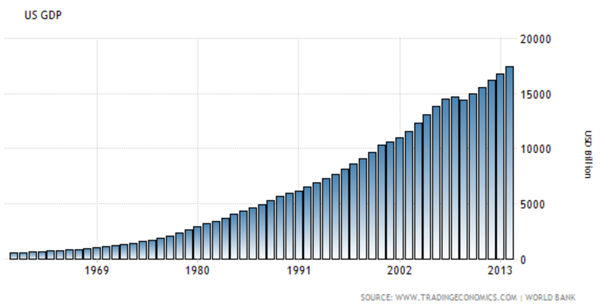
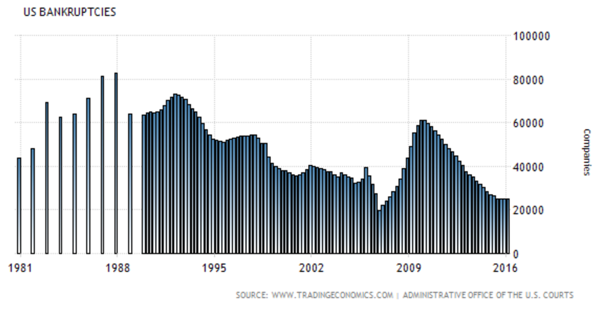
As an outsider when you hear people shouting that American must be made great again, or it is time for Britain to be "won back" all I hear is bigotry and racism. Sorry, that is what I read and see. If people want to exclude those with skills and drive (and no plan B) in some of these territories, then you are missing a giant piece of your humanity. Last I checked, the US registered their biggest GDP ever last year - see Trading Economics. How does this graph look to you?


And then, according to the Migration Policy Institute (source): "Immigrants in the United States and their U.S.born children now number approximately 81 million people, or 26 percent of the overall U.S. population." Basically, by telling one in four Americans that you want to make the country great again, you are insinuating that immigrants (or someone else) made it bad. Yet with unemployment at a historical low, and if you used businesses folding as a measure, you would hardly think that America needed to be "great" again, right? Check this out -


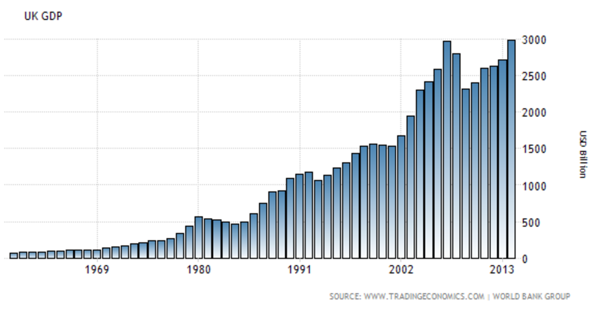
And Britain? I mean the United Kingdom, where two out of their three football teams won yesterday, it would have been three, except two had to square up against one another. With all the shouting from (insert whatever you want here), the longer dated GDP growth seems to benefit from being inside of Europe, see below.


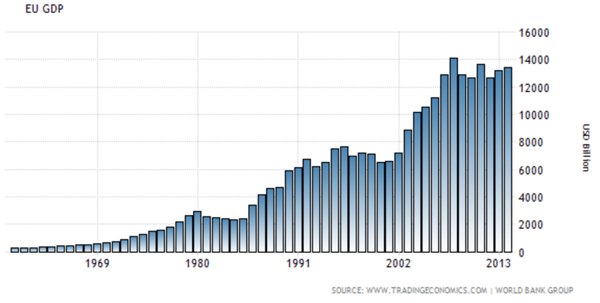
And then lastly, how has the Eurozone done over a longer dated period, how has that done? See below, again, thanks to Trading Economics for all these highly useful charts.


What does become apparent however is that the last six years have been somewhat of a struggle for the common union. After a doubling of the economy inside of a decade, there has been what market types call "consolidation". Over the long (long) term, European GDP has hardly grown, it is a mature market. Which is why immigration to the area should be encouraged to the area, both skilled and unskilled labour. And also to boost productivity and create extra demand. The fact of the matter is that whilst headlines suggest that Europe is finished, the very sad truth (and reality) is that people die to get across the oceans to Europe, from war torn areas. It is better in Europe, there are more opportunities.

The tragic death of a member of parliament in the UK (not to mention mum to two young children) has lent a hand to the Bremain crowd. Bremain being the opposite of Brexit of course. I feel desperate for all those around the family. It is our job to squash hatred, as individuals.


Scoreboard check quickly. On Wednesday when we closed for business, the Jozi all share index was 1.23 percent higher. 123! There were several big news stories of the day, including Steinhoff and Naspers (as well as Tencent), we will deal with those below. Resources were leading the charge, gold stocks have been on fire! The gold price breached 1300 Dollar an ounce after Janet Yellen suggested that rates may stay low for a long, long time. There was some older trade data from the session before that continued to weigh on the currency.

Across the seas and far away, stocks in New York, New York, reversed a four day losing streak through the course of the session. Whilst the half a percent gain on the day is hardly earth shattering for the Dow Jones Industrial, at the worst point stocks were down nearly 1 percent on the day. The broader market S&P 500 added nearly one-third of a percent, the nerds of NASDAQ just over one-fifth of a percent by the time the bell rang for the close. Stocks across Asia are looking better, as a result of the heroic comeback in US markets.


Company Corner

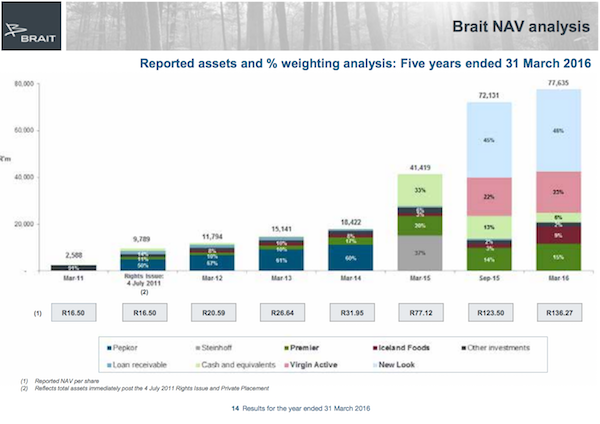
We saw the full year numbers from Brait on Tuesday morning. This caps off another busy year for the investment company with the purchase of Virgin Active, New Look and upping their stake in Iceland Foods from 19% to 57%. Given that the company is an investment company the figure that matters the most for the year is the growth in Nett Asset Value (NAV), over the 12 month period management did not disappoint. NAV went from R77.12 a share to R136.27 a share, a more than "solid" 77% growth.

A big chunk of the gains came thought increases in the value of their investments, the investments grew R22 billion of the total R30.5 billion in gains. Then given that most of the assets are offshore, gains from the weaker currency are around R9 billion of that, so by no means a small number. Here is a quick look at the breakdown of the weightings of each asset, the image is unfortunately poor quality but the colours give you a good idea which are the important ones.


The most important assets are now their two new acquisitions. The value of New Look has increased substantially since they bought it thanks to a reshuffle of debt. Using the balance sheet of Brait, management has been able to reduce weighted average interest cost from 9.4% to 6.3% and extend the average maturities from 3 years to 7 years. This puts New Look in a far stronger position and upping its value nicely.

Some numbers from New Look, their online sales grew by 28%, 41% of woman in the UK have shopped there in the last year and they are adding 50 stores in China to their already 85 stores.

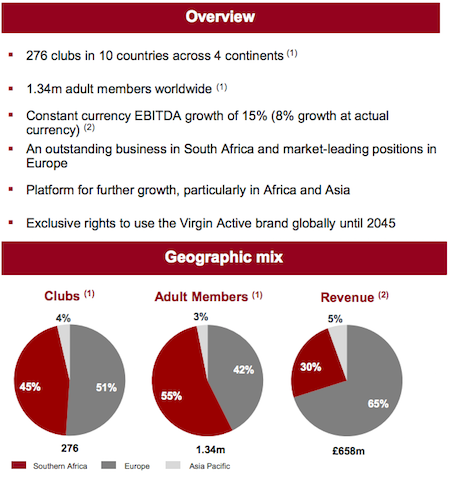
A quick look at Virgin Active in the image below.


Europe is where the money lies for this business, even though South Africa is the bulk of the members is it only 30% of the profits. As the globe becomes more health conscious so will the value of this business increase.

If you want a more in depth look at each of the businesses have a look here - Audited Final Results Booklet. Management have demonstrated through their two acquisitions this year their ability to increase margins significantly, add revenue streams whilst using the Brait balance sheet to the advantage of their subsidiaries. This company is still a buy in our book.


Naspers was in the news Wednesday. Once with a trading update ahead of the results, which I think are next week Friday. By this time next week, we should have a clearer result of where all the spend is taking place in the newer businesses. Remember that now, the company has said that they will report in Dollars. Here goes a copy and paste of the "core" and "headline", as well as earnings per share. Why does Naspers use all the different metrics? And which one matters the most? The company, when they have reported in the past always suggest that "core" headline earnings matter the most.

The company reported that "We expect core headline earnings per share to be between 15% (38 US cents) and 20% (51 US cents) higher than the comparable period's 255 US cents."

Headline earnings per share are expected to be flat, earnings per share will likely be 20 to 25 percent lower. As they say, results next week will give us clarity. Stand by for our coverage next week.

And then "source" close to Tencent said that the company nears $6.6 billion deal to buy majority stake in Supercell. We have spoken about this over the last few days or so, Tencent are a world leader in online gaming. In fact, one of Tencent's games are at the top of pops - Most played PC games on gaming platform Raptr in November 2015, by share of playing time.

Nearly one in four minutes globally is spent on League of Legends. Smashing World of Warcraft and Counter-strike. Sorry serious chaps, the size and scale of the Chinese market, and specifically League of Legends put this into perspective. Entertainment comes across in all forms. Whilst we may pooh-pooh certain activities, do so at your peril!


And then another set of news from Steinhoff, I saw somebody calling it "third time lucky". What? In the falling away from the Darty deal, in which FNAC prevailed, Steinhoff owned so many shares and were bought out at the higher level. Meaning that shareholders extracted a pretty sizeable and unexpected gain. So why would that be considered "unlucky"? Anyhow, Darty is gone, the group are making a go for a smaller UK listed company called Poundland. The first announcement is where Steinhoff "confirms that it is considering a possible offer for the entire issued share capital of Poundland."

Steinhoff have been busy, in a further announcement - Statement Regarding Possible Offer for Poundland Group PLC. The company points out that they already own 22.78 percent of Poundland. They will no doubt announce an all cash offer soon.


Linkfest, lap it up

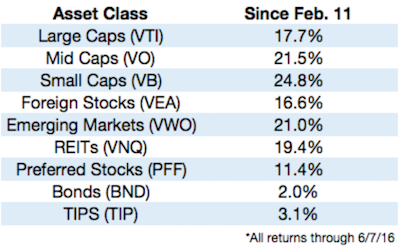
Ben Carlson, makes the point that the world was ending in January and February if you looked at the headlines in the financial media. Since then markets have done rather well - While You Were Worrying. . . The markets are currently under pressure at the moment due to Brexit concerns, given that most of the companies that you own have no direct link to the UK these market pull backs are a good time to add again.


Given the challengers of operating equipment deep under the ocean there are still many things that we have to learn about our ocean floors - China plans massive seal 10 000 feet underwater

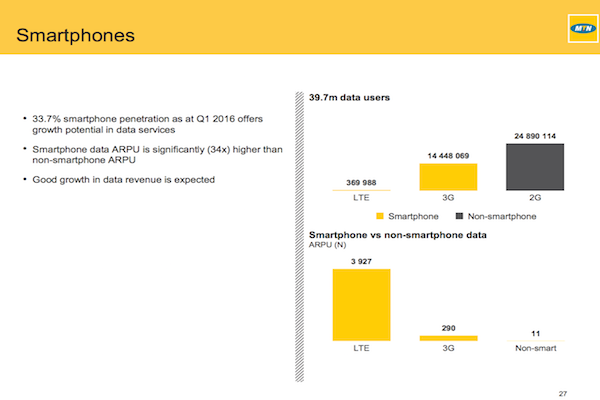
We have been chatting about this article in the office over the last week or two - Humans are about to eat through an unprecedented amount of mobile data. One of the main companies to benefit from the data growth is the telecommunication companies, MTN being one of them. Have a look at how few people have LTE in Nigeria and then look at how much more those people with LTE spend than those with just 3G.


Home again, home again, jiggety-jog. A negative start to the day here locally, I am a little surprised. I cannot wait for Remain (Bremain) referendum to be over, done and dusted. Dumbness prevails and then opportunities always knocks.


Sent to you by Sasha, Byron and Michael on behalf of team Vestact.

Email us

Follow Sasha, Michael, Byron, Bright and Paul on Twitter

078 533 1063
Tuesday, 14 June 2016

FED Focus, again


"To add to her pot are the small matters of the Job Market Is Getting Stronger, Not Weaker and Janet Yellen's Inflation Problem. In the bigger picture this is immaterial to the continued holding and ownership of the businesses that we hold for clients. Sure, it is disruptive for equity markets, it comes with the territory!"


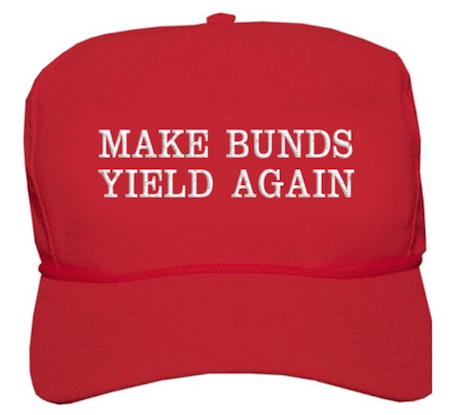
To market to market to buy a fat pig Another day, another set of fears around the looming Brexit vote. A week and a day away now, that 23rd of June, it really cannot come fast enough now. That doesn't mean that there wasn't action in other places, there certainly was. However with increasingly hazy looking polls and too many I don't knows, the usual is happening. Sell and then ask questions later. German ten year government bond yields went negative. So that means that for the pleasure of owning sovereign bonds in Germany, the continents biggest economy, you get to pay them interest too. Wow, that sounds incredibly dumb, what do I know though, right? Twitter had their own fun with "make it do" xyz again, and came up with this gem.


Read the Bloomberg coverage to understand why this is happening - German Bunds Reach New Milestone as Yield Declines Below Zero.

Locally in the trenches it was a market that sold off by over two percent, all across the board, financials, industrials and resources, there was no place to hide. It seems that, to paraphrase many a trader type, we are at a stage where the foxhole may be the best place to hide for a while. Amongst the majors, inside of the ALSI 40 there wasn't a single spot of green on the screen, it was a complete red-spread. After an astonishing run, MTN gave back some ground, there was a presentation of their Nigerian business that I was trying to make sense of.

More importantly for them, the central bank of that country is set to announce easing rules for the whole lock stock and barrel - CBN to release flexible exchange rate policy today. Obviously the short term implications are not that desirable, it is the right thing to do in the long run though. A free floated exchange rate is the way forward, even if it hurts, ask the Argentinians, who now have a free floating currency. It certainly hurts, it all equalises in the long run. Tell that to the Chinese central bank and their authorities! Not me, thanks.

There was other significant news in the city founded on gold, at least from a stock exchange release, the company in question resides in Cape Town. Pick n Pay stores and Pick n Pay Holdings, the holding company controlled by the founder, the Ackerman family, is set to unwind the structure that has existed for quite some time now. Pick n Pay Holdings, or Pikwik as the market calls is, will unbundle all of the Pick n Pay stores shares, of which it owns 52.8 percent.

The Ackerman family own through their vehicle, the Ackerman Investment Holdings company, nearly 50 percent of Pikwik, giving them effective control of the stores business. Fear not for the family and their control, after the Pick n Pay stores shares are unbundled to shareholders and the shell will delist, it doesn't mean the family are ready to give up that control. No. A new class of B shares, unlisted, will be created by the company in order to give the controlling family the same control, through a different structure.

Simplification, one vehicle, one set of costs and the family will still maintain the control, I am not too sure that the last part is the most important in the modern age. Mind you, we have seen the various structures put together recently, Google and Facebook with their founding shareholders spring to mind, those businesses, with all due respect to one of Mzansi's finest, are a little more tech intensive, and perhaps require a different kind of vision. I do hear that the founder and need we say again, one of our finest, still goes into work every single day, perhaps I am wrong now. The circular goes out next week, it is expected to take a couple of months to completion. Pikwik, which was the cheaper entry to stores, shot up over 13 percent, whilst stores sank a little, down 2 percent on the day. Our only food retailer, which is also a clothing retailer, is Woolworths, we prefer that business.

The other significant news on the day was PPC's results. The stock was hit hard. They will have to raise significant pots of money, between 3-4 billion Rand. Bearing in mind that the market capitalisation of the business by close of business was 5.46 billion Rand. Down at 9 Rand a share (off 7 percent and some more on the day), the discount is possibly going to be pretty deep, it may well be a case of 1 to 1. And if someone is going to take the view that with plants in two of the most populous countries on the continent, the DRC and Ethiopia, as well as businesses in Tanzania, Zimbabwe and locally, a very long dated approach may well yield positive results. It is difficult to say when and how long, it may take half a decade before the results filter through.

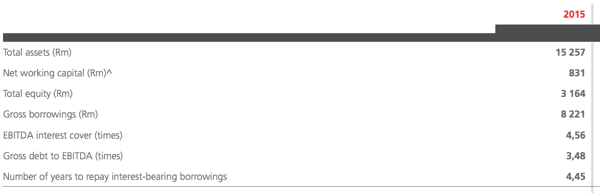
I was checking the annual report of PPC yesterday, the company lists total assets and gross borrowings, see the image below. Total assets far exceed a mountain of debt, the duration of the debt is not that favourable -


A company that has had a proud history of paying dividends is passing here, and perhaps likely to do so for the next 18 months or so. It is another reminder of the cyclicality of it all, a company with significant assets, and post such a recapitalisation of this nature it may well look "good" again. The cycles are long and deep, weaker commodity prices mean that many of the continents countries reliant on higher prices are facing budgetary pressures. Which leaves little wriggle room for infrastructure development. I think that if the PIC wanted to stand up and recapitalise the business in a big way, they have the time frames and the deepest pockets in order to be counted. We will wait and see what transpires here. It is not a stock we own, we have not for a long time now.


Over the seas and far away, across the oceans and into the Northern Hemisphere summer, stocks in New York, New York closed lower, significantly off the lows though. If that is any consolation to the bulls. The nerds of NASDAQ were the best performers of the majors, down 0.1 percent, whilst the blue chip index, the Dow Industrial Average closed off one-third of a percent. The broader market S&P 500 was somewhere in-between those two. Today of course the focus will be on the Fed, the most important woman in the world (hopefully not for long, if you know what I mean) delivers her state of the economy along with the outlook for rates, more importantly. That is right, we are on Fed-watch again, and it ain't Roger!

To add to her pot are the small matters of the Job Market Is Getting Stronger, Not Weaker and Janet Yellen's Inflation Problem. In the bigger picture this is immaterial to the continued holding and ownership of the businesses that we hold for clients. Sure, it is disruptive for equity markets, it comes with the territory! And if that wasn't enough for the Fed smorgasbord, then the small matter of US Retail Sales Up A Solid 0.5% In May all point to a continued recovery.


Linkfest, lap it up

This headline from the BusinessInsider is self explanatory and feeds into the health and wellness investment theme that we like so much - The fitness world is experiencing a seismic shift that should terrify retailers. Big winners, Nike and their peers, Under Armour, Lululemon and the like. Big losers, old casual attire folks.

A few more useful snippets about Apple from their WWDC Monday evening, a good summary for those who didn't get a chance already - Apple's 7 Most Immediately Useful New OS Features. Photos, the size of those get in the way!!!

The reason to buy Nike is due to the growth coming out of China. (Yes, growth and China were used in the same sentence) - Nike's Success Will Continue In China

Human innovation is the reason why we don't still live in caves. It is great to see the solutions that people come up with, in this case communities built their own glaciers during winter so that they would have water for their crops when things warmed up - India's Desert Farmers Are Saving Themselves With Artificial Glaciers.


Home again, home again, jiggety-jog. Looking at the markets already open in the East, most have bucked the red trend that we have seen over the last few days. It is not often that you see the market as a collective down over 2%, so lets hope that we have some green on the screen today. On the news front we have local retail sales out at 14:30. Then the big news for the current 45 day cycle, the FED have their interest rate decision out at 20:00 our time. The markets are currently pricing a close to 0% chance of a rate increase tonight. Expect some currency volatility on the decision and then some more based on the tone used in her speech. As a long term investor though just sit back, relax and watch all the reactions and emotions playing out in the trading arena.


Sent to you by Sasha, Byron and Michael on behalf of team Vestact.

Email us

Follow Sasha, Michael, Byron, Bright and Paul on Twitter

078 533 1063
Smitten with Britain


"Anyhow, there is no use wondering or speculating, let the vote happen first in nine days time and let us see the outcome of it. The upshot of this all is a spike in gold, a rush at already depressed yields. And like we said, a sell off in riskier assets, including equities, the stuff that is our bread and butter. Or in this day and age, our full cream yogurt, cashew nuts and berries. Does that sound about right?"


To market to market to buy a fat pig Oh dear, stocks were sold off aggressively across the globe. Out of risky assets and into bonds that yield zilch, zip, zero. Brexit fears. Yes. Even as we explained yesterday those Paddy Power odds (which have narrowed a bit) suggest that the likelihood of a vote against the European common economic zone is lower than the polls. Question. In light of a vote from nearly a year ago in which the people of Greece wanted to exit their austerity path, and voted NO to more of that, politicians overturned the vote. Instead, Greek politicians used the vote as leverage against the rest of Europe. Might this well be the same? I mean, who actually gets the final say here? Who has to decide that the United Kingdom no longer wants to be a member of the European Council.

The UK is not a founder member of the European Union (Belgium, France, Italy, Luxembourg, the Netherland and Germany are), they are second round members from 1973. Along with Denmark and Ireland. How do you unpick all of the agreements that have been signed over the years? I haven't seen anyone practically put forward the practical unwind of the membership. Luxembourg aside, on a GDP per capita basis, the UK is near the top of the list of rich folks amongst other rich folks.

They (the UK) are the second largest economy in the zone, after Germany, and marginally ahead of the old enemy, France. Only Italy and Spain are the other member states that boast GDPs in excess of one trillion Dollars. The UK has as many member votes as France, Germany and Italy, 29. That is the maximum, and it is purely based on population. Malta, with only 440 thousand people (the area from here to Sandton I am guessing) has only 3 votes, out of the 345. A rounding error sadly. Looks like a lovely place though!

I am simply making the point that, should the public actually vote to exit, how would that actually work? Not that I think it would happen, surely there would be a timeline thing happening here. Would all member states have to "un-sign" the treaty of Lisbon? Or sign a new one? I read yesterday that 1.5 million Britons live in continental Europe.

As far as I have read, Poland and the UK have an opt out over the Charter of the Fundamental Rights (the ordinary rights, dignities, freedoms, equalities, justice and general provisions of citizens across the zone) across their respective territories. Too complicated and giving me a headache here just thinking about it. All I know is that the benefits far outweigh the bigoted views of narrow minded groups. Would the ancient types even approve that nation states (and not kingdoms) fraternise with one another? Of course not. The treaty was designed to end centuries of conflict, normalise affairs and integrate each others cultures. Embrace differences, small minded people can't think beyond their personal borders. Think global idiots.

Anyhow, there is no use wondering or speculating, let the vote happen first in nine days time and let us see the outcome of it. The upshot of this all is a spike in gold, a rush at already depressed yields. And like we said, a sell off in riskier assets, including equities, the stuff that is our bread and butter. Or in this day and age, our full cream yogurt, cashew nuts and berries. Does that sound about right? Across the seas and far away in New York, New York, stocks sold off, the Dow Jones down three-quarters of a percent, the broader market S&P 500 down four-fifths, with the nerds of NASDAQ falling nearly a full percent. Apple and Facebook were the biggest losers there, some interesting "stuff" coming out of the Apple annual developers conference, we will cover that in a touch. The biggest news of the day was the news that Microsoft was buying LinkedIn for just over 26 billion Dollars.

Locally stocks sold off just over one and one-quarter of a percent. Aspen and MTN continued to gain against the backdrop of news related activities, see here on Aspen - Aspen debt raise & deal with AstraZeneca, and MTN - MTN fine resolved. The rest of the market, resources sank over one and three-quarters of a percent. Stocks with a European and British feel were sold heavily. Reinet down 2.9 percent, Steinhoff down 2.28 percent, Capco down 2.1 percent, Investec Plc. down 2 percent, Old Mutual, Intu and Brait down just over 1.9 percent. So there you go, at the top of the list, along with some resource stocks, are European flavoured. Sell first, ask questions later.


Company Corner

So LinkedIn is going to fall into the mitts of Microsoft. Not so much fall as shareholders of the largest self promotion business connection platform need to accept the offer of all cash at 196 Dollars a LinkedIn share. How big is this for Microsoft? At their (Microsoft) closing price of 50.14 Dollars last evening, the market capitalisation of the creator of the "Office" products was 393 billion Dollars. 26.2 billion Dollars in total. That is 6.67 percent of the Microsoft market capitalisation. Even with the 50 percent premium that they offered. I suspect that Microsoft are looking for a greater web integration into their office suite. If you think about it, and Paul often says it, the spreadsheet, email clients and editing tools such as Word have boosted productivity immeasurably. The world has changed for the better.

Not much will change on the LinkedIn front, for the time being, as per the Microsoft to acquire LinkedIn release - "LinkedIn will retain its distinct brand, culture and independence. Jeff Weiner will remain CEO of LinkedIn, reporting to Satya Nadella, CEO of Microsoft. Reid Hoffman, chairman of the board, co-founder and controlling shareholder of LinkedIn, and Weiner both fully support this transaction."

Using Office 365, the cloud and now LinkedIn, Microsoft plan to take on more business users with a wider network. As the news release shows, and to anyone who has been following LinkedIn will know, the company has been growing pretty quickly. 433 million users. What does strike me is that there are still very few job listings, only 7 million active job listings across the network over the last year, growing 101 percent year on year. I had to chuckle a little, each tech organisation recognises their own weaknesses and strengths, a sign of maturity, the announcement was uploaded via the Alphabet (Google) platform YouTube.

At the end of the day, Microsoft wants to make people more productive, connecting like minded skill-sets via the Office Suite certainly makes perfect sense. As long as that paperclip thing doesn't suggest so and so, who is constantly self promoting, right? I have already seen a little pushback, you will always get that with deals of this nature. At 59 Dollars a LinkedIn user, is this cheap for Microsoft, or expensive? This is around 8 times annual revenues, that sounds really expensive. As is human nature, people are comparing this to the Skype transaction. Microsoft bought the telecommunications company back in 2011 for 8.5 billion Dollars. Skype into LinkedIn to get researchers to solve their problems in real time in a face-to-face environment, via their Virtual Reality headsets? Not too far away I suspect, using a Amazon Alexa or Apple Siri prompt command, why not?

So whilst it seems expensive, how much more expensive would it be for Microsoft to not integrate this type of technology into their Office Suite, if they had to spend the time and effort developing something similar. And then get all the users to migrate across. You may well ask, is 59 Dollars a lot to pay for the CVs of all the professionals in the world, most of whom are all online? Not that all of them keep a great profile, we showed you Standard Bank co-CEO Sim Tshabalala's LinkedIn profile the other day, remember? Here it is - Sim Tshabalala. Seems, judging from that, he is very happy in his job, and you would hope so.


Not everybody then uses the service actively, this is a clear sign. Sim has a great job and gets paid handsomely to be on call (on behalf of the shareholders) 365 days a year, 24 hours a day, it comes with the territory. At that price of 196 Dollars a share, and with the LinkedIn management guiding in April (results presentations) to 3.30-3.40 Dollars non-GAAP earnings per share, the deal gets done at above 57 times earnings.

This is not a service that you use daily, or weekly, unless you are actively looking for a job or a job is looking for you. As the recent JOLTS report showed, the jobs are there, the skills needed to fill the jobs are lacking. What better than the most complete collection of online CVs to help solve the problem. It may seem hellishly expensive NOW for Microsoft, on a per user basis I think it is dirt cheap at the price. And will prove to be in the long run.


Apple! What a company. Their WWDC 2016 started yesterday. Huh? For those of us who will only frequent stores and not attend the Worldwide Developers Conference in 2016, or any other year, we need to look at these events in relation to our products and more importantly, the future revenue streams of the business that are likely to be generated via better products. And services. You can check out all of the updates pending - Apple Special Event. June 13, 2016.

iOS 10 is coming to your iPhone, provided that you are lucky enough to have one. MacOS Sierra is coming, provided you are lucky enough to have a Macbook or a Mac. The Watch operating system gets an upgrade too, making it more useful. The TV operating system also gets a huge update too. All your usernames and passwords don't have to be stuck in all of the time. And then something called Swift, where you can learn code on your iPad. Will the coding encourage you to buy an iPad and get your kids to code like crazy? Everyone can code, they say and everyone can develop an app with Swift. That is pretty cool, not so? Apple Pay, HomeKit, SOS, Unlocking your Mac with your Watch, and so on, these were all pretty well received by the community. Excellent news.

CNET as ever has a cool look at all things Apple - Apple iOS 10: Will it make you love your iPhone again? And then from the Verge - The 13 biggest announcements from Apple WWDC 2016. When is all this available? In a few months, you are going to have to wait until the "fall" in the Northern Hemisphere. Noooooo.

What about the share price? I sent an email to a client about the company, here is an excerpt:

    "Sir Jony Ive is still the best technology engineer in the world. He is the guy who designed and MADE the devices that Jobs thought of. I am sure that there are a number of products in the pipeline, including project Titan, the car.

    You will recall that Google had a similar funk for a while, people worried about it being a one trick pony.

    Of the 536 billion Dollars market cap, 235 billion odd is cash. Or 44 percent of the share price currently. With earnings of close to 8.27 USD a share, ex cash, Apple trades on 5.2 times earnings. Dirt cheap."


That should answer the question that everyone is asking, right?


Linkfest, lap it up

As renewable energy becomes more prominent the deal sizes are increasing too. India is hoping to double it's current renewable energy by 2030 - Tata Power's acquisition of Welspun unit just turned up the heat in India's renewable energy sector

Running communication through Twitter has saved this town money. It has also improved the interaction between officials and residents - The Spanish Town That Runs on Twitter.

There is no doubt that as 3D printers become cheaper, they will play a more dominant role in our lives. The one constraint on 3D printing at the moment is that what ever you are printing needs to be smaller than the printer you are using, here is one potential solution to that problem - Siemens is building a swarm of robot spiders to 3D-print objects together


Home again, home again, jiggety-jog. Stocks are lower again. Hey, the Fed meet tomorrow! That should be exciting. More exciting than Brait numbers? No. We can cover those in the newsletter tomorrow!


Sent to you by Sasha, Byron and Michael on behalf of team Vestact.

Email us

Follow Sasha, Michael, Byron, Bright and Paul on Twitter

078 533 1063
Monday, 13 June 2016

Clarity on MTN


"280 billion Naira, over three years, how much is that? On a relative basis? At the official Rand Naira exchange rate of 13.09 Naira to one Rand, this equals 21.39 billion Rand. That is still monster amount and in my opinion unreasonable"


To market to market to buy a fat pig It is Monday. Raining in the city of gold, excuse us people from Cape Town, this is highly unusual and your friends from the highveld will talk about this as some sort of event, OK? The weekend included tragic events, I am not too sure what to make of it, I feel incredibly desperate for all concerned. We all have differences, we are all made up of the same "fibre". I shall leave it there.

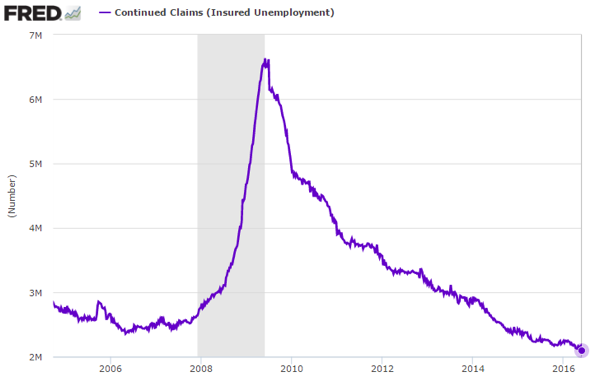
Stocks this week are likely to be swayed by two specific events, first and foremost (front and centre) will be the Federal Reserve meeting this week. Since the last jobs number, the likelihood of a rate hike at this meeting has dropped significantly. If you look at this set of graphs from the The Daily Shot, the one that stands out the most for me is this one (the first one), total unemployment claims chart over ten years:


I would like to points out that the last "disastrous", with monster emphasis on the inverted commas, jobs report needs to be taken into context with this graph above. It hardly looks like tens of thousands of people are queuing up for unemployment benefits. And as we also highlighted with the jobs opening report (the JOLTs report), the skills shortage is actually the problem and not the lack of jobs (or people being actually employed) out there. If the Fed raised rates, if they felt the timing was right, there is certainly nothing that you or I can do about that. Nor should we get anxious about it. They are the best people for the job.

Once this "event" is over, the second event of the coming days can be dealt with by the same experts on every subject, the matter of a Brexit. The smart acronym made up for Britain voting to exit the Euro common trade area. If ever I have heard an incredibly dumb idea, this may well be one. Around this time last year the Greeks were voting for or against austerity, remind me how that went? Oh yes, the Greek people said no (Oxi) - Greek bailout referendum, 2015. I was actually in Greece on the day of the vote. The ATMs had money. In case you were not paying attention, in-between then and now, the Greek people have implemented further austerity in return for further funding. We are currently on the Thirteenth austerity package (Greece).

Being out of the "zone" will create unintended consequences. How does one tell what the odds are at the moment of a Brexit happening? The mud island has a bet on everything approach, not so? So go and check out Paddy power - EU Membership Referendum. In favour of remaining in the EU has odds of 2/5 and in favour of exiting the EU has odds of 2/1. So, if you take a percentage based approach, the chances, according to the bookmakers who will be paying out real money if they lose, there is a 33 percent chance of the vote suggesting that Britain will exit the EU. Remaining in, 71 percent.

The polls are far closer than Paddy Power - Brexit poll tracker. Apparently with 10 percent undecided, those choosing to leave are polling higher than those apparently staying. Remember the Scottish polls? Expect volatility in the coming ten days. In polls, people are likely to shoot from the hip, rather than think these things through a little. There are hundreds of thousand of Britons in Europe and hundreds of thousand of Europeans in Britain. Better to be in than out, right? Like many things that people are experts on, we will hear tens of experts on both Brexit and the Fed. We purport to be neither, we will just be watchers.

So what is going to, or more likely happen in the lead up to the Brexit vote? Emerging market stocks and currencies (and bonds) are likely to get sold off, "safe" currencies like the Dollar, the Swiss Franc, the Japanese Yen and the like are likely to experience major strength on a relative basis, volatility is likely to spike, and in general stocks are likely to experience softness, whilst gold prices are likely to catch a bid. And what should you do about Brexit, the Fed or any other event in the market? Nothing. Remember that doing nothing is an action of an important kind. Ignoring noise, seeing through the mist.

Scoreboard check quickly from Friday, the Dow Jones closed two-thirds of a percent lower (goodbye 18 thousand), the broader market S&P 500 lost 0.92 percent, whilst the nerds of NASDAQ sold off quite heavily, down nearly one and one-third of a percent. Locally we lost just over one-third of a percent. The biggest story by a country mile you can find below. It was all about MTN, the stock closed the day up 13 percent to 140 Rand.


Company Corner

MTN have finally announced a settlement with the Nigerian government slash communications authorities. The announcement is pretty simple (excuse the poor format, not ours) - MTN - Nigerian fine update & cautionary withdrawal. As you can see, the fine is tiered, in terms of payment. The company will pay 330 billion Naira over three years. What amazes me about the release is this excerpt from the sentence detailing the fine - "the equivalent of USD1.671 billion at the official exchange rate and USD902 million at the Lagos Parallel Market Rate".

WHAT? The company talks openly about the unicorn rate (the so called official rate) and then the real rate that you get on the street, the "Lagos Parallel Market Rate". In other words, the rate that real people use when they change money. As is always the case, the collective knows the prices and rates better than governments do. If the government in Nigeria were to devalue their currency that would head in the direction of something resembling the "Lagos Parallel Market Rate", then the quantum of the fine is reduced. Perhaps if you know someone who lives in Nigeria to explain how it actually works practically, right now. I lived in Mozambique in the dark days, I know how it works, you rock up and change Dollars (or Rand) for the local currency and then use that to purchase goods and services. Of course if they were available, thanks to the awesomeness of communism, many things were unavailable.

How does it work however for a company? They cannot go along and change a ton of Dollar bills (here are my Benjamins!!) for a few thousand tons of Naira. Surely they just have to pay the Nigerian government the fine at the prevailing rate? What is good news for shareholders, in terms of this fine is that the company will fund this internally. There is also talk of a listing in Nigeria. If the government becomes an owner of a stake, that may well benefit the company in the medium term. Less regulatory hurdles to overcome and less pushback. All countries are weary of external influences, and somehow think their ways are best.

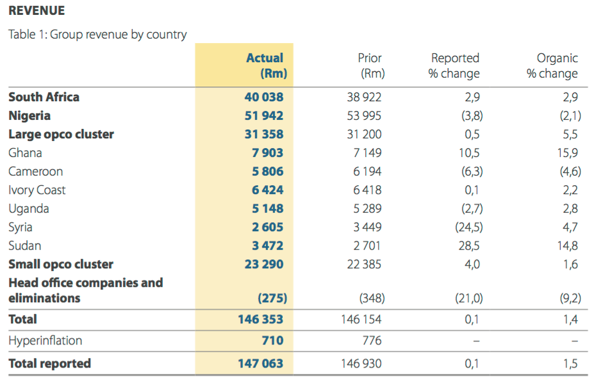
280 billion Naira, over three years, how much is that? On a relative basis? At the official Rand Naira exchange rate of 13.09 Naira to one Rand, this equals 21.39 billion Rand. That is still monster amount and in my opinion unreasonable. Watch the FDI flows, they are likely to be, errr .... not strong. Mind you, there are many external circumstances, including a change of government, and more importantly a crashing (and subsequent recovering) oil prices. First things first, from the recent MTN results, group revenues, including Nigerian revenues:


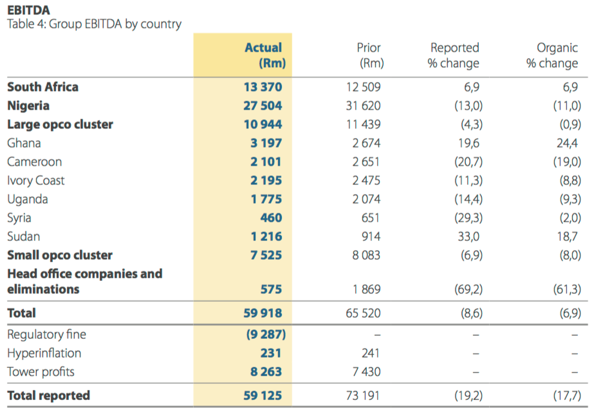
And then, remembering that group margins are around 40 percent, Nigerian margins are much higher than that, it is truly a very profitable territory for them. Herewith EBIDTA by territory:


So, doing quick and back of the matchbox calculations, last year EBITDA (2015) in Nigeria, relative to fine payable of 21.39 billion Rand is 77 percent, that is still left to pay. And in terms of turnover, it is around 63 percent of revenues that the company has been fined, that includes the "goodwill" payment that they have already made. If you don't disconnect your customers, in a country that has first world FICA requirements for cell phone users and a place where the rate of exchange from government is not believed, you get fined a significant amount of your revenues. Whilst we are still upset at the quantum of the fine, we are happy that it has been resolved. We will continue to monitor the ongoing results and advise accordingly.


Linkfest, lap it up

All hail to Uber. We are not referring to the massive Saudi investment announced recently, rather the company now lets you reserve a cab up to 30 days in advance - Flight Booked. Bags Packed. Ride Scheduled. It is going to take a while to be available in all territories. What now Cape Town and Joburg taxi drivers?

3D printing will be a game changer for the manufacturing industry. One of the big advantages is that there is very little wastage and printing something is generally faster than any other manufacturing method out there - Airbus presents 3D-printed mini aircraft. For the airline industry where there are many moving parts, it is safer to have one part printed than a comparable part that needs to be assembled (which can become many parts with unforeseen events).

Amazon's push into India is good from the point of view of an Amazon shareholder. As a Naspers shareholder though it means that they (Naspers / Flipkart) have increased competition in India - Bezos says Amazon to up India investment to $5 billion

Sticking with Amazon, as they add services like this, the gap between them and their competitors widens - Amazon is launching its AmazonFresh food delivery service in London

As the debate rages on about how big of an influence humans have been in the warming of the globe, new ways are being devised to cap greenhouse gases - Turning air into stone


Home again, home again, jiggety-jog. Whoa, markets across Asia are being crushed, Shanghai stocks are down 2 percent, Japanese stocks are down three and a half percent. Hong Kong, that is down nearly three percent. You guessed it, all major markets across the globe are going to retreat into the background in anticipation of something bad. Tighten your seatbelt, here comes the Brexit ride and it is not pleasant.


Sent to you by Sasha, Byron and Michael on behalf of team Vestact.

Email us

Follow Sasha, Michael, Byron, Bright and Paul on Twitter

078 533 1063
Friday, 10 June 2016

Napping Giant


"So remember, Naspers owns 33.85 percent of Tencent. Tencent currently has a market capitalisation of 1.66 trillion Hong Kong Dollars, Naspers' stake is worth 561.91 billion. In Rand, at the current exchange rate of 1.91 Rand to the Hong Kong Dollar (using Google), that equates to 1.07 trillion Rand. The current Naspers market cap, as per the closing last evening, was 985 billion Rand. In other words, the other parts (or some parts) must be worth negative, when the market calculates the sum of the parts valuation of Naspers."


To market to market to buy a fat pig A mixed bag on the local front. No, let me rephrase that, pretty much an average day all around for the local market, and by saying "average" I am being very generous. Resources were much lower, down nearly three percent, industrials and financials also took some heat, stocks as a collective were down 1.12 percent by the end of the session. We closed near the session lows, mining heavyweights like Glencore and Anglo, as well as BHP Billiton were down more than four and a half percent (and more). The "winners" amongst the majors were few and far between. Banks and financials as a collective also took a bit of heat.

Two of our biggest (by value) and most widely held stocks however were in the news, first, Aspen (which we discussed at length yesterday - Aspen debt raise & deal with AstraZeneca) soared 9.2 percent on the day, to levels last seen in August last year. Year to date the stock has now comfortably outperformed the index, now up 13 and a half percent, thanks mostly to the announcement yesterday. Over 12 months the stock is a smidgen (just over a percent and a half) lower. From the all time highs in January last year, the stock is still down nearly 20 percent, as ever (we say this a lot) it matters where you draw your line in the sand.

The other notable story was not directly related to one of the companies that we own, the makeup of their NAV depends almost entirely on this company though. You guessed it, we are talking about Naspers and Tencent. The Chinese "internet" and entertainment company, Tencent, is rumoured to be, as per the Bloomberg story Weighing Supercell Deal at $9 Billion Valuation. This morning the stock (Tencent) has traded at a 52 week high, and in fact it looks like an all time high to me. In fact the closing high from yesterday is the all time high.

Why do we always fuss about Tencent when we talk about Naspers? For those of you not familiar over the years with the "what is Tencent worth to Naspers" calculator, it is a very simple one. It is their stake (Naspers) in Tencent, back to Rands from Hong Kong Dollars, and of course compared relative to their market cap. So remember, Naspers owns 33.85 percent of Tencent. Tencent currently has a market capitalisation of 1.66 trillion Hong Kong Dollars, Naspers' stake is worth 561.91 billion. In Rand, at the current exchange rate of 1.91 Rand to the Hong Kong Dollar (using Google), that equates to 1.07 trillion Rand. The current Naspers market cap, as per the closing last evening, was 985 billion Rand. In other words, the other parts (or some parts) must be worth negative, when the market calculates the sum of the parts valuation of Naspers.

Remember that currently Naspers is losing money hand over fist in their ecommerce businesses. Talking of which, Bloomberg reported yesterday that Naspers Said to Plan Sale of Polish EBay Competitor Allegro. That business could be worth as much as 3 billion Dollars! Or 45 billion Rand. Or roughly 4.6 percent of the current market cap. And that is my point, there are some businesses inside of Naspers that don't really feature high on the list, yet, as you can see, they are a huge part of the business.

This also ties in nicely to the piece that we had yesterday, not all companies can be measured against one another using the same metrics. Whilst on an out and out earnings basis, the market is predicting that Naspers trades on a 50 plus multiple forward (for this year just past). Tencent trades on a 45 multiple historic and 33 (and a half forward), with a PEG ratio of 1.29 times. I couldn't "find" it for Naspers, their PEG ratio. Both companies, as you would expect, have similar metrics. To talk about a historic multiple of 100 and forward of 50, shows you that earnings are growing really fast, and whilst you could argue that the market has it wrong, it almost always seems to me that the local market discounts the whole business relative to Tencent. We still continue to accumulate this business at these levels.

Lastly, if you struggle to understand Chinese culture and entertainment patterns, why they are drawn to sitting in front of computer screens engaging in League of Legends, don't drive yourself crazy. It is called e-sport. It is a different kind of entertainment, where you can immerse yourself in the virtual world and be anybody you want. ESPN reports on global rankings, if you are interested - League of Legends global power rankings through June 8. There are tens of millions of online active people a DAY, who partake in League of Legends. It is a phenomenon.

Much like World of Warcraft, the movie that is. Check Quartz Asia - The record-breaking debut of "Warcraft" divided China's moviegoers into two opposing clans. Someone else (it may be your spouse person) may think your obsession with your favourite sports team or series is dumb, the fact that it counts for entertainment means that there is money to be made somewhere!

Stocks over in New York, New York, recovered from their worst levels at about midday. The nerds of NASDAQ closed down one-third of a percent, the broader market S&P 500 ended 0.17 percent lower, whilst the Dow lost just over one-tenth of a percent. The "journal" (WSJ to us mortals) reported in their market update (Stocks Near Records Despite Decline as Yields Fall) that recessionary fears had abated since the beginning of the year, hence that is why the stocks have gone up and bond yields down. Got it?

And that old fellow Soros said that he was bearish again on stocks. Cullen Roche took him apart in a blog and on Twitter, see - Beware of Guru Worship - George Soros Edition. The last paragraph: "the key lesson here is that we need to be very careful about how much we read into news headlines about market gurus. It's very easy to get swept up in the idea that a wealthy investor knows more than the rest of us and that we should follow their disclosed moves as reported and after the fact. The financial media loves to use big names to grab headlines and page views. But in many cases you're not getting the full story about what this investor is doing. And following their supposed positioning could lead to bad decisions and unnecessarily poor performance."

And then Josh Brown weighed in with something softer and different - What you're not hearing about George Soros today. Josh points out the obvious: " ... he can, at a whim, change his mind, change the directional leaning of his trades and even completely rework his portfolio to bet the other way." Soros might have changed his mind already. He is after all very directional. File this in the drawer of what makes news, it is somebody important, it does not mean that he is right! If he was right all the time on his big calls, he would be "worth" (as a measure of rightness) more than Buffet, Gates and co. put together.


Linkfest, lap it up

Last week we had what market commentators called a bad jobs number due to there only being a couple thousand jobs added to the US economy. The JOLTS number that came out this week showed that the number of job openings are on the rise - It's never taken longer for US businesses to fill a job opening. Either this is due to people having the incorrect skill sets to fill the open jobs or it is due to employers not wanting to pay enough as the job market reaches full employment. I tend to think it is the latter, which shows strength in the US market.

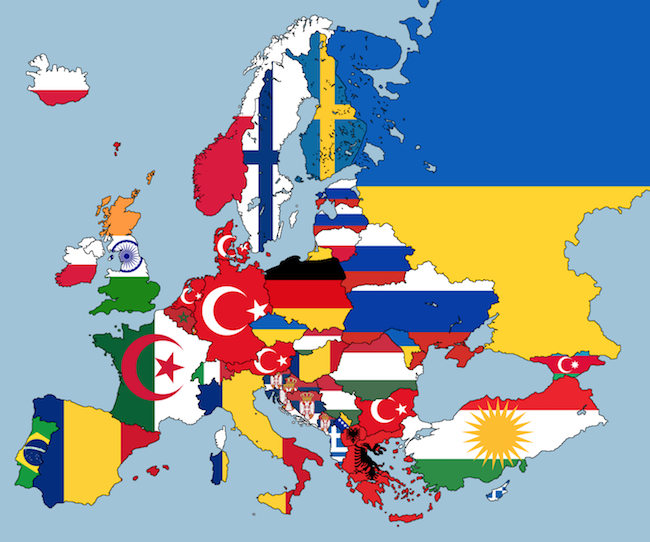
An interesting look at immigration patterns. I think this map highlights how we are becoming more of a global village each year - 2nd Largest Nationality Living In Each European Country


For those of you who wrote CFA last weekend. It seems that clear benefits of having the designation were hard to find when Bloomberg did some research, they don't say how many people formed part of their research though - The CFA Exam's Toughest Question: What's the Payoff?


Home again, home again, jiggety-jog. Markets are a little lower to start with. Stand by for hundreds of headlines about the Fed, their meeting is soon. Will they pass, hint at X or Y or Z, that is what is going to be the focus. Get used to it, the Fed meets every 45 days after all!


Sent to you by Sasha, Byron and Michael on behalf of team Vestact.

Email us

Follow Sasha, Michael, Byron, Bright and Paul on Twitter

078 533 1063
Thursday, 9 June 2016

Asp#win


"I think all you need to know is that the company has managed to attract new investors (they say so), across all territories. Most of the debt is in Euro's, some in Rand and some in Aussie."


To market to market to buy a fat pig Dow 18 thousand. Again. The first time that the Dow Jones Industrial Average closed through that mark was December 23 in 2014. You don't need to be a genius to figure out that we have pretty much trended sideways since then. The all time high was reached intraday 19 May 2015, at 18351.36 points we are still around two percent adrift from that mark. Close, a year and a few weeks on. At the closing level of 18005 last evening (and some change), it is easy enough to say that we have been in a market flux for some time.

That said, it doesn't mean that there weren't opportunities along the way, the rolling 52 week low is 15370.33 points. If you were suckered into selling either late last August, or in the first half of February, you have done yourself NO favours. Part of our job will always be acting like shock absorbers when the train is tricky. The number of times I have said "don't sell" outnumbers the number of times I have said "sell" by a very wide margin.

As a result of this both nowhere and everywhere move, I was reflecting on the stocks that we used to own, either that we sold late, or that did well after we had sold them. We used to own SABMiller over ten years ago, we also held Anglo, GoldFields and Harmony at some point too, mostly all the commodity exposure was through BHP Billiton. Netcare, PPC, AVI and even Edgars at various stages. Standard Bank and African Bank (that went to the wall), we also owned Impala (emissions controls were going to clean the world), Sasol and of course MTN has been one we have owned since the beginning.

We also owned Massmart widely. As well as Liberty International, that no longer exists in the current format. Selling and buying these stocks at different times in their respective cycles have meant that we have missed out on some upside and equally avoided steep losses by having sold timeously, seemingly late at the time. Timing is very tough in equity markets, hindsight is an exact science. How many times have you heard, I should have, and I knew I should have. We all fall for that rookie investor mistake.

Most of the stocks that we have owned for the last half a decade have been the regulars that appear in client portfolios, Aspen, Naspers, Richemont, Discovery, Steinhoff and Woolies, as well as several others. You can check them out on the website. The reflection was nothing more than whilst "things" change, often they stay the same. I have seen countless times that often the only stock that people want to speak about is the one that shows up negative in the profit and loss column. And human behaviour conditions us to believe that perhaps this is a bad company somehow, whereas a stock that soars and immediately we are led to believe that the company is excellent, well run, consumers are receptive to their products, it is seemingly just "a good one". Again, a rookie mistake that all investors make at some time.

The irony, and it is very difficult to process this common sense approach, is that the lower the stock price, the happier an investor should feel. Provided that the thesis remains intact and that the company is set to meet your expectations. Often a company may feel priced at a level that seems perpetually expensive, you make the mistake of waiting for that stock price to come lower, as it does not check all of your boxes at that point in time. And many times you may simply have to pay up for quality.

I was looking across the depth and breadth of our US stocks and checking the current PEG ratios. A PEG ratio is simply the Price to Earnings (per share) divided by the expected growth. You can draw it out a little more by testing longer dated back earnings and growth rates, relative to the expected growth rates. Most measures I see take expected price to earnings ratio and divided by expected growth. What this measure does is quite simply determine at this moment in time if one stock is "priced right" versus their growth prospects. The most expensive of the stocks that we follow is Facebook, yet it has the lowest PEG ratio, very close to 1 in fact.

In a relatively new company, like Facebook, perhaps the PEG is not the best ratio to use. Equally, different industries use different metrics to value them, cash flows and return of equity are traditional, well tried and tested metrics that apply across all industries. Every now and again you come across companies like Apple that hoards large sums of cash and is seemingly "lazy" at deploying it, and then you come across companies like Amazon that invests in their business like crazy and must be an accountants nightmare. There can be no perfect metric for determining what price you should or must pay for all companies at any given point in time, which is why we don't like generalising, i.e. How is Mr. Market today, or next week, or for the year. Rather, each company should be investigated on their own merits at the price today. And apply all metrics and ratios you may think are applicable. After all, we are all really taking and making calculated assumptions about the future.

You know where the Dow Jones ended last evening, the broader market S&P 500 is closer to the all time high, up one-third of a percent to end 2119 by the close. 13 odd points away from the all time high. And only up 3.7 percent year to date. Did you know that the Dow Jones Industrial Average took 20 years to get from 9 to 18 thousand points. It hardly sounds like plain sailing to me now, does it? In that time there were two huge noticeable drawdowns, I understand where the caution comes from. We also did a 50 year check back, there was a period in the late 60's, through to the early 1980's (January 1966 to July 1982 to be exact) where the Dow Jones went from 7333 points to 1966 points. Jeepers, that sounds ugly! From there, below 2000 points, all the way through to 16 thousand points and December 1999, it was pretty much plain sailing (the big blip of 1987 aside).

The nerds of NASDAQ closed up one-quarter of a percent to nearly squeak into the green for the year. That is right, notwithstanding the recent rally from the February lows, tech stocks are not in the green for the year. Google is down four and a half percent year to date. Facebook is up 13 percent. Apple is down 6 percent year to date. Microsoft is down by a little more than Apple, jeepers, why don't we see the anxiety about plateauing growth there? Even as Microsoft is much more expensive than Apple.

Quickly, on the local front here, stocks fell away in the afternoon. Fitch kept our rating effectively the same. The Rand strengthened. And this was strange, as the shock and horror of first quarter South African GDP was released. I thought to myself, we are in June this year. We are nearly half-way through the year people. So the market has basically baked this into the cake. So whilst there was a little surprise and a sell down of financials and ZA inc. stocks, most of it is there and known. We have seen company numbers, from the likes of Omnia yesterday, to know that mining and agriculture are struggling. We know that, tell us something new. I think that a bigger and longer take of the South African economy of ten years is probably worth looking at, to see how we have morphed away from the traditionally associated South African economy to something newer. Perhaps we will look at it in the coming days, readers of the daily newsletter will know that we are company interested.


Company Corner

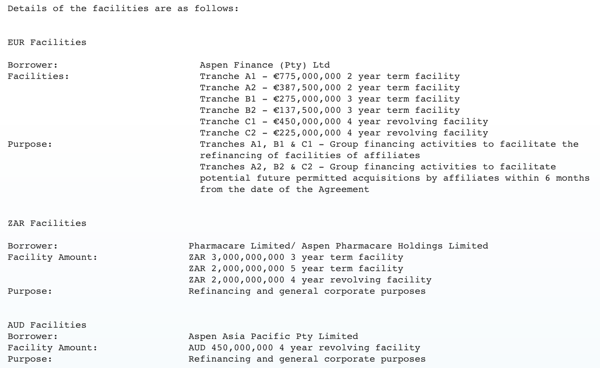
Two sets of news from Aspen yesterday and then this morning. First, the news came yesterday afternoon that the company had obtained funding facilities of 3 billion Euros. I will do a copy and paste of the announcement:

"The Facilities were structured across EUR, ZAR and AUD term and revolving credit facilities with tenors of 2 to 5 years. All facilities were consolidated into a single facility agreement ("the Agreement") with all creditors ranking pari-passu.

The initial launch size of EUR1.5bn for the EUR facilities was significantly oversubscribed (over 2x); allowing Aspen to upsize the EUR facilities to EUR2.25bn and still offer the EUR banks considerable scale-back."

Got it? I think all you need to know is that the company has managed to attract new investors (they say so), across all territories. Most of the debt is in Euro's, some in Rand and some in Aussie. They do lay it out in the SENS (image below), that this of for refinancing, raising money for future acquisitions and general corporate purposes.


And funny that the company points out: "Tranches A2, B2 & C2 - Group financing activities to facilitate potential future permitted acquisitions by affiliates within 6 months from the date of the Agreement" Why? A deal announced this morning. More like 6 minutes or 6 hours we said in the office.

Announcement this morning: "Aspen Holdings is pleased to announce that its wholly owned subsidiary, Aspen Global Incorporated ("AGI"), has signed an agreement with AstraZeneca AB and AstraZeneca UK ("AstraZeneca") whereby AGI will acquire the exclusive rights to commercialise AstraZeneca's global (excluding the USA) anaesthetics portfolio ("the Transaction")."

Price? 520 million Dollars for now and then double-digit percentage royalties on sales of the portfolio. As well as sales related payments of up to US$250 million based on sales in the 24 months following completion. I am copying and pasting a bit here, forgive me for that. The supply agreement lasts initially for ten years.

What are these anaesthetics? Copy and paste time again: "seven established medicines, namely Diprivan (general anaesthesia), EMLA (topical anaesthetic) and five local anaesthetics (Xylocaine/Xylocard/Xyloproct, Marcaine, Naropin, Carbocaine and Citanest) ("the Portfolio"). The products in the Portfolio are sold in more than one hundred countries worldwide including China, Japan, Australia and Brazil. These products generated revenue of US$ 592 million in the year ended 31 December 2015."

The market clearly likes this. Why? As Aspen points out: "Based on the terms of the agreements and Aspen's current cost of funding, Aspen's interest in the Portfolio would have generated a contribution to profit before tax of approximately US$100 million in the year ended 31 December 2015."

The stock is up 8 to 9 percent to begin with today. That is what Mr. Market thinks. We continue to accumulate the stock, this is clearly good news for shareholders.


Linkfest, lap it up

Opportunities are sometimes stumbled upon, driving an Uber means that you reach and talk to a diverse group of people who you would not ordinarily have done - He Sold His Business for $2 Billion. Now He's an Uber Driver. Huh?

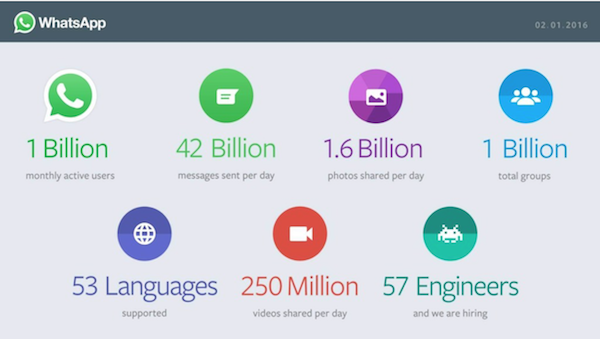
There is no doubt that WhatsApp is huge, the question is where will they make money - WhatsApp Revenue Model And The Reasons Behind Facebook's 19 Billion Dollar Acquisition !. Having 1 billion people spend large amounts of time on the app means that there are many opportunities, the trick is to not drive people to other apps as revenue streams are introduced.


This graph shows why Apple makes the bulk of the profits in the smart phone industry. The price gap also highlights that the iPhone can be considered to be in a different league to other phones - The Smartphone Price Gap

Infographic: The Smartphone Price Gap | Statista
You will find more statistics at Statista

I think this patent law is taken too far but it is the case nonetheless - Sweden Bans M&Ms in Chocolate Trademark Dispute

This is one of our favourite new websites, pictures are great for all ages - The World's Largest Factories. What we would give for a factory visit.


Home again, home again, jiggety-jog. Stocks are mixed at the start here, some up, some down. Asian markets all closed lower. The main news for the networks is that Mario Draghi is talking about buying European corporate debt. Stocks across Europe are lower on balance.


Sent to you by Sasha, Byron and Michael on behalf of team Vestact.

Email us

Follow Sasha, Michael, Byron, Bright and Paul on Twitter

078 533 1063