Monday, 11 February 2013

The Gold Fields sideways shuffle

"Having said that though, I suspect that few people "own" gold company shares. I had a very quick look at the Freeport-McMoRan Copper & Gold company. Shares in issue, 1 billion. Daily volume 11.77 million. What? So in less than 10 sessions nearly 10 percent of the company swaps hands. The whole company shares in issue turns over in 85 days. Nearly three times the shares in issue trade each and every year. Nuts. But, the NASDAQ turns over nearly twice a year, should we be surprised? Trading crazies going to and fro. High blood pressures and all that."


To market, to market to buy a fat pig. The ratings agencies are still taking some flak, perhaps rightfully so. But when Fitch, a ratings agency, cuts the credit rating of the parent company of Standard & Poor's, another ratings agency, one couldn't help but chuckle -> Rater vs. Rater? Fitch Cuts S&P Parent on Lawsuit Worry. It was not just me that had a fat laugh, many a business anchor decided this was fairly funny too.

Horsemeat. This is really poor. But then again, we asked the question in the office here, should people be so precious about what they eat? I know horses are more cuddly and cuter than cows (not for everybody), and you can ride them, but they keep themselves cleaner, and they are essentially seen as pets and working animals, so you can't eat them. Personally I don't eat cow, so I can't exactly say, one should eat this or that. But check this out: Horse meat. But you can't sell one thing as another Paul said, that is problematic. I doubt whether horse meat is bad for one's health though, as livestock they are just not great at converting one energy into another. Phew, I have my flak jacket on already, but my two main points are in a world with fewer resources, should we be less precious about what we eat and two, what fines should be imposed on the sellers of the meat that they thought was beef? You can't lie like that.

I figured to myself that I am never going to see the Angel Falls in the Canaima park in Venezuela, unless I want to watch the movie "Up" again. But this is the very reason that I do not like government interference in the economy, this FT article: Venezuelan devaluation sparks panic. The core of the story is on how multi-national companies and ordinary Venezuelans lose in all of this. Their Dollar purchasing power plunges. But the government wins. And seeing that 94 percent of exports is oil, as the story points out, that is all that the socialist government care about. Talking about who is nuts and who is not, here is the best example.

I was gutted when I read this news: Goldman Sachs Asset Management Chairman Jim O'Neill to Retire. That was the middle of the last week. I could not even bring myself to write about it until now. But, as was discussed in the office, having been a partner at the company for nearly two decades, he must be just OK as far as money is concerned. What next? Sports administration (big Man U fan), politics or central banking? We will have to wait and see, I certainly do not think he will fade into the background.


Jozi, Jozi 26o 12' 16" S, 28o 2' 44" E Stocks closed out the last trading day of the Chinese lunar calendar with another record here. Thanks, the year of the dragon was good, but enter the snake. I mean exit the dragon. Oh well, you Bruce Lee fans will forgive me. The Chinese trade data on Friday was enough to push resource stocks across the board higher, a percent and a bit, but as I pointed out to a journalist friend of mine, those stocks had done poorly and actually underperformed the market over the last decade. Listen in here, Gold Fields over the last decade is down 9 percent. Despite the heroic price of the product they mine, gold. And in Rand terms it has been like watching a train wreck. The GLD ticker, the Rand gold price since the middle of October 2004 is up nearly 450 percent. In the same time Gold Fields has only managed a 17.5 percent gain.

And Sibanye Gold, the company spun off today, what will "investors" think of that? If there is such a thing as a gold company investor. Well, time will tell. At the get go this morning, if you add the two up, they are greater than the price Friday. But of course the full proof will be over the longer term. You would be forgiven for thinking that this was a complete separation of South African and non South African assets, but if you recall when we wrote about it: Gold Fields announces that they are splitting their business. See that line in bold: "Will the new Gold Fields part get a higher valuation? Especially when you think that 62.5 percent of their reserves are still actually in South Africa." This is just to get a higher rating for Gold Fields, what is now the core of the group, whilst the "legacy" assets will trade separately. I think this is a test. You want to own these shares, then you must. But I wouldn't touch them.

Having said that though, I suspect that few people "own" gold company shares. I had a very quick look at the Freeport-McMoRan Copper & Gold company. Shares in issue, 1 billion. Daily volume 11.77 million. What? So in less than 10 sessions nearly 10 percent of the company swaps hands. The whole company shares in issue turns over in 85 days. Nearly three times the shares in issue trade each and every year. Nuts. But, the NASDAQ turns over nearly twice a year, should we be surprised? Trading crazies going to and fro. High blood pressures and all that.


Impala Platinum have released a trading update. It looks bad, and Mr. Market has also marked the stock down. In part because it was worse than consensus. This is of course for the six months to end December, the first half of their year. The going has been really, really tough. The company has pointed to rising costs and lower production as the main culprits, but have also taken a charge of 603 million Rands on long-term receivables. I wonder if this relates to any autocat or motor vehicle manufacturer that fell on hard times. I wish I knew. It could also be related to Zimplats I guess, but it sounds small. Not sure, I am sure that all will be revealed this Thursday. No chocolates and flowers for management.

I am starting to wonder what sort of dividend Impala are going to pay in the first half, perhaps a small one, but if the second half dividend was a mere 60 cents, and this last half was worse than the second half last year, it is making me wonder. In fact the 60 cent dividend paid in the second half of last year was the worst half yearly payment since their interim dividend in the year 2000. And to think that there was a special dividend paid back in 2006, adjusted for the split that was 687.5 cents per share. The dividend in 2008, for the full year, was 1475 cents. At current levels that would have meant a dividend yield of close to 9 percent. BUT, Mr. Market is expecting around 170 cents for the full year, those expectations might have to be ratcheted back somewhat. Still, that is an awful yield of just over one percent.


    Byron beats the streets. On Friday news hit the wire that the National Credit Regulator (NCR) lodged a complaint against African Bank for making reckless loans, predominantly in KwaZulu-Natal. The complaint states that Abil granted loans to at least 700 consumers who could not meet the instalment requirements and that the tribunal should impose a fine of R300 million.

    This goes back to November 2011 when the bank found out three Abil employees who were colluding with clients in order to give those clients loans they wouldn't normally qualify for. The capital value of this fraudulent activity came to R15.5 mil or 0.01% of loans granted that period for the group. This activity which took place in the Dundee branch is what the NCR are specifically targeting.

    Before reading any responses from African Bank it is immediately obvious that R300 million is completely excessive for the extent of the irresponsible loans. It is also clear that this was as a result of fraudulent activities against the organisation which there security system eventually picked up on. There was no intent on behalf of the bank to make these loans.

    On the news the share price dropped 6% but as people started to see the facts behind the allegation the share price came back all the way to close flat. This is not the first time the NCR have hauled African Bank in front of the tribunal and it won't be the last.

    Leon Kirkinis the African Bank CEO was on CNBC late Friday afternoon with his side of the story. Here is what he had to say. ABIL to Face R300mln Fine for Fraudulent Activity.

    I understand that Abil are responsible for their employees at the end of the day but because they were in collusion with clients it is not as though the clients taking out the loan were oblivious to what was going on. These clients knew that they did not qualify. Well that is the way I see it. Regardless the amount is excessive and I am sure Abil will come out of this allegation intact.

    The biggest issue I can see is that it is shining a dim light on an industry that is already in the dog box. People see the headlines that an unsecured lender has been irresponsible and immediately an even more negative picture is painted. Like I have mentioned before, the company has grown earnings but the share price has not followed suit because investors are scared of the industry. At this stage, when the company's image is tarnished, this can only bring negative publicity.


Crow's nest. Year of the snake, happy new year to all of you following the Chinese Lunar calendar. An estimated 200 million people are set to travel to their families to spend time with loved ones. That is the single biggest human migration on the planet, think of the noxious fumes as a result of that. This is amazing, check this out: Quotation of the day: Capitalism has lifted humanity out of the dirt and is greatest value creator in history of the world. Makes you think not so?


Sasha Naryshkine and Byron Lotter

Email us

Follow Sasha and Byron on Twitter

011 022 5440

Friday, 8 February 2013

Sasol not so big in Iran

"That is about as awful as you can get I think. And perhaps it is best to push through as much as possible for shareholders at this point. It all ties back to that point that I made at the beginning of this piece. The Americans only care about investments if they have an American operating business. And that is what Lake Charles is set to change."


To market, to market to buy a fat pig. The ECB had their rates decision yesterday, obviously there was nothing to be done in that regard, the most important thing is the statement and the Q&A segment after that. There were concerns expressed by "super" Mario Draghi about the strength of the Euro. Unintended consequences, there you go! The FT leads with this: Draghi move fuels currency war fears. Hmmm... So we (the European we) want a better perception of the area, but not so good that it starts to impact on exports. Phew, what a tough balancing act. Too strong is a problem. Anyhow, I am mostly just interested in the progress that they are making, moving forwards and perceptions continuing to improve. But, the Europeans felt the brunt yesterday, the Euro sold off the most in seven months. Ah well, at least there is no talk of an exit here or there. That reminds me, someone still owes us for suggesting that Greece would be using the Drachma as we speak......

Meanwhile tensions between the Chinese and Japanese continue to rise as the two continue to tussle for what is essentially fishing rights around some non descript islands where nobody ever plans to live. See, people love to eat, and eat a lot and fish is tasty. Plus also, add into that centuries of distrust of one another, that is not such a good mix. And a history of conflict, well, not so long ago either. So expect more of the same. All I can say is that humans are a lot more aware of what conflict does to their countries perceptions, so I suspect that can be sorted out at some stage and peacefully. I hope.....


Jozi, Jozi 26o 12' 16" S, 28o 2' 44" E This morning we have a trading update from Sasol and perhaps it is not what you expect. They are basically waving goodbye to Iran and their investment in Arya Sasol Polymers Company (ASPC). According to Wikipedia, ASPC is one of the biggest polymer projects in the world. But, if Sasol want to be taken seriously in North America, then they have to ditch their Iranian asset. This is not new news however, this asset has been for sale for a while now. The only burning question however is, who is going to buy this business? I suspect that the other shareholder, the state owned petrochemicals company could offer them a discounted price, take it or leave it. The Iranians can't divest from Iran. And not too many people are friendly in the region, due to religious differences between Shia and Sunni Muslims. And ethnic differences too. I shall never attempt to understand religious intolerances of one another, I shall always steer away from that subject, it spoils ones get togethers. And I would like to think that I have friends everywhere of every walk of life. End of story before I trip over my own tongue here!

OK, back to Sasol here. Trading statement for the six months ended 31 December 2012 is where you can download the full release. The company cites a weaker currency as both a good thing and bad thing, in terms of costs. Overall costs however were also impacted by higher labour and maintenance costs. The story of South Africa, but we must live with this, the intention has been made clear by the powers that be that we do not intend to build a low wage and labour intensive economy. A client told me yesterday that every factory that he knew of in and around King Williams Town had closed over the last half a decade or so. And there used to be thirty plus. Uneconomical to run a clothing and textile plant, the loser I guess is almost everyone. That is another argument.

The guts of the announcement are as follows: "We continue to actively engage with interested parties to divest from our share in ASPC. During the current reporting period, the investment was impaired by R1 974 million based on our assessment of the fair value of the asset, which takes into account the uncertainty associated with the Iranian environment in which we operate. In terms of International Financial Reporting Standards (IFRS), further losses relating to the foreign currency translation reserve of approximately US$100 million may be recognised in income once we finally divest from ASPC."

So, another 100 million Dollars charge could be taken as a result of the weakening Iranian Rial at some stage. According to Wikipedia, and this does not really bode that well for MTN either, the Iranian Rial is the Least valued currency unit globally. The Zim Dollar is not on the list, that would be worse. That is not a list you want to be on, here is hoping to never making it, OK?

The Sasol statement continues: "There may be further potential impairments linked to the fair value of the asset as a result of a deteriorating Iranian environment and the accounting requirement to continue recognising operating profits, which might not be recuperated through the divestiture. Despite a solid operational performance by ASPC, results for the six month reporting period have been negatively impacted by the devaluation of the Iranian currency, which resulted in translation losses of approximately R1 015 million being recognised in the income statement."

That is about as awful as you can get I think. And perhaps it is best to push through as much as possible for shareholders at this point. It all ties back to that point that I made at the beginning of this piece. The Americans only care about investments if they have an American operating business. And that is what Lake Charles is set to change. It is going to be huge. Remember we wrote about it back in December: Sasol. This changes everything. Almost 190 billion Rands is what it is going to cost. That is roughly three quarters of the current market capitalisation. This is basically like moving all the chips in, if you are that way inclined. A bold move, a very bold move. But one that I suspect will pay handsomely. But. And this is the big but, you are going to have to be very patient as a shareholder. And, as we discussed with a favourite client yesterday, perhaps the dividend will go sideways for a while. Until then, wait for results around the 11th of March, a month and a weekend away.


    Byron beats the streets. Yesterday Apple was in the news again. Actually Apple is in the news most days but this was quite an interesting turn of events. David Einhorn, the famous hedge fund manager who started Greenlight Capital, publicly requested Apple shareholders to vote against a proposal which would eliminate the company's ability to issue a preferred stock that pays a dividend.

    He has proposed a solution for shareholders to extract cash and value using pref shares. Basically Apple issue pref shares to existing share holders, say $50 billion worth with a 4% dividend yield. According to their calculations this would value the pref share at $32 per share. The Apple share price would drop less than $32 because Einhorn believes the cash portion of Apple is not valued correctly. This could create 7% more value for Apple shareholders which when you look at Apple's size and scale could create billions of dollars of value.

    When asked why Apple doesn't just pay out a special dividend or buy back shares, Einhorn said his proposed structure would create immediate value without requiring Apple to pay out a big lump sum immediately. They can keep the cash for whatever they want, only have having to yield out 4% on the pref shares annually.

    You must bear in mind that Einhorn is a hedge fund manager so he probably has a geared position in the stock. A 7% gain will be a lot more for his fund. He is definitely talking his own book and looking for instant gratification. But it is interesting to see how shareholders can rally up the troops and try and push a company for more value. The $137 billion is miles more than the company needs to run its business.

    Apple do come back with a response. It is nicely summed up here by Business Insider Apple Issue Statement on its Massive Cash Pile. I know that Steve Jobs will be rolling in his grave as management ''waste their time'' caring about shareholders and not focusing on what is important, innovation. And as a shareholder myself I agree. Company's these days are way too pressured to keep investors happy on a quarterly basis. And this is one of the main reason's Dell are delisting. Businesses are successful because they focus on the long term picture. Somehow Jeff Bezos of Amazon has managed to convince investors to be patient.

    I have a feeling we will look back at this era of instant gratification and realise that patience was your biggest asset. Ever since I entered this industry it is a lesson that is re-learnt every day.


We were just having a look at CGT prices yesterday, and I was suddenly struck by a few things. SARS put out their base price spreadsheet with the starting price in October of 2001, Value of listed financial instruments for Capital Gains Tax purposes. The first thing is that "things" change rapidly in the number of businesses. If you scroll down the list there many that are not around anymore. Many had been recently listed in the listing booms of the late nineties. There are many more listed entities on that list (2001) than there are now. So, the tough times and perhaps bigger demands of being listed leaves investors with fewer choices. Back then there were 638 entries, today as I check, and this includes suspended companies, there are only 370 listed companies. 268 less. Not all companies mind you, some of those listed instruments were (and are) pref shares. I found 206 stocks with share prices under 50 cents. 281 with share prices of under 100 cents. There were only 12 stocks with share prices over 100 Rands a share, if you want to talk about the inflationary impact on share prices over time. A separate discussion for another day.

Some big stocks and big companies back then have barely made headway, that was the next thing that struck me. AngloGold was at 285 ZAR a share, that was even before the company changed name to AngloGold Ashanti, following that deal in 2004. The stock closed at 255 last evening. There are roughly 160 million more shares in issue now, largely due to the cancelling of the hedge book. Anglo Platinum was at nearly 300 Rands a share, the stock last evening closed at 470 ZAR a share. Equally, there are a lot more shares in issue now, back in 2001 there were 214 million shares in issue, today there are 261 million shares. And then perhaps the two most fascinating ones for me, two companies that start with a S, one Sasol had a share price of 71.30 ZAR and the other, Sappi had a share price of 72.74 ZAR.

Today, the changes between the two companies and the divergence since then are amazing. Sappi, after admittedly two tough days after a poor quarter closed at 28 ZAR last evening. But listen to this. Number of shares in issue have ballooned from 229.5 million in 2001 to the current 520 million mark in 2012 after a massive, truly massive restructuring process and rights issue back in 2008. 6 new ones for every 5 you held back then. If you have not followed your rights you well and truly got thrashed. Err.... more than you had already. But their market cap is lower today than it was back then in late 2001. And then Sasol, who closed last evening at 389.3 ZAR. And, listen in closely here, there are actually fewer shares in issue now than there were all of those years back. In 2001 there were roughly 664.9 million shares, last June that number was 644.8 million. Buying back shares.

So how do those two things stack up, Sasol surging and Sappi getting slammed? Is it as simple as saying that if you were making an investment in Sasol back then and buying the business on the basis that commodity prices were in general going to remain at these recent elevated levels for longer. That was a tough call to make back then, bearing in mind that commodity prices had been anaemic for the better part of two decades. In December of 1998, which was less than three years prior to that, the oil price, Brent Crude had sunk below 10 Dollars a barrel. The next decade proved to be amazing for Sasol and their shareholders, Brent is currently trading around 116 Dollars a barrel. In the big washout of 2008 and 2009 however, the oil price went below 40 Dollars a barrel. Now, it has been steady at these "new normalised" levels. But you were certainly making a big call back then on greater global consumption underpinning a rising commodity price and as such earnings from the company growing strongly in the coming years.

Sappi however has been a disaster. Softwood pulp prices are higher now than they were back then. But I guess fine coated paper is being consumed less in the digital era. How were you supposed to know that such a thing as the iPad could exist? Or that Amazon.com would sell more electronic books than real ones? And the purchases done in the years prior to that, how were you to know that they would prove so costly that you would pay dearly in the coming years? You might have been forgiven for thinking that greater magazine readership in emerging markets would see demand for one of their core products grow strongly. And unfortunately you were dead wrong. Sappi suffered from a little of the same as the lyrics of "Video killed the radio star". Although that is not entirely true, Radio still has a massive captive audience, captured in your car of course.

So what does this exercise prove, other than you can get something right or completely wrong on how you see the future? There are also many smaller listed companies that vanish over time. The trick I guess is to own the quality businesses with a positive future. As Paul said yesterday, I don't like to own businesses where I can see clouds on the horizon. Be that next year or in half a decade’s time. Any company that is likely to run into more regulation. Companies that are likely to attract more market share with their products that customers are more likely to buy. Companies with good margins. Sounds so easy, doesn't it? The other trick is to avoid disasters. Stay the course with quality. Do not be steered off course because of noise. Try hard to carry on accumulating stocks when you can.


Crow's nest. Record highs here again. Chinese trade numbers perhaps have everything to do with it. And they are excellent, where was that hard landing?


Sasha Naryshkine and Byron Lotter

Email us

Follow Sasha and Byron on Twitter

011 022 5440
Thursday, 7 February 2013

Cash, what's up with that?

"We still see this stock as great entry into the developing market which will grow as the developing market consumer grows. It will also grow as we shift our spending patterns. They are innovative and at the forefront of payment technology. It is priced for growth but we expect it to remain at this valuation as the share price grows with earnings."


To market, to market to buy a fat pig. The Libor rate scandal continues to be exposed, more fines being dished out. I could not quite understand why the UK authorities would fine RBS, when they are 82 percent shareholders, what was the point I thought, but then the thought of bonus claw backs and lower remuneration for bank employees started to emerge across the wires. Yes, financial authorities are trying their level best to reduce banks to utility like companies, the ones our grandparents knew so well.

Hold on a second here, that suggests that bank failures didn't happen when our grandparents were around, not true. These events happen from time to time, Panic of 1893, the Panic of 1907, Wall Street Crash of 1929, the list of course goes on. Any regulator that thinks that they can prevent people from engineering a new crisis is probably betting against human ingenuity.

According to Wiki anyhow, Charles Holland Duell, the commissioner of the United States Patent and Trademark Office from 1898 to 1901 was misquoted as saying: "Everything that can be invented has been invented." Quite right. As far as we know, it should have been added. A personal computer cost 3000 Dollars 30 years ago, today, according to my inflation calculator that is 6881 Dollars in 2011. Prices have plunged by more than 90 percent on an inflation adjusted basis. Makes you think, technology improved massively, but yet got wildly cheaper over just three decades. And now, just this morning on Bloomberg there is talk about the greater usage of robots in society. Just think Drones a little. And then read this: The Green Drone of the Future Will Never Come Down.

Lastly, the purpose of this segment has changed. As the newsletter always changes and evolves. Originally this letter was meant to be one about the markets, it has over time moved to a more analysis related one. I hope that it is still worth reading, if you get bored, let me know. If it gets too long however, I suggest that you read faster! This is funny, really funny: Why Do People Hate Rising Stock Prices? Turns out it is because that they are missing out. The last two lines are key to the whole thing: "So yes, it's okay to hate rising stock prices. But it's not okay for you to respond to rising stock prices irrationally." Yes, and if that means saying that prices have gone up too fast, too soon, then that is code for "I have been sitting on the sidelines watching and hoping for the markets to fall". Respond rationally. Equally, oversold = time to buy methinks. But, as you can remember from yesterday, the market by many measures still looks cheap enough to me. Many professionals look nervous of the levels. That is pleasing.


Jozi, Jozi 26o 12' 16" S, 28o 2' 44" E We went slip sliding away, banks were off a percent and a quarter, Vodacom was a big drag, MTN went south in sympathy with those weaker than anticipated numbers from South Africa's number one mobile provider. MTN of course across the continent. Luckily for all of us the most populous country on the continent and MTN's biggest market qualified for the AFCON final. They must be feeling happy with themselves. And perhaps talking about it a lot. On their mobile phones. Their last AFCON cup was in '94, whilst this is the first final for Burkina Faso, a country with one tenth of the population of Nigeria. Nigeria has an economy roughly 20 times the size of their close-ish counterpart in Sunday's final. But, as the minnows have proved in this tournament, it is not about the size of your economy, otherwise I guess we would win every single time.

Locally we saw Sappi fall 5.7 percent, Vodacom fell over four percent and that caused local competitor MTN to sink around three percent. Too bad. Cell C fell err..... not sure. Shareholders there, at Cell C swapped their monster debt for equity three odd years ago. Whilst we continue to see a big change in mobile voice pricing, data is huge now and growing fast. I use my phone more for data now than ever before, accessing apps and news that way. Mobile, that means being out and about. I love pictures, Instagram, posting them to Facebook and Twitter, letting folks know what you are up to. Some people worry about their privacy being exposed, just what are you hiding?


New York, New York. 40o 43' 0" N, 74o 0' 0"W As the US Postal service, in an attempt to save money booted Saturday deliveries, market participants, the bulls and the bears were wrestling in and out of negative territory. The nerdy bulls lost, what a surprise, but the broader market and blue chips managed to eke out a tiny gain on the day. I am starting to wonder what the weaker Dollar to the Euro will do for many of the listed companies in the US that have big European exposure. Perhaps the anxiety over this: Biggest U.S. Companies With Large European Exposure old piece, means that those companies are going to benefit now. Talk of the town is that the Europeans, having "saved" the Euro, are now worried about the strength of their currency. I see. It happens everywhere, with the Japanese on the Buzz Lightyear currency path, somehow intertwined with the Neverending story. Remember that big hairy flying dog?


    Byron beats the streets. One of our best performers in New York, Visa, reported first quarter earnings. It seems like such an obvious story. Carrying cash is a liability of sorts, some people want to steal it. It makes life so much easier and safer to pay electronically. The people want it, governments want it because it makes it easier to collect taxes but the majority of transactions still take place in cash, especially in the developing world. That is why Visa's strategy is to get half of their revenue outside the US by 2015. $9 trillion of card spending is expected in the Asia pacific region in 2016. That is 42% of worldwide card spend. Visa are certainly targeting growth in that region.

    Let's take a look at the numbers. Revenue grew 12% to 2.85bn versus expectations of R2.8bn. Operating earnings per share came in at $1.94 (30% growth) versus forecasts of $1.79 although 11c of that came from a tax benefit. Earnings for the full year are expected to come in at $7.46. The stock trades at $158 or 21 times 2013 earnings. Is it expensive? I remember in 2011 when it was trading at $70 and people called the stock expensive because it was trading at a multiple of 16. Looking back the stock was actually trading on less than 10 times 2013 earnings. Payment volume for the quarter equated to a whopping $1.1 trillion

    Of course this does not mean that future growth is going to be at the same pace. But like I mentioned earlier there is still so much room for growth as the world adopts electric payments. I am sure you experience the shift in your everyday lives. I barely pay with cash any more and in fact my bank, FNB rewards me with eBucks if I swipe my card. Cash is as much a liability to the individual as it is to the bank. Moving physical money around is a dangerous, expensive process. Electronic transfers between banks is just so much easier.

    To get a perspective of where the growth comes from let's look at sales regionally. Of the volume processed by Visa the US was responsible for 38%, this grew 2.7% for the quarter. Asia pacific contributed 25% which grew 11.9%, CEMEA (Central and Eastern Europe, Middle East and Africa) contributes 16% and grew 20.1% and LAC which is Latin America contributed 15% and contracted 2.7%.

    We still see this stock as great entry into the developing market which will grow as the developing market consumer grows. It will also grow as we shift our spending patterns. They are innovative and at the forefront of payment technology. It is priced for growth but we expect it to remain at this valuation as the share price grows with earnings.


Crow's nest. We have started better here again, which seems to be a theme now. Remember that the first hour is devoid of trade volumes, until late March in Europe and 10 March in the US. That is the only good thing about winter here, we get an extra hour of trade around here on both sides of our session. Earlier in Europe and earlier in the US. Those are the days my friends.


Sasha Naryshkine and Byron Lotter

Email us

Follow Sasha and Byron on Twitter

011 022 5440

Wednesday, 6 February 2013

They are nuts

"Those crazies in North Korea are threatening something worse than a nuclear test. Bozos. If I could hope for one thing in my life it would be freedom for the people of North Korea. Right there is the best example of socialism (communism) and democracy (although not entirely) next to one another. How a more and a less liberalized economy has benefitted the people. If any crazy communist tells you of the collective and how it works better, just ask them the simple question, how many people crossed the Berlin Wall from the West to the East?"


To market, to market to buy a fat pig. Gee, that was quicker than I thought. Equity markets bounced back pretty hard yesterday, in part due to some better than anticipated services data out of Europe. The US number was a meet, and that was good enough. A bounce back this quickly suggests that there is more than one fellow fielding at back stop. With Dale Steyn seemingly you don't need that! We were there Saturday to watch the most amazing bowling spell in a while, but my kids dragged me around looking for hats and ice creams, so I didn't quite catch all of it.

Away from the cricket there was the confirmation that Michael Dell, a private equity crowd and Microsoft money wants to take Dell private. This was a poorly kept secret anyhow, the WSJ reports: Dell to Sell Itself for $24.4 Billion. The FT's take is similar, the price is fair relative to where it has been recently. Although as we explained yesterday, it all depends where you drew your line in the sand, the last one, five and ten years have been poor for stockholders. So why now? If approved by shareholders this would be the biggest ever tech buyout and the largest deal since the financial crisis. That stinky period. But, again the FT reports (Daring $24bn deal to make Dell relevant) that none of the investors have presented a proper plan of how they would turn the business around.

So, how would this make you feel as a long suffering Dell shareholder? Particularly in a world where Walt Mossberg of the WSJ just suggested that the newest Microsoft product has an average battery life and is more than a little clunky? Why is that relevant? Because Microsoft are pretty much in the same boat as Dell. Business Insider have a great piece showing what Dell could do: EXCLUSIVE: Here's The Secret Private-Equity Plan For Dell... A truly great piece from Henry Blodget. Whatever your take is, the fact that a deal of this size is taking place, that fills me with confidence. Deals only happen at this sort of scale when folks are confident about the future.

Those crazies in North Korea are threatening something worse than a nuclear test. Bozos. If I could hope for one thing in my life it would be freedom for the people of North Korea. Right there is the best example of socialism (communism) and democracy (although not entirely) next to one another. How a more and a less liberalized economy has benefitted the people. If any crazy communist tells you of the collective and how it works better, just ask them the simple question, how many people crossed the Berlin Wall from the West to the East? 5000 odd people defected to the West from the East and 136 died trying to cross over. I can't find any stories of people trying to escape across the Wall into the arms of communism. If you find, please share. That tells me all that I need to know about socialism. And perhaps the most understated fact was that 2.5 million skilled folks left East Germany for good in the lead up to the wall being built. Extreme socialism, it really is a downer for economic progress. The state cannot do a better job than private money. Impossible, remove the profit incentive, remove willing and able human beings.


Jozi, Jozi 26o 12' 16" S, 28o 2' 44" E Platinum stocks weighed on the overall market, Impala Platinum specifically, that stock was down nearly three percent on the day. The stock is slightly lower over 12 months, up a lot over six months, around 23 percent, but down 38 percent over five years. Phew, if nothing the Implats ride has been really volatile. Perhaps someone at the Mining Indaba in Cape Town did not like what they saw there. Wild. This morning there are results from Sappi, another volatile stock, and the market is not taking too *nicely* to the numbers. Personally it is not a sector that we either consider a growth area, or one that has steady and reliable earnings. Sappi has neither and judging from the short term outlook, debt is going to continue to increase, and earnings are going to go sideways for a while. I quite like their specialised cellulose business, and the applications associated with the product, those look decent enough. It is also a market that they are making a bigger part of their business. But the old legacy assets that they have, man, I just wouldn't touch it with a borrowed barge bowl.


MTN have been in the news over the last week or so, we should have expanded on what looked like a rather important announcement. Here is the very best SENS from the MTN investor relations website: MTN -- delivery of report by Independent Committee. We were waiting for this, and I am sure that in recent days the stock has been lifted to higher levels on the basis that the allegations of an individual might actually be dismissed. That would obviously leave Turkcell with some egg on their face, if it was the case. Remember that this was the internal MTN investigation findings. Before you say, yeah right, I knew that was going to happen all along, bear in mind that Lord Leonard Hoffmann is chairman of this board tasked with looking into these allegations and his very good reputation is at stake. The next date to watch out for then is closer to the middle of this year, where the US Supreme court will decide whether or not it has jurisdiction or not. We will keep a close eye on this one.

The other newer and fresher piece of news is that MTN have announced this morning that they have increased their interest in MTN Cyprus to 100%. And there we thought all along that it was the odd one out, if you know what I mean. Odd one out in the sense that the GDP per capita in Cyprus is a great deal higher than their other operating territories. I suspect that MTN will continue to use a more mature and developed market, Cyprus, as a sign of things to come. The announcement does not even say how much half of the MTN Cyprus business is going to cost them. Small enough to not be reported, but I guess nevertheless an important market. I suspect that all markets are important for MTN, including Iran, where they are seemingly always up to some strange things. Including plastic jet fighters and sending monkeys to space. Real or not, this is what folks I read think of it: Iran's New 'Super' Stealth Fighter Jet Is Totally Fake.


    Byron beats the streets. This morning we received a trading statement from Vodacom for the quarter ended 31 December 2012. Group revenue was up 1.7% but within this sales number there were lots of moving parts. Group data grew 23.3% while data customers grew by 33.8% to 18.5 million. People sure are lapping up those smartphones. The international operations grew 22% whilst group customers grew 12.2% to 51 million. Of those customers, 30.6 million are from South Africa where clients grew 11.7%.

    South Africa is still comfortably the biggest revenue driver with R15.5bn of the groups R18.3bn. This is certainly a concern and a risk. I would not go as far as to say the South African market is mature because I think current subscribers still have a long way to grow. But I do feel that the opportunities north of our borders are more attractive.

    In SA data revenue grew by 17.2% to R2.3bn. It is now 15% of sales and growing. Data traffic grew 29.8%.I have said many times that the better smartphones get, the more data will be consumed. In Africa growth is coming from both avenues, new smartphone users and more consumption through better phones. Pricing for data dropped 13.5% but this was compensated for by increasing traffic.

    I have already seen negative comments about the ARPU's which have dropped from R161 in the 4th quarter last year to R134 this quarter. I am not concerned about this because a whole new business has emerged in the form of data which is making up for the fall in ARPU's. Ironically the use of data is cannibalising profits from voice and SMS's through services like Whatsapp and Skype and is the reason ARPU's are dropping. If you look at the developed world's ARPU's I would reckon that ARPU's in SA will bottom out and start to pick up as the country becomes wealthier and more developed.

    The international business has been growing well and if you exclude a once off sale and currency movements, service revenue increased 22%. Customers grew 12.9% to 20.4 million, data doubled to R306 million while data customers also nearly doubled to 4.7 million users. This was lead by 72.6% growth in M-Pesa which is their mobile payment business that has been so successful in Eastern Africa.

    This is what I take from the numbers and how I feel they will look going forward. Subscribers are still growing double digit. This will continue in the rest of Africa but will slow down in SA where we will still see decent subscriber growth. Data will carry on ploughing forward and will become more and more significant in the earnings mix. This will more than make up for the slowdown in ARPU's. After a while I feel ARPU's will start picking up again, especially in SA as more data is consumed thanks to more efficient phones. In telecommunication, when prices drop due to competition, people just consume more and spend the same.

    This means that these companies are far from ex growth. We still prefer MTN because they have access to more subscribers and more potential subscribers but Vodacom is still a good investment with good growth prospects and great dividends.


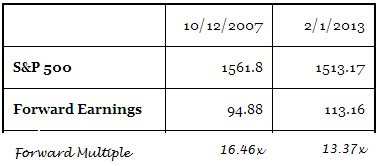
New York, New York. 40o 43' 0" N, 74o 0' 0"W This level, that level, we often say around here that the index level is just a number. Everyone has been getting excited about Dow 14000. Because it has been here before, two days ago, but more importantly for the first time since October of 2007. It breached these levels again last evening. But what is more important is earnings, and the market expectations. Jeff Miller from "A Dash of Insight" explained it pretty well in his recent blog post: Dumb Money. The part that I was most interested was the table at the bottom, and I have hacked the first two rows and inserted a forward multiple:

Ok, that means if I apply the same multiple to the current market then I get to an S&P 500 level of 1862, which is 23 percent higher than where we are now. So, at the height of overconfidence the market would re-rate to those sort of levels. We are not even close and earnings are expected to continue to improve from here. So what am I really trying to say? I agree with Jeff I guess, the levels are pretty irrelevant from a historic point of view, earnings are more important. Equally, Mr. Market can simply re-rate lower in a low growth environment, I suspect that is what we have just emerged from.


Crow's nest. What is quite interesting is that there is a significant gap that has opened up between the gold and the platinum price, largely due to two things I think. The premium that gold attracted when the outlook was dodgy, well, that is slowly diminishing. And perhaps the major reason is that the platinum market is expecting the first shortfall in over a decade. Certainly not new news, this has been knocking around for a while now. We are higher here again, another record if we close at these levels.


Sasha Naryshkine and Byron Lotter

Email us

Follow Sasha and Byron on Twitter

011 022 5440

Tuesday, 5 February 2013

Yum! not so tasty

"It has been a very tough quarter for Yum! Brands who saw fourth quarter earnings slip 5.3%. It dampened what was going to be a fantastic year for the company. Well it still was a very good year. Full year earnings grew 13%. But were it not for the government report in China which questioned the quality of their chicken, it would have been a lot stronger."


To market, to market to buy a fat pig. Global markets sold off yesterday, the bears finally had their day in the sun. Punxsutawney Phil over the weekend suggested that it wouldn't stay that cold for much longer. Perhaps that was enough to make the bears emerge from their hibernation. I suspect however that the root cause of the selling was actually not market related as such, but rather led to selling of Spanish bonds. And aggressively at that, the worst day since September last year. This does not look good for Spanish Prime Minister, from the FT: Rajoy storm blasts Spanish bonds. Pfff..... a slush fund, a politician, abuse of public funds, well I never! Sorry, I forgot to include sarcastic alert. Many in a position of power in public service have the inability to separate what is ours from mine. Public funds are not "mine" OK? Along with that, and Paul mentioned it yesterday was the news that Silvio Berlusconi's party is polling better. He invited everyone to his infamous shindigs suggested that austerity under him was bound to be a thing of the past. Sadly people respond a whole lot better to something that affects your back pocket rather than the long term reality.

So, weakening Spanish and Italian bonds, as well as the French finance minister suggesting that the Euro was too strong led to a pretty broad sell off in European markets. No, correction, a big sell off in European markets. I guess the short termers have had an itchy selling finger, looking for an event. France's CAC40 ended the session down three percent, Germany's DAX sold off two point five percent. Italian markets down 4 and a half percent and lastly Spain kicked in the chops too, down three and three quarters of a percent. Political shenanigans derailing a fragile European equity market recovery.

I took a medium term look at markets in Europe and the results were not that surprising. The healthiest market in Europe, the DAX is up around only 13.5 percent over the last five years. From the lows in March of 2009, it has doubled however, so sometimes it depends where you draw your line in the sand. The CAC40 in Paris is down nearly 24 percent over five years. The Spanish index has been hammered, the five year performance unfortunately points to a 38 percent fall from grace. But it gets worse. The Italian market is down a whopping 50 percent over the last 5 years. Err.... Forza Italia? So, as ever it depends what you look at and from where. If you have decided to be a European equity investor from the time that the ECB president, Mario Draghi brought out "the Mask" bazooka, markets have improved substantially. Six months ago. I guess that this is a series of speed bumps along the way in the great European integration project. The list of Europeans conflicts on Wiki is a long and sorry one, here is hoping that over time, because of economic ties the list becomes history.


Jozi, Jozi 26o 12' 16" S, 28o 2' 44" E At the beginning of the session we touched an all time high, but from there it was slip sliding away. For the reasons mentioned above of course, Spanish and Italian anxiety of a different kind. Which is much more difficult to predict, with uncertain outcomes post such an event having taken place. Our president suggested closure of mines in South Africa, Amplats specifically, that is tantamount to blackmail. I am not too sure what he means, but Amplats is not SAA. The taxpayer does not backstop Amplats. When the company is in financial trouble because of unprofitable mines, there are difficult decisions to be made, and unfortunately shareholders suck those up. Those shafts were sunk with shareholder funds. I can assure you that shareholders want those to work just as much as all stakeholders, if not more. For it is shareholders that entrusted the company with their savings to grow them, this is as big a disaster.

If shareholders decide that their capital is better allocated elsewhere, then I suspect there will be fewer projects going ahead. That is in fact already the case, Amplats have cut back their capex plans for the short and long term. This means fewer jobs, which means lower government revenues in the long run. If I were to force any business to continue to operate unprofitable shafts to benefit labourers at the expense of capital, that is not a sustainable model. What is the definition of a shareholder? "Shareholders are the owners of a company. They have the potential to profit if the company does well, but that comes with the potential to lose if the company does poorly." The balance of course for governments is to make companies profitable enough to contribute taxes to the government coffers, as well as provide gainful employment for folks in society. Who in turn are being taxed themselves.

Investopedia have a really good explanation of what it means to be a shareholder. "Shareholders' equity comes from two main sources. The first and original source is the money that was originally invested in the company, along with any additional investments made thereafter. The second comes from retained earnings which the company is able to accumulate over time through its operations. In most cases, the retained earnings portion is the largest component." Of course, the folks who originally invested in Anglo American, I doubt many of them would still be shareholders. The risks that shareholders assume are high, and if they are not willing to continue to commit their capital to a specific company then I suspect the selling will push the equity value lower over time. And investors will be fewer. This great anxiety of attracting outside investors when there are perfectly capable investors here at home perplexes me. This time last year, corporate cash deposits were sitting at a record. And we have multi decade low interest rates. In short, companies are and continue to be paralysed by mixed messages around investment in South Africa.

Let me challenge you a little. If your business is in the fortunate place of sitting on a whole lot of cash, that you are at a wits end of what to do with it, why are you not either expanding your business or hiring more staffers? What is the simple number one reason that you are doing nothing? Please write in and we can publish your comments either anonymously or if you want to include your name. Many thanks and be absolutely sure to include your suggestions to change these things.


New York, New York. 40o 43' 0" N, 74o 0' 0" W Stocks registered their worst session of the year so far, after having in recent days threatened to have got closer to the all time highs. The news again resurfaced around Dell going private, hey, whatever happens Dell has been an awful investment over the last one, five and ten years. In fact, the last good year for the stock was 1998 and 1999 which were heroic. And the price from the crazy NASDAQ highs is down nearly 75 percent. It depends for how long you have been holding the stock of course. If you have held it since they listed your gains have been enormous. Huge. Your return from the late eighties is, as per Google finance, 1206263.64 percent. In life, timing is almost everything. At these levels Dell trades on less than ten times historic earnings, perhaps the cheapest the stock has been since their listing around 25 years ago. Michael Dell himself has around 243 million shares of the 1.74 billion odd shares outstanding. The effective listing price (adjusting for all share splits) is 1 cent. He, Michael Dell that is, has definitely been winning.


    Byron beats the streets. It has been a very tough quarter for Yum! Brands who saw fourth quarter earnings slip 5.3%. It dampened what was going to be a fantastic year for the company. Well it still was a very good year. Full year earnings grew 13%. But were it not for the government report in China which questioned the quality of their chicken, it would have been a lot stronger. This announcement turned sales sharply in the last two weeks of December.

    Earnings for the full year came in at $3.25. Management reckon that same store sales in China will drop as much as 25% in the first quarter of 2013. That means that earnings for 2013 could come in lower, around $3.10. Trading at $60.48 (down 5% from the announcement) the stock trades at around 20 times.

    Most analysts feel this is a comfortable rating for a company like Yum! and when this China issues fades away earnings growth in 2014 will come off a lower base due to a once off. That is of course assuming the issue does go away. Our experience with this kind of news shows that these issues pass and the lure of KFC coming from the "trusted" Western World will prevail.

    Because it is an important issue I will copy paste what Yum! had to say about the issue in the release.

    "KFC sales in the last two weeks of the fourth quarter were significantly impacted by the intense media attention surrounding an investigation by the Shanghai FDA (SFDA) into poultry supply management at Yum! China. The investigation was prompted by a report broadcast on China's national television (CCTV), which aired on December 18, 2012. The report showed that a few poultry farmers were ignoring laws and regulations by using excessive levels of antibiotics in chicken. Regrettably, some of this product was purchased by two poultry suppliers of KFC China. The investigation caused further media attention, including social media commentary, and this negatively affected consumer perceptions of poultry safety, and KFC in particular.

    On January 25, 2013, the SFDA concluded its investigation and released its recommendations. We appreciate their thorough and diligent review. The SFDA identified issues and provided "Supervisory Recommendations" to Yum! China to strengthen our poultry supply chain practices including refined voluntary self testing procedures, improved reporting and communications and enhanced supplier management. Our team in China has taken a comprehensive review of our current system and is in the process of incorporating all of the SFDA's recommendations. We have always recognized the importance of building a world-class supply chain in China, which is why we have implemented a wide range of quality assurance and testing practices over the years above legal and regulatory standards. The SFDA's recommendations will further strengthen those practices. The SFDA did not bring a case against Yum! China and no fine was assessed."

    To put things into perspective of how important China is to Yum! let's look at some stats. China is responsible for nearly 50% of profits for the company (not sales, margins in China are better than most regions). Of the 1976 new stores opened last year, 889 were in China. It is a huge part of their growth strategy because its return per store in China is fantastic. It is why they have outperformed the likes of McDonalds but also creates a risk of being too exposed to one region, and that risk unfortunately has resulted in a big drop.

    The share price has dropped dramatically. From $75 to $60 today. We feel the negativity is already priced in and probably oversold. We will add during this weakness.


Crow's nest. We are slightly flat here to begin with, can you believe it. A whole lot of European Services PMI numbers look like a solid beat to me this morning, but retail sales across the region look like a miss. There is a US services number later, that should be interesting!


Sasha Naryshkine and Byron Lotter

Email us

Follow Sasha and Byron on Twitter

011 022 5440

Monday, 4 February 2013

Amplats, it's tough out there

"And production this year is expected to be around where it was last year, 2012, between 2.1 and 2.3 million ounces. Cash costs per ounce back in the year 2002 was 3599 ZAR. That is around 4.5 times higher now than it was back then. Sadly, back in 2002 total PGM production was 3.947 million ounces. Now. The pattern emerging here is exactly the same between Harmony Gold and Amplats. Lower production, higher costs."


To market, to market to buy a fat pig. Whilst the jobs number in the US was more a meet (and greet), it was enough to see the "bluest" blue chip index, the Dow Industrials reach 14 thousand for the first time since October of 2007. Back then people were starting to get anxious about subprime mortgages and the general state of the housing market in the US. Cracks were starting to appear. And all these cracks were exposed as too much leverage, too much risk taking and not enough oversight coupled with perhaps an overly friendly central bank in the US. Back then most sectors were overvalued relative to today, check out figure 18 from this long piece: Earnings, Revenues, & Valuation: S&P 500 Sectors. Industrials (scroll to page 17 at the top) are trading at under 14 times forward earnings, back then as the S&P 500 topped out at 1560 (there and there abouts), industrials were trading at closer to 17 times forward earnings. Which was more expensive than the long time mean. Take a look at how cheap tech stocks are, perhaps collectively as cheap as anyone can remember. Healthcare looks cheap, financials not that much.

On a relative basis however, if you scroll down to page 18, longer term "cheapness" is laid bare. Not too sure that I would stake any meaningful allocations towards the financial sector, but that being said there are probably only two stocks that should catch a rebound in the housing market, JP Morgan and Wells Fargo. But know for the record that Vestact as a house is not in favour of complicated financial services companies as "safe" investments, if there is such a thing. If you need a single graph to show you what I mean, scroll forward to page 20, the page titled: S&P 500 Sectors Forward Earnings. Find the financials graph and then immediately below it see healthcare. Which one looks "safer"? Add to that mix that the powers that be in Washington DC are more bent on making the banks more utility like in the long run, and perhaps the heydays of the middle part of the last decade might be a thing of the past.

So, what am I trying to say in a convoluted way? The markets, at the same sort of levels as they were all those years back in October '07, are cheaper on a forward basis now. All we have seen over the last few months, leading into the fiscal cliff and beyond is multiple expansion. Meaning that ordinary investors are willing to pay more for the market now than they were six months ago. Normally you should be keen as beans to get a discount, and not the other way around. I suspect that the sunny outlook does flow into an improved confidence, confidence that politicians can get the job done, hiring can begin and generally trade can start to expand again. That is all that we have seen, folks are willing to pay more for the same thing.


Jozi, Jozi 26o 12' 16" S, 28o 2' 44" E OK, this morning there is a set of quarterly numbers from Harmony Gold. And this is also for the first half of their financial year, we will focus on these. Why should we, here at Vestact and specifically me, care much for these numbers? We do not hold any of the shares at all. We do not encourage our clients to own any gold companies. Well, I guess sometimes you need to look at the numbers in order to crystallize why we are not invested in single commodity stocks and specifically gold companies. The issues around higher costs, a seemingly unhelpful government and militant labour unions does not exactly add up to a pleasant investment outlook. Cash operating costs for the six months increased by 15 percent, to breach 300 thousand Rands per kg for the first time that I can remember. Excluding Kusasalethu, cash costs improved on the quarter. That tells you why the mine is being shut. Ten years ago, if you were approaching 100 thousand Rand per kilogram you were in trouble. So, in short, cash operating costs have more than tripled in a decade. In fact, I checked, just to be sure that Mr. Memory was not too fuzzy.

It is sadly a lot more, for the same quarter a decade ago, cash operating costs were 68,302 Rands per kg, cash costs have increased four times over. Back then, for the half to end 2002, ounces produced, 1.57 million, the yields were 3.5 grams per ton, the gold price was 103,362 Rands per kg with a very weak Rand at that point, assumptions were for 10 ZAR to the USD. Presently, fast forward (DeLorean DMC-12 style) to these numbers, ounces produced for the half were 613 thousand ounces. WOW, that puts "things" into perspective. If you annualize that lost production you get to roughly 1.9 million ounces of gold no more. I guess that part is all you need to know about the declining gold production picture in South Africa. The ounces produced however are of higher quality I guess, underground recovered grades improved in the quarter to 4.77 grams per ton. Now listen in closely, the gold price received for the half is 460,244 Rands per kg. The Rand gold price is nearly four and a half times more than it was a decade ago. But, cash costs are about four and a half times more than they were a decade ago. And as you know, production is wildly lower than it used to be.

The share price is up over six percent this morning to top 60 Rands, but that is only half the story. The ADR price in New York over ten years is down nearly 58 percent. Ten years. Down 58 percent. As they say in the classics, that is all you need to know. And what about Wafi-Golpu? Out in the middle of nowhere, environmental issues, social issues, grades are average, I am not too sure if this is the saviour for now. I don't know what to say other than we continue to avoid the stock, the company is stuck in a difficult downward spiral.


A company with problems of their own, not too dissimilar to the ones mentioned above is Anglo American Platinum Limited. The opening lines are unfortunately the long and the short of what was a year to forget: "In a year that was marred by illegal and violent industrial action across the mining industry, and where continued high levels of inflation and a subdued macroeconomic environment, particularly in Europe, led to severe margin contraction, Anglo American Platinum today reported an operating loss of R6,334 million for the year ended 31 December 2012. This represents a 180% reduction, from a profit of R7,965 million in 2011." This notion that mining companies have billions of Rands, perhaps someone should send those two short lines to the powers that be.

The reason why the company continues to point to Europe is that motor vehicle demand has been awful. See the latest: Declining January car sales sink European upturn hopes. Sadly. So in the short term, a combination of austerity, short term policy uncertainty and tax compliance issues in Europe have seen lower consumption of Amplats core product. This major issue is lost on many people locally, including politicians and Joe Public.

I wanted to do a similar thing, as I did above with Amplats now versus ten years ago, and highlight how their costs have risen and their production is much lower, just so that many people can see all the issues that are facing South African mining companies. So let us start with the numbers today, production in a troubled year was 2.22 million ounces, down 8 percent from the year prior. Let us use the cash costs projection: "between R16,000 and R 16,500 per equivalent refined platinum ounce" And production this year is expected to be around where it was last year, 2012, between 2.1 and 2.3 million ounces. Cash costs per ounce back in the year 2002 was 3599 ZAR. That is around 4.5 times higher now than it was back then. Sadly, back in 2002 total PGM production was 3.947 million ounces. Now. The pattern emerging here is exactly the same between Harmony Gold and Amplats. Lower production, higher costs and no doubt much smaller work force has been the order of the day. Lower capex going forward also means that fewer jobs are/can be created. I have not seen a detailed costs breakdown over the last decade, but I suspect the usual suspects. And now Eskom want further increases.

I saw this morning an interview with the Chamber of Mines (involving Chris Yelland, and Brian Kantor from Investec) in which the Chamber guy said Eskom would have all the excess they needed in 2018 at the current escalation rate, implying that mines aplenty would be closed. I have always said that if government want to lend a helping hand, this is a possibility here. If you want to know why South African mines and industrial South Africa in general is under pressure, search no further than this table: Average price increases. Wow. And I guess that is all to say about that.

Sad face. Business cannot go along absorbing the costs all the time, if government want them to maintain full employment. It is pretty well known that Eskom employees are pretty well remunerated relative to the other SOE's. Which themselves are comfortably above the private sector. This has been the mainstream line: Eskom hike for salary increases - report. Average salary over at Megawatt Park currently (average!!) 633 thousand ZAR per annum. I am not too sure what you think about that, but I would rather this amount offset the outstanding debt, after all, what major risks are these employees taking? And where is the competition? Exactly.


    Byron beats the streets. This morning we had a very interesting announcement from Aspen which has put them under cautionary.

    "Shareholders are advised that Aspen is currently engaged in discussions with MSD (known as Merck in the United States and Canada) in respect of a possible transaction comprising the acquisition of an active pharmaceutical ingredient facility situated primarily in the Netherlands and a related portfolio of pharmaceutical finished dose form products."

    Now remember that Aspen already have a fantastic relationship with GlaxoSmithKline, a global healthcare company based in the UK. Glaxo own 18.6% of Aspen which they acquired in a deal which allowed Aspen to supply their products in SA. A second deal was struck which allowed Aspen to supply GSK products in Australia. This was bought for cash though.

    Although the details of the Merck deal are not given one would expect that something similar is being struck. Merck have some great products but like Glaxo their focus may not be on Africa, South America or Australia. You see Aspen take the responsibility for marketing and selling these goods in return for either shares or cash. You'd probably find that since they became larger they would prefer to pay using cash and debt as opposed to equity. Although when you lock in a client with equity your interests do become aligned so we could see a bit of both.

    Another interesting observation is that the acquisition is taking place in Europe. This could be Aspens entrance into a new continent. Why Europe you may ask? Well they entered Australia to gain access to Asia so this may be another gateway to gain access to the products and bring them to the developing regions where Aspen operate. At the same time Europe has an aging population, cheap debt and big growing populations to the east.

    This time around they are looking to buy a production facility. When these deals were first struck they would not have been able to afford a facility. But again this may have been forced upon them by Merck. It is also interesting to see Merck divesting from Europe. Do they see Europe as a place to get out of? I wouldn't take that as a negative for Aspen, they strive on underappreciated, noncore assets. There are still lots of unanswered questions which I am sure we will get the answers to soon. As always we back what is often considered the best management team in the country to make the right acquisitions. If history is anything to go by, this will be an exciting development.


Crow's nest. We are higher here again to begin with. Another record high. Although we are slipping.


Sasha Naryshkine and Byron Lotter

Email us

Follow Sasha and Byron on Twitter

011 022 5440

Friday, 1 February 2013

Jobs Friday

"Expectations today are for around 160 thousand more jobs to have been added for the month of January. I am always amazed that so much emphasis is placed on the number when you consider the sheer size of the numbers. 160 thousand new jobs when compared to the overall labor force is only 0.1 percent. But I can promise you that if the number is 220 thousand, market will rally. And if the number is 80 thousand, the markets will fall, and hundreds of billions of Dollars of market capitalisation will be added or deducted from listed companies. When in reality, not too much (in the big economy that it is) has really happened. But like I pointed out, that market trades like crazy."


To market, to market to buy a fat pig. Chinese PMI numbers released this morning, although above the 50 mark and indicating growth rather than contraction, have disappointed somewhat. That was the official data, which had been better than the HSBC PMI, but this time around it was the private institution that printed a much better number, in fact a 24 month high. I see..... now which one suits you better? I see some people are worried about the recent Chinese employment numbers, suggesting that we could see a hard landing in the second half. What? Same old stuff over and over. Get this now, the Chinese economy is not going to grow at next to eight percent forever. It is impossible. Growth will slow as the country grows economic output. In around two weeks the Chinese will usher in the year of the snake. I'm no snake, I am a dragon. And then in March the Chinese will officially change their government structure, the once in a decade Communist party changeover has taken place already, just around the same time as the US elections. Poor Chinese officials, I read in the FT that festivities associated with New Year are to be scaled back from the normal lavish celebrations to much more muted affairs. From sizzle to fizzle. Anyone here taking note?

The whole day today will be about Biff. I mean, the whole day today will be about non-farm payrolls. The most eagerly anticipated numbers for almost anyone who watches markets closely. There are 12.2 million folks in the US without a job, but because the country is so large that "only" equates to an unemployment rate of 7.8 percent. The civilian labour force in the US is 155 and a half million folks. The participation rate (the measure of those actually working out of the Civilian noninstitutional population, which is 244.3 million strong) is 63.6 percent and has been hovering around that area for some time now. There are more men in the civilian labor than there are women, but it seems that women are better at keeping their jobs than men.

Expectations today are for around 160 thousand more jobs to have been added for the month of January. I am always amazed that so much emphasis is placed on the number when you consider the sheer size of the numbers. 160 thousand new jobs when compared to the overall labor force is only 0.1 percent. But I can promise you that if the number is 220 thousand, market will rally. And if the number is 80 thousand, the markets will fall, and hundreds of billions of Dollars of market capitalisation will be added or deducted from listed companies. When in reality, not too much (in the big economy that it is) has really happened. But like I pointed out, that market trades like crazy. Like gang busters. Employment Situation Summary is where you must tune in around 15:30 our time this afternoon, if you don't already have the telly and your favourite business channel on later this afternoon.


Jozi, Jozi 26o 12' 16" S, 28o 2' 44" E Stocks managed to eke out a tiny gain, financials dipped but industrials gained just enough to see us into the black. There were some strange moves, FirstRand sank, all the other banks gained marginally. Gold stocks took an absolute pasting as the bullion price sank a little and Rand firmed up a touch (better than anticipated trade numbers), back below that nine to the US Dollar mark. Harmony Gold took a lashing at the close, ending the day down a whopping five percent. Whilst some stocks look to beat or near all time highs, I am sorry to say that Harmony keeps testing multi year lows. I suppose a combination of costs, the Eskom outcome is one that everyone will be watching really closely. A story from last evening, by David McKay over at Miningmx lays it out: Eskom tariff is 'tipping point' for mines: Cutifani. Government is hell bent on declaring coal a strategic asset that they kind of forgot about their customers. Power generation cheaper at a micro level? Well, we should encourage Sasol to provide solutions to these businesses, but that might mean competition. And efficiencies. Hell no!

There was a surprisingly strong update from beleaguered mining company Lonmin, indicating that they have had at least had time to reflect on that infamous day etched into our memories forever. The company is important to this country, they are after all the third largest producer of platinum on the planet. And the company has answered the questions around their social issues that plague so many of these mines, who operate often away from urban areas and employees are from afar. It is certainly not a place that mine workers can call home. Migrant labour must be certainly the one of the trickiest issues that any company has to deal with, not just here, but globally, look at the issues that Foxconn had in China with riots and suicides around their working conditions. The production report themselves were also ahead of expectations, sending the stock 12 and a one third of a percent higher.

Sometimes things are cheap-cheap for a reason. That is just so poor, sorry. Rainbow Chickens released a trading update for the 6 months to end December and it looks pretty tough out there for the chicken producers. We knew that issues around imports and higher feed prices were biting, but perhaps not to this extent. The company explains: "The lower than anticipated earnings are mainly a function of the two major issues facing the local poultry industry, namely record levels of imports and escalating feed raw material input costs. The resultant oversupply in the local market has meant that the price of chicken in retail bears little reference to its cost of production, and has resulted in significant reductions in chicken margins."

The only good news I guess is that in the last 6 odd weeks the Rand has weakened significantly to the Brazilian Real. By around 8 odd percent. So, local producers are now competing against chicken imports that are far cheaper. We will have to wait to see what Mr. Market is going to do this morning when we open up, 65 to 85 percent lower on EPS and HEPS suggests that in the middle of the range the company is likely to earn around 17 cents per share for the first half. Dividend could be in question this year. So they will probably make around 50 million Rands for the half. All that effort. Over one billion chickens are consumed in our country every year, it is a massive industry, but feed prices have been volatile at best. Perhaps the weakening currency will lend a hand in the second half, we will have to wait and see. Typically we have always avoided these businesses, because they are unfortunately prone to disasters from time to time. Oh, and I can imagine that their tax contribution will come tumbling down, not good.....


We should make entrepreneurs (and the newly created ones) a strategic resource. Government is not going to change the jobless situation in this country. Unfortunately there is a lack of skills, evident in the huge amounts being spent on consultants and more importantly a complete lack of resources. There would however be more resources should the tax revenues increase because of increased economic activity. Too many walls for business to negotiate around, the lack of skills is also a serious problem that we have around here in South Africa. So why coal? Well, I can understand, the vast majority of our power production comes from coal fired power stations. And we are in the process of building another two. A favourite client (you are all favourites) in Botswana told me what we knew, these were the last two ones ever funded internationally. Botswana, sorry about that, and apologies that you have massive coal reserves, enough to power Eskom for the next thousand years or so. I suspect that the Beijing smog and pea soup is just a reminder why we can't go on burning fossil fuels forever. But coal as a strategic resource. And putting a tax on exports? Was it you who created the external demand, or do the coffers just need to be filled so that inept folks can take their place in society at the expense of job creation in the private sector. That is what it all boils down to me......


New York, New York. 40o 43' 0" N, 74o 0' 0" W Stocks sank on Wall Street, but still managed to close out January with an incredible gain, year to date the S&P 500 is up just over five percent. I saw that the BusinessInsider had found a graph of how the year ends up if January is an up month. I am not too sure that applies to logic around here, but it was interesting nevertheless. The one tweet overnight that struck was when Josh Brown (who mixes well on Wall Street) said the following: "Rolling with the bankers - Four Seasons to Phillipe - trust me NYC is in the grips of bull market fever" That is interesting. Because the common thread that I am getting is that the professionals are the worried ones, but the flows into equity markets are strong, very strong. The economic news is OK, that big miss in GDP as a result of perhaps two anomalies were perhaps exposed a little later.

Like I said however yesterday, isn't this what we want, more private sector, less public sector? Less government spending on behalf of the people, more people creating business activity in the private sector. Libertarian type James Pethokoukis had this interesting post: More on the supposed austerity threat to growth. In which he clearly tells you from which side of the aisle he stands in the debate around government involvement in the economy: "We should want economic policy that enables private-sector growth, not prop up GDP statistics through government spending. I also pointed out that from 1994 through 1999, GDP growth averaged 4% a year. But government spending added, on average, just 0.3 percentage points to that total. The rest came from private sector growth. So to the extent the fourth-quarter GDP report reflects a shift in composition to the private sector away from the public sector, so much the better" I agree with him. So many examples could apply here too.


Crow's nest. We are higher to begin, markets at another record high.


Sasha Naryshkine and Byron Lotter

Email us

Follow Sasha and Byron on Twitter

011 022 5440