Tuesday, 16 July 2013

Naspers cash pot

"The net proceeds will be used for general corporate purposes, including future acquisitions and the repayment of certain amounts outstanding under the Naspers group's revolving credit facilities."


To market, to market to buy a fat pig. It is not often that this happens, when you get a day that the bourse (when we close) basically registers a flat line. Well, not exactly, five and one quarter points better, or 0.01 percent. Unfortunately the gold miners sold off, nearly one and two thirds of a percent. The wage negotiations between the industry and the unions are ongoing, the gold miners put their best foot forward and offered a four percent wage increase and a benefit increase too, but it is literally a universe apart from what was put forward by some unions. NUM said this was an insult. More on the gold miners in a second!!

Over in Europe markets were pretty decent, the French were celebrating Bastille Day (the roll over to Monday from Sunday) and again the visuals from Europe's second biggest economy suggested that they were not finished. No potholes. No people in rags on the side of the road. No buildings going to ruin. Rather some pretty good looking aged buildings in the beautiful countryside. A lovely advert for France each and every year, the Tour de France, the 100th such event. On the other side of the Atlantic, stocks ended the day better than where they started, despite worse than anticipated retail sales. Check: A Slower Rate Of Growth For Retail Sales In June, But The Annual Pace Rises.

But hey, I stumbled across this piece: Irrational Exuberance Again? (excerpt), which suggests that based on collective S&P 500 earnings of 117.3 Dollars for 2014, the forward multiple is just a little over 14.3 times. Hardly expensive, it was maybe just too cheap at the beginning of the year. Another closing high for the S&P 500 tells you that this is the case, the collective think so too. 8 in a row!


As expected, we are going to start to see some of the trading updates of the Anglo stable companies, this first one was from Amplats yesterday. The release says that "Headline earnings per share ("HEPS") for the period is expected to increase to between 480 cents and 535 cents from 273 cents reported for the six months ended 30 June 2012." Sounds a lot better. Due to what? Well, the weaker Rand did benefit them, but there were also higher sales volumes which sounds encouraging. Results expected Monday next week. We will do a detailed write up then.


An ex Anglo company that still shares the name to some extent, but not the shareholder, AngloGold Ashanti announced yesterday alongside their results that they would look to "sharpen (their) focus on efficiency and to tighten up on costs, overheads and capital." And what that means is lower production guidance for the year, but pleasing to note that cash costs are in-line with expectations. Lower yield mines would attract less capital expenditure, that would be deferred to their higher quality production. Next quarterly results when we can expect more information is the 7th of August.


Byron beats the streets

    On Friday Naspers announced a successful bond issuance of some significance. They managed to raise $750m 6% notes due by 2020. This compared to a similar raising done by the company in 2010 of $700m at 6.375%. A lot has changed since then, the company has grown a lot but interest rates have also increased significantly in recent weeks, especially for emerging markets. According to Bloomberg this is Africa's first overseas corporate bond sale in two months following a massive pullback on emerging market funding. You see how quickly money can talk.

    What I find interesting is the sheer size and scale of the bond raising. $750m or R7.5bn is equivalent to the annual profits made from the paid TV business. The cash from that business is what they usually use to fund acquisitions. According to the balance sheet of their latest results, cash and cash equivalents sits at R15.8bn. Balance sheet gearing only sits at 12% so there is plenty room to raise some cash and probably why they got such a competitive rate.

    But why are they raising this money? Here is what the announcement had to say: "The net proceeds will be used for general corporate purposes, including future acquisitions and the repayment of certain amounts outstanding under the Naspers group's revolving credit facilities."

    It is pretty vague. Companies roll over debt because they feel their cash reserves can be put into better use elsewhere. This means that Naspers have lots of opportunities in the pipeline and as a shareholder this is good news. The company is taking advantage of the low interest environment so that they can grasp any opportunity that presents itself with both hands.

    And we are well aware that the company is acquiring with a big focus on ecommerce in developing markets. It is certainly the way of the future. People are busier than ever before. Shopping online saves you time and money. Just the thought of having to park at Sandton City makes shopping online worth every cent. I am sure that parking in Turkey or India is even worse. It is simple and efficient and once people develop trust in the system, I think it will fly. Anyways who are we, or anyone else to question what Koos Bekker thinks the future of technology will be.

    As big holders of the stock we welcome this news and wait with anticipation to hear what and where the next acquisition will be.


Jules Verne.


It has been exactly a year yesterday since GANGNAM STYLE was released by PSY. As I was doing this piece, the video had 1,743,631,346 hits. The most watched YouTube video of all time is not in English (the most spoken first and second language worldwide), it is not mandarin, which is the world's largest first language at roughly 12.5 percent of the globes population. But rather Gangnam style is in a language that is spoken by only 76 million people (as a first language), 1.14 percent of the globes population. And you can bet that the vast majority of the 24.5 million people in North Korea have not seen the YouTube clip, because of the oppressive regime that means a lack of internet connectivity. And an oppressive regime, oh, we said that. I bet that the folks would rather have freedom than the internet.

Google bought YouTube in late 2006 for 1.65 billion Dollars, not long after the company was founded on Valentines day in 2005. I went onto the YouTube website to get an idea of views/hits/uploads. Amazing, check it out: Statistics. The factoid that blew me away was: "Over 6 billion hours of video are watched each month on YouTube, that's almost an hour for every person on Earth, and 50% more than last year" More interesting is that in the Google first quarter results there is not a single mention of the word YouTube. Because it probably still costs them a lot (a huge amount) and probably does not make them that much. Yet. Results on the 18th of July, two days time. I can tell you that I am pumped for them!!


Staying with that theme of search, interwebs, download the Rimm-Kaufman Group Digital Marketing Report for the second quarter. You probably will have to give them a little information, but hey, who is anonymous anymore? Want that? Move to the Mosquito coast!! I have no idea why that bigot had such an impact on me in that book. Some interesting "stuff" in there.

"Stuff" that I picked out: "In Q2, 58% of visits from social sites were generated by Facebook." AND, this takes a couple of reads to sink in: "Although the iPad saw its share of tablet traffic slip from Q4 to Q1, it has held steady since then, generating 85% of tablet clicks." And then lastly: "Google commanded 80% of search spend and 81% of search clicks in Q2 as Bing Ads continued to chip away at both metrics." Bing, too little too late? I see that Microsoft is rated a sell by a couple of investment houses whilst Apple, Google and Facebook are mostly buys. All fun.....


In recent months I have been hearing this theory. And it was bound to happen. After 15 years of higher than anticipated oil prices the price has levelled off over the last half a decade. Here was an interesting article from the BuzzFeed business segment: Here's Why "Peak Oil" Peaked. Peak supply is what everyone is talking about. And the reason why is that humans are becoming far more efficient than ever before. True story. I am however the furthest thing from a petrolhead. I have watched maybe two whole episodes of Top Gear in my life. A motor vehicle gets me from home to work and back. And all the other driving in-between. Free piston Stirling engine, bring it on!! But to get to the core of that argument, is this peak oil production? Will efficiencies trump longer term demand, because of the price of a barrel of oil? Possibly. Time will tell.


This is not a widely held view, but it should be: Wal-Mart deserves the 2013 Nobel peace prize for improving the lives of millions of low-income consumers globally. OK, perhaps not the Nobel peace prize, I would give that to "the internet" if there was such a recipient. But lower prices equals more spending power and lower inflation, which translates to higher standards of living. Labour might view the company as exploitive, but without the business consumers (the majority of us) would be all the poorer, both literally and figuratively. The largest company by sales globally, but not the most valuable, that tells you that retail is a tough old trade!!!


Home again, home again, jiggety-jog. Sis. European motor vehicle sales released this morning are terrible. Signs were there a couple of months ago that we had bottomed. False bottom? What does that even mean? No bottoms today, stocks are lower to start with!


Sasha Naryshkine and Byron Lotter

Email us

Follow Sasha and Byron on Twitter

011 022 5440

Monday, 15 July 2013

China. Still power!

"I think this is a good trend for everyone. Consumption growth is more sustainable and the Chinese government know this. They are even implementing policies to encourage it. Increasing minimum wages, lowering interest rates and altering taxes to support consumption, to name just a few. This has two long term implications which immediately spring to mind. Firstly this is the Chinese government's way of preventing a massive bubble burst."


To market, to market to buy a fat pig. It is hard to get a "sense" of it all, one week the collective is distraught at the ending of the Fed action, the next week the interpretation of the same said Fed seems to point to easier monetary policy for longer. The only "thing" that irritates me a little is that good news might well be interpreted as bad news, because that would mean that the Fed will wind down their bond purchasing program.

I always fall back to this Cullen Roche piece -> Stop With the "Money Printing" Madness. I think the points are well made, the Fed has the ability to extend the banks the necessary liquidity to extend the loans, but if the banks fail to make the loans then there is no "money created", right? See that first point: "Banks create most of the money in our system. Loans create deposits and deposits are, by far, the most dominant form of money in the economy. So, if you want to say someone "prints money" you would be most accurate saying that banks print money." And because banks, at best, have been a whole lot more conservative than in the lead up to the financial crisis of 2008, businesses (small and medium) mostly have struggled to secure credit lines.

Credit for individuals has been much harder, even here in South Africa, contrary to popular opinion. I was going through the Capitec results not so long ago (about two weeks ago) and the number of people turned down for unsecured loans in South Africa far outnumber the loans granted. And whilst the non-performing loans ratio might be too high for many to stomach, the banks on balance in South Africa have been very good, relative to their developed world peers in the last two decades. There was actually a web reference to a thesis done by Sipho Makhubela (a quick Google search suggests that he is just down the road here) for his MBA at the University of KZN, Westville campus on Causes of bank failure in the post democratic South Africa. It is pretty old, but relevant, have a skim read!

All I was looking for was the list of the banks that had fallen over, and a short bunch of reasons, I got more than I bargained for. I did not read the whole lot either, that I promise, time is precious. The list includes (since 1994) Prima Bank, Sechold Bank, African Bank (not related to the one that you know, only by name), Community Bank, Islamic Bank, FBC Fidelity Bank, New Republic Bank, Regal Treasury, Saambou and BoE. A pretty short list, but because the South African banking arena is NOT fragmented, they are usually upsetting and irregular.

As each banking crisis passes you would expect each and every regulatory environment to continually update their reality (the rules are almost always behind the curve) so as to make sure that they exclude the past loopholes and limit risk taking. But I am always mindful that the next financial crisis globally is being brewed right now, and being hatched somewhere else. As Jamie Dimon (CEO of JP Morgan Chase) answered when his daughter asked "what is a financial crisis", he simply replied something along the lines, "oh, it is something that happens every seven odd years".

Let us quickly recap Mr. Market on Friday, locally the Jozi all share index closed nearly half a percent better on the day. The rally was largely driven by financials and banks, who had endured a horrid session the day before. Resource stocks sank, Sasol was amongst the best of the majors, being driven higher by elevated oil prices and a Rand that has been weaker for longer. Results however are not for a long time, expectations are for early in Spring, around the 9th of September, according to the Sasol investor relations section of their website. Last year we had a trading update on the 8th of August, so I am pretty sure that in the next three weeks we should have a fair idea of earnings for the full year.

Over the ocean and two thirds of a days flight away, the markets on Wall Street managed to register modest gains, nearly one third better for the overall market, another closing high! Blue chips (the Dow) were dragged lower by the Boeing Company, which was down 4.69 percent on the session. Why? A fire broke out on an Ethiopian Airlines 787 on the runway at Heathrow on Friday. Even though as far as I understand it, the plane was parked and not going to fly, but was scheduled to fly soon. The Queen of Sheba was the name of the plane. I remember when I was young, that question was always asked, "who do you think you are, the Queen of Sheba?" I suspect that meant royalty. In other words, get the milk and biscuits yourself!

Helping themselves to milk and biscuits whilst we stay on the banking theme, Wells Fargo reported record quarterly net income on Friday. This was for the second quarter of the year. Size and scale, the mind absolutely boggles when you read through the numbers. Deposits at quarter end of 941.2 billion Dollars, roughly 9.4 trillion Rand. Non-interest income for the quarter (which was lower than the prior quarter) was 10.6 billion Dollars. If you annualise that, you get to 42.4 billion Dollars, around 420 billion Rand, which is not much less than the entire market capitalisation of Standard Bank, FirstRand and Nedbank combined (437 billion ZAR). Size and scale folks!! Massive.

What is most interesting is that in the last washout there were big time losers and those that handled themselves better. Remember that not everyone wanted the TARP money, but some took it. Wells Fargo stock is trading near their all time highs. Citi, over the last ten years is down nearly 89 percent, you have effectively been wiped out. What are the chances of the stock being a ten bagger over the next decade? Virtually nil at that size and scale I am guessing. Often when investing in a banking institution, you might be puzzled why it is important to align yourself with big shareholders.

And in this case it might well be, what is good enough for Warren Buffett's Berkshire Hathaway, is good enough for me. Berkshire owns 8.66 percent of Wells Fargo. And they are the biggest shareholder by quite some margin, double the second biggest, which is Vanguard. No doubt through ETF holdings. The stock has had an amazing year to date, but has actually underperformed both JP Morgan and Citi, not by much. We might well be in a wait and see stage for financials. Still, the stock trades at less than a 12 multiple, with a yield of 2.8 percent. Seems like good value to me.


Byron beats the streets

    Over the weekend we saw Chinese GDP figures which, throughout the years have become more and more significant as the economy has grown. Compound growth is an amazing thing. The number came in at 7.5% growth for the second quarter which was in line with expectations and in line with government's goal of 7.5% for the whole year.

    This WSJ article titled China Slump Ripples Globally has a look at the numbers and also interviews a few businesses who have been affected by the slow down. As you can see the trend is obvious, China is turning into a consumer based economy while the infrastructure boom is definitely slowing. Here are the numbers from the article looking at growth in the different divisions.

    "China also said Monday that industrial output rose 8.9% in June from a year earlier, compared to a forecast of 9.1% and lower than May's 9.2% growth. Fixed-asset investment also disappointed slightly, with 20.1% growth in the first half compared to a forecast of 20.2%. Consumer spending was a bright spot, as retail sales accelerated to 13.3% in June, compared with 12.9% growth in May. But disposable income growth for urban households slowed, to 6.5% year-on-year in the first half, down from 9.7% growth in the first half of 2012."

    I think this is a good trend for everyone. Consumption growth is more sustainable and the Chinese government know this. They are even implementing policies to encourage it. Increasing minimum wages, lowering interest rates and altering taxes to support consumption, to name just a few. This has two long term implications which immediately spring to mind. Firstly this is the Chinese government's way of preventing a massive bubble burst. They are helping the economy evolve while trying to avoid human natures greedy habit of over exploiting anything that is good until it collapses. A strong Chinese consumer will then benefit everyone who supplies them with goods. We have seen this with the US economy and the knock on effects have been beneficial for the whole globe.

    The second thing that comes to mind is commodities. Why are we so heavily invested in BHP Billiton if we believe the infrastructure boom is slowing down? Because Billiton have the diversity to benefit from the shift. As economies evolve they consume more energy and food. BHP Billiton have huge projects on the go in gas and potash. This company has picked up on the Chinese trends long ago and have geared themselves for the change.

    There is another huge benefit here that not money people mention. Because Chinese demand for commodities has slowed, everything has become cheaper and inflation has been non-existent in most developing countries. That has allowed the US and Europe and to keep interest rates low in order to boost their own economies. If inflation had reared its ugly head the US economy would not be in the great position they currently find themselves.


Home again, home again, jiggety-jog. The Rand has caught a bid. It must be because we have five year olds from East London that are champion chess competitors. Chess is not a sport is it? Wiki reckons that one {can't say the word, use "session" instead"} lasts between 10 to 60 minutes. Phew. I must be either useless or can't think ahead too much, my problem is almost each and every time I partake, I take too long! Markets are modestly ahead in another big week for US earnings. Ours starts next week. Real market "stuff"!


Sasha Naryshkine and Byron Lotter

Email us

Follow Sasha and Byron on Twitter

011 022 5440
Thursday, 11 July 2013

Bernanke's Prom date

"And Mr. Market breathed a sigh of relief, she said yes, he asked! So back to the prom for stimulus, long live the rally. All the armchair Fed chair people can sit down now. I know this is an aggressive line that I am taking, but it goes back to the core of investing and what we are trying to achieve. We buy companies. With good prospects. We do not buy Fedspeak."


To market, to market to buy a fat pig. Ha-ha!! This is almost as if we are watching a high school romance between the main cheerleader and the buff flyhalf, or should that be the eigthman, to use a rugby analogy instead of an American football one. It is Craven week after all. Take your pick, perhaps the Fed and the teamsheet (the FOMC announcement and minutes) are the jock and the market participants are the cheerleaders. The highs and lows of the relationship leading to the prom (matric dance) almost seems the same to me as the short termers trying to time the Fed exit from their bond program and pending taper. Will he choose me, will she say yes?!?

I wrote this morning to a client who sent an email asking if bad news is good news:

    Imagine chasing your tail all the time trying to second-guess the Federal Reserve and flopping from one FOMC meeting and announcement to another?

    Sounds rather tiring, I had a fox terrier as a kid named Goggles (she had brown rings around her eyes) and that was my favourite thing to watch, when she tried to catch her docked tail!!!

    What sets stock levels ultimately are earnings, in the short term the sentiment around rates and economic growth outlook waxes and wanes like the moon cycles.

    Stay the course as usual! Be invested in industries that are going to transform society and business, not old and stale business losing market share to new technologies.

Watching the Fed and getting anxious about their next move is going to make you old and always uncertain. I love history and read markets history. What for? Just curiosity, I don't think that you get patterns developing and history repeating itself. And when I hear people say "this reminds me of 1986, or 1997" I ask the same question: "How many iPhones were sold in that year?" That question of course will change and no doubt in 15 years might be driverless cars.

OK, time to make a point, your time is precious. The Minutes of the Federal Open Market Committee June 18–19, 2013 were released last evening. The key paragraph for me was this one:

    "Since the September meeting, some participants had become more confident of sustained improvement in the outlook for the labor market and so thought that a downward adjustment in asset purchases had or would likely soon become appropriate; they saw a need to clearly communicate an intention to lower the pace of purchases before long. However, to some other participants, this approach appeared likely to limit the Committee's flexibility in adjusting asset purchases in response to changes in economic conditions, which they viewed as a key element in the design of the purchase program. Others were concerned that stating an intention to slow the pace of asset purchases, even if the intention were conditional on the economy developing about in line with the Committee's expectations, might be misinterpreted as signaling an end to the addition of policy accommodation or even be seen as the initial step toward exit from the Committee's highly accommodative policy stance. It was suggested that any statement about asset purchases make clear that decisions concerning the pace of purchases are distinct from decisions concerning the federal funds rate."

And then after having said that, this member was worried about this and that member thought asset purchases should end early, the line that every one picked up on:

    "Many members indicated that decisions about the pace and composition of asset purchases were distinct from decisions about the appropriate level of the federal funds rate, which would continue to be guided by the thresholds in the Committee's statement. In general, members continued to anticipate that maintaining the current exceptionally low level of the federal funds rate was likely to remain appropriate for a considerable period after asset purchases are concluded."

Many members means almost everyone. As the FOMC have said before, until asset purchases end, they won't. It is almost the inverse of that quote from Dev Patel (who is the character Sonny Kapoor) in the movie The Best Exotic Marigold Hotel: "Everything will be all right in the end... if it's not all right then it's not yet the end."

And Mr. Market breathed a sigh of relief, she said yes, he asked! So back to the prom for stimulus, long live the rally. All the armchair Fed chair people can sit down now. I know this is an aggressive line that I am taking, but it goes back to the core of investing and what we are trying to achieve. We buy companies. With good prospects. We do not buy Fedspeak and then try and interpret it. We do not buy extraordinary programs designed to restore faith in banking systems and liquidity, which is the lifeline of businesses. I am pretty sure that the FOMC will do what they think is right. And the combined human processing power of the committee is amongst the greatest economists in public service anywhere and at any time. So getting anxious about it is probably a waste of time. End of rant, time to move on!


I am outraged! It is laughable. But sad at the same time, because it is your money in the end. I am going to try and spell it out for you as absolutely best as I can, the difference between a private business and a State Owned Corporation. This has to do with something that is really important to all of us, and in particularly if you happen to live within the borders of this great country of ours. Power. For the people. Of the electrical kind. Eskom released results yesterday, for their year to end March 2013. First difference, as a listed entity accountable to shareholders (of all sorts) you are obliged to meet parameters that the exchange has put in place to report within 3 months of your reporting period end.

Here are the Annual Financial Statements for the year ended 31 March 2013. The Financial Director, Paul O'Flaherty, has resigned over at Eskom, some suggest that he might be the fall guy, perhaps the pressures of the job got to him. I have absolutely no insight into that whatsoever, but it must be an incredibly tough gig. But money is money, and when the state and by function their citizens are funding a State Owned Enterprise accountability is all the citizens ask for.

It is perhaps a coincidence that Sasol yesterday inaugurated a gas fired power plant at the same time as the Eskom results. The media release is here: South Africa's first gas-fired power plant fully operational. Some interesting points. Firstly, the project cost 1.5 billion Rands. The plant on average produces above its operational capacity at 152MW (since it became operational at the end of last year). So, quite easily I can work out cost per megawatt of output, by dividing the one by the other. 9,868,421.05 ZAR. And another point worth noting, as Sasol do in the release: "Gas powered plants require less time to build and install, taking between 20 to 30 months, opposed to the 40 to 50 months required for a coal power plant and 60 to 80 months for a nuclear plant."

And Medupi? Well, we were told that is was going to cost 105 billion Rands. And when finished, the plant will have maximum capacity of 4,788 megawatts. Cost per megawatt? 21,929,824.56 ZAR. 122 percent more than the Sasol plant. Which also took shorter. Fair enough it is a small scale plant and both have different energy inputs with variable costs, but all we want is value for money delivered timeously. Again, I am no engineer, the closest thing I ever came to that was creating amazing lego contraptions out of old style blocks. The kids of today have all the fun!

There are a few things that I must concede. I have no insight into economic policy of the upper echelons in government and how individuals who form it have themselves been shaped by the ugly events of South Africa's past. Today is a particularly historical day in our chequered past, it marks the 50th anniversary of the arrest of 19 folks at Liliesleaf Farm, not too far from where I sit. Arrests of Govan Mbeki, Walter Sisulu, Nelson Mandela and many other famous South Africans took place that day. Those men gave up a large portion of their lives that day as free citizens in their country of birth. So I concede that the overwhelming feeling that the state can provide the best possible services to the people, because there is a genuine care about the have-nots, might not be shared by business. But surely at the end of the day, everyone wants electrification at the lowest possible cost to the tax payer.

The end user probably doesn't care who supplies the electricity. And greater competition will result in a lower price to the end consumer. Unfortunately (with my capitalist hat on always) the state will proceed along this path. Perhaps in decades time with the private sector supplying more power to the grid it will become more fragmented as the state sells off portions, floats the business (Eskom) publically as perhaps economic decisions trump ideology. That would be best in the long run.


Home again, home again, jiggety-jog. Wow. Amazing. The Bernanke big bust out today as taper weaning is delayed. Our market was up nearly 2 percent at one stage earlier this morning, we are not too far off for the time being. Almost everything is up! Resource stocks, the most beat up are catching some serious bids here. Commodity prices are up, the Dollar is taking a hit, the Rand as such has strengthened.


Sasha Naryshkine and Byron Lotter

Email us

Follow Sasha and Byron on Twitter

011 022 5440

Tuesday, 9 July 2013

Medupi delays, another sad phase

"At the end of the day, it is about price. I am guessing that individuals and businesses will continue to save money by cutting their electricity costs. Hopefully between now and next year we can close the "potential gap in supply in 2014, with the most likely scenario being a gap of in the region of 700 MW." Change your bulbs!"


To market, to market to buy a fat pig. We enjoyed a great day of gains here locally, a blue Monday nowhere to be seen. Resource stocks rallied as the underlying commodity prices gathered a little steam. Excellent, this sector has underperformed the market for five of the last six years. Yes sir, it has been pretty difficult out there! And the wildcat strikes at Amplats yesterday did little to ease the frayed nerves, but it was very speedy and workers at Thembelani and Khuseleka have returned to work. It seems like there was a resolution pretty quickly, which I guess is very pleasing.

Why does everyone get their knickers in a knot about the delay around the Medupi Power Station? Because the minister said that it would be ready? I think that he probably regrets those comments, and regardless of the heads will roll comments yesterday and today, he can't go back and change them. How many mega projects do you know that were delivered before the initial deadline (or even on time) and below budget? Very few, that is for sure! With projects of this nature there are all sorts of different moving parts. A project the size of this (105 billion Rand) is enough to build four Gautrains, according to Timeslive.

The full media release is here: Eskom update on its new build programme. Now Unit 6 at Medupi was supposed to come online before the end of 2013 (last update) but the welding on the boilers, as well as technical challenges with the control and instrumentation systems for the units are also an issue. As well as labour "challenges".

I'm no engineer, but I am pretty sure that this is pretty self explanatory: "The critical issues on the boiler related firstly, to inadequate post-weld heat treatment, which meant that multiple welds needed to be retested and fixed. Secondly, welds made using unqualified procedures needed to be replaced." And also: "there has been continued under-performance on the control and instrumentation contract, despite active interventions by Eskom over the past year, and it is now clear that the issues on the control and instrumentation for Unit 6 will take time to resolve."

And two companies have been fingered specifically for the control and instrumentation contract, as well as the technical issues surrounding the boiler, Alstom and Hitachi. Alstom is of course the French power generation company that not only produces power generating equipment, but also the TGV, that super quick train. As per their website: "Did you know that Alstom machines are fitted to more than 80% of the South African power plant installed base!" Impressive, long history with that one company! Alstom are providing the turbine.

Now the other contractor, the giant Japanese company Hitachi, as per their website: "Hitachi Power Europe and Hitachi Power Africa were awarded a contract from ESKOM to deliver and install boilers for power stations." In construction contracts there are often damages payable in terms of project delays. Hitachi are providing the boiler. We were updated with the project last year in June: Medupi Power Station: Update to The Media, which suggested December 2013 that the first unit (unit 6) would be delivering power to the grid. Last one delivered in mid 2017. I do wonder what it means for those dates and those units coming online, surely a delay to the first one, would be a delay to the rest?

The Three Gorges Dam (the biggest power generation plant in the world) took 14 years and cost 26 billion Dollars and has a fully installed capacity of 22.5 GW, or more than half of our current grid! The updated cost of this project is closer to 105 billion Rand (or around 10.5 billion Dollars) and if finished by mid 2017 would take 10 years, and have a installed capacity of 4764 MW. Did we get (or going to get) bang for our buck? Again, I'm no engineer! What do you think? My overwhelming feeling is that business is best with the business of business, whilst government is not the best. When you have a big shareholder with potentially never ending deep pockets, why push the limits? The question we should rather be asking, can we possibly get a better grid if there was more competition?

At the end of the day, it is about price. I am guessing that individuals and businesses will continue to save money by cutting their electricity costs. Hopefully between now and next year we can close the "potential gap in supply in 2014, with the most likely scenario being a gap of in the region of 700 MW." Change your bulbs! Set your pool pump for the middle of the day. Rich people problems.


What is happening in Egypt? Violence yesterday of the worst sort, scores killed and hundreds injured. Bearing in mind that the prior president was actually democratically elected, that part actually happened. Argue about low turnouts and infighting as much as you want, it happened. The truth is, that although Egypt has a very long and colourful history, democracy is very, very new to Egyptian citizens. The outlook is not that great, the economy is struggling, this FT article is OK(ish) in explaining The Egyptian economy in 10 charts. Matters are not quite dire yet, but close.

I think that the biggest impact for those outside of Egypt are probably twofold, one is the oil price that has strengthened on the news. Not because Egypt is a big producer of oil, in recent years for the first time they had to import oil for domestic consumption. That is partly because of falling production and partly because of increased demand as a result of a growing economy. But it matters for the oil price because of passage of oil through the Suez Canal. Now as far as I understand it, anyone is allowed passage through the canal, even if for the purposes of war. An Egyptian company manages the canal and it is an important source of income. And according to the website of the operator, The Suez Canal Authority, 8 percent of all seaborne trade passes through this important link. So it is very important.

I read on the newest and best project (NICARAGUA CANAL AND DEVELOPMENT PROJECT) that: "Between 1996 and 2013 the largest container ships have more than tripled in size, from 6,000 TEUs to the recently-constructed Maersk EEE ships at 18,000 TEUs, and the average ship size has grown at a steady 4% over that period." Wow!!! For the time being however, the Suez Canal represents an important trade route and a good source of income. Any trade and passage of energy products close to an area of instability is bound to cause more than a little anxiety. And as such the oil price has gone higher.

Notwithstanding this violence and seemingly fractured political landscape the economy has grown, albeit off a low base. An article I read suggested that the opportunity cost lost, as a result of violence over the last twenty years, suggests that the citizens could have been (nearly) twice as wealthy. I am never one for saying, oh well, this or that could have or should have happened. It didn't. No point in crying over spilt milk. Even if Cleopatra bathed in it!

The second impact outside of the oil price, which affects all of us in the form of higher transportation costs, is emerging market perceptions. It might sound crazy, the distance from here to Cairo is over 6200 km's. The distance from New York to Cairo is around 9000 km's. But in the eyes of investors in emerging markets, it might as well be the same, we might as well be next door to one another. I have seen many folks talking on the box sharing that sentiment, emerging markets should be sold, they say. Now year to date, the iShares emerging market ETF, ticker in New York EEM, is down 15.7 percent, whilst the S&P 500 is up 15 percent year to date. This suggestion seems Johnny-come-lately to me!! However fresh this idea may or may not seem, the renewed violence around emerging markets has a huge negative impact. And I am afraid that we fall into that category.


Byron beats the streets

    According to a Business Insider article I read yesterday teeing us up for earnings season, when Alcoa beats estimates the price of the S&P increased about 80% of the time over the next three months. Well I am happy to report that Alcoa did beat earnings estimates but to be honest those kinds of stats mean nothing to me. History is one thing to look at when trying to predict the future but it is definitely not the only thing. What I am more interested in is what Alcoa had to say about global conditions and what future demand may look like according to their predictions.

    Why is it important what Alcoa have to say? Because they produce and sell Aluminium which is a great barometer for the whole economy whether it be Aerospace, Auto, Heavy Trucks, Beverage Cans, Commercial building, Construction or Industrial gas turbines.

    We do not recommend the stock or own any shares so I will skip any details with regards to actual operations. Here is what they had to say about aluminium demand:

    "Alcoa continues to project 7 percent global aluminium demand growth in 2013 and essentially balanced alumina and aluminium markets. Alcoa projects global growth this year across the aerospace (9-10 percent), automotive (1-4 percent), commercial transportation (3-8 percent), packaging (1-2 percent), building and construction (4-5 percent), and industrial gas turbine (3-5 percent) end markets."

    As you can see, 7% is a strong number if spread throughout all the regions. Aerospace is seeing good growth as more airlines demand new, fuel efficient planes to cater for growing middle classes in developing regions. Auto growth in regions such as China is also strong which you can see filtering through. The US building market is looking strong, the small variation in their prediction shows confidence and certainty in that market. I guess the US market is one of the most certain things out there at the moment. It is ironic that the country has been through so much financial scrutiny since the sub-prime crisis is the one viewed by investors as the best investment destination right now.

    Further down in the report they go through their strategic goals and it is very clear that they are putting their money where their mouth is with regards to this demand prediction. Billions of Dollars are being spent on expansion plans.

    Usually they do a geographic analysis looking at demand for each region but not this time. All in all a nice start to what, as always, will be a very interesting earnings season. If you are interested at looking at the earnings calendar, here is one from Yahoo! Finance.


Home again, home again, jiggety-jog. We are having a pretty decent day at the start. We are at the start of what is more important for market levels, earnings. More important than anything for me anyhow, that sets the absolute values in the long run. JP Morgan Chase results on Friday, that is good news! Citigroup next Monday, Coca-Cola next week Tuesday, as well as JnJ on that day too, then IBM Wednesday and then Google after market on Thursday, those are some of the bigger companies to report quarterly numbers. General Electric next Friday! The only thing that I do not like about quarterly numbers is that Mr. Market places way too much emphasis on these quarterlies. One swallow does not make a summer. One poor or good set of quarterly numbers do not make a company, even though many may get anxious!


Sasha Naryshkine and Byron Lotter

Email us

Follow Sasha and Byron on Twitter

011 022 5440

Friday, 5 July 2013

Extended period of time

"He was asked the question and replied with his extreme coolness: "It says an 'extended period of time'." So he said that, and he means that. Economics, not an exact science. And of course economics is always answered, on the one hand this and on the other hand that."


To market, to market to buy a fat pig. Mario Draghi dovish guidance was enough for markets across the globe to feel positive again. And the ECB and Bank of England agreed to provide the market with more information. Because somehow that will make everything better and time to feel ok about the future. No, wait, just remind me, the Fed suggested that the bond purchasing program was going to end, and they signalled that. When they said that, let us just say, it wasn't better. So whether central banks supply longer dated guidance will smooth people towards making less hysterical decisions, that remains to be seen.

The release is available there for all to read, it makes for fun interpretation: Mario Draghi, Frankfurt, 4 July 2013. The key line that got everyone excited was: "The Governing Council expects the key ECB interest rates to remain at present or lower levels for an extended period of time." Extended period of time? I guess that means different things for different people. He was asked the question and replied with his extreme coolness: "It says an 'extended period of time'." So he said that, and he means that. Economics, not an exact science. And of course economics is always answered, on the one hand this and on the other hand that. Always hedging your bets there!! But having indicated this, it means that the sunlight is a way away.

Markets globally, even without the Americans, celebrated a solid day of gains, we were not excluded from that rally. Today the European gains are muted ahead of the next big event. The Japanese market surged another two percent, I wonder if it is even worth watching that volatile market! You are only likely to reach for the tums.


Well, it's jobs day.... again...and that must mean we're glued to our screens waiting for the forecast from the Labor department in DC, to tell us if the "jobs situation" continues to improve. I reengineered that line from Phil Connors out of one of my favourite movies, Groundhog Day.

The jobs data, or as the Labor department in Washington DC refers to the report as the "jobs situation", is unfortunately sandwiched in-between the July 4th Independence Day holiday and a Friday. So there are plenty of people who have taken the day off today. I am very sure that they will be watching from a distance however, even if that distance is the Hamptons. It must be one of the most well known places to have a population (permanent) of around ten thousand folks or so. Tell that to the folks of Xiamen, a Chinese city with a population of 3.7 million!

Expectations, what are they today? 165 thousand new jobs created for the month of June and an unemployment rate of 7.5 percent, unchanged that one from the month prior. People are expecting the workforce to expand again after having contracted for an absolute age. Hours worked and pay, watch out for those too, and of course the revisions.

Now listen in a little, because this is the part that is harder to understand than normal. If the data is good, and is better than anticipated, then how will the collective react? And if it is much worse, then bad news is bad news, right? Well, the gold bugs might not view it that way and the hyperactive gallery might be happy with a miss either one way or another. A meet at every level could be the worst outcome for the networks. What then with the octoboxes and shouting like mad guests? What then? Boring makes for bad viewing. But a terrible report might lead the short termers to believe that the Fed are going nowhere for now, and that is good if you like the so called liquidity fix! A very good report might have the opposite impact, and the Fed taper angst might return in a flash. For us around here, good news is good news. Bad news is bad news. Interpret what the Fed or anyone else is going to do from there at your own peril I think.


Byron beats the streets

    Yesterday we received a SENS announcement from African Bank with the details of a recent Moody's assessment. Although deposit ratings were unchanged the outlook was changed from stable to negative. Fair enough, following the recent write-down the business made a lot less money than was expected in this last half. Ratings agencies have to look at the businesses ability to pay back loans and if the business is less profitable then the risk increases. Here is what Moody's had to say:

    "Moody's said that African Bank originated credit has remained within their expectation and was not the driver for this change in outlook. The Agency however indicated a concern that, based on ABIL's interim results released in May 2013, asset quality on furniture-related credit may deteriorate more than they had initially anticipated. This, together with potentially weakening profitability on the back of lower yields and increasing provisioning requirements precipitated a downgrade in their outlook for African Bank. The Bank's high capital levels continued to support the current ratings."

    There are 2 things to look at here. Firstly, it is the furniture business (Ellerines) that is being singled out as a problem area. I have touched on this before when comparing Ellerines to Lewis. It is quite clear that although the furniture industry is tough at the moment, Ellerines are losing market share and need to up their game. Maybe they have put too much focus on using the stores as kiosks rather than on what is important, selling furniture. That is an internal issue however that needs to be fixed.

    The second point to note is the potential weakening profitability from lower yields and increasing provisional requirements. I have also touched on this before, the interest rate environment is cyclical and it is something this business will always have to deal with. The market knows this and it is factored into the price. An increase in regulation is also to be expected as the industry has been in the lime light for a while now about a potential bubble.

    I have often stated my opinion about ratings agencies. I feel they are way too reactionary and although they play a role in how to judge a potential investment, I feel that role has diminished somewhat after the financial crisis of 2008. African Bank was up 2.2% yesterday and we still feel it is extremely undervalued at current levels.


Home again, home again, jiggety-jog. Can you believe that Alcoa have results on Monday evening after the market closes. You know what that means, earnings season for the second quarter of 2013. My favourite four seasons, first quarter, second quarter, third quarter and fourth quarter earnings. You could argue that even that is overkill and bombarding the market with information and guidance all the time seems like a little too much for me. But, it has been engineered that way and much like the monthly non-farm payrolls number, there is always a great deal of energy and excitement. For us here these numbers are more important than worrying who is or isn't the finance minister of Portugal.


Sasha Naryshkine and Byron Lotter

Email us

Follow Sasha and Byron on Twitter

011 022 5440

Wednesday, 3 July 2013

Adcock's red hot Chile

Adcock's red hot Chile

"The biggest news of the day hands down is the news that a Chilean listed business, CFR Pharma have made a non-binding cash and stock bid for all or part of Adcock Ingram for 73.51 Rand a share, valuing the bid at 12.875 billion ZAR in full. The stock of Adcock has not absolutely blown their boots this morning, and in fact trades at quite a big discount still to the potential offer price."


To market, to market to buy a fat pig. We drifted around yesterday after a power session prior, the gold stocks were the only ones that had any momentum during the course of the day. Retail stocks tacked on some good gains, as did the platinum stocks, but a firming Rand held back the advancing of the industrials and after all was said and done we closed down just a touch more than one fifth of a percent. The news that the Portuguese finance minister had resigned and that Greece had been given another ultimatum must have given Mario Draghi a headache. Equally Mario Monti was threatening to leave the coalition government in Italy because of the slow pace of reforms weighed a little. Gosh, he is Italian, he should understand bureaucracy more than anybody else around there!! But what he wants is hard to stomach for ordinary citizens, pension reforms, labour reforms and tax hikes and spending cuts. I am not too sure that there are many who understand the evil necessities of those reforms and welcoming them with open arms.

And if that was not enough the Egyptians filling up the TV screens with their mass rallies across the country again, the army there having issued a 48 hour ultimatum that expires this afternoon. Now I guess there is a case to be made for not having implemented the reforms necessary, but he, Mohamed Morsi and his party were elected right? So what gives? What has changed so much in a year. What I do know is that there have only ever been five presidents in Egypt. The prior president, Hosni Mubarak served five terms. Great. Sounds like democracy is a pipe dream around there. And adds more ammunition to the fact that their best moments were thousands of years ago. Hey, but who am I to judge the country and their progress, the people must decide.

All these new anxieties could disappear (or be compounded) by the simple precursor to the jobs report this Friday in the form of the ADP employment report which is released the Wednesday before that major Labor department release. Expect that at around 14:15 our time here locally, the expectations, if you are keeping score, is for 160 thousand new jobs. I have absolutely no way of knowing what the reaction will be from Mr. Market. The so called stimulus junkies might decide that bad news is good news. Or good news might be interpreted as good news. Who knows!! The Friday report and the unemployment rate is perhaps a better indicator of what the Fed and the FOMC are checking out. We wait as the spotters line up.


The petrol price in South Africa hit a record high at a second past midnight this morning. I heard on the radio yesterday people phoning in suggesting that someone should do something, especially the government. Well, you could argue that not the friendliest business environment is one of the reasons that the Rand has weakened. But that is another story entirely, in truth we are held captive by global markets and the currency. The price of a barrel of oil is set in US Dollars. We have to pay Rands for what we import. Which is an enormous amount to shell (excuse the pun) out.

As per the Department of Energy's website when explaining the Fuel Price Structure: "The petrol price in South Africa is therefore directly linked to the price of petrol quoted in US dollars at refined petroleum export orientated refining centres in the Mediterranean area, the Arab Gulf and Singapore." Factors of which we have very little control over.

And the reason that we somehow think that we need the pricing to be adjusted by a group of people is as follows, according to the department: "This means that the domestic prices of fuels are influenced by (a) international crude oil prices, (b) international supply and demand balances for petroleum products and (c) the Rand/US Dollar exchange rate. The import parity (BFP) principle is an elegant, arms-length method of basic fuels price determination to ensure that local refineries compete with their international counterparts."

Is it the most elegant solution? In a world where people love to think that the government should control everything, the truth is always that the most elegant solution is that the market should set the price. Which I suppose it does, monthly. So what do you pay for a litre of fuel? Well, this lays it out for you: PETROL LEVIES, TAXES AND MARGINS 95 OCTANE (UNLEADED PETROL). For every single litre of petrol that you pay for, 212.5 cents is petrol tax, possibly the most efficient way for the government to collect taxes. A further 96 cents goes to the road accident fund. That amounts to 308.5 cents. A further 4 cents customs and excise, another 0.15 cents petroleum products levy, a demand side management levy (what does that even mean?) of 10 cents and then a Incremental Inland Transport Recovery Cost of 3 cents is added. Wow. Sounds like a whole lot of levies and taxes, adds up to 325.65 cents per litre of fuel here on the Highveld.

That customs charge of 4 cents has been the same for a decade plus, but the fuel tax used to be 90.6 cents back in 2000. So it has been creeping up, one could argue not so slowly. A litre of fuel to me is a litre of fuel to your motor vehicle, even though massive strides have been made with motor vehicle fuel efficiencies. I fill up with 93 Octane, so the percentage of taxes at 13 ZAR a litre is just over 25 percent.

And then you hear the same old line, "oh, Sasol should do more, check their shareprice, they make so much money, blah, blah, blah." All true. Become a shareholder if you believe that you are getting ripped off. But what you don't hear is that when Sasol release their last set of interim results, take note of this line: "During the period, we paid R15 billion in direct and indirect taxes to the South African government. Sasol remains one of the largest corporate taxpayers in South Africa, contributing significantly to the South African economy." Exactly. Sasol have no way of knowing which way the crude oil price is trending (OK, they have a better idea than most) and have very little control over the currency. I am pretty sure that Sasol feels that as one of the biggest tax payers in South Africa that they pretty much do their bit.

If we really wanted to improve the situation we could by doing what the Americans have done. You want energy independence? Then start fracking and improve energy relations with our neighbours to the North (Botswana) and East (Mozambique) and reduce your reliance on oil imports. Mineral imports, as per the monthly trade statistics are 22 percent and were a whopping 17.8 billion Rands last month. Check out the MERCHANDISE TRADE STATISTICS for May from the SARS website.

The other solution is and will be for consumers to be much better at how they manage their fuel consumption with more focus on smaller vehicles. I get the sense that is happening already.


The biggest news of the day hands down is the news that a Chilean listed business, CFR Pharma have made a non-binding cash and stock bid for all or part of Adcock Ingram for 73.51 Rand a share, valuing the bid at 12.875 billion ZAR in full. The stock of Adcock has not absolutely blown their boots this morning, and in fact trades at quite a big discount still to the potential offer price. Around 7 odd ZARR lower this morning on a down day at the start of the market. So that tells you something at least, in fact right at the end of the statement you get the line: "The Independent Board cautions shareholders that there is still no certainty at this stage that a firm offer will either be proposed or implemented.". An old client once used to say to us, a deal is not a deal until the money is in the till. Yes. Of course he was right, and that is why shareholders are urged to continue to be "cautious".

The proposal includes stock, and the suggestion is that CFR could have a secondary listing here on the JSE. All good, it is better as an investor to have options. But there are many hurdles, including the board, the shareholders, the various regulatory authorities, governments and so on. The first hurdle for me always are the board and the shareholders, the latter being the most important. For after all, it is they who own the business and ultimately should have the say. Even though somehow commentators seem to think one thing or another.

OK, so who are CFR Pharmaceuticals? As per the about us section: "CFR Pharmaceuticals S.A. (CFR Pharmaceuticals or CFR) is a multinational pharmaceutical corporation with a leading position in Latin America and operations in 15 countries in that region (mainly Chile, Peru, Argentina and Colombia), as well as in Vietnam, Canada and the United Kingdom. The Company specializes in the research, development, production and sale of off-patent and locally unpatented branded specialty pharmaceutical products and complex injectables."

Their stock price seem a little overvalued at just shy of 24 times, the company has not actually been listed that long (2011), but has a 90 year history with the Weinstein family at the helm, this is the third generation. Interestingly for CFR, they would look to shift production facilities to India and South Africa, I can imagine the DTI getting excited about that. Like everyone we wait and see, I suspect that Bidvest might be thinking that this is a lost opportunity of sorts but perhaps no use of crying over spilt milk.


Home again, home again, jiggety-jog. Global markets are selling off anxiously again, the Portuguese market is in another crisis mode, the index down 6 percent, the ten year yield climbing to the worst level since December. Crisis, what crisis? Never let a good crisis go to waste. Stocks for starters are lower across the board.


Sasha Naryshkine and Byron Lotter

Email us

Follow Sasha and Byron on Twitter

011 022 5440

Tuesday, 2 July 2013

Dividend bonanza

Dividend bonanza

"Dividends are a portion of earnings that the company pays out it to its investors. The company makes the decision after all other cash needs both now and in the future. Obviously there are other factors to consider but that is the simplified version. So this means that companies are making more money and can afford to pay it out to investors. It is a good indicator of the financial health of a business."


To market, to market to buy a fat pig. A much better day for the local bourse, in fact globally a much better day. It was Canada Day, and equally the first non British citizen to head the Bank of England is a Canadian fellow, Mark Carney. The poms do get ahead of themselves, Jimmy Anderson is not the best bowler in the world. Surely the rankings are there for all to see. I do not envy Mark Carney, he has a tough job ahead of him. In the age old tradition of English tabloids, Carney was reported to have taken the tube to work yesterday. Carney is the 120th governor of the bank of England. The first fellow, according to Wikipedia was a chap by the name of Sir John Houblon. I wonder if there was any operation twist and I wonder what the information stream was like to the market back then.

Non-existent I guess, perhaps he reported directly to parliament and the Queen at the time, Mary the second. And then there was William the third. Confused about royalty all the time around here, I can't figure out the fuss about being born into a family where your ancestors invaded a place and set themselves up as the leaders! William III of Orange is a perfect example, sending the future family of James II into obscurity. I suspect that there is no better time to be born a royal than today. Nobody is going to storm the castle and depose the incumbent and place themselves as the rightful heir.

Away from that pomp and ceremony and back to the nitty gritty of equity markets. Retail stocks enjoyed a cracking day yesterday, adding over three percent, resource stocks and in particular gold stocks comfortably outperformed the broader markets. The Jozi all share index started the second half of the year with a 0.9 percent gain to settle just below 40 thousand points. Overall the market is around 5 percent off their year highs. Over on Wall Street, in New York, New York, stocks closed comfortably off their highs for the day.

Initially stocks were buoyed by the June 2013 Manufacturing ISM Report On Business PMI, a good report that beat expectations. And that is how humans are conditioned in markets, a beat of expectations. Earlier in the session the European PMI numbers were all largely better than anticipated. Hey, on that score I remember back in the first quarter when everyone was anxious about the outlook for the manufacturing numbers because of the automatic cuts in spending from government. Now, because market participants have the short term memory of a goldfish, that doesn't seem to matter anymore.

There was also a positive May 2013 construction number that increased by 2.1 percent when measured against the prior May. What the Americans often neglect, and this is because they are used to the sheer eye popping size of the numbers, is that a seasonally adjusted annual rate of 874.9 billion Dollars might not be that impressive to them, but it is absolutely huge to almost everyone else. Relative to their economy of 14.99 trillion Dollars that is 5.8 percent of their overall economy, but bigger than the annual GDP of Argentina or Poland. And if we added another fifty percent annual economic output, that would equal US construction spending for a year. That feeds *nicely* into the next piece.


There is a certain anxiety about slowing Chinese growth. Sometimes however a bit of perspective is needed. Once you have built a base, and you have done it quickly, expectations rise quickly. Let us put this into numbers. According to the Google database of these numbers, in 1993, twenty years ago, the Chinese GDP clocked 440.5 billion Dollars. Ten years later the number had increased a little less than fourfold to 1.641 trillion Dollars. Fast forward to the expectations for this year. Nominal GDP is expected to grow to 8.8 trillion Dollars, if the Chinese economy can grow by seven percent this year.

In recent days, various investment houses have even suggested a three percent growth rate in China inside of the next three years. What would that equate to? Well, presuming that this year we have seven and next year we have five and then four after that, and then to three percent growth in 2017, what would that number be? Well, I can tell you, that it would be roughly 70 percent of their entire economic output from 1993. Sounds just fine to me.

The Chinese economy cannot grow at 10, let alone 7 percent forever. A slowdown to more consumer led growth is inevitable. Is there a housing bubble? Probably. Chinese company debt issuances are growing at a rapid rate, as the underlying businesses look to expand. A recent Forbes article suggested that Chinese non financial businesses could look to issue between 16 to 18 trillion Dollars of debt. What matters not is the quantum, but rather the ability to be able to repay the debt timeously.

Should you worry about Chinese interbank liquidity? I guess it is important. Do you think that the Chinese authorities are on it? Yes is the short answer. The future is cloudy as ever. We have no way of knowing whether the Chinese economic miracle of our time has the legs to continue the momentum. My sense is that the Chinese consumer is ripe to become a bigger portion of consumer spend globally. The Chinese are only around 5.3 percent of global consumer spend, but on the list, Household final consumption expenditure percentage, they keep company with Libya, Kuwait, Saudi Arabia and Chad.

China households spend around 37 percent of their budgets on consumption, comfortably below India (57 percent), Russia (55 percent), Brazil (60 percent) and South Africa (61 percent). So think that if that number rose by 25 percent to roughly 50 percent how significant that would be for the consumer based businesses globally. Less house buying and crazy saving, more consumption based economy. That is the direction that the Chinese are trying to massage their citizens. It is not easy, but doable.


Byron beats the streets

    We have just seen the end of the Q1 earnings season in the US. We often make a big thing of earnings season and rightfully so. It tells us what is actually happening on the ground and how companies are finding business conditions. It is far more important than economic data in my opinion, but of course is not the whole part of the puzzle, just a very important piece.

    So what have we gathered from this latest earnings season as a collective? According to a Reuters report Q1 earnings grew 5.4% compared to the first quarter last year. 66% companies beat earnings expectations while 46% beat revenue estimates. The trend of cost cutting and the efficiency controls are still clear.

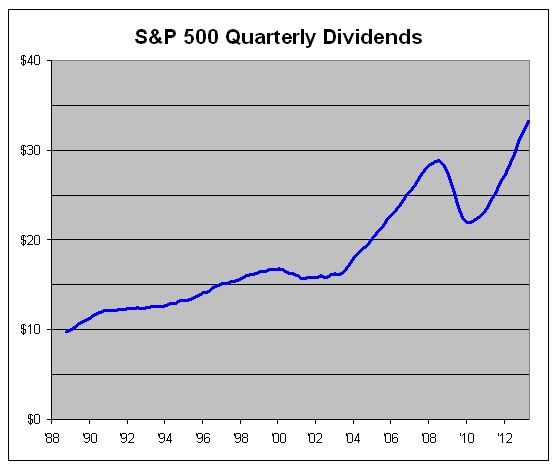
    An article from stock picker and blogger Eddy Elfenbein titled S&P 500 Dividends Grew 15.49% in Q2 is an interesting precursor to what to expect from Q2. The title gives a lot away but there is more to it. As he mentions, this is the tenth straight quarter that dividends rose by more than 12%. He also points out that the dividends paid out from the S&P will be double what they paid ten years ago. This is after a couple of market hiccups on the way.

    What does this tell us? Dividends are a portion of earnings that the company pays out it to its investors. The company makes the decision after all other cash needs both now and in the future. Obviously there are other factors to consider but that is the simplified version. So this means that companies are making more money and can afford to pay it out to investors. It is a good indicator of the financial health of a business.

    A graph from his article which shows that dividends have comfortably overtaken the highs of 2008. This is another reason why markets in the US are justifiably at their current levels. Investors have been attracted to these stocks because as an asset class they offer some of the best yields in developed markets.

    As one earnings quarter ends another begins. Alcoa release earnings on the 8th of July which will announce the start of a whole new stream of information from companies operating all over the world. As always we will process and cover the relevant companies as the news flows in.


Shorts. Eat these ones.

If I did not see this with my own eyes, I would have scarcely believed it. It takes some getting used to that the US is becoming the leading oil producer globally: No. 1 US produced more petroleum in March than: a) Saudi Arabia, and b) Europe, Central and South America combined. Resource abundance in the US, and all thanks to having embraced the shale oil and gas revolution. Now, about that fracking in the Karoo, let us talk about it for the next 10 years, OK. Oozing sarcasm in that last sentence, apologies.


Blackberry used to be the phone that everyone wanted, it could get your email anywhere and you could chat to your specific group. Now every single smartphone allows you to do all those things and much, much more! To illustrate how much market share Blackberry has lost, read this article: The Crucible of the Phone Market. The graphics are astonishing. "It becomes immediately evident that BlackBerry has lost a huge part of its user base to Android and iOS. In 2.5 years market share went from about 42% to 8%. In raw numbers that's 11 million users that switched to another smartphone." Wow, how the once mighty have been reduced to also rans.


Nobody knows what the future holds. But you get folks who try and predict what the future holds for mankind, and in particular innovation. This interesting graphic that I found tweeted via Aki Anastasiou (the traffic and technology fellow over at 702), titled Tomorrow's world: A guide to the next 150 years is fun, and interesting. These are folks betting, and being given odds, because as you know, the poms bet on everything! World government in place by 2030? Really? A 10 kilometre high building by 2050? Tax abolished in the US by 2100? Admittedly that is a long shot. According to Wikipedia: "In 1894, Democrats in Congress passed the Wilson-Gorman tariff, which imposed the first peacetime income tax. The rate was 2% on income over $4000, which meant fewer than 10% of households would pay any." Seems like governments need more nowadays, perhaps they need to get more efficient.


Home again, home again, jiggety-jog. European markets have all been teed up for a modest fall this morning, as a result of the US markets closing off their highs, having halved from their session highs. I suspect that we will follow suit here and open lower. Later this week there are of course US employment numbers in the form of the non-farm payrolls. We will get the ADP numbers tomorrow I think, that is the usual cycle. Of course the hyperactivity and the octo-boxes will fill our screens and we will be led to believe that this is the most important jobs number ever. Even though nobody remembers what it was six months ago.


Sasha Naryshkine and Byron Lotter

Email us

Follow Sasha and Byron on Twitter

011 022 5440