Monday, 11 June 2012

Rajoy Frobs them off

"The Eurogroup is confident that Spain will honour its commitments under the excessive deficit procedure and with regard to structural reforms, with a view to correcting macroeconomic imbalances in the framework of the European semester. Progress in these areas will be closely and regularly reviewed also in parallel with the financial assistance."

Jozi, Jozi. 26o 12' 16" S, 28o 2' 44" E. It was a big weekend for data and for Spain, and as such I was reading on my twitter feed that some people were sitting this one out. What? Yes, I heard that a lot, and sure it might have worked for some, but we can see today that it was the wrong thing to do. Resources sold off heavily, eerily the Jozi all share closed at 33666, off around 0.7 percent on the day. Locally there was a strange interpretation of a Reserve Bank speech from Thursday evening, which you can read (if you want) here -> Monetary Policy and Inflationary Challenges in the Face of the Global Economic Crisis. The suggestion is that if pushed, the Reserve Bank will act.

It was expected I guess. The news Friday that kept coming was that Spain was going to engage the rest of the union and ask them for funding for their banking sector. Someone said something interesting on the weekend, I think it was the FT which pointed out that the three countries which have taken funds from the European Union, Ireland, Portugal and Greece collectively are half the size of the Spanish economy. So, Spain are in the category of too big to fail, most definitely. Mariano Rajoy, who when campaigning that they, Spain, would not be taking any money. Read my lips, no bailouts. So, how did this go down politically? Victory of course, announced Rajoy, because this proves that Spain's finances are in order and their banks just need the money. Politicians, I swear to you, victory at all corners. It doesn't matter Mariano, it is like saying that Torres should have scored and Spain should have won three – one. Yes, Balotelli should have buried one too, but was pretty Harry casual.

OK, into the nitty gritty, Spain has "asked" for 100 billion Euros to recapitalise their banking system, more than the fellows at Fitch suggested. So how is it going to work? Well, there is that fund that the Spanish have setup already, called Frob. Sorry, Fund for Orderly Bank Restructuring, or just Frob as before. What the Frob is that about? OK, that is and was rude, let me not get involved in that. The Frob, as Felix Salmon explains in this article over the weekend, is the Spanish version of the US TARP, if one wants to look at it in the crudest sense, the TARP is the Troubled Asset Relief Program, check it out if you need a refresher. Felix asks the question, surely the Europeans could have lent the money directly to the Spanish banks? But again, this is about sovereignty and with that a certain amount of dignity for the citizens. Begging (?) bowls and dignity, how does that work?

So, simply, Spanish banks will be recapitalised via the Frob by the Spanish authorities, who are in turn borrowing the money from the European Union. You can read the very brief announcement: Eurogroup statement on Spain. That one line is supposed to calm the markets: "The Eurogroup notes that Spain has already implemented significant fiscal and labour market reforms and measures to strengthen the capital base of the Spanish banks. The Eurogroup is confident that Spain will honour its commitments under the excessive deficit procedure and with regard to structural reforms, with a view to correcting macroeconomic imbalances in the framework of the European semester. Progress in these areas will be closely and regularly reviewed also in parallel with the financial assistance."

The real questions to be asking are, what are the terms and conditions of the line of credit? Fabrizio Goria, an Italian financial journalist, who you can follow on Twitter, has had the following to say:
"EU spokesman says interest rate of 3-4% is reasonable in regards to the loan to Spain from the EU"
"EU spokesman says EU loan shouldn’t affect Spanish deficit"
"EU spokesman says EU loan to have strict conditions on Spanish bank overhaul"
"EU spokesman says EU loan to Spain may not reach EUR 100bln, average loan rate depends on the market conditions"

OK, thanks Fabulous Fabrizio, for letting us know what we can expect. I am thinking that the next steps will be for the Spanish banks to let the Frob know of how much money they think they need to be OK. At the same time, another independent audit, stress tests of the local banks. Just to see how bad the books actually are. In other words, how much money the Spanish banks will actually need in order to meet capital requirements. But this is a really good graph, via Fab again (I follow him on Twitter, he MUST be my friend), which shows one how good and or otherwise the capital market structures are inside of the European economies. Because you would imagine that German pension funds would own mostly German debt. But this graphic shows how loads of people are keen to own German and French debt, but it seems that locals don't want to own their own debt in the smaller markets. There is little appetite for local Fins to own Finnish debt, or so it seems. Ditto Greece and Austria. Portugal and Ireland too. Check it out and see if you can understand it.

See. Austrians are more likely to own German debt it seems. So much for that school of Economics. That is meant to make you laugh. I suspect what the Europeans want to do here, and Felix Salmon deals with it in his conclusion, the Spanish must decide how they deal with the fund flow, maintaining some sort of control, even though in theory this is a defeat. A Spailout. And remind me, Rafa did not completely take it away from Novak (first names basis, you know, like people pretend to know actors) yesterday. And the rain is expected to keep them away again today.

So, what do we think here? Well, Europe in their slow and bureaucratic manner are dealing with each problem, one at a time. Spains borrowing costs would be reduced. And as you can imagine, the next time that any Spanish property developer asks for money to build 250 units on the Galician or Andalucian coastline the answer from banks is going to be a resounding no in a double negative way, as one does in Spanish. Spanglish. Oh, and whilst we speak, there is a little detail, collateral is wanted by some of the smaller Northern European economies. The anchors of the CNBC program in London said that perhaps Rafa could be used, handed over to the Netherlands or the like.

Byron's beats deals with the other big issue this weekend, the one that everyone was "scared" of, the Dragon of the East.

    We had lots of Chinese data this weekend so let's jump straight into it. Firstly we had industrial production which came in slightly below consensus. Consensus was for a 9.8% increase and the actual number was 9.6%. This is a very important number because industrial production represents 40% of Chinese GDP. It is also a number which has been slowing because of higher wages and of course slower demand from Europe. 9.6% still sounds strong to me but I feel production will become less significant over time which is good for long term sustainability.

    Consumer prices (CPI) fell by more than expected which is a good thing. This gives policymakers more room for stimulus like we saw on Friday. Inflation is a threat to the Chinese economy so numbers like this are very good news. The recent fall in commodity prices should help maintain this control.

    Retail sales also missed consensus. This is not good because this is where the next phase of China's growth is going to come from. Consensus called for 14.2% growth while the actual number came in at 13.8%. Growth is never linear. There are so many moving parts and there will be pull backs in the economy. This is what we feel has just happened. A slump in economic activity. We see it time and time again. We expect data to start improving again and all the naysayers will start quieting down. They have been very loud lately. Even so 13.8% is a strong number.

    Fixed Asset Investment managed to beat with a 19.9% increase compared to May last year. Here is the breakdown of the data thanks to The BusinessInsider. Property FAI growth rebounded to 18.0 percent in May, from 9.2 percent in April. Railway investment growth was -35.2 percent, compared with -46.9 percent the previous month. Manufacturing FAI jumped to 28.2 percent in May, from 22.7 percent the previous month. The leading indicators of FAI growth, total planned investment in newly started projects jumped to 28.2 percent, from 191.9 percent in April. "The pickup of FAI growth in May suggests that the govt was ramping up infrastructure and social housing investment to bolster the economy on the weak economic data in April."

    So overall a mixed bag but following Fridays rate cut and proof of fiscal stimulus from this Data you would have to say that the Chinese economy, with a little help, will remain healthy

Currencies and commodities corner. Dr. Copper is last at 336 US cents per pound, the platinum price is slightly higher at 1443 Dollars per fine ounce. The gold price is last at 1591 Dollars per fine ounce. The oil price is better at 85.05 Dollars per barrel. The Rand is a little here and there, 8.32 to the US Dollar, 12.94 to the Pound Sterling and 10.46 to the Euro. We are better here today, but off the best levels so far.

Sasha Naryshkine and Byron Lotter

Email us

Follow Sasha and Byron on Twitter

011 022 5440

Friday, 8 June 2012

Spain. Good at football and tennis.

"An old timer trader once said, trading gold makes you old. I suspect that Bernanke testimony and lack of clarity on extra stimulus saw the precious metals (and oil price) go a whole lot lower in a flash."

Jozi, Jozi. 26o 12' 16" S, 28o 2' 44" E. We rushed through 34 thousand points on the Jozi all share index, for the first time in four weeks. We certainly have had a stunning two day rally on the speculation that policy makers will do whatever necessary if they need to. Well, the European Central Bank did not cut rates, the theory is that they are waiting post the Greek elections before they use their silver bullet. But, the Chinese cut rates for the first time since 2008, possibly in a sign that we are in a softer patch now in the second quarter than in the first quarter. In fact there is no doubt that is the case, the recent data from across the globe suggests as much. Byron covers that in detail, ahead of major data releases from the Chinese later tonight and in the wee hours of tomorrow and Sunday. Data on a weekend? Wiki suggests that economic activity, like in Jozi here, takes place every day of the week, so I guess data releases on a Saturday are just fine in a Chinese context.

The mood is about as glum as I have seen in a little while, business confidence locally is at a ten year low. In fact, this is the worst number since the South African Chamber of Commerce has been releasing these numbers. So, you might well be forgiven for thinking that it looks quite cloudy out there. This time reminds me a little of the beginning of 2009, where the solutions around the banks and their liquidity in America related to the subprime mortgage melt down were starting to become clearer. This is the same sort of issues, remodelled in a different way.

All major sectors gained yesterday, other than the gold miners who were carried out on a stretcher, down nearly five percent. What is that about? An old timer trader once said, trading gold makes you old. I suspect that Bernanke testimony and lack of clarity on extra stimulus saw the precious metals (and oil price) go a whole lot lower in a flash. Remember that the Aussies earlier in the week also cut rates. So, I am guessing that Asia is feeling the heat of the cold and stodgy looking Europe. For the record, my homemade pasta (I roll and cut myself) last evening was overcooked. Overcooked pasta is not great.

Perspective. Sometimes you need it badly. Paul sent me a chart last evening, the chart this courtesy of TradingEconomics.com. Check it out:

OK, so these are Spain's borrowing costs, the yield on the 10 year government bonds, the current "scary" six percent plus is nothing compared to the 12 percent rates that the country had to borrow money at, pre the Euro area. But of course this is much worse than the close to three percent back in 2006. So perhaps on a more normalised basis, if you draw a graph from the top left to where we are now, the graph looks good for Spain. The rates are not what they (the Spanish treasury) WANT it to be, but this is FAR BETTER than where it was.

So why do we bring this up? Well, Spanish banks are stuck with stinky looking mortgage books, problems with loans to property developers, a softer economy that was too geared to construction, high unemployment rates not dissimilar to what we have here. And just last evening the fellows over at Fitch decided to cut Spain's credit rating to BBB, down a whopping three notches in one go. The ratings agencies, grrrr.... my theory is that they (the ratings agencies) went from a time of not paying attention at all to perhaps being too aggressive, not wanting to get it wrong again. That is our general view here. There were some no you know what Sherlock observations from Fitch around the Spanish banking sector.

Just yesterday Spain managed to raise government debt at just over 6 percent for the 10 year debt, which of course is nearly 25 basis points more than 7 weeks ago. The Economist (yes, I read the electronic version) article titled Slouching towards a banking union, in which Credit Suisse reckon that Spanish Banks will still have to raise around 60 billion Euros, as they might still have to write down 150 billion Euros worth of debt associated with loans to property developers. Further down there is a link to a graph which suggests that Spanish banks may need close to 100 billion Euros, as a results of NPL's rising significantly in the coming quarters. Reuters is reporting this morning that Spain is expected to make an aid request for their BANKS and not the central treasury, which I guess is very different from the Greek situation.

Now there are three charts that you need to see. Also courtesy of TradingEconomics.com, who are absolutely fabulous for all info graphic that you are looking for with regards to economic activity. First thing, to illustrate how the construction boom sucked up a lot of unemployed folks, check this 15 year graph:

So, unemployment rates 15 years ago were also at these same levels, perhaps nothing too new. But away from what was the recent norm. We all suffer from recency bias. Next graph, Spain has a problem at government level, right, too much spending, the people of Spain get too many benefits, is that right? So Government spend as a percentage of GDP must be higher now than ever before? Well, no. Notwithstanding the fact that the Spanish GDP is lower now than a few years ago. Check this out, this is government budget as a percentage of GDP:

So, according to Fitch the far right of the graph is going to look worse and not head in the right direction. And to recap the banking sector, worst guess would be as much as 9 percent of GDP, that is Fitch's worst case scenario. Next graph, perhaps the most troublesome of all of them, because of the downturn on the right there, Spain's growth rate.

The only way to solve the budget deficit problem is to make sure that growth picks up and treasury collects more taxes. Well, growth is more important in the long run, you can put a cap on government spend right now and stimulate the private sector. But how? Spain has pretty restrictive labour laws, the worst of the lot in Europe. What is the incentive to get to Spain and start investing there? Well, the Invest in Spain website in this section, which I took a look at, Why Spain? tries to make a fist of it. I suspect that they will be OK. But it is time to act and stop thumb twiddling in the typical European bureaucratic way. I guess we do not have to wait that long.

Byron's beats is always upbeat about life, and takes a slightly different view to the one being offered out there about why the Chinese cut rates.

    We don't talk about China enough. Yes we refer to it all the time when talking about growth and where it's coming from but how much detail do analysts really cover? It is understandable. It's a foreign economy in a foreign language so it would be difficult to watch their news channels like we watch coverage of the US and Europe. Yesterday my screens were showing the Bank of England's decision to hold rates whilst China were also making some important monetary decisions at the same.

    Yes the Chinese news was covered but not nearly to the extent of the UK decision. Yet the Chinese economy creates the equivalent of the UK economy every three years. This is where I think we are getting it wrong at the moment when it comes to sentiment about global growth. And it's not as if Europe is going to fall off the face of the earth. People forget how resilient we are. When times get tough the will to survive will bring out the extraordinary. Europe has proven they have the grit many times before throughout their history.

    So what actually happened in China yesterday? Well rates were cut by 0.25 percent. This was unexpected and of course good news. This is part because of inflation reads coming in lower than expected. But there were some other policy changes announced. Banks are now allowed to offer a 10% premium to the benchmark deposit rate compared to 0% previously. This means that money deposited will actually earn more. Very good for a country with such a high savings rate. A higher yield will also take some pressure off the inflated property market.

    On top of that banks are now allowed to offer a 20% lending discount to the benchmark compared to 10% previously. So this will make money even cheaper. At this stage none of the big 5 banks have offered anything less but if you did Economics 101 you will know that the prisoner's dilemma will force banks to cut at some stage in order to be competitive.

    So you see, a deeper look shows that this was actually a rate cut on steroids. There have been calls for the liberalization of the Chinese banking system for ages now. This is a step in the right direction. It makes you realize that we are all on the same side here, pushing in the same direction for a better world and a bigger pie for all.

Telkom. Why do I even cover the company, is it a certain smugness about them having woefully underperformed their two market "peers"? We were told years ago that the yield on our preferred investment MTN was not up to scratch with regards to their dividend payments. Well, the shocker this morning is that Telkom has suspended their dividend payment. And at current trading levels, MTN has a historic dividend yield of 5.55 percent, Vodacom currently at 7.17 percent. Telkom have suspended paying dividends. Yes. So their historical yield, from the last full set of numbers is zero percent. {Sigh} With exceptional items becoming the norm rather than the exception, that exposes management weaknesses. At the results presentation this morning a customer was heckling the CEO. I have nothing else to say, I will absorb everything this morning. I did a piece which I will talk about next week. Government should just buy the rest of the business that they don't own already if it is of national importance. Really. The price is dirt cheap now.

Currencies and commodities corner. Dr. Copper is last at 3.30 Dollars per pound, the gold price is off the best levels at 1577 Dollars per fine ounce. The Platinum price is also lower at 1420 Dollars per fine ounce. The oil price is much lower, down at 82.31 Dollars per barrel. The Rand is weaker as Mr. Risk-Off tugs his Friday strings ahead of a very important weekend for Spain and China bulls. Currently the Rand is trading at 8.47 to the US Dollar, 13.08 to the Pound Sterling and 10.60 to the Euro. If only Spain had a better looking economy than their tennis stars and football team.

Sasha Naryshkine and Byron Lotter

Email us

Follow Sasha and Byron on Twitter

011 022 5440

Thursday, 7 June 2012

What you Yellen about?

"The news from yesterday was that ABSA would be buying Edcon's book. That left us puzzled here and thinking that perhaps Bain's timing had been poor on the way in and that they were creaking for half a decade. Or perhaps Mitt Romney needed more funding as his campaign entered the critical stage of the US presidential race. Make the connection?"

Jozi, Jozi. 26o 12' 16" S, 28o 2' 44" E. Yesterday was D Day, well the 68th anniversary of the Normandy beach landing, which I guess was the turning point in the Second World War, but instead of red on the beaches, we had green across the market maps. Whilst Europe has sovereign debt issues to contend with, I promise you that the problems that they had back then were MUCH worse. The ECB did not use up any of their bullets yesterday, saying that they would watch it. I suspect that the talking heads are right, the ECB will wait until after the Greek elections which are in just over a weeks time, next Sunday, and then decide on whether to act. The great Greek tragedy stills weighs on everyones minds, the Spanish "situation" is far greater and heavier, in fact Spain is set to sell 2 billion Euros worth of debt today, the yields undoubtedly will be much higher than last time around. Both short and medium term debt, Bloomberg TV tells me 2,4 and 10 year. But, if you could think of a day to be doing it, much better than the end of last week. Because the headlines read across the major publications that policy makers are preparing to do more, and equity markets were favourably disposed to news of this sort. Bloomberg TV is calling it "Stimulus Speculation". I guess that is exactly what it is.

We were in lift off mode in the late afternoon after having enjoyed a good time earlier in the session, the Jozi all share added a whopping 1.47 percent to end at 33603, up 485 points on the day. The main stars were the resource stocks, which have been in the dog box as of late, collectively the mining houses added just shy of three percent. The action for the bulls however was everywhere, banks up 0.85 percent on the session, remember the news from yesterday was that ABSA would be buying Edcon's book. That left us puzzled here and thinking that perhaps Bain's timing had been poor on the way in and that they were creaking for half a decade. Or perhaps Mitt Romney needed more funding as his campaign entered the critical stage of the US presidential race. Make the connection? I hardly think that it is that, like Paul said when Edcon discuss their results and present to their mostly bondholders as interested parties, the bottom line is hardly ever discussed. The stand out performers yesterday were the platinum stocks, they collectively went nuts, up five and a quarter percent, but they still trial the broader market, and are in fact year to date (YTD) the worst performing index, down nearly 12 and a half percent.

Byron's beats looks at the global motor vehicle industry, platinum and oil price correlations. Fascinating stuff.

    There is one sector which is doing very well both locally and internationally and that is vehicle sales. Last month automakers around the world reported 25.7% stronger retail sales in May. This equated to an annual rate of 13.8 million vehicles compared to 11.7 million for the comparable year. That is a big increase especially when you consider that the base was considerably increased by the Cash for Clunkers campaign in the US a couple of years ago.

    Locally sales have also been flying. Sales increased by 20.7% year on year in May to 50228 units. Consequently Imperial who sells vehicles is replacing Lonmin who mine the material that goes into vehicles, on the JSE top 40. The Imperial share price is up 37.5% so far this year while Lonmin is down over 20%. So I guess it is better to sell cars than it is to produce catalytic converters. In Imperial's latest results, vehicle sales grew by 14% which was on top of a 49% increase in the comparable period a year before.

    This makes me wonder about two issues. Firstly, why are so many cars being sold? And secondly, why is the platinum price so low? Let's deal with the first issue, car sales. I think you know what I am going to say here, Aspirational Consumerism. One of the first purchases you aspire to when you get your first job is a vehicle. Especially in South Africa and other developing markets where public transport is lacking. It really is life changing and often a symbol of success.

    So why is the platinum price so low? Or is it low? The benchmark is usually gold but that metal price is driven by very different factors. In fact over the last 5 years the platinum price is 86% correlated to the oil price. That is a much better indicator than gold. So maybe it is not so 'cheap'.

    Regardless of that I posed the question to the other guys in the office and we agreed on a few things. Technology has improved so that the amount of platinum per catalytic converter has decreased. Small diesel vehicles have also increased in sales which require less platinum. Recycling has also become more prominent.

    That was off the top of our heads, here is what Johnson Matthey had to say, we were not far off. "The platinum market swung into an oversupply of 430,000 oz last year. Supplies of platinum rose by 7% to 6.48 million ounces due to inventory releases from South Africa as well as higher output in North America and Zimbabwe. Recycling increased by 12% to 2.05 million ounces. Gross demand for platinum rose by 2% to 8.1 million ounces largely as a result of heavy purchasing by the glass and petrochemical industries. Demand for platinum for use in heavy duty diesel autocatalysts was strong but this was partly offset by lower use in light duty diesel emissions control and reduced buying by Japanese auto manufacturers. Autocatalyst demand grew by 1% to 3.11 million ounces. Purchasing last year by jewellery manufacturers was 2% higher than in 2010 at 2.48 million ounces. Investment demand declined by 30% year-on-year but remained positive at 460,000 oz."

    So what about the future for platinum. The miners are struggling therefore supply is slowing. We feel demand will remain strong as developing market consumers grow. However you know our thesis about investing in the miners at the moment, we don't. A platinum ETF would be the best exposure.

New York, New York. 40o 43' 0" N, 74o 0' 0" W. Wow. A large rally, I saw a couple of tweets that I quite liked and even emailed them to my colleagues. Email a tweet? What for? Well, they come and go tweets, and email gets archived. First, the one from about the only fellow that I would call a realist, neither a bear nor a raging bull, his name is Cullen Roche. His username is the on the twitter handle @PragCapitalist. It was a rather sarcastic tweet and went like this:

"Beginning of the face ripper???? #teamworldisendinglosesagain"

First things, a Face Ripper is a huge rally. Second, he is really sarcastic when he says team world-is-ending loses again. I guess that part often goes to the core of our argument here, the world doesn't end even though loads of people ALWAYS tell you that it is going to.

The next tweet that I sent was age restricted. The_Real_Fly is a terribly rude guy who you should not be introducing to young children, and is sort of known as a very crazy fellow. His tweet that I was interested was basically suggested that everyone had gone completely quiet about Credit Default Swaps and Bond quotes, because of course bonds were no longer the flavour. It was all about equities, which absolutely roared, stocks gained big time, the best day of the year, with all indices adding more than two and a quarter percent on the day. The S&P 500 tacked on 29 points to close at 1315 points, a gain of 2.3 percent. Quite, a real Face Ripper.

Not everything has had a face ripper. In fact some have had their headlights, fender, wing mirrors, mags and handles ripped off. A stock price which has had the most awful time in the last month and a half is Tempur-Pedic International. Some of you might well know the company as the seller of beds in the TEMPUR range. When I got married all of ten years ago, my wife and I decided that there were two things that we had to have. One was a king size extra length bed and the other was a dishwasher. We still have both and don't intend to get another one. But there was a craze in the US about memory mattresses, the ones that remember your shape for the night and you can sleep beautifully well. Question, you can never have enough apps for your cell phone, but how many new beds can you have? One, right? And how many plush pillows can you have? Well, I am guessing one. So, when people went crazy buying mattresses, you could have guessed that it would come to an end at some stage. And it has, Tempur-Pedic said last evening that they were losing out to their competitors as everyone continues to roll out memory mattresses, they operate in the niche space. And it is getting more crowded. So whilst revenues might be up 70 odd percent over the last two years, don't expect that to continue.

And boom, the share price fell nearly 50 percent. But that is not the worst of it, less than two months ago the stock was trading at 87 Dollars a share. Down 74 percent in just 8 weeks. The company expects to earn around 2.70 Dollars per share. But at 22.39 Dollars, is the stock now completely oversold? Or is the outlook so bad, that the heavy selling is over and buyers are scarce. Over ten years, the stock is up, but the last eight weeks has been horrid. The response from other manufacturers in the space, Select Comfort fell twenty and a half percent. Sealy (awesome share code, ZZ) fell over five percent. So what is the moral of the story? Pay attention? Well, some things humans change often, handsets are a good example, but some other things people keep for a long time. So when there is a fad, like cool mattresses, how many can you actually sell?

Currencies and commodities corner. Dr. Copper is last at 338 US cents per pound, the gold price is a little better on the session, last at 1622 Dollars per fine ounce. The platinum price is last at 1460 Dollars per fine ounce, part of the reason that the platinum stocks went nuts yesterday. The oil price is last at 85.4 Dollars per barrel. The Rand is firmer, naturally, up at 8.31 to the US Dollar, 12.85 to the Pound Sterling and 10.43 to the Euro.

Parting shot. Remember yesterday we were talking about falling off a cliff, the abyss, etc? How things in Europe appear to be bad, but not that bad as reported? We tend to do that here too as South Africans, using the word freezing too generally. Yesterday was not freezing. Freezing implies that the air temperature drops below zero. In other words, minus. In the same way when central bankers talk, "Fedspeak" confuses almost everyone. Because there is a lot said, without saying anything in particular.

This was driving Josh Brown crazy last evening. Perhaps he had a beer or two, but in response to Janet Yellen's speech last evening, titled Perspectives on Monetary Policy he said the following: Talking for the sake of talking, half of them want to tighten and half want to cut. None of these speeches are giving anyone any "clarity". And then he (Josh Brown) got really mad, and said Janet Yellen: "Headwinds persist." Wow, how should we make the check out, Janet, that was amazing Where's the afterparty? Dripping with sarcasm of course. What am I trying to say, connecting misuse of the word freezing with Fedspeak? Well, it is all about interpretation in Economics, and forecasting is a very difficult job. But, I can tell you that according to the Accuweather application on my phone, Jozi is going to experience very cold conditions this weekend, and yes, here it is apt to use the word freezing. A maximum of 11 degrees celcius. That is cold, but not freezing. A bit like economic conditions, cold, but not freezing.

Sasha Naryshkine and Byron Lotter

Email us

Follow Sasha and Byron on Twitter

011 022 5440

Wednesday, 6 June 2012

Not quite cliffs and the abyss

"He paid the money on the basis that he said MTN would pay him back at some stage. Sounds just all fishy to me, and where there is smoke there is almost certainly fire. But where did the fire start?"

Jozi, Jozi. 26o 12' 16" S, 28o 2' 44" E. We finally had a day when the buyers exceeded the sellers and markets locally actually closed in the green. It wasn't anything to write home about but it has been a tough couple of months so a 0.1 better close felt kind of good. The all share ended at 33117 points mostly led by the resource sector which was up by 1 percent while financials were flat and industrials slightly down, 0.1 percent lower on the day. All this was on the back of a rand that strengthened 0.8 percent on the session to the US Dollar.

Most of the positive news came from speculation that the Fed was going to implement a more aggressive stimulus plan following the latest negative economic data. This is also the case for both Europe and China. Again these are short term sentiment swings, you know the usual risk on and risk off. There is a European Central Bank monthly rate-setting today and Ben Bernanke makes a testimony before a congressional panel tomorrow. Both will gives us more clarity on any policy actions.

Company news. The biggest news of the day, from our perspective anyhow, was the update on the MTN allegation. The Hawks are now getting involved sparked by former executive Chris Kilowan having now admitted to bribing Yusuf Salojee, South Africa's former ambassador to Iran. Remember that Mr Kilowan is the disgruntled former employee who gave the docs to Turkcell in the first place. Again we are watching this very closely, the market did not seem too bothered with the share down only 0.3%. Here is Times Lives coverage of the update

I (Sasha here, that was Byron above) was actually on the radio, SAFM, this morning directly after Chris Kilowan was being interviewed. I was sitting in my car in the parking lot of my eldest daughters school, ha-ha! I listened to Kilowan and quite clearly it sounds like he is implicating himself. He paid the money on the basis that he said MTN would pay him back at some stage. Sounds just all fishy to me, and where there is smoke there is almost certainly fire. But where did the fire start? And even if worst case scenario for MTN, how would the US force MTN to pay Turkcell? This is presuming that a US court found in favour of Turkcell, presuming the court case still goes ahead. Presuming that MTN do not have their noses completely clean. A lot of presumptions, and for the moment everything is murky.

Edcon. Something I guess finally happened you could say. The announcement starts by saying that Edcon are pleased to announce that they have entered into an agreement with ABSA into selling their accounts and receivables (their book) for around 10 billion Rand. A retailer masquerading as a bank, that was I guess how people used to say over a decade ago. Edcon delisted on the 25 May 2007, so a little more than five years ago. With the benefit of hindsight perhaps not the best timed deal, but I am pretty sure that they were not the only one, African Bank also bought Ellerines at perhaps not the best time. But that is water under the bridge, it matters what you do with the business now and not then.

Back in February of 2007 I had this to say about Edcon:

    Edcon (ECO) finally coming to the table with the deal that has won the hearts and pockets of the board. The offer recommended by the board is from a crowd called Bain Capital and the offer is the single largest buyout of a South African company yet, the offer is all cash and for 46 Rands an Edcon share. A massive premium it must be said, many doubted whether it would be anywhere near forty at one stage. But excellent for existing shareholders and a big vote of confidence in the retail environment in South Africa. Or is it excellent for shareholders?

    Because at this price the stock certainly aint a bargain in the true sense of the word, but if you dig a little closer and look a little longer perhaps you are buying fashion a few seasons in advance. For the full year to March 2007 the analyst community were looking for around 350 cents per share for the stock, at 46 Rands that would make the stock on a forward PE of 13 and a bit. Two years out and that price reverts back to a ten at 46 Rands per share, so any of the short term gains you are likely to pocket now, you definitely are likely to miss out going forward.

    So if it were a real premium in the sense of the word premium, one of the definitions of the word premium is "a sum above the nominal or par value of a thing". I guess it all boils down to what you would call premium then, if selling the stock on a 13 forward PE to March is indeed a premium then by all means go for it, but my sense is that it is a bit cheap and there will be an awful lot for the chaps buying it.

    They are of course at pains to point out that at the announcement of the first cautionary middle of October last year the offer is well over 50 percent higher than where the stock was trading. So, in short you are being handed a fat premium. But inside of their own sector Foschini (FOS) trades close to a 13 times earnings multiple and Truworths (TRU) is way higher than that, nearly a 19. I guess the outlook for the sector a mere five months ago was not exactly the most favourable, folks worried about the tightening cycle, recent inflation numbers seem to suggest that we might be near the end.

    Either the timing of this offer for Bain, in terms of the first SENS release makes it look like a nice juicy steak (of course if that is your thing), or are shareholders really getting the best ever deal and being dished up something that resembles a diner short order cook offer?

I do not even know what to say all these years later, who did better, the shareholders exiting for a premium or Bain for having to sweat it through this rather tricky period. Very tricky period. Although retailers have done really well, other than in '08 and '09 and perhaps the timing thing was not on their (Bain's) side. We think that Bain has been forced here.

Currencies and commodities corner. Dr. Copper is last at 338 us cents per pound, the gold price is much higher at 1637 Dollars per fine ounce. The platinum price is also getting a lift, last at 1460 Dollars per fine ounce. The oil price has recovered sharply to 85.35 Dollars per barrel. The Rand is much stronger as the buyers have come back. 8.41 to the US Dollar, 13.01 to the Pound Sterling and 10.49 to the Euro.

Parting shot. I think that the ECB are going to cut rates today, or perhaps should cut rates today. But that is just me agreeing with Christine Lagarde, and in fact CNBC suggested that 62 out of the 73 analysts polled suggested that rates will stay on hold. Why? Well, let me put this into context, we see "falling off a cliff", "standing on the edge", "staring into the abyss", "Eurozone falling apart" and all the other sorts of scary headlines in the major publications on a day to day basis. So if someone (something) is falling apart, or staring into an abyss then you would expect economic growth to look completely ugly, not so? Yes, I would have expected with all the headlines that I am reading to see far worse GDP contraction than what we have seen this morning from the Euro Zone. The Euro zone read was flat, quarter on quarter. Falling off a cliff? Staring into the abyss? Sounds like what I would call a landing, a steady landing, but that is just me, because zero means you are on the ground, which is zero? Yes? No?

But that is the first quarter, the current quarter is worse, because the data suggests as much. German Industrial Production month-on-month is down 2.2 percent. So I am thinking that the ECB can act, and act a whole lot faster than folks think. I saw pop up on my screen that traders and not investors are looking for a rate cut. I tell you, I would not be at all surprised. We will see, my sense also is that if there is a hold on rates, this rally could fizzle a little. So far we out the blocks strongly, thanks to decent enough Australian data. Err... and then of course the Fed announcing that they may be more active. Twist II or QE 3 or perhaps something different. I certainly do not have the answers, and as much as I like Barack Obama, I am starting to think that the Republican best could be the better guy for markets. Sies, I can't believe I said that.


Sasha Naryshkine and Byron Lotter

Email us

Follow Sasha and Byron on Twitter

011 022 5440

Tuesday, 5 June 2012

The lawyer, an economist, the chemist and four bureaucrats.

"A friend of mine who works over there said that the senior execs had used up as much as 70 percent of their time speaking to the Koreans and were introduced by government to each other, only for the government to "pull the plug" on the deal."

Jozi, Jozi. 26o 12' 16" S, 28o 2' 44" E. We were comfortably off the worst levels of the day, but we were also quite a way off the highs. Resources were lower by half a percent, retailers were strongly higher, up nearly three quarters of a percent. Platinum miners rocked in the face of a Rand that strengthened to the US Dollar. Banks added nearly two thirds of a percent, in what was a tale of two separate sides of the market, again largely driven by fluctuations in the currency. After all was said and done the Jozi all share closed down 31 points to 33076. That is a loss of 0.09 percent, nothing to write home about I guess.

Byron's beats looks at an interesting announcement from last Friday. Which once again confirms to me that the levels that the retailers trade at, is about right. Because of what others are prepared to pay, if not locals, who are stuck on past valuations.

    On Friday we saw some more evidence that the developed world find our retail sector very compelling. Last week a SENS was released by Spar Group stating that the Government of Singapore Investment Corporation has acquired a beneficial interest in SPAR securities and now holds 5.18% of the company. Now we all know about Wal-Mart's 51% acquisition of Massmart and although this is of a smaller scale, it is still significant as a vote of confidence.

    This now makes them the third biggest share holder of Spar behind the PIC and Coronation and is valued at around R1bn. But this is a strong trend we have seen over the years with regards to our retailers. We often hear South African analysts talk about how our retailers are overvalued. But in truth their opinions do not count for much. That sounds harsh but I say it because most of our retailer shares are owned by foreigners.

    Annaleigh Vallie from BusinessDay wrote this article about the Spar announcement and found the following stats on the foreign ownership of our retailers. "International investors own about 70% of Truworths, SA's largest clothing retailer, from 67% a year ago, and more than 90% of Massmart. Almost 60% of shares in Mr Price and 54% of Woolworths are owned by foreign funds, increasing from 51% for both stocks in May last year, according to Bloomberg data."

    What does this tell me? It tells me that cheap money from developed markets is coming into developing markets trying to grasp the developing market consumer which is growing stronger and stronger. It is a massive growth theme that many are trying to grasp. We have ample exposure via Massmart, African Bank, Cashbuild, Woolworths and Famous Brands. I am sure that many of these foreign investors have done very well over the last few years. In 2009 the retail sector was up 26.2%, 55.8% in 2010, 14.7% in 2011 and 14.25% so far this year. That's good going.

Poor Telkom, the news is hardly getting any better. A friend of mine who works over there said that the senior execs had used up as much as 70 percent of their time speaking to the Koreans and were introduced by government to each other, only for the government to "pull the plug" on the deal. Sounds about right. But I am not talking about that, rather a trading update that came a little late yesterday. Here is the trading update that deals with their pending results. There was already a trading update that "things" were looking poor, we covered these, here -> Telkom. More write downs. More bad news.

Turns out it is going to be slightly worse than initially thought: "Telkom hereby advises shareholders that basic earnings per share from continuing operations for the year ended 31 March 2012 are expected to be between 95% and 100% lower than the comparative period. Headline earnings per share from continuing operations are expected to be between 30% and 35% lower than that of the prior year."

Restated headline earnings per share for the period to end March 2011 clocked 484.8 cents, for continuing operations. As such, it is pretty easy then to work out. So, you should expect around 325 cents worth of headline earnings per share from continuing operations. Which means that the stock trades on no more than six and a half times earnings. And I am guessing that the dividend payment will be very slim, last year it was 145 cents for the final dividend. At current levels, if the dividend payment is maintained (I would think unlikely), then the company could be on a yield of close to 7 percent. That seems all too cheap, but I guess if the main shareholder cant be convinced by the company of what their strategy is, then neither can the rest of the market. Who then can't afford a higher rating to the company.

The G7 are going to be holding emergency talks on matters of the Euro zone debt crisis today. The G7 who does not include the Chinese or the Indians, but in all fairness, this debt crisis should rather be the focus of the olde worlde rather than the newer entrants. Because of course the crisis impacts on all of them. France, Germany, Italy, Japan, the United Kingdom, the USA and Canada are part of the G7, but the European commission also sends along a representative to these meeting. WHEN the Euro project gets closer to completion, perhaps the EU can have a single member there on their behalf, and then we can include China and India, perhaps even the crazy Russians can get a look in.

Stephen Harper (Canadian PM) is a lifer politician. Barack Obama is a lawyer by trade. David Cameron is sort of a lifer politician with a journalism background. Yoshihiko Noda sort of has some business background, but is mostly just a politician lifer too. Mario Monti (Italian PM) is an academic economist and bureaucrat. Angela Merkel holds a very impressive doctorate in quantum chemistry, but is outside of that a lifer in politics. Francois Hollande is a lifer politician, heck, he even studied it, as they do in France. So what do we have? One economist, one lawyer, one chemist and four politicians are going to save the European debt issues, how confident are you now when I put it like that? Less, or more confident? What does make me confident is that these masters of the planet are going to be getting together using technology, we are told by conference call. Awesome. BUT, lucky for all of us, it is the Finance chiefs that are going to be on the call, not the butcher, the baker and the candlestick maker. Resolution? Hardly expected, but at least folks will get a better understanding of what the Germans are thinking relative to what each of the others are thinking.

Remember that very fun "dis is ze German coastguard" YouTube clip, where the poms say "Mayday, mayday, we are sinking". To which the young German coast guard operating the radio asks the stricken ship "What are you sinking about?" It definitely seems that this is the kind of space that we are in right now, everyone is not understanding each other. What still amazes me is that English is one of the three "working languages" of the European commission, along with French and German. And the ECB press conferences are almost always in English. Are we expecting any press release to make the bears shudder and awake the bulls? Or is this just getting a plan together ahead of the next G20 pow-wow in Los Cabos in 13 days time? Possibly both, but posturing at these meetings is high on the agenda and a nice relaxing environment to say hi to new buddies in the form of Hollande. In the meantime a European services PMI read BEAT expectations, but both a German and French read did not. Time for the big hitters to be big hitters and come out of the dugout methinks.

New York, New York. 40o 43' 0" N, 74o 0' 0" W. It was better later in the day than in the middle of the session where an early rally had been rubbished by another set of weaker data in the form of US factory orders. Not huge in the bigger scheme of "things" but I guess jangling the frayed nerves. I do see a lot more talk about valuations, which does at some level mean that common sense will prevail in terms of when the buyers do eventually come back and are believers again.

I was then quite interested by a series of tweets from a fellow by the name of Matt Busigin, who describes himself as an amateur investor and economist, in an interaction he was having with another fellow I follow, Barbarian Capital who is a nameless fellow, but has lots of interesting things to say, including last night that 12.4 billion visits were made to drive thru spots in the US last year. Michael Bloomberg should outlaw that too in New York, but at least people actually walk there. Matt said two things that caught my eye, first:

    "I calculated it at as 25% of foreign sales in January, and 48% of sales are foreign. Discount EZ to 0, you get $93 from $105."

He is talking about the S&P 500 earnings expectations for this year, and has adjusted his Euro Zone profits to zero for the collective companies. And he still gets to 93 Dollars on the S&P for this year. And the level is 1278 for the S&P 500. So, at the current levels, even in an absolutely disastrous outcome from Europe, the S&P 500 is trading at 13.74 times forward earnings. And if worst case does not transpire, then the market leaves even a cheaper 12.2 times forward. Pretty cheap sports lovers. He then goes onto to something a whole lot more complicated:

    "That still leaves us at a ERP of 5.67%, or LERP of 2.32%. So you could make the argument that's baked into valuation."

ERP is equity risk premium. The Investopedia definition is as follows: "The excess return that an individual stock or the overall stock market provides over a risk-free rate. This excess return compensates investors for taking on the relatively higher risk of the equity market. The size of the premium will vary as the risk in a particular stock, or in the stock market as a whole, changes; high-risk investments are compensated with a higher premium."

Risk free of course is the US ten year treasury which yields a paltry 1.52 percent right now. Yech, what sort of an investment is that, no really? Many people are starting to call for the US to issue a whole lot of debt at these rates for future funding. I mean, if someone is silly enough to want to earn only 1,5 percent per annum for ten years and then get their money back, well then..... perhaps they should not be paid to run money. Anyhow, I like the arguments about the valuations, they appealed to me.

I am not the only one cherry picking and putting on a brave face here, remember the Goldman Sachs note from yesterday that Byron was talking about? Yes? Titled: Do The BRICs need Replastering? The conclusion from Jim O'Neill was quite similar, it goes as follows:

"It all looks rather grim doesn't it? And it isn't even May any more. But, as I saw from a broker note this week, if you look at the valuation of many European markets, their current level relative to the CAPE (cyclically adjusted price earnings) are at such low extremes that this could be close to one of the best investment opportunities in a long, long time. Our own CAPE analysis suggests the same."

Long, long time, is that a few year, five years or ten years? Either way the conclusions that I am beginning to draw is that the market is cheap. And quite a few people think that too.

Currencies and commodities corner. Dr. Copper is last at 334 US cents per pound, the gold price is 1618 Dollars per fine ounce, better on the session, whilst the platinum price is also starting to get a little traction, up at 1438 Dollars per fine ounce. The oil price is 83.87 Dollars per barrel. The Rand is steady. 8.49 to the US dollar, 13.05 to the Pound Sterling and 10.56 to the Euro. We have started about flat here.

Sasha Naryshkine and Byron Lotter

Email us

Follow Sasha and Byron on Twitter

011 022 5440

Monday, 4 June 2012

Where is this Grand Plan?

"As readers will be aware, in recent weeks, I have attempted to put the Euro Area crisis into what I thought was an appropriate global context. I have pointed out that in 2011, China's nominal $GDP rose by 1.3 trillion, equivalent to creating an economy the size of Greece every 11½ weeks and an economy the size of Spain in not much more than a year. The BRIC countries collectively contributed around $2.2 trillion, not too far off the equivalent of another Italy."

Jozi, Jozi. 26o 12' 16" S, 28o 2' 44" E. We were a whole lot worse at one point, we will discuss in detail the views about the jobs data a little later. The Jozi all share index closed 35 points lower, or 0.11 percent lower to end at 33107. So, things are not that bad, when you compare us to some developed markets, some chatter this morning about certain Japanese stocks being at multiple decade lows. Sony last traded at these levels in 1980. Yech. And for the technical folks the TOPIX is in bear market territory. So that is Japan. Spain is awful, Italy is not that good, Greece is a disaster, so my point is, we should not feel that beat up, our market is not that bad at all. We are three and a half percent higher as of close of business Friday. But that includes being held steady here somewhat by a weakening currency. If you have a look at our exchange when compared to the FTSE, which has a very similar makeup from a resources exposure point of view, the FTSE is down five and a half percent. We are still some distance above the lows of early October when we were talking about the US debt ceiling, remember that? And the FTSE is nearly 12 percent lower since the middle of March. Over the same time the S&P 500 is down nearly nine percent. And ourselves? We are only down just over three and a quarter percent. Why? The weakening currency has helped the dual listed stocks, and to a lesser extent some of the local miners.

These Cadiz results are hard to read. Because, the company is very different now than what it was a couple of reporting periods ago, as they sold 60 percent of their securities business. But, investors get a once off 50 cent dividend from that sale, the way it should be, not so? I mean, the money belongs to shareholders. As Cadiz says, Unit trust funds under their management increased 29 percent. Total assets under management are about the same as twelve months ago at 41.6 billion ZAR. So what is the market valuation for those assets, because that is roughly how it is done in our industry. 456 million Rand is what the market values Cadiz at, which is cheaper relative to some of their peers in the market. Do you think that the discount is applied because of two things that we could think of a) The market loses interest when earnings are patchy and the going is tough and b) The big derivatives business means that you should apply a higher discount. Perhaps that is the case. But here is a practical example, Coronation is just over 8 billion Dollars in market cap, and at the last results had 296 billion Rand under management. So the ratio that is applied is 2,5 times greater in favour of Coronation. Not an exact example, because there are many differences between the two companies, but a fun comparison between the two.

The numbers are messy because of these once offs here, there is a new boss in the form of Fraser Smith, who succeeded Ram Barkai, who has gone to pursue other interests. He is a long distance swimmer, Barkai, perhaps he is going to do something different, like swim to St. Helena. Is this the sort of business that you should buy? I always think not, because often they are a proxy for the market anyhow. And perhaps some of these companies are too closely correlated with the markets. But as Paul said, when they listed the business back in 1999 they saw themselves as the financial services giant of the future. Decent job, good people that work there, whether or not it makes investment grade for the conservative portfolios, that part I think we answer with a no.

Byron's beats are back! He has a look at the current state of the globe. Light reading, with great conclusions!

    We have gone through a patch of negative data with a lot focus being pointed towards Europe and the US. However some of the news from the developing markets, in particular the BRIC nations (our supposed saviours) has not been great either. This is understandable, the developed markets are big trading partners with these countries.

    Jim O'Neil the man who coined the BRIC phrase addressed the issue in his latest note. Here is the PDF, it's definitely worth the read but if you strapped for time, I'll try summarise it for you.

    He's come up with some amazing stats, this in his opening puts developing market growth into perspective. "As readers will be aware, in recent weeks, I have attempted to put the Euro Area crisis into what I thought was an appropriate global context. I have pointed out that in 2011, China's nominal $GDP rose by 1.3 trillion, equivalent to creating an economy the size of Greece every 11½ weeks and an economy the size of Spain in not much more than a year. The BRIC countries collectively contributed around $2.2 trillion, not too far off the equivalent of another Italy."

    He covers all the BRIC nations as well as Europe and the US but I want to focus on what he says about India and China. First of all India. The country has experienced negative economic data of late. But as Jim mentions, India has thehuge potential with its demographics and a fairly mature democracy. It seems like some consensus is required with regards to policy makers which sounds similar to Europe. Fortunately it is a lot less complicated than the European situation for obvious reasons. The issue seems very fixable while the economy is still expected to grow above 7%.

    "India's leaders also suffer from another commonality with much of Europe in that they cannot seem to get anything done. Hopefully, the sizable nature of the recent disappointments will finally force some of their key policymakers to start making some decisions. The reversal of some of the mistakes made in late 2011, particularly in regard to foreign direct investment, seems key to me."

    And then there is China which Jim says is still the beacon of light. As we so often say, Jim also thinks that the Chinese economy is going to shift to a more sustainable consumer based economy.

    "In terms of comparisons to 2008/09, I think it unwise for people to expect another big infrastructure based stimulus, for two related reasons. First, the 5-year plan assumes China will grow by 7.0 pct. This year, Premier Wen suggested real GDP growth of 7.5 pct would be likely. At the moment, the “slowdown” looks to deliver real GDP growth above this level. Second, policymakers want to engineer an era of better-quality growth based on higher consumption and lower energy-consuming and polluting production as I have talked about repeatedly. Therefore, past fiscal solutions designed to support investment are not going to dominate. We are much more likely to see more specific steps to encourage consumption, especially if they tie in with other goals, as well as efforts to ease financial conditions. In this regard, news earlier this week that the government is stepping up measures to subsidise the use of more energy-efficient cars is more typical of what is likely to occur."

    It's good to know that we are not the only people still positive about global growth. Like we have mentioned before, yes Europe is in trouble but there is still a lot of growth being created out there. Just because it is coming from a different source does not mean it has less of an effect. To conclude his letter he says that now presents a fantastic buying opportunity. In fact he says this could be close to one of the best buying opportunities in a long long time. We agree.

New York, New York. 40o 43' 0" N, 74o 0' 0" W. Global concerns hit markets Friday, I am pretty sure that a good US jobs report would have helped offset some of the poor data during the week, but that was not to be. Weekly nonfarm payrolls fell well short of estimates and the futures markets, which was already a percent down, lost almost another percent immediately. There were very few ways to sugar coat the report, and I had to admit that the glum faces on the screen told the story. Republican and Democrat politicians that came on the screen both looked fairly upset, although inside the Democrats were probably trembling and the Republicans were smiling. This is after all, an election year. I think Josh Brown (The @ReformedBroker on twitter) got it right when he said that Mitt Romney's smile (or was it grin) could be seen from outer space.

The actual number registered 69 thousand, the unemployment rate ticked up to 8.2 percent, that headline would be seized by the mainstream press. Suddenly, before our eyes the gains of 2012 had disappeared, as the Dow Jones Industrials had their worst drop of the year. A decent jobs report might have actually led to a rally, but during the week there had been poor GDP data from the poms, poor jobs data from the Europeans, very average PMI data from the Chinese as well as an Indian GDP miss. Although give me above five percent growth and I will be happy with that miss every day of the year.

At least the poms get somewhat of a reprieve with a four day weekend, all around the celebrations of the Queen Elizabeth II's Diamond Jubilee. The Telegraph ran a series of pictures through her reign on the throne, my personal favourite was one where she was firing a machine gun in the pouring rain. She was kitted in her finest of course, and a soldier in his military fatigues held an umbrella over her whilst she let rip. Amazing. Ending here quickly, the Queen has reigned over the United Kingdom for a series of 13 Prime Ministers, the first of which was Winston Churchill. 60 years is a long, long time. Only three years and 100 odd days as of last Saturday, and she would have been the longest "serving" British Monarch ever. In the modern era, and by modern and British monarchs, I mean from 927 AD roughly. It always amazes me how significant people think the monarchy is, but do yourself a favour and see their lineage and how they got there in the first place. Queen Elizabeth II would be a person you sort of knew if her father had not been in line when his brother abdicated. Just saying, I am pretty sure that there are many more examples.

But we are not here to learn about old history, we are here to see the one unfold in front of us. And in this case it was the worsening jobs data. At the same time the yields on the US ten year treasuries had been falling to record lows again. There was a fellow who compiled a list of folks who said recently (last two years) that this was an awful investment, for all the obvious reasons. Jim Rogers, Nassim Taleb, Bill Gross, all looking I guess more than a little wrong at the moment. Hey, we all get it wrong, but the first two on the list had such enormous conviction. And Taleb is a narcissist. He stopped his Twitter account just over two years ago, luckily the Business Insider preserved what they refer to as his completely obnoxious tweets. Examples include: I now take a hot bath after reading emails from businessmen or journalists; I then feel purified from the profane until the next email No, really. And then another classic We are better at (involuntarily) DOING out of the box than (voluntarily) THINKING out of the box. Thinking is just ornamental; for show-off Wow. This guy is amazing. He is truly clever, fluent in multiple languages and is highly qualified. But dare I say it, completely arrogant and pig headed. He is still telling everyone to short the pants off US treasuries. Quite. So far, very wrong.

Meanwhile, Jim Cramer, that crazy guy perhaps has the best suggestion yet, calling on Treasury Secretary Tim Geithner to literally issue 500 billion Dollars worth of debt at these crazy low yields. I guess Jim has a point, when next, in a generation or two are you going to see rates this low? So how do you even begin to look at these jobs numbers and say, well, there is a ray of sunshine here. The ever optimistic Tom Lee from JP Morgan said that these were the best employment numbers he had seen in 13 years, for the month of May. What? Well, that was the Business Insider response too, check it out: This Was The Best May Jobs Report Since The Year 2000*. Tom has been accused many times for being too bullish.

Well, I am guessing that he might be right on a couple of things. The Chinese are going to do something of some sort. But the one that I think is going to be most significant is that I think the Europeans are going to do something different and "special". The project was designed for fiscal integration at some stage. I suspect that time might be on us already. Italian Prime Minister, Mario Monti is urging his fellow leaders in Europe to do more. And by that, he means Germans and to a lesser extent the French. I wait for that outcome, because I think that will place the concerns about Europe and contagion further down the feeding chain.

But what does all this mean for folks who hold equities? Well, I found another amazing chart from Scotty Barber. Take a while to look at it and tell me whether or not you can decipher this or not. But, at first glance, equities look cheap.

Quite. So, someone ought to tell someone, but in our case we shall just encourage folks to add at these levels, when they can.

Currencies and commodities corner. Dr. Copper is lower at 334 US cents per pound, the gold price has gone nuts, up at 1617 Dollars per fine ounce. The platinum price also has had some buying support as the Dollar has weakened, 1428 Dollars per fine ounce last. The oil price is last at 81.44 Dollars per barrel. The Rand is steady, last at 13.17 to the Pound sterling, 10.68 to the Euro and 8.57 to the US Dollar. Looking a little weak again here this morning. And meanwhile the Europeans are working on a grand plan while the poms sit out for two days as they celebrate the Queen having sat on the throne for 60 years. Wow.

Sasha Naryshkine and Byron Lotter

Email us

Follow Sasha and Byron on Twitter

011 022 5440
Friday, 1 June 2012

Telkom. SMHIDA.

"For the moment the miners must feel like they are on a slippery slope coated in baby oil with their hands tied behind their backs, and feet tied together. You can scream all you want, but nobody is hearing anything."

Jozi, Jozi. 26o 12' 16" S, 28o 2' 44" E. Everyone is quickly becoming an expert on Spanish banks and bond yields from Spain and Italy and their respective levels. Yesterday the US ten year treasury fell to a historic low level of 1.5326 percent. Like my headline suggested yesterday, conservation of capital is at the top of the list for the loose term "investor". People get paid a lot of money to all park for a while in Bunds, Bonds, Gilts and JGB's. All the while in Europe we are moving towards the idea of Euro Bonds, my favourite European CNBC journalist, Sylvia Wadhwa suggested that there could be a start at the short end of the curve. Very short term debt, just to help out the liquidity of the struggling banks. An FDIC type deposit guarantee could also go a long way from us seeing the headlines that Greek depositors continue to transfer funds out of their banks into other Euro banks. I guess that might stop if the looming elections in Greece go in the favour of the conservatives and less in the favour of the far lefties. I saw polls suggest two things, one, the 80 odd percent of the people in Greece want to stay in the EU, but the same percentage, more or less want to see the austerity measures stopped. In other words like most human beings around the world, want to be paid more, be better looking, live in a bigger house and drive a bigger car. Gotcha!

Mr. Market here added 174 points, or 0.53 percent to close at 33143, around 150 points off the highs of the day. The gold miners rocketed away, the collective were up 4.2 percent after all was said and done. Phew, that is amazing. Platinum stocks lagged the rest of the market, Implats was downgraded by two separate brokerage houses. This morning Aquarius is falling hard, it is down to an all time low. The once darling sector of the JSE is having a rather tough time sadly. This is a great pity, because we have so much potential to exploit these assets. I suspect in time the demand will continue to rise for the metal, and we will see better days. For the moment the miners must feel like they are on a slippery slope coated in baby oil with their hands tied behind their backs, and feet tied together. You can scream all you want, but nobody is hearing anything. Someone once asked me what it would take for a shakeup, and sadly it would be worst case scenario, a major mine (not miner) shut. It must be incredibly tough out there in the platinum and gold mining sector in South Africa. And as the assets age and the fixed costs continue to climb, I can't see it getting much better in the short term.

Telkom. Shaking my head in disbelief again (SMHIDA). Touching tomorrow or perhaps never touching anything, the announcement this morning basically suggests that the biggest shareholder, the Government of South Africa is not happy with the Koreans taking a twenty percent stake in the only fixed line operator in South Africa. Pfff... One of the conditions would be that the South African government as a shareholder would ultimately decide on this. Remember at the beginning of the month, with the last announcement, you saw that basically government and the government employees pension fund control the business with a little over fifty percent of the business: Telkom and KT Corp. Is this for real this time?

The news today comes as no shock then: "Shareholders are advised that on 31 May 2012 Telkom was informed by the Honourable Minister of Communications that the proposed transaction between the Companies had been presented to cabinet on 30 May 2012 and that cabinet had taken the decision not to support the transaction as proposed. The board of directors of Telkom will be engaging with the Honourable Minister of Communications to discuss cabinet's decision and the implications thereof. A further announcement will be made in due course." As my old varsity friend used to say and Paul said this morning which made me chuckle: "Legends of the..... fall asleep". Well, whatever you want to think of the business, shareholders have voted with their feet over the years.

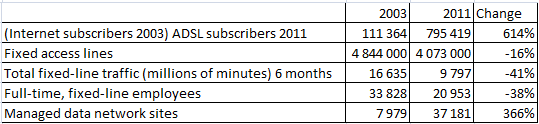
But then I thought to myself, let me whip out the first set of results after they listed nearly ten years ago and the last set of numbers and compare with those numbers from 2003. Perhaps not real revenue and profits numbers, but rather subscriber numbers and number of lines, because back then Telkom held a significant stake in Vodacom, that of course is no longer the case. Remember also that one of South Africa's corporate legends (IMO) Sizwe Nxasana ran Telkom back, perhaps having a much easier job than Nombulelo Moholi, otherwise known as Pinky. I hear she is tough, but she perhaps needs to be tougher. So, here goes, I stuck it into a spreadsheet and have a graphic here below for you, this compares September 2003 half year results to September 2011 half year results:

So, what does this tell us? First, that there are a whole lot more internet subscribers, but the margins in that part of the business are probably not what they were a few years ago, internet packages have been getting cheaper and not more expensive. The fall in number of fixed lines is lost to those folks with mobile lines, who are happier to use their mobile services over their fixed line options. Because everyone is mobile nowadays. The headcount reduction could actually be misleading, Paul suggested that perhaps there are actually non permanent staff in there.

But, there probably were quite a few people who have left over the years, old timers whose time for lying on the beach had come. One can see this in employee expenses, which for the six months of 2003 clocked 3.707 billion Rand. In 2011, the same expense was 4.542 billion Rand. On a per staff basis, Telkom's costs have doubled from the six months to end September 2003 to the six months to end September 2011. Quite simply it is employee costs divided by staffers. Perhaps if you run through many a company you will find the same thing, I have no problem with people earning more if they are able to deliver more. And sadly, I suspect that from a customer point of view, not much has changed over that time. Sub standard service really, that is always what I have had. Is it then any surprise that the company has seen turnover flat for five years. Completely flat. Yech. The market cap is now 12.7 billion Rand, versus 19.2 billion Rand last year at the end of March. The governments roughly 40 percent has lost 2.6 billion Rands in value in just over a year.

So, why say no? Perhaps the price is too cheap. But as you can see, has got cheaper. I have always been completely against owning the company because of the corporate culture, that I have experienced as a customer. If you do not treat your customer as king, they will and have found alternatives. And if the government continues to block a part sale for whatever reason, then I wish the remaining shareholders of Telkom the best of luck. One problem however, is that I guess we are all owners of government and as such Telkom. Telkom, which were whacked yesterday as a result of being chopped out of the MSCI emerging market index, the region specific one. So, this time zone, which includes Poland and Turkey. Today the stock is experiencing similar heat, down nearly five percent, another 621 million wiped off the market cap, more or less. And governments stake is not diluted (happily), but is worth 250 million Rand less. I am sure that the Honourable Minister of Communications should be made aware of this shareholder destruction. And do not get me started about the massive write offs of failed African business forays.

New York, New York. 40o 43' 0" N, 74o 0' 0" W. OK, today is about nothing else other than non-farm payrolls. The ADP number from yesterday was positive, but missed expectations by quite some margin really. Not a big margin, but one nevertheless. The weekly jobless claims number was worse than anticipated, as was a second look at US GDP. Or was it? I quite enjoyed this Bob McTeer piece: Real Final Sales Tick Up a Notch. He comes to this conclusion about the GDP read: "This morning's revision of the second quarter pulled the headline GDP number down to plus 1.9 percent from the earlier estimate of 2.2 percent, but real final sales were actually revised up a notch to plus 1.7 percent. So, while the headline number will get the press and will be treated as a downgrade, one could argue that it was actually a tad stronger than the earlier estimate" But concedes straight thereafter that strength is relative and we continue to see this weakening trend. The Fed, their foot off the gas, slowing naturally, that sort of thing, easing off.

I am not completely excited about the non-farm payrolls number because of their variability and unpredictability and remember that they are always prone to all sorts of revisions too. We actually spoke about that last month, remember:

    You know how I feel about the "jobs number", and it was great that I stumbled across this article titled Wise Up to the Proper Flaws of Monthly NFP Data, by Barry Ritholtz. For him, and his publication, the "stuff" that is useful is hours worked, temp help and wages paid.

My irritation that it is the one and only focus aside, it is what it is, the most important number across the globe, the one that everyone trades around. So, what are expectations then? The unemployment rate is set to stay steady at 8.1 percent, the average work week is set to be unchanged too at 34.5 weeks (I don't know anyone who works that little), whilst private payrolls number is supposed to be in the region of 160 thousand. So, tune in to possibly the biggest market data point on the planet at around 14:30 Jozi time this afternoon to catch it.

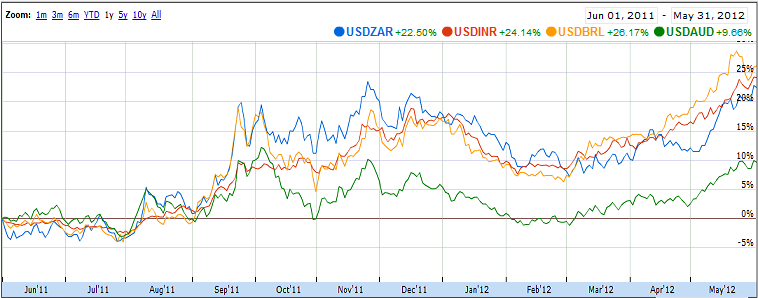
Currencies and commodities corner. Dr. Copper is lower at 336 US cents per pound, the platinum price is last at 1390 Dollars per fine ounce. The gold price is also lower at 1553 Dollars per fine ounce. The oil price is trading at levels last seen in October last year, 85.03 Dollars per barrel on WTI Nymex. Good for inflation reads, that is for sure. The Rand has taken a fair knock, like all emerging market currencies. And I have illustrated this with a little hacking of a Google Finance currencies graph, this shows Dollar strength when compared to the Indian Rupee, Brazilian Real and South African Rand, all weakening relative to the USD, all around a quarter weaker over the last 12 months, this has very little to do with the local currency. And then for good measure, I have thrown in the Aussie Dollar, a commodity exporter. Nice graph, tells us that risk off the table means all emerging market currencies and equities have been sold off.

If you want the more up to date link, follow here: US Dollar ($) / South African Rand (ZAR). For the record, the Rand is at 8.64 to the US Dollar, 13.22 to the Pound Sterling and 10.70 to the Euro. We are slightly lower here at the start. Waiting like everyone else.

Parting shot. Chinese manufacturing activity slowed once again, the government number suggest slight expansion, the HSBC number contraction. The government number missed expectations, and now everyone is getting all down on themselves and asking if China can maintain eight percent plus growth for the current quarter. The suggestions are starting to point to yes. But who am I to know, what I do know is that whilst we are all feeling beat up about life, companies are hanging onto more and more cash. Which needs deployment sooner rather than later. In the meantime, the ECB is telling European leaders to act with shock and awe. I am still looking for this, sooner rather than later.

Sasha Naryshkine and Byron Lotter

Email us

Follow Sasha and Byron on Twitter

011 022 5440