Friday, 18 January 2013

Chinese GDP 2012 print is 7.28 times that of 1999

"An even more astonishing number is that in the years from 1999 to 2009 (11 years), collective Chinese GDP was 26.6 trillion Dollars. The last three years almost equalled the 11 years prior to that. Yes, add 2010 through to 2012 (three years) and the cumulative Chinese GDP was 26.12 trillion Dollars. So, I suspect that whilst getting anxious about China slowing their economy either through interest rate hikes or by raising the triple R (reserve ratio requirements for banks) the truth is that the base is incredibly higher with this type of growth."


To market, to market to buy a fat pig. Boeing continues to suck wind, the new shiny fleet of 787's is basically going nowhere as the batteries are investigated across the globe. I checked out Wiki and that suggested that only 49 planes have been built. The giant Airbus, the A380, only 92 have ever been built. Amazing. I flew on an Airbus 380 twice, to Germany and back with Lufthansa and it was amazing. Incredible. Mind blowing. And this was after the wing cracks had been discovered. I never felt unsafe.

People were looking forward to the Lance Armstrong interview. He sort of came clean, folks were upset there was no remorse. No crying. No jumping up and down on Oprah's couch saying that he loved EPO with all his heart. There was none of that.

Rio Tinto, you remember that from yesterday, I read a WSJ article -> Miner Rio Tinto Ousts CEO as Bad Bets Cost Billions that left me feeling that commodity prices are going to have to trend higher.

Why? Well, if aggressive capex plans have been shelved and Chinese demand is still pretty robust -> China records slowest growth for 13 years. I am not too sure that I am fond of that FT headline. I mean, yes, their growth rate might be the slowest for 13 years, but the size of the Chinese economy was 1.0833 trillion Dollars according to World Bank data from Google Public Data. It's cool, you must use it! I worked it out though. According to the World Bank Chinese GDP was 7.3185 trillion Dollars. Growth slowed to a 13 year low to 7.8 percent. But GDP for 2012 was 7.889343 trillion Dollars. More than 7.25 times more per annum than in 1999. Get that? Chinese annual economic output in 2012 is 7.28 times what it was in 1999. You don't see that headline. AND, wait for it...... using the same data -> China Gross Domestic Product, collective GDP from 1999 to 2003 (five years) was 6.7 trillion Dollars. Think about that for a second!

An even more astonishing number is that in the years from 1999 to 2009 (11 years), collective Chinese GDP was 26.6 trillion Dollars. The last three years almost equalled the 11 years prior to that. Yes, add 2010 through to 2012 (three years) and the cumulative Chinese GDP was 26.12 trillion Dollars. So, I suspect that whilst getting anxious about China slowing their economy either through interest rate hikes or by raising the triple R (reserve ratio requirements for banks) the truth is that the base is incredibly higher with this type of growth. And to think that in reality the Chinese are still a long way behind their American counterparts by most measures. Anxious? Not us, not here and like I said, commodities should continue to have a positive outlook.


Jozi, Jozi 26o 12' 16" S, 28o 2' 44" E I wasn't here for the whole day yesterday. I was spending the day with half of my little family, who were celebrating a birthday on the same day. My wife and youngest daughter happen to share a birthday, not by design I promise you! But it is fun for everyone I think, other than my eldest daughter, her nose seems out of joint. Life and its small intricacies. I think it was Michelle Obama's birthday too yesterday. Yeah, three great ladies on the same day! On the exchange stocks caught a bid, having their first day in the black since last week. Hey, what is this, a market report? No. Like Byron pointed out the other day, a great Josh Brown piece on why he writes his blog really sounded well with us: The purpose of this site. Exactly, thanks Josh, we could not have said it better ourselves!

Big ticket South African deep miners (deep as in shafts deep) struggled yesterday, as anxiety over government and labour with the companies continued to weigh heavy. He ain't heavy, he's my brother. We need more of that type of discussion. Less "them" and "they" should be used, even if you are referring to labour, government or business. Use names, people. That is a good start, because for better or for worse, business used private money to build the infrastructure, using exploited labour (yes, that happened for many years), with a government that is not exactly friendly to business because of their alignment with workers. Everyone has vested interests. We all live and breathe the same air. We all want success for our country. We (yes it is time for we) need success for our children and grandchildren. And this was all before I had seen the rather inspiring FNB advert last evening: FNB You Can Help - Live Broadcast, a message from South Africa's children. I don't care how many times she practiced that speech, it did it for me!

My biggest take away from this current environment in South Africa is this. If government want more tax revenue to support social spend they are going to have to work harder to get business to spend more. You can't force business to spend more. If business is encouraged, entrepreneurs are celebrated, the appalling jobs situation in South Africa will be dented a whole lot quicker. Encourage people to stand on their own two feet, rather than the current perception out there being that a government job is the most sought after job. How and why does that perception exist? More small businesses and greater tax revenue generated would leave more for social programs that the government have their eye on. And ironically that would be good for creating jobs in the rural areas, jobs that would be longer lasting. More businesses = greater tax revenue. We should celebrate and encourage entrepreneurs, but instead we wonder how the state could do more. People do more, not the state. End of rant, apologies.


    Byron beats the streets. At half past four yesterday we received another trading update from one of the retailers. These updates are really painting an interesting picture of the environment at the moment. The update was from Mr Price which at the face of it looked very disappointing. But as ever the market had already priced in the news. From trading at R145 on January the 7th it fell all the way down to R125.55 where it opened yesterday. It is currently trading just above R120 as I type this.

    "During the third quarter (30 September 2012 to 29 December 2012) of the financial year ending 30 March 2013, Mr Price Group recorded sales growth of 10.0% over the corresponding period in the prior year (2 October 2011 to 31 December 2011). Comparable store sales increased by 4.4%.

    Retail selling price inflation for the period was 4.8% and cash sales constituted 78.8% of total sales(LY: 80.1%). Weighted average trading space increased by 3.4%. During the quarter the Group opened 32 and closed 2 stores, adding a net 12 294 square metres to its trading area and ended with 1 019 stores."

    As I have mentioned before, these companies are priced for higher growth than 10% and more importantly same store sales of 4.4%. That same store sales was less than the inflation rate so you could even assume less goods went through the tills. But there is a reason for the lack of growth which is interesting from a strategic view.

    "As anticipated, sales performance for the quarter was impacted by the planned curtailment of credit sales growth. In the third quarter of the prior year, unsecured credit granted in South Africa increased by 57.1%. With the Group's intention to remain a cash-based retailer and the downside risks currently associated with unsecured credit, a decision was taken to slow credit sales growth off the high base."

    Mr Price have always been predominantly a cash retailer. It is what they know and what they are comfortable with. If they are not happy to get into the credit market then I respect that decision 100%. Although I do not believe we are in credit bubble. They have managed to grow fast enough without having to rely on credit and as a shareholder it is one less risk to worry about.

    As for the divisions, Apparel (which includes Mr Price, Mr Price Sport and Milady's) disappointed with sales growth of 9.1% and same store sales of 2.9%. The Home division did a lot better with sales growth of 12.6% and comparable sales of 8.8%. Apparel got hit the hardest by the credit pull back. I was surprised by this though, the Famous Brands update indicated that lots of people stayed in South Africa for the holidays which would have benefitted Mr Price, especially Mr Price Sport. But I guess there has also been a big influx of international clothing retailers which has really ramped up competition. Just like what happened with Apple, when there are lots of profits to be made the competition will come running.

    Although disappointing there is a legitimate reason that growth was slower than what retailers have been used to. I still like the company and agree with them about the fourth quarter being stronger. In fact they indicated a 17.2% sales growth so far this year.


New York, New York. 40o 43' 0" N, 74o 0' 0" W US stocks closed at a new fresh five year high last evening. Weekly jobless claims also plummeted to a five odd year low, that was one catalyst. Bank earnings in the form of Bank of America disappointed, as did Citigroup. Both stocks were punished. But the rest of the sector actually was just fine, up around one third of a percent. I saw the biggest winner was the Bank of Ireland ADR, which was up nearly six and a half percent. BUT, over the last five years the stock is down 98.4 percent, I kid you not. Over 10 years the stock is down nearly 98 percent. Let us just say that the financial crisis almost crushed them to next to nothing. The last year however, the stock is up 80 percent. But hey, who really cares when you have been completely wiped out! Right?

After hours there was more news that the PC market was taking more than just a little pain: Intel's weak outlook, spending hikes unnerve Wall Street. The stock was also weak after hours, down 5.3 percent. If you read the Reuters article you will see that the massive capex plans are making everyone nervous. Margins are going to be hurt, and the hope is that there will be a whole lot more capacity in the smartphone market. I suspect that there will be. Smartphone saturation in the US is a number of years away. There are amazing handsets that have not been discovered yet, I suspect that Intel are going out on a limb here. And that is the part in the headline, unnerving "investors". Investors don't do "things right now". Investors are people who own a piece of a company. Not worried about the share price today, or tomorrow, those are not investors.


Crow's nest. British retail sales disappointed. How they possibly think that they are in a better position than the collective Europe is beyond me. Look at their budget deficit. Plus, it does not look like growth is coming back anytime soon AND inflation is a little bit of a problem. Deficits, no growth and inflation, sounds worse than Europe to me. If the awful Algerian events were not front and centre of peoples minds then the British Prime Minister would be telling us of a European failure. Nice, thanks for that. We are higher here today to start with, bring Mr. Earnings on!


Sasha Naryshkine and Byron Lotter

Email us

Follow Sasha and Byron on Twitter

011 022 5440

Wednesday, 16 January 2013

Anglo American feels the heat

"Costs. Part poor decision making, part labour, part electricity. And of course, probably the most important part in all of this, part weaker demand. Because you can let the costs get out of control and then what do you have? Peter Major used a gangrenous toe having to be chopped off to save the leg, and the rest of the body. I suspect that it is that bad, maybe worse. And requires corrective action."


To market, to market to buy a fat pig. Whilst the Germans were reporting sub-par economic growth, the key thing is that the economy is still growing. There was a little nervous excitement during the day leading into the Facebook event, which took place in the early evening our time. More on that later. Someone tweeted that most of the comments were happening on Twitter, about Facebook. Yes, Facebook is not for the chattering masses, but rather for updates about your life. Facebook is about your first day at work (or your kids first day at school), your prolonged insomnia, your shiny new kitchen appliance and your brilliant genius offspring. I like to think that I use both Twitter and Facebook properly. I hope.....


Jozi, Jozi 26o 12' 16" S, 28o 2' 44" E The response from both government and the unions to the Amplats announcement was of course noticeable shock and horror. Amplats is not SAA. There is no seemingly bottomless pit of money to help the business out when times are tough. There are real shareholders making real life economic decisions. Either it is these four shafts, or all the mines go in a while if the prevailing economic conditions exist. Government could lend a helping hand by strong arming Eskom to offer cheaper electricity prices to marginal mines. With all due respect, Minister Shabangu probably has little real world experience on the business of business. The economic realities are that the mines are losing money. Yes, the idea that mining companies are "making billions" is false. Amplats are going to report a loss for the year. A rather big one at that too, perhaps the parties that are outraged by the shaft closures and job losses failed to see the announcement only a day prior to this one. Oh, and all these businesses pay substantial and hefty tax bills, which contribute to the rather pleasing on the eye lifestyles, talking about large sums of money.

But that is me just being "chacharag", a term made popular by some (populist) fellow who is just a poor cabbage farmer now. It is easy to think that formal employment offered by big companies is secure and that the companies have large sums of money. Correct me if I am wrong, but parent company Anglo American took on a rather large pile of debt in a debt to equity swap when Amplats was forced to raise money just to keep the wolves from the door, somewhere down the line. That was less than three years ago, in case you needed reminding: Anglo American supports Anglo Platinum's $1.6 billion rights offer. The other shareholders, including the Government Employees Pension Fund I presume followed their rights. And I am presuming then that roughly 850 million Rands was sunk into the company via that specific shareholder. Of which no doubt Minister Shabangu will draw down on her pension when she retires. So, in a roundabout way, she is a shareholder.

And!! Wait for it, since the rights issue, where Anglo American shareholders sucked up over 10 billion Rands worth of debt, more debt has been added to Amplats. As much as was retired. And Amplats is not going to be paying a dividend to Anglo American this year. Nope. Not happening.

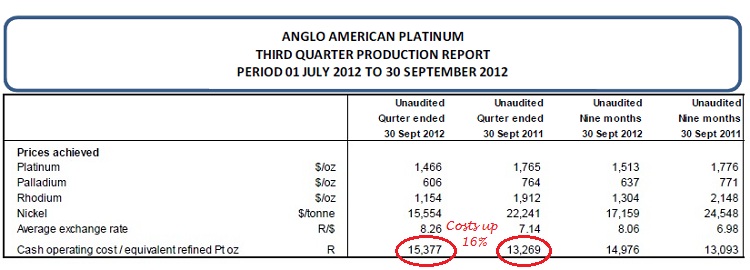
In 2006, a happier year for the company and shareholders, Amplats produced 2,816,500 ounces of platinum. Sales ballooned, profits were gargantuan when compared to the year prior and the company paid out extraordinary dividends. Cash operating unit costs per ounce produced was 6116 ZAR. That was in 2006. That was before the lights went out, because the longer term planning was not altogether good. You remember from yesterday when I showed you that table, of cash operating costs per ounce? For the September quarter it was 15,377 ZAR per ounce. For the year, the nine months to September it was 14,976 ZAR per ounce. In 2011, for the same period it was 13,093 ZAR per ounce.

Costs. Part poor decision making, part labour, part electricity. And of course, probably the most important part in all of this, part weaker demand. Because you can let the costs get out of control and then what do you have? Peter Major used a gangrenous toe having to be chopped off to save the leg, and save the rest of the body example. I suspect that it is that bad, maybe worse. And requires corrective action. Meanwhile the ruling alliance had this to say in a statement: The ANC condemns the action taken by Anglo American Platinum Limited. That hardly sounds like a friendly country to make bricks and mortar investments: "We call on the Minister of Minerals and Energy to call an urgent meeting of the industry with a view to considering the idea of companies who want moth ball shafts to surrender their licenses in respect of those shafts so that they can be put on a public auction for new owners who are still hungry to mine to put them to good use."

All of this review would be unnecessary if every person was renewing their motor vehicle purchases every two years, or whatever it is that people with shiny new motor vehicles do. But this is not the case -> Europe car sales fall to 19-year low. Is that Amplats fault? No. And that is where I think I will leave my attack on people that only talk to their constituencies. A full blown platinum mine strike will do little for companies willingness to sweat their marginal assets. And for those Japanese scientists beavering away at substitution methods at Toyota R&D centres, we better hope as a country that there is nothing new any time soon.

The repercussions this morning of the overnight speeches from both the Minister and the ruling party have been negative for investor sentiment. {Sarcastic Alert} But who cares about those investors, right? The alert ends. I care. We should actually care what people think of our country as an investment destination.


Woolies released a -> Trading Update And Trading Statement this morning. And the stock has responded positively, but that is against the backdrop of a stock price that has been pummelled in recent days as the retail sector has taken pain. Byron covered that nicely yesterday in his piece on Shoprite. There are a lot of moving parts in there, because of acquisitions, the addition of Witchery and Mimco's saw New Zealand and Australian sales jump over 55 percent. But, the key part in seeing group sales increase 18 percent for the comparable 26 week period last year is that earnings have comfortably outpaced that. For the first time in my life I left a Woolies store during December because it was so busy that I just couldn't bear it. There was a queue of 15 odd trolleys just to get in.

Woolies "expect that both earnings per share ("EPS") and headline earnings per share ("HEPS") for the 26 week period to 23 December 2012 will be between 18-24% higher than the corresponding reporting period of the previous year." Inside of that there are transaction costs associated with the Witchery Group, some restructuring plans involving employees, once off and net unrealised foreign exchange losses, which collectively add up to 111 million Rands. "Adjusting for these items, core EPS and core HEPS are expected to be between 33-39% higher than the corresponding reporting period of the previous year." That is what made me sit up, wow, that is a big increase. Expect around 164 cents worth of earnings for the second half, so, somewhere around 330 to 340 cents for the full year. Woolies deserves a slight re-rating, as they have got this morning. Earnings expectations from the analyst community suggests a 17 percent per annum increase for the next three years. Woolies are fairly generous with the dividend. We will review when the numbers hit the screens, the company suggests Valentines Day. Thanks for that!


    Byron beats the streets. This morning we received another trading update from one of our retailers, this time fast food franchisee Famous Brands. The update was only for the month of December which is nice because it gives us some important information about what kind of month December was, especially for holiday makers.

    "System-wide sales across the Group's total brand portfolio (including South Africa and the Rest of Africa region) grew 13.2% while like-on-like sales increased 9%, up from 6.1% in December 2011. System-wide sales in South Africa alone grew 12.4% in December, while like-on-like sales rose 8.5%. In the Rest of Africa region, system-wide sales increased 25.6%, with like-on-like sales improving 15.1%."

    This looks like a good outcome for the company who are at the same time the sole suppliers to this sales growth. It is a double edged sword in a good way. It also highlights how well the company has managed to integrate itself on our roads, keeping travellers full and satisfied. Targeting our petrol stations has been genius. And as you would imagine people on holiday eat out more.

    Kevin Hedderwick reiterates this: "In contrast to the 2011 December trading period, there was a discernible migration of holidaymakers from Gauteng to the coastal areas. Our restaurants in KwaZulu Natal and the Western Cape outperformed the inland markets, delivering stand-out results. Further reflecting this trend are the record turnovers reported by our restaurants on transit sites, at casinos such as Sun City, and entertainment centres including uShaka Marine World in Durban and the V&A Waterfront in Cape Town."

    There are two reasons for this in my opinion. Firstly it reflects the growth in our middle class/formal sector. People who have formal jobs work throughout the year and then go on holiday over December. That is what we do here in Sunny South Africa. And on that drive to the coast it is traditional to stop at a petrol station to fill up both your car and your stomach.

    Secondly I think it shows that people have cut down on overseas travelling thanks to a weaker Rand and tough economic conditions. This has forced them to take advantage of the lovely country we have at our disposal. The great weather we had over December also helped, especially at Milky Lane which the update suggests. This also leads me to believe that retailers like Holdsport and Mr Price have also had good Decembers.

    Other things to note from the update was how well Tasha's has done, growing turnover by 30%. Not only is this brand stealing market share because everyone loves them and it has become the fashionable go to for lunch and coffee, but it also shows peoples willingness to eat up and pay a bit more for a better dining experience.

    And see how well Africa is doing, just like Shoprite and Massmart we are seeing growth well north of 20%. I was listening to the MD of Yum! Brands Africa on Bruce Whitfield's show last night and he was explaining how KFC has become aspirational in many of these countries. In Lagos people go out on dates to the KFC, one couple even got married there. This is no laughing matter, remember how excited everyone got when the first McDonalds arrived in South Africa. If you are not used to it, it is special and new. Plus the other restaurant options in these areas may be lacking.

    We remain buyers of this company which has so much potential here in SA and throughout the continent. And they are certainly not hanging around having opened up 31 restaurants in the month, 21 in SA and 10 in the rest of Africa region. And this was over a slow period where builders go on leave and people go on holiday (to consume Steers and Wimpy on the way) which is even more impressive.


Facebook launched their third big offering, or that was what I was led to believe, last evening. A search function. With a weird name, "Graph Search". Now, according to the Business Insider who suggested that Facebook should have just called it "Facebook search", the term in tech world, social graph, refers to your network. Even Facebook network would or could have worked a bit better. If you are looking for the Facebook explanation, look no further: About Graph Search. As Paul said, this only works well if you make sure that your mates are active and you make sure that you are active. If you are active and post where you have been, what it was like, what you like, then one can get a better search result for all concerned.

But, don't take my word for how this function will be used, listen to the experts over at CNET -> Facebook takes on Google with Graph Search. And then there was another good one from PC Mag: Facebook Introduces Graph Search With Limited Rollout. I quite like that one paragraph, which shows the power of Facebook: "searches tap into the people, photos, places, and interests that populate those 1 trillion connections and 240 billion photos generated by Facebook's more than 1 billion users" 1 trillion connections? And you thought only Gideon Gono could count that far. Or the trillion Dollar coin idea, that was sent away in a rush!


Crow's nest. SA inc. is going through another troubling time. Amplats is down nearly six percent. Yes, really. Anglo was downgraded by Credit Suisse earlier today, the parent company that is. Boeing continues to see problems in their 787 plane, another incident with a fire and a Japanese carrier, so much so that several fleets have been grounded. That is weighing on Dow futures somewhat.


Sasha Naryshkine and Byron Lotter

Email us

Follow Sasha and Byron on Twitter

011 022 5440
Tuesday, 15 January 2013

The Amplats truth is ugly

"I have always maintained that this would be the point where all involved parties would now be forced to sit down and get serious. Because now it impacts everyone. Labour is losing revenue as members will probably be unable to maintain membership, government is losing potential tax revenue, and shareholders have to scale back their expectations for the business in the coming years."


To market, to market to buy a fat pig. There was a lot on the go yesterday, people talking about record inflows into equity markets. And also, did you see this? Hedge-Fund Leverage Rises to Most Since 2004 in New Year. But the key as ever for us around here is earnings. And with it being US earnings season, which is just starting to sink in as companies give us the real juicy pieces that we wait diligently for. However, we are not susceptible to quarteritis around here. We just enjoy earnings season. There is of course the debt limit battle looming, that is a mere month away or so from being more than just a sideshow. I guess the fact that people are talking now seriously is better than leaving it until the very last minute. But, mark my words, that is what the heel dragging politicians will do. If you don't have an ego you might as well avoid this as a career. German support for Angela Merkel seems to be heading in the right direction, at least that is what we were led to believe. The WSJ leads with -> Obama Escalates Debt Fight. Turns out that the man is very clever. It is politicking of course, pointing at the Republicans as holding the whole country to ransom.

Over in Europe, the powers that be decided to block the proposed takeover of TNT by global titan UPS -> TNT slumps as UPS pulls bid on EU veto. TNT down a whopping 42 percent, UPS up fractionally. It turns out, according to the Reuters story that both FedEx and DHL had lobbied the commission to send the deal proposed documentation into the dustbin and hit the reject button. Hmmm... TNT has the small pleasure of getting 200 million Euros by way of a break fee from UPS. Global logistics, parcel delivery, it is not easy out there.

Swatch bought the jewellery division of Harry Winston Diamond Corporation, which strangely impacts BHP Billiton positively. How? Because the remaining mining company, Harry Winston now would have the cash to acquire the Ekati diamond mine in Canada, which BHP Billiton have up for sale. Harry Winston in November agreed to purchase the BHP Billiton mine in November for a mere 500 million Dollars. Nice.


Jozi, Jozi 26o 12' 16" S, 28o 2' 44" E Retailers took a caning, largely due to a big fall in both Shoprite and Woolies, Mr Price was crushed too. Shoprite released an operating update -> SHOPRITE CONTINUES STRONG GROWTH which showed that sales had grown by only 13.8 percent. I use the word only, because that is what Mr. Market decided, sending the stock down nearly six percent on nearly four times the daily traded average. Wow. Forward, the stock trades on a 26 multiple. Now, that is wildly expensive by any South African retail measure. But. If you were faced with the task of trying to find the next best retailer on the planet, that operated in previously untouched markets, where would you start? Well, Africa. And that introduces it nicely for Byron.


    Byron beats the streets. As Sasha mentioned above, yesterday we received an operating update from Shoprite which shed some more light on the retail sector. As he also mentioned, the market did not receive the news too well pushing down the whole retail sector which is now down 5.5% for the year. That is not what we are used to from a sector which has been flying since it took a knock in 2008, down 20.2% that year. In 2009 it was up 26.2%, 2010 up 55.8%, 2011 up 14.7% and last year it was up 45%.

    Here is what Shoprite had to say:

      "For the six months ending December 2012 the Group grew turnover by about 13,8% to R46,7 billion. Growth on a like-for-like basis was 6,9%.

      The South African supermarket operation increased sales by 11,5% and by 6,2% on a like-for-like basis. For the month of December 2012 sales were 10,8% higher than for the corresponding period. Internal food inflation was on average 4,3% compared to the estimated official figure of 5,9%.

      The rand remained weaker against most non-RSA currencies resulting in the Group's non-RSA supermarkets achieving a sales growth of 28,2% and, on a like- for-like basis, of 13,4%. At constant currencies a rand turnover growth of 23,5% was achieved."

    As you can see the numbers are very similar to Massmart who grew turnover by 14.6% in the six month period, 7.3% on a comparable basis. Interestingly Shoprite's turnover was R10bn more than Massmart's R37bn yet its market cap is comfortably more than double that of Massmart's. Shoprite is valued at R107bn while Massmart is just North of R40bn.

    Why is that? As I have mentioned before, Massmart have taken a hit on earnings because of the costs of the Wal-Mart transaction plus certain social commitments forced on them by the authorities. They are focusing a lot of time and money on expansion.

    Back to Shoprite, see how well Africa is doing, growing 23.5%. Last year non-RSA supermarkets were responsible for 11% of sales. This was from 131 non-RSA stores. Total stores for the group amount to 1740 according to last year's full year results. After opening 18 non-RSA stores in the last financial year they have pin pointed over 30 opportunities to open new stores this year, especially in Angola and Nigeria. It is a costly exercise because unlike here in SA where shopping malls are built by property developers, in areas where there is a big lack of infrastructure, Shoprite and Massmart have to build the malls themselves, or at least put forward a lot of money to help the developers.

    Last year capital expenditure came in at R3.1bn compared to net profits of R3bn. So you can see the company is still in expansion mode. Interestingly, Massmart had a very similar ratio for 2012. They spent R1.3bn on capex compared to R1.36bn in profits. The market may be initially down on this news, the share price is expecting a lot. But I am not worried about the long term growth of both Shoprite and Massmart.


The operational review at Amplats happened sooner than most folks expected, later than originally telegraphed. And you can find all of it right here -> Anglo American Platinum takes action to create a sustainable, competitive and profitable platinum business. It is a tough read, because the economic realities are laid out. Four shafts in the Rustenburg region are to be put on care and maintenance, Khuseleka 1 and 2 and Khomanani 1 and 2. Production will therefore be ratcheted back by as much as 400 thousand ounces per annum. The new annual production target is 2.1 to 2.3 million ounces per annum. This is more realistic I suspect and away from the production at all costs.

But it is not just those four shafts. "The Rustenburg processing operations will also be reconfigured to align with the revised mining footprint, which may include closing the Waterval UG2 Concentrator and No. 2 Smelting Furnace." And it does not stop there either. Unfortunately the Union mine is up for sale. I say unfortunately, because I suspect that the selling price will not be what shareholders would have probably anticipated. It is by no means a small deal, the THIRD QUARTER PRODUCTION REPORT suggests that the Union Operations had for 9 months produced 174 thousand ounces. So, based on the three quarter year production, the annual run rate was roughly 230 thousand ounces. I hacked that specific production report, I can't believe that they spelt quarter wrong, and that nobody picked that up.

So. Amplats have had to think about the future of the business. And the hard task of being able to create value for their shareholders, after all, shareholders are the people who own the business, and in this case, Anglo American own nearly four fifths of Anglo Platinum, whilst the very distant second biggest shareholder is the GEPF, the Government Employees Pension Fund, with a little over six percent of the business.

There are always losers as businesses seek to optimize their businesses. And in this case it is the jobs of 14 thousand folks, most of them in the Rustenburg area. But all is not lost for these folks, as per the release: "the Company will target the creation of at least 14,000 jobs - an equivalent number of jobs to those that may be affected by the restructuring. The job creation initiatives will focus on housing, infrastructure and small business development in Rustenburg and the labour-sending areas" The sad realities are that there is both lost revenue for South Africa (at current levels I worked out 5.9 billion Rands for 400 thousand ounces), but even worse against the backdrop of unacceptably high unemployment, job losses.

If you add in the Harmony announcement from earlier this month, that amounts to close to 20 thousand jobs "lost" in the mining sector so far this year. And the closure (care and maintenance) of six shafts, two of course from Harmony. I have always maintained that this would be the point where all involved parties would now be forced to sit down and get serious. Because now it impacts everyone. Labour is losing revenue as members will probably be unable to maintain membership, government is losing potential tax revenue, and shareholders have to scale back their expectations for the business in the coming years. Amplats are up nearly a percent, but perhaps more importantly the platinum price is up over two percent. That is just today. And now, for the first time in an absolute age the platinum price has opened some daylight between itself and the gold price. Which is also slightly higher, 1690 Dollars per fine ounce versus 1680 Dollars per fine ounce for the Gold price. I await the responses from government and the unions.


New York, New York. 40o 43' 0" N, 74o 0' 0" W There was some excitement around in some patches of the market, the news that Dell was looking to go private certainly had some tongues wagging and also sent the share price up 13 percent on the session, over three and a half percent in the aftermarket. See -> Dell in Talks to Go Private, Shares Surge. That might sound like good news, but as Mr. T would say "I pity the fool that has owned Dell shares", because the stock is down nearly 55 percent over the last 10 years. Yes, ten years. But, if you were in all those years back, when the company listed, then according to Google finance, the return since listing is basically everything you see in the share price. If you adjust the price for the splits, backwards of course, your entry price 25 odd years ago is 0.001 cents.

The other big news of course was the Apple components orders story, Byron covered that yesterday. The stock took more pain and trades at close to 500 USD now. That is a price from over 11 months ago, so you are getting a years discount, in terms of price. One guy did make a good point, with a quote in Barron's suggesting that with 200 odd of the worlds biggest hedge funds owning the stock, there are bound to be some pretty big reactionary moves. As ever, we see this as an opportunity.


Crow's nest. Stocks are higher here in Jozi for starters, I just caught wind of a Mining: Production and sales number. It does not make for pretty reading. German GDP growth was average, slightly less than expectations. But, futures are slightly higher, if not a whole lot.


Sasha Naryshkine and Byron Lotter

Email us

Follow Sasha and Byron on Twitter

011 022 5440
Monday, 14 January 2013

Amplats. Shocker. Everyone sort of knows that.

"This is a shock, but not a big one, there were certain expectations that these were going to look ugly. Well, the write down is something that will no doubt be fleshed out in the results, but the operational review (which is late I guess, but perhaps that is as a result of that review timeline coinciding with Cynthia Carroll resigning, too much happening) should reveal the real weighty issues facing the company."


Jozi, Jozi 26o 12' 16" S, 28o 2' 44" E The market here at the southern tip of Africa essentially ended the day flat, but that was not the real story. Well, flat is being slightly generous, eighteen and a half points lower on the session for the all share index. Being a drag were the mining stocks and specifically BHP Billiton and Impala Platinum. Both for different reasons. BHP Billiton production facilities were dealing with a tropical storm (Narelle) in the Western Australia region, and as such had to shut both petroleum and iron ore operations. Of course they were not alone, with other Australian mining giants such as Rio Tinto, Woodside and Fortescue also having to deal with the same storm. But there was another storm that BHP Billiton had to deal with, a downgrade from Bank of America Merrill Lynch to underperform and Macquarie to neutral was hardly encouraging, coinciding with the crazy graphics of dust storms that I saw. Unrelated strangely to the tropical storm. Just a storm, a red one -> Storm delivers Onslow a red-dust sunset.

Impala Platinum sank nearly one and a half percent, but are still trading near 52 week highs after a heroic rally from July last year. Heroic and epic. Amplats are back at 500 Rands a share, if you were wondering. And their review of their mines are still pending, many I have spoken to are worried, but I guess that is human nature, we worry, we are cautious. But then that is always nicely balanced with the optimists amongst us. I consider myself a cautious optimist.

It is however quite hard to be an optimist when you look at the trading statement released by Amplats this morning however. This is for the year to end December 2012, a year that was the worst for miners in terms of labour relations for as long as many can remember. Sis. I am going to copy and paste the Trading Statement: "Headline earnings per share ("HEPS") for the period is expected to decrease to a loss of between 491 cents and 628 cents from a profit of 1,365 cents reported for the year ended 31 December 2011."

It gets worse, because the company are using this as an opportunity and perhaps this is a sign of what will come with the operational review: "Basic earnings for the period includes losses of R463million resulting from the revaluation of certain investments and R6,606 million (after-tax R4,756 million) for the write down in the carrying value of various projects and other assets, not in use, that are considered not economically viable in the current market environment."

So, that means "Basic earnings per share for the period is expected to decrease to a loss of between 2,487 cents and 2,624 cents from a profit of 1,374 cents for the comparative period."

This is a shock, but not a big one, there were certain expectations that these were going to look ugly. Well, the write down is something that will no doubt be fleshed out in the results, but the operational review (which is late I guess, but perhaps that is as a result of that review timeline coinciding with Cynthia Carroll resigning, too much happening) should reveal the real weighty issues facing the company. Read those lines: "The losses in production resulted in an increase in unit cash operating cost in 2012, due to the retained fixed cost base which further negatively impacted on HEPS for the period." 306 thousand ounces of lost production, according to Amplats. Which is 4.365 billion Rands of lost revenue at a current platinum price of 1634 Dollars per ounce, and 8.73 Rands to one Dollar. Wow, that is a huge number....... Lost export revenue. Costs are too high. I am expecting the long knives to be sharpened at 55 Marshall Street. Which does not really bode well for job creation in South Africa. Expect the full results, as per the announcement three weeks today.


New York, New York. 40o 43' 0" N, 74o 0' 0" W Markets closed flat to lower on Friday. Basic materials, read resource stocks, were the biggest losers on Friday. Technology grabbed the headlines though, Byron will discuss in a little more detail later. Technology, imagine a world without broadband, mobile phones, WiFi, personal computers and laptops. That was 20 years ago. Even less really, many people only adopted PC's and also converted in the workplace less than two decades ago. And remember those awesome 386's, before Windows 95, which was a deal breaker. Dial-up, that sucked a lot, that whining and tinny noise when you tried to make a connection to download your seven emails a day. I consider myself new-age, when I met my wife, I asked her for her email address, that was the year 2000. She honestly thought that by not asking for her mobile number (she had a funny and clunky NEC number) I wouldn't "call". See she is wrong, but only sometimes you see.

I guess what I am trying to say is that that there are perfect examples around us of how it changes dramatically over a generation, or in this case just over half a generation.


    Byron beats the streets. There is no doubt that Apple has lost market share. It was inevitable. When you have those kinds of margins as first movers in the high end smartphone market, it is standard economics 101 that competitors will see those abnormal returns and try and get their piece of the pie. Samsung have been worthy competitors responsible for 31.3% of shipments in the third quarter of 2012 compared to Apple's 14.6%. For Apple however it was never about market share of shipments, it was market share of profits of which they pulled in over 60% at the end of last year.

    Of course as shipments market share decreases so will the share of profits and this is why investors have been concerned. On top of this The WSJ released an article yesterday which suggested that orders for components for the iPhone 5 have been cut due to weaker demand. Here is the article titled Apple Cuts Orders for iPhone Parts.

    It is one of those articles that quotes "people close to the matter" which I always take with a pinch of salt but The WSJ is a credible publication and this kind of information is bad news. I'm not too worried about market share because firstly, the smartphone market is growing very fast so even if you are losing market share, you can still be growing nicely and secondly Apple's exclusivity has allowed it to maintain growing profits. But this is bad news because if Apple are missing their own forecasts, it really does throw a spanner in the works.

    Even if this article speaks the truth I am still adamant Apple is a great investment at these levels. Their brand is still a huge pull and there are talks that a cheaper iPhone is being made in order to get hold of people who love Apple but cannot afford the phones, especially in the developing world. I am all for this because even if they sacrifice margins, they could introduce millions of people to the Apple world which includes massive content consumption and an immediate incentive to integrate iPads and Mac Books. Once you are in the Apple world, it is hard to get out.

    I know we are far behind here in South Africa but since iTunes has been introduced here, I am even more sucked in as a client. Music is a global language which everyone loves and will never go out of fashion. iTunes alone is the 12th biggest tech company in the world and as that platform grows it will work hand in hand with the hardware. I feel content will be become more and more significant for Apple in the future.

    Back to the hardware, I have read great reviews on the iPad mini and apparently it is flying off the shelves. I have spoken before about the fundamentals behind the share price and how cheap it is looking. We continue to use this weakness to add to the stock and wait in anticipation for results on the 23rd of January where we will get much needed clarity on this latest quarter.


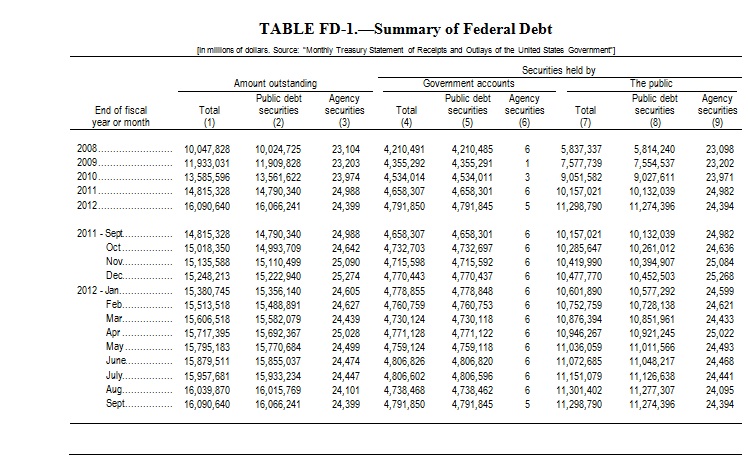
I don't like it, you don't like, I am guessing that there are very few people who like it. What I am referring to is the US federal debt situation. It is huge, it is colossal, it is a number in excess of 16 trillion Dollars. Why is it there in the first place? Well, simple really, the alternative, if government had not stepped in during those dark days of late 2008, what would have transpired? Would we have seen a wasteland that the purists might have referred to as the market having taken care of the situation itself? Probably. And with the Federal Reserve Governor having been a student of the Great Depression, he knew what the consequences were not only back home in the US, but also for social stability globally.

In case you needed reminding, the aftermath of the stock market crash of 1929 that led to the Great Depression saw a deflationary spiral, a breakdown of trade internationally, US exports by volume halved (in monetary terms sank over two thirds), unemployment peaked at 25 percent in 1933, bank deposits were uninsured and folks lost billions as 2 out of every 5 banks fell over completely. The Fed was powerless (and relatively new), Congress froze and it took years to recover. Now, I can hear you make the argument about asset prices re-rating, make no mistake the equities market was grossly overvalued before getting routed in the late twenties. Credit had been too easy, but who could blame people for thinking that they lived in a brave new world. You could own a motor vehicle at relatively inexpensive prices, electrification had taken place, folks could listen to news around the world with their wireless. Leverage however was a new science, and stock prices were catapulted to some crazy valuations. Companies however were doing really well in the late 20's, earnings in the Dow Jones Industrial Average were growing some one third per annum from 1926 to 1929, you would be crazy to believe that it was not going to continue.

But, as in most corrections, and this was one was severe and ruthless, too much excess was exposed. And the people who suffered most were ordinary Americans. Thanks for the history lesson, but where is this all going? Well, that was the one option that the powers that be could have taken, that route. I am not suggesting that the same would have taken place, I am not suggesting that those with too much leverage should have been called out. No, that should still have happened. There were "victims" of the past financial crisis, 3.9 million odd houses have been foreclosed by the banks. That means that a lot of families are without a place they used to call home. Perhaps in this case many of these were not primary homes, but still, I can't imagine the pain of losing a house. California and Florida were worst affected. So, forget for a moment all the financial jobs lost during the crisis, think about these people. I am guessing that is what the concerted effort was to save the banking system. The federal overspending took place to step in where business had run away (very simple way of looking at it) which has now seen US government debt balloon to very uncomfortable levels. Check it out, a table hacked from the Treasury bulletin - December 2012 website.

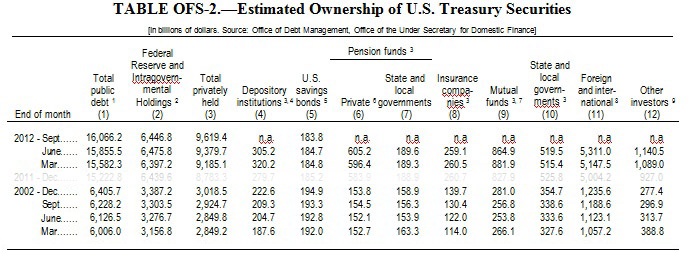
OK, so that is "nice", the debt has clearly exploded in the 2008 to present era, but in truth this is nothing new. The US federal debt has been expanding at a rapid rate. So, who owns these securities? I did another hack-job of the ownership of US government debt, you can find a bigger breakdown of the foreign ownership here -> MAJOR FOREIGN HOLDERS OF TREASURY SECURITIES, but this is overall.

It turns out that it is not China that owns US government debt, but rather many different people and investment companies. More debt is owned in the US than externally owned, even though politically one would have been led to believe that the opposite is true. So, where am I going with all of this? Well, this is a long winded way of getting to what is perhaps the next big battle in Washington DC, raising the debt ceiling. The WSJ had a piece over the weekend: Ugly Choices Loom Over Debt Clash. The actual date of when the debt ceiling will be hit is sometime between the day after Valentines day (which is the same as "the day after tomorrow" movie for some sadly) and the beginning of March. Two weeks, more or less.

The idea of the trillion Dollar coin has been booted into touch, via Bloomberg from yesterday -> Treasury, Fed Oppose Using Platinum Coin to Avoid Debt Ceiling. But, if you read the story above from the WSJ, the US government spends 40 percent more than it takes in. So, tax receipts have to rise. And how do tax receipts rise? Well, at least the politicians are one step closer to figuring that out. Even if they appear very far away. Many things that could change, have to change. Including the debt ceiling. Because, according to Wikipedia, the US has been without debt or a deficit for only one percent of their existence, if you take the treaty of Paris signed in 1783 as the starting point. So, what is the point of the debt ceiling then? According to Wiki: "The debt ceiling has been raised 74 times since March 1962, including 18 times under Ronald Reagan, eight times under Bill Clinton, seven times under George W. Bush and three times (to August 2011) under Barack Obama."

The debt ceiling was raised 18 times under Ronald Reagan? WHAT? But now we are led to believe that the US politicians are serious about the debt issues. I suspect lots of scrumming, mostly mauling and perhaps some good old fashioned rucking (when you could mountaineer the ball out of the ruck) in solving this solution. And let us be clear here. Who wants to be the politician that was responsible for social security cheques not finding their way to the recipients? Who wants to be the politician who is responsible for that. Even though, according to a slide show that I saw on CNBC, the social security fund owns just a little less than 3 trillion Dollars worth, and is in fact one of the largest holders. I am guessing that the Social Security fund could actually sell treasuries to meet their onerous obligations. The fight is on to settle the debt ceiling debate and I am presuming that it will happen at the 11th hour, or perhaps even thereafter. Angst. Expect it!


Crow's nest. We are higher to start with. Again. Another day in Jozi and another record high. If the Protea's can clean up the second half in PE quickly, we can return to earnings season with great excitement.


Sasha Naryshkine and Byron Lotter

Email us

Follow Sasha and Byron on Twitter

011 022 5440
Friday, 11 January 2013

Impala waterhole leaks

"If I were an Impala shareholder I would not be impressed. At least you are still getting the proceeds of the mine but slowly but surely 51% of that vital asset is leaving your books. And what happens when expansion is planned and money needs to be raised? Does the 51% stake holder have the money to fund such operations? And what happens if the Mine falls into hard times in terms of production? Impala's revenue from the government will diminish. Basically they hold the risk of the entire mine but only own 49% of the asset."


To market, to market to buy a fat pig. Yesterday we were subjected to another ECB conference, after they had decided to put rates on hold, there was never really a chance of a rate cut. There was some silly fellow at the conference who started spewing some nonsense about him having met a fellow during the holiday who said he was a garbage collector. But the banking kind, implying that there were still a lot of toxic assets out there. The ECB president Mario Draghi simply deflected his silly questions and then moved on. That was the highlight for me. But then the screen flashed that Mario Draghi saw that the environment had stabilised and things were looking better in 2013. Really? I can't remember when last I saw anything on the Greek debt issues. Six weeks ago? Remember the PIIGS? Well, Ireland just had what you would call a relatively successful debt auction. And Spanish ten year bond yields just dipped below 5 percent. Just to remind you, towards the end of July in 2012, the very same bond was yielding 7.6 percent. Yowsers. And then that famous comment came along: "Within our mandate, the ECB is ready to do whatever it takes to preserve the euro. And believe me, it will be enough."

And then they did do whatever they needed to. Which meant that the peripheral yields, the ones under pressure, countries borrowing costs were getting to levels that were close to untenable, have now been dramatically reduced. It did help that the Spanish had a cracking bond auction yesterday morning. Well, better than anticipated. We were discussing the tactics of central banks yesterday. By Mario Draghi just showing his arsenal (the potent weapons kind and not the football club, which is the opposite, ouch) he has managed to scare folks away that were suggesting the doomsday Euro breakup. Draghi said the Euro was irreversible. And the rest, as they say in the classics, is history. The next test will be as early as today, Italy has a bond auction. I suspect that will go pretty well too, although remember that the Italian elections are being eyed closely. Don't even get Italians started on the "pigsty" electoral system. Parties choose the candidates for you! Awesome.


We took some tap here in Jozi, Jozi 26o 12' 16" S, 28o 2' 44" E initially, SA inc. stocks under a little pressure as the Western Cape farm violence continues to reflect poorly to the rest of the world. Make no mistake, the daily earnings are not a rate to be proud of. But the flip side of that coin is the question around skills and commiserate remuneration. What skills do the farm workers bring to the table, and how can their skills be improved so that they can be more productive and as such command a better wage? Surely that is a fair enough question to ask. The outside world sees the images like this in the WSJ slideshow, with the simple caption: "MOVING TOGETHER: Protesters occupied a highway and threw rocks at police Thursday in De Doorns, South Africa, as they rallied for higher wages in the Western Cape's vineyards. Police responded with rubber bullets, a water cannon and stun grenades." Picture from the slideshow: Photos of the Day: Jan. 10. As ever these images are dramatic, violence is not the way to solve problems, whichever way you look at it.

The positive sentiment flowing from the ECB press conference as well as the happy feeling from the Chinese trade data helped us end nearly flat on the day. Slightly lower, but better than it was around midday. But then there is the small issue around a rating downgrade from Fitch, not really saying too much new, but serious issues nevertheless. Check it out: Fitch Downgrades South Africa to 'BBB'; Outlook Stable.

Some of the main points are: "Economic growth performance and prospects have deteriorated, affecting the public finances and exacerbating social and political tensions." Yes, this is of course very true. And with a populist approach to economic policy, even if it is something that is sorely needed to rebalance the ills of the past, I suspect this approach will continue. And then: "Public finances have weakened. Fitch estimates national government debt will have risen to 41% of GDP." I suspect that this figure does not include parastatal debt, it would be much higher. "A trend decline in competitiveness, reflecting wage settlements above productivity and infrastructure constraints, contributed to a widening in the current account deficit to 6.5% of GDP in 2012 (Fitch estimate) from 3.4% of GDP in 2011." But yet this is a non issue with the unions, they will dispute this productivity issue. Phew, there was quite a public spat between COSATU General Secretary and Adcorp Labour Analyst Loane Sharp last year. You will recall the one around productivity.

Lastly, another very well documented reason: "Social and political tensions have increased as subdued growth, coupled with rising corruption and worsening government effectiveness, have constrained the government's ability to improve living standards, reduce the 25.5% unemployment rate and redress historical inequalities as rapidly as the population demands." But government will tell you that they are fighting corruption. And unfortunately the education system, regardless of what the ruling party tells you, is really not that great. The ruling party hails the recent matric results. If I could change one thing, it would be excellence in education. Give someone a quality school leavers certificate and they can do the rest. Real democracy will be achieved when everyone has a quality education. Unionisation of teaching, don't get me started on that one, that is almost an essential service like healthcare, police or military. Surely teaching should be one of those. That is a worldwide struggle, between the correct salaries for teachers and their lifestyles. The downgrade is what it is, and the observations from Fitch are nothing new.


    Byron beats the streets. This morning Impala platinum finally announced the details of the Indigenisation deal between the Zimbabwean government and Zimplats which is 87% held by Impala. As you can imagine the details are complicated and I'd imagine a long negotiating process took place going back to the days of David Brown. Before we go into the details let's have a look at the latest numbers and see how significant Zimplats is to the Impala picture.

    In last year's numbers Zimplats contributed 187 100 ounces at a cost of $1 239 per ounce. This was out of a total of 950 000 for the group at an average price of $1 737. So you can see why Zimplats is so significant and plays a big part in Impala being one of the lowest cost producers around.

    "The term sheet, which will be signed today, stipulates the key terms, subject to certain conditions precedent, for the sale by Zimplats Holdings of an aggregate 51% equity ownership ("the Indigenisation Shares") of Zimbabwe Platinum Mines (Private) Limited ("Zimplats") to select Indigenous Entities as set out below. Zimplats Holdings will retain the balance of 49% of Zimplats.

    The purchase price for the Indigenisation Shares, after taking into account the payment for the release of ground obligation (in lieu of indigenisation credits), is US$971 million (R8.3 billion) ("the Transaction")."

    After reading those first few lines the first question I asked was how will the Zimbabwean government afford this? The 2013 budget for the entire country is $3.8bn so this is more than one quarter of that. Of course they relay the details further down in the announcement.

    "Zimplats Holdings will facilitate the Transaction by providing vendor funding to the Indigenous Entities at an interest rate of 10% per annum. The vendor financing will be repayable from 85% of the dividends declared by Zimplats on the Indigenisation Shares. The proceeds, as and when received by Zimplats Holdings, will be declared as a dividend to Implats or used to fund Zimplats Holdings' share of funding requirements of Zimplats. Management of Zimplats will remain with Zimplats Holdings."

    So basically most of the free cash flow from the mine will be paid back to Impala shareholders via the Zim Government. 10% per annum on the US Dollar is steep but I think overall the Zim government has a great deal here. Of this 51% stake, 10% goes to the surrounding community, 10% to an employee trust and 31% to the National indigenisation and economic empowerment fund.

    If I were an Impala shareholder I would not be impressed. At least you are still getting the proceeds of the mine but slowly but surely 51% of that vital asset is leaving your books. And what happens when expansion is planned and money needs to be raised? Does the 51% stake holder have the money to fund such operations? And what happens if the Mine falls into hard times in terms of production? Impala's revenue from the government will diminish. Basically they hold the risk of the entire mine but only own 49% of the asset.

    I guess they never had a choice and this was making the best of a bad situation. At least they still have the asset and there is some sort of compensation. Hopefully everyone sticks to their laurels and the people who are supposed to benefit from such a deal do actually see the compensation.


New York, New York. 40o 43' 0" N, 74o 0' 0" W Stocks finished at a five year high again, led by bank stocks. I read some lame commentary that suggested that perhaps earnings are not going to be as bad as some people predicted. Who are they, and these people? Weekly jobless claims were not great, but not that bad. The long term unemployment rate showed some signs of improving, I am guessing that is the number that was cheered. Another interesting fight, a very public one is the short position that Bill Ackman has built up on behalf of his investors in the company Herbalife. 1 billion Dollars worth of shorts! The execs at the company have rubbished Ackman's claims. But that is not the real meat of the story that is attracting a lot of attention, rather that Daniel Loeb (a friend of Ackman) has a serious long position, 8.2 percent for his investors. And none other than Carl Icahn announced that he had initiated a position, a long position. Well, I never. This is really a fight amongst hedge fund gunslingers. A high noon meeting on the tumbleweed streets. Except this is modern day, there are air conditioned offices and the media who are loving this.

The stock, coincidently looks cheap. But when Ackman calls the company basically a pyramid scheme, you have to ask the serious questions. But, as some suggest Loeb might be out already, having made a short gain from when Ackman announced his short position. Ackman's last TV appearance that I remember on CNBC was a little embarrassing, he has a big position in JC Penney and he was telling Andrew Ross Sorkin all about the vision, using the show as a presentation of sorts. Defending his investment which had gone poorly so far. Well, the Business Insider suggests: HERE IT IS: Herbalife's Full Presentation On Why Bill Ackman's Short Will Be A Disaster. A disaster? We will have to see.

Talking of mini disasters, Boeing has bounced back nicely in recent days, their chief technical officer was on a conference call suggesting that the Dreamliner problems were not unanticipated. There are always problems when a new aircraft was launched, I did also see Jim Cramer suggest on his morning slot at the NYSE that Boeing was one of the best engineering companies on the planet. Perhaps, but I know Jim likes the company a lot. So, go figure, he still manages his own money and a charitable trust.


Crow's nest. We are seeing BHP Billiton sink over two and a half percent as they are forced to shut iron ore production in Western Australia, along with Rio Tinto and Fortescue. Cyclone Narelle. It is also impacting on BHP Billiton's oil production. Although recent news suggests that the caution ahead of the cyclone was perhaps not warranted, but I guess you can never be too careful. But this is dragging the market lower to start with.


Sasha Naryshkine and Byron Lotter

Email us

Follow Sasha and Byron on Twitter

011 022 5440

Tuesday, 8 January 2013

Mark Cute and funny

"I suspect that he will be tasked with the tricky job of making sure that himself and Chris Griffiths give Anglo Platinum all of their attention. It is going to be a tough road ahead for making sure that the asset is restored to its former glory. It is after all 25 percent of NAV, but less than 5 percent profit contributor. It might be less in fact, I think it is closer to three percent. Another tough job will be making sure than the billions sunk into Minas Rio bear fruit for the shareholders."


To market, to market to buy a fat pig. Right, we are at the start of my favourite season. Cricket season..... I mean earnings season, this time for the fourth quarter of 2012. Every now and again the fundamentals become part of the focus and just for a while we can forget about the intense politicking that has been the order of the day for over two years I suspect. Or is it longer? Three years in April, if you use the Greek debt explosion (implosion?) as your starting point. Or perhaps it is four if you use the Irish debt crisis as the starting point in Europe. I am almost tempted to suggest that the starting point was a lot earlier than that, Bear Stearns was bought for a song (and many unknowns) by JP Morgan Chase in March of 2008.

Or was the crisis telegraphed earlier? I suspect that the first losses related to subprime mortgages that were exposed in October of 2007 were the first signs. If I remember at that time there were a few people bleating when banks started to show big losses. Wiki suggests that by March 2007, just the subprime mortgage market in the US was 1.3 trillion Dollars. And by October of that year adjustable rate mortgages (ARM's) were in deep trouble, with 16 percent either delinquent or in the process of being closed. So, this crisis caused by humans is over five years old. And the European and American politics still continues to come and go.

But like I said, every now and again earnings drive stock prices and we can for a bit forget about political figures past and present. The BusinessInsider has this piece: The 5 Biggest Questions Going Into Earnings Season. Yeah, perhaps the last one is a made up one. Or maybe not!

Jozi, Jozi 26o 12' 16" S, 28o 2' 44" E There is big news this morning, the confirmation has come from, wait for it, AngloGold Ashanti first (for me anyhow), that Mark Cutifani was leaving. Check it out: AngloGold Ashanti Announces Departure of Mark Cutifani. This is sad for AngloGold Ashanti, but I think that this is a very positive development for Anglo American. Anglo American have a nice picture of Cutifani on the front page of the Anglo American website, cracking no more than a grin. The official Anglo release: Anglo American appoints Mark Cutifani as Chief Executive. I think that this is awesome news for Anglo. Anglo stock is up on the news, whilst AngloGold Ashanti is down. There will be a lot written about the skills of Cutifani, but I think the clincher was his no nonsense attitude to the reality that faced the company when he was at the helm. I do not think he will sugar coat anything.

I suspect that he will be tasked with the tricky job of making sure that himself and Chris Griffiths give Anglo Platinum all of their attention. It is going to be a tough road ahead for making sure that the asset is restored to its former glory. It is after all 25 percent of NAV, but less than 5 percent profit contributor. It might be less in fact, I think it is closer to three percent. Another tough job will be making sure than the billions sunk into Minas Rio bear fruit for the shareholders. I am not too sure that Cutifani can speed that process up, but perhaps he could take a more practical approach. Maybe. Let's see, I wish him and the shareholders all the best of luck, everyone in the commodities space can always do with a whole lot of that!

Staying with commodities and gold miners, perhaps the saddest news in a long time yesterday finally came. The economic realities finally had a cause. And that was the fact that Harmony announced: Kusasalethu remains closed until such time as it is viable to mine it safely and profitably again. Sad. When Harmony bought this asset in the year 2000, see this press release: AngloGold Sells Its Deelkraal And Elandsrand Mines To Harmony For R1 Billion, there were over 9000 employees at the mine. From the Harmony announcement this closure impacts around 6100 jobs and livelihoods, and sadly as we well know in South Africa, many other folks are dependent on those jobs.

What happened? How did it get to this? Militancy from labour is to blame. That is the way that I see it anyhow, that is just my opinion. And what has that achieved? Nothing. Everyone is left all the poorer for it. Labour needs to understand that it is an expensive business to run these operations. During the December quarter, the total opportunity cost lost was 325 million Rands. Or approximately 3.5 million ZAR per day. Or, around 575 Rands per employee per day, including the contract workers. That is what the company lost because of illegal activity and stoppages. As per the presentation, two people were murdered, one person injured whilst the mine property was damaged too. And police and security were fired upon with live ammunition. There was complete disregard for both safety and health rules. Graham Briggs cited that as one of the main reasons, they cannot work under such circumstances. So. We wait 60 days under a piece of legislation called section 189 of the Labour Relations Act under which all stakeholders will present their ideas to make the mine work again.

Briggs suggested that the mine still has a life of over 20 years, but I suspect that this is just a way of appeasing all stakeholders for the time being. The December quarter was awful for the mine. There is a conditions for production to commence in the presentation that suggests just general guidelines to following the rules and a peaceful workplace. Violence is no way to solve burning issues. Unfortunately the precedent has been set, and for better or for worse AMCU think that this is the best way to get their grievances heard. Phew. As per the Harmony announcement: "Management is of the view that the status quo concerning production and labour strife will remain, as it has exhausted all possible avenues to achieve normal production and cannot find a solution to the current state of lawlessness prevailing." I am guessing that this is not the last of this happening in South Africa. Outrage anywhere? I have not seen it yet.


He is back ladies and gentlemen! Byron returns to our screens with this piece today. Socialism. Not for us.

    Byron beats the streets Over the holidays I went to the Seychelles for 8 nights. It was a fantastic trip and the place is unrivalled in its beauty. Being a finance piece I want to convey what I picked up about the economy of this group of islands which as a country has the smallest population of any African state. To understand where we are coming from let's first look at the demographics which I have gathered from Wikipedia.

    The population consists of 86 525 people who live on the 115 islands. Nearly 80 000 of those people reside on Mahe, the biggest of the islands and where we stayed for 5 nights. In 2011 the size of the economy amounted to $2.2bn. It has the highest Human Development Index in Africa but also the highest income inequality in the world. That is probably skewed by 4 or 5 wealthy families who own lots of land and hotels.

    Tourism employs 30% of the population while agriculture, which used to employ 33% in the 60's before tourism became so prominent, now only employs 3%. So how do you govern a country which is high in demand with tourists and has such a small population? Naturally, in order to get the votes you will let the people benefit from the land they live on in a socialistic type state. It is a lot easier when the pie is the size of the land and you could fill up soccer city with the entire countries population.

    Schooling is free and the literacy rate is well above 90%. Land is being redistributed at very cheap rates for the local Seychellois people. How do they fund this? They are busy reintroducing VAT but the majority is raised from big import duties which is ultimately shifted onto the consuming tourists who eat and stay at the restaurants and hotels which are over inflated in price because of these duties. The majority of goods are imported which makes everything expensive.

    This has also created a very lazy mentality amongst the local people. Who can blame them, no one is poor and there are no incentives to create wealth. There is a big drinking problem and a growing drug problem amongst the youth. Indians and Bangladeshis have to be brought in to do all the labour because the locals refuse to. There is a huge sense of entitlement and the lack of entrepreneurial drive makes me believe that any progress will be slow.

    What is my point here? If you cannot successfully run a socialist state which consists of 87 thousand people with good assets at your disposal then how are you going to do it with 50 million? Unfortunately human nature requires incentives. Without goals we become lost, lazy and stagnant. As a tourist destination I highly recommend it. The country also has huge opportunities because if you work hard your competition is low. You have to form a partnership with a Seychellois to buy assets there however.


Digest this linkfest.

Whoop, whoop! Finally the only person I suspect who was able to answer the literal 1 trillion Dollars (coin) question has answered it. Yes, and it was on the Pragmatic Capitalist website. And, the guy who did it was the fellow who was responsible for the law being written in the first place. At least that is what we are led to believe, the comment left on the story This Bill to Close the Trillion Dollar Platinum Coin Loophole Should be Passed...IF... is from none other than Philip N. Diehl, the 35th Director of the United States Mint.

In short, it is possible. The mechanism from the blog comment is simple: "Moreover, the accounting treatment of the coin is identical to the treatment of all other coins. The Mint strikes the coin, ships it to the Fed, books $1 trillion, and transfers $1 trillion to the treasury's general fund where it is available to finance government operations just like with proceeds of bond sales or additional tax revenues. The same applies for a quarter dollar." Amazing, isn't it! And I suspect that this is the answer that everyone was looking for.


Like the fellows over at Calculated Risk, we have always suggested that there was NOT going to be a breakup of the Euro Zone and that all members would stay inside of the zone. As of now, this is still true, just over the weekend I saw that Latvia was preparing for full membership, Poland was still thinking about it whilst the Czech Republic was still there and wanting to join, they just had no date as of yet. Check this post: Question #10 for 2013: Europe and the Euro. It is amazing how quiet everyone has gone. The leaders of Europe must be very pleased with the fact that the Americans are having all their "issues". Cullen Roche has a similar view, in this post: Euro Crisis Risks Eliminated?, but one certainly gets the sense that there are many challenges that lie ahead.


Crow's nest. Regulators have softened on the Basel III rules, which I suspect is a good thing. Anglo is giving our broader market a lift of sorts to be about flat on the day. Futures are marginally lower. But hey, it is earnings season.


Sasha Naryshkine and Byron Lotter

Email us

Follow Sasha and Byron on Twitter

011 022 5440

Friday, 4 January 2013

The Fed set sail

"Now that might sound as ever a little cryptic, Fedspeak, but that means inside of the committee there are a few dissenters. Or people asking questions about the current path. But with the single vote against, the same fellow, Jeffrey M. Lacker, he may be starting to sway the others. I suspect that at this juncture this is a very good conversation to be having. Because that probably means things are improving, they well might be better in the coming months than most folks anticipated. Although the struggles in American politics continues to be a bigger problem."


To market, to market to buy a fat pig. There was pleasing employment data in the form of ADP employment data which is always the precursor, the tantalizing entree if you will, to the US non-farm payrolls number. A better than anticipated number gave the market some forward momentum and boosted hopes of today's number being better. Of course there is a certain seasonality to these numbers, hiring for the holiday period. You can as ever read the full report and decide for yourself whether or not the jobs market is moving in the right direction: ADP National Employment Report December 2012. Now ADP has been wrong for just a little bit in mirroring the Labor Departments number, but they have changed their methodology, ADP, as far as I understand it. The guesstimate for today is somewhere around 150 thousand additional jobs for the month of December.

Jozi, Jozi 26o 12' 16" S, 28o 2' 44" E Stocks registered another day of gains, moving higher after lunch. Lunch here consisted of nuts, bananas and dried fruit, very apelike of me really. I must have been feeling in touch with my ancient ancestors, luckily I did not feel like eating ants, or any other insects. Not ant eating were the indices, they were more termite mound piling, the all share added nearly another half a percent to close well above 40 thousand again. Again, I want to stress that this might be a big number for some, but around here we stress that we care more about the companies that we own than the levels of the index. But, it is pleasing to note that confidence seems to be returning somewhat.

A journalist friend asked me two questions: "What is so significant about the All-Share touching the 40,000 mark?
What are the long term, negative and positive effects of the US Fiscal Cliff deal on our market?"
I thought they were decent enough to ask, and I thought that I would share my answers to him:

    I suspect that there is a certain amount of relief that a last minute deal was struck, but the worrying signs is that like in the debt ceiling negotiations in 2011, the timeline is almost breached each time.

    We knew about this for the better part of a year, but the political landscape remains deadlocked in Washington DC.

    A number is a just exactly that. Just a number is that 40 thousand I say. I suspect unless your time frames are extremely short and you deal with nonsense (in my opinion) such as resistance levels then I fear it means nothing. Ultimately the levels of global indices are determined by the mood in the US and where you next think the S&P is going. On a historical basis the index (the S&P 500) is relatively cheap, some sunny outlooks on Wall Street suggest that when the confidence returns the rally could be comfortably on. I would say that we should continue to watch US employment data closely, the trend has been in the right direction. We should also monitor closely the US housing recovery which seem over half a year old and a definite trend intact, at least to me.

    I suspect that all that they have done for now is make progress on tax reforms, at least put a dent in it. But dealing with the more serious issues, that has been delayed a little. And (it) needed to be, because whilst there is a recovery in progress, it is much too fragile to risk the spending cuts and tax hikes.

    So, for now we can breathe easy, but make no mistake, there are still many bitter battles to be fought on Capitol Hill.

    As investors one should view this as opportunities, when they present themselves, the selling on concerns of X or Y or Z. As a trader, phew, that makes it way too tough to call.


New York, New York. 40o 43' 0" N, 74o 0' 0" W Stocks sank after the Fed minutes release of the December meeting showed that not everyone was in agreement with the current bond buying program. You can get an insight into the behind the scenes action if you want, follow the link: Minutes of the Federal Open Market Committee, December 11–12, 2012. In the paragraph titled "Options for the Continuation of Asset Purchases" there is a clear indication that not everyone is completely convinced after having done a review. This little piece sums it up quite nicely: "In their discussion of the staff presentation, some participants asked about the possible consequences of the alternative purchase programs for the expected path of Federal Reserve remittances to the Treasury Department, and a few indicated the need for additional consideration of the implications of such purchases for the eventual normalization of the stance of monetary policy and the size and composition of the Federal Reserve's balance sheet."

Now that might sound as ever a little cryptic, Fedspeak, but that means inside of the committee there are a few dissenters. Or people asking questions about the current path. But with the single vote against, the same fellow, Jeffrey M. Lacker, he may be starting to sway the others. I suspect that at this juncture this is a very good conversation to be having. Because that probably means things are improving, they well might be better in the coming months than most folks anticipated. Although the struggles in American politics continues to be a bigger problem. I had to have another laugh as Dr. Wrong Doom, also known as Nouriel Roubini suggested yesterday that there would be another crisis in Washington DC. He is rather stating the obvious, a lot still needs to be done and the fight around entitlements will come to a fore soon. It has to. I would like to think that an improving US economy, albeit at a slower rate would probably just do enough for now.

Have you heard the whole idea of avoiding the debt ceiling debate? This is strange, but legal, and involves one platinum coin worth one trillion Dollars. Joseph Weisenthal (who has a poor view of the Nouriel, like me), has been talking about this idea for 18 months or so: Suddenly, Lots Of Influential People Are Talking About The Trillion Dollar Coin Idea To Save. Now of course Tim Geithner could make this his last act, but is unlikely to do it. But the fact that he could, that is just strange. Perhaps the lawmakers of yesteryear had more than a little insight into human nature and pigheadedness of politicians.

Today is that dreaded non-farm payrolls number. I say dreaded because for me it is. The amount of emphasis placed on one number is in my opinion way too much. For instance, why don't people care more about Chinese retail sales and which direction that is heading in? I suspect that may be a number to watch in the coming years, but until then, NFP it is. More jobs created in the US = greater economic activity in the world's biggest economy. Which means that should be good for stocks globally, right? The greater the spending power of the US as a collective, that means good things for manufacturing companies globally. So, until the Chinese spend more collectively than the Americans, the importance of this number is probably justified. And I must just get over myself and get into the same excited mindset as all the others around.


Digest this linkfest.

Of course when I came across this story, via the BusinessInsider you would have appreciated that I would have almost been numb with excitement. The link is to a brief piece at the CME website, written originally at The Schork Report, titled: Venezuela: A Squandered Opportunity. Treating the national oil company as your personal piggy bank, but more importantly for the people, the missed opportunity of at least 100 billion Dollars in revenue is just dumb. Thanks for nothing Hugo Chavez. As I have often said, nationalisation does very little for the masses, very little. There are many more examples of failed state companies than successes. All state companies do are provide cushy overpaid jobs with great inefficiencies. Call me a capitalist pig, I prefer libertarian. A vanishing breed I suspect.


If you ever wondered why we are not big fans of the big banks, then hopefully this article will go a long way to putting that argument forward. One of the key elements when making an investment in a company is to be able to understand as fully as you can as to what it is that the company does. The piece is via one of the aggregators that I follow and the headline pretty much gives it away: What's Inside America's Banks? If most folks struggle, what price is there in it for the retail investors? I suspect that the "smart" money will tend to trade these financial and banking companies in the cycles. You have heard the whole argument: Privatizing profits and socializing losses. Someone needs to be blamed for human stupidity, and if that is an institution, all the better than singling out specific humans with names.


I thought that this was perhaps the most interesting thing that I saw yesterday. Buffett Utility Buys $2.5 Billion SunPower Solar Projects. I am pretty sure that the Oracle of Omaha would have taken a serious look at this, or am I mistaken? The part that made me laugh, because there is a Twitter account that I used to follow (uuummmm, excuse my English) called (another word for excrement) Analysts Say, and this little quote nailed it: "The sale gives panel-maker SunPower "a sizable captive demand channel for its modules which should help ensure the company maintains healthy factory utilization levels even if the oversupply conditions in the industry take longer than expected to be resolved" Hah-hah! Awesome. Try and make up one of your own.


Crow's nest. Stocks are mixed here in Jozi, the Rand is weaker and commodity prices are lower as the Fed signals a change of sorts. No more QE beyond this year. And that means that the gold price is taking a bit of a smear. Gold stocks are down around two and a half percent this morning. Eish.


Sasha Naryshkine

Email us

Follow Sasha and Byron on Twitter

011 022 5440