Showing posts with label Barclays. Show all posts

Tuesday, 1 March 2016

Market FOMO


"In the same way that markets sell for reasons that seem strange, they also go up for reasons that seem strange, and market FOMO is as real as having an edge connection with the best sunset ever, and hungry for Instagram likes."


To market to market to buy a fat pig We were not fireballs, rather the market was to borrow some awesome lyrics from Pitbull. OK, I know you are all purists, and like most music lovers they only ever think that their music is the one that is worth listening to. Whether they listen to Otis Redding, Willie Nelson or Johnny Cash, Michael Jackson, Madonna or U2, or whether you can listen to all of it and admire it. Modern music never is as good as past music, yet in practice the artists are quite possibly better and better as each generation passes. In the same way you can't compare Tendulkar to Bradman (although Bradman did), Messi to Maradona or Roger Federer to Bjorn Borg.

Equally you cannot and should NEVER look at a graph and presume that the market is going to act like X as a result of the graph looking like A. Remember that graph of the 1929 crash and the similarities it showed to a period not so long ago? This is not a "what happened next", Discovery series in which we have to science it (I dropped the Matt Damon "Mars" expletive). Markets were on fire yesterday, stocks across the globe rallied sharply. I was starting to see headlines suggest, "has the worst passed" or "stocks in recovery mode".

In the same way that markets sell for reasons that seem strange, they also go up for reasons that seem strange, and market FOMO (Fear Of Missing Out, for our readers with more life experience) is as real as having an edge connection with the best sunset ever, and hungry for Instagram likes. Where is my sunset picture, why can't you post it? And you can't even tell the adoring fans that you have an Edge connection as you have ...... an Edge connection. Modern day rich people problems.

There was only one story here locally and that was the announcement about the worst kept "secret" in town. The news that Barclays Plc. was looking to sell (some of) their 62.3 percent stake in Barclays Africa was something that most people were expecting, at least the small circles that I mix in. Over a period of two to three years is what the new management team said, Jes Staley is an ex JP Morgan investment banker, old time pal of Jamie Dimon.

The chairman of Barclays Plc. John McFarlane is referred to as Mac the Knife, thanks to his cost cutting measures. Barclays Plc. shareholders have seen the stock in Pound terms down nearly 50 percent over the last five years. Including an 8 percent drop yesterday and a horrible six months (down 37 percent), as well as a volatility trading suspension, triggered by being down over 11 percent at one point yesterday. They, the Barclays Plc. shareholders are demanding action!

Barclays Plc. with no natural buyer of what is a significant Rand value (PIC have indicated they may be keen for some of the stake), have decided to sell the stake through the market. There were many different views on what they (Barclays Plc.) should or shouldn't do, I wrote down a couple of key points to put it into perspective.

1) If Barclays Plc. were all of the normal daily traded volume (1.9 million shares), it would take them 277 trading days to sell their shares. They obviously can't be all of the daily trade, even if they are heavily active, they wouldn't even sell half over two years. By my crude estimation.

2) The initial stake was bought in the second half of 2005 at 690 pence (82.50 ZAR at an exchange rate of 11.95 to the Pound, back then) and the current price is 640 pence at the exchange rate this morning, over a decade later.

3) Don't feel sorry for Barclays Plc., since the beginning of 2006 they have had dividends of 74.84 Rand a share, even at the exchange rate today that equals 344 pence, which makes the bad taste of their selling at a lower price a little more palatable.

4) Barclays Plc. are perhaps going to keep a slice of Barclays Africa, a smaller and non controlling stake in which they wouldn't be responsible for 100 percent of the capital commitments of the bank, thus relieving some of their home pressures.

5) This may seem like a big divestment from South Africa, and possibly is in the democratic South Africa the biggest, it was far worse in the mid eighties. I found some "data". In 1985 we saw 9.2 billion Rand divestment from South Africa, our economy was roughly 67 billion Dollars, the exchange rate (there were 2, that is how broken it was) was 2.40 Rand to the Dollar, the "financial Rand" was between 20 and 40 percent lower than that. Doing back of the matchbox calculations at the mid point of the "financial Rand", the divestment as a percentage of GDP in 1985 was around 5 percent. This is for a full divestment is 4.68 billion Dollars relative to an economy that is around 350 billion Dollars, over a percent. And not all in one go. The 80's divestment was ongoing too and far bigger.

After the dust settled, Barclays Africa stock ended the day up a couple of percent after having been down as much as 6 percent at the beginning of trade and up five percent less than two hours later.

Markets locally had a cracking day, stocks closed up 1.8 percent to see the Jozi all share index finish above 50 thousand points, a rare sight this year indeed. Less rare than the mythical national animals of Wales, Scotland, North Korea and even Mauritius (their one did exist once upon a time). Financials were the big winners on the day, perhaps a realisation that the cheapness is just too much to ignore. The stocks certainly look at about the cheapest I have seen them in over half a decade, from a fundamentals point of view. Globally however this is the case and some European and UK banks are trading a long, long way below book value. Meaning that perhaps the market is expecting dilution via capital raises, or expecting further asset write downs. Either way, the market is certainly telling you something about banks and financials.

Across the seas and far away (from here, not the financial capital of the world), stocks in New York, New York rallied sharply. And by sharply I mean up over two percent, in the case of the nerds of NASDAQ up 2.89 percent. Why? An ISM manufacturing survey allayed some of the recessionary fears that Mr. Market has had lately. And as such a broad based rally sent the broader S&P 500 up 2.39 percent. I used the word or an extension of the word broad twice there. Apologies. The Dow Jones Industrial Average rallied just over two percent, these are the best levels since the beginning of the first week of January. Markets in the US, or at least the S&P 500, is only down 3.21 percent year to date. Oil, the prices thereof, rallied sharply and the correlation between the two, which still leads me to scratch my head hard, continues.


Linkfest, lap it up

George Airport is set to run on solar generated power. The Airport may be a small one but it a step in the right direction - South Africa just opened the continent's first solar-powered airport

The title of the post sums up our job at Vestact - You Do Not Get Paid for Knowing Yesterday's News!. Jeff Miller makes some good points about the current assumptions being reflected in the likes of the Apple share price, oil price and global stocks in general.

What is the best way to learn how the body reacts to long term exposure to zero gravity and living in space? Take identical twins, send one to space for a year and keep the other on earth and then monitor both of them - How Scott Kelly's year in space may have changed his body. Things like how your immune system changes due to living in a contained space for a year is some of the data that is likely to be learnt from the experiment. All the data will go toward the next goal, sending man to Mars.


Home again, home again, jiggety-jog. Stocks across to where the sun rises, the East, are also rallying this morning. Japanese markets are up around four and one-third of a percent, Shanghai is up two and a quarter and in Hong Kong stocks are over two and a half percent better. We should expect a better start here today, notwithstanding the "stuff" going on in the background.


Sent to you by Sasha and Michael on behalf of team Vestact.

Email us

Follow Sasha, Michael, Byron, Bright and Paul on Twitter

078 533 1063​

Wednesday, 4 July 2012

Happy 236th birthday US of A

" So, the sense from the mainstream is that bankers are evil, money grabbing, greedy individuals who mostly do "things" at the expense of their clients and the broader public. But this note suggests that pressure from the regulators was placed on a major global bank to somehow influence their submission. Everyone of course was chatting back then, and the regulators were very close to the institutions trying to maintain some form of stability."

Jozi, Jozi. 26o 12' 16" S, 28o 2' 44" E. Well, well, we took off in the second half of the afternoon, risk on came back in what is a festive week in the USA. The sense globally, at least that I get is that there is going to be another round of coordinated policy response, the Chinese inflation worry is dissipating, the Europeans have kind of steered away from hard and fast austerity thanks to the people having spoken, and the US economic growth although better than Europe, still looks anaemic in dare I say it, an election year. We saw the commodities complex benefit yesterday, in particular the oil price and the copper price surged during the day. The oil price also got a lift as the Iranians of course are no longer able to export oil as freely, potentially removing as much as one million barrels of supply a day. Exacerbating the supply side is that Norwegian workers in the oil industry are striking currently. So, now you know why the oil price took off yesterday.

The Jozi all share index closed up shop at 33986, up 333 points, or .99 percent. All sectors measured decent enough gains, financials, resources, industrials all participating in the European afterglow rally from last Friday. And we are steadily heading back to the highs, so clearly the balance of the market believes that the worst might be behind us. But, that is the optimist in me, many others would call themselves realists when in reality they are pessimists. Mark Mobius is right, you have to be an optimist to be a long term investor, you have to have conviction around your investment thesis. I suspect that the local and global vehicle sales numbers we saw yesterday were upside surprises, the recent PMI numbers that we see have a lot to do with the European dithering and hence delaying of spend or paralysis of decision making of sorts.

MTN yesterday decided to unleash a release which calls for the immediate dismissal of the Turkcell US claims, check out the official release: MTN dismisses Turkcell US claim. They use some pretty strong and colourful language, well I thought so anyhow, the first part and last part I think is most important. Here is a copy/paste. "... the US court does not have jurisdiction over the subject matter of Turkcell's claim, because Turkcell has not alleged a violation of the law of nations as required under US law for the sort of claim Turkcell is seeking to bring... " AND " ... the US court lacks personal jurisdiction over MTN and its subsidiary, MTN International..., which is also named in the US action. MTN and MTN International both lack sufficient contact with the United States to be subject to the jurisdiction of the US court." MTN are suggesting the US courts dismiss the case, Turkcell will respond to this motion by mid August. I hope that I have used the correct legal terminology.

Second, as MTN point out, Turkcell have already been sent packing in Paris (that is France guys) in front of a arbitration tribunal, in which their former Iranian JV partner was involved. MTN reckons that the case will be thrown out by the end of the year, but I then wonder what Turkcell would do next, because clearly they are not letting this just lie down or go away. The MTN share price in recent days has awoken from their seemingly long slumber, and are pretty close to their 52 week high. In contrast, poor Telkom traded at a 52 week (and all time low in their current format) low yesterday. That of course is another story, for another day. In a way, Telkom are admitting defeat through their increasing of their ADSL offering.

Another sad story is the operational update from the fellows over at Aquarius Platinum, who this morning have released a Operational Update. I guess the only positive thing that you could say about them relative to the rest of the sector is that they are taking a proactive view when compared to their industry peers. And I guess although ugly for their shareholders in recent weeks and months, Aquarius you could argue have done the right thing. In fact Aquarius say as much, with Stuart Murray saying the following: "I would hope that the other industry players follow suit and cut the unneeded production that is depressing the industry." Interesting, not so?

As you can see from the release, Aquarius have terminated their mining contract with Murray and Roberts Cementation, and Aquarius will assume the owner operator role. As they point out, this is part of the cost saving initiative. Poor Murray's, both the construction company and Stuart the CEO of Aquarius, I feel bad for both them, circumstance I guess. The other good news is that 75 percent of the workers at Marikana have been placed in "other organisations" as the news release puts it. Everest is on care and maintenance, as you well know.

The overall impact is heavy, from a production point of view, the company has produced 412,594 4E oz so far to the end of the financial year, with the next financial year (the one we have just started) expected to yield around 327,500 4E oz. So roughly 85 thousand fewer ounces this year, not a train smash, but certainly much lower than the group production in 2008 which topped 500 thousand ounces and was even better back in 2007, with 530 thousand ounces produced. Going backwards is not what shareholders want to be reminded of, that is for sure. A sad state of affairs, but as Stuart Murray points out: "The Board and management of Aquarius are acutely aware of the difficulties facing the industry at present, and are monitoring the business and financial health of the Company as closely as we have always done. We believe that the measures we have outlined today and over the past few weeks once again demonstrate our commitment to controlling our own destiny while carefully husbanding our assets on behalf of shareholders and thereby ensuring the survival of the Company in these extremely difficult times." Survival mode at the moment, hanging in there. All I can say is that emissions controls don't look like they are going out of favour anytime soon.

Byron's beats looks at an issue that is probably the most close to my heart, other than family, and that is education.

    You know the saying "good things happen to good people". Well sometimes good things happen to good companies. And I don't mean good as in well run. I mean good in the context of performing a good service which helps build our nation. Yesterday Curro, the private schooling company made an announcement headed Curro, PIC and Old Mutual join forces to expand quality low-fee schooling.

    It is a joint venture between Curro and the OMIGSA schools fund. This fund is backed by the PIC and Old Mutual and has financing of up to R397.1 million. Curro will add a further R42.9 million bringing the fund to R440 million. The purpose of the fund is "to play a supportive role to Government in addressing the educational needs of South Africa in the lower income market and to put in motion the objectives set out in Curros pre-listing statement."

    This is how the fund will work according to the announcement. "The joint venture includes the incorporation of an operating company that will operate schools, to be known as the Meridian Independent Schools, and a property owning company, held 65% by Curro and 35% by the OMIGSA Schools Fund, that will provide the school facilities and premises for the schools, with Curro being appointed as the manager of the schools. The Meridian Independent Schools will focus on providing private schooling to students where the majority of parents earn less than a defined threshhold, currently R200 000 (two hundred thousand Rand) per annum."

    So basically they are putting in 10% of the capital but owning 65% of the fund. Sounds too good to be true not so? This Moneyweb interview with CEO Chris van der Merwe explains it very well. You see what he says right at the end there. Curro have specialised expertise to manage the schools and that is where their bargaining power comes in. Old Mutual and the PIC get good PR for investing in a project which will benefit our nation. In fact many say education is the core solution to most of our problems. I agree.

    It is also important to note that through this fund Curro are targeting the lower to middle income bracket. This is where the gap seems to be in the market and where we see future growth in this sector. Like I mentioned earlier, this is also a good example of why we like to invest in positive themes that are seen favourably by government and the public. I can't see this kind of a deal being struck with a Tobacco company. All in all this is a fantastic deal for Curro and a great deal for the nation and the 100 000 children who stand to benefit.

Do you remember that instant messaging software called ICQ? When you got a message from someone it popped up and said uh-oh in a very high pitched voice. Remember? Well, I heard that voice again as the Barclays Libor scandal escalates, the chairman Marcus Agius (the only true defender of London/Rome) resigned first, then Bob Diamond the CEO yesterday morning, and then if that was not enough, the COO Jerry del Missier announced his resignation. My twitter feed lit up, even one that made me laugh from the fake Christine Lagarde account: "*BARCLAYS CLEANING LADY RESIGNS WITH IMMEDIATE EFFECT"

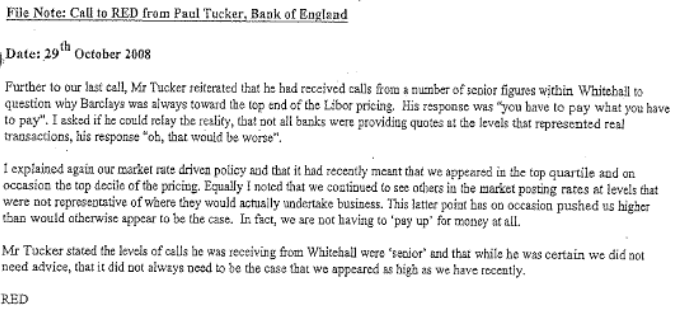
But this is not a laughing matter. Bank of England deputy governor Paul Tucker is under the spotlight, because the sense is that the Bank of England is involved. How? Well, Tucker queried with Diamond via a telephone call late October 2008 (at the height of the non trust of banks of one another) how Barclays could submit such a high borrowing rate at the time. If you recall from that time Libor spreads blew out. Still confused about Libor is used for? Don't worry, here is "simple" explanation of how banks get to the published rate: The Basics of BBALibor. Now as I can tell from my reading, the actual process is not THAT old, it has been around since 1985 and accepted as the standard.

So, why would Tucker be at fault here? And how is this all going to come out in the wash? Well, we do not have to wait long at all, because as luck would have it the Treasury select committee will grill Bob Diamond today. The seemingly unapologetic Bob Diamond, but I am pretty sure that he does have certain regrets, if not apologies for the broader public. Remember that Barclays did not seek assistance of any sort during the depths of despair, the same time as "that" phone call. Barclays have submitted documents ahead of the hearings, INCLUDING that call and the note that RED (Robert Edward "Bob" Diamond) made on the day. The full submission including all the Libor rates submitted are included in this document, Supplementary information regarding Barclays settlement with the Authorities, but I have cut the note made on the day. Excuse the fuzziness, but that is how it appeared in the submission:

So, the sense from the mainstream is that bankers are evil, money grabbing, greedy individuals who mostly do "things" at the expense of their clients and the broader public. But this note suggests that pressure from the regulators was placed on a major global bank to somehow influence their submission. Everyone of course was chatting back then, and the regulators were very close to the institutions trying to maintain some form of stability. But the last question worth asking, where were the law makers and regulators when we always need them? Mostly asleep at the wheel, if you read Too big to read "Too big to fail" you will get the sense that SEC Chairman Christopher Cox was not exactly up for the job. Well, he was criticised by all and sundry openly as being more than asleep at the wheel, nowhere to be found. So whilst the popular line might be to point fingers at everyone here. And Joe Public might feel let down. The ONLY folks in the pound (no pun intended) seat here could be Osborne/Cameron and they could use this to score cheap political points over Darling/Brown. And I have no doubt that they will do this, kick them while they are down you know.

New York, New York. 40o 43' 0" N, 74o 0' 0" W. It was a shortened session on Wall Street, with trade only up to 1pm, allowing people more than enough time to get to their respective fireworks displays (not yet, that is reserved for day) or hot dog eating contests. Picnic type foods is what I am led to believe, to watch the various displays and patriotic marches, music and attractions. In terms of economic data points before all these festivities there were the auto sales, which looked like a comfortable beat to me. Session end all the indices closed higher. The nerds of NASDAQ tacked on 24 points to close at 2976 points, the broader market S&P 500 added eight and a half points to 1374, whilst blue chips, the Dow Jones Industrial Average added 72 points by the end of the session to 12943. All the majors near some pretty important milestones, 3000 on the NASDAQ and 13000 on the Dow. And I guess 1400 on the S&P, although that is further away I am thinking.

Currencies and commodities corner. Dr. Copper is last 352 US cents, the gold price is lower at 1615 Dollars per fine ounce, the platinum price is off a touch at 1476 Dollars per fine ounce. The oil price is lower at 86.94 Dollars per barrel for WTI as per the NYMEX quote. The Rand is slightly weaker, at 8.12 to the US Dollar, 12.72 to the Pound Sterling and 10.21 to the Euro. The market is marginally higher on a VERY slow trading day.

Parting shot. Happy birthday the United States of America, which turns 236 years old today. Well, in the form that we are used to anyhow, this is obviously a holiday that Americans hold near and dear to their hearts, they are a patriotic bunch, you can't fault them for that. The WSJ has a great article on what the USA looked like back then in 1776, check it out: Fleming: What Life Was Like in 1776.

Sasha Naryshkine and Byron Lotter

Email us

Follow Sasha and Byron on Twitter

011 022 5440

Tuesday, 3 July 2012

Goodbye Big Boy Bollinger bottle Barclays Bob

"Banking again is falling into that domain where the public are outraged, and Barclays employees monkeying with Libor is just another example of what lies in those murky and muddy waters when investing in these entities. I am sure that most bankers, like lawyers and doctors hold their industry in high esteem and it is a small part that causes such scandals, when uncovered. But, for us, for these very reasons, these companies do not make compelling and enduring investments."

Jozi, Jozi. 26o 12' 16" S, 28o 2' 44" E. There was something very different yesterday, the JSE started disseminating information locally with the matching having moved from London to a home grown system. The idea was that speeds would have improved dramatically, but this is clearly not the landscape that we roam, the eat-what-you-kill space, but rather we are at the other end of the spectrum. So whilst we noted that the JSE and the broader participants were struggling it was by all accounts a success at the end of the session I would argue. Now there was something also different about yesterday, the 2nd of July according to Wikipedia is exactly the midpoint in the year, and we ticked over to the 2nd part of the year after midday. Now you might have thought that this would have happened a day earlier, but count your knuckles and you will see that both July and August have 31 days, and of course you know that February has fewer days in the year, even though this year was a leap year. Which begs the question, are we halfway, or not? Well, perhaps this Tumblr picture can help you, we are NOT there yet. Check out: number of days in each month

Yesterday we kind of went nowhere, the Jozl all share index closed down at 33683, a loss of just 25 points on the day, or less than one tenth of a percent. Resource stocks were the biggest losers on the day, down two thirds of a percent, PMI data across the globe helped nobody, falling mostly bar for a few surprises here and there. My simple theory is that PMI's will improve in the coming months as confidence returns, the Europeans are at least on track looking for some sort of integration processes as far as their banking institutions go. I take this as a move in the right direction.

Goodbye Big Boy! We could learn a thing or two from this. This morning the news comes that Bob Diamond is a goner, he has resigned from Barclays. Remember that the Chairman is staying until his replacement is found. That is yesterdays news, he is now staying until a CEO replacement is found too. A rudderless ship? Well, it seems that we might have been led to believe that the deckhands were acting like ragamuffins below deck whilst the bloated management, the XO and CO were not quite asleep at the wheel, but dozing. When I say that we could learn a thing or two, all I am saying is that accountability is key for any business, organisation or country, when someone is caught out. And in this case Bob Diamond has also fallen on his sword.

Ultimately someone needs to take responsibility, but it is a hard one, must the top man be accountable for 140 thousand odd employees across the 50 or so countries that the company operates in? I guess the short answer is yes. Banking again is falling into that domain where the public are outraged, and Barclays employees monkeying with Libor is just another example of what lies in those murky and muddy waters when investing in these entities. I am sure that most bankers, like lawyers and doctors hold their industry in high esteem and it is a small part that causes such scandals, when uncovered. But, for us, for these very reasons, these companies do not make compelling and enduring investments.

It is not something that we give enough airtime around here, Byron did briefly chat about PMI's yesterday, but perhaps because there is enough media coverage. The local Kagiso PMI monthly release as per the release is: "An economic activity index based on a survey conducted by the Bureau for Economic Research in conjunction with CIPS Southern Africa and sponsored by Kagiso Tiso Holdings" So, this is a survey and there are various questions asked to various managers about how they see manufacturing conditions. The segments include employment, business activity, prices, new sales orders, suppliers performance, backlog of sales orders, expected business conditions, inventories and purchasing commitments. I am not sure about you, but when I am busy and someone is looking to do a survey, I either say that I am sorry, or ask how quick it is, so that I can get it over with quickly. So, does it depend what time of the month the survey takes place, on a day of either good news, or bad news? It is a bit like price targets, yesterday I was asked for a price target on the ALSI 40 from here on out for the rest of the year. Their (Thomson Reuters) guess is as good as mine, anything can happen over the next 12 months.

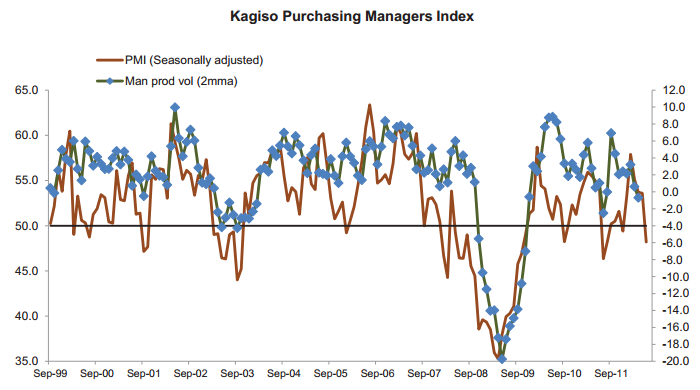
But back to this PMI, because sentiment is key in decision making and normally people are a whole lot more bullish about the future when the present looks rosier than the previous months. As was pointed out to me once upon a time, good news headlines and cheap stock prices don't come along at the same time. When the news is bad, or not good, that is when you get cheaper stock prices historically. This is almost always true, the quality of the company matters more than the stock price in the short term. But the same company with a cheaper stock price, now that is something to get excited about. We digress, again, apologies, back to the local PMI number which fell into contracting territory for the month past, the official June 2012, from the release: Kagiso Purchasing Managers Index

"The seasonally adjusted Kagiso PMI ended the second quarter on a weak note as the index declined sharply to below the key 50 index point mark. At 48.2, the PMI lost 5.4 index points and is now at the lowest level since August 2011 with almost all of the key sub-indices posting sharp losses. Whereas the early stages of 2012 saw the domestic PMI registering significantly more positive results than was the case in our key export markets such as the EU and China, the latest figures are more in line with the weak numbers seen in these countries for some time already."

Here is the graphic from the release, which is far more telling than the explanation above.

So is this something that is happening locally? Not at all sports lovers, this is a worldwide phenomenon, check out this glorious chart courtesy of Scotty Barber, who you MUST follow on Twitter, the stuff that he produces is legendary! This is of the PIIGS (without the P) PMI compared to the stronger economies in Europe. The picture looks exactly the same.

BUT WAIT! There is more, I found a more global one, this time courtesy of Bloomberg, this is PMI's across the globe, which includes the Chinese:

So, that leads me to believe that we are all following each other here, worried about the same thing. Confidence in the business world will be largely determined by central bankers and politicians for the remainder of the year. Expect a better plan and timeframes from the Europeans, whilst the US has election campaigning. And the sense from market participants is that we should see policy response in light of the weakening numbers globally.

New York, New York. 40o 43' 0" N, 74o 0' 0" W. Byron will explain what happened with a specific release, but I guess the Friday hurrah could explain why the Dow ended essentially flat last evening on Wall Street, but there was a surge in the last hour again, the S&P 500 closed one quarter of a percent higher and the nerds of NASDAQ added more than half a percent. The thinking, and that was explained above was that policy response is imminent.

Byron's beats checks out the disappointing ISM number yesterday

    Following the relevant manufacturing reads yesterday there can be no doubt that Europe is taking its toll on the global economy. If a European family decides to stick with their old washing machine because they cannot afford a new one the Chinese manufacturer will lose a sale. The same applies to a products produced around the world and this in turn has a knock on effect.

    Even the resilient US economy has been hit. I'm not surprised, Europe is their largest trading partner. According to the US Census Bureau last year the US exported $3.3 trillion worth of goods to Europe and imported $4.48 trillion from the region. Imagine how many ships that takes to transport those goods across the Atlantic. I did a quick Google search and couldn't find a number. If you have any info please send it through.

    This has caused the US factory sector to shrink for the first time since July 2009. The reading came in at 49.7 compared to 53.5 last month. Remember that anything below 50 is a contraction. This will also hamper confidence as companies start holding back their expenditures in order to face the turmoil with strong balance sheets.

    US companies also face another challenge in the form of currencies. The Euro is weakening against the dollar which makes US exporters less competitive. This is a short term issue because a weaker Euro will in turn benefit the European economies which indirectly picks up their demand for US goods.

    On this news the DOW dropped 85 points but later in the day regained all of these losses. Why is the market so resilient to such negative news? Because most of the downside is already factored into share prices. This is not an unknown-unknown. If we have a major drop then we could see a huge sell off but everyone knows that a weak European economy will have a negative impact on everyone else. The fact of the matter is that companies are prepared. They have learnt their lessons from the past.

    There are also solutions out there. State assets can be sold, labour laws can be loosened, banks can be allowed fail or be bailed out if need be, lending prices can be controlled. The collective debt to GDP in Europe is 80% which is more than manageable, as a collective. That is why the market is riding on what the policy makers are saying. We are still positive their decisions will be more positive than negative. Jim Cramer says that if it weren't for Europe the US economy would be steam rolling and markets around the world would be at all time highs. The future is always uncertain but stocks do look cheap.

I saw an interview on Bloomberg TV in which Mohamed El-Erian of PIMCO and "new normal" fame was chatting about the way that he and his firm see the short term. Now El-Erian is always concise, smart and works for the biggest bond firm in the world, so let us just say that he did not get there by luck. But PIMCO is always cautious, I guess it is in their nature as bond investors. You might have heard about the "fiscal cliff", well, El-Erian warns that the event might trigger a recession in the US next year, something that many believe will be the case. But signalled this far forward, surely lawmakers will do something about it? Remember the debt ceiling debate though, and how that worked out for us? How the politicians fumbled and milled around until the 11th hour. Well, these two events are related, because the fiscal cliff refers to the points next year when the automatic spending cuts start to happen. And the so called Bush tax cuts expire at the same time.

Moody's have run some of their models and the suggestion is that if the automatic spending cuts are to take place and the automatic return of the taxes, the impact could mean that the US economy could contract by as much as 3.6 percent, and that would almost inevitably lead to the US recession. So, what to do? Well, I think that the lawmakers are actually aware of the lack of their actions last time and as such will act quicker, expect something more concrete by October, that is my best guess.

Currencies and commodities corner. Dr. Copper is higher, last at 351 US cents per pound, the gold price is higher at 1608 Dollars per fine ounce. The platinum price is last at 1463 Dollars per fine ounce, while the oil price is much higher at 84.38 Dollars per barrel. The Rand is much firmer as risk on is back, perhaps the EU summit did more for sentiment than we know. Last quoted at 8.11 to the US dollar, 12.73 to the Pound Sterling and 10.21 to the Euro, all stronger against those major currencies. We have started a bit better here today, catching the late rally in the US, but remember folks, tomorrow is the fourth of July, which is the US Independence Day. The USA turns 236 tomorrow, well, at least in the form that we all know well.

Sasha Naryshkine and Byron Lotter

Email us

Follow Sasha and Byron on Twitter

011 022 5440

Monday, 2 July 2012

Forget the yields, check the goals!

" Accountability is key for shareholders, lawmakers, employees and Joe public alike. So whilst I think that this is a step in the right direction, I am not too sure what it means about the culture of the bank itself and the perception by politicians at large."

Jozi, Jozi. 26o 12' 16" S, 28o 2' 44" E. The stuff online, on twitter, on the box, that I saw on Friday, ranged from this is very good, "the Europeans had gone a long way to solving their integration issues", all the way through to the usual "this solves nothing". Question, is Greece still in the Euro zone? The answer is yes. The decision by the Europeans to not lend the money to Spain, but rather directly to Spanish banks sent the borrowing costs of Spain and Italy markedly lower on the day, but had the opposite effect for Germany, their borrowing costs climbed, but admittedly we are not really that far off record low levels for the German Bund. So, I am guessing that it is fair to say that bond investors in Europe were either scrambling to cover their tracks, or genuinely believe that the Europeans were closer to a banking union, which is the first full step towards fiscal integration. I think that it is important that the Europeans have a central banking authority. If not Euro Bonds immediately, because the statistics (and Angela Merkel's not in my lifetime comment) leads me to believe that we should see these late 2036. By which time most of us will have forgotten this crisis. But I am pretty sure that we might be able to recall the wonderful football of Euro 2012, poor Italy last evening, but Spain were just too majestic. Now time for the tour de France.

Friday we had stocks rocking, resource stocks benefited from a lift off in commodity prices, the copper price, the oil price, the precious metal prices all steamed ahead in a rally alongside the equity market, and alongside falling sovereign yields for the peripheral bonds. At the end of the session resource stocks had rallied a whopping 2.54 percent, it could have been more if it were not for a surge in the Rand to almost all the major currencies. It was a clear sign of risk back on again. The Jozi all share index closed at 33708, up 455 points on the day, or a gain of 1.37 percent. Gold stocks slipped, but that probably was the currency, the Rand which had been trading at 8.40 plus the US Dollar earlier in the week, traded at the best level in weeks, down to 8.19 to the US Dollar. Mr. Risk-on was shooing Mr. Risk-off away from Mr. Markets house. There were a couple of downgrades, from the day prior where ABSA and FirstRand were both given the 'unlike' button, with a ratings change from buy to hold. Not that I care too much about 12 month target prices and estimates, because our time frames are a lot longer than that, but they matter.

When a scandal rocks, you expect someone to take the fall, not so? Accountability is very important in the way the world works, saying sorry is a hard but necessary part of life. In South Africa I get the sense that we are not good at this. The story that I am referring to is the Barclays Chairman having resigned overnight. He said sorry. And then he went his own way. No wait! He is staying until the company finds a replacement.

Is it a good thing that Marcus Agius took the fall? I reckon yes. According to the Barclays CORPORATE GOVERNANCE document that I dredged up: "The Chairman's main responsibility is to lead and manage the work of the Board to ensure that it operates effectively and fully discharges its legal and regulatory responsibilities. The Chairman will lead the Board to ensure its effectiveness in all aspects of its role, including setting its agenda to ensure that adequate time is available for substantive discussion on strategy, performance and key value issues."

Accountability is key for shareholders, lawmakers, employees and Joe public alike. So whilst I think that this is a step in the right direction, I am not too sure what it means about the culture of the bank itself and the perception by politicians at large. Only bad things for the bank. In CEO Bob Diamond's letter to a Member of Parliament Andrew Tyrie (who is also the Chairman of the Treasury Select committee) he makes it clear that this sort of behaviour is out of line: "The first issue is that Barclays traders attempted to influence the bank's submissions in order to try to benefit their own desks' trading position. This is, of course, wholly inappropriate behaviour. Barclays submissions should reflect the cost of interbank borrowing rather than individual traders' positions."

And then Diamond says something even more interesting, that will leave you saying a multitude of things, these days expressed through short hand in text messages and social media: "It is also important to note that these traders had no way of knowing whether or not their actions would ultimately benefit or detriment Barclays overall. They were operating purely for their own benefit. This inappropriate conduct was limited to a small number of people relative to the size of Barclays trading operations, and the authorities found no evidence that anyone more senior than the immediate desk supervisors was aware of the requests by traders, at the time that they were made. Nonetheless, it is clear that the control systems in place at the time were not strong enough and should have been much better."

Undoubtedly the way that Libor functions now is kind of silly, as John Cleese in a Monty Python act might say. It is rather silly. How can the banks send their rates to Thomson Reuters, who then aggregate and slice and dice and then come to a number. Surely the process itself, of which hundreds of trillions of Dollars globally depend on a rate, should be refined. The WSJ (in an article titled Barclays's Agius Is Stepping Down) puts the silliness into perspective, or perhaps it is just me: "Libor - or the London interbank offered rate benchmark - is supposed to measure the interest rates at which banks borrow from each other. It is based on data reported daily by a 16-bank panel."

And then the reason why I think it is silly appears in the next part of the explanation of how Libor is set: "By 11:10 a.m. London time, the banks on the Libor panels submit to Thomson Reuters, as an agent for the British Bankers' Association, their estimated borrowing rates. Thomson Reuters discards the highest and lowest submissions. The remaining 50% of the submitted quotes are averaged to work out the Libor rate. By about 11:30 a.m. London time, Libor rates are published."

Discards the high and the low rate? And then averages? What is the point, if the importance is for tens of trillions in swaps, securities and loans depend on a few reported bank rates and then the aggregating by Thomson Reuters, is the only benchmark. That has to change. And no doubt will. Expect Bob Diamond to appear in front of the politicians.

Byron's beats covers a pretty poor trading update from Angloplats and shifting PMI.

    This morning we had a very disappointing trading update from Anglo Platinum. This industry cannot catch a break with the biggest global producer announcing a more than 20% decrease in earnings compared to the 6 month period ending June 2011. The stock is down 2.7% while the whole index is down 1.7%.

    "Anglo American Platinum's earnings for the period is expected to decrease by more than 20% from that reported in the six month period ended 30 June 2011. However, in view of volatility in exchange rates and metal prices, Anglo American Platinum cannot, with reasonable certainty, quantify the extent of the decrease in expected earnings other than that the decrease is expected to be more than 20%. The expected decrease in earnings is primarily as a result of lower sales volumes and lower metal prices achieved compared to the comparative period."

    So not much info given but I can tell you now that reasons include lower production due to labour issues, increasing costs due to electricity tariff and wage increases. The Platinum price, as we spoke about a while ago is not actually that cheap when you compare it to oil. I wouldn't say that is an excuse for a 20% decrease in earnings. Last year the company made 1236c per share for the period. Assuming best case scenario, earnings are down only 20%, the company will make 988c. At R468 the company looks pricey for an industry that is struggling. I can't say in decline because I do feel the platinum price will pick up. We will await the full release on the 23 July for all the explanation.

    In other news we had a whole lot of PMI numbers released today which paints an interesting picture. For the record PMI measures activity in the Manufacturing sector. Any number above 50 shows expansion. Any number below 50 shows a contraction. As expected the average for the Eurozone was not good, 45.1. But, there is light at the end of this tunnel. Ireland which was one of the first countries to be bailed out and have had a torrid time showed their best improvement in manufacturing for the last 12 months. The read came in at 53.1. The Irish are still being funded by bailout money but the yields on their bonds have decreased exceptionally. If they can do it, so can the rest.

    Elsewhere India showed their best month on month increase since August 2011 with a healthy looking read of 55 while locally we had a negative read of 48.2. China also came in with a read of 48.2 as their economy shifts to one of higher wages and stronger consumers. I am not trying to sugar coat this read. It is not good that Chinese exports are decreasing. Lower demand from Europe is taking its toll on both our economy and the Chinese. No one said it would be easy.

New York, New York. 40o 43' 0" N, 74o 0' 0" W. Lift off. Stocks surged through the session, closing at the highs, with the nerds of NASDAQ rising a whole three percent on the optimism that the Europeans had finally done something concrete, or moved in the right direction. Forward is a good direction to move. The broader market S&P 500 added two and a half percent to 1362, whilst the Dow Jones added a more modest (relatively speaking) 277 points or 2.2 percent to close at 12880. This was the single biggest rally and day for markets since last October, so I guess it is worth a serious mention then.

The rally was pretty broad based and across all sectors, energy, materials conglomerates all clocking huge gains, only one stock went backwards in the Dow Jones Industrial Average (out of 30), and that was JP Morgan. The size and scale of their hedge gone bad is just being predicted at this point. The London Whale finds his position at a parish called Kemble, the source of the Thames River. I beg your pardon, the River Thames is the correct way to name the river. If you are interested the FT has a whole lot of articles on how and why the London Whale trades have not yet all been unwound, meaning what, I am not too sure. So, JP Morgan still have serious problems on their hands.

Currencies and commodities corner. Dr. Copper was last at 346 US cents per pound, the gold price is slightly lower at 1592 Dollars per fine ounce. The platinum price is also slightly lower at 1434 Dollars per fine ounce. The oil price is also lower at 83.66 Dollars per barrel, but had a huge rally late last week from prices that we have not seen for the last 18 months. The Rand is firmer at 8.17 to the US Dollar, 12.79 to the Pound Sterling and 10.37 to the Euro. We are firmer here today, just a little bit, after having been lower initially.

Currencies and commodities corner. Dr. Copper was last at 346 US cents per pound, the gold price is slightly lower at 1592 Dollars per fine ounce. The platinum price is also slightly lower at 1434 Dollars per fine ounce. The oil price is also lower at 83.66 Dollars per barrel, but had a huge rally late last week from prices that we have not seen for the last 18 months. The Rand is firmer at 8.17 to the US Dollar, 12.79 to the Pound Sterling and 10.37 to the Euro. We are firmer here today, just a little bit, after having been lower initially.

Sasha Naryshkine and Byron Lotter

Email us

Follow Sasha and Byron on Twitter

011 022 5440

Tuesday, 26 June 2012

ABSA bank tanks

"And that is why costs come into focus, sweat the assets a little harder, turn the screws a little tighter. At the get go here this morning ABSA is trading down over six percent. Mr. Market is clearly disappointed with this outcome, and the rest of the sector is trading down in sympathy with the weak trading statement."

Jozi, Jozi. 26o 12' 16" S, 28o 2' 44" E. We started in the green but quickly joined where the Asian markets had closed, and slid all day long to close near the lowest levels of the day. The Jozi all share index gave up 296 points, or 0.87 percent to close shop at 33821.98 points, the main losers (L above forehead) were the resource stocks, down one and a quarter percent, banks sank nearly one and a half percent. Retailers were at the other end, "winning" (in the words of that nutter Charlie Sheen) up nearly half a percent, but perhaps the biggest surprise was MTN that really caught a bid, up over two percent on the day, on more than double the usual trade, over one point one billion Rands worth of stock crossed 'hands' yesterday. Interesting. Syria remains a huge concern for MTN, but Iran is still more than a little worrisome, with these Turkcell allegations hanging around like an unblocked drain with no plunger in sight. Sis, sorry.

ABSA have released a voluntary trading statement for the half year to end June, even though we only have a few days left in this half year. And perhaps the numbers are going to be slightly worse than Mr. Market as a collective expected, because the company expects headline earnings to be between 0 to 10 percent lower than the corresponding period last year. Why? Well, let me do a copy paste from the release that you can read yourself: "Credit impairments have increased due to higher cover required on our mortgage legal book, as property prices and distressed customers remain under pressure. However, early arrears on most portfolios continue to improve. Absa Group's revenue growth was also subdued in the first five months. While our new lending volume is improving, this is only expected to become evident during the second half of 2012. In this environment, sustainable productivity improvements remain a priority and costs continued to be managed effectively."

Ahhh, what does that last line mean? Does that simply mean that there must be less golf days and meetings and more real working that must take place. Sis Sasha, don't be like that. But this is interesting, because whilst the South African Reserve Bank was and is a little worried about credit extension in the unsecured space, it seems that the core of ABSA's business is still struggling, but as they indicate, improving now and expected to get better in the second half. Costs, the fellows over at Barclays are looking to get their pound of flesh. Barclays has a market capitalisation of 23.67 billion Pounds, or 312 billion Rand, roughly. ABSA has a market cap of 110.7 billion Rand, of which Barclays own a 55.5 percent stake, or in Rands and cents, 61.44 billion Rand. At the current exchange rate of 13.2 Rands to the Pound, Barclays stake in ABSA is 19.66 percent of their overall business. Not small fry, that is for sure. And I can see why they are demanding more, because HQ has been sweating under increased regulation, increased political and public pressure on costs, so there is no doubt going to be a transfer of pressure locally.

There are 718,210,043 ABSA shares in issue (at last results), a 55.5 percent stake is 398,606,574 shares. Whoa, Barclays have owned ABSA shares for longer than I thought, the deal was struck back in May of 2005, or the announcement was made back then, rephrase that. 82.5 Rand a share was the price offered to ABSA shareholders, that also included a sweetener 2 Rand a share final dividend. But that is the most important part, because regardless of the capital gain that Barclays have made on their purchase of ABSA at those low prices, the dividend flow has been nothing short of magnificent.

Since late 2005, ABSA has paid out 35.07 Rands a share in dividends. And this is how you have benefitted as a shareholder alongside Barclays who want to suck everything out that they can. But it has not been all roses of course and it could have been a whole lot better, a huge oopsie globally in 2008 and 2009 and tightening regulations have perhaps squashed the most optimistic and even middle of the road type expectations. And that is why costs come into focus, sweat the assets a little harder, turn the screws a little tighter. At the get go here this morning ABSA is trading down over six percent. Mr. Market is clearly disappointed with this outcome, and the rest of the sector is trading down in sympathy with the weak trading statement.

New York, New York. 40o 43' 0" N, 74o 0' 0" W. Rising home sales (see this piece -> Some Positive Signs in Today's New Home Sales Report for a Significantly Improving Housing Market) were one bright spot in an otherwise rubbish market for the bulls, the broader market S&P 500 closed 1.6 percent lower to 1313 points. The Dow Jones Industrial lost 138 points to close at 12502, the nerds of NASDAQ lost nearly a whole two percent on the day to end at 2836 points, the first time that the index crossed that level was in October of 1999. Hmmmm..... that was a long time ago, I had just moved to Joburg then. The traffic was better back then too.

HOWEVER, the NASDAQ valuations are very different now to when they were back then. Some of the very big constituents now trade on very low double digit earnings multiples and some even on single digit multiples. The worlds biggest technology companies have turned from blue sky to utilities, and look very cheap. Obviously not all companies, the recently listed Facebook is trading on a very demanding multiple. But the maturity of the NASDAQ when compared to 13 years ago is easy to see, the tech companies are no longer those companies that are not understandable, but well held across all the investment managers and retail investor types. Oh, and in case you missed it, whilst we were talking about Facebook, the company's board became more diverse overnight as Sheryl Sandberg, the COO was added to the main board. Good for her, she seems like a good operator.

Byron's beats continues the index versus economy debate.

    The article titled Reminder: Stocks And The Economy Are Not The Same Thing from The Business Insider has sparked me to write my piece about a statistic that I bring up with clients time and time again.

    More than 50% of S&P 500 earnings comes from outside the US. So what does that mean? It means that companies are flexible and have the drive and the ability to manoeuvre around the globe seeking profits while you as a shareholder sit happily at home supplying your own competitive advantage in order to make a living. It also means that when you buy shares in companies like Richemont, BHP Billiton, Visa, McDonalds and Nike you are not relying fully on the growth of developed markets where all the troubles lie. These companies have strategically placed themselves in economies that are growing very fast. That is why we strategically place our money with such companies.

    In the article there is a Deutsche Bank analyst quote which compares the US economy to the S&P. Here goes. Manufacturing dominates the S&P, but services dominate US GDP. "Services make up more than 80% of US private sector jobs and 60% of US GDP. The slow recovery in services has been the main reason behind lacklustre US GDP growth. But S&P 500 profits have rebounded quickly and strongly owing to their bigger exposure to commodities, capex and exports. Although not big enough to make for strong overall US GDP or employment by itself, we expect manufacturing to remain a bright spot within US GDP and should be of great benefit to non-financial S&P EPS."

    Since the financial crisis hit, it has been a lot harder to make money for everyone. It has forced companies to cut jobs, manage costs and generally be more efficient. It has also forced companies to leave their comfort zones and seek profits in more risky territories. It is not as easy anymore. The same applies to investors. You have to be very selective in the stocks you buy. Look at examples like Nokia, European banks and what ABSA is doing today. You can get your fingers burnt.

    But there are also some absolute gems out there with successful business models and fantastic management teams. Companies who have embraced the crisis as a challenge and come out better because of it. That is where we come in, ploughing the news every day, picking up trends and discussing these topics together intensely so as to find these stocks. You could probably say that because all that has happened, asset managers like ourselves have also become more efficient. In hindsight maybe the crisis was needed by all. I get the feeling that the current situation in Europe will be a huge wakeup call and that after the clean up the current nations under scrutiny will be a lot more efficient. In fact they have to be in order to survive.

    To back my thesis take this into consideration. In 2009 Latvia, one of the first European nations to fall had its economy contract by 18% in 2009. They implemented policies which cut wages and increased productivity. The Latvian economy grew 5.5% in 2011 and 6.9% in the first quarter of this year. This is all amongst a Euro zone that is struggling. Don't underestimate human resilience.

This raised more than just a few eyebrows, Microsoft announced last evening that they would be acquiring Yammer for 1.2 billion Dollars. Yammer has nothing to do with Usain Bolt and his ability to smoke the opposition over 100 metres, but rather a plug in piece of software that was supposed to improve productivity. That probably really does that. What is Yammer? Well, we used it once here and then promptly uninstalled it, for the only reason that Yammer is actually for bigger organisations with multiple users. It is basically a closed network of users who can interact with each other on chat, replacing memos, but has file sharing abilities as well. So, if I remember right, the software runs on your desktop, and integrates your calendar, tasks and all those clever things that Microsoft has achieved in their software over the years. But, 1.2 billion Dollars? I worked it out, it is a mere 14 and a bit days of Microsoft's EBITDA. Two weeks. That is it. And, if you forgot, Microsoft has a war chest of around 60 billion Dollars, in the bigger picture this is not a giant leap. So, expect the next patch in your new Windows operating system soon.

Currencies and commodities corner. Dr. Copper is last at 333 US cents per pound, the gold price is better on the session, last at 1585 Dollars per fine ounce. The platinum price is flat, 1438 Dollars per fine ounce is where it was last quoted. The oil price, that was last at 79.53 Dollars per barrel. I made a mistake yesterday, it was pointed out to me by a commodities dealer, who said that I had the price completely wrong on Cocoa, it should have been 2102 Dollars per ton. Whoa, that sounds like a lot. The Rand is weaker, last at 8.45 to the US dollar, 13.20 to the Pound Sterling and 10.58 to the Euro. We are marginally better here today after that selling pressure yesterday.

Parting shot. Cyprus. I don't care that they have become the fifth country to ask the central authorities in Europe for money. In part because they do not fit into the PIIGS acronym, that is disappointing, but in reality Cyprus has an economy the size of Ivory Coast (with all respect to the turf of Didier Drogba, Byron's favourite footballer) and in the Euro Zone is the third smallest member in terms of economic prowess. And is only 0.2 percent of the overall Euro zone economy. So, Cyprus is just a little more than half a day of the overall Euro zone economy, if the EZ economy is represented by a whole calendar year. Small. Not so small today is the Spanish Treasury auction, all very short term debt auctioned. I think that even though it is a 3 billion Euro auction, it is important for the pending European meeting on Thursday in Brussels, to test the levels of demand. That is likely to be the biggest news of the day. Tomorrow I am definitely going to write about the ANC policy conference, the stuff about miners makes me mad. The only reason that miners have benefitted hugely from an uptick in profits is because Chinese raw materials consumption has run away to levels not anticipated.

Sasha Naryshkine and Byron Lotter

Email us

Follow Sasha and Byron on Twitter

011 022 5440