Showing posts with label Bonds. Show all posts

Tuesday, 4 April 2017

You've been junk'd

"Junk is not investment grade. Junk means that the pool of lenders is smaller, those willing to take sovereign risk at that level is less. It also means that any new debt has to be issued at a higher interest rate, to compensate the investor for the risk they are assuming. Which means that the government pays more in debt, rather than using the funds for infrastructure development."


To market to market to buy a fat pig You've been junked! I mean punk'd. Whatcha gonna do with all that junk, All that junk inside your trunk ... One is a Black Eyed Peas song and the other is a TV show from over a decade ago, that ran on the MTV network here. Yowsers, that old? The other, the junked, well .... that is real. The credit ratings agency, Standard & Poor's decided South Africa Long-Term Foreign Currency Rating Cut To 'BB+' On Political And Institutional Uncertainty; Outlook Negative. You may well need to sign up, it is for free and you get to read the whole statement.

It is an opinion. Investors of course can do what they want, there are another two ratings agencies that are likely to act in the coming days possibly. Most importantly for us, as per the release: "We are therefore lowering our long-term foreign currency sovereign credit rating on the Republic of South Africa to 'BB+' from 'BBB-' and the long-term local currency rating to 'BBB-' from 'BBB'." So local debt still carries a credit worthy rating, the foreign denominated one comes with a warning signal. Junk is a strong word for non-investment grade. It doesn't mean you cannot pay your debts, it means that you are going to struggle to pay your debts.

Government debt, like in many places around the world, has risen in recent years, S&P does expect it to stabilise in the coming years: "On a stock basis, general government debt net of liquid assets increased to about 48% of GDP in 2017 from about 30% in 2010, and we expect it will stabilize at just below 50% of GDP in the next three years." What does local denominated debt look like? Michael found a "nice" graphic which I tried my best to draw lines on:
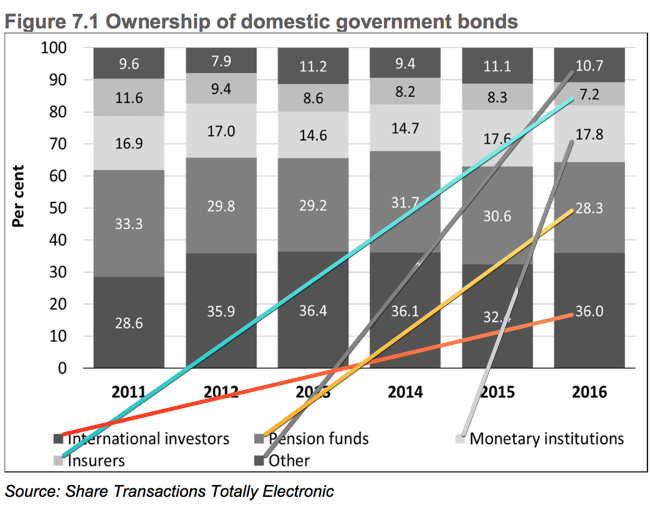


As per the Standard & Poor's release, it breaks it down: "Although less than one-tenth of the government's debt stock is denominated in foreign currency, nonresidents hold about 35% of the government's rand-denominated debt, which could make financing costs vulnerable to foreign investor sentiment, exchange rate fluctuations, and rises in developed market interest rates. We project interest expense will remain at about 11% of government revenues this year."

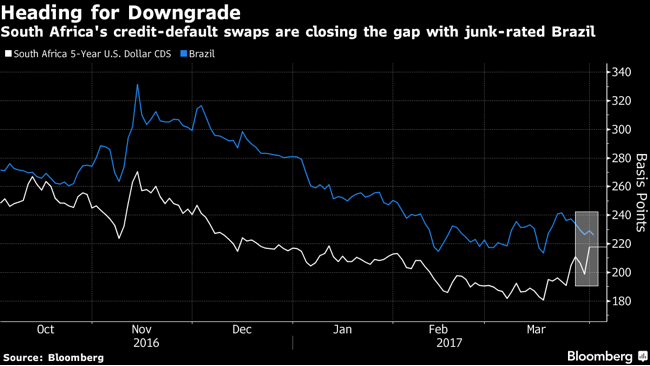
There may be investment mandates by some of those holding Rand denominated debt that does not enable them to own debt at a certain credit rating. They may be forced sellers at some level. Although, having said that, the credit default swaps (insurance on our sovereign bonds) spreads have been widening over the last "little while", as per this Bloomberg graph below (Traders Prepare for South Africa Credit Downgrade to Junk: Chart):


What about the foreign denominated debt? The one that has been downgraded to "junk"? Estimates by Treasury are that 222 billion Rand in foreign loans, relative to 2.016 trillion Rand in Domestic loans. If the medium term estimates expect that to grow, it may well come at a cost. Here is a table that Michael captured from the full budget review in February 2017:
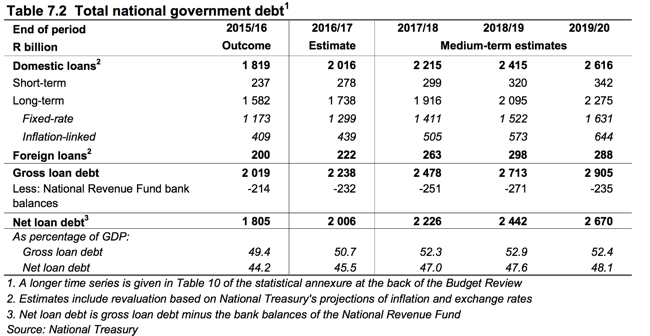


It seems that in recent days and weeks, folks were preparing for this. Which is natural, the market does anticipate events. OK, so what does this mean? Is junk bad? Junk is not investment grade. Junk means that the pool of lenders is smaller, those willing to take sovereign risk at that level is less. It also means that any new debt has to be issued at a higher interest rate, to compensate the investor for the risk they are assuming. Which means that the government pays more in debt, rather than using the funds for infrastructure development, for instance. Greater infrastructure advances economic growth, which equals higher tax collection as a result of greater economic activity. Which equals more money to use for social programs.

In the end the poor pay the price of a lack of policy. A lack of investment and a lack of growth means higher borrowing rates and more money spent paying interest, currently we pay 11 percent of revenues by way of interest. Less money for schools, clinics, roads and so on, if you are paying more interest. Equally, imported inflation means that we have to pay more for food and energy. The projections, at least by Standard & Poor's, point to a low growth trajectory to 2020 and an inflation rate around five and a half percent. There is little wriggle room for the Central Bank to provide stimulus.

As we look at it, the Rand is trading at nearly 13.90 to the US Dollar, having lost over ten percent in 8 days. 17.26 to the Pound Sterling. 14.82 to the Euro. These are levels seen at the end of last year. You can imagine that there is likely to be a continued negative reaction that may result in further weakness. Know that, not necessarily by design, our portfolios are more geared to a weakening currency. As such, we expect client values in Rand terms to not be as impacted in this weaker environment, this is also due to our lack of exposure to the banks and financials, that part we have chosen. If you have queries and questions, feel free to direct them at us.


Across the seas and vast blue oceans, in New York, New York, stocks finished comfortably off their worst levels of the session. The Dow Jones Industrial average lost 0.06 percent, the nerds of NASDAQ was down nearly one-third of a percent, whilst the broader market S&P 500 ended the session in the middle of those two, down 0.16 percent. The biggest story on the session was without a doubt the Tesla production numbers (see yesterday - Q1 production numbers), as well as the seemingly cryptic tweet from Elon Musk:



What does he mean by all of that? Well, for starters, check out the Tesla, Inc. Short Interest.



And the upshot of it all? Tesla stock up seven and one-quarter of a percent. Bigger than Ford, the market cap that is. A short squeeze. The message is that Tesla are morphing into something else, the share price may have run exceptionally hard, and is very volatile at the best of times. As a holder, you have to accept this. Josh Brown, aka the "Reformed Broker" responded to someone when making the comparison to Ford and Tesla: "Apples and Oranges. Tesla is a battery company or a platform company I am told. Ford makes metal carriages." And there you go.


Linkfest, lap it up

OK, this is complicated. Very complicated. Worth a read and maybe you have an opinion on this - Age Makes You Happier - And Poorer. The short message, don't get grumpy and conservative as you get older, as an investor that is. For kids and dogs running on your lawn, that is different.

How much would you pay for a piece of history? It turns out quite a lot: Relatively Pricey: Einstein Letter Fetches $54K at Auction.

This was a fun read this morning, it shows the weird logic that is used when the investment community is compared to every day life. There seem to be some double standards - What If Other Areas of Life Operated Like Wall Street?


Home again, home again, jiggety-jog. We have started marginally better here, around one-third of a percent to the good. Banks and SA inc. are down, Rand hedges are flying. It is a tale of two halves, again.


Sent to you by Sasha, Byron and Michael on behalf of team Vestact.

Email us

Follow Sasha, Michael, Byron, Bright and Paul on Twitter

078 533 1063

Thursday, 11 June 2015

The Good Old Days


"My point is simple. It always turns out better than you think. There is never a better time to own equities than today. There is no use saying that I missed the March 2009 generational lows and trying to wait for another one. There are so many articles that tell you how the world is ending and that stocks are going down 50 percent tomorrow. In reality, through the 50 years that Buffett has been associated with Berkshire Hathaway, the shares have lost their value by more than 50 percent twice. Or strangely, once in a generation. Makes you think, doesn't it?"


To market to market to buy a fat pig. Whoa. It is not often that you see a move like that, stocks locally up nearly one and three quarters of a percent, halting the worst emerging market sell off in nearly a generation. 24 years right, that is in the middle of what is considered Generation time. If you read the Wiki piece you can see that a generation measure is pretty simple, the time taken to produce the next generation. As simple as that. I can imagine that in some parts of the world it is much higher than in other parts of the world, people are having fewer children and indeed, having children later in life.

The population explosion in the last few generations has been something to behold. According to various measures there have been around 105 to 110 billion people to have ever walked the earth. We crossed 1 billion people for the first time around the time when Napoleon was awesome, 1804. It took another 127 years for the next billion to be added, the human population effectively doubled from 1804 to 1927. The next billion, i.e. from 2 to 3 took 33 yeas, by 1960 there were 3 billion souls alive at any one given time. And then "things" really sped up. By 1975 there were four billion of us, 5 billion was reached in 1987 (a mere 12 years), by 1999 there were 6 billion and in 2012 we had crossed the 7 billion mark, slowing from the pace of adding a billion every 12 years.

Expectations are that we will reach 8 around 2025, slowing again after that, 9 billion by 2045-2050. As famed baseball player and coach, Yogi Berra said: "It's tough to make predictions, especially about the future." Berra quotes make those of "The Honey-Badger" (Nick Cummins) seem lame. No wonder consumption has rocketed like it has, at the same time rapid industrialisation has taken place too, over the last 40 years. Urbanisation rates are over 50 percent now, in 1950 that was closer to 30 percent. Back then (and I am guessing, doing simple math), in 1950, with around 2.7 billion people on the planet, only 800 million lived in cities. Nowadays, there are 7.3 billion of us, with the urbanisation rate over 50 percent there are 3.7 billion people in cities. So nearly 3 billion people have moved to cities in 65 years, roughly 46 million a year. And we have not starved, as Malthus suspected, the Malthusian catastrophe did not transpire.

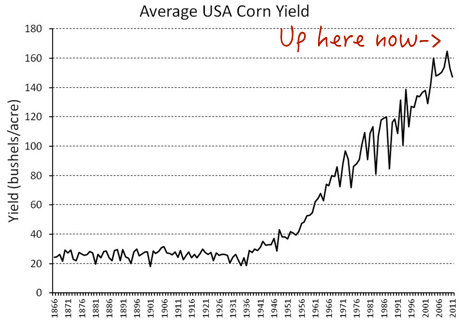
Why didn't this happen? It is not as if there was more arable land available? Crop yields have rocketed. In the US, last year (a record year) corn yields were an estimated 171.7 bushels per acre. See this graph which shows United States long term yields per acre, revolutionised farming methods must have started post the Great Depression.


And it seems to be getting better and better, meaning that greater technological innovations mean that people can live and work in cities if they prefer. The yield per acre of land, for corn at least and specifically to the US, has increased 8 fold in a time that the population has increased less than fourfold. Yet the sad truth is that 2 billion people globally go to bed hungry each and every night, and more than 1 billion people are obese, remembering that obesity is not necessarily connected to wealth, rather cheaper calories. You can talk about the good old days, the truth is that generally human lives have been improved. I guess it is easy to say from where I sit, tell that to somebody in the multiple conflict zones around the world, of which there is the Global Conflict Tracker tool. Sad.


There are more of us demanding more services and products. Newer companies are being formed all of the time, providing products and services that you would have thought not useful 40 years ago. Look at your desk, look at all the things around you and imagine a world with a rotary dial telephone and nothing else on it, other than an in and out tray. I saw a fabulous video that describes exactly that. See here, how all the clutter on your desk moves to your notebook (laptop) over time:

(video courtesy of:bestreviews.com/best-desk-chairs#evolution-of-the-desk)

My point is simple. It always turns out better than you think. There is never a better time to own equities than today. There is no use saying that I missed the March 2009 generational lows and trying to wait for another one. There are so many articles that tell you how the world is ending and that stocks are going down 50 percent tomorrow. In reality, through the 50 years that Buffett has been associated with Berkshire Hathaway, the shares have lost their value by more than 50 percent twice. Or strangely, once in a generation. Makes you think, doesn't it?


Factoid of the day

We take fixed income markets for granted, we take equity markets and interest rates for granted, yet we never question how they came about? According to Wiki, the first general government bond was issued by what is today the Netherlands, less than 500 years ago. In 1517. Interest rates were around 20 percent, talk about expensive debt! The very first government debt issued by a national government was apparently the English, back in 1694. It must have been complicated, from a reporting point of view. What is more astonishing is that the very first electronic trading platform, the NASDAQ, is less than 50 years old. Although the evolution to straight through processing (matching on market in an electronic environment) did not happen immediately, we now take it for granted that sometimes we are trying to buy or sell stocks against algorithms and high frequency trading participants, happy to have the liquidity.

What I have not been able to conceptualise is why global daily forex transactions is in excess of four trillion Dollars, the US international trade of goods for their entire year is around the same amount, and equal to just over one-fifth of their entire economy. What is also very interesting is that whilst commodities investing may not be the best long dated place to part with your hard earned money, commodity trading as a percentage of global trade is more than any other industry.


Linkfest, lap it up

Many of the web pages that you use get revenue from advertising, which is then used to produce the content and maintain the site. What happens though when people use software to block adds? As more people move online this question becomes more prominent - Block shock

Here is why Amazon is leagues ahead of their competitors, given their scale they can do things cheaper than the rest and create big brand loyalty - Why Amazon Is Putting 'Minions' on Their Boxes

It is hard to comprehend that there are still countries as isolated and backward as North Korea - This is what it's like to teach in North Korea.

It is not a surprise given all the hype around the fight that Mayweather and Pacquiao are one and two - The World's Highest-Paid Athletes. It still blows my mind that someone can earn that much off one fight! I suppose when there are only two athletes to share the profits, they take home big money. Compare that to Football where there are two teams to split the profits between.

Here is a nice list of food you can feel better about eating - 10 foods to nourish your brain. Glad to see that red wine and dark chocolate made the list.

This is a pretty long article which goes through energy consumption patterns of human beings, starting with the discovery of fire and ending with the awesomeness of Tesla. The objective of the article is to show how Tesla will change everything. If you do not read it word for word, browse through it and speed read. There are also some great images and graphs. How Tesla will Change Your Life.


Home again Markets are marginally higher here after the huge rally yesterday. The currency is weaker and commodity prices are down, that tells you that the Dollar is stronger.


Sent to you by the Vestacters, Sasha, Michael, Byron and Paul.

Email us

Follow Sasha, Byron and Michael on Twitter

087 985 0939