Showing posts with label GE. Show all posts

Tuesday, 13 June 2017

"Of all the recent fancy acronyms, FANG (Facebook, Amazon, Netflix and Google) and FAAMG (Facebook, Apple, Amazon, Microsoft and Google). Google is of course Alphabet, in theory that acronym should read FAAMA"


To market to market to buy a fat pig Oops it happened again. Thanks Britney Spears. Thanks for nothing. Of all the recent fancy acronyms, FANG (Facebook, Amazon, Netflix and Google) and FAAMG (Facebook, Apple, Amazon, Microsoft and Google). Google is of course Alphabet, in theory that acronym should read FAAMA, that may be too close to the Nobel economics laureate, Eugene Fama. Fama is also called the "Father of Finance". Sounds like a swell fellow. At twice the age of Spears, Fama is less well known to most people around the world. Possibly "has less" on paper too, relative to Spears. Facebook, Amazon, Netflix, Google/Alphabet are all younger than Spears (incorporation versus birthdate). Microsoft and Apple are older than her, recently in their fifth decade of existence.

The youngest company in those cutesy acronyms (the first of which is attributed to Jim Cramer, the second to a recent Goldman note) is Facebook. That company has gone in a decade from employing 150 people to 17 thousand plus (by the end of 2016) and possibly far exceeded the wildest dreams of all of the founders and original employees. Technology improves the lives of all those on planet earth, it increases productivity and definitely raises standards of living. Facebook, does that improve productivity? What are your internal work policies in that regard?

Anyhows, fancy acronyms aside, tech stocks opened the New York session with another fast and sharp sell off, down nearly one and a half percent to begin with. The buyers did emerge through the session though, coming back all the way through to the close. The nerds of NASDAQ still registered another half a percent lower on the session, it was a comeback from a far worse situation though. The losers still included Apple (down two and a half percent), Amazon (down one point four percent) and Alphabet and Microsoft, both giving up around three-quarters of a percent. There was news specific to General Electric, long time CEO (not the favourite of all and sundry) Jeff Immelt, is leaving the business at the end of the year. The full release is here - John Flannery named Chairman and CEO of GE.

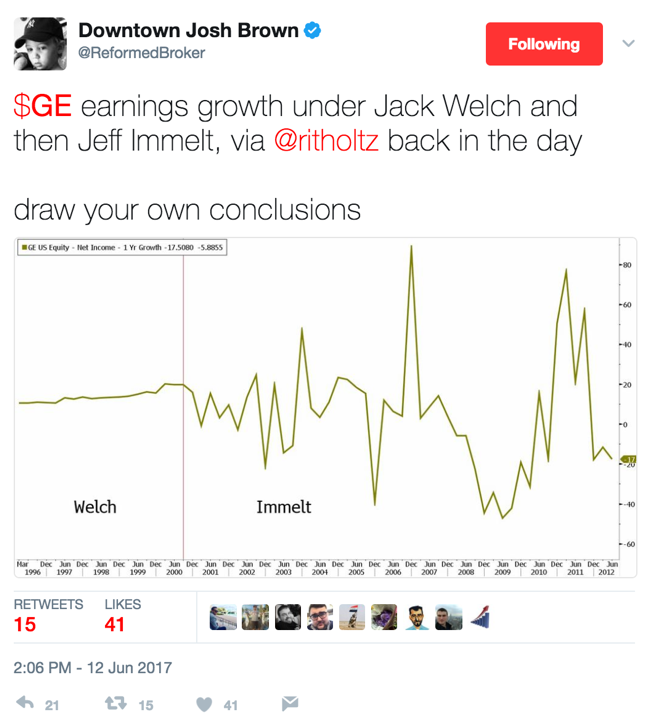
For better or for worse, the stock was the main gainer on the day, up over three and a half percent. The company did also re-affirm guidance for the year, which may well have had something to do with the share price moving higher, it tells you that "the street" is in a way happy that the days of this CEO are numbered. Downtown Josh Brown tweeted that favourite graph of the era of Jack Welch and Jeff Immelt. Draw your own conclusions as they say!


What this tells you is that when earnings meet expectations, you may well have to scratch your head and think a little harder whether management were hell bent on pleasing the street, or whether earnings became more volatile in the era of Immelt. And by extension, harder to predict. It is also important to recall that Welch was outraged (tweeting something about Chicago gangsters) with a good "jobs number" just before Obama was re-elected. You be the judge of whether the street was incredible in their analysis or Welch smoothed earning. Either way, like him or not, another era ends at an iconic company.


We were not immune to the technology sell off here in Jozi, there may be FANG and FAAMG, here we basically only have N. N is for Naspers. Of which the whole value of Naspers is less than their holding in Tencent. Which at face value makes little to no sense, I hear that the market is discounting the sum of the parts, that happens. It is what it is, I guess. N for Naspers sank heavily, as global technology stocks sold off. The heavyweight sold off nearly 6 percent on the day, descending to 2525 Rand a share, which is a level seen in late April, just for perspective. Not benefitting from a weaker currency was the likes of AngloGold Ashanti and British American Tobacco, as well as Glencore and BHP. There were winners on the day, Amplats was top of the pile of the majors, followed by Nedbank and Barclays Africa.

After all was said and done, the move south by Naspers dragged the rest of the broader market down, the all share index closed the session off one and one-quarter of a percent. The Rand is now around three percent away from being at the strongest point to Pound Sterling since late 2013. That England cricket tour couldn't have been better timed for the visitors than last summer! At 16.15 to the Pound, the memories of 24 odd Rand to Sterling feel like a bad memory (it is a bad memory).

For the record, the Jozi all share index over the last three years is completely flat. Flat as a pancake. Which feels about right, bearing in mind that the local economy makes Chitty Chitty Bang Bang look like a Bugatti Veyron 16.4 Super Sport. Which just happens to be the fastest production car in the world.


Linkfest, lap it up

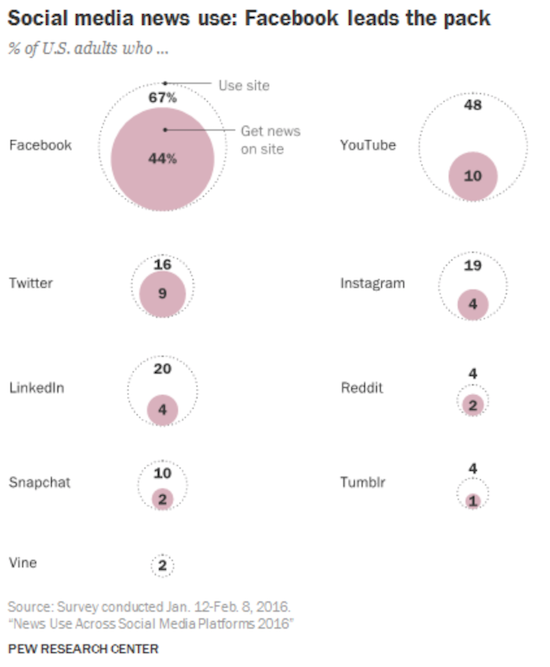
Social media is continually becoming a bigger and bigger part of our lives, getting our news from them is just another example of what we use them for - News Use Across Social Media Platforms 2016. Here is a look at what percentage of American's use each social media platform.


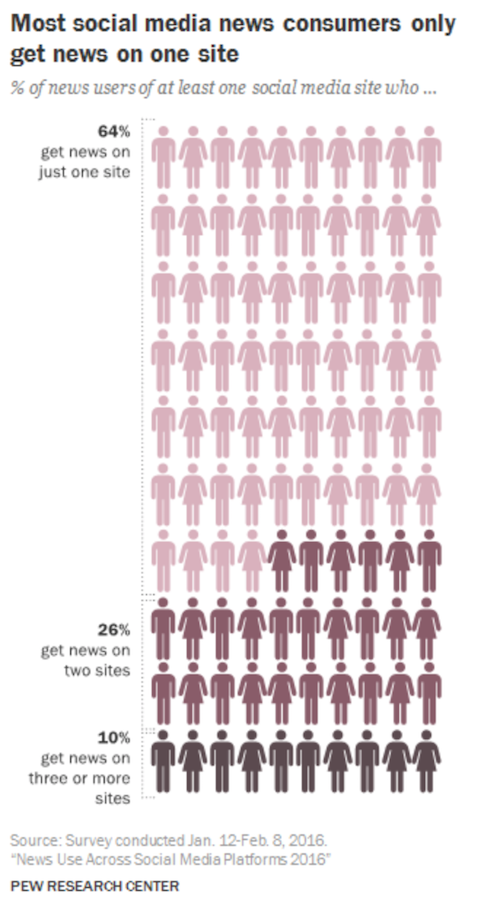
Given how many people only use one site to get news, it shows how easy it is for fake news to get a foothold and spread. It also shows how important it is for the likes of Facebook to stop the spread of fake news as soon as possible.


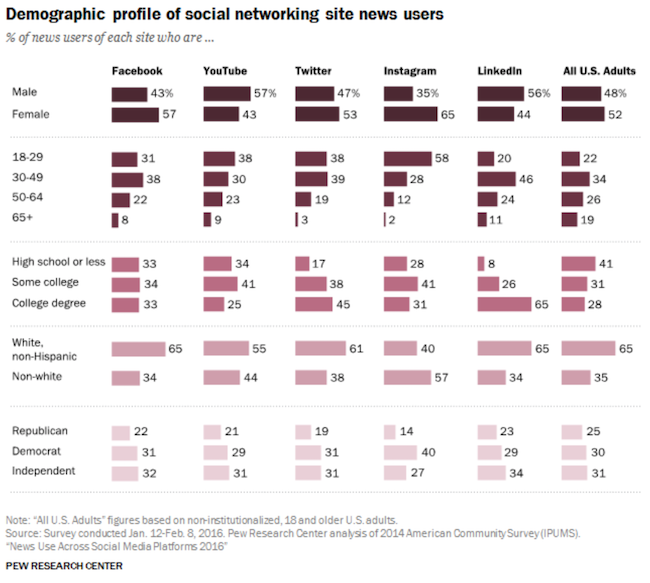
Lastly, here is the demographic breakdown of users. Interesting to see Republicans are the lowest users across the board, I would have expected in a developed country like the US that the a persons political views would be inconsequential in the use of the internet and social media.


Home again, home again, jiggety-jog. Stocks across in Asia are mixed to better. I saw a tweet that suggested that the equities market (the S&P 500) had gone 231 days without a 5 percent drawdown/sell off, the longest such period since 1996. That is 21 years! Whoa. I guess it always comes, the sell off, be it a technical bear market or whatever people like to call it, when it does it always feels very bad. That is however always the moment to remember why one does this! Gains are hard fought and enjoyed over the years, not won in days and weeks, or months.


Sent to you by Sasha, Byron and Michael on behalf of team Vestact.

Email us

Follow Sasha, Michael, Byron, Bright and Paul on Twitter

078 533 1063

Monday, 24 October 2016

McEarnings


"Will it come immediately? I doubt it, there are many more middle income neighbourhoods around the world. Global comparable sales up three and a half percent, across the 36 thousand restaurants in over 100 countries is a decent enough reflection of the global economy. Depending on where you are in the world, the offering is a quick fix of calories or a soft luxury."


To market to market to buy a fat pig A mixed close for Wall Street Friday, earnings still continue to stream in thick and fast. See below in the company segment, my colleagues have told me to be strict about separating the various segments, otherwise we end up with a fruit salad. And we are looking for more than one flavour. Chocolate or vanilla? Personally I prefer both over many other exotic flavours. Talking of exotic flavours, AT&T are buying Time Warner for 85 billion Dollars. There was some news that Apple would go after Time Warner, obviously the content is what everyone is after here. AT&T will pay half cash, half stock. I tried to understand the content side, who has what, who is likely to be the winner in all of this. Consolidation is obviously the key in all of this, Apple may build up their own content in time, they certainly have the resources to take on Netflix and Amazon. I suspect that unlike many people think, there is loads of space for multiple entrants.

By the end of the session stocks had finished mixed, the nerds of NASDAQ was boosted by the likes of Facebook (traded at an all time high) and Microsoft (also trading at an all time high), one pre their results and the other one post their results. The Microsoft all time high comes nearly 17 years after the dot-com high (adjusted for splits) just before Christmas 1999. Talking of which, I saw Christmas decorations this weekend. With a little over two months to go, I am not surprised I guess. Microsoft have done good work in directing all their customers to pay a subscription based monthly (or annual) for the office suite, as well as having a strong cloud product. Not a coincidence.

The nerds of NASDAQ closed up 0.3 percent, the Dow Jones Industrial closed 0.09 percent off for the session, whilst the broader market S&P 500 lost a smidgen, less than one-fifth of a point lower for the session. We are about 50 odd points away from the all time highs. Provided that we see decent earnings this week from the likes of Apple, Amazon and Alphabet (the company formally known as Google), stocks may get a decent leg up this week. Oh, and there is the small matter of the first look at US GDP this Friday. A big week! And at last, mostly earnings related.


On the local front we had stocks up two-fifths of a percent by the close, resources were rocking, up one and three-quarters of a percent by the end. At the top of the leaderboard was Anglo American, at the bottom was BATS after announcing the deal with Reynolds on Friday, that is really big money relative to their market capitalisation, 47 billion Dollars, dilution and more gearing is a little insipid in the short term.


Company corner

McDonald's results Friday beat the street and the stock jumped over three percent. It hasn't been the easiest in their operating space, the stock, notwithstanding their move Friday, is down three and a half percent year-to-date. Owning stocks shouldn't be a quarter to quarter thing, nor year to year, and the giant golden arch in the sky stock is a testament to that. The company has delivered 40 consecutive years of dividend increases. Through the savings and loans crisis, through the dot-com crisis, the financial crisis, you name it, McDonald's stock has delivered dividend growth. The company basically pioneered the restaurant franchise model and is synonymous with fast food. Perhaps in a changing world where habits are trending healthier, the company may come under pressure from fresh food again. Or they may just tweak their menu, or perhaps the reality is that ultra healthy food is a rich people thing.

Will it come immediately? I doubt it, there are many more middle income neighbourhoods around the world. Global comparable sales up three and a half percent, across the 36 thousand restaurants in over 100 countries is a decent enough reflection of the global economy. Depending on where you are in the world, the offering is a quick fix of calories or a soft luxury. The company also offers employment for hundreds of thousands of employees across the globe, not the most glamorous job, it is a look into the organised workplace for most first time entrants.

The stock has done well, it is a steady Eddy, 1000 Dollars invested in 1991 (25 years ago) has delivered returns of just over 800 percent, including the reinvestment of the dividends. The yield now stands at 3.3 percent (pre the tax). On a 21 multiple I would have to say that the stock is well priced, in this space we prefer the coffee business and the higher margin food of Starbucks. You can't own everything and that is also something you have to come to terms with as an investor. Starbucks has underperformed McDonald's both YTD and over the last 1 year, the five year chart tells an astonishing story however, Starbucks up 154 percent versus McDonald's up 23 percent. Of course that tells you exactly nothing about the future of the business, a historical chart!


At the opposite end of the markets liking was GE, the stock was down sharply in early trade, managing to recover by the end of the session to be just under one-third off. It wasn't so much the current results, rather than forward guidance on revenue had been lowered. Their power and renewable energy businesses had performed "well", their oil and gas business (which is more recent business) is struggling, along with the rest of the folks in that sector. The only stock to have stayed the course in the Dow Jones Industrial Average is hardly the most exciting company you can own. And as a result of the sectors they operate in, is bound to be more cyclical than a food business of any sort.

I suspect that the company is likely to struggle over the next 12-18 months, with no growth and a 20 multiple, do not expect anything other than a market performer. Which of course sometimes catches you off guard! The company however tells you what every investor wants to hear, that they have paid a dividend each and every quarter for over 100 years. Think about that. Multiple World Wars, multiple recessions, inflation, stagflation and the list goes on and on. And GE? No worries, we will pay you a dividend year in and year out. The financial crisis and the exposure to too much finance and not enough industry was a bad patch, hence the move back to the "old business". Whilst this is possibly a stock that you can own forever, there are certainly businesses (in our opinion) with better prospects in the medium term.


Linkfest, lap it up

As technology changes and technology moves on, there are winners and losers. Change is always difficult, two companies bearing the brunt of anti-change sentiments are AirBnB and Uber - The next 10 days will decide whether Airbnb lives or dies in New York City. Over the weekend the law was passed that people are not allowed to advertise rentals for less than 30 days at a time. The fact remains that Uber & AirBnb allow for societies to more efficiently use resources, making society better off as a whole.

There are some amazing facts about Google - 55 Facts You May Not Know About Google.


The goal of any corporation is to get the most out of their employees, working longer hours doesn't always lead to getting more work out of employees. Finding the average work hours worked and then comparing it to the amount of work produced/ productivity levels will help researchers get a better understanding of that work/ life sweet spot - Americans Work 25% More Than Europeans, Study Finds.


Home again, home again, jiggety-jog. If you like wearing Yellow and Orange, then your sporting teams had a fabulous weekend. Sundowns can proudly sport a star for the African champions above their badge, the only other South African team to do this are the Bucs. The Cheetahs were deserved winners of the oldest rugby completion in the world. Western Province have won this trophy 33 times. Wow. Famous Brands results this morning, and MTN have a quarterly update, we will have more on that tomorrow.


Sent to you by Sasha, Byron and Michael on behalf of team Vestact.

Email us

Follow Sasha, Michael, Byron, Bright and Paul on Twitter

078 533 1063

Tuesday, 20 October 2015

Shoprite in the tough spot

"Shoprite is a business that has, to borrow a quote from Charlie Munger on Costco, done more for society than any charitable cause. Of course the company has benefited from government social security programs, being able to do business in places where previously economic activity was limited."


To market to market to buy a fat pig. The slower growth rates (everyone misses off a much higher base) in China weighed on commodity stocks locally, Anglo American down nearly 6 percent on the day, equally Glencore down heavily, over four and one-quarter of a percent. BHP Billiton fell by nearly one and a half percent, inexplicably South32 was up nearly by the same amount that BHP Billiton was down. What is that about?

And then there was a more noticeable loser at the top of the boards, Shoprite shares were down over six percent, on a first quarter trading update that failed to meet the markets lofty expectations. Mind you, I checked yesterday, the stock might be up over 50 percent in five years, it is however down over ten percent in the last three years. So basically the stock has gone nowhere, and some of the other retailers have crushed it. Of course if you take a longer dated return period, Shoprite has still done exceptionally well. The market clearly looking at the valuations, and see that Shoprite trades on a 20 multiple and is only able to deliver around 5 percent revenue growth in their biggest market, South Africa. Make no mistake, it is tough out there.

Shoprite is a business that has, to borrow a quote from Charlie Munger on Costco, done more for society than any charitable cause. Of course the company has benefited from government social security programs, being able to do business in places where previously economic activity was limited. You can say what you want about the present government, the social security nets created have certainly helped businesses like Shoprite. And in return, Shoprite have benefitted the consumer by being able to deliver cheaper goods, year in and year out. The consumer knows, in 2005, Shoprite turnover was a little over 30 billion Rand, five years later in 2010 at the year end stage it was 67,4 billion Rand. At the end of their financial year in June this year, five years on, the company achieved turnover of 113.6 billion Rand. They have nearly quadrupled revenues in the space of a decade.

Nearly 133 thousand people work at Shoprite (115 thousand in South Africa) currently, as of the end of the last financial year to June, compared to 63 thousand folks back in 2005. In short, Shoprite have created 70 thousand jobs over ten years. That is nothing short of a massive success story in bringing consumers lower priced goods day in and day out. Good for them, good for the consumer. This trading update however was NOT good, released on the day of the AGM. In short, in their local business: The core customer base of its flagship Shoprite chain in particular remained under pressure from mining job cuts, rising electricity costs, labour instability and lack of job creation. And then in their rest of Africa businesses: "Non-RSA Supermarkets achieved turnover growth of 12.8% (18.6% in constant currencies) despite the impact of lower commodity prices and currency devaluations of the three dominant countries in which the Group trades on the continent."

So when the market values your stock at 20 times, this is unfortunately not good enough. And whilst the company points out: "a stronger double digit sales growth is already evident for the month of October" it is difficult for them to predict Christmas sales. The market has a forward multiple of 17 times with a dividend yield of 3 percent, hardly cheap. And with a negative perception towards emerging markets, and South Africa finding themselves in an unenviable position of being inside of the "fragile five" (Brazil, Indonesia, Turkey and India make up the rest), sentiment could weigh from external investors. And bear in mind that shareholders of this business are looking for the longer term African growth story, for the time being three-quarters of revenues are confined to South Africa, with 80 percent of profits from this one territory (as per the last annual report, 2014).

Of course the risk is that international shareholders like Lazard, JP Morgan, T. Rowe Price, Blackrock, The government of Singapore investment Corporation, Vanguard and First State (all amongst the top shareholders) get downbeat on the growth credentials that the continent offers. I think not, I heard an interview with Jamie Dimon from JP Morgan yesterday in which he was generally positive on the outlook for our continent, Dimon looks well and is great. I agree with Shoprite: "The Group remains optimistic in the medium term." It may not be time to buy the shares yet, there will however be time, not too much is expected to change in the next 18 months or so.

Over the seas and far away in New York, New York, stocks fluctuated ending marginally in the green (S&P 500 up 0.03 percent, Dow Jones up 0.08 percent and nerds of NASDAQ up 0.38 percent) to notch off another day of gains and the memories of the Northern Hemisphere summer a distant one. Energy stocks were slammed, I saw Jeff Currie, the Chicago lecturer (and holder of economics PhD from the same institution) turned head of Goldman Sachs head of commodities research make some not so exciting predictions about oil markets in the short term. He is always worth listening to, suggesting that we are in a lower oil price for longer scenario.

That is impacting heavily on economies reliant on oil exports, reports yesterday were that Saudi had delayed paying some contractors, a New York Times article over the weekend painted another bleak picture of Venezuela. Currie's thesis is that cash costs are 20 Dollars a barrel (globally), there is a whole lot of oil in storage capacity already, and we are in a world of surpluses. That is excellent for all global consumers, not so good for the producers, someone is going to have to turn off the taps to return to price equilibrium. Currie suggests that two to three years out, he is bullish on oil prices, from what level he is not too sure. For the time being we ignore.


Generally Electric, the longest surviving Dow Jones Constituent

The company is synonymous with Thomas Edison, one of the greatest investors of the 19th century. The man was however funded for his electrical lighting experiments by none other than the Vanderbilt family and JP Morgan (the person, not the company), we have capital to thank for light bulbs, not political parties or organisations. People make things, people take chances on people and humans all win in the end. Of course the light bulb that Edison invented looks very different today, it is all about saving precious resources today. Using less power to make the same lighting choices. In 1896 the company became part of the Dow Jones Industrials index (only 12 in those days), and is the only remaining member. It hasn't always been there, it is however 120 years later, the only company left.

The business looks very different today, even from ten years ago. The company is committed to slimming down the finance arm and continues to divest various assets from GE Capital. Third quarter results released last Friday before the bell, showed that earnings per share from continuing operations were flat, revenues for the quarter clocked an impressive 27.9 billion Dollars, even though that was a slight miss from the estimates. Profits of 4.5 billion Dollars were ahead of the market, margins increased a very pleasing 100 basis points.

There is something coming soon, the company is going to spin off a business called Synchrony Financial from GE Capital, what this will do is make the new GE (post the reduction of the credit business, into the rest of the currently listed Synchrony Financial) not important as a financial institution any more. So what you will now own is unfortunately a few Synchrony Financial shares for the GE shares you own.

The results themselves were not really that exciting, predictably the oil and gas business fell off a cliff, they do like the business long term, and I guess it is close to the Jeff Currie thesis above. An abundance for now, the usage should pick up sharply at the lower prices. Climate change, warmer winters might mean lower energy usage however, at least in the winter to warm up. Perhaps more in the summer to cool down, we could do with some rain over here.

Why own this diversified industrial business with reaches to all four corners of the globe (what is that English lovers? There are no four corners on a globe) that reaches into all aspects of life, travel (aviation), healthcare, oil and gas as we mentioned, water purification, power (gas turbines and the like), lighting and energy management? The stock is cheap, the company is getting leaner and meaner and sweating harder than before. The yield is still over three percent pre tax. There is lots to still like, the company is under-appreciated, perhaps as a result of their heritage and size. We continue to hold the stock for all of the reasons above.


Michael's musings

The free education debate is heating up, here is a post from one of my economic lecturers from days gone by. I respect his opinion as he is very well read and is not afraid to admit when he does not know something.

    "Higher education not only should be free, it can be free since there is enough money. This is because, unlike a household, a government does not face a budget constraint, despite all the BS credit rating agencies tell us. A government with its own fiat currency and a floating exchange rate is in fact a currency CREATOR, not a currency user.

    If you understand the history and reality of money, you would know that taxation is not needed to finance government spending, but that it is in fact the other way round. It is government spending that enables people to pay their taxes. In other words, we don't need more taxes to enable to finance higher education - that is utter nonsense. Free higher education will even generate higher tax revenue if that is what we want.

    A government can create as much currency as the real resources of its economy allows - in other words up until the point where it causes inflation. And that point is much, much further out than most economists (like me in the past) make us believe.

    Anyone who has studied the actual history of money (not the fictional history of economics textbooks) will tell you that money is essentially a product of our collective imagination - so it has NO inherent limits. If it is scarce it is only because we choose to keep it artificially scarce."


There are many points and theories that he touches on, some that I don't agree with. I don't want to get into the free education debate itself but look at, "what is money"? As soon as you view money as anything more than a way of simplifying transactions, you then run into trouble. Why did QE not create inflation in the US? It was due to the real resources of the country (and globe) being higher than the cash in the system, which results in under utilisation of the resources or deflation.

The above post is more than likely going to stir emotions and challenge views. It highlights that there are many conflicting economic theories out there but that is what creates a market.


Home again, home again, jiggety-jog. European markets are called lower, Xi Jinping is visiting the United Kingdom ahead of the fifth plenary session of the 18th central committee of the Communist party of China, next week. As was pointed out, this is a sign that Xi is large and in charge, there is no infighting in the upper echelons of power, if he is confident enough to have stepped away. We are possibly expecting a lower open here, who knows what could happen during the course of the day. IBM reported last evening, the 14th straight quarter of lower growth, the stock had slid sharply in pre market and after hours trade. Is it a Buffet mistake, the investment, or is he using this as an opportunity to buy more shares at what will be close to a 52 week low?


Sent to you by Sasha and Michael on behalf of team Vestact.

Email us

Follow Sasha, Byron and Michael on Twitter

087 985 0939

Thursday, 23 April 2015

The Face of the Zuck


"The company of course incorporates more than just the original desktop blue, 1.44 billion monthly users across mobile and desktop now use the network/service, 1.25 billion on their mobile phones. On mobile that represents a monster jump of 240 million. Daily that number is 936 million (not quite at 1 billion yet), 798 million on mobile phones."


To market, to market to buy a fat pig. Seeing as it is earnings season and there is a whole host of company data flying in, today will focus mostly on these businesses that we hold for our clients. Not all company earnings will be dealt with immediately, there are of course some releases that might be a day or two late. For instance there is a MTN announcement that is very important this morning, in terms of subscriber numbers for the first quarter, and an update. We'll have to deal with that one tomorrow. As I write this the share is down 0.4% so the news has not been a market mover.


Company corner

Stryker reported operating results for the first quarter of 2015, follow the link for all the numbers. The company is a global leader in medical equipment, better known for their selling of knee and hip replacements, as well as a whole host of other devices. Everything from a surgical drill, a saw, smart meters and high tech surgical equipment (screens and the like), to innovations like eliminating surgical smoke (important) to fluid disposal. The Neptune 2 is a fluid disposal product.

The business was founded post the war, by a orthopaedic surgeon of the same name, Dr. Homer Stryker. Stryker was 47 when he founded the company, one of his earliest inventions is still used, the vibrating saw to remove casts. Those of you who have ever broken a limb will know what I am talking about. Homer Stryker specialised after practicing for eight years as a GP, returning back to where the company still has their headquarters, his home town of Kalamazoo, a city that Wiki tells me is equidistant from Detroit and Chicago. Hipsters love the place, it is an important town with regards to craft beer. The other famous thing about the town is that it is the home of Gibson guitars.

In his final years he got to see the company list on the NYSE, Stryker died in 1980, the company listed on the NASDAQ (early days back then no doubt) in 1979, May the 2nd. Sadly his son had died 3 years earlier in 1976, in an airplane crash, along with his wife and two companions, leaving three kids sadly without parents. There are three siblings, Jon, Pat and Ronda Stryker, the grandchildren of Homer, they share a board seat.

Orthopaedics is the most profitable of the three divisions, it also represents 43 percent of group sales. Hips, knees and ankles, foot, and other reconstructive equipment, including a recent purchase of MAKO, robotic arm assisted surgery. MedSurg represents 39 percent of sales, the balance is the Neurotechnology and Spine, 18 percent. MedSurg includes all the instruments (drills etc.), medical equipment (including the biggest part of the business 50 years ago, beds and stretchers), as well as all the endoscopy business. Neurotechnology and Spine includes stroke therapies and spinal implants.

Revisit some of the other numbers quickly. Gross margins are a whopping 65.6 percent. Obviously the company spends heavily on research and development, 6.4 percent of total revenue. On the conference call, guidance for the quarter was given as 1.15 to 1.20 Dollars for the current quarter and 4.95 to 5.10 Dollars for the full year, currency headwinds trimming off 0.25 to 0.30 Dollars, 5 to 6 percent. Of course that is not insubstantial, what is important to remember in owning global businesses (remembering that US sales are 68 percent of total sales), you cannot get away from currency fluctuations. What we have seen here is pretty unprecedented, the massive moves in the developed world in a very short period of time. Normally currencies move 20-25 percent over years and not months.

We maintain our buy on Stryker. This is both a consistent business, since they have been listed, they have only once reported lower revenue than the prior year, and that was in 2009. Hospitals pulled back their spend sharply. The innovation and cutting edge surgical technology is evident from the company. In a world where more and more treatments and therapies are being administered on a population that is living longer and longer, their target market has more time and deeper pockets, and there are more of them. People I mean. With a price to earnings multiple of 19.3 times forward, a yield of 1.4 percent it hardly seems like a steal. I am more than happy to pay that price for a company growing profits at ten percent per annum however, a solid business.


Facebook reported numbers post the market last evening. Facebook, contrary to the chattering classes and naysayers, has turned out to be a solid business run by a fellow that has some serious skills. I think that Mark Zuckerberg is in a league with the business greats, obviously there is a lot of work to do. I get that he wants everyone to have access to the internet, I sometimes think that if I could give the Nobel peace prize to a thing, it would be the internet. Who would get the money, Al Gore? Ha ha, kidding, perhaps it can be donated to Wikipedia. Did you know that Zuckerberg's middle name is Elliot?

The company of course incorporates more than just the original desktop blue, 1.44 billion monthly users across mobile and desktop now use the network/service, 1.25 billion on their mobile phones. On mobile that represents a monster jump of 240 million. Daily that number is 936 million (not quite at 1 billion yet), 798 million on mobile phones. That is just the main service, the other businesses which we chatted about a few days ago, have massive numbers too. WhatsApp has 800 million proper and engaged users, 600 million people use Messenger, 700 million people use groups (the only one I don't use), 300 million active members use Instagram. Across all the networks, 45 billion messages are sent a day. That is around 6 per person on the planet per day.

Of all the services, I think that Instagram is the most beautiful, pictures are gorgeous and I would urge you, if you have a smartphone and like seeing and taking pictures for Facebook, to use that platform. Video of course is growing like gangbusters, there are 4 billion views a day. You can of course also post 15 second clips of video on Instagram, which is about the normal persons attention span. I am sure that it is more than that. Average time spent on Instagram is 21 minutes a day. I have never heard of the movie "Age of Adaline" which premiers this Friday, I may watch it on BoxOffice, or some other platform. Lionsgate has, via Instagram been targeting younger woman in the lead up to this movie, said Sheryl Sandberg on the conference call. The company has retargeted their efforts to Facebook, she said and they are expected to bear fruits, come the movie release this weekend.

You can have all the users that you want in the world, the fact of the matter is that the service is for free. You pay for the inter webs with your service provider, so I guess strictly speaking it is not for free. For advertisers however, it is the most pointed platform in the world. You can set your parameters as close as you need. I have used it, with mixed success I must say. Having said that, there are a mere 2 million advertisers on Facebook. That is all. They are responsible for quarterly revenue of 3.32 billion of the groups 3.543 billion in the last quarter. Revenue on a comparable quarter last year grew by 42 percent. If you excluded the strong Dollar, revenues would have increased by 49 percent. Around half of revenues are in the the US and Canada, one quarter in Europe, one sixth in Asia Pacific and the balance the Rest of the world. People like you and I. Mobile ad revenue is now 73 percent of total advertising revenue, if you recall there was a lot of anxiety around how the company would monetize mobile. Well, that is how.

ARPU's are still low however. Across the group, global ARPU's are 2.5 Dollars. That is the measure of revenue generated by the company per user. What the company are doing however is that they are spending a lot more on marketing than ever before, as a percentage of revenue, 17 percent this last quarter when compared to even the biggest revenue quarter (traditional the holidays quarter, Q4) where the company spent 16 percent. Research and Development expenses as a percentage of revenue topped 30 percent in the last quarter, we knew that the company was going to invest heavily, we were told that in the last quarter. Non GAAP operational income grew 28 percent when compared against Q1 2014, non GAAP diluted EPS clocked 42 cents for the last quarter.

The stronger Dollar and the increased spend (up heavily) means that earnings are going to be slim pickings for a while, I suspect that whilst revenues grow like crazy, expectations are for this year is 17 billion Dollars, over 23 next year and nearly 29 the year thereafter. EPS is however only expected to be around 1 Dollar this year, there is no prospect of a dividend as of yet. With a share price of 85 Dollars it is easy enough to figure that one out from a simple fundamentals point of view. This investment is not for everyone, the company has not put a foot wrong so far. They have a strong team, there is plenty of growth ahead.

Indeed last evening another new initiative was released: Introducing Hello. It is pretty darn cool, you can see more info. How does it work? Like this: You can also search for people and businesses on Facebook and call them with just one tap. So if a friend tells you about a new restaurant in your neighbourhood, you can use Hello to find their hours, make a reservation and get directions, all without leaving the app. Many different applications and bolt ons are coming, you must own a percentage of this company in your portfolio. We maintain our buy rating on Facebook, you are going to have to continue to be patient in order to see the big unwind from a valuations point of view, as in the case of growing businesses like Amazon, you can wait a decade.


Michael's musings

There have been two big announcements from GE in the preceding weeks;They are disposing most of GE Capital in the next 24 months and then they had their 2015 Q1 figures. The GE of late has always been a tale of two segments, industrials (for which they are known) and then GE Capital (which makes up the largest part of earnings). The share price jumped around 10% when they announced the sale of a large chunk of GE capitall, so the market likes the idea of moving to a more pure industrial play.

The theory is that the financial arms' earnings are too volatile for an industrial player like GE. The industrial assets don't get the same valuation in the market because they are diluted by the banking part of GE. (You can see it is not an ideal mix of assets).

The bulk of GE Capitals real estate assets will be bought by private equity company Blackstone and some of the loans business will be bought by Wells Fargo. The goal is to have GE Capital contribute only 10% of the earnings in 2018, from the current 42%.

There are many moving parts to GE, here is the easiest way to see what is going on:
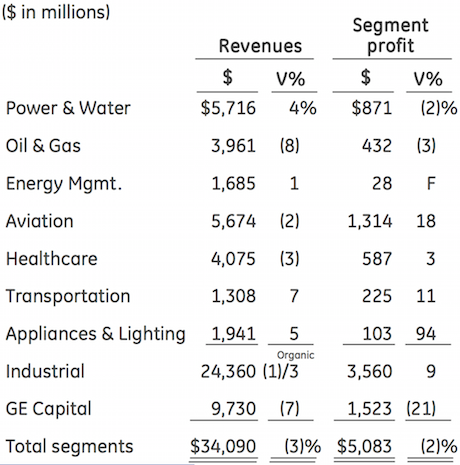


You will note that the industrial segments revenue went backwards by 1% but if we exclude the impact of the stronger dollar, revenue would have grown by 3%. Both Healthcare and Oil & Gas have positive organic growth but due to currency impact they also went backwards. In total the stronger dollar impacted revenues by $950 million.

Looking forward our focus needs to be on the Industrial segment as it is going to be the business post 2018. The industrial segment looks strong with earnings growth of 9% and operating margin expansion of 120 basis points. The company has nice diversification across many sectors, with one of them being the high growth healthcare sector. Add to all of this, GE plans to return to investors $90 billion in the form of dividends and share buy backs up until 2018. The conclusion drawn by all these numbers is that GE is a solid blue chip company that will probably be one of your most boring investments, they will chug along giving you a nice dividend yield (currently 3.2%) and grow earnings regularly.


Things we are reading

Owning sports teams is definitely a vanity project. Heck, Steve Balmer bought the Clippers for 2 billion Dollars! Manchester United has a market cap of 2.6 billion Dollars, annual turnover of around 650 million, profits of 35 million. The players however collectively earn 215 million pounds, or 323 million Dollars: United overtake Man City with Premier League's highest wage bill

This battle is over but the war between publishers and Amazon is not, and probably won't be over until one of the sides no longer exists - Amazon, HarperCollins deal opens door for smaller e-book battles

Another shift away from analog - In 2017, Norway will be first country to shut down FM radio and this is the technology that will be replacing it, Digital Audio Broadcasting(DAB)

Depending on when you invest has long lasting impact on your future returns - The Impact of the Tech Bubble on Future Returns. The basic moral of the numbers (story) is to be constantly adding, which gives you the advantage of average pricing. Remember that if you are constantly adding, which means buy when the market is "expensive" and "cheap", you will be buying more shares with the same money during down turns. Which results in your average entry prices being biased to the "cheaper" side. "Patience can be a great equalizer in the financial markets, but it usually has to be measured in decades, not just years."


Home again, home again, jiggety-jog. Earnings, earnings, earnings. Exciting times in the office! The local bourse is at an all time high, stemmed partially by a weaker a Rand.


Sent to you by the Vestacters, Sasha, Michael, Byron and Paul.

Email us

Follow Sasha, Byron and Michael on Twitter

087 985 0939