Showing posts with label Twitter. Show all posts

Wednesday, 15 February 2017

Subscriber Growth is King

"Twitter themselves have the easiest explanation of what the platform is supposed to be for their users: "the best and fastest place to see what's happening and what people are talking about all around the world. From breaking news and entertainment to sports and politics, from big events to everyday interests. If it's happening anywhere, it's happening first on Twitter." (That is a lot more than 140 characters)"


To market to market to buy a fat pig Thanks to the hawkish statements from Janet Yellen, the markets closed at all time highs, she indicated that March is "live", i.e. The Federal Reserve could raise interest rates at the next FOMC meeting of the year, being March. So why would that make markets go up, surely the opposite would have happened? For one thing, this is very supportive for financial stocks. Whilst March is not a "done deal", June would be a definite, at least in the eyes of Mr. Market.

By session end stocks have rallied again, financials added six-tenths of a percent, Goldman and Wells Fargo closed at all time highs, Apple also traded at an all time high. The market cap of the company that makes wonderful things now stands at 714 billion Dollars, a long, long way off from where pundits can cross another milestone off their list, the first company to one trillion Dollars. Perhaps it may be a Chinese business, Alibaba or TenCent have the growth trajectory to make a real rush and grab of the first. Remembering that nobody remembers that Michael Collins watched Neil Armstrong and Buzz Aldrin descend to the moon, let alone Eugene Cernan, the last man to step off the moon. Cernan recently passed away, mid January. Ah, stock records are made to be broken.

Session end the Dow Jones Industrial average had added 92 points, which is 0.45 percent these days, to top 20 thousand and five hundred points. That was a fairly quick 500 points, I suppose as the index swelled in size, the milestones are reached quicker, the percentage is smaller. You get it .... The broader market S&P 500 added four-tenths of a percent to close at 2337, whilst the nerds of NASDAQ added just shy of one-third of a percent to close at a record 5782. I don't think that Mr. Market is complacent, I suspect that there could be a huge leg up from here, another five odd percent if a concrete tax plan was shovelled through in the coming weeks and months. There are loads of businesses with lots of cash abroad (outside of the US), that could be brought back "home". For share buybacks? Retire debt? Possibly.

I had a look back at the ten year performance of some financial stocks, Wells Fargo, Goldman Sachs, JP Morgan and Bank of America Merrill Lynch. And then I threw in Citi because I "felt bad" that they were not amongst that grouping. The relative performances will astound you, so hold on to your seat here for a second, the ten year performances of the respective financial heavyweights in the US are as follows - WFC +63.96%, GS +16.87%, JPM +77.56%, BAC -54.75% and C -88.79%. The S&P 500? That is up 62.54 percent over the last ten years. Wells and JP Morgan have outperformed the market over ten years, remembering that the highs, before the sub-prime mortgage implosion was October 2007. When we have, towards the end of this year, a ten year comparative time frame, "things" will start to look more interesting, historically speaking.


Locally we were hamstrung (stocks were) by the strengthening Rand. This is a good thing, when the Rand strengthens, this is a good thing for all of us you see, as it bites into inflation in a good way. The less we have to pay for imports the better. Equally, with strengthening commodity prices, that is better for our exports. Not so good for our stocks that report Dollar revenue that converts back to Rand terms. There was an unemployment number which Michael looked at in detail, the number of folks with a school leavers certificate is bleak, I tell you. It should be much, much higher than the current levels. Having said that, school is not necessarily for everyone. Skills learnt cannot be taken away, the more people with skills, the better for everyone.

The All Share index sank over nine-tenths of a percent, industrials were the biggest losers, down over a percent and a half on the day. Kumba was at the top of the losers board (not a place you want to be), down nearly six and a half percent. The volatility has been nothing short of heart stopping in recent days, with Chinese numbers and SARS settlements, Iron Ore prices rocketing ahead (the company thinks that they are too high) and then the company forgoing a dividend. It has been a wild ride in Kumba in recent years. Other stocks to take pain as a result of the strengthening Rand included Naspers, British America Tobacco and Steinhoff, all these companies have listings elsewhere. Those benefitting from a firmer Rand, unsurprisingly were the banks and retailers, the prospects of a better inflation outlook could mean lower rates down the line. Nedbank, RMB and FirstRand all found themselves near the top of the winners leaderboard.

There was a NAV update from Brait, which at first caught the market off guard, the stock sank over five percent before calm was restored and the stock gained just over a percent and one-third on the day. We have certainly been wrong on this one, as a result of a number of factors, including an ill timed UK purchase of a retailer that is now "struggling", New Look is roaring ahead in China, their base is still the UK. Brexit helped like a hole in the head, the weakening UK currency and the weaker outlook has meant lower Rand profits and equally downgraded expectations for the UK economy. Brexit, who saw that coming? What is likely to transpire with the negotiations, your guess is as good as mine. We will have a more detailed look in the coming days, tomorrow is the likely publish date.


Company corner

Twitter is a great platform for staying in touch with each others thoughts, be they not well thought through or on point. The fact that the platform is completely live, all of the time, no matter where in the world you happen to be, counts for a lot. I recall hearing about the poor soul who was taken by a shark in the Cape via Twitter, that was in the early days. People are addicted to their phones and are addicted to news-flow. The platform is a little more school-ground bully and less sunshine and lollipops than say for instance Facebook, where there are more roses. You may think you know the people on Twitter, heck, you do not even know your friends on Facebook!

The investment thus far has been a disaster. You would have expected a company with multiple eyeballs and streaming customised news to attract a lot more revenue from advertisers, yet they have stumbled. Trump tweets about his daughter during a White House brief (or there abouts), people pick it up and crazily retweet. Trump tweets attract an enormous amount of attention. Twitter themselves have the easiest explanation of what the platform is supposed to be for their users: "the best and fastest place to see what's happening and what people are talking about all around the world. From breaking news and entertainment to sports and politics, from big events to everyday interests. If it's happening anywhere, it's happening first on Twitter." (That is a lot more than 140 characters)

So why then is the business struggling to grow? Monthly active users in the last quarter is 319 million, flat at 67 million in the US. The cost per ad is falling across all platforms, Twitter experienced a 60 percent fall in the last quarter. Revenues were basically flat, the fourth quarter clocked revenues of 717 million Dollars, when measured against the corresponding quarter from 2016. In the US, advertising revenues fell from Q4 2016 (down 7 percent), international revenues picked up the slack marginally. Added to that, the business suffered a 167 million Dollar loss, or 23 cents per share. For the full year the company recorded revenues of 2.5 billion with a loss of 457 million Dollars. What irks most people is the stock based compensation, which was 24 percent of revenues in 2016. WHAT? And 31 percent last year. They have roughly, in the last two years, dolled out half of revenues in stock based compensation.

That is enough to get your blood boiling. Why would the staffers at Twitter be remunerated in that fashion when clearly, from a subscribers and revenue point of view and definitely from a profitability point of view, you are not getting the returns you deserve? The outlook for 2017 and the next quarter is average at best, it looks a little anaemic. In the end, shareholders only have themselves to blame for having the business dish out so much lolly to the staff. Of course this would not have been such an "issue" if the company had struck pay dirt immediately and grown revenues sharply, and the advertisers had rushed in order to be front and centre of their platform.

I do not think that it is binary from here. Twitter as a product has incredible uses. Believe it or not, they still have a fair share of what is going to become an increasingly big part of the social media platforms, the streaming market. They (Twitter have around ten percent), YouTube and Facebook (unsurprisingly) dominate here. Is it a good invest though? The short answer is not in the very short term, the company is expected to see revenue go backwards this year before it slowly starts to stabilise. Heck, the investment community only expects the company to make a marginal profit in 2019 and to break even in 2018. I guess that means that whilst the platform is exciting and that there is plenty of engagement with the pretty loyal community, the chances for shareholders to be upbeat in the short term are few. If you own them, be patient. It is a shaky hold at best.


Linkfest, lap it up

My word. After having read this admittedly one sided piece, it becomes clear that marketing is very important, as is the supply of diamonds in creating the allure that there is this huge demand for something that is very rare. Neither of which is really true, industry can manufacture (at a cost), diamonds. You cannot make gold or platinum. Read this and let me know what you really think - 6M Americans may get engaged today with a diamond that costs $5K (avg.) including a huge premium for false scarcity. Whoa, this is the first time that I have seen this angle.

The holy grail for those living in the tropics and in danger of being infected with Malaria, scientists believe that they are a little closer to solving the mystery that could help hundreds of millions of people around the globe - New insight into malaria could boost the search for a vaccine.

In an age of political incorrectness, that seems to have reared its ugly head, it is good to see that someone got fired for being insensitive and acting in a manner unbecoming of any generation. YouTube's biggest subscriber base has been pulled for anti-Semitic remarks and content. Do you think that they have gone far enough though? Read here and see - PewDiePie Show Canceled by Google's YouTube. Disney have gone one step further and completely cut the fellow off - Disney Drops PewDiePie and YouTube Distances Itself After Reports of Anti-Semitic Videos. In so much that math and accounting (and economics) are important, history is very important too. Kjellberg has apologised, is it enough though?

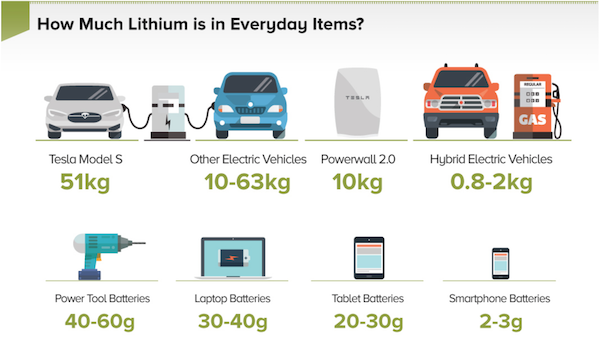
Glencore just upped their stake in two Cobalt mines, a key component of the modern battery. A bigger component is lithium, visual capitalist has a great break down on lithium - Lithium: The Fuel of the Green Revolution


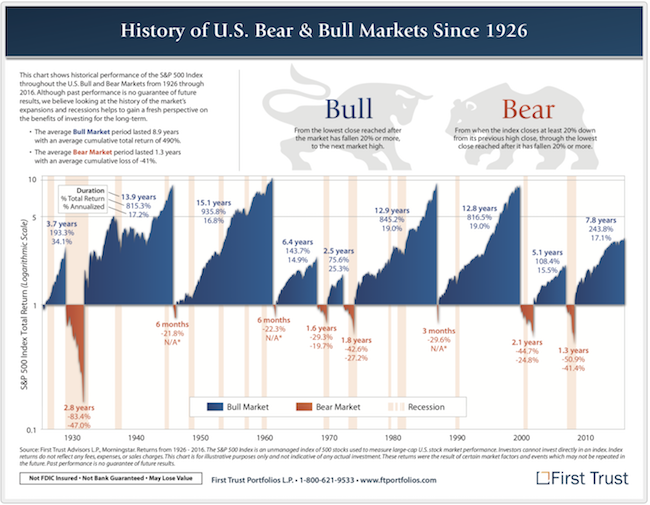
When we talk about having a long term view on equities, here is what we mean - History of US Bear & Bull Markets Since 1926. What a great graph! Note how big the drawdowns are and how long they last for. 30% - 40% pull backs ARE going to happen, this is par for the course when investing in equities.


Home again, home again, jiggety-jog. Stocks across Asia are higher mostly, both the Japanese and Hong Kong markets are much stronger. US futures are up a smidgen. It is that time of the year that the asset managers release their 13F filings, Berkshire Hathaway said that they had increased their Apple stake to 57.4 million shares, up from 15.2 million shares earlier. That is more than 1 percent of Apple. That happened quickly. Berkshire also sold all their Walmart shares. When are they going to own a few Amazon?


Sent to you by Sasha, Byron and Michael on behalf of team Vestact.

Email us

Follow Sasha, Michael, Byron, Bright and Paul on Twitter

078 533 1063

Tuesday, 11 October 2016

A Little Birdie Told Me So


"Last thing about Twitter. We sit here and wonder about the company and their ability to monetise their platform. Here is an amazing statistic. From the 90 minute US presidential debate on Sunday evening, there were an amazing 17 million tweets."


To market to market to buy a fat pig Stocks across the oceans and far away closed better, off their very best levels, as the oil price barrelled higher. Huh? Yes, the Saudis and the Russians, two of the biggest producers of crude have agreed in principal to freeze production. Or suggested that. The Saudi oil minister says that he thought that the the oil price could go to 60 Dollars a barrel. Well, he said that a rally to that level was not unthinkable. Yes. Jeff Currie (who hasn't got it all right) thinks that the frackers would have another say should the price rally hard. i.e. any production cuts from the majors would be met with production by the frackers. The frackers are more nimble and only have one objective, to be profitable. State entities have all sorts of liabilities, current and future. It is what it is, you cannot stop the profiteers from advancing their cause, which is simple. As the Mask said in that world class movie, you can't be the scene if you don't have the green.

Basic materials and energy led the charge last evening, the Dow Jones Industrial Average added nearly half a percent. The broader market S&P 500 closed up 0.46 percent whilst the nerds of NASDAQ added just over two-thirds of a percent, a day in which Apple's star shone brightly. Not quite a 52 week high, that was last November, certainly a year to date high, the stock is up a little over 10 percent. Add on a 2 percent yield and I would take that return year in and year out. Of course we cannot be too greedy! Samsung woes have been a positive for Apple, eish, it is never good to see the wild ride that another company is experiencing. Burning batteries. It is just another reminder of the remarkable engineering that goes into these devices.

At the opposite end of the Apple scale was Twitter, I saw ex-CNBC staffer Charlie Gasparino burning more bridges along the way, making some choice remarks on Twitter. About the Twitter sale that never happened. See this series of low blows:


Oooffff. If you needed reminding of Charlie when he was at CNBC, here goes: Strange Charlie Gasparino, and here is another gem way back during the financial crisis - CNBC's Charlie Gasparino Drunk/Hungover on Air. Really, Charlie is a force of nature. So I wasn't surprised to see this tweet, basically implying insider trading:


Last thing about Twitter. We sit here and wonder about the company and their ability to monetise their platform. Here is an amazing statistic. From the 90 minute US presidential debate on Sunday evening, there were an amazing 17 million tweets. During the 90 minutes, I am sure that there were many more afterwards. This is a record. This is not the Super Bowl or the World Cup Final, it is a presidential debate. And whilst we were getting served these juicy numbers, you would expect this to be positive for Twitter.


Not so friends, the stock was getting poleaxed, down 11 and a half percent on the session. The "buyers" were supposedly lining up, well, they seem to have disappeared in a hurry. I for one suggested that going it alone would be a good thing. They may have to be really patient. And please stop dishing out stock to staffer en masse, it seems that is "not working", at least in the short term. I still maintain that the company should go it alone, the audience is there, they are highly engaged and tweeting more than ever before.

I use Twitter as my number one go to for news. The product is designed to be your customisable news feed, if you are interested in following people that are famous for being famous, then do that, if you are interested in the local news, there are plenty of quality people to follow. I also use it to message people. Next results for this company, 27 October. Perhaps I have undue "faith" in the model, that they will monetise it, it is taking a lot longer than many would have thought. Investors and silicon valley types are all equally hyperactive and unlikely to want to be told this. The old CEO Dick Costolo said something that stuck with me "Once you get it, Twitter becomes indispensable". The biggest issue for them, a lot of people do not get it. And are not going to try any time soon.


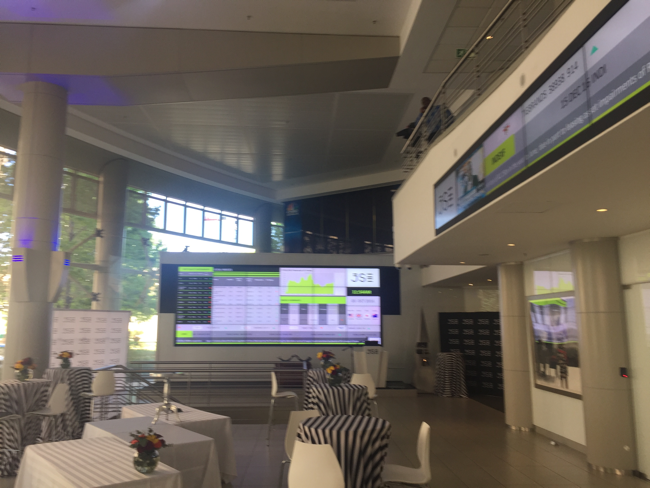
Crossing over to the financial capital of Africa, the JSE sits not quite in the heart of Sandton, close enough I guess. I took a picture of the foyer of the JSE last week, I said I would, and then I promptly forgot to publish it. It isn't what you expect, not much "action" going on, all these boards and multiple floors. Nice and airy foyer though, here is my best shot:


OK, that is horrible. Perhaps I will ask Bright to take a short video or better shot. Darn, that is bad. Or Paul, he goes there each and every day. Stocks on the local front ended about flat. Financials lost one-quarter of a percent, resources were the driver of gains, the oil price drove Sasol to near the top of the winners board, Richemont was the biggest "winner" on the day, up 1.85 percent. At the opposite end of the spectrum was South32, the stock however clocked a 52 week (and possibly all time Rand) high the day before. I think. There was another 52 week low for Brait, the Brexit weight is too much for the company at the moment, the Rand NAV sagging as the Pound tests new lows to the Dollar, and multi year lows to the Rand. Currently 17.06 to the ZAR this morning. One Dollar gets you 13.89 Dollars, One Euro gets you 15.45 Rand. That is spot, you are certainly NOT going to get that from your bank now, are you?


Company corner

Famous Brands have released a trading update ahead of their results on the 24th of October. Those should be exciting, we were discussing Kevin Hedderwick the other day, in person he always downplays his role (a good characteristic), those who have dealt with him suggest that he is really good quality. Not just a chap from East London, someone who has certainly changed a mom and pop type business into a professional outfit with multiple irons in the fire. Recognising that there is a food revolution afoot, they also want to control the supply chain from top to bottom. Controlling the quality of all the ingredients will be key to the consumer coming back and back time again. My wife often tells my kids about her dad's saying, it is not how many people come, it is how many people come back. Quite right.

What is also quite cool about this business, is that according to the last annual report, individuals own one-third of this business. The biggest institutional share holder is the PIC with 10.63 percent of this business. The business was founded back in 1969, it has been around for an absolute age. It has been professionalised over the last 15 years, Kevin was appointed as the managing director of the Steers brand in Feb 2000, he came from a food and beverages background including SAB (as it was back then), Foodcorp and Distell. The family, Halamandaris and Halamandres still own 28 percent (more or less) here. With a market cap of 16.68 billion Rand, as at close last evening (around 100 million shares in issue), the life work has turned into 4.67 billion Rand. And 113 million Rand (before tax) of dividends a year at current levels, forget what they paid for it!

I thought that this was supposed to be about the trading statement? Quite right. Let us do a copy paste of the two exceptional items:

    "- a R141 million derivative gain on the call option that was utilised to hedge the purchase price of the acquisition of GBK Restaurants Ltd. in the United Kingdom, of which details were published on the Stock Exchange News Service ("SENS") of the JSE on 1 September 2016; and
    - a R20 million impairment of the investment made in 2013 in UAC Restaurants Ltd. in Nigeria."


Of course, as Michael points out, if that hedge isn't closed then they are in a bad way now, they have closed that deal, effective date was the seventh of October. I guess that they may have lost some money there. We will have to wait and see how the market reacts. Headline earnings per share are expected to be 67-74 percent higher than the comparable first half, 403 to 419 cents per share. Before exceptional items, HEPS is expected to be around 10 to 14 percent higher, more reflective of a tougher operating environment, that range is 264 to 275 cents per share. The next two reporting periods will include the full integration of the gourmet burger business in the UK. We wait for the half year results on the 24th.


Linkfest, lap it up

Our default status is risk aversion, this probably comes from back in the days when not being aware of risks ended up in you being eaten by a sabre tooth cat. Receiving regular price updates on your asset values means that you are more likely to 'act' to avoid loss with the long term result being that we underperform - How Short-Term Noise Affects Risk Taking

Getting data from A to B across the internet in the most efficient manner is starting to matter more and more. Particularly if you are a High frequency trader, video streamer or gamer - How the company behind League of Legends rebuilt its own internet backbone so that it's faster for gamers. Remember that as a Naspers shareholder you own part of League of Legends.

That article is part of a series that Quartz did on the internet - Map of the Internet. Give it a look, it is well worth your time.

I've never noticed the smell of a new Mac, have you? I understand the new car smell, this seems a bit over the top - Love that new Mac smell? Now you can buy a candle that smells like a freshly-opened Apple product. Does the normal burning smell of a candle represent new Samsung products?


Home again, home again, jiggety-jog. US futures are lower, Hong Kong stocks are lower, Japanese stocks are higher.


Sent to you by Sasha, Byron and Michael on behalf of team Vestact.

Email us

Follow Sasha, Michael, Byron, Bright and Paul on Twitter

078 533 1063
Wednesday, 17 August 2016

Stick to what you know, avoid FOMO

Hey, why haven't you watched last week's addition to humanity, the Blunders weekly release. So that means 6 months of blunders that have been rolling around. Do yourself a favour, watch it - Blunders - Episode 26. It features Fish Paste Oreos, a volcano eruption that threatens humanity, judge us by our car sales rather and lastly, Egypt on the skids again. Subscribe so you don't miss a thing - Blunders - Vestact TV.


"Remember, you do not have to own every single stock out there, you are going to miss periods when other companies share prices are doing better and you feel you are missing something. Stick to the plan, go for what you know. Try and avoid FOMO. Good, I hope that makes sense."


To market to market to buy a fat pig Stocks locally were at their best levels just before midday, financials slipped away, the Rand weakened against all of the majors and the all share ended the session down a fraction. In fact, not even a couple of points lower, which is too small to register a percentage change. The scoreboard will show that the market ended the session lower, yet the percentage calculation suggests a "negative" move of 0.00 percent. That doesn't happen every day, and feels like a tie and three-way silver medal. That was cool. Construction stocks recently have seen a small comeback, albeit from deeply depressed levels.

Murray & Roberts clocked a 12 month high, closing at 15 Rand. For those who missed the hurrah of the greatest football tournament on the planet, which graced our shores in 2010, all construction related stocks caught a serious bid. Rewind 11 years, Murray's (as affectionately known by Mr. Market) was trading at exactly the same price as it is now. By October 2007, a mere two and a bit years later, the stock was at 105 Rand a share, reaching a high of nearly 112 Rand during the financial year to end June 2008. Turnover went from 10 billion Rand in the year ending June 2005 to 26.6 billion Rand in the financial year ending June 2008. The company makes 2 billion Rand worth of profits on 32.6 billion Rand worth of turnover in the financial year to end June 2009. Earnings per share clocks 685 cents a share. The dividend was 218 cents that year (back when there was no dividend withholding tax).

And then everything changes. The financial crisis arrives, every territory catches a bad bout of flu. The company reports a loss in their financial year that ends June 2011. Turnover actually remains steady for the next few years, margins are razor thin and although turnover regularly exceeds 30 billion Rand, profits are patchy (another loss in the 2012 financial year) and the best the company can do is 847 million Rands of profits in the 2014 financial year. Oh yes, and I almost forgot, the company is forced to raise cash at a deep discount (at the time), shares in issue balloon from 331 million to 444 million in the 2012 financial year. Still, although you are diluted (if you didn't follow your rights), the stock price bottoms at 22.95 ZAR that financial year. The next three years are horrible for stock holders, a lack of spend by their clients leaves the construction group fighting in a drying pool of work, forced to compete on price.

In January this year the stock price bottoms out at 6.51 ZAR. The company has been fingered in the collapsed bridge on the M1 here in Jozi. They are fined for further collusive tendering related to a now distant memory of the World Cup football back in 2010. So what has changed between January and now? The stock is up from the worst level seen since 2002, 14 full years ago. And more shares in issue of course. I guess the price has recovered with the rest of ZA inc., thanks to a global belief that emerging markets are not finished in part and secondly that some green shoots are appearing, albeit small and facing tough growing conditions. Does one now believe that the worst is past and you can buy the same company from an era when there were no smartphones, no tablets, no broadband, no Facebook, no Twitter, that era?

Is the construction sector, as an investor, a whole segment of the market that should just be ignored? It sounds crazy, some of the smartest people I know work in the industry. They build tangible things, improve peoples lives along with the architects that design amazing "stuff". The roads and infrastructure they build are invaluable to society. We cannot live without the motorways, the electricity and water infrastructure that makes modern living so convenient. Along with all the economic activity that goes with it. Or is it a case of project risk and changing goal posts being too difficult for investors to understand, most especially retail investors.

Feast or famine. For long only institutional shareholders, like the top four shareholders, Allan Gray (18.86 percent), The Government Employees Pension Fund (17.75 percent), Coronation (15.03 percent) and the Public Investment Corporation (13.44 percent), who collectively own 65 percent of the business, their investment time horizon is forever. For a retail investor that perhaps cannot live with the volatility and does not need to be that widely diversified, the sector is an avoid. Too cyclical, too volatile, margins not good. Remember, you do not have to own every single stock out there, you are going to miss periods when other companies share prices are doing better and you feel you are missing something. Stick to the plan, go for what you know. Try and avoid FOMO. Good, I hope that makes sense.

To add to this piece, I was chatting to an old school, varsity and digs mate pal about the commodities market, something that he knows intricately, having mined in Brazil. Yes, he speaks the language and has been deep in the jungles. I sent him an email suggesting that there were various reasons why we didn't invest in commodities companies either, that is for sharing:

    "I wish I understood the commodity markets better, I understand human nature and their desire to want more things, I understand engineers who are motivated by profitability to do more with less. Hence the same goods will be made of significantly fewer resources in the future and not more. i.e. lower commodity consumption per capita over time, we will also get far better at recycling, of that I am sure. As humanity we are also acutely aware of fossil fuel usage means it is gone forever, ironically this should be your favourite kind. There is of course rich people adoption of alternatives, which is driven more by ethics than economics, as they are rich and can afford it. The greater the adoption, the lower the price will be, without a doubt alternatives will compete with old energy technology more favourably in the next decade. Like most companies and humans, when there are excesses, we fail to provision. We get stuck with recency bias. i.e. if it is bad, it is never going to get better, if it is good, it is never going to get worse."


Again, I would be interested in getting your opinion on all of this! Recency bias is another whole debate, the inability to see past last week and extrapolate forward. In other words, Syria is always going to be a place of conflict (history suggests this may be right), Greek people are always going to have too many benefits and not pay their fair share of taxes, the older generation in Italy and Japan are going to place fiscal strain on government finances, and of course the list could go on. Interest rates in the UK, Europe and the US are never going up and we are stuck with negative rates forever. That sort of thing. We tend to take the moment and immortalise it. No. Things change, and they creep up on you slowly. Like HD TV, like high speed broadband, like smartphone technology, like cloud computing, like different transportation methods (driverless cars). Like robotics. Like Uber. That is a discussion I am sure for another day.


Over the seas and far away, stocks on Wall Street sank towards the end of the session, down between half to two-thirds of a percent for all the majors. why? There are some moments in stock markets that you do not need a reason. An inflation read from earlier in the session showed what we know, there is little or no chance of that keeping the Fed up at night. There were comments from one of the Fed team members, William Dudley, who said that he thought that the labour market was looking good, and by extension they could raise rates.

Jeepers, I have heard this a lot over the last umpteen months, if not years. Joe Weisenthal, aka the Stalwart on Twitter and Instagram, who now has his own show on Bloomberg called "What did I miss" suggested in a tweet exactly that: "Is there any economic debate in which finance twitter was more ahead of the curve than in calling for more fiscal stimulus?" To which he replied (I think snarkily) to his own tweet: ""Like probably 5 or 6 years ahead of the curve.

Twitter finance knows and doesn't know everything, all at the same time. Sorry Twitter, you may want this and that, and scream from your study or desk in your sweats (desks littered with coffee stained papers you should read) that the Fed must do this or that, be sure that someone else is in charge. No matter how much ranting and raving you do, or have done in the past, the Fed will move when they are ready. Their network goes beyond Twitter, the tentacles are more like the lion's mane jellyfish.

Check that one out, 37 metre long tentacles are the largest known to man, longer than a blue whale. The Fed are all like lion's mane jellyfish tentacles, you should shout when someone tells you that you know nothing about the way of the world. That ought to put them in their place. Anyhow, spending valuable time worrying about the Fed is time not spent reading blogs and annual reports about companies. That is our view, and we are sticking to it.


Company corner

Twitter is a company that we have small holdings in for a few people. Which is a good thing, it is small in part as a result of the initial weighting and the fact that the rest of the market has done better whilst the Twitter share price has taken loads of heat. To be perfectly frank, the stock has been a bitter disappointment, the company hasn't managed to get the traction on subscriber numbers that they should have, perhaps it is more niche than we thought. The stock listed with much fanfare, the product is pretty amazing in my opinion.

It is the only customisable news feed any where that exists, small snippets with links to longer stories if needs be. There are images too. There is a whole lot of sarcasm, opinions, humour and unfortunately attacks on individuals. That is a big gaping hole in their armour, the inability to "protect" users. Hatred is normally spewed by unknown people (you can be anonymous) and your tweets can be read and heard by all and sundry.

So there are problems with the platform, the interface isn't all that clear to new and first time users, it is hard to build a network of people to follow. Plus, the advertising roll out method isn't all that clear either, trust me, I have used the interface in order to promote tweets. You do definitely get more bang for your buck with Facebook advertising, you certainly get a much bigger reach with Twitter. Twitter gets far more "roll", it is quicker and sharper.

The inability of the platform to grow the user base is possibly a function of the aforementioned difficulty in understanding how it works. Perhaps Twitter should tell you, as a new user, what to do, who to follow and how to use it. It is second nature to me, I open that app first on my phone to find out what is going on. I also understand that the reason for the plateauing user base is that it is more niche. Some people couldn't be bothered to read the news this way, there is an app for that. For me, to be able to follow individuals and different organisations around the world is very valuable. I would pay for it, if needs be.

So that is the user experience, what about the profitability of the business? Twitter dishes out too much stock to their employees, heavily diluting you the share holder. I understand that competition is tough out there for quality. Revenues at the last quarterly report beat expectations, as did earnings per share. The quarterly revenue topped 600 million Dollars, this is by no means a world beater.

There is a wonderful bull case made for the company in this blog - Twitter Earnings Revolution. The real change will come from videos and the ability for advertising to come through content generated by the networks. Twitter have signed multiple deals for sport and other content, including the aforementioned Bloomberg show by Joe Weisenthal.

Twitter will live stream two Bloomberg TV programs, as well as Football (of the American kind), Baseball, Basketball, Soccer (that is football to others), Ice Hockey and Wimbledon, as well as some European football (of the feet and head kind, no hands involved). Perhaps this is the future, I thought Periscope would be bigger by now, it is the live streaming TV effectively. Perhaps that is harder than tweeting.

This is not for everyone. The stock price has actually rallied hard since results, notwithstanding the fact that we fell hard post the event. Over a year the stock is down 30 percent. Since it listed, it is down 51 percent. The expectations are for the company to make 50 cents of earnings in the current financial year, which means it trades on around 40 times earnings. With the growth not seen as tearaway, perhaps that is at the top end of the valuation metrics. Part of the reason for a stronger share price recently is that they may well be a takeout target. Someone would have to pay a premium over and above the current 15 billion Dollar market cap, unlikely with the direction fuzzy.

Having said that, I like the platform, it is very valuable to their core users. It becomes indispensable. Unlike Facebook, they only have one platform. The main reason that they haven't succeeded (and have succeeded, they have 312 million monthly users) is as a result of being direct. Paul pointed out this Vanity Fair article - Twitter is betting everything on Jack Dorsey. Will it work?, where the author points out: "From the moment it was born, 10 years ago, it has existed in a near-constant state of chaos."

A stable management team will no doubt put the business on an even keel. If you hold them, keep them. There could suddenly be major traction in another business shift phase, higher advertising, more structure. Perhaps Twitter needs their Ruth Porat (Alphabet CFO from Wall Street), their Sundar Pichai (internal professional Google person, who is now the CEO of that division). Stability and professionalism needs to rule the roost. Legendary investor Peter Thiel suggested that it was horribly mismanaged and there was a whole lot of pot smoking going on. Talk about taking green to a whole new level. There is nothing like a very soft share price to remind you that with an idea and a community comes hard work. User adoption of another network means you lose. I suspect that Twitter will crack it. It is a solid hold at best, meaning that if you have them, keep them. Until there is a sign of improved management of resources, that is the furthest I am willing to go.


Linkfest, lap it up

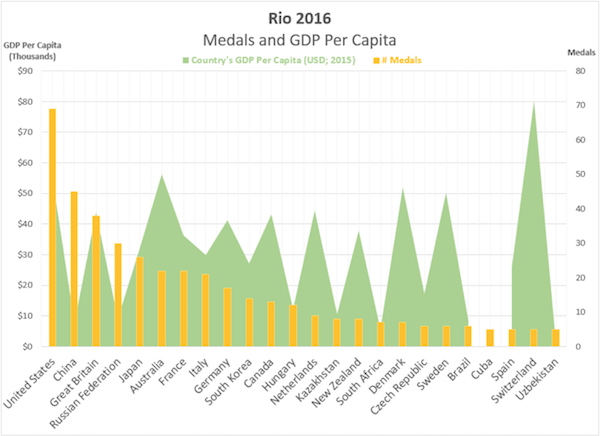
Which nations get the most medals? Well the nations that spend the most on athletics, which seems obvious. There doesn't seem to be much of a link between medals and GDP Per Capita - Medals, GDP, and the 2016 Rio Olympics


Having a water proof iPhone will be a great feature addition, especially for those of us who use the phone as an exercise performance tracker - Rumor has it Apple's next iPhone may be waterproof. My current phone survived a swim while ridding my bike, so they are durable to a degree.

A quick video showing how Olympic winning performances have progressed over the last 100 years. How much more can technology help in breaking records? - It isn't Olympians who have evolved. It's sports.


Home again, home again, jiggety-jog. Yech, can you believe it. We spelt Wayde wrong. Sorry. One of the things I was taught early is not to get the spelling of a name wrong, equally, not to ridicule a name. That is one of the things that is difficult to change and many people are reluctant to do that. Let me share a story, I took my dog to the vet for inoculations when she was a little puppy. The woman behind the counter said "name" to which I replied "Sasha". She then said, "no-no, your name?" I said, "that is my name" to which she proceeded to hide under a pile of paper that existed on her desk. Sasha is a diminutive for Alexander, which is my only given name. The second part, Sander somehow became Sasha. Like I say, don't ask me, I just work here. When people ask "how is that possible", I normally say, well, how do you get Dick from Richard?

Markets are mixed with to start, at the get go we are a smidgen higher. Good work Alex/Sasha .... the Alex column? The Lex one dates back to just after the end of the Second World War in the FT. The Alex blog dates back to 2003 sadly, there is some way to go. Luckily there was no war event preceding it, at least at a global level.


Sent to you by Sasha, Byron and Michael on behalf of team Vestact.

Email us

Follow Sasha, Michael, Byron, Bright and Paul on Twitter

078 533 1063
Wednesday, 18 May 2016

Yebo Gogo


"Whilst Vodacom is not a broad part of our client portfolios, it certainly does have an important place. Even if earnings don't show material moves higher, the company is likely to continue to show good dividend growth. In an increasingly volatile world, locally that is. Having said that, the company still has a large portion of their earnings in South Africa. Which is seemingly MUCH better than being in Nigeria, even if only for the next little while. We are still buyers of this company for our higher yielding portfolios."


To market to market to buy a fat pig Oops. When a Fed official says that the US economy is strong enough to withstand a rate hike in June, next month, that should in a way be a cause for some sort of celebration. Not to be however, Mr. Market in New York, New York (sing it old blue eyes style!) was trading down around half a percent until Fed official Dennis Lockhart spoilt the second half. For the bulls of the equity market, that is. It can't necessarily be said that this is bad for those with cash, who have seen near zero rates for around one-third of a generation. He wasn't alone - Fed officials Williams, Lockhart stress that June meeting is 'live'. John Williams, the lesser known of the two and Lockhart both stressed the obvious. Here is the FT take - Markets underestimate chance of June rate rise, says Fed official.

The upshot of it all was that stocks sold off. The data is encouraging they said, inflation is a little hotter from a recent read (yesterday) and as such the Fed possibly need to act. I just can't understand how that is a sell, sell, sell scenario. Surely if the data is encouraging, that means the US economy is slightly hotter than people are currently giving it credit for. The other upshot, as pointed out by Barron's - Yield Curve Flattens as Fed Officials Say June Hike is Possible.

Mr. Market's freak out meant that stocks sold off, sell first and then ask questions later. The Dow ended down just over a percent (after gaining a percent the session prior), the broader market S&P 500 lost less than a percent whilst the nerds of NASDAQ sold off around 1.25 percent. Only energy and materials stocks gained, pretty much everything else sold off. Sigh, I suppose that we are stuck in this part of the cycle where Mr. Market makes sweeping conclusions about almost everything. I guess it always presents us with opportunities, when the same stocks sell off based on some large macro view, then so be it. We should actually be thrilled. A very deep piece about why you may well want to kick the macro view to the curb: The Power of Stories.


Company Corner

Vodacom reported full year numbers on Monday. The company traces its heritage back to the dawn of democracy in South Africa, I had the pleasure of being at a dinner birthday function and sat with a man who was part of the team that wrote that there would be a maximum (at the time) of 250 thousand users of the mobile service. Phones were big and clunky and took calls only, remember? It is a little difficult to believe that the touchscreen smartphones are not that old, and in terms of being mainstream, less than a decade. The iPhone is not even 10 years old. Remember the Symbian operating systems on the Nokia? Remember Nokia? Remember Windows phones, how huge that was going to be. It is Android and iOS now, to be fair there are others, not as dominant as these ones.

So why is this at all important for Vodacom? The more amazing the hardware and software, the more chance there is of consumers using more of their services, in particular more recently data. We dredged up an ancient video of us picking up a Nokia N97 and predicting more people would use the device more. And encouraging the investment in MTN, that has been the company that we have owned for years. For the time being we have been very wrong on that one, Vodacom has comfortably outperformed MTN on the returns stake for quite some time now. We continue to remain patient and await the resolution of the pending fine in Nigeria. Whether or not you think that the quantum (we don't) of the fine is "fair" or not, that is another question entirely.

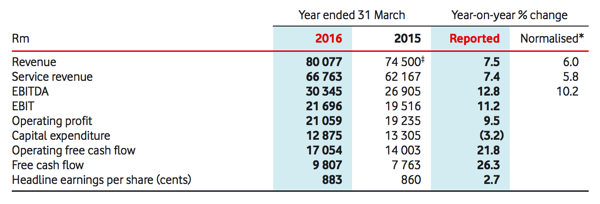
Back to the results at hand, annual ones for Vodacom. Herewith a table with the comparable year:


Whilst Vodacom is not a broad part of our client portfolios, it certainly does have an important place. Even if earnings don't show material moves higher, the company is likely to continue to show good dividend growth. In an increasingly volatile world, locally that is. Having said that, the company still has a large portion of their earnings in South Africa. Which is seemingly MUCH better than being in Nigeria, even if only for the next little while. We are still buyers of this company for our higher yielding portfolios.


Google I/O starts today. You can watch it all live via that link. Which means no expensive flights and jet lag, no hotel and fast food (just the junk you'll eat at your desk whilst you watch this delivery) and most importantly, you can stay put in your pyjamas if you want. Perhaps it will be warmer in San Francisco than it is here. The full first day schedule includes the kick off by CEO Sundar Pichai. Pretty cool three day event for all things Google and all things Android. I was doing a little snooping for my Vodacom piece yesterday and discovered that there are roughly 24 thousand unique devices that run Android operating systems. Yowsers.

For a preview of what to expect at nerd central over the next few days, TechCrunch has written this,Here's what we expect, that includes Android N, the next operating system, a real and proper virtual reality headset, as well as a home/personal assistant type device to rival Amazon's Alexa. Remember that (and the article reminds you) Google (Alphabet, sorry) bought Nest, a home automation business, in January of 2014. All sorts of nifty things have emerged, including this one - Linus, a secured by Yale and connected by Nest solution. I am guessing with that one, the power is going to have to always be on, or a battery back up system, your device had better never run out of batteries. The plus side is that keys could be a thing of the past. Expect nerd central to hit fever pitch over the coming days!


What does a picture tell? A 1000 words is what we were taught. Twitter has actually taught us that it can be 23 characters, 19 percent of the characters. Now when you are dealing with useful "insight", 23 characters as to the 140 character limit can cramp your style. Equally a link to an article takes up your valuable 140 character real estate. Twitter's response is seemingly to exclude both images and links from your amazing insight - Links, Photos Won't Count Against Twitter Limit. Think more carefully before you tweet next time, OK?

Why is Twitter doing this? It seems pretty simple, if you follow the link in the PC Mag article, you will see that photos get a 313 percent more engagement than just a line or a link - #TweetTip: use photos to drive engagement. As for Twitter stock, that is another story altogether. Trading near their 52 week lows, the company operates in what is clearly the future of media, yet the failure to get Mr. Markets endorsement on very patchy earnings has seen the stock rerated. Those of you who follow us on Twitter, would you prefer to see more photos from inside of Vestact? Let us know, to improve the experience.


Linkfest, lap it up

As global poverty levels drop the distinction between "developed" and "developing" is getting more blurry - The World Bank is eliminating the term "developing country" from its data vocabulary.

One way to see if a currency is over, or under valued is to compare the price of goods. Theoretically the price of goods should be relatively similar between countries. The most famous comparison between currencies is the Big Mac index, based on that index the R/$ should be at R/$ 5.68 - The Big Mac index. Notice how emerging market currencies have been the most sold off. One thing to note though is that the index doesn't take into account the cheaper rent and wages paid in RSA compared to the US.

Alternate investments generally charge more, use leverage and are seen as an investment tool for the wealthy or sophisticated investor. How do you measure the performance of these funds though - How Should Alternative Investments Be Benchmarked?

Do you want to know how Netflix can spot a new show and stick it on their popular streaming service. It turns out that Cindy Holland, who has been at Netflix for nearly 14 years according to her Netflix profile, is driving this hard. A rare interview given - How Netflix Exec Cindy Holland Spots A Hit Show. Related in some way, Holland finds herself on the list of The Most Creative People in Business 2016.

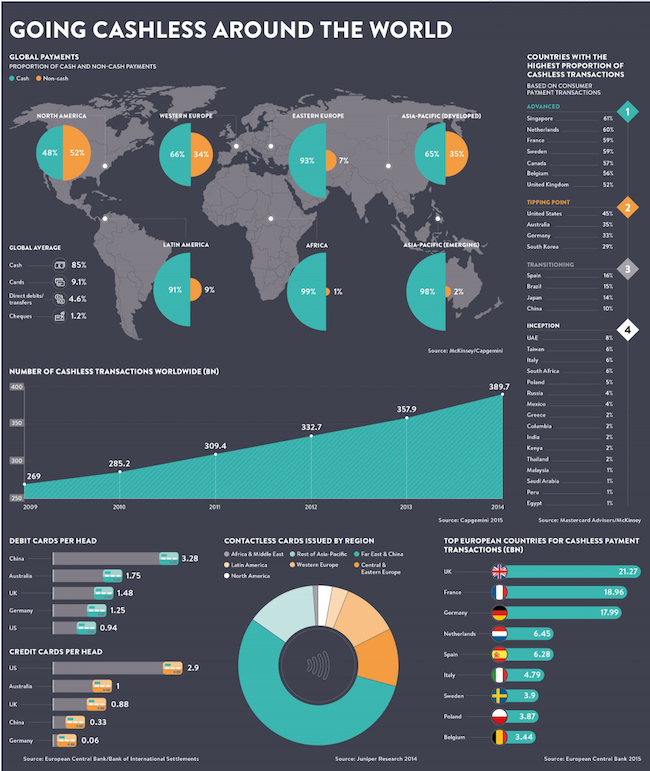
Visa, MasterCard? Apple Pay? Android versions of Pay and so on? This is pretty darn cool - The Shift to a Cashless Society is Snowballing.


Home again, home again, jiggety-jog. Hey! Tencent results today. This is big news for our shareholders of Naspers of course. Those results are normally received after the Hong Kong close and before the US open, so around 11 to midday local Jozi time. Those are most exciting and we will report in the coming days on the results. I do wish that Google Finance would fix the split of the Tencent stock in Hong Kong on their graphing tool, it is all a bit weird to see that massive step down, have a look and let me know what you think.


Sent to you by Sasha, Byron and Michael on behalf of team Vestact.

Email us

Follow Sasha, Michael, Byron, Bright and Paul on Twitter

078 533 1063
Friday, 12 February 2016

Bad news sells


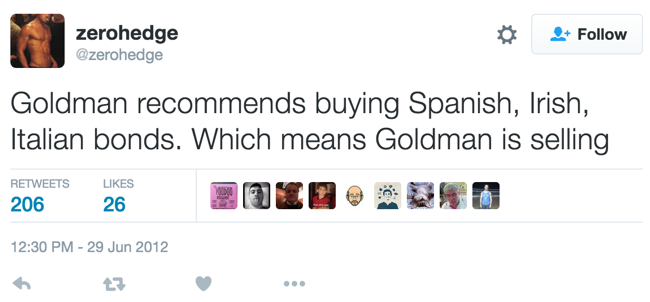
"OK, back to the point at hand, the sell offs and how long they lasted and what the response was at that moment in time. I am going to also take the responses from the great doom Twitter account (his world is always ending) ZeroHedge (the doom attracts 311 thousand followers) and the voice of reason, Eddy Elfenbein, as well as our own Paul Theron"


We are very pleased to announce the debut of Business Blunders the YouTube version. Paul is innovative and as long as I have known him is someone who is always looking to stay fresh. In fact the older he gets, the wiser he gets and he stays hip. He is possibly the fittest I have ever seen him. OK, enough of that, I am not looking for a raise here, I am trying to introduce what will be a fun segment, you must equally do two things when viewing this "video". Subscribe to the YouTube news channel after watching this Blunders - Episode 1. Or even better (and easier), go sign up for the video link to be delivered to your in box: Blunder Alert! Tell us what you think!


To market to market to buy a fat pig I was prompted by a post of a relatively young, London based Bloomberg journalist's blog on the global market nearly entering bear market territory (down 20 percent from recent highs) to do a little exploratory work on recent vicious sell offs, and to test the memories of my colleagues. It always feels completely awful when you are in the midst of a market sell off, you cannot recognise whether or not this is part of something that is likely to continue for an extended period of time, or whether the confidence will return, the world really isn't finished and better company earnings guide prices higher. Being pessimistic does attract people to your theories, you always seem to hold the secret sauce that everyone yearns for.

I set out to check all the sell offs over the last half a decade, keep it to those time frames. After all, lots happens during a relatively small period of time in history, yet at the same time, much doesn't change either. People who work at organisations for a generation can tell you of hard and easy times, they can tell you of how the company managed to do x or y in response to a crisis, or perhaps how they wrestled market share away from their competitors with better delivery or superior products. In fact, I would love a three paragraph piece on your experiences in a specific industry and how you have seen it change. Most especially if you have been around in a single industry/company for two to three decades. I would love to hear how "things" have changed. How spreadsheets have made your life both easier and harder. That sort of thing. Send it!

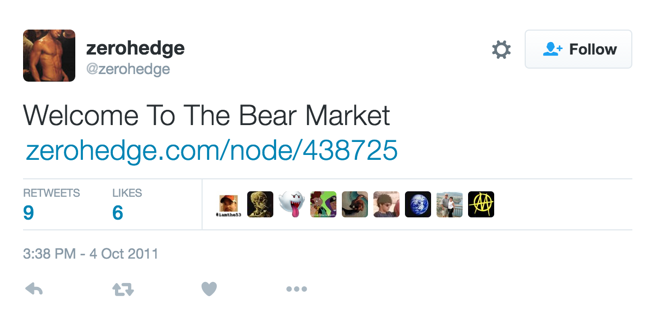
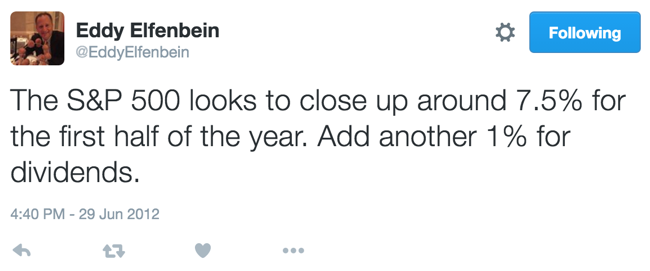
OK, back to the point at hand, the sell offs and how long they lasted and what the response was at that moment in time. I am going to also take the responses from the great doom Twitter account (his world is always ending) ZeroHedge (the doom attracts 311 thousand followers) and the voice of reason, Eddy Elfenbein, as well as our own Paul Theron. First, in the middle of 2011, from late July 2011 to the beginning of October 2011 the S&P 500 fell from around 1343 points to a low of 1074 points, a loss of around 270 points, down around 20 percent, what would be referred to as a bear market, not so? Standard and Poors had downgraded US debt, yields on Greek debt was at a record high, the debt crisis in Europe wasn't contained. At the depths of the market despair, what was ZeroHedge saying?

Stuff like this:


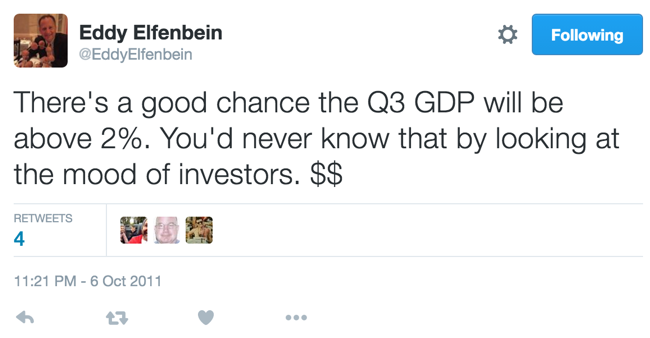
Which led you to this "news" from the anonymous fear feasting blogger: "The S&P 500 is now over 20% lower from the highs, and we are officially in a bear market. Gun to our head, and with an eye on where MS is trading, we are going much lower. But even gun to our head we are unsure if the S&P will enter triple digits first, or if that will be preceded by Morgan Stanley "Benjamin Button-ing" its teenager status..." There you go, the market was going to single digits, MUCH lower, you should stick a gun to your head, they said. What did voices of reason say? Eddy said this:


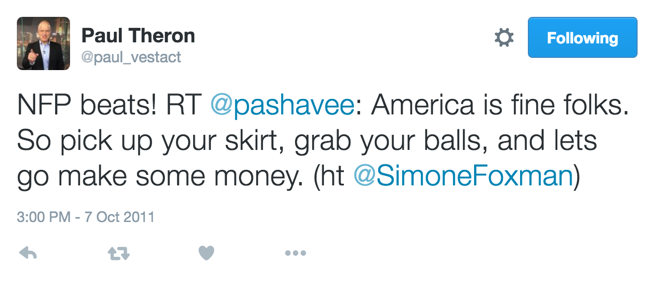
And then Paul? He was a little less subtle, this was pretty hilarious, Paul retweeting a fellow:


Since ZeroHedge said we should have stuck a gun to our heads the market is up nearly 62 percent, the broader market S&P 500 that is. That has been the Dollar return for equities. {Insert heavy dose of sarcasm} Not bad for a world that was going to hell in a handbag.

It didn't take long for another bout of heavy selling to ensue, stocks were sold off heavily during the course of the end of April 2012 through to June 2012. Stocks sold off on the S&P 500 from levels of 1405 to 1277, down around nearly ten percent, or a "correction" if you prefer technical language, which I certainly do not. Again a period in which Europe was dominating the headlines, the emergency loans, Angela Merkel scrambling, Mario Draghi also pleading and scrambling himself. So of course the end was nigh, ZeroHedge:


In a related post from that day (the 29th of June) on the update from the Europeans, ZeroHedge said in a post titled Hardball In Brussels: "The markets are rallying but the realization that nothing really was accomplished, meaning implemented, will drive the markets the other way soon I fear." And then Eddy, what was he saying? Obviously not bearish:


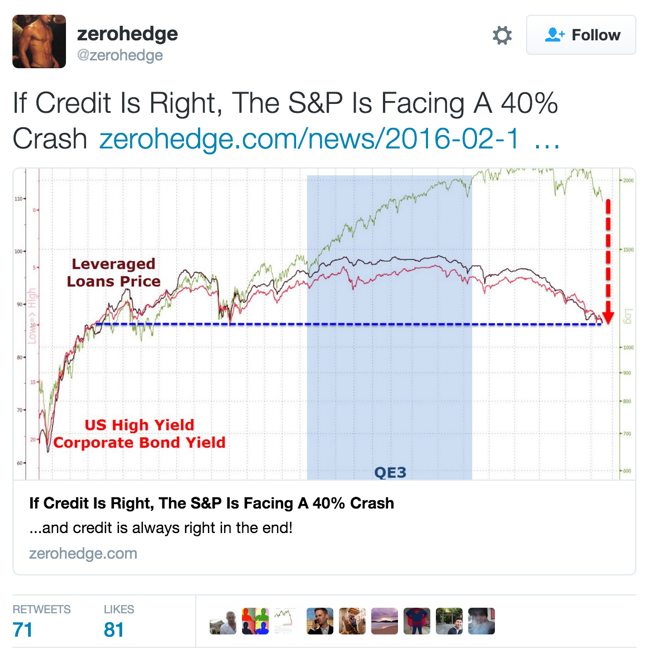
I think you get the point. I could go on currently, this is what ZeroHedge is "saying" and the tweets as you always see get retweeted furiously:


Of course being bearish makes for very compelling reading. You could possibly go all the way back on the bearish peoples timelines and see whether or not they ever change their tune. As with us. We advocate the long term holdings of companies (and not share prices). It is very important to remember that you own stock which reflects the outlook at any one given point in time. Those folks who bought Facebook at their disastrous IPO feel fine right now, those who own Twitter and equally participated in their IPO feel awful. Both companies have different sets of outlooks, and the market is pricing them accordingly. In his weekly letter Eddy had this to say on current valuations:

    "The drop in medium-term rates has been a strong signal for prudent investors to focus on stocks with generous dividends. Let's work some simple math. A five-year Treasury currently pays you 1.11%. That's above half the dividend yield for the S&P 500. For the return of stocks to match the return of the five-year, stocks would have to decline by 1.11%, on average, for the next five years (this assumes dividends remain the same). That would bring the S&P 500 about 100 points lower by February 2021."


We would continue to advocate that owning stocks is a far better outcome than current fear suggests, negative yields everywhere. Whilst market sell offs are unnerving, if you have spare funds, add them when the moment, like now, arrives. Whilst you can never catch the perfect bottom, you can own quality assets at a cheaper price. Stay the course, own the company, the clouds pass. for the time being it feels bad, I just thought a little perspective may be in order.


Company corner

Woolworths released six month results yesterday morning. We had already been sort of primed during the course of last month, the 26 week trading statement was released on the 14th of January. Group sales increased 17.1 percent, if you exclude David Jones (acquired on the 1 August 2014), sales grew by 12.3 percent. Basic and headline earnings grew 52.8 and 44.9 percent respectively. Headline Earnings Per Share grew by just 3.6 percent, remember that there are far more shares in issue now, due to the rights issue. Clothing and General Merchandise sales grew 12.5 percent, a pretty pleasing result. The Food business grew sales by 12.1 percent, with price movement (inflation) of 5.7 percent. It all looked OK, Ian Moir suggested in an interview that they continued to take market share across their respective businesses.

There are some *nice* graphs in the analyst presentation, showing you the Woolies diversity, both geographically from a revenue perspective (43 percent Australia, 57 percent Africa) and from a turnover per segment. That is as follows, 14 percent Country Road (take me home), 20 percent Woolworths Clothing and General Merchandise, 36 percent Woolworths Food and the balance, 30 percent being David Jones (and his locker). Problems seem to be Womenswear in their Country Road stores down under. C'mon Sheila. It is also important to remember that this six months is being measured against five months of David Jones, on that basis, David Jones is not that flattering.

The outlook is mixed, whilst the group concedes that their core clientele in both South Africa and Australia are by no means immune to a global economic slowdown of any sort, their trading for the first six weeks of this year was in line with the results for their first half. Their plan of action is to review their cost base and continue to sweat CAPEX as best as they can, I suppose this is always a natural response.

I like the CEO Ian Moir, I think that the group has done an amazing job with the clothing over the last half a decade. My kids actually prefer this destination to all others, when it comes to clothes and food. I do too, I have shareholder user biases unfortunately. You have to use the products that you are a shareholder of, that is the way that it goes in my family, and generally in this office as well. It does also help to get the user experience, talk to the staff, observe subtly.

The stock however got pounded like a tough steak on a day that the rest of the market was selling off heavily. In part there were a couple of reasons, I will include a few from the presentation. "South African economy likely to become more constrained". Yip, sounds about right, I think that this is kind of overstated, we are not Greece (to paraphrase the Spanish prime minister Rajoy). And then "Australian economy and retail environment to remain tough in the short term."

The real clincher I guess was the Janet Yellen line: "Both economies are commodity-based and therefore reliant on China". This is true. We do both (Ourselves and Aussie) have more diversified economies than say for instance Russia, or Angola, or Nigeria for that matter. One line in there that we liked equally: "Expect the upper income consumer in both regions to remain relatively resilient." Also true, whispers are of increased taxation for high income earners here in South Africa might test this theory. I still think that Woolies offers a quality proposition, i.e. you get what you pay for. Their returns policies are excellent, their staff is incredible when compared to their competitors. Shoppers judge value for money.

The stock closed down 7.65 percent on the day. Their "sector peers", stocks like Truworths and The Foschini Group sank 3.74 and 5.86 percent respectively. Pick n Pay lost 0.59 percent, Shoprite 1.1 percent, those are the food retailers. So I guess you could say half the market and half the results that were not well received. The company does currently command a higher multiple relative to their peer grouping, that is perhaps one of the reasons. Whilst we note that there are several speed bumps and major obstacles, we continue to feel that management execution will be spot on and their target grouping will continue to be resilient, and newer customers will be attracted to their quality offering. We maintain our buy rating on the company, accumulate on weakness.


Twitter had their full year numbers on Thursday (Twitter Q4 and Fiscal Year 2015 Shareholder Letter). The stock has been under pressure and these numbers didn't help give the stock a leg up. Over the last year the stock is down a huge 70%!

Here is a quick overview of the numbers, full year revenues up 58% to $2.2 billion, 4Q revenues are up 48% to $710 million and the number of advertisers is up an impressive 90% to 130 000. So there has been solid top line growth and good traction made on getting a foot in the door with advertisers, the problem lies in the user growth numbers. There was no user growth between the 3Q and 4Q and only a 9% growth year on year.

For a company that currently trades on a market cap of 5 times sales (after the stock has fallen 70%), you can't have flat user growth. The users are the lifeblood of the company, if eye ball numbers are not growing then you very quickly hit a cap on the revenues that you generate from advertisers. Currently there are 320 million Monthly Active Users (MAU) of which 80% access the site via mobile.

The other problem with being a shareholder currently is that over the last year $682 million was granted in stock options. That is a huge number considering that the current market cap is around $10 billion and that revenues are only around $2.2 billion. Stock options are not a once off expense because once those stocks have been issued, current shareholders then have to share all future profits.

As a daily user of the service, the user experience has got better as of late. Also if you read the shareholder letter they have a long list of ideas/ user experiences currently in the pipeline. For our information driven world and especially for those of us who want news minutes after it happens, Twitter is a core part of our daily routine. I think that in the coming quarters they will start hitting their stride, the unknown hanging over the company with the change up in CEO's is gone and Jack Dorsey seems to have a clearer vision for the company than Dick Costolo did.


Linkfest, lap it up

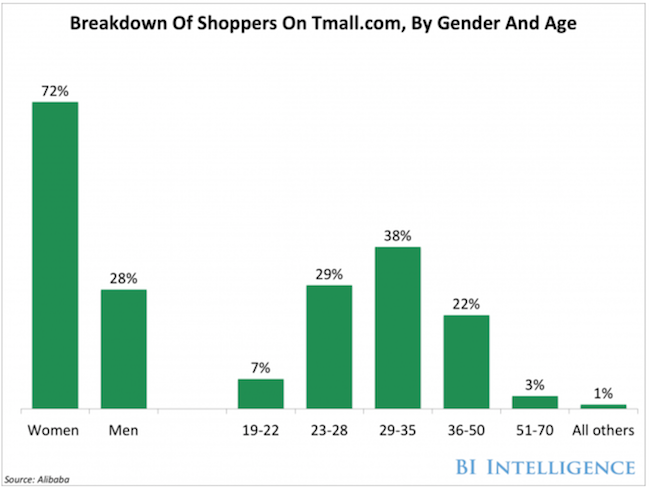
Here is a look at what online Chinese retail demographics looks like.


Im sure that there is a similar trend in brick and mortar shops, does this mean that the men are just better savers or that woman just do all the shopping for the family?

After the clobbering the markets took yesterday here are some reassuring numbers from Ben Carlson - When Global Stocks Go On Sale. History is not the future but in the last 10 global bear markets, there are only 2 occasions where stocks were not higher one year later.

Earlier this week Japan lowered their interest rate into the negative territory. A couple years ago negative interest rates was something that was considered undoable, who would pay to put their money into a bank? Currently 30% of of European government debt has a negative interest rate - Negative Interest Rates.It is easy to hide thousands under your mattress, not so easy if it is millions. People are willing to pay for the security that they will get all their money back, minus the interest they are paying obviously.


Home again, home again, jiggety-jog. Stocks have started on fire here, up sharply. US futures are about flat, stocks bounced hard in the last hour and a half of trade, where they were at their lowest point. I suspect that the buyers are going to return in the coming days.


Sent to you by Sasha and Michael on behalf of team Vestact.

Email us

Follow Sasha, Michael, Byron, Bright and Paul on Twitter

078 533 1063