Wednesday, 20 February 2013

Klippity Kloppers on his horse

"Kloppers is young, only 50, I suspect that he will pop up somewhere soon, there would be a certain irony if he went on to replace Andrew Liveris (an Aussie by birth and in contention for the BHP Billiton job when Kloppers got it) at Dow Chemicals in the US. So, good luck to him and what looks like a really tight family. The fellow replacing Kloppers looks like a magnificent replacement. He has extensive mining and petroleum experience, having worked for both Rio Tinto and BP."


To market, to market to buy a fat pig. Better than anticipated German confidence numbers gave us a really good lift across the board, Germany's DAX rose 1.6 percent and some change. France's CAC went better, adding nearly 1.9 percent on the day, the FTSE closed up nearly a percent on the news. Most of these markets all buoyed by that ZEW data. The ZEW is a non for profit research organisation, staffed by 183 odd (very smart no doubt) folks who publish all sorts of economic papers. And this monthly sentiment read as per their website is where around 350 financial experts are surveyed. Interestingly, not only does the survey ask about Germany, but also the large economies of the world too, including the Eurozone.

Unfortunately the yellow metal is getting no loving. This is really bad for our local miners, who after having worked hard at downsizing to more profitable ounces produced, now they have to deal with a weaker metal price. The most unfortunate part comes as Gold Fields unbundles Sibanye Gold from their stable, to focus on their higher quality assets. Adding the two share prices back together and unfortunately the move has coincided with a gold price that has been crushed. When the company announced the split, the Gold Fields share price was at 105 odd ZAR a share. Add the current Gold Fields price, last at 8269 and Sibanye Gold, last at 1269, and I get to nearly 95 and a half Rands. A drop of over 9 percent. Granted, the Rand has strengthened and the gold price has fallen in that time, but at face value many will say, "oh well that didn't work". A year or two of results first before making those comments, but it might not look pretty in a while from now.


We have a long standing {insert word that rhymes with spoke/smoke/broke} in the office here, where Byron can't sleep before the BHP Billiton results because he is so excited. Of course that is not true, but we always have a chuckle. Not laughing I guess is Marius Kloppers. Or perhaps he is, who knows? We did know that he was going to retire at some stage, that was telegraphed last November. This morning, along with interim results, Marius Kloppers has announced his resignation. No doubt to spend more time with his fishing rod, I mean his family and garden. Kloppers has been at the helm of BHP Billiton since the 1st of October 2007 when Chip Goodyear resigned. Previous to that Kloppers ran the Non-Ferrous Materials division, and has been at the group since the beginning in 2001. Kloppers went to school just down the drag here, at the corner of Jan Smuts and Empire, at Helpmekaar.

Kloppers has worked at Mintek and Sasol for a short amount of time. He first however obtained a chemical engineering degree from Tuks and then he managed a Phd from MIT. That was not good enough, he went on to get an MBA from INSEAD. And he is a vegetarian, so no horse meat has passed through those lips. I found quite a *nice* old bio in the FT of Kloppers, it is worth a read: Man in the News: Marius Kloppers. Because the retirement coincides with an expected slump in profits, comparisons are drawn between Cynthia Carroll of Anglo American and Tom Albanese of Rio Tinto. But, if you quickly look at the respective share prices from when Kloppers took over, you can quickly tell that he has done a whole lot better. Kloppers took over on the 1st of October 2007, the month coincidently that the Dow Jones and S&P 500 reached their all time highs, so that should have been near the top I guess. Since then, to present day, BHP Billiton is up 35 percent in London. The FTSE 100 is down over a percent since then. But more importantly, if you want the Carroll and Albanese comparison, then you will quickly see that Anglo American is down 37 percent since then, and Rio Tinto is down 8 and a quarter percent. So there you go, if you needed a comparison.

Kloppers is young, only 50, I suspect that he will pop up somewhere soon, there would be a certain irony if he went on to replace Andrew Liveris (an Aussie by birth and in contention for the BHP Billiton job when Kloppers got it) at Dow Chemicals in the US. So, good luck to him and what looks like a really tight family. The fellow replacing Kloppers looks like a magnificent replacement. He has extensive mining and petroleum experience, having worked for both Rio Tinto and BP. This replacement does tell me that BHP Billiton are increasingly going to move towards the energy side of their business, something that they have been doing already of course. Andrew MacKenzie was actually hired by Marius Kloppers from Rio Tinto, where he spent 4 years, the previous 22 years had been at BP. In his last years at BP, MacKenzie was working for BP's petrochemicals business in the US. He seems like a wonderful replacement, I suspect that he definitely will be a one term guy, six odd years, because by that time he will be 62 or so. An excellent end to a career at BHP Billiton and a wonderful replacement in the form of MacKenzie ushers in the "energy" era for BHP Billiton.


Now, we can actually get to the interim results themselves having dealt with the management change over at BHP Billiton. Revenues decreased by 14.1 percent to 32.2 billion Dollars. Phew, that is a big number for a materials company. Underlying EBIT fell 38 percent mostly as a result of inflationary pressures, a weaker US Dollar and of course the most obvious one, lower commodity prices. Better volumes and good cost controls were not enough to offset the decline in underlying commodity prices. Profits excluding exceptionals clocked 5.7 billion Dollars, but attributable profits including exceptional items of 1.4 billion Dollars slumped 58 percent to 4.2 billion Dollars. This is the part that you could be forgiven for thinking that Kloppers was pushed as a result of lower profits. The last time I checked, Marius Kloppers himself had very little sway over commodity prices. The company continued to divest from non-core assets, remarkably asset sales totalled 4.3 billion Dollars (announced and completed) for the half. Astonishing, translate that to Rands at the current exchange rate, 8.835 and you get to almost 38 billion Rands. Or basically a company locally that would just sneak into the top 40. Wow.

The impact of the lower commodity prices was across four divisions, Iron Ore where total price variance was 3.169 billion Dollars. Phew. Metallurgical coal experienced a similar thing, total price variance in this half topped 1.6 billion Dollars. Add in energy coal at 439 million Dollars and the Aluminium and Nickel business at 385 million Dollars, and there you have the difference. Held sway by the fast moving commodity prices and a function of supply and demand, restocking and running down of inventories, who knows the truth behind the Chinese slowing? That leadership change conference in November was key, both to confidence in the Chinese economy as well as the newer leaders being committed to continued infrastructural development. That said, Chinese commodity demand is moderating, expectations are still however that demand growth rates are set to be in the 2 to 4 percent range per annum for BHP Billiton's core products. Energy, copper, iron ore and metallurgical coal no doubt.

The sensitivity of the moves in the underlying commodity prices is remarkable, a one Dollar a ton move in the iron ore price has a 110 million Dollar impact on the company. A one Dollar move in the price of a barrel of oil amounts to a 45 million US Dollars swing. The other big factor is a one cent move in the Aussie Dollar relative to the US Dollar, that swing is as much as 110 million Dollars. All these important swing factors are found on slide 34 of the BHP Billiton interim results presentation. The last slide is most interesting, their three core businesses, the petroleum, iron ore and base metals all separately have higher EBIT margins than the average group margins. Equally, margins have been falling in an "uncertain" commodities pricing environment.

The company announced cost savings of 944 million Dollars, around 1.9 billion Dollars on an annualised basis, shareholders will no doubt be pleased with these initiatives. But the part that we care about most is direction, and perhaps always in the present, valuations. Excluding exceptional items, the company made 106.8 cents per share, a 43 percent drop, but still boosted their dividend by nearly 4 percent to 57 US cents. At current Rand/Dollar exchange rates that translates to 9.43 ZAR of half year earnings and a dividend of 503 cents per share. On these numbers if you annualise the half, the stock is not dirt cheap anymore. But, and this is a big but, I suspect that the gas assets will start becoming more and more important to the future of the company.

The few research notes that I have read so far suggest the appointment of MacKenzie means business as usual at BHP Billiton and no earth shattering deals. The company will continue to invest in their businesses where they see future demand. This is key to the future, it might sound like a simple thing to get right, but this company has importantly the quality, the geographical and commodity mix diversity to see you through the cycles. And the last cycle was severe, about as bad as you are going to see. We continue to recommend this company as the core part of our client portfolios to leverage off the longer term commodities consumption story in developing countries.


    Byron beats the streets. Yesterday we had another trading update from a big recommended stock, Bidvest. And it sure was a nice surprise. But, like the Massmart one, there were lots of moving parts. You see, last year they sold a stake in Mumbai International Airport which resulted in an abnormal profit of R399 million. That means that the last comparative period has an abnormally high base.

    The statement says that if you exclude the abnormal profit (which is perfectly normal as it is a once off) headline earnings per share are expected to be between 17% and 19% higher for the 6 month period ending December 31 2012. This is compared to the 6 months in December 2011 where the company made 613c.

    If you add 18% middle of the range to 613c we should be expecting R7.23. Expectations for the full year are for around 1527c of earnings. This makes sense, the second half normally outperforms the first. Trading at R232.50 the stock trades at 15 times this year's earnings. But that is not the only reason we hold them. We feel there is a lot of value to be unlocked and the sum of the parts is worth more than what the market affords the stock.

    As far as growth in earnings is concerned, 18% is very commendable for a company who boasts revenues of over R139bn. They are a great proxy for growing economies around the world and then of course you are buying the M&A skills of the legendary Brian Joffe who I am told is one of the most talented negotiators in the country and clearly has a great eye for a good deal.

    Bidvest made two deals at the end of last year which looked very compelling, targeting the growth of the South African consumer. That is how conglomerates work. They use their size and scale to take a small business and grow it faster than if it were operating independently. It makes perfect sense, access to capital, lots of potential synergies and of course the intellectual talent the company has built over the years.

    We are optimistic about global GDP growth and even more optimistic that Bidvest can outperform that. The stock price has had a good run of late, coming from R180 midway through last year to R232 today. When the full set of numbers come out we will look at the actual business in more detail but as far as the trading update is concerned, we are happy to add to the stock even after the share price has rallied.


Crow's nest. Local CPI was lower than anticipated, which is great. BHP Billiton is getting drilled, this is not what people were looking for, even though surprisingly it was a beat. It is pretty much lower across the commodities complex this morning. The gold price is below 1600 Dollars per fine ounce. Yech.


Sasha Naryshkine and Byron Lotter

Email us

Follow Sasha and Byron on Twitter

011 022 5440

Tuesday, 19 February 2013

Shoprite slips on sloppy outlook

"Shoprite is still very much a South African business, with the fast growing non RSA business contributing 12.3 percent of group sales in this first half. For the full year to end June 2012 that number was 11.0 percent. Phew, that is growing at a serious click. At the full year stage the presentation documentation suggests that 100 million folks went through their Non RSA stores. Wow, now that is a big number. Angola strangely at that point (June 2012) was their biggest contributor to non RSA sales. You might have been forgiven for thinking that Nigeria would be the place where it was happening for them."


To market, to market to buy a fat pig. Yesterday was rather quiet as the Americans were closed for a holiday, presidents day. It was a chance to reflect on the 43 presidents before the current sitting one. Currently there is George Bush senior and junior, Bill Clinton and Jimmy Carter, who is 88 years old. So, out of the 44 presidents that there have been in 74 different terms (I think I have that second part right), five are currently alive, including the sitting president. But presidents day is the celebration of the 1st American president's birthday, that of George Washington. And all the subsequent presidents get "celebrated" too. Although the NYSE was only founded in 1817, there was an earlier agreement, the Buttonwood agreement signed under a tree by the same name, in 1792. 3 years after independence from the British. And from there was born the best example, in scale, known to man for opportunities to be successful in the business place. Democracy coupled with capitalism made America what it is today. And don't you dare say nearly bankrupt.

Talking democracy, yesterday was perhaps the start of something fresh and new that I suspect the chattering classes were waiting for. The 65 year old, but still very health looking Dr. Mamphela Ramphele started a new movement which will lead to a new political party to contest the 2014 elections. She has launched Agang, which as per the Facebook page translates to "Build South Africa". Agang in the Nguni languages means Build. Is this something to get really excited about? Like I said above, democracy and capitalism combined together are truly a great mix for wealth creation. Dr. Ramphele covers all the necessary bases, the historical connection to Steve Biko is huge and shouldn't be completely discounted. That said, she is an academic, she has been involved on the world stage at the World Bank, she has been involved in business, she resigned as the chair of Gold Fields just last week. She seems like the human face that has been lacking. We will see how much momentum she gets initially and whether she, and whomever joins her, can maintain that momentum.

Over in Spain the folks at Iberia have had to take a long hard look at their business and unfortunately have plans to shed 3800 jobs. Of course this was met with violent protests from the unions, and "things" turned ugly. Out with unprofitable routes, and cost cutting at pace. According to the New York Times, Iberia loses 2 million Euros a day. That is unsustainable. No entity can suck that up. Byron and I had this discussion yesterday and he disagreed on my proposals for long haul flights that carried fewer staff and involved a greater deal of self service by passengers. The only reason I use (rarely at that) a long overnight flight is to get to my destination. Time for the work force to skill up, reliance on government or quasi government type jobs, that is gone. Big government is unsustainable. But hey, tell that to the people who wear black caps with little red stars. That did not work in Russia, that did not work in Eastern Europe, extreme socialism discounts the human element.


Jozi, Jozi 26o 12' 16" S, 28o 2' 44" E Platinum stocks got whacked, in particular Amplats as news came through that inter union violence had again risen at their Siphumelele mine, part of the Amplats Rustenburg mines. Siphumelele is next door to the Khomanani mine, where remember shafts one and two are targeted as potentially being shuttered in the operational review. So, as you can imagine tensions are already high. The official Amplats parent, Anglo American release is as follows: Incident at Siphumelele mine in Rustenburg. So it seems from that release that NUM shop stewards were told to vacate their offices by the workers committee at the mine. Now, what the release does not say is that rival union AMCU was involved here. That is what is being widely reported. So, once again it is about union rivalry.

And what is in it for championing the causes of the working class? Money. Unions make money off their members, by entering into the collective bargaining process on their behalf. How much money the unions "make" in South Africa is unclear to me, but what is clear is that being a shop steward for one of the unions comes with better working conditions than the miners themselves. And more money probably. In 2010, Cosatu's revenue was nearly 71 million Rands, that was from their affiliation fee collections, grants received and political levy. That information is available from the document: Cosatu Secretariat Report 2011. Now, I can't find the National Union of Mine Workers annual income. It turns out that a few unions are rather late with their financial statements, no wonder that my sneaking around could not find the relevant documentation. I managed to find however this story from the M&G titled: State nails errant unions. There is a key paragraph in there:

    "Unions receive membership fees from their workers, which Watkins estimated at an average of R30 to R35 per member per month. This means that Cosatu unions receive R60-million to R70-million a month in dues. But Watkins said that payments for pension and provident funds, funeral schemes and many other offerings far exceed membership fees and that unions were big business."

Yowsers. See what I mean. The business of being in unions is big business. A multi million Rand business. Now you can understand why there is violence at the mines and union turf wars, it ultimately boils down to money and a "what is in it for me" attitude. So much for the collective and taking the workers needs and putting them first. You have of course seen much written about this. David McKay as ever has a cracker of a story at MiningMx: Rival unions shatter fragile peace at Amplats. His conclusion is worth noting: "It will be interesting to see how the South African government responds to this latest setback for union peace after president Jacob Zuma declared in his State Of The Nation Address to parliament last week that public protests would no longer be tolerated." You heard anything yet?

So, what is the fallout expected to be? Well, as far as I can tell, don't expect that specific mine to be open today. More lost revenue for the company who is under pressure already. Very bad. Bloomberg and CNBC Asia ran the stories in their headlines. Err.... at the top of the hour. And I have already seen a research note that suggested that this event suggest further downside and heightened risks to mining equities in South Africa. As a journalist friend of mine said: "Money, money and more money, while people face losing their jobs. It’s quite sickening actually." As for Byron, I might actually have to tie him to his chair today, as he becomes more and more enraged with the unions in South Africa.


    Byron beats the streets. Yesterday Massmart released an informative trading update which told us what to expect in terms of earnings for the 26 week period ending 23 December 2012. Before we delve into the numbers they explain the once off effects. Last year's earnings included transaction costs, mostly integration costs following the Wal-Mart deal. That pushed the base down. This year the company is still facing integration costs as well as a R140m increase to the Supplier development fund. That total of that fund is R240m. That is a lot of money for a company who made R865 million in the comparable 6 month period last year.

    When you consider these added costs, the R140 million charge probably having the biggest impact, headline earnings per share are expected to be down between 18% and 25%. That equates to between 312c and 341c a share. This is not good for a company that is priced for strong growth. Had it not been for these extra charges the company looks to make between 410c and 438c. That sees growth of between 2%-9%.

    Again that is not good enough for this company. Annualise the top of the range 438c and we get 876c. Trading at R185 and 21 times forward earnings you can see why I say these results are not good enough. But as an investor we are not at all unhappy. I go back to something I have spoken about a lot of late. We are not worried about short term earnings. Of course it is important but it is only one element to consider when deciding on the long term bigger picture.

    We have full faith in the Massmart management team who are investing heavily now, for the future. Africa is hungry not only for food but for appliances, sports equipment, entertainment devices and everything else that makes our lives as comfortable as they are. It is not going to be easy getting it there and this will be an expensive exercise. But once it is there they could experience growth that is unattainable anywhere else in the world. We will continue to add to this stock and will remain patient.

    As for the share price, it was actually up 1.8% on the news yesterday. Obviously these numbers were slightly better than expected. However it lost that all today and more as Shoprite released disappointing numbers. Sasha has covered those in intricate detail, as always.


Shoprite has released results for the six months to end December 2012 this morning. Sales for the 6 months increased 13.2 percent to 46.723 billion Rands. That is a big number. Net profit for the period was 1.697 billion Rands, headline earnings clocked 1.690 billion, which was an increase of 18.9 percent. Growth in HEPS was more muted however, remembering that the company raised money through a share issuance last March. And extra 27 million shares were issued. Good for the company to raise money at what many would consider, a lofty share price. But we will get to that part later. Outside of South Africa (read as the rest of the continent) sales cracked on the pace, with turnover up 28.2 percent. Constant currency growth was very, very impressive managing to grow by 23,5 percent. See, stop worrying so much about the valuations.

Shoprite is still very much a South African business, with the fast growing non RSA business contributing 12.3 percent of group sales in this first half. For the full year to end June 2012 that number was 11.0 percent. Phew, that is growing at a serious click. At the full year stage the presentation documentation suggests that 100 million folks went through their Non RSA stores. Wow, now that is a big number. Angola strangely at that point (June 2012) was their biggest contributor to non RSA sales. You might have been forgiven for thinking that Nigeria would be the place where it was happening for them. At June 2012 Shoprite had also only just opened their first store in the DRC. The DRC, which as Shoprite points out (and this all happens in a territory where extreme violence is a way of life) has shown nearly a decade of 6 percent real GDP growth, astounding. Many believe that the DRC could be the real Africa unlock of extreme wealth. The country possesses extreme mineral wealth but yet struggles with conflict after conflict. A young and violent population. But with major risks come potential great rewards, bearing in mind that the country is able to have these growth rates against that sort of backdrop. Imagine the potential.

*Nice* little factoid, basically for every 1 ZAR in sales (imagine your Checkers basket) the company makes after all costs 3.6 cents. Retail is an incredibly tough old business folks, and these guys are amongst some of the best. Just bear that in mind next time you are standing in the queue, take a look around at the staff compliment and store infrastructure. And how well it runs, that does not just happen, that takes an enormous amount of skill.

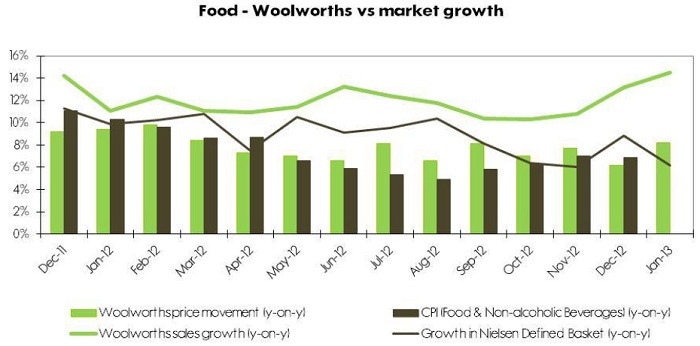
Shoprite points out that 74 supermarkets were opened last year, 56 of those in South Africa, the rest across our continent. The company creates employment for 109 thousand people, those shops opening and also further beefing (and not horsing) up their infrastructural development saw another 6700 jobs being created. Retail jobs. If you do a quick analysis of the South African economy over the last decade plus, that is one of the strong growth points. At the expense of the old traditional part of the economy, mining and manufacturing. Shoprite reported that they had managed to continue to gain market share, South African sales increased 11.5 percent, which is comfortably ahead of the 8.2 percent growth rates in local food sales across the industry.

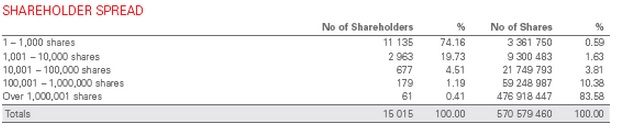
Valuations. I told you that I would get to this part. The company reported headline earnings per share of 315.9 cents per share, with an interim dividend of 123 cents. Last years HEPS was 590 cents. The stock trades at 170 odd Rands and is down over four percent this morning as these results clearly disappointed "investors". OK, but this perhaps explains more than anything else why the stock trades at a premium. Their shareholder analysis breakdown, first a list of who really owns the stock, Shareholder Analysis:

So, as you can see from that table, 61 shareholders own 83.58 percent of the company. And most of those as you can see from the second part that I hacked are "committed" long term holders.

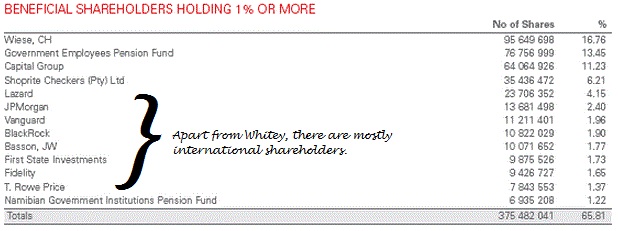
These are the entities or shareholders that own more than one percent of the shares in issue. So, what you can see here is that Christo Weise, the GEPF, Shoprite Checkers and Whitey Basson are the South African shareholders. The international institutional shareholders are the other main shareholders. And in their world, paying between a 20 and 25 multiple for these growth rates is not out of line. Most especially when taking a much longer term view on the stock. So, I suspect without thinking too hard about the current valuations, these shareholders find Shoprite as a great investment for leveraging off the low base that is African retail sales.


Crow's nest. German ZEW numbers beat by a whopping margin, sentiment is obviously improving a lot in that part of the world. That is the very good news. The very bad news is that the noise around Amplats continues to get louder and louder. That is the awful truth, union turf wars. And I have not seen any government response as of yet.


Sasha Naryshkine and Byron Lotter

Email us

Follow Sasha and Byron on Twitter

011 022 5440
Monday, 18 February 2013

Gold losing some shine

"The decade plus long gold rally looks rather old and stale, and some serious names are starting to sell. The whole thinking is rather simple, and perhaps holds true for sovereign bonds that carry the safest of safe tag. Some are calling it the great rotation out of fixed income to equities. And that has a negative impact on the lustre of gold as either a "safe" place to park cash for the disaster trade, or for inflation that never appeared. What now though? Unfortunately this is not good news for the local gold industry that have been battling high costs and less attractive ore bodies for years."


To market, to market to buy a fat pig. Amazing footage over Russia with the meteor streaking across the sky. I guess if we are amazed by one, imagine what the dinosaurs must have gone through! The G20 were shuffling papers last week in Moscow talking about currency wars and how they should end, but gee, what does that really mean in the short run? Merger & Acquisition activity is starting to pick up, Buffett is even getting involved. Which tells me that this little cycle is a little like the last time that he stepped in, he only steps in when he recognizes value and the investment makes. The WSJ has a nice table of all the Berkshire deals over the last 10 years: Biggest Berkshire Deals. This one is sizeable. Really sizeable. Although Heinz is not the market, this deal does tell me something positive.

Perhaps this graph tells you something, that expectations are either low, or that companies are starting to do slightly better than some folks anticipate: Percentage of companies beating earnings estimates by quarter: 2000-present. That graph is from the Jeff Miller post, which is always fabulous: WEIGHING THE WEEK AHEAD: IS THE HOUSING REBOUND FOR REAL? The reason why I quite like Jeff is that he is measured, he is neither overly crazy in terms of being bullish or bearish, as he says, he likes to present a balanced view. Another graph that got me really thinking and I have seen it several times is this one: Federal Government Finances. Perhaps it is just me, but if both the revenues and spending continue along the same trajectory, then shouldn't those lines converge at some stage before we reach 2020? Why does everyone freak out? Because of the sheer size of the debt? Make no mistake, the US federal debt outstanding is a huge problem, but had there not been forced intervention "things" would have been much, much worse.

Talking about much, much, worse this is possibly the most amazing story that I have read in a long, long time. I keep saying that the time for the time (how do I say this nicely) for a low skilled job is gone. And I found the best article that I have read in this regard titled: The Mystery of the Incredible Shrinking American Worker. Ok, you have to read this really, really carefully. Why I like this is because I met and had a wonderful conversation with a client last week and we agreed on several themes over the next decade. More mechanisation. Robotics. Those were two key investment themes that we agreed on, amongst many others. Robots never sleep, they work overtime, they don't get paid, sure you need to buy them once off and it requires humans to fix them if they break, but it improves the companies output over the short, medium and long term. So, instead of being many folks on the factory floor as a low skilled worker, you instead are getting skilled workers whose jobs it is to make sure that the robots works. That is the simplest way of putting it, I think.

The article asks the simple question: "People are becoming less valuable to companies. Why?" The answer is fairly forthright and rather obvious: "Simply put, the world shrank. Two seemingly unrelated inventions -- the microprocessor and the shipping container -- conspired to create a global market for all assets, including people. A century of achievements in computing power and shipping ushered in an era of global trade so expansive that it completely disaggregated the process of doing business (especially in manufacturing), allowing firms to treat finished goods as a bundle of globally sourced components and services." Faster computing power, the internet and easier dissemination of information and the remarkable take off of the shipping container handling. A remarkable look at the global trends and it underscores that a hell bent approach to industrializing rather focusing on the digital age is the incorrect one. We need more high end jobs, which unfortunately requires a large amount of work on the education sector. Or, am I completely off the mark here?


Jozi, Jozi 26o 12' 16" S, 28o 2' 44" E Whoa, precious metal stocks got crushed as the underlying metal prices took a turn for the worse. The decade plus long gold rally looks rather old and stale, and some serious names are starting to sell. The whole thinking is rather simple, and perhaps holds true for sovereign bonds that carry the safest of safe tag. Some are calling it the great rotation out of fixed income to equities. And that has a negative impact on the lustre of gold as either a "safe" place to park cash for the disaster trade, or for inflation that never appeared. What now though? Unfortunately this is not good news for the local gold industry that have been battling high costs and less attractive ore bodies for years. The only thing keeping them afloat is the much stronger Rand price of gold. Profitability has been scratchy at best.

There was some stunning insight from a friend about one of the gold miners in South Africa: "Harmony went from 28,5m shares issued in 1996 to 428m, buying the gold mines that everybody wanted to sell and paying over the odds all the time. In the 12 financial years 1997 – 2008, Harmony cumulatively lost R1,17bn nett profit after tax while the gold price was going in their favour." Wow. What an amazing destruction of value ongoing here. I suspect that whilst Harmony Gold might have stabilized, South African gold mining is not what it used to be. Still, we have valuable minerals that we need to exploit. We might just have wasted valuable time flipping a flopping however focusing our attention on all the wrong things.


    Byron beats the streets. The Tiger Brands share price has been very bumpy of late. It peaked at R335 a share on the first day of the year then dropped throughout January to around R290. It slowly started recovering until the trading update last week which knocked the share price 8%, back to R290. It has since recovered, now trading at R305. We looked at the trading update but not in full detail, last week was very busy. What has seemed to spike the price again was the Pioneer update on Friday and then of course, Berkshire Hathaway paying a 20% premium for Heinz.

    Tiger Trading update. There were no numbers mentioned. Obviously the change in earnings is not big enough to legally announce a percentage. What it did say was that trading conditions have been tough on the back of a constrained consumer, mostly because of high inflation. They also give us some clarity on the financial impact of the Dangote Flour Mills acquisition. In the short term it will be earnings dilutive and benefits will only be seen over the next two years. Short term speculators do not like that kind of news.

    Pioneer Update. Pioneer foods, one of Tigers biggest competitors released a trading update for the four months to 31 January 2013 on Friday. Revenues increased 12% for the four months. Inflation was responsible for 7%-9% while volumes grew 3%-5% according to the group's estimates. Much of this was also due to a weakening rand and increases in the wheat price.

    You see, this is a perfect example of inflation directly impacting the consumer at the heart of their necessity requirements. It is tough out there and getting tougher. But what does this mean for the food producers? There is no doubt that higher prices are going to negatively affect volumes. But these are necessities so the impact will fall on less defensive discretionary spend.

    As for the long term picture, we are still optimistic. The growth in Africa is very exciting. As Massmart, Shoprite and Pick n Pay expand they will bring Tiger with them. Tiger fortunately do not have to build the shopping malls. They do have logistical challenges and producing directly in other countries is clearly a growth opportunity as with the Dangote Mill acquisition.

    We are not concerned about the short term dilution. Those who sold on that news only created a buying opportunity for us long term investors. The other day I downloaded the last 15 of Warren Buffet's annual investor letters onto my iPad. I started reading 1998 last night and one thing he said is very relevant in this case. Talking about volatility he said that he would choose a lumpy 15% return over a smooth 12% any day. This being over the long term. We feel the same about Tiger, this is a good long term investment, we are not concerned with the volatility.


New York, New York. 40o 43' 0" N, 74o 0' 0"W Stocks started the session well, but soon traded lower around lunch and beyond before clawing their way back to end about flat. Gee, that sounds pretty idiotic to describe the collective indices as a collective crowd or the like. Today is Presidents day in the US, the third Monday in February. I like the way that the Americans take their public holidays, something that is done in other parts of the world too. Mondays and Fridays for the important holidays leads to greater productivity both before and after the holidays. Too many holidays in the middle of the week. OK, back to Wall Street, basic materials and energy stocks took some heat for the same reasons described above. Commodities sold off as part of the rotation trade. I suspect unfortunately this might spill across to other commodities, if of course you are a commodity bull. Good for the inflationary outlook however, although it is pointed out that gasoline prices continue to go up in the US, whilst we are expecting another petrol price increase here locally.


Crow's nest. The next ten days are really crazy from an earnings point of view. Shoprite tomorrow, BHP Billiton, Truworths and JD Group on Wednesday and Thursday sees Discovery and Mondi report. On Friday we have Exxaro, Imperial and Northam. An action packed week, and next week it does not let up with some big names too. I must admit, I miss the days of everyone telling me all the time was the Credit Default Swaps are for Greece, or Italy or Spain, and equally what their ten year bonds are yielding. You see, the less bad news, because humans are mostly reactionary means that in general people feel a little more cheerful about the state of the world. And as we well know a little bit of confidence goes a long way. Oh yes, and the Proteas ratcheted up their performance yesterday, amazing.


Sasha Naryshkine and Byron Lotter

Email us

Follow Sasha and Byron on Twitter

011 022 5440
Friday, 15 February 2013

Anglo beats expectations

"But let me put one thing straight here, the Anglo American that you know today is and was not the Anglo from 15 years ago. Anglo industrial side of their business has been slowly unbundled, Tongaat Hullet, Highveld Steel, Mondi, they owned a big chunk of what is today FirstRand, they owned media assets, what is Times Media today. Byron points out of course they owned a large chunk of AngloGold Ashanti and Gold Fields."


To market, to market to buy a fat pig. European growth numbers disappointed the market and we sold off for much of the afternoon, but then the best non-farm payrolls for a while: U.S. jobless claims hint at firming job market conditions. Yes, things are getting better. On that side of the pond of course, the European worse than anticipated numbers left you feeling deflated on a day in which the winds were taken out of your sail already: Euro zone economy falls deeper than expected into recession. But, St. Valentines Day could have picked up your spirits, here is a nerdy bunch of charts pointed out to me by a friend that are guaranteed to make you smile: 14 Ways an Economist Says I Love You.

And then possibly the big news of the day, the news that Berkshire Hathaway and 3G Capital were buying Heinz, a huge global brand for 28 billion Dollars, including the debt. Buffett's business would put up around half the cash required, and would also fund the deal with a 9 billion Dollars convertible pref shares. 9 percent? Wow, those are good rates for Berkshire. Heinz's best and flagship product is of course what we call "tomato sauce" here. In the southern hemisphere English speaking countries, here, Australia and New Zealand we know what "tomato sauce" is. Elsewhere it is called ketchup. The funniest thing was that apparently Buffett said something along the lines that he was familiar with their product and used it. The WSJ reports that 650 million bottles are sold a year, the New York publication cites the Heinz website as the source. Phew. That is lots of bottles of ketchup. And essentially, as the WSJ points out, ketchup is recession proof. A real soft luxury. Which Americans put on everything from fries to omelettes. All sorts of food requires a little sauce on it, not so? What is the strangest dish that you have put ketchup/tomato sauce on? Anyway, Buffett is adding his brand as an investor in another brand, Heinz.

A Wall Street big slug out afterhours again with the same fellows Carl Icahn and Bill Ackman involved and of course the same company again, Herbalife. Icahn is looking to Ackman out of a billion Dollar short scoring a profitable trade, but also win what is an enormous battle of egos. Ackman must be under huge pressure now. Fortune fills you in on the background: Icahn Squeezes Ackman With Big Stake In Herbalife, May Push For Sale. Now that is not the only front that Ackman is struggling on, he is long JC Penney. I saw a story with a simple enough headline to strike fear into the hearts of his investors: Maybe JC Penney is just one of those companies that can't be saved. You see, folks who would give Ackman money have less patience, they need their money to work hard given those kind of fee structures of the hedge funds. Today Icahn is on the box explaining his long. For all I know he might be selling to the shorts that need to close out their longs this morning when the market opens. The biggest risk to Ackman is simply that his investors stop believing him, because fund redemptions equals forced sales, or buy backs in this case. Good luck to them!


Jozi, Jozi 26o 12' 16" S, 28o 2' 44" E This morning we have results from perhaps the most well known South African company, at least inside of our borders. The one founded by a German who worked in London. And then moved here, after getting his first job in the diamond business in London, a place called Dunkelsbuhler & Company. And the money to fund the business came in part through involvement from JP Morgan. The funders, the original shareholders you stumped up 1 million pounds were from the old world in the United Kingdom and the new world, the USA. Hence the name.

But let me put one thing straight here, the Anglo American that you know today is and was not the Anglo from 15 years ago. Anglo industrial side of their business has been slowly unbundled, Tongaat Hullet, Highveld Steel, Mondi, they owned a big chunk of what is today FirstRand, they owned media assets, what is Times Media today. Byron points out of course they owned a large chunk of AngloGold Ashanti and Gold Fields. They also owned motor vehicle assets. They owned a lot, I have probably forgotten a lot in there too. So that is what I mean, they are not the company that we know today, which is not an industrial and mining company, but rather just a mining company. But, both Rio Tinto and BHP Billiton have comfortably outperformed Anglo American since June of 1999. I remember there was a time when Anglo was the biggest. No more. They are now the hunted, perhaps we will see a merger of not so equals at some stage with the Xstrata/Glencore merged entity.

But history aside, let us look at these numbers. We have seen most of the results of the listed entities that they own, but there were still surprises, the analyst estimates were well short of what the company actually managed to produce, even if the at face value number looks slightly worse for wear. Underlying profits decreased 44 percent to 6.2 billion Dollars. On a per share basis the company earned 2.26 Dollars per share, the interim dividend declared was 32 US cents. The company has even recommended a 53 cents final dividend, bringing the full year dividend to 85 US cents. At the average exchange rate of 8.21 to the US Dollar that comes to full year earnings of 18.55 ZAR and a dividend of 6.98. So, at the current share price, 282 and a half ZAR, the earnings multiple is 15 times plus and the yield is around 2.5 percent in Rand terms. But, the stock is priced for recovery, not for disaster anymore. Is the worst past? Gee, I still think that Amplats issues are a long way away from being resolved. The Eskom price hikes, after being promised no further material hikes last year, well, look what happened. I shall read more on the weekend of these results, but a slightly better than anticipated result means the stock gets more than a little relief today, up three percent plus in London.


    Byron beats the streets. "Cisco delivered record earnings per share this quarter and record revenue for the 8th quarter in a row in a challenging economic environment. We continue to drive the innovation, quality and leadership our customers expect, and we remain focused on consistent returns to our shareholders, said John Chambers," Cisco chairman and chief executive officer.

    This was after Cisco released second quarter results which beat expectations. Net sales of $12.1bn and net income of $3.1bn which equated to 59c per share is what the company managed for the quarter. Expectations for the whole year come in at around $1.71 and $1.92 for 2014. The stock trades at an undemanding $21 or 11 times 2014 earnings.

    The company has been through a rough patch. It tried to do too much, increasing its economies of scope and losing focus from its core objectives, which is to provide integrated systems and to service them. By buying businesses which did not fall part of their core business, they started crimping margins which was not taken well by the market. However they realised this and have gone back to plan A, having sold and still selling less profitable businesses.

    Analysts reckon that consistent improvement in margins will allow this stock to rerate. Paul often says that the real money is made when a stock rerates on the whim of a brighter future. When the good earnings come in, it is often too late.

    But that is market sentiment. The core reason we like the stock is the way the world is going. Smarter smartphones and more smartphone penetration means more data is consumed. Cisco provides the infrastructure for this. The same goes for businesses who strive to become more efficient. Because let's be honest, being connected is the first step. And of course the developing world will be coming off a much lower base in this regard. Cisco already have the architectures, solutions and services to provide these services, probably better than anyone else in the world.

    Our one concern is CEO John Chambers who has been CEO of the company since 1995. There is no doubt he is a great man and has had an illustrious career. We just feel a new CEO may be a much needed breath of fresh air. That is not for us to decide though, it is up to the board. Regardless we continue to add and see lots of value at these levels.


OK, what did I think of the state of the nation speech? Well, does it really matter what I think? No, not really at all. You read the headlines today and take away the mood of the media to the president's speech. The Mail & Guardian goes with: Sona: Zuma's speech reveals nothing new. The Daily Maverick has three takes on it: The State of the Nation: Zuma receives lukewarm response by Khadija Patel, her friend J Brooks Spector had this to say: State of the Nation Address: Too many ingredients, not enough theme. And then lastly, from the same publication from Ranjeni Munusamy: Grocery-list State of the Nation fails to inspire.

Well, I guess one could forgive the president for being sick, he must shake a whole lot of hands, ad many of those folks must have been sick. Perhaps when you do shake that many hands you do in fact have a whole pack of wet wipes nearby. And if not, then you are bound to catch something. Perhaps it was the cold and snivels that saw him fall flat. Poor guy. But, he is the president. Ordinary citizens expect the best, demand the best, so we have to pick at the content of the speech and not necessarily the delivery. Here is the speech, from the presidency website: State of the Nation Address.

The word "unemployment" was used only 4 times. "Education" 14 times. The word "land" was used 24 times. "Mining" was mentioned 5 times. "Business" was mentioned 6 times. The word "tax" only three times. But I suspect that business would have looked for more clarity, instead another wishy washy sign on mining tax increases or review. More uncertainty, less time wasting here locally. Now we turn out attention to the budget speech. The real speech. The one that actually tells you how much money there is, or is not for the running of government.


Crow's nest. We are about flat here to begin with, Anglo is enjoying a good day whilst Impala Platinum is not. The second poor day in a row following worse than anticipated results and strange happenings with land in Zimbabwe. Sounds like more of the same unfortunately, and you think that we have problems! There is a sentiment number a whole lot later in the day, that could determine where we end up. I am looking forward to that smack down between Ackman and Icahn though!


Sasha Naryshkine and Byron Lotter

Email us

Follow Sasha and Byron on Twitter

011 022 5440
Thursday, 14 February 2013

Show some loving Mr. Prez

"If you had to ask me what the one thing that was going to change our country dramatically I would have to say that there is only one thing. Education. Skills. But that takes guts and determination and of course a whole lot of hard work. And that is not easy, it actually means knuckling down and getting the job done. But through hard work will come success. We need to be committed to up-skilling and learning more. Only that way will the workforce have more to offer."


Jozi, Jozi 26o 12' 16" S, 28o 2' 44" E Resources led us higher here, industrials slipped a touch, but the markets ended in the green again. Since the beginning of February again we are stuck in a zone of sorts globally. New levels that folks are getting comfortable with, people speaking of the great rotation out of fixed income and into equities. Some argue that the rally is still fuelled by easy money with a low interest rate environment. That might well be the case, but certainly risks are subsiding, still there, but further away. And let us face it, companies and countries have made hard and very difficult decisions. Some real economic news did sway the Rand bears to back off for a touch, retail sales for the month of December more than exceeded expectations. Perhaps a bounce back in the retail trade for obvious reasons, Christmas, but also as a result of industrial action ending and employees having more spending power.


Discovery had a trading update yesterday, let us do the Jackie Selebi, I mean a copy and paste job. I should stop that. After being sentenced to 15 years in jail, he was released on medical parole. I have no idea of his medical condition even if the whole process seems like a farce. So, here goes the meaty part of the Discovery trading update: "Shareholders are advised that headline earnings per share will be between 15% and 25% higher than that of the corresponding reporting period of the previous year ("corresponding period"), while earnings per share will be between 10% and 20% higher than the corresponding period."

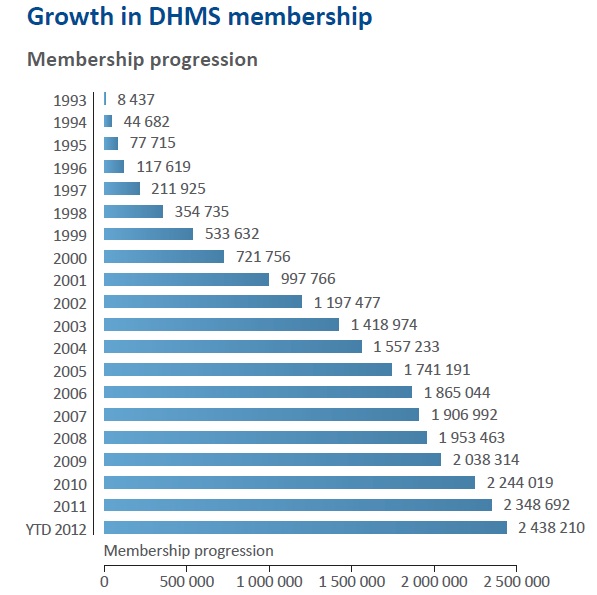
Over here at Vestact we see healthcare as a theme that one can comfortably invest in over the coming years. As folks in the middle class start to fall into the bracket where they can both afford and view private healthcare as a necessity and not a luxury. In many ways the private healthcare industry in South Africa can be seen as a failing of the state in some regard. I can think of a few other examples, Naspers winning because the SABC has failed to provide proper content to their viewers. MTN and Vodacom over Telkom. And so on. BUT, of course we know we live in a country where the disparities between the haves and have nots are huge. So, not everyone can afford luxuries such as private healthcare, but it becomes a necessity when you get the chance of formal employment. Check what I mean, hacked from the annual report:

Discovery has over 2.6 million lives covered by their health management scheme. Around 312 thousand people contribute monthly payments as individuals, that is interesting, those must be self employed professionals. I would think. They are pretty revolutionary in terms of their approach to technology, the HealthID iPad app is taking off. Only 5 percent of doctors use it, according to the annual report. The company is innovative. Very innovative. Unfortunately consent has only been given by 44 thousand odd folks so far, I am one of four in my family to let our family doctor have access to all our purchases and other visits, and so on! The risks are the National Health Insurance plan and the implementation thereof and what it means for Discovery. It is a risk, but I have no doubt that the smarts there are hard at work.

It is an innovative company. They have managed to embark and gain market share in places nobody ever thought that they could. The business is run by an incredibly brilliant South African mind in the form of Adrian Gore. Those who know him say that he is humble and brilliant at the same time. The company has learnt lessons from failures before, the obvious one is the USA, but fear not, they went back, stronger than before. I like the fact that they are tackling big territories and staying away from what are heavily subsidized by the state territories. More when the results come, but we are adding this one at the fringes for clients who want more healthcare exposure. Results are due a week today.


Woolworths released their results for the 26 weeks to end 23 December 2012 this morning. There are a few moving parts in there. But some of the headline numbers look quite strong. And if you take out a few moving parts the numbers themselves look even better: "Adjusting for these items, adjusted EPS and adjusted HEPS were 35.4% and 35.9% higher respectively than the corresponding period."

And what was pleasing to see were the improving margins and cost controls both here and in Australia. OK, here are the quick numbers, comparable store sales increased 9.4 percent, including the new purchase of Witchery sales increased by 18 percent. Profits before tax rose 20.8 percent, I am thinking in this tough environment that must be pretty pleasing. Headline earnings per share increased to 164.2 cents, a 59 cents a share dividend had been declared, an increase of 14.7 percent is comfortably ahead of inflation, perhaps to compensate however for dividends tax. The after dividends tax that translates to 50.15 cents per share.

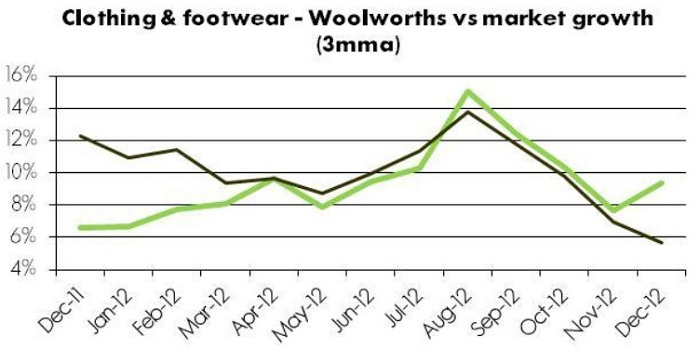
Operating margins in food were 6.1 percent, in clothing & general merchandise (GM) it was 18.9 percent, both divisions showing solid improvement. The clothing and general merchandise division contributes around two thirds of all Woolworths profits before tax, 66.2 percent to be exact. Of the group profits before tax, the clothing & GM division contributes 52.3 percent. So, it is their most important division, and in third place is their newly acquired plus existing Australian businesses. Food is 26.6 percent of pre tax profits, whilst Country Road is only 16.4 percent. Not insignificant. A weaker Rand of course helped, the Aussie Dollar has been very strong.

These two graphs are however the ones that stand out, these are from the investor presentation, Interim Results 2013. First, is how Woolies have been able to take market share away from their competitors in their clothing division:

And then in their food division:

You can lie to your customers about a cheap price, or a sale, but you cannot pull the wool over their eyes if you are talking about quality. That is why in these tough times Woolies is growing their market share. That is the one reason. The other and major reason is presented in the outlook section: "We believe that economic conditions in South Africa will remain constrained, especially in the lower and middle income segments of the market where consumer debt levels remain under pressure. However, the upper income segment in which we operate continues to show some resilience. Trading for the first six weeks of the second half of the financial year has been positive, and we expect sales growth to be broadly in line with the first half." The target market of Woolies is OK. In a South African context skills are few and far between, those people with skills are well remunerated. Woolies is an excellence brand, plus they are also very innovative. They have done innovative things like reduce their relative energy bill by 27 percent from the 2004 benchmark. They have also engaged the supply chain and as far as I know are the only organic "farming for the future" chain store.

But, innovation and green technology aside, the stock does not exactly look cheap. However, to many an offshore investor, seeing that Woolies are expending to the rest of the continent, there is a big attraction. With earnings consensus looking at a middle teens growth through the next three years, you have to pay up for quality. The yield is very good, three and a half percent forward at current levels. Of course before tax. But the company has a fairly aggressive dividend policy. We like it a lot and continue to add it.


    Byron beats the streets. Yesterday City Lodge released their interim report for the six months ended 31 December 2012. I did this fairly detailed report titled City Lodge revised trading update, still good a few weeks ago when the trading update was released. It focused mainly on the property underpin and how the value increase has perked up the market cap and of course the yield has increased earnings. It also covers the fundamental analysis of the numbers.

    This report gives us some more detail on the numbers as well as the actual hotel business.

    "Group occupancies for the six months to 31 December 2012 increased to 63% from 60% in the previous interim reporting period. Revenue for the period increased by 11% to R492,1 million, mainly as a result of improved occupancies and the resultant increase in the number of rooms sold. Achieved room rates increased in line with inflation."

    This resulted in normalised headline earnings per share to increase 30% (there was a BEE transaction last year which lowered the base) which was at the top of the range considering the update. This equated to 290.4c a share, 60% (176c) of that being paid out as a dividend.

    One of the best ways to get some extra info from a results release is to watch the interview with the CEO. Here is Clifford Ross on CNBC yesterday. He makes some interesting observations on cost cuts, especially with regards to electricity. See they are replacing 40 000 light bulbs to the energy saving type. I wonder if that contract is done with Ellies? They also make sure they heat their water and do the washing at low peak times. You see there are many innovative areas they can work on and all the better for the country.

    That said part of their revenue increase was due to the occupancy increase while the other part was due to inflation related price increases. 63% is still far from their all time high of 83% and also below the world average 65%. This is probably because of the massive hotel boom before the 2010 world cup. Otherwise I would expect the top low cost hotel in a developing market like South Africa would comfortably beat the global average. And I would expect the City Lodge number to certainly increase as the South African market normalises.

    It was encouraging to see that their Joint Venture in Kenya has beaten their expectations, bringing in profit after tax of R7.1million and the 104 room hotel in Gabarone has been built, just awaiting regulatory approvals to start business. In the Outlook segment they say that the trend for 2013 has continued with occupancies growing nicely. They have also benefited from the African cup of Nations.

    I saw no mention of management's replacement value of their property. They usually mention that in their full year numbers. All in all a good set of numbers, we are happy to be adding at these levels. South Africa is the gateway to Africa and City Lodge are going to provide the beds for those visitors.


The Mother City We are all gearing up for the president's speech here today, a little later tonight, let me hope for some love. Unfortunately progress is always constrained by limited resources. Governments have to think a little harder on how to collect more revenue, one is through boosting business activity and collecting more through growing company and individual revenue. Higher taxation through economic growth. Unfortunately the government is stuck in what a client told me a couple of days ago is industrial age thinking. We want desperately to "make things" rather than supply services. Making things would be ensuring that we have to go the low wage economy route with more factory jobs, or more mechanisation, both of which only business is fond of, the unions almost certainly are not.

If you had to ask me what the one thing that was going to change our country dramatically I would have to say that there is only one thing. Education. Skills. But that takes guts and determination and of course a whole lot of hard work. And that is not easy, it actually means knuckling down and getting the job done. But through hard work will come success. We need to be committed to up-skilling and learning more. Only that way will the workforce have more to offer.

I saw a couple of tweets on what people would like to see, this one from economist George Glynos: "Top of my wishlist for SONA: 1- More accountability for govt officials. 2 - A return to meritocracy. 3 - Start of dialogue with Business" BBC journalist and ex CNBC anchor Lerato Mbele tweeted this morning: "Zuma says priorities are Education, Health, Jobs & Land Reform. Whilst Ramaphosa on a roadshow to promote National Development Plan" You can follow on Twitter during the course of the day if you click on the #SONA2013 search tag. You will see many social issues being discussed too. The biggest issue around violence and rape, all too common a tragedy here in this country. Changing perceptions, that takes a lot of doing, but all falls back to education, the only true leveller in life.


Crow's nest. Today is an important day for European GDP, with expectations for the fourth quarter to have contracted by 0.4 percent, following the prior quarters 0.1 percent contraction. It is certainly tough in Europe, the numbers were worse than anticipated. Youngsters are unemployed, perhaps this will spur a whole new generation of entrepreneurs. The problem is that many are too reliant on the state, I am not saying that is a bad thing, but desperation has a strange old way of creating more opportunities. These are rich people problems, the problems of Africa are poor people problems and perhaps that is what Christine Lagarde was trying to say when she compared the problems in Greece to the problems of starving children in Sub Saharan Africa. I got what she was saying, the suffering lot in Greece were outraged, I understand their pain too. The other news that is unbearable to think about right now is that Oscar news.


Sasha Naryshkine and Byron Lotter

Email us

Follow Sasha and Byron on Twitter

011 022 5440
Wednesday, 13 February 2013

Tim doesn't overCook it

"When I sort of zoom out and look at the smartphone market in particular, what I see is a market that last year was around 700 million [units], plus or minus. It's projected to double in the next four years to 1.4 billion—this is a huge market. I believe that more on a longer-term basis, all phones will be smartphones, and there's a lot more people in the world than 1.4 billion, and people love to upgrade their phones fairly regularly."


To market, to market to buy a fat pig. A journalist friend of mine sent this to me (Australian miners attack 'obsession' with tax), following on the piece that we did yesterday on Kumba Iron Ore. It always amazes me that higher prices in a local industry created by external demand (important) attracts the leeches attention of the tax bleeders in government. Oooooohhhh, we could tax those guys more! The core of my argument is that the minerals in the ground were there long before people. And possibly will be there long after people. So it is the duty of the country (in my opinion) to make sure that we foster an investment environment that helps facilitate the mining of these minerals as quickly as possible. I can assure you that the Chavez administration will be scorned by future Venezuelan generations as the fellow that did not produce enough oil at the golden time for their country. Perhaps that can all change, attracting the Chinese, Indians and Russians to forge towards a Norwegian type model, that is what is being suggested. Hopefully.

Nutmeg was once so valuable because it was thought to have properties that could ward off the plague. The Dutch and the British had several skirmishes (in a long line of bigger global fights) to gain control of an island named Run which is in modern day Indonesia. Why? Because there was a whole lot of Nutmeg trees there. Phew. Whale oil used to be useful before humans discovered kerosene. What I am trying to say is that Venezuela has seen oil production decline under nationalisation, by nearly 50 percent. Who is Chavez doing a favour? According to Wiki, citing OPEC analysts, Venezuela has 230 odd years of oil left at current production levels. And that is at current production levels, which is lower than when private business was able to operate in that territory. There are already people predicting the end of the combustion engine, including the International Energy Agency chief back in 2010. And engine manufacturers are always pushing the boundaries in terms of fuel efficiency, even though this article points that the design of the engine has not transformed dramatically since the first one was invented: More bang, less buck: How car engine tech does more with less.

The only point I am trying to make is linked to that Citi report (curse it) that suggested that we have around 2.5 trillion Dollars worth of minerals under our feet, almost all of it in platinum. Of course those are only useful if people want them. We better hope that the combustion engine moves in the direction of fuel cell technology. Check out this useful page from those who know platinum well, Johnson Matthey: Applications. What use is a mineral if nobody wants it? Get it out the ground as quickly as you can, make the business conditions so favourable. Unfortunately miners locally find themselves in a trap of higher costs and with an unfavourable business climate. And that ultimately leads to lower employment and investment. So, the challenge is to get it all out the ground, beneficiate it if you must, but get it all out. Before nobody actually wants it. Can you imagine a motor vehicle in the future that uses clean energy and does not require any device to clean emissions, because there are none? Such vehicles exist already. I only need what is called an NEV, something that gets you to work and back. On second thoughts, a "golf cart" for me is nuts. But still you get my point. Resource rent taxes, resource nationalisation or nationalism is full of short sighted and internalised less global thinking. Dumb. Like I said yesterday, you didn't make that iron ore price.


Jozi, Jozi 26o 12' 16" S, 28o 2' 44" E We slipped from about midday onwards, retailers taking a little knock. On that score I want to share a little insight that I got from reading a global retail (in emerging markets) report from arguably the most loved/respected and the same time hated investment bank on the planet. Yeah, you know who I am talking about. Anyhows, this report suggests that our retailers are cheaper compared to their global counterparts. Yes, you read that right. As lofty as the valuations might seem to the locals, these are cheaper than their global peers. And the point that I always make, so who cares whether or not we think something is expensive when foreign investors looking to invest in the next big theme, African consumers over a decade or so, like what they see. The way that we would invest in Nigerian stocks, taking a longer term and broader view is possibly how foreign investors view our retail companies. As big as we think Shoprite is, at roughly 11 and a quarter billion Dollars that is smaller than the Campbell Soup company.

Having said that though, Shoprite would slot into 3rd place on the list of retail, subsector department and discount companies (16 in total). Behind only WalMart and Macy's. If you had to stick it on retail/grocery stores, it would be in fourth place. Wait for it, just behind Companhia Brasileira de Distrib. Which has fewer stores than Shoprite, just a few. And operates a similar business. And guess what, Mr. Market is willing to give the company a 27 multiple. A paltry yield of 0.74 percent. So next time you say that these retailers are expensive, think global. CBD has worse margins, but of course operates in an exciting territory, Brazil. That is the main attraction for investors, and I genuinely think that there are investors in this company. The average volume in New York is lower than the rest of that hyperactive market.


New York, New York. 40o 43' 0" N, 74o 0' 0"W Stocks stretched their lead again, after a period of two weeks where we have been moving sideways. The Dow breached 14 thousand again and stuck, I noticed a little ticker on CNBC which suggested that we were only one very good session away from reaching the all time high for blue chips. 145 odd points. The broader market is still a fair way away from that all time record from October 2007. I think that the part that is most important to remember is that the last time we were at these index levels the overall market valuations were much more demanding than they are now. Collective earnings expectations for the S&P are somewhere around 113 Dollars for this year. With the S&P 500 level currently at 1519, at slightly less than 13 and a half times forward earnings hardly looks stretched now, does it? We often point out here that all that has happened is a re-rating of riskier assets because the worst case scenario has passed somewhat. In short, these dramatic events have been navigated, Euro Crisis, US elections, Chinese leadership change, Fiscal cliff, those have faded. But, of course the looming sequestration could cause some anxiety, some folks don't even think that is huge. As every day goes by and we hear less about Greece, Spain, Italy (elections are close) and so on, the more ordinary folks have confidence to invest for the future.


This does not happen too often, but I guess the fact that a fair price has been reached and more importantly an overhang of sorts has been removed. I am talking about Comcast's purchase of the balance of NBC Universal for a whopping 16.7 billion Dollars. This announcement coincided with very good fourth quarter results from Comcast -> Comcast Q4 Profit Rises, Boosts Dividend By 20%; To Repurchase $2.0 Bln Of Stock.

This article seems to suggest that Comcast got a great price from GE: Comcast's NBC Purchase Pushes Roberts Into Entertainment. Before the rise in the aftermarket, the deal represents around 15 percent of Comcast's market capitalisation. It is less of a big deal for GE, but it is not insignificant, around 7 percent of their market cap. A special dividend could be in the offing, if GE were in the business of doing that, they have done that from time to time. There was a statement from chief Jeff Immelt that suggested as much, so look out for further cash. I suspect the real reason that people buy GE is for their global industrial business. I suspect that in the coming years there might be a separation of the GE Money business. That business however is linked closely to the industrial business.


Why Tim Cook, Apple's CEO used this as a platform is perhaps beyond me, but I guess this one came with a little umpfff. The event was the Goldman Sachs technology conference, the place was San Francisco. Initially the stock was up, but it ended down around two and a half percent. In part due to the fact that Cook said that too many impatient investors spoil the broth the companies cash was not burning a hole in their pocket. And that the remarks and lawsuit from David Einhorn were a silly sideshow. And not a well thought out lawsuit following a detailed slideshow. I can understand the want and desire of David Einhorn to spruce up his returns, but I am guessing that if he is not patient enough, then find another investment with more juice. Or buy more shares and ruffle some feathers on the board. I guess his fund does not have the money to do that. BlackRock, the worlds biggest asset manager has been buying Apple shares like crazy, they own 5.31 percent, or 49.8 million shares. What do they think?

Back to the Tim Cook and Apple news, the main reason for actually talking there was possibly to get the number out there that Apple developers have generated around 8 billion Dollars worth of app sales. Apple keeps 30 percent of that. It was just showing you what we got, and what you have and how much money you can make on this platform. Howard Lindzon suggested that Goldman employees use Blackberries at work and iPhones and iPads at home, so this was barking up the wrong tree.

There is luckily for us a transcript of the speech: This is Tim Cook at the 2013 Goldman Sachs conference. Some of the important pieces for me were around innovation: "The innovation is so deeply embedded in Apple's culture: the boldness, the ambition, the belief that there aren't limits, the desire among our people to not just make good products but make the very best products in the world, it's as strong as ever, it's deeply embedded, it's in the values, it's in the DNA of the company." Like we often used to say, we are sure that the next Steve Jobs might want to associate him or herself with the business.

But the stuff that I really like is the following: "When I sort of zoom out and look at the smartphone market in particular, what I see is a market that last year was around 700 million [units], plus or minus. It's projected to double in the next four years to 1.4 billion—this is a huge market. I believe that more on a longer-term basis, all phones will be smartphones, and there's a lot more people in the world than 1.4 billion, and people love to upgrade their phones fairly regularly." This is true. People love their smartphones more than their families, in the case of Piers Morgan. So I have heard, or read through an article by his second wife. Perhaps soon to be ex if he keeps that up. Well. Not too sure what to make of all of this other than Tim Cook has been at this conference for a while. And he makes good points. Rather than the TV or watch rumours, I would prefer to see an augmented reality glasses rumour. Perhaps they will wait for Google to release them and then "Apple" them. We continue to hold and recommend the stock.


    Byron beats the streets. Yesterday we had full year results from one of our newly recommended stocks in New York which certainly pleased the market. L'Oreal managed to grow sales 10.4% for the year which came in at 22.46 billion Euros. On a like for like basis (excluding acquisitions etc) this grew 5.5% which beat the sectors growth of 4%. This obviously means that they managed to gain some market share. Net earnings per share grew 15% to 4.9 Euros while the dividend was increased by 15% and another share buyback worth 500 million Euros was announced.

    The stock trades at 111 Euros which puts it on a historic valuation of 22.6. Forward earnings are expected to come in at around 5.31 Euro this year, 6 Euro in 2014 and 6.9 Euro in 2015. Trading at 16 times 2015 earnings the stock is certainly not cheap. But when you look at those growth rates and the fact that the company has zero debt you can see why.

    The future looks bright. They have targeted 1 billion new clients over the next 10 years. Wow that is huge. They have also expanded production outside of France to target the developing market consumer. They opened factories in Indonesia and Mexico last year with one in Egypt planned for this year. That may be on hold at the moment. 2012 was the first year where markets outside of Western Europe and North America were responsible for more than 50% of sales.

    I read an analyst note yesterday (it's paid for so I cannot say who) which suggested the following sales growth rates per region for 2013. Indonesia (34%), India (23%), Argentina (20%), China (12%), US (7%), UK (4%) and France (3%). That looks very positive and reiterates my view that the developing world is going to become more and more image conscious, both men and women.

    I guess the only negative to consider is the ownership structure of the company. Nestle own 30% and the Battencourt family (founders) own 31% who both act in concert pursuant to a shareholders' agreement. Basically they vote together and dictate which path the company takes. I generally have nothing wrong with that, Google and Facebook have similar structures, as long as everyone's interests are aligned. Apparently though there is a bit of a rift amongst the Battencourt family in terms of inheritance. Here is the wiki entry about Liliane Bettencourt, the founders daughter who is now 90 years old and is worth over 20bn Euro. It is just a niggling issue that does need to be considered when buying these shares.

    It is also a possibility that Nestle could try and buy the family out once she dies and with that the whole company. That of course would be good for shareholders who would demand a premium.

    Regardless of this issue which needed to be pointed out I see this as a fantastic entry into the aspirational consumer growth group.


Crow's nest. Local retail sales were better than anticipated, sending the Rand slightly firmer. The G20 is hanging out in Moscow for the next couple of days dealing with matters currency and other. The president here will make his state of the nation address whilst there was mixed reaction to the Obama state of the nation. I thought it was excellent.


Sasha Naryshkine and Byron Lotter

Email us

Follow Sasha and Byron on Twitter

011 022 5440
Tuesday, 12 February 2013

You didn't make that iron ore price

"And you can see the amazing figure of how much China accounts of annual steel production. It is fair to say that the Chinese have changed the fundamentals for global iron ore and metallurgical coal trade. Nobody else has changed the industry as much as the Chinese have over the last decade plus. So, with the companies paying much higher taxes across the globe as a result of bigger investments (and risks) that private companies and their shareholders took on. And now the state wants to tax those companies higher, everywhere. Leeches."


To market, to market to buy a fat pig. Everyone was getting excited about the Pope taking what I thought was a pretty bold decision, and perhaps the best decision for the Catholic Church. That announcement certainly dominated the news. Dominating this morning is the news that the nut jobs in North Korea conducted a nuclear test. I wonder if the North Koreans called the bomb "Fat Boy" after their esteemed leader and the "Fat man" bomb that was dropped on Nagasaki. Although there are around 4500 thousand bomb on the planet that could be deployed at any one given go. Nuclear ones that is. That is just nuts! Like the "leadership" in North Korea, they are just nuts.


Jozi, Jozi 26o 12' 16" S, 28o 2' 44" E Stocks ended the session slightly lower on the day, the trading statement that we chatted about yesterday weighed on Implats, but the stock certainly recovered off the lows of the day. There was some confusion around Cipla Medpro, and Indian company Cipla, an Indian newspaper reported that "talks were off", but the company down here in South Africa said talks were ongoing. Strange that. The Economic Times of India suggested that the deal had been put on ice as a result of valuations being too rich: Cipla puts Medpro buyout on hold over valuation issues. A very short story, with the conclusion that another Indian company, Sun pharma had "saved" money by not buying Israeli company Taro. Not sure, but the locals, Medpro (as the Indian journalist differentiates the two businesses) have suggested otherwise. Cipla Medpro is down another two and one quarter percent this morning, on top of five percent yesterday. Smoke and fire?


Kumba Iron Ore released results this morning, for the full year to end December. Normally Byron would have jumped all over this one, but I said that I wanted to cover them and work in resource nationalism, whatever that means. Because I had heard a radio interview with John Robbie and Prof. Ben Turok this morning, and in fact the first lines of the results nail what I am talking about. Record production of 43.1 million tons, that is excellent. Wait for it, export sales volumes increased to 39.7 million tons. The difference between the two is obviously what we use here, a total of 3.4 million tons. Wow. This is a 27 percent reduction in domestic sales, perhaps another sign that the local steel industry is in crisis mode. So, more than 90 percent of what is produced here is sold elsewhere. Why? Because someone else needs it more than we do.

If our market was completely closed to the rest of the world and Kumba Iron Ore was selling iron ore at cost plus a small percentage amount to state owned steel mills. I am just guessing that they would employ a whole lot fewer folks and almost certainly wobble from one period to another. But, because of the great Chinese economic miracle of our time, South Africa has benefitted already from rising iron ore prices and greater tax collection. Kumba Iron Ore is a company that it could be argued is in the right place at the right time. Let me try and quantify that with a few graphs, first, the 20 year Iron Ore price from Index Mundi:

The whole idea I am trying to explain is that iron ore prices used to be negotiated once a year and then that changed to a spot market. It is amazing to think that 8 years ago the iron ore price was 28.11 Dollars a ton. Nowadays the price is around 155 Dollars per ton. The average price that Kumba Iron Ore received in a very volatile year last year was 122 Dollars per ton, a decrease of 23 percent from the year prior. If the iron ore maintains these current levels then expect the first six months of this year to be a record half. Production will be up, the rand will be weaker and the average price will be near records. However, as you can see, predicting the iron ore price is about as easy as predicting climate change and where the next natural disaster will happen. Or even harder, will Lindsay Lohan ever act in another movie?

But, this is a more important table than any other here, and is taken from this document: Annual crude steel production, 2000-2009. I have then stuck on and hacked a column from this table, Annual crude steel production, 2010 mainly because 2010 saw a bounce back in demand for iron ore and metallurgical coal. So, I have tried to stick that onto the table, to give an extra year, and then I plugged in the 2011 results, that document you can find here: Crude steel production 2011.

OK, just to introduce the pieced together table, the total global steel production has risen 75 percent in the period from 2000 to 2011. Of that increase, China accounted for 86.5 percent. Strip Chinese steel production out of the equation and you see only 10 percent growth. Exclude the whole Asian continent and growth over that 12 year period would have been a mere 3 percent. Three whole percent. This is the whole point that I am trying to make. The new customer on the block and the other growing ones in Asia, South Korea and to a larger extent India have fuelled the increase in the underlying commodity prices. Iron ore and metallurgical coal prices have not increased because the Australian, Brazilian and South African governments suddenly "got so clever". No. It has nothing to do with you, the rising prices. The rising demand was fuelled and is fuelled by the Chinese decision to industrialize heavily. In fact, as far as I can tell from those longer dated tables, out steel production is lower. That now has something to do with us.

And you can see the amazing figure of how much China accounts of annual steel production. It is fair to say that the Chinese have changed the fundamentals for global iron ore and metallurgical coal trade. Nobody else has changed the industry as much as the Chinese have over the last decade plus. So, with the companies paying much higher taxes across the globe as a result of bigger investments (and risks) that private companies and their shareholders took on. And now the state wants to tax those companies higher, everywhere. Leeches. If we can go back to that quote from yesterday. Capitalism has lifted humanity out of the dirt and is greatest value creator in history of the world:

    "In statistics we discovered when we were researching the book, about 200 years ago when capitalism was created, 85% of the people alive lived on $1 a day. Today, that number is 16%. Still too high, but capitalism is wiping out poverty across the world. 200 years ago illiteracy rates were 90%. Today, they are down to about 14%. 200 years ago the average lifespan was 30. Today it is 68 across the world, 78 in the States, and almost 82 in Japan. This is due to business. This is due to capitalism. And it doesn't get credit for it."

That lays out all the reasons why I am opposed to higher taxes on specific industries that are perceived to have done well. The whole golden goose theory, lets milk it, because we can. And I am convinced that the intentions of the company Imperial Crown Trading 289 with regards to the prospecting rights (on a mine already in production, but that is a separate story) would not have existed in the first place if it were not for an iron ore price that had been catapulted higher due to increasing demand. It should be governments job to encourage the companies to mine as much as the commodities in the ground as they can, because the customer is not going to be there forever at this pace.

Back to the results now that we have explained the market and what has been going on over the last decade and a bit. Chinese customers account for 66.3 percent of all their sales last year, the geographical category "rest of Asia" account for 23.2 percent. Earnings decreased by 28 percent to 12.2 billion Rands from 17 billion Rands last year. Largely as a result of the average iron ore price being much lower than the prior year, but also as a result of costs increasing comfortably above inflation. Headline earnings per share clocked 37.97 ZAR for the full year, with a final dividend of 1250 cents being declared. That brings the full year dividend to 3170 cents. Lower than the 4420 cents per share last year, but of course that is understandable. Cash costs per unit cost is still mind blowing, 31.43 Dollars a ton at Sishen and 31.22 Dollars a ton at Kolomela.

One thing that I must say is that Anglo, the parent company who owns around two thirds of Kumba Iron Ore, has taken a lot of heat with regards to their Amplats holding, their Minas-Rio project in Brazil and their Copper operations on the West coast of South America, but sometimes they do not get the credit for Kumba Iron Ore. The work that has been done there was just somehow "expected" by shareholders. Kolomela was developed ahead of time and is rocking. Well done. But, it is clear to me that there are problems at Sishen, where production was lower by 5 million tons. That is more than 10 percent of production and at the average basket price of 130 Dollars a ton and the average exchange rate received (8.19 Rands to the US Dollar) that totals 5.323 billion Rand. Think of the lost revenue for government, let alone the company and the shareholders. More profits equals greater government revenue. Equals expansion. Equals more employment. What the strike did do however was wind down inventory, which was fairly important, sales exceeded production, so there were some benefits to the business, but as you can see, the costs were far greater to the broader economy.

Finally, the hot molten question is, does one continue to hold Kumba Iron Ore at these elevated levels. The stock no longer looks cheap, but that is because the expectations are perhaps for a big year this year. The anxiety around continued Chinese infrastructural plans fading have gone. The new Chinese leaders have committed to continued to development. Which will bode well for the underlying commodity prices. Being in a single commodity stock always has its problems. The dividend flow should continue to be good as Anglo, the parent company, continue to suck as much out as they can. I would expect the stock to continue to yield around 6 percent next year and the year thereafter. At current levels I have seen a few analyst reports suggest a sell on the stock. But if you bought them a long time ago, you can expect around another 75 odd Rands in the next two years, I suspect that you should continue to hold. And watch like a hawk in the coming years for signs that Chinese demand is slowing. Remember too that there are big plans globally to bring more iron ore into production as demand continues to grow. A hold for now.


    Byron beats the streets. It has been a tough start to the year for the retailers as the majority of their updates have not shown the growth that their share prices expect. That caused the index to drop nearly 16% as everyone started panicking about a credit bubble, strikes, inflation and a strong Rand. Yes these are factors one needs to consider but we have always been of the view that the selloff in the sector was an overreaction.

    This has proven to be the case (so far) as the sector has improved 9%, now only down 5.6%. The market can definitely be volatile, especially when a sector hits the lime light. One of our preferred entrants into the sector came out with a good looking trading update yesterday, especially when you compare it to its direct competitors. I am talking about Holdsport here.

    "Holdsport shareholders are advised that total sales for the five months ended 31 January 2013 ("the period") increased by 11.2% compared to the corresponding period last year. Retail sales increased by 11.5% with sales for comparable stores increasing by 8.6% over the period.

    Total (and comparable) sales growths for each division for the five-month period, were as follows:

    - Sportsmans Warehouse sales increased by 12.9% (10.4% comparable);
    - Outdoor Warehouse sales increased by 7.4% (3.6% comparable);
    - Performance Brands recorded external sales growth of 1.5%.

    Retail trading space increased by 5.4% relative to the prior corresponding period and the retail divisions experienced price inflation of approximately 3.6% for the period."

    Like I said above, these are good numbers and the market thought so too, pushing the stock up 3.5%. When you have a look at the trading statement the company released during the exact same period last year it looks very similar. Overall sales increased 11.5%, 12.3% from Sportsmans, 6.6% from Outdoor and 42.8% from the wholesale division. Evidently the sales from the Performance Brands division has slowed from a much higher base than last year.

    On the back of this growth the company reported earnings of 387C in May last year. It's a difficult one to analyze though because in the first 6 months of this financial year they only reported 157c which was hampered by currency movements. Expectations are for about 400c but again the weakening Rand will certainly hamper margins as much of their products are imported.

    However, and I have said this before, the share price, as you would expect has already factored in the movements of the rand. Trading at R44 or 11 times this year's earnings the stock sure does look cheap if it is poised to grow sales at this rate. And of course we believe they can. Sport is aspirational and a way of life in South Africa no matter what income bracket you fall in. A healthy lifestyle is becoming the norm. There is room for new stores and existing sales will continue to grow. We are happy to carry on adding to this stock.


Crow's nest. We are lower here. Retail taking some tap again, although there has been a heroic recovery from some lows ten days ago or so. Tomorrow is important, because US retail sales come. And that single figure will let us know how the US consumer is really doing in January, the first month with "issues" for Joe Public.


Sasha Naryshkine and Byron Lotter

Email us

Follow Sasha and Byron on Twitter

011 022 5440