Thursday, 17 May 2012

Partly cloudy with a chance of severe storms

"Operationally, PPC lagged the rest of the industry in terms of overall cement sales as they point out market share losses inland as a result of "fierce" pricing from their industry peers."

Jozi, Jozi. 26o 12' 16" S, 28o 2' 44" E. We lifted off in the second half of the session, there were two things going on yesterday, one, Angela Merkel who said in an interview with CNBC's Sylvia Wadhwa that as the chancellor of Germany she wants to see Greece stay inside of the zone. I can understand the politicians wanting all members in, but the supposed smart money is telling everyone that the Euro zone is going to break up. But The Iron Frau's soothing comments saw some of the jangled nerves give way to some buying activity. Greece announced a new election date as anticipated, on the 17th of June, which is a Sunday. Anyone listening to me going on about elections being on a Sunday? But perhaps the biggest catalyst for the buying was a much better than anticipated industrial production read, and even more exciting a better housing starts number, the best number seen in ages. We once did a piece on those housing starts numbers, and made the same observation as some folks yesterday, the overall number, the housing starts numbers is still half of the post war average. That US data saw us head higher and close at the top end of the days range.

We closed up shop here at 33781 points, up 295 points on the day, or 0.88 percent for the Jozi all share index. Banks added 0.7 percent, general retailers surged ahead, just over two and one third of a percent, but the action was mostly with Richemont, that stock surged 7.85 percent to reach an all time closing high of 5084. I have even seen more glowing analyst reports, which is surprising because there were cautious types pointing at a stumbling European luxury goods market. I saw an FT video which tried to explain the Asians buying luxury goods on their European holidays or business trips, because it is so much cheaper than buying them (luxury goods) back home.

There are a whole host of results this morning, we are going to be a little more focused today, there are results from PPC which we will cover, Gold Fields, Tsogo Sun and Investec, those are all very sizeable companies that deserve our attention over the coming days. Time is a bit tight, but we will definitely give those sizeable companies our attention in due course. We continue to be buffered by strong winds coming from the Europe directions, the forecast looks sunny and mild, those storm clouds might blow away, but right now folks are still scared.

Straight into the results from PPC, the regions biggest cement producer, these are of course interim results for the half year to end March 2012. Reminder, the stock trades at 29 Rands a share, the market cap is 17.9 billion Rand. The business is run by Paul Stuiver, 55 years old, who worked at PPC for 18 years in their Lime, Packaging and Logistics divisions. He then left, according to his bio on the PPC website and went to Barloworld and came back to run the business from 2009. Somewhat of a surprise, but he knows the business well. The CFO, Tryphosa Ramano, has only been at the business since the 1st of August 2011, she was the CFO of SAA for a few years, from 2004 to 2006, and more recently was the CFO of WIPHOLD. She has worked for RMB, JCI (Whoa!) and National Treasury. She has been around for roughly 16 years, so my best guess is that she must be close to 40. And judging by Paul Stuiver's comments that he would like to be retired in around 5 years time, she might be a natural successor by that time. But who am I to know how these things turn out. The non executive chairman is Bheki Sibiya, who is better known as the Chamber of Mines CEO. Sibiya has a whole lot of board positions across the South African business landscape, including at Tiger, Brait and Famous Brands.

To the numbers we go. Volumes decreased three percent as a result of weak markets in the Western Cape and Botswana, but this did not stop revenue increasing by 8 percent to 3.529 billion Rand. Average cement selling prices increased by six percent. Costs increased 11 percent, mainly as a result of electricity costs up 30 percent and diesel prices increasing by the same amount. Overall costs were somewhat offset by a better than anticipated coal price negotiations and a smaller salary bill as a result of a job cut program in 2011. Sad face for the employees, but that is the world I guess. PPC say that it pays them to ramp up their inventories just before the winter electricity pricing kicks in.

EBIDTA increased by 5 percent to 1.093 billion Rand. EBITDA margins were crimped to 31 percent from 32 percent in the last reporting period, operating profit margins also fell by 100 basis points from 25 percent to 24 percent. HEPS were up 8 percent to 77.6 percent with the interim dividend slightly higher at 38 cents per share. Payment date is on the 11 of June, just around the corner. The first half accounts for about 40 percent of earnings, so that is pretty easy to work out, somewhere around 195 cents for the full year. With a dividend cover of 1.2 to 1.5 times, expect a dividend of around 130 to 160 cents for the full year. Perhaps another Rand in the second half. That sounds about right. So, on an out and out simple fundamentals basis, the company trades on a forward earnings multiple of less than 15 times earnings and a dividend yield of around 4.5 to 5.5 percent. I reckon around 4.8 percent.

Operationally, PPC lagged the rest of the industry in terms of overall cement sales as they point out market share losses inland as a result of "fierce" pricing from their industry peers. Hmm.... I don't know how I feel about this. PPC Zimbabwe started well and then ran into serious electricity constraints as there was a "major transformer failure during February and March that necessitated clinker imports from South Africa at considerable expense.". Oh dear, power problems in Zim? But PPC reckons Zimbabwe are going to be a good place to be over the next half to a full decade. Botswana was a whole lot worse than last year, firstly because government scaled back on their infrastructural plans, BUT also a long and well documented civil servant strike in that country too. And again, they (PPC) refer to greater competition. And for the record, PPC does not see Botswana coming back soon.

PPC have decided to stick with the quality of the brand, and do not enter into the pricing war that is a whole lot more sensitive at the lower end. They suggested that they are winning clients back on quality and one of their competitors increased their cement strength, which Stuiver suggested was a vote of confidence for their product. That is why they saw market share loss, because the pricing was cheaper by their peers. Stuiver suggested in response to a question that if you cut the price of your product 5 percent, you need to have a 15 percent improvement in volumes, and he expects the prices to improve.

I missed a bit of the presentation because I was not really there, but Byron is and was, he will flesh out what I have done here already. On balance the cycles of building see high peaks and low troughs. As such the earnings are not as smooth as you would perhaps like. I would say that we should be patient for the time being, but there will be a sign to sell them, when we reach a higher point in the building cycle, that is probably inside of the next five years.

New York, New York. 40o 43' 0" N, 74o 0' 0" W. Jamie Dimon continues to take a whole lot of heat, Ken Langone one of the Home Depot founders had only good things to say about the guy yesterday whilst being a guest host on CNBC. In fact Langone said that he wanted Jamie Dimon to run Home Depot. Wow. It is always interesting when you get the human element, the other day another fellow on the box said that his version of Mitt Romney was outstanding. He was a founding member of Bain capital, both Romney and this guy. So, if you know someone personally and you are asked about him on the telly, you are likely to give a very good account of them, not so? There is an interesting piece in Bloomberg titled: The Hubris of Jamie Dimon. Read it.

Market fell away on Wall Street after a great start and bounce, the same issues of course around the world hurting equity markets. In the end we closed down one quarter of a percent on the Dow Jones, nearly two thirds lower on the NASDAQ and 0.44 percent lower on the S&P 500. I said smugly yesterday if you ever wondered what the real safe havens are, check out the three government bonds that have attracted so much money and see close or record low yields. They are US treasuries, UK Gilts and German Bunds. If you ever wanted an example in this recent time as to the safety trade, this is it again. It is not pork bellies or gold bullion. In Britain, the Unites States and Germany we trust, all the rest, well we sort of trust you, or not at all. The real safe havens.

Currencies and commodities corner. Dr. Copper last clocked 350 US cents per pound, the gold price is slightly better at 1546 Dollars per fine ounce. The platinum price is also slightly higher at 1438 Dollars per fine ounce. The oil price is slightly higher at 92.89 Dollars per barrel for NYMEX WTI. The Rand is weaker at 8.33 to the US Dollar, 13.21 to the Pound Sterling, with the Euro at 10.62. The market is a whole lot lower here to start with. Same day, you know same, uhhh-ummm. My eldest daughter turns 7 today! This is awesome news for her and us. Facebook lists tomorrow, and is eight years old this year. Nice......

Parting shot. Scotty Barber, there is a guy that you should be following on Twitter, he has a whole lot of interesting charts. The fellow works for Reuters in London and often Tweets the most amazing graphics that make it all fall into place. First graph which caught my eye yesterday, Greek private sector deposits. A picture tells a thousand words here sports lovers. And it is not good. The next graph that he tweeted was a whole lot better, BUT showed that as much as "things" have improved in the US housing market, they are not quite back where they should be. 717 thousand starts in the last monthly read, but that is far away from the all time high. Check it out: US new housing starts. These two graphs are supposed to represent two things, one (the housing data) is going in the right direction and two, the other dataset (Greece withdrawals) means that people have been taking their money out of the Greek banking system for a while. A friend of mine told me back in 2010 that his Greek father had left the ship already. We wait and see.

Sasha Naryshkine and Byron Lotter

Email us

Follow Sasha and Byron on Twitter

011 022 5440

Wednesday, 16 May 2012

Coca-Cola is not Chateau Lafite

"On Monday alone according to the WSJ Greek depositors withdrew 700 million Euros of cash alone. Greek banks are going to have more and more liquidity issues as the panic spreads, I guess we should expect similar or higher numbers today. And German bunds are also attracting attention from Greek folks and institutions."

Jozi, Jozi. 26o 12' 16" S, 28o 2' 44" E. The Eurozone managed to avoid a recession by registering no growth for the region, but with absolutely no growth (a goose egg) comes no contraction either. Germany printed a better number than anticipated for Q1 GDP yesterday and that initially lifted us (Spain and Italy printed a worse number) through the morning and into the afternoon. And then bam, just like that we were derailed again by the same little (or big) wagon at the end of the train. Greece. And like lightning the market sellers got to work. The Jozi all share index closed the day at 33486, down 47 points or 0.14 percent, not the worst result in the world, but we were held afloat by a weakening currency. Industrials rallied half a percent, Sasol benefitted from a weakening Rand, the "sector" up one and a third of a percent. Resource stocks sank three quarters of a percent. Platinum stocks sank over a percent. Gold miners fell over two and a half percent as the respective underlying metal prices fell heavily. Hey? Question here, the same one that I ask every time we have a mini crisis, why doesn't the gold price rocket? It seems to be in more of an anti lock step with the Dollar. So, is it an asset class thing and not a safety thing? But as Byron said to me, stop bashing that asset, history is basically against you. Yes, he is right. And he is going to cover it, today!

The Greek announcement, which was widely expected anyhow, was that Greece would now be heading for a fresh round of elections as the president of Greece failed to get all the political parties closer to forming a unity government. Thanks guys. On Monday alone according to the WSJ Greek depositors withdrew 700 million Euros of cash alone. Greek banks are going to have more and more liquidity issues as the panic spreads, I guess we should expect similar or higher numbers today. And German bunds are also attracting attention from Greek folks and institutions. Yip, see, even the folks inside of Greece know that they would rather have Euros. Greek banks are entirely dependent on the ECB for funding. And remember that emergency funding is only available if Greece is a part of the ECB. And the countdown now begins, because the Eurozone powers that be have told Greece that unless the reforms are put in place (remember the commitment to you, because we expect you to honour your promise), the funding will dry up. I suspect even if the Greeks are out of the Eurozone that folks will continue to use their Euros until they are fresh out.

And the message as far as I understand it is clear. We (The rest of Europe) agreed to help you, you (Greece) must maintain your side of the bargain. Otherwise...... no more money. And whilst recent opinion polls put that lefty Alexis Tsipras ahead of everybody else. BUT yet, the polls also suggest that more than a slim majority of Greeks want to stay inside of the Eurozone. The knock on is that both Italian and Spanish bonds are rising rapidly, and whilst the weather is getting better, so the heat on the central treasuries is being turned up too. The Spain-German spread has risen to 500 basis points, Italian yields have crossed six percent this morning for the first time since late January.

And last evening of course the new French president, Francois Hollande met German chancellor Angela Merkel last evening. Hollande's Airbus was actually struck by lightning on the way to meet Merkel. His plane had to turn around, and he had to hop on another one. And as such, the two lost an hour. It could have been worse. Hollande actually had been drenched earlier in the day, soft(ish) rain in Paris wet the new leader. He had waved to a distant crowd, sticking his whole body out of a Citroen, with heavy drizzle falling all the time. At the same time the made in France car was flanked by horses and the general pomp and ceremony of a presidents inauguration. And nothing was finished. The carpets looked new. The building was spotless. The guests were not wearing rags. The uniforms and gear of the military types looked outdated, but beautifully ceremonial of course.

Back to the meeting between Merkel and Hollande (the French swear word is not the new mix of the two, you know Merde, only saying it once), saw Angela Merkel say that they (HollMerk) can reach common ground. Meaning that she and her party are now listening to the voters and the austerity sucks crowd, or at least that is the way that I read it. At least they are on the same page, France and Germany are key to the whole project. They kind of like the weaker central currency, it is much better for their exports!

Richemont, the luxury goods producer and retailer, have released results for the full year to end March 31 this morning. And they look ahead of expectations, I can tell because the share price is comfortably ahead of the rest of the market. You can check out their Annual Results FY 12, from which I will be pulling a whole lot of data. Sales grew a whopping 29 percent to 8.867 billion Euros. With record operating margins (23 percent) the company has seen a 51 percent gain in operating profits which top 2 billion Euros (2.04 billion) for the first time. Net profits clocked 1.54 billion Euros, an increase of 43 percent. Operating expenses increased quite sharply by 19 percent, but obviously this is blurred when you see such good results. And you also see sharp increase in capex, to 6 percent of sales (from 4.7 percent), which is all aimed at increasing their retail presence, nearly half of all capex, and more importantly manufacturing, around 27 percent. Total capex for 2012 was 535 million Euros.

Earnings per share clocked 2.756 Euros per share, divide by ten (the Global depositary receipt here is one tenth of the Zurich stock) and multiply by the current exchange rate (10.60 to the Euro) you get to just over 292 ZA cents worth of earnings per share. The dividend in Euros declared was 55 Euro cents, on the same ratios is 58 ZA cents. But of course the Swiss government keeps 35 percent of that.

Richemont make some interesting observations about sales in Europe being driven by tourism, austerity is impacting on their southern European sales, but other clientele in Europe is fairly resilient. Russia is performing strongly, I guess largely fuelled (excuse the pun) by high oil prices, if not natural gas prices. A Russian GDP number yesterday saw a comfortable beat. But the real excitement is that now Asia Pacific is their largest area by far and away the biggest revenue contributor, 42 percent of the total. Europe represents around 27 percent of total sales. Would you believe that the presentation says that both Nigeria and South Africa are becoming good markets for their products. Upwardly mobile middle and upper middle classes, the theme that we follow and invest in, aspirational consumerism is exactly what it is. Everybody, most people like nice things, and if flashing it around means that you have arrived and your friends and colleagues think that is the case, then so be it.

More than half of the sales are through their jewellery maisons (51 percent), nearly three quarters (74 percent) of operating profits are from that division. Specialist watchmakers contribute roughly one quarter of both revenue and profits, the fashion and accessories (which includes Net-a-porter) segment is fast growing, but still not quite profitable yet. Time and patience is required with that business, there are many a person who enjoys shopping, but folks enjoy the end product more.

I managed to catch a little of the presentation, the bandwidth was poor, so it was just in dribs and drabs. I heard another priceless Johan Rupert classic line, that went something like this: "If you want to be successful you have to have a high dose of paranoia. You have to be worried that someone is going to eat your breakfast. Healthy paranoia is not bad". I guess he is right, and has always been very cautious about the future. When trying to explain quality and manufacturing of their products, he had this to say, holding up a bottle of Coca-Cola, "When I buy this, I am not expecting Chateau Lafite, I am expecting Coca-Cola". He basically said that you cannot confuse your well to do clients, they recognize quality. i.e. No knock offs. Their products might not be for the people that sit in this room with me, but monster sales growth means that many people are "dying to have it". Yip, they be "having" the jewellery, we be "having" the stock.

It is a great business. Really profitable. The single biggest risk that I can see is that Johan Rupert plays a really dominant role in the business. That is both a very good thing, and a very bad thing. He is clever and right there, fully involved with the business. Perhaps not really focused on the old assets over here in South Africa, he is giving his full attention to Richemont. But he almost overpowers his fellow execs. And he is the alpha of all alpha. In fact I commented to Paul that I thought that he made Patrice Motsepe's ramblings at results presentations look average, and anyone who has ever seen Mr. Motsepe's ramblings after results will know what I am talking about. So whilst he is fun to listen to and a laugh a minute, he is a risk to fellow shareholders. He might get hit on the head by a flying golf ball at these wonderful tournaments that he takes part in. He even uses that Buffett line saying that he wants to own businesses that are idiot proof, because one day they will be run by an idiot. I wonder what his fellow execs think about that? Well, they had better tow the line, because he has voting control for the moment.

A quality company with lots of cash (net cash position of nearly 3.2 billion Euros or nearly 34 billion Rand) which holds some of the best quality brands on the planet, that is Richemont. We continue to add, today there has been a big pop in the price, the stock is up as much as 8 percent this morning in Johannesburg. Having reached an all time high of 5123 too! Part of the reason is the announcement of a share buy back, I am not the biggest fan of buy backs unless the shares are retired. Richemont is the only bright spot on an otherwise sad looking market for the bulls here today.

Byron's beats looks at a charged issue, gold as an asset class. Please don't direct you insults at me today gold bulls, send it to him. Hah-hah.

    We do a lot of reading at Vestact and when I started here one of the most difficult adjustments was to establish a good system to process all the information available via the web and blogosphere. We use email, RSS feeds, Twitter, iPad and iPhone apps and various subscriptions to name just a few. While this reading is being done we have Bloomberg and CNBC running live on two big flat screen TV's on the wall.

    I find it amazing how specific themes come and go and whilst they are in fashion everyone talks about them and then they disappear and everyone seems to forget about it. Remember Dubai defaults, Ireland, the silver price, Greece (which is back with a vengeance), nuclear energy, market correlations and many more. Sasha and I often cover these themes to keep you informed and on top of recent topics. One of these themes which has caught my eye and has been spoken and debated about since investments began is the gold price. At the moment everyone is talking about how gold, which is supposed to be a hedge against risk, has been falling with the market this year.

    The price is now slightly down for the year, 13% below its 2012 high of $1800 and 18.7% below it's all time high of $1920. But what has confused the market is that gold has moved pretty much in line with the market and acted more like a commodity (supply and demand) and not a currency which is supposed to be a storage of value and a hedge against risk and inflation. 60% of gold demand is for actual use of the metal as a commodity while 40% is for investment and speculation.

    It's the 40% that puts us off the metal. We battle to understand why people buy the metal and store it away while it pays no dividends and has no use but to look shiny and pretty. (And there is a holding cost with regards to storage - Sasha) The big issue now is that if gold loses its function as a hedge against risk we could see a collapse in the price because it has lost a huge function. Maybe this is the rerating we have often worried about and the metal will finally start trading like the commodity it is.

    Just for the record, as vocal gold critics we do realise it has done fantastically as an investment class and made a lot of money for a lot of people. We are equity investors however and buy into companies who pay dividends. we don't buy commodities just like we don't buy property. As a gold play the gold miners have not done well over the last decade or so. So in that regards, within our limits, we have been correct.

Currencies and commodities corner. Dr. Copper is much lower at 351 US cents per pound, the gold price is lower at 1536 Dollars per fine ounce, whilst the platinum price is also weaker at 1426 Dollars per fine ounce. And as you guessed it, so is the oil price, down at 92.54 Dollars per barrel for NYMEX WTI. Brent last traded at 110.30 Dollars per barrel. The Rand is taking a hammering as you can imagine, down to 8.37 to the US dollar, 13.30 to the Pound Sterling and 10.64 to the Euro. We have started lower, but there was a small crumb of news that made everyone excited for a bit. And that was Angela Merkel saying that she was committed to keep Greece in the Eurozone. And she told my favourite European journalist, Sylvia Wadhwa on CNBC that there were no contingency plans for a breakup of the Euro. Meaning, read my lips, no breakup. And now Angela Merkel is saying that growth policies and austerity must go hand in hand. But as we have said many times over the last few days, the Greeks must decide that. Want to stay in, reform. Want to be out, no money. And that means totally bankrupt. And who wants that?

Sasha Naryshkine and Byron Lotter

Email us

Follow Sasha and Byron on Twitter

011 022 5440
Tuesday, 15 May 2012

Juncker rubbishes a Grexit

"It took landline telephones about 45 years to get from 5 percent to 50 percent penetration among U.S. households, and mobile phones took around seven years to reach a similar proportion of consumers. Smart phones have gone from 5 percent to 40 percent in about four years, despite a recession. In the comparison shown, the only technology that moved as quickly to the U.S. mainstream was television between 1950 and 1953."

Jozi, Jozi. 26o 12' 16" S, 28o 2' 44" E. It was all fall down yesterday, markets across the globe sank, that nasty word contagion made an appearance again. The headlines across the publications that I read point to the great big fat Greek political impasse affecting the Mediterranean markets negatively, Spain was squarely in the sights of the government bond sellers, with the yields reaching levels not seen since late last year. And also being highlighted was the record spread between German Bunds and Spanish bonds. Indicating of course that internally in Europe, folks are happy to park their money with the Germans, and the others, well, not so much. Much needs to be done now by the European Finance ministers, who started a meeting yesterday in Brussels, more on that later.

These issues that continued to swirl around saw folks shoot (sell in this case) and ask questions later. Across the globe we saw steep sell offs, but especially in Europe, where the FTSE and DAX were down nearly two percent, with the CAC40 in France down just over two and a quarter percent. Welcome Francois Hollande. Across most of Europe stocks were clocking year lows, we were marginally helped out here by the weakening currency, that always helps out the Rand hedges and in particular the perceived defensive stocks, both SABMiller and BATS held firm, but that was not enough to prevent the Jozi all share index sinking nearly one and a half percent, down 504 points to 33533 points. Whoa, where did 34 thousand points go? Banks sank two percent, resources dropped 2.36 percent, gold miners showed their hedge properties fell three and one third of a percent, whilst industrials sold off just one percent. Retailers were off 1.7 percent. It was a horrible no good day to be long the market, but to panic, well, that is not the way to go about investing. If anything, if you have any spare funds lying around, line them up!

Right. The message from the folks in Brussels yesterday is that there is no talk about a Greek exit from the Eurozone, or what is being dubbed "The Grexit". This is propaganda they say, which I guess is at some levels weird for many. It almost smacks of crisis, what crisis? BUT, at the same time, the Europeans want solidarity. I can definitely understand why they want to stay together, any exit of any sort then opens the door for others and no doubt will spook the market. But I think that they (the collective) hear the pain that austerity is causing amongst the common folk and now see the results politically. So whilst fiscal discipline is important, well, so is political stability, even more so in a time of crisis. So perhaps the austerity measures implemented across much of Europe should have been phased in rather than rushed in, because humans do not like change of any sort, and in fact across the Atlantic, that is exactly what monetary stimulus is designed to do. To make sure that when the economy stabilizes that the spiked punch bowl is removed slowly. Because the idea is that as tax revenues rise, then the gap is closed and the short term issues abate.

Meanwhile, Moody's has downgraded 26 Italian banks. {Crickets chirping} Err, moving along. Meanwhile in GDP numbers just released, the French registered no growth for Q1, whilst Germany beat estimates and their economy grew by 0.5 percent in the first quarter. So, in the absolute worst of times, Europe's two biggest countries have not shrunk. In fact Germany embarrassingly has grown better than expected. Because I can see those folks down south saying, well it is going fine for you.

Back in Greece, the president is trying to form a unity government, of which Alexis Tsipras, the firebrand youth does not want to be a part of. From the pictures I see, he swoons around like the power broker and says things like, 70 percent of Greece voted against austerity. Yes, but just less than 17 percent of the electorate voted for your party, meaning that as far as I can tell, 83 percent of the voters did not vote for his party. But this is the key part, last evening these were comments made by Eurogroup president Jean-Claude Juncker after the meeting of the European finance ministers on talks about Greece and the Euro. To find all of the comments from this Reuters story: HIGHLIGHTS - Comments from euro zone finance ministers and officials.

    "I made it perfectly clear that nobody was mentioning an exit of Greece from the euro area. I am strongly against. We are 17 member-states being co-owners of our common currency. I don't envisage, not even for one second, Greece leaving the euro area. This is nonsense, this is propaganda.

    We have to respect Greek democracy. I'm against this way of dealing with Greece, which consists in provoking the Greek public opinion and giving advice and indications to the Greek sovereign. Greece has voted, we have to take into account the result. We do hope that a government will be formed in the next coming days or weeks and then we have to deal with that government. We don't have to lecture Greece.

    But the Greek public, the Greek citizens, have to know that we agreed on a programme and this programme has to be implemented. But I don't like the way of dealing with Greece, those that are threatening Greece day after day. This is not the way of dealing with partners, colleagues and friends and citizens in the European Union."

Oh! Propaganda and nonsense. I can see where he is going with all of this. I agree that for Greeks in the long run there is going to be a whole lot of pain. But that is better than reverting to the old currency. But the Greek people have spoken. I suspect that in the short term we will see commitments being made by the Greeks (once they form a government) and by the Eurozone to one another. And perhaps concessions on both sides, to admit too much austerity is not too helpful, but equally that fiscal discipline needs to be maintained in order to stay inside of the zone. That is the result that I am looking for, a concession from both sides. Oh, and meanwhile Hollande is sworn in today and his first visit is off to Berlin tonight. No guesses to what they will be talking about. France and austerity, Spain and their bond yields, Greece and errr... lots of issues, Italy and our friend Mario. All in German no doubt, Francois Hollande can speak German fluently is what a guest on CNBC Europe said this morning.

Byron's beats looks at BHP Billiton and their gas assets.

    Yesterday Sasha covered the BHP Billiton report which was titled "Technology, strategy and the growth of gas as a source of global energy." I want to touch on it again because as investors in this company it is an extremely important growth story that Billiton are investing billions of dollars in. Billions of dollars which may have been ill timed.

    In fact there are rumours that they may have to write down the $17bn investment they made in both the Fayetteville and Petrohawk shale gas assets they bought last year. Why? Because, the price for shale gas has halved since this acquisition. It was unfortunate timing as a warmer than expected winter hampered demand while an improvement in technology flooded the market with supply. I would say this is one of the large factors that have hampered the Billiton price this year.

    A write down will not be ideal and in the report Billiton state that they are actually holding back on gas production because the price is so low. But what may be a negative in the short term could be a big positive for the long term. Because the price is so low, gas is becoming more and more attractive as an alternative source of energy. This means that more technologies are going to be developed which is geared towards gas consumption. This will include mass consumption industries such as transport and electricity generation. Not only does it produce 1/3 of carbon that oil does but it is also in abundance in the US which will play very well into the US governments strive for independence from the volatile Middle Eastern oil producing nations.

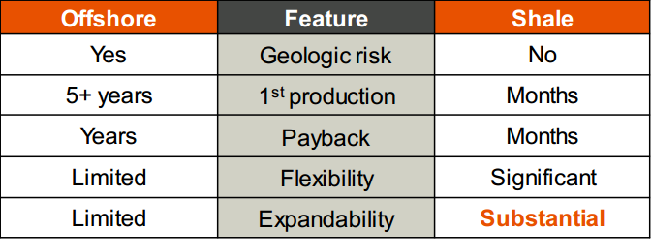
    All the fundamentals are there for an increase in energy consumption globally and as the world embraces gas more than it already has, Billiton will be ideally placed to benefit. And when this happens it will happen quickly. As you can see from the graphic below which I took from the presentation, mining gas is easy, sustainable and profitable.

    Yes, supply will keep the price low in the short term and the technology will only improve but as a long term play this industry is going to be massive in a country that is ideal to operate in and extremely willing to embrace alternate sources of energy. In Fact Citigroup said that the gas industry in the US could be the catalyst to the next industrial revolution which will solve all their budget issues. Why not? And mankind as a whole will benefit from cheaper cleaner energy.

New York, New York. 40o 43' 0" N, 74o 0' 0" W. Stocks managed to more than halve losses all the way to lunch time on Wall Street, but sadly fell away in the last two hours. The same problems of course, they are global in nature, we are all hooked in. So what, does that mean protectionism is not going to work? More on that later. All three major indices sank around one percent after all was said and done, the S&P 500 is trading 80 points lower from their April the 2nd year high. One and a half months later. We are down 5.7 percent from those recent highs. Hmm... I think that it might be time, and I suspect that the Facebook IPO might well be a catalyst of sorts. We wait for the end of the week for that.

{Sarcastic alert}. Well, so much for no demand. {End Sarcastic alert} It seems that Facebook demand is so strong for their IPO, that they are set to raise the price range to 34 to 38 Dollars. Or so, that is what a source close to the company says to the WSJ. From the existing range of 28 to 35 Dollars a share. That means that the share price range could bring the market valuation to above 100 billion Dollars. There are loads of people talking about the IPO. It is of course a bit of a problem that an 11 year old wants to part with her life savings in order to pay for her college education (same WSJ article - In Facebook IPO, Frenzy, Skepticism). Well, that would mean that she was and is owning shares before Warren Buffett did. In age, not time. Judging by the headline, and I got some head nods in the office this morning when I said, that is a good sign to still see healthy scepticism from the market. Yes, this is also true.

Currencies and commodities corner. Dr. Copper is last at 358 US cents per pound, the gold price is slightly higher at 1556 Dollars per fine ounce. The platinum price has recovered a little to 1443 Dollars per fine ounce. The oil price is steady at 94.71 Dollars per barrel for WTI NYMEX. The Rand is weaker at 8.17 to the US dollar, 13.14 to the Pound Sterling and 10.50 to the Euro. We have started around half a percent higher, that German GDP data lifting all of us.

Parting shot. Good news. This time from a usual source, one of my favourite bloggers, Prof. Mark J Perry who updates a blog by the name of Carpe Diem daily. Who, crazily, I do not follow on twitter. Why? Because he mostly updates his "stuff" around midnight our time and I am ashamed to say, I am asleep then. So, I just rely on his blog posts and my RSS feeds to read his good work. And I stumbled across this one this morning: Smart Phones and Tablets Might Be Spreading Faster Than Any Technologies in Human History. And let us leave you with the amazing last paragraph:

"Smart phones, after a relatively fast start, have also outpaced nearly any comparable technology in the leap to mainstream use. It took landline telephones about 45 years to get from 5 percent to 50 percent penetration among U.S. households, and mobile phones took around seven years to reach a similar proportion of consumers. Smart phones have gone from 5 percent to 40 percent in about four years, despite a recession. In the comparison shown, the only technology that moved as quickly to the U.S. mainstream was television between 1950 and 1953."

Sasha Naryshkine and Byron Lotter

Email us

Follow Sasha and Byron on Twitter

011 022 5440
Monday, 14 May 2012

Greek creak

"Basically, global natural gas consumption is expected to double inside of thirty years, starting in 1990. And if we believe the forecasts, then natural gas consumption should double between 2000 and 2030, keeping up that thirty year trend."

Jozi, Jozi. 26o 12' 16" S, 28o 2' 44" E. After starting poorly here on Friday, we rallied into the close, the Jozi all share index managed to close half a percent higher, or 168 points to close at 34038 points. Financials driving markets higher, Old Mutual continues to look much better after an interim management statement from Thursday morning from before the market opened. The last little rush up in the market was as a result of a better than anticipated consumer confidence number, as much of the day was dominated by a real howler by JP Morgan. A 2 billion Dollar trading loss. I suppose that whilst the company will still make a profit for the quarter, people are saying, that is not the point, they (JP Morgan) were the ones that sniggered at everyone else and were supposed to the kings of risk. As far as I can tell, the very word risk implies something in the first place, that "things" can happen and that "it" can go all wrong. A few employees have had pink slips already.

Lonmin have released results for the half year to end March this morning. I saw an interview with Ian Farmer, the CEO, this morning. I suggested that he looked like he had just lost his crop. He looked relegated. That look on the Bolton fans yesterday. Whilst Lonmin describe their results as solid, it is in a challenging environment. Costs in Rands up nearly 11 percent, revenue basket in Dollars down 10 percent, but the Rand basket price was only 0.5 percent lower, thanks to a weakening local unit. Platinum sales for the half basically flat at 318 thousand ounces. In the interview Farmer basically said whilst European auto catalytic convertor sales (platinum used in Diesel vehicles, of which there are many in Europe) were understandably weak, he still sees the long term fundamentals intact. I guess I would have to agree with him on that score, and even though we have dropped our platinum company exposure, we hold that view too.

It seems that whilst mining companies are still pointing fingers at safety stoppages, there is definitely a sense that both companies and the DMR are working towards a solution to reduce downtime. As they point out in the release: "Lonmin performed well in a period where unprecedented high levels of Section 54 safety stoppages, labour and community unrest impacted on our production. The impact was slightly less in Quarter Two however as we saw the benefits of our partnership approach with the DMR in tackling the safety journey start to come through. We expect production to ramp up in the second half as normal, absent any further abnormal disruptions."

The company has registered a loss for the period, so I guess no matter how much they tell us about the fundamentals and the future, this is the ugly truth. What I found quite interesting was their supply forecasts, because I am starting to read that notwithstanding the shortfalls, we might even see a surplus in the platinum market, not palladium as those crazy Russians continue to monkey with the price. But Lonmin reckon that they expect now the market to be undersupplied this year, check it out: "Platinum supply estimates have been progressively revised downwards since 2007, due to supply disruptions and constraints in South Africa. 2012 has already seen disruptions affecting over 200,000 ounces worth of production due to strikes and industry wide safety related stoppages. Some analysts are estimating that 2012 could see supply disruptions of up to 400-500,000 ounces, which would almost certainly lead to supply deficits, despite softer demand."

So how do these results make me feel? I know how Mr. Market feels, the stock is down four and a quarter percent today. This is the lowest price since December of 2008. And at 113 Rand it seems the days of 600 Rand in the middle of 2007 were a long time ago. A long, long time ago. The results make me feel like that, as South Africans we are missing an opportunity to mine these assets that we happen to find ourselves on by bickering all the time, about issues that should be easy enough to resolve. No thanks, the platinum mining companies seem to be facing too many pressures, I am still surprised that the platinum price is NOT higher than these current depressed levels.

And now they are talking about it. I suspect that the chances of Greece leaving the Euro zone have risen over the last few days, because basically the Germans have said, if you want to, then you must. It will be bad for the Euro, but it would be so much worse for Greece. It would be disastrous for Greece. And, the Germans have basically said that the Euro, whilst it would suffer, it was much better placed to deal with these issues now.

I saw an FT graphic from last year, which explained simply what happens practically when you default without support? Simple. You run out of money, because nobody is actually going to lend you anything, because your recent record is patchy. Forget the fact that Greece's record is very patchy anyhow. And then you cannot pay your civil servants. No healthcare, no teachers, no public transport, nothing works. Poor people get poorer, because at least one Euro is worth something, one Drachma will not.

What next for Greece? Well, there seems no chance of a coalition government in Greece, or little chance, so fresh elections are coming. The central bank governor of Belgium reckons that it is OK if Greece wants to make that decision. It all comes down to the money. The politicians can say that they have the peoples mandate, but I think that their (the peoples) emotions probably do not translate to wanting to exit the Euro. File that in the drawer of unintended consequences. But, austerity sucks. There were Spanish people protesting over the weekend, and Germans protesting by voting Angela Merkel's party out of power in some regional elections over the weekend. Elections on the weekend, that is how it must be done. These regional elections are important, because we can see that even the common German folk are sending a signal. But instead of voting in fringe parties, the democrats and greens in Germany are starting to make progress. So you see, even though the German government is pressing Greece and Spain hard, the truth is austerity sucks.

There is a EU Finance meeting today. Guess what is on the agenda, Greece of course. And Spain. And later, investors get to vote themselves with a bond auction for Italy today. The Italians are not too excited about being compared to the Spanish and in theory this is true, the two countries are very different economically, if not geographically. Germany, France and Spain also have debt auctions today, this has become almost as exciting as watching the various football leagues come to a conclusion. So the noisy neighbours eh? I am pleased for them, and their Italian coach, Italy is winning! And Greece is too, Olympiacos Piraeus, a basketball team from Athens won the Euro league yesterday. But, we wait for the outcome of these talks today and how much the Greek people want, or do not want the European money. Because for me, that is what it comes down to, accepting the money in return for further reforms and cutting of a bloated public sector, and just another chance to stay afloat. All of these hard decisions are not for me to decide.

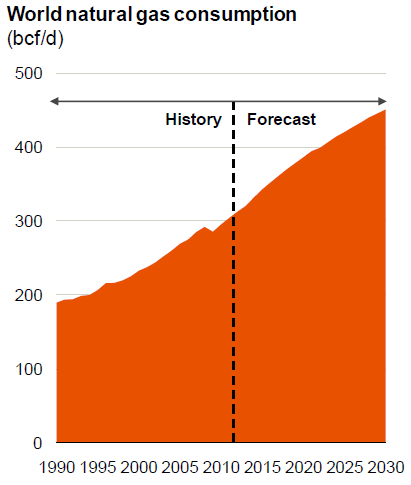
There are a whole lot of interesting slides in a BHP Billiton presentation: Technology, strategy and the growth of gas as a source of global energy. Check out the slides, because a picture of course tells ten (or is it a thousand) words. So I have gone and grabbed a whole lot of screen shots. First, world natural gas consumption shown in Billion Cubic Feet Per Day. I can't even imagine how big a billion cubic feet is, and how you can actually shrink it, but for the purposes of consumption and production, that is what it is measured in. It is much easier to imagine a barrel of oil.

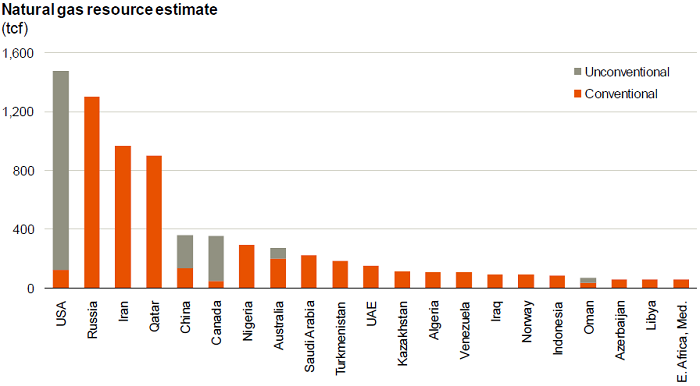
Basically, global natural gas consumption is expected to double inside of thirty years, starting in 1990. And if we believe the forecasts, then natural gas consumption should double between 2000 and 2030, keeping up that thirty year trend. The next slide points out why we have seen lower gas prices, because the improved technology has led to greater supply. In the US, the greater use of technology (fracking) has seen US production improve dramatically. Many companies in the US, either at a services level or at a production level have ramped up their exposure to natural gas, and this next visual tells us why. Natural gas resource estimate sees the US have years and years of "unconventional" gas resources.

The next few slides are specifically related to BHP's business in the US, how their operations are lower cost than their peers. And one slide which explains how 600 thousand jobs have been created by this US gas push. And how they no longer import. No wonder natural gas prices have plunged, there is now huger interest. I suspect that Americans will revolutionize gas usage plugging into the mainstream and developing new methods. We maintain our positive bias towards BHP Billiton, their gas purchases were "early". And interestingly Pat Davies (the ex Sasol CEO) was announced as a BHP Billiton non exec this morning.

Byron's beats looks at another one of the South African hospital groups.

    We had Life Healthcare releasing results on Friday and then this morning we had Netcare with 6 month interims. The big difference between these two companies is that Netcare have operations in the UK along with R26bn in net debt compared to Life's R2.2bn.

    Here is a brief overview of the Netcare results. "A positive performance in South Africa (SA) was offset by weaker results in the United Kingdom (UK) primarily due to the challenging economic environment. Adjusted headline earnings per share (HEPS) increased 16.1% to 51.9 cents for the period under review. Operational efficiency and implementing business improvement plans were again key focus areas for the Group."

    You can see where my message is going to go with this one. In a world of choices why would you choose a company with big exposure to a declining economy when there are better options out there? Well the difference is that Netcare understandably looks a lot cheaper. Trading at the R13.93 we get a forward PE of 13 (if we annualise this number) compared to Life's 19. Let's look at their debt situation in the UK and how their South African businesses compare. Of their R26bn debt burden, at least R21bn of that sits in the UK with their General Healthcare Group (GHG) business.

    "GHG continues to meet all financial covenants on both the OpCo and property- owning companies (PropCo) debt facilities. PropCo remains focused on achieving a solution to the PropCo debt facility, which matures in October 2013. Advisors have been appointed and various options are being evaluated. The PropCo debt is ring-fenced from the OpCo and is also without recourse to Netcare`s SA operations."

    See that the debt facility matures in 2013. They are going to have to arrange a new facility otherwise they may default and the hospitals could be seized. They seem to be on time with their payments so I would expect them to be able to arrange something but it is certainly a concern. Margins in the UK are decreasing as consumers shift to the lower margin NHS (state care) from the private hospitals as tougher times fall upon the wealthy. It is not an economy I would want to operate in right now and I would expect this trend in margins to continue. GHG has now become the largest private service provider to the NHS but with austerity measures being implemented one wonders how lucrative this kind of business is.

    The South African Business is a similar size to Life with operating profits of R1.1bn compared to Life's R1.2bn (for the whole group) yet Life has a market cap of R27.5bn compared to Netcare's R20.9bn. In fact overall Netcare makes more money than Life with operating profits of R1.8bn. You can see that the UK business is a big portion of that (38%).From my message on Friday you know I like the fundamentals of the industry. But the UK business along with its massive debt facility puts me off this stock. I certainly feel it deserves the cheaper valuation that the market afford it.

Beijing central. 39o 54' 50" N, 116o 23' 30" E Hah! Chinese authorities have cut the reserve ratio requirement in an attempt to get the banks to lend more money. Now, depending on what your view is on China, whether you fall into the too-much-debt-and-banks-are-built-on-quicksand crowd, or whether you see the internal consumption story driving Chinese growth in the long term, as it should, you would view this triple R cut differently. Indeed I am not alone thinking along those lines, I came across this Bloomberg story (China's Stocks Drop to Three-Week Low) in which a quote suggests that "things" have to get much worse for a serious policy response. As many have suggested, interest rates need to be cut to make a real difference. But I get the sense with subdued inflation that policy makers are going to be forced to move in that direction. Stand by.

New York, New York. 40o 43' 0" N, 74o 0' 0" W. Ooops. JP Morgan came in for a whole lot of heat, I saw Jim Cramer having a big go at Jamie Dimon, who was really the attention of a lot of abuse, both on the box, but folks let rip on twitter. And the Greek connection going too, Dimon is of Greek extract and the losing investment had a connection to the name Achilles. Because a fellow by the name of Achilles Macris, ran the trading division. And now, I see from over the weekend that folks are saying no, he must go, that is a true South African line. Doesn't it come from District 9? They must go, really, they must go. Whether or not he will, well that is what the (now smaller) board must decide along with shareholders. Not for Joe Public to decide.

Currencies and commodities corner. Dr. Copper is having a really tough session, last at 359 US cents per pound. The gold price is also taking a drubbing, Mr. Giant Risk Off is visiting Mr. Markets house today. Last at 1562 Dollars per fine ounce, the platinum price is also under the same pressure, down at 1448 Dollars per fine ounce. The oil price is trading much lower at 94.15 Dollars per barrel for NYMEX WTI, 109.9 Dollars per barrel for Brent crude. As we said, Mr. Market is taking another hit today, more worries about the Greeks.

Sasha Naryshkine and Byron Lotter

Email us

Follow Sasha and Byron on Twitter

011 022 5440
Friday, 11 May 2012

Giant pile of scrambled egg falls on Jamie Dimon

"If you judge the fellow by what he is wearing and that is how he views investors, well then, don't own the stock. If people thought that about Steve Jobs or even Bill Gates (who kind of dressed up) opinion of shareholders is what they wore, then that is you conforming with a opinion of your own. Once, the Zuck actually gave investors a presentation in his pyjamas in the early days."

Jozi, Jozi. 26o 12' 16" S, 28o 2' 44" E. We were flying, markets around the world were recovering after a week of selling, heck, even Prince Charles was presenting the weather for Scotland on BBC. I am pretty sure that I could have done the Scotland weather without checking too hard. Cold, windy, chance of snow here and there. That line about Scotland from Trainspotting could have been used to describe the weather. Watch both of those things if you have not already. Factory output in South Africa unexpectedly fell (Read Cees Bruggemans piece: SA mining bounces as manufacturing crashes), most economists were expecting a gain. The same thing has happened in India this morning, not good. I guess the Euro austerity is starting to impact on all of us, somehow the Germans are just fine with the weaker Euro. Those Germans are workaholics, I suppose there is no sun to sit in, you might as well be indoors and working.

Resources stocks bounced hard, up two and a quarter percent, sending the Jozi all share index to 33869 points, a gain of 435 points or 1.3 percent. Banks added a percent and two thirds, gold stocks ramped up nearly three and a half percent, industrials underperformed, but still gained nearly three quarters of a percent. There were a whole host of results, from paper maker Sappi, gold producer AngloGold Ashanti, as well as ArcelorMittal and a host of smaller companies including Afrimat. But the management statement from Old Mutual was received with a great deal of enthusiasm by shareholders, the stock added 4.84 percent on the day. Nampak said afterhours that HEPS for the six months were expected to be between 10 to 20 percent higher than the 93.5 cents recorded at the last interim results.

Byron's beats takes a look at a company that is in a sector that we really like. Healthcare. This time it is Life Healthcare, who listed in 2010. But it was Afrox Healthcare beforehand, a separately listed business and a private equity buyout. It has expanded significantly from that time!

    This morning we had another good set of numbers for the six month period ended 31 March 2012 from hospital group Life Healthcare. Group revenue increased by 11.7% to R5.5bn while operating profit increased 22.4% to R1.2bn. Normalised earnings per share increased 21.9% to 62.3c. The share price has done fantastically well. Since listing in June 2010 at 1350c it's been a one way ticket up, now trading at 2655c, nearly a 100% return if you had got involved in the IPO. Sasha in fact pointed out that they are now the biggest hospital group in the country by market cap. At R27.5bn they have overtaken both Mediclinic (R24.9bn) and Netcare (R20.9bn). Both of these competitors have massive debts on their balance sheets which may have something to do with their lag.

    So how do the valuations look? At 62.3c per share for 6 months, analysts expect 140c per share for the full year. That puts the stock at a forward valuation of 19. Which seems expensive but for a company growing this fast I wouldn't be deterred. Let's look at the commentary.

    "Life Healthcare continued to grow during the period under review and is in a healthy financial position to deliver on its strategic objectives of growth, efficiency and sustainability. Activities as measured by hospital paid patient days (PPDs), increased by 6,0% as a result of an increased demand for hospital services due to high incidence of disease together with a growing and aging medical aid population and preferred network arrangements."

    That last part is important. Life Healthcare are well positioned to benefit from our aging higher income group while disease incidence remains high. They have also taken advantage of the gap left by the public sector with regards to healthcare. Our very advanced medical aid system also benefits the hospital groups, thanks Adrian Gore.

    Are there social issues about a company like this providing an essential service at such high margins and making so much money? I guess that is why the government want to roll out those national healthcare plans. It does pose a concern. I also think competition will increase which should benefit the (sick) consumer. Life Healthcare are rolling out their capacity aggressively and so are the other two groups, the market is there to be grown into.

    The fundamentals still remain strong for this sector and you would have to back the management to maintain this efficient growth as they increase beds. We prefer Aspen in this sector because of their alliance with the regulators (cheaper medicines) and international exposure but I do rate Life Healthcare a good investment for the future.

A few Greek facts that I managed to piece together yesterday in preparation for an interview. Greek youth unemployment has doubled since February 2007, with the overall unemployment rate sitting at a pretty lofty 21.7 percent. Youth unemployment is 53.8 percent. Greek industrial output, the figures released yesterday showed a drop of 8.7 percent year on year. According to a CNBC interview I saw, around 1000 businesses close every week, and after the elections, hotel bookings on the first two days of the working week fell 50 percent relative to the norm. There have been huge tax increases and massive spending cuts, needed, because the civil service was completely bloated. GDP is down 20 percent from the recent highs. BNP actually stuck out a note on what a Greek exit (being termed a Grexit) might mean for the country in the short term. GDP would contract another 20 percent overnight. Inflation could spike to 50 percent and debt to GDP would climb to comfortably over 200 percent.

The banking system would implode. The country, as the far left have said already would stop making debt payments. And as such would quickly run out of money. And the civil service (bloated civil service) would not have any money to get paid, because Drachmas would quickly become worthless. There is a whole lot more merit to keeping the Euro, but tell that to the people who are now buying bags of potatoes for cash off the back of a truck, the supermarkets are being bypassed. It is sad, but perhaps the ordinary Greek people lived comfortably above their means relative to their productivity and economic output of their northern neighbours. A sad state of affairs all around. Although as I often say, these are rich people problems, the average GDP per capita for Greece is more than Portugal, just a little less than New Zealand. Double Venezuela or Bulgaria. Four times that of an Albanian citizen. MUCH bigger than a South African, around two and a half times more. Ten times the economic output of a Pakistani. So in a very crude kind of way, these are still rich people problems.

Beijing central. 39o 54' 50" N, 116o 23' 30" E I smell policy response in China after the data this morning saw some key metrics miss expectations. Although at face value the numbers themselves still look good, Chinese fixed asset investment year on year increased 20.2 percent, Mr. Market was expecting 20.5 percent. Retail sales missed, clocking 14.1 percent, the expectations were a whole percentage point higher. But at face value those numbers look not fine to me, but rather very good. I would prefer it to see that retail sales numbers rising more sharply, but hey a 14 percent rise is still significant. Why I think policy makers might be poised to do something is that inflation eased back to 3.4 percent.

New York, New York. 40o 43' 0" N, 74o 0' 0" W. It was quite the opposite of what has been happening recently, with the last weeks sessions characterized by deep falling markets at the start and then in the last half finding some buying support. This time we were out the blocks in a flash, and slid in the second half of the session to just close in the green. The Dow Jones just eked out a gain, there was something interesting which caught my eye, check it out: With Apple in, Dow would have set record long ago. See that, see why we should get more excited about the S&P rather than the level of the Dow Jones.

Yuck. JPMorgan Chase reported a trading loss of 2 billion Dollars on credit derivatives trading that clearly went against them. And of course everyone is seeing this as a sign that the regulators should only push harder to see prop trading banned for banks of this nature. The culprit, a trader who has the nickname, "the London whale". Well, let us just say that his trade looks more like the Twitter whale. From what I read, the trades, which were related to corporate debt, went bad quickly when markets started to move against the positions, around a month ago.

As the news leaked, JPMorgan arranged a conference call and Jamie Dimon took responsibility. That is what I like to see, accountability for wrong doing, it means that you are human and make mistakes. Nothing like saying sorry for a saga to end, but I am thinking that this trading loss (Dimon said that the company remains profitable) gives regulators everything they need to say, see, told you so. Because of course JP Morgan is the US' largest bank by assets, who wants derivatives bets messing with client deposits and borrowings? Nobody. Another reason why we don't invest in big banks where there is stuff under the hood that is impossible to understand. The stock afterhours is down six and three quarters of a percent. Not nice. This is like a giant omelette falling on Jamie Dimon as he crosses the curb from his Lincoln Town car that stops outside of 270 Park Avenue, Manhattan.

Currencies and commodities corner. Dr. Copper is last at 367 US cents per pound, the gold price is lower at 1576 Dollars per fine ounce, whilst the platinum price is also lower at 1469 Dollars per fine ounce. The oil price is also lower, 95.80 Dollars per barrel for NYMEX WTI, whilst Brent is trading at 111.10 Dollars per barrel. The Rand is weaker at 8.10 to the US Dollar, 13.03 to the Pound Sterling and 10.51 to the Euro. We are weaker here today at the start as risk off visits us again.

Parting shot. Does it matter? I mean, does it matter what you wear in order to give your investors a presentation? Steve Jobs used to wear the same thing, the turtleneck and the jeans. I wear jeans all the time, does it impact on my performance whether I wear a suit or not? Where am I going with this? Well, Wedbush securities, actually an analyst who works there by the name of Michael Pachter, who actually have a buy on Facebook and a price target of somewhere around 44 Dollars if memory serves me right (remember that the IPO range is 28 to 35 Dollars) had this to say about the Zuck's attire: "Mark and his signature hoodie: He's actually showing investors he doesn't care that much; he's going to be him. I think that's a mark of immaturity. I think that he has to realize he's bringing investors in as a new constituency right now, and I think he's got to show them the respect that they deserve because he's asking them for their money."

All I have to say is, if you judge the fellow by what he is wearing on how he takes investors, well then, don't own the stock. If people thought that about Steve Jobs or even Bill Gates (who kind of dressed up) opinion of shareholders is what they wore, then that is you conforming with a opinion of your own. Once, the Zuck actually gave investors a presentation in his pyjamas in the early days. Once, the Zuck actually gave investors a presentation in his pyjamas in the early days. To me it doesn't matter, as long as he was appealing to the investors in question, and gave them all his attention. And I do not even own a hoodie. A week today could see the listing of Facebook, what matters I guess are the valuations and the future of the business, and where the market price settles ultimately.

Sasha Naryshkine and Byron Lotter

Email us

Follow Sasha and Byron on Twitter

011 022 5440
Thursday, 10 May 2012

The disco ball falls on Cisco

"More data is being consumed than ever before. The iPhone 4S consumes 3 times more data than the average smart phone thanks to Siri and its ability to use data so efficiently. Over 35 million of these were sold by Apple last quarter. AT&T and Verizon are spending millions to keep up with this demand. Then you have companies like Netflix which stream movies and the Xbox which allows gamers to play on the web, all of this requires Cisco's products."

Jozi, Jozi. 26o 12' 16" S, 28o 2' 44" E. What a difference a week can make. At the beginning of last week we were talking about 4 year highs for the Dow Jones and all time highs for the Jozi all share index. But then disappointing jobs numbers and uneasy feeling markets about the political outcome in European elections over the weekend came along and did almost everything to trash the rally that has been largely earnings led. Also, the markets have been improving against the backdrop of largely improving economic data for most of this year, although that same data has been looking a touch weaker over the last five weeks or so. We have had two US employment numbers that have pointed stronger, but it was a case of only the first Oliver Twist bowl of porridge, we were left asking for more please sir.

So the open debate of the Greek elections has captured every watcher and participant this week, the Greek stock market has plunged to the worst levels in 20 odd years, probably a whole lot worse on an inflation adjusted basis. Perhaps my review of the situation was a little alarmist yesterday, but there are many that share my view, being a member of the Euro club is far better than being out, check out this Economist piece: The euro crisis - No way out. You see that analysis, the second paragraph? Yip, whilst being out might be a good idea at the time, being in is better.

Spain was also feeling a whole lot of heat yesterday, the equities market was off heavily, around three and a half percent, the bond yields had spiked through six percent and there were serious worries about the new plan to inject liquidity into Spanish banks. Excuse me for thinking this is a slow motion repeat of the part nationalisation of the American banks European style. They are a bit slower and a whole lot more bureaucratic, but eventually the job gets done. Spain is in the process of organising a program to inject new capital into their banks. Last evening basically the state through a fund named Frob (what kind of a name is that) took a 45 percent stake in the nations third largest bank, Bankia. By basically converted state funding to equity, this is not the first (the 8th as far as I understand it), but the biggest, ten percent of bank deposits in Spain. The Spanish stock market is at its worst level since the end of 2003. Sigh. At the same time German bund yields dropped to their lowest level ever, signalling that Europeans trust the Germans, and nobody else. No wonder the Germans continue to drive this line, but I am sure that they will start to share the view of the new French president, austerity is not everything.

As a result on this side of the world (Paul told us the other day that only ten percent of the global population live in the Southern Hemisphere, I feel lonely) we saw equity markets sell off, we had started well enough, but quickly slid. The Jozi all share index closed at 33434, down 113 points or 0.34 percent on the day. Banks sank three quarters of a percent, industrials lost around the same amount, resources, perhaps thanks to a weakening Rand added just over half a percent. Gold miners added a whopping two and a half percent.

Staying with gold miners, Harmony Gold released numbers yesterday morning. These are third quarter numbers, the company is a June year end. Production for Q3 was 18 percent lower than Q2 and cash costs were up by as much, an 18 percent hike sports lovers. On a nine month basis however production is only down 2 percent, cash costs are also up 21 percent. But I am not going to go into the reasons I would not want to own it, you know what those are already. I do not want to own gold as a physical asset, and therefore do not want to own a company that mines gold. David McKay had a great story yesterday, which basically explains that Harmony have decided which asset is the future of this company, and it is not a South African mine. Briggs nails colours to "this animal Wafi-Golpu".

Interesting, not chasing production at all costs, but rather focusing on being a more profitable company. Sadly for shareholders the stock has done very, very little for a very, very long time. There are periods of weakness and periods where the stock sank sharply. Over five years, the stock is down 34 percent. Amplats are down 60 percent over the last five years. Yech, so, in short the Harmony shareholders have beaten the Amplats shareholders over that time frame, and by quite some margin. Both stocks are closing at 52 week lows.

Remember we were talking about Swedish finance minister and his amazing handling of their economy through the crisis. A staunch free market type that I follow gave the thumbs up to a Mark J Perry post (that must have been where I read it) about Sweden's amazing supply-side, tax-cut experiment. Read it. Because for a socialist country to promote what are seen as a pro business policies, that would be considered a huge turning moment for James Pethokoukis. Because he does not like the Democrats and their policies, that is Pethokoukis, so obviously this would be exciting for him.

New York, New York. 40o 43' 0" N, 74o 0' 0" W. Phew. Markets again fell hard at the beginning but managed to recoup half of those losses again, the same old issues impacting us here weighed on markets there. The nerds of NASDAQ again, after having been down over a percent and a half, managing by the time markets closed to end less than four tenths of a percent lower. The Dow Jones industrial average lost nearly 100 points, down nearly three and one third of a percent over the last week.

Byron's beats looks at Cisco's results from last evening, which were released after the market.

    It's amazing to see how investors interpret results releases. Especially when it comes to management commentary. You get the feeling that the traders sus out the general consensus as quick as possible and then everyone follows like sheep, trying to eke out those tiny basis point gains. Seeing that more than 50% of the US market is traded by machines, once the traders push a stock down the momentum gathers and the stock stands no chance. This can happen both ways, pushing the stock up or crushing it. Unfortunately Cisco has experienced the latter after they released quarterly results which actually looked pretty good. The stock is down 8.8% post the market.

    It wasn't the numbers that disappointed but the forward looking commentary. This is not the first time management have been cautious and the stock has been hit. Sales and Earnings actually came in above consensus, sales of $11.59bn and earnings of 48c per share versus consensus of $11.57bn sales and 47c per share earnings. This is up 20% compared to this quarter last year. Analysts expect earnings this year to come in around $1.84 and $1.93 for 2013. The share trades at $17.15 (following yesterdays fall) putting them on a very attractive forward valuation of 8.9 for 2013 estimates.

    So why the low rating? Let's look at the commentary and the fundamentals supporting this $100bn company. CEO John Chambers projected revenue growth of 5%-7% for the next quarter citing significant uncertainty in the global economy as a big risk. Europe and the US public sector has shown some demand weakness, as you would expect.

    But the fundamentals are still there. More data is being consumed than ever before. The iPhone 4S consumes 3 times more data than the average smart phone thanks to Siri and its ability to use data so efficiently. Over 35 million of these were sold by Apple last quarter. AT&T and Verizon are spending millions to keep up with this demand. Then you have companies like Netflix which stream movies and the Xbox which allows gamers to play on the web, all of this requires Cisco's products. As technologies improve (the rolling out of 4G as an example) data consumption will only increase and Cisco should benefit.

    There are some issues over management which pose a concern for us at Vestact. Last year Cisco scaled back on efforts to expand into more than 30 businesses, rather focusing on a few core businesses. The market liked this (as did we) and the stock started rerating. John Chambers has a controversial self invented management style based on 5 pillars to drive collaboration. The CEO who has been at the company since 1991 has done great things but we feel that maybe a change is needed. Valuations look attractive and the fundamentals look exciting. We remain buyers of this stock but we follow potential reshuffles closely.

Currencies and commodities corner. Dr. Copper is last at 370 US cents per pound, the gold price has recovered somewhat to 1591 Dollars per fine ounce, the platinum price better to 1497 Dollars per fine ounce. Quite a lot of talk about the platinum market recently. And not all good. The oil price, NYMEX WTI is trading at 96.41 Dollars per barrel, Brent crude oil is last at 112.42 Dollars per barrel. The Rand is firming a little, as risk on seems to be back, 8 exactly to the US Dollar, 12.90 to the Pound Sterling and 10.37 to the Euro. We have started better this morning, around two thirds to the good.

Parting shot. China has reported a larger than anticipated surplus, with both exports and imports increasing at a much slower pace than last year. All pointing of course to a slowing in the Chinese economy, because this means that less is being imported by their major trading partners. As the FT points out of course, this slowing in exports is being felt by both Taiwan and South Korea. Slowing investment in China and not quite the pickup in internal consumption that everyone is looking for might well get Beijing central to act faster than anyone else. And there are those that suggest that the Fed at their next meeting might well be more accommodative. I would not really welcome QE3, because I concur with the Fed, perhaps it is a case of waiting a little.

Sasha Naryshkine and Byron Lotter

Email us

Follow Sasha and Byron on Twitter

011 022 5440

Wednesday, 9 May 2012

Slippery Greece. Again and again.

"The idea of leaving the club (the Euro Zone) and going it alone (Greece) might have a certain romance to it, but the reality is that almost everything that you hold dear will be crushed almost immediately. Think about pension savings that would halve or more at worst, the trade benefits of the current arrangement, the fact that Greece has no natural resources of their own. It would almost be a sure recipe for anarchy."

Jozi, Jozi. 26o 12' 16" S, 28o 2' 44" E. It seemed that the major issue was still the European elections from the weekend, but it almost seems like a foregone conclusion that the Greeks are going to have another election coming soon. Well, they better hurry. According to the last agreement, Greece had to vote through further austerity measures by the end of this month, in order to receive their next round of funding. Otherwise they are going to default. And how did their markets take to this? Well, down to the worst levels in 20 years. Whilst people might well be spooked by the fact that the anti austerity and anti Europe types got quite a large portion of the popular vote, not enough to form a government. And the Pasok party which was dragged through the brambles and nettles at the polls does not really have much of a chance of forming a government of any kind. So the Greeks, who invented democracy, will get another chance to go back to the polls. According to a Bloomberg article which I read on the serious problem of a more than a simple hung vote, more than two thirds of Greeks polled want to stay inside of the Euro zone. They are just tired of all the austerity measures.

Ironically, Gideon Rachman of the Financial Mail has weighed in saying that the Greek dilly dallying is actually a "good" thing for Angela Merkel and the German austerity push, because it leaves new French president Francois Hollande with very few options really. He might talk up some emotive issues, but really in the end the conclusion is clear. The French, faced with the choices of supporting Greece or supporting Germany inside of the Euro project are going to go with the Germans. I urge you to read it (even if you sign up for a free thirty day trial, just for this one), you must check it out: The Greek crisis will fast expose Hollande. Like I said to Paul yesterday, the idea of leaving the club (the Euro Zone) and going it alone (Greece) might have a certain romance to it, but the reality is that almost everything that you hold dear will be crushed almost immediately. Think about pension savings that would halve or more at worst, the trade benefits of the current arrangement, the fact that Greece has no natural resources of their own. It would almost be a sure recipe for anarchy.

At the same time would you believe, at the core of the Euro in Germany, the country reported a much stronger than expected industrial production number with the suggestion from the IMF that a domestic demand recovery is underway. Yeah. See that? This Euro exercise is very good for Germany. A monster construction number inside of the release (March number), but in part the suggestion was that February was terribly cold and this was a rebound plus pent up demand drove the overall number. The beer drinkers might well be suggesting, crisis? What crisis? At the same time I read a fascinating article of Sweden's colourful finance minister Anders Borg of how he led Sweden through this crisis by NOT following the mainstream. And lowering taxes for the wealthy (wildly unpopular), cutting entitlements (also unpopular) but all working in the favour of the average Swede. To such a point where Sweden has looked much better than their peers. And to such a point that he is probably the coolest finance minister in the world. Although with a good haircut (lose the pony tail) he might actually be cooler, sometimes trying to be cool can come off as way nerdy.

Briefly, the markets sank heavily in the last quarter of trade, the Jozi all share index closed at 33547 points, down 408 points for the day, resources being a big drag, down 1.52 percent. Telkom rallied to see the fixed line index up (it is only them in that index), but phew, it was just because KT Corp. was taking a stake, or that was the intention at least. Platinum miners got thrashed, down nearly three percent. Eish, not looking very good, but at some stage these miners might be attractive. Or as we often say, perhaps we are watching the same story as the gold miners from a decade ago in slow motion. The fundamentals for the metal that they mine as still great, but owning the companies sadly has not worked out well for shareholders. Sis.

Byron's beats gives us feedback on his investor day yesterday.

    Yesterday I went to Massmart's annual store visit which I must say was very interesting. They took us on four store visits as well as a look at their central distribution centre for Gauteng and the rest of Africa. We started off at the Makro in Woodmead which is their second biggest revenue spinner. The store has revenues of over R1,1bn a year and the second biggest butchery in the country. It's all about size and scale and allows the customer to get almost anything he/she needs or wants within one shop. The liquor store is also massive.

    The next store we visited was the Dion Wired in Boksburg. This is one of my favourite shops and one that falls well within that aspirational consumerism theme we like so much. From iPads to affordable flat screen TV's to Nespresso machines. They have it all and although the electronics industry is highly competitive I am confident these stores will do well considering our economy.

    Then we went to one of their Cambridge stores in Vosloorus, a township in the South East of Johannesburg. I was very impressed with the size and scale of this grocery super market offering very cheap goods to low end consumers. It has the feel of a massive African styled kiosk with everything from fresh meats to an array of African healing muti selections. Although it was still early, the queues were growing by the minute. There is competition for this market but I believe there is still such a high demand for such stores which is still a fairly new concept in this country.

    After that, we went to their distribution centre which was back in Boksburg, nice and close to the N3 highway coming in from Durban. The warehouse was massive as we sat with an aerial view from the meeting room. As the operations manger explained how the systems worked you realised how well organised the warehousing process was. It has to be. Everything is processed electronically with a maximum of 48hrs in the warehouse before being trucked off to the relevant Game and Dion Wired stores.

    South African retailers are not reinventing the wheel here, it's all been done before and on an even larger scale. That is why it is so important to have Wal-Mart guiding these guys in the right direction and avoiding mistakes they have already made and learnt from whilst building the biggest retail system the world has ever seen. Seeing the warehouse made me really appreciate the behind the scenes hard work it takes to get quality products to consumers at good prices.

    Our last visit was to the Game and Foodco at Greenstone mall. Everyone knows about Game but Foodco is a fairly new concept. Basically they have taken 20% of the Game store and turned it into a grocery section. It has a very similar feel to a really nice Pick n Pay targeting the upper middleclass consumer. I was impressed and think that a lot of Game customers will be pleasantly surprised. I do feel however that they need to roll out a big marketing campaign to get the brand out there. The sector is very competitive.

    All in all it was an interesting visit and I remain happy to have this company as our favoured retailer. The fact that Wal-Mart is guiding an already very highly regarded management team through the challenges of being a mass retailer in an undersupplied economy makes me believe that even though it looks expensive, as a long term hold, shareholders will be handsomely rewarded.

New York, New York. 40o 43' 0" N, 74o 0' 0" W. The worst point of the session was reached around 11 in the morning, around the time that Europe was signing off, but markets actually rallied from that point to trim the losses. The nerds of NASDAQ was off nearly two percent at one stage, but closed off 0.39 percent in the red, a heroic recovery I guess. Some of the tech heavyweights have had a bad time over the last few weeks, Cisco is down 11 and a half percent since the beginning of April, Apple is down five and a quarter percent over the same time period, whilst the Microsoft share price is down five and a half percent since the beginning of April. Google has fared the best, down "only" 4.44 percent. But seriously, I can't wait for the Facebook listing in just under two weeks. Around then.

McDonald's released same store sales that really flunked, they were not bad, but for Mr. Market all he/she wants to see is that it beats expectations. And this it did not. We wondered for a little bit whether or not the stories about people starting to "eat up" in value was partly to blame for these numbers coming in with a weaker showing. Here is a quick screen grab from their press release -> McDonald's Global Comparable Sales Rise 3.3% In April.

I think that whilst analysts may have underestimated the impact of the stronger US Dollar on these sales, the constant currency sales number was quite important when trying to develop a trend view of how their sales are panning out. Looks just fine to me, but the equity participants voted with their feet, sending McDonald's over two percent lower to 93.55 Dollars. I like these prices, this is the same price as you are getting in November last year. The stock forward with estimates of 6.30 Dollars worth of earnings for the next fiscal year is trading at less than 15 times earnings. Which is a whole lot cheaper than Famous Brands, see Byron's piece from two days ago: Famous Brands trading update, still looking good. And let me be clear, I would rather own McDonald's AND Famous Brands, but if faced with only the choice of one, I would side with McDonald's. After all, McDonald's has increased their dividend EVERY year since implementing one for the first time back in 1976. Healthy sign, which is ironically the direction that their food is moving.

Currencies and commodities corner. Dr. Copper last clocked 366 US cents per pound, across the commodities complex prices are lower, the gold price is last at 1594 Dollars per fine ounce. The platinum price is also lower at 1506 Dollars per fine ounce. The oil price is lower at 96.7 Dollars per barrel for NYMEX WTI, whilst Brent is also lower at 112.42 Dollars per barrel. The Rand is weaker, most currencies that are not the Dollar and Yen are lower relative to those two, last at 7.90 to the US Dollar, 12.75 to the Pound Sterling and 10.26 to the Euro. You know how many times we say Dollar in this segment normally? 6 times, if we include the US cents as referring to Dollars. So, until commodities are priced in another currency, the Dollar will continue to be king. You could probably ask a European what the oil or gold price is, and they will quote the Dollar price. Locally the same. We are going to start higher here, but not by too much.

Sasha Naryshkine and Byron Lotter

Email us

Follow Sasha and Byron on Twitter

011 022 5440