Tuesday, 19 June 2012

Did it even scratch the Surface?

"The best performing stock is the unlikely Bank of America, up an astonishing 39.5 percent YTD. But, over 10 years, Bank of America is down an astonishing 78 percent. Most of that was over the last five years. HP on the other hand is up only 12.6 percent over the last ten years. IBM over the same time frame is up 153 percent, crushing the dogs of the Dow."

Jozi, Jozi. 26o 12' 16" S, 28o 2' 44" E. Wow, I did not really expect such an astonishing rally at the end, although there was great Grelief, there was anxiety about Spanish bond yields again spiking to Euro era highs. Spanxiety? Urban dictionary suggests that the word is way too rude, I had no intention of being rude, so perhaps we should call it what it is, Spailout. And who knows, Italy might be looking for cheaper credit sooner rather than later. All of this going on in the midst of the most important football tournament in Europe, which is exciting, and at the end of the week possibly the most anticipated match in an absolute age. The irony of it all, Germany against Greece on Friday evening. As we speak (write?) the new not yet formed government of Greece are asking Germany for more time for implementing the austerity measures. Which must leave the Queen of Europe shaking her head, in a match that we must term, the mother of all sovereign debt struggles.

Back to markets here locally, the Jozi all share index added a whopping 478 points, or 1.41 percent to close up shop at 34438 points, with gains across the board for all of the major indices, the banks roared over two percent, the retailers a more muted 0.29 percent better, the all important resource stocks added over a percent and a half, whilst the only noticeable losers were the construction stocks, down just shy of a third of a percent and the gold miners which sank just shy of a tenth of a percent. General industrials added nearly 1.2 percent on a generally good day for all and sundry. We closed on the ALSI a mere 43 points away from the early May all time highs. Tough going? Seems like it, but hey, the numbers tell a different story.

Naspers released a trading statement yesterday, it is complicated, because there are three different measures. That is often not a good sign, but be that as it may, the company considers what they term "core headline earnings" to be the true measure. And by that measure, on a per share basis, the company expects to increase core earnings per share by between 10 to 20 percent from the last years 1612 cents. So, in the middle of that range, 1853 cents per share. So, at the current share price of 46760, the price looks completely stretched. But. But. Not so fast, the valuation is in part earnings, and in part an NAV type valuation. We have covered this before in results, check it out: Naspers valuations, that was from last year, almost a year ago, that coincided with the results there. Results are in 8 days time, that would be the true test again of what the company should actually trade at, or be worth. Because often, and I hear this, folks suggest that the Multichoice business and the just less than 35 percent stake in TenCent make up the rest of the entire market cap. So, basically, you get the rest. But that is a simple and easy way of valuing what is a complex business.

Telkom, still trying to touch tomorrow, but at yesterdays share price. The BusinessDay has a story that suggests that the state are going to discuss this one in their policy pow-wow as to whether or not the asset is strategic. And whether or not it should be re-nationalised. Phew, that is why the share price is up a lot today, around four percent better. But what would they have to pay? Well, there are 520,783,898 shares in issue and government own a 39.76 percent stake which translates to 207,063,678 shares. So, if that were the case, government would have to buy the other 313,720,220 shares that they do not own in order to take the whole thing off the market. Let us suggest for a second that government pays 23 Rand a share, and I am not too sure that minorities would accept that, then the price tag for the rest would be 7.21 billion Rand. That would come from where? Total GDP at market prices in 2011 for South Africa was 1.895668 trillion Rands. So, this is not big, but our total budget is one trillion Rand, why would you blow around .75 percent of the total budget on buying this? And the way that we see it here in the office, the mobile entrants, of which two are dominant here in South Africa, are rolling out their infrastructure faster and with less red tape. Fewer meetings about how to do it, just plain old doing it. Execution and not talk, we are pretty good at that in South Africa.

Byron's beats is again focussed on the construction sector. I must be sure to buy him some Lego for Christmas.

    Cees Bruggemans Chief Economist at FNB comes up with some very interesting material. Here he covers some data called the FNB/BER construction confidence index which of course looks at the health of the construction sector in South Africa. Here it is. Now this is a sector that is very important for the economy and especially our jobs market. We are also invested in the future of this sector via PPC and Cashbuild.

    So what does the report tell us? This is the 3rd consecutive quarter where the index has risen and is the highest it has been since the end of 2009. "The 2Q2012 results suggest that the recovery is gaining momentum with construction activity in particular picking up noticeably. Despite this, there is still reason to believe that this recovery remains fragile."

    That is good news. We saw signs of this near the end of last year where we saw a turn in cement sales. The construction index is up over 12.5% for the year so far which means the market believes in this recovery to. It is off a low base however. Just as a reminder the sector was down 43% in 2008, up 8.2% in 2009, flat in 2010 and down 25.6% last year. Let's carry on with this report.

    "Capital expenditure (capex) from provincial governments remains robust. During the 2011/12 financial year (ended on 31 March 2012) provincial capex was 21.7% higher year-on year. This momentum likely continued with a number of projects focused on the healthcare sector and water and water waste management being initiated.

    In contrast, municipalities continue to struggle. Only 41% of the total municipal capex budget had been spent during the first 9 months of the financial year (until March 2012). However, some work could have flowed from municipalities as they push to spend more in the last quarter.

    Public corporations saw an increase in civil construction activity with new projects from the TCTA and ACSA in particular coming on line.

    However, construction activity from the private sector likely contributed less with mining production slowing and some mining firms holding back on expansion plans."

    Unfortunately the sector is still very dependent on the public sector. With rumours of bankruptcy amongst municipalities and story's like the Sanyati one who are insolvent because they have not been paid by government, you can see why they say this recovery is fragile. We have to see a pick up in the private sector. PPC did mention in their results presentation that private housing, which is responsible for 50% of cement sales, was starting to pick. With interest rates at historic lows and a growing middle class I tend to agree. There are still many headwinds for this very cyclical sector but having read this report I remain confident that we have seen the bottom of the cycle.

New York, New York. 40o 43' 0" N, 74o 0' 0" W. After opening much lower, stocks proceeded to pare losses and then mostly hang onto some slim gains. The S&P 500 managed to just eke out a gain, up nearly 2 points or 0.14 percent on the day to close at 1344 points. The nerds of NASDAQ had an even bigger gain, adding nearly four fifths of a percent, driven by a strong move from Apple, the stock was up over nearly two percent. The Dow Jones Industrial average bucked the trend, losing 25 points on the day to 12741, banks and energy lagging there. Plus also some technology giants, HP sank nearly three percent, the stock is now down all of 18.3 percent year to date and is the worst performing stock in the Dow this year. The best performing stock is the unlikely Bank of America, up an astonishing 39.5 percent YTD. But, over 10 years, Bank of America is down an astonishing 78 percent. Most of that was over the last five years. HP on the other hand is up only 12.6 percent over the last ten years. IBM over the same time frame is up 153 percent, crushing the dogs of the Dow.

Strangely, the Dogs of the Dow is an investment strategy that suggests that at the end of the year, you must take the top ten best yielding stocks in the Dow Jones, and buy those. The idea is that blue chip companies included in the index will pay higher dividends over time and you therefore are getting a bargain, over the longer term. Check it out, somebody actually maintains a daily table and spreadsheet to help folks make these very easy decisions: Dividend Yield for Stocks in the Dow Jones Industrial Average. All 30 stocks in the index pay a dividend, which was not always the case. IBM I am guessing are going to have to think about a stock split soon, their price is nearly double that of the next most important stock, because the Dow Jones is a price weighted index.

Do we even want to talk about the Microsoft Surface tablet? I guess we should and we must, the "Surface" was unveiled by CEO Steve Ballmer. The device weighs slightly more than the current iPad (the new iPad) but has a bigger screen, 10.6 inches compared to the iPad 9.7 inch screen. The pricing will be similar to that of other options out there, and by that I suspect that Ballmer means the Samsung Galaxy and the Apple iPad. What is quite cool is that there is a magnetic cover that doubles up as a fold down keyboard. And it can connect with printers, and it has a USB port. But, the expensive part will be that it runs a version of Microsoft 8 and office, so that licence part will have to be paid for by the user, which could mean that it might be more expensive that an iPad. As the WSJ points out though, if this is meant to replace the PC at home, then how do the manufacturers of PC's feel about this hardware muscling by Microsoft? Not too sure how they feel, but my thinking is that they do not feel altogether excited by this, HP, Dell and the like. I guess the good news for Intel is that their chips will be used in these products.

Microsoft is still a beast, with a market cap of 250 billion Dollars, over five years the stock is flat, but has paid a regular dividend, the current quarterly dividend is 20 cents per share, up from 10 cents five years ago. You would have got 182 cents if you had owned them over the same period. I swear to you that I ran a simple one year valuation model assuming that a growth rate of 8 percent was acceptable and got to about the current share price, in fact just below at 28.37 Dollars. The stock currently is at 30 Dollars in the pre market, indicating that whilst there might be haters for the device, Mr. Market thinks this is about neutral. Check out the presentation, which was live blogged by the fellows over at the Business Insider: Microsoft Announces Its Own Tablet, The Surface. Am I sold? No. But the stock still looks cheap man.

Currencies and commodities corner. Dr. Copper last traded at 340 US cents per pound. The gold price is last at 1631 Dollars per fine ounce, the platinum price has crept up to 1485 Dollars per fine ounce. The oil price is last at 83.03 Dollars per barrel. The Rand is last at 8.25 to the US Dollar, 12.93 to the Pound Sterling and 10.46 to the Euro. Stocks in general are being sold off today, after having touched an all time high earlier in the session.

Parting shot. Check it out, as Randy Jackson would say, he might add dog to that, but it is an endearing dog. The Jozi all share index touched an all time high, 34561.99. It would have been better if it was at 34567. But there you go, in the face of what is still poor news, we continue to see the indices head higher. Because Europe will solve their problems, they are not insurmountable, they are dire at present, but so were many moments in history. In five years time we will look back at the European sovereign debt crisis in the same way that we look at the subprime mortgage mess in the US, that period there. And Europe will be a more united place, not less so. Question: Is Greece still in the Euro zone? Answer: Yes.

Sasha Naryshkine and Byron Lotter

Email us

Follow Sasha and Byron on Twitter

011 022 5440

Friday, 15 June 2012

Greased up and ready to go

"I am of the opinion that if Greece "goes", which I still think has the lowest odds, then there might be some relief of sorts. Equally if the base case applies and Greece stays in the Euro zone, then there could equally be a rally. Worst case scenario would be if there were another stalemate."

Jozi, Jozi. 26o 12' 16" S, 28o 2' 44" E. Not the best day ever, the same old anxieties come back time and again. It feels like trying to start exercising again, and being hurt by a niggling injury that just won't go away. And that niggling injury is Europe and their sovereign debt issues. We feel your pain, but at the end of the day these are rich people problems, just this morning I saw that 91 day Kenyan T-bills are yielding 10.537 percent, according to an interview done on CNBC Africa. The comparable rate in the US is 0.1 percent. Portuguese ten year debt currently yields 10.65 percent. So, whatever you think in terms of whether one economy is finished or not, that is what people are prepared to pay.

So, I often suggest that the problems of Europe are rich people problems, because to borrow the Spanish Prime Ministers text message, Portugal is not Kenya. Portugal has an economy roughly the size of the Nigerians, and seven times the size of the Kenyan economy. Kenya, according to Wiki, has a population of 42.7 million versus Portugal of 10.5 million. Don't take this the wrong way, but if you had to ask 10.5 million Portuguese and an equal number of Kenyans where they would like to live and adopt the relative lifestyles, what do you think the answer would be? And Portugal have Nani and Ronaldo, Pepe and Meireles. Kenya has McDonald Mariga. Have I missed anyone? I still maintain that the "problems" in Europe are rich people problems. And they have the resources to deal with them, if not now, then sooner than we think.

The Jozi all share index closed down 211 points to 33826, a loss of 0.62 percent on the day, there were a few spots of green across the board, Sasol, the platinum shares and general retailers all closed a little higher, in the negative column there was the broader sector resources down three quarters of a percent, banks off nearly a percent. Not too much from a companies or earnings point of view yesterday, Sentula released results which saw their price higher on the day, but that said, the stock is trading near the five year lows, and over that same time frame are down a whopping 91 percent. Yech. Numbers of shares in issue at Sentula are up four and a half fold over 9 years. Not good. Although it is a different business of course now, than it was then, but having said that, turnover is down 16 percent from 2009. Perhaps they have turned the corner. But there is still a small matter of a civil judgement(s) against the former CEO and CFO, that hangs over the business like a bad smell. The NPA and the FSB sniffed around and raised numerous red flags (danger, communism I guess, or perhaps the athletics usage applies) that have been dealt with. Phew, too much baggage.

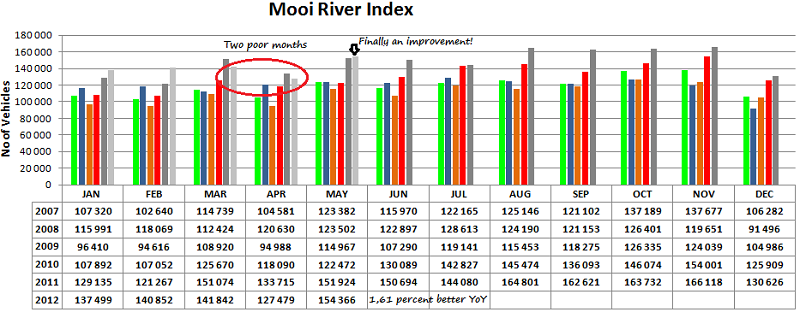
It is back! The Mooi River Index went missing for a while, Byron actually knows the fellow who compiles them, I think he was just very busy moving up to Joburg from Mooi River. But the reading is back, thanks to the settling of the compiler of this very important piece of our puzzle. What is it? Well, the Mooi River Index was thought up by a logistics chap by the name of Adam Kethro. He thought that heavy trucks, those with five axles or more, travelling on the national highway between Jozi and Durbs would be a good measure of state of the economy. The more traffic means that the wheels of the economy are moving faster than anticipated.

Strangely however, we are not too sure if this is as a result of the Transnet numbers falling. I have heard from several sources that Transnet is struggling, on the railways side, and in fact I was told yesterday that the last month's coal volumes through to Richards Bay was NOT GOOD, not because the demand was not there, but because of derailments and poor performance from the supplier of rail services. Which is a business that is 100 percent owned by government, so effectively, you and I, the people of the country that we live in, own this asset.

But that is another piece of the puzzle, something that I do not have access to unfortunately. If I did, I would put it all together and get a sense of whether this explosion in road traffic is as a direct result of a worsening in rail services. Here goes the Mooi River Index, for the last six years, since the beginning of 2007.

As you can see, the year on year improvement is slight, 1.6 percent better. I decided to take a leaf out of the cement stats book and introduce two sets of extra data to this, the moving annual total (MAT) and compare that to the prior twelve months and then of course the year to date statistics, and see how that is going. First, moving annual total, which will compare the second half of the last 24 months, to the first half. So, for the last 12 months the volumes of five axle trucks through Mooi River toll plaza has totalled 1,784,710. Or roughly 4889 trucks a day, 203 an hour! The 12 months prior to that, June 2010 to May 2011, registered 1,502,634 heavy trucks, or roughly 4116 a day, 171 an hour. That increase is a pretty remarkable 18 percent. Moving annual total. Now, onto the year to date numbers! 702,038 heavy vehicles went through the Mooi River toll plaza from Jan 1 to May 31 2012. The number for the year 2011, fitting the exact same dates were 687,115 heavy vehicles.

So, that is an increase of just over two percent so far this year. And I guess it tells you something, that whilst we have recovered to pre crisis levels, the going lately has been fairly stodgy. Europe, slower growth rates in China, fairly ropey local looking economy, it all adds up I guess. There is cause for being optimistic, this is the BEST May ever, for the data that goes back to 2004, and in fact over 80 percent better than in 2004. That tells you that there is a lot more trucks on the road now, than there was then.

Byron's beats today must be a yearning for his youth, when he built structures with Lego. Sigh, we were all engineers back then!

    I often talk about a YouTube clip I saw which shows a 15 storey hotel being built in six days. This of course takes place in China and is a great tribute to their work ethic and efficiency.

    This WSJ article has indicated that the company which made this viral video has made more clips and is now using it as a fantastic marketing tool. Good on them.

    The next clip they made is one where a 30 storey hotel is built in 15 days. Here it is. I strongly urge you to watch it. It is absolutely fascinating, starting from the foundations to the installation to the interior. I am far from an engineer so this kind of thing is almost mind blowing for me. When I walk through any CBD around the world and look up at the buildings I am astounded and dumbstruck by these structures. Yes Joburg that includes you. How we as humans manage to put up such an amazing structure with such precision is phenomenal. To do it in 30 days is even more impressive.

    The next step for this company is plans to build the tallest building in the world in 9 months. The building will be a whopping 838m high, 10m higher than the current tallest building, the Burk Khalifa in Dubai and nearly double the height of The Empire State Building. That is whole lot of iron ore, copper, cement, labour and many many more inputs.

    Where am I going with this? We are getting more efficient which means we consume things faster and therefore more of it. That's how humans work. Look at the iPhone. Because it works better and quicker than all the others the average iPhone consumes 3 times more data than any other smartphone. That is why innovation is so important for economic growth. And the more we innovate the more room is made to innovate, if you get my just. Because I can use my iPad and the internet to get so much information across to you so quickly I have more time to do other productive things. So basically the more efficient we get, the more efficient we get. And the more efficient we get the more we consume. McDonalds, Starbucks, Wal-Mart, Visa, Amazon and many other great companies are good examples of this.

    So you see why I love stories like this and why I get frustrated that we sit and watch negativity on our TV's all day. I guess bad news is what sells and for some reason by sounding bearish you seem very clever. It is in our nature to be cautious but if you ask any successful person, breaking out of your comfort zone is key.

New York, New York. 40o 43' 0" N, 74o 0' 0" W. Stocks benefitted late from the rumour mill running at full tilt again, this time on the whiff that central banks are ready to act in full force against any uncertainty. And that announcement could come Monday, or so it is thought, that was what the rumour mill was doing. Session end the Dow Jones closed a whole percent and a quarter higher.

Currencies and commodities corner. Dr. Copper last traded at 339 US cents per pound, slightly higher on the day, but noticeably higher than yesterday. The gold price is about flat on the day, last at 1623 Dollars per fine ounce. The platinum price is creeping up, the last traded price is 1489 Dollars per fine ounce. 84.69 Dollars per barrel is where the oil price last traded, that is for WTI as per the last NYMEX quote. The Rand is slightly firmer today, 8.36 to the US Dollar, 13.01 to the Pound Sterling and 10.61 to the Euro. We wait for the Greek elections on Sunday, I do think that the distraction of the Euro 2012 is much better for my health. Because, whilst I do not really have any allegiance, the French are who I am backing there!

Parting shot. I am not too sure why people are fascinated with the worst case scenario, and why people who are bearish always get more attention. I guess it is the same morbid fascination of how someone met their demise. Probably. I am just saying how I see it. Those who bring bad news are revered, because they somehow know something that we don't. I remember seeing a tweet from a journalist friend in which he said coming back from a Nouriel Roubini talk that he was going to put his money under his mattress. Make no mistake, I have heard this from many people who have heard Roubini talk, they all say that he is very smart and very compelling, and as such sucks you in. And in fairness, thus far he has been right about the European debt issues. But is it completely awful? Spanish yields might have topped 7 percent yesterday, but it was much worse in the 90's, in the pre Euro common currency era, so I guess there is a whole lot of room for great concern. And clearly the banks creaking and requiring more money (and the unsold properties which top 1 million) in order to shore up reserves, are a huge issue. Are these problems insurmountable? Can Spanish and Italian debt issues be solved?

Well, you can take a quick scan through this, you will be left being completely deflated: The End of the World as We Know It. And the comments on the side are full of praise for such an insightful piece, what insight, these predictions.

Last evenings rally in the US was founded on a rumour that globally central banks are setting up a coordinated manoeuvre post the Greek elections. So, what to expect on Monday? Well, I found via the eFX, the scenarios from Bofa Merrill Lynch:

    "Base case (high probability): election result allows Greece to form a pro-EU government; limited European policy response

    Bull case (low probability): election result means Greece does not form a pro-EU government; substantial ECB & European policy response

    Bear case (low to medium probability): election result means Greece does not form a pro-EU government; limited ECB/ European policy response"

Thanks for that, I am of the opinion that if Greece "goes", which I still think has the lowest odds, then there might be some relief of sorts. Equally if the base case applies and Greece stays in the Euro zone, then there could equally be a rally. Worst case scenario would be if there were another stalemate. Do not count that out. Do I care about the inventors of democracy struggling to form a government, because the political landscape is so fragmented? Perhaps not. In the ultra short term, I do, in the long term, I don't.

Sasha Naryshkine and Byron Lotter

Email us

Follow Sasha and Byron on Twitter

011 022 5440
Thursday, 14 June 2012

A Dimon for your thoughts

"I'm not focusing this on you or your party or anyone in particular but they're pointing out that the federal deficit is running 3 billion per day, for the fourth consecutive year and congress is not entitled to hold hearings on other shortfalls. Maybe this will humble congress to act. It nice that you're so concerned with JP Morgan."

Jozi, Jozi. 26o 12' 16" S, 28o 2' 44" E. We did alright all things considered, Spanish and Italian yields continued to rise, and that problem has come to a head today where the Spanish 10 year yield has crossed through the 7 percent mark. It is a little lower than that now, and I guess now everyone is becoming experts on where to next, and with solutions for the Europeans. They are working on one, in the meantime we are seeing the Europeans buy time in the words of Dave Rosenberg, the realist from Toronto, who works at Gluskin-Sheff a niche firm, for high net worth individuals. Rosenburg writes a wonderful daily titled "Breakfast with Dave", which you only get as a client. Well, nearly every day is what the Gluskin-Sheff website says. And by telling me that he is back on the screen, I get the distinct sense that we are in that bearish news cycle for a while. Greek elections this weekend for whatever reason are key again, the Germans are starting to come round to the idea of the bazooka option.

Locally yesterday we had a decent day, the Jozi all share ended the session up 182 points and above 34 thousand, by a mere 38 points. The main drivers were the resource stocks, driven by a large jump from the platinum miners. The decliners were few, a slight sell off by the retail companies, and the gold miners lost a little bit of loving, down 0.61 percent on the session. Retail sales locally were pretty poor, or were they? Russell Lamberti, from ETM said this on the Twitter thingie: "Big overreaction to SA Apr retail sales data. Sales not as weak as data suggests. Adjust for statistical shenanigans & sales up 5%y/y not 1%" Now, strangely I have numbers from May, which I can share tomorrow, the Mooi River Index and the Transnet Ports volumes data, which are pointing in the RIGHT direction and not weakening. So, perhaps the monthly data shortly will be better than we expect going forward. I also caught reference to a Chinese current quarter GDP number looking weaker than anticipated and could even fall below 7 percent. OK, everyone is preparing themselves for this, seemingly.

New York, New York. 40o 43' 0" N, 74o 0' 0" W. Because there was a lack of corporate news, or anything new from the Europeans, the main focus was on JP Morgan CEO Jamie Dimon being grilled by the Senate Banking committee. Now, as I understand it, this is the first time that JP Morgan has to appear in Washington in front of such a committee since the early 1930's and the CEO back then was Jack Morgan, the son of the founder, J. P. Morgan. Jack himself was JP jnr, but went by Jack to avoid being compared to his father. Gosh, it is going to be tough for the Graf/Agassi kids. Amazingly, both Graf and Agassi (who happened to be married) are two of three singles players EVER to have won all the grand slams (not necessarily in the same year) and an Olympic gold too. Poor kids. The other player is none other than Rafa.

But we are getting distracted, back to the Jamie Dimon thing. He was grilled, said I am sorry, apportioned blame to himself and his team. Included departed execs. Hey, there is nothing wrong with saying that you are sorry for something. I do it, we should all do it a little more often. Jim Cramer thought that he was wrong, and called Jamie Dimon a loser, which a lot of people think was very harsh, but to be in that box at that time, there was no way of winning in front of politicians that were baying for your blood and your whole industries blood. Rather than be completely combative, he went the other way. Which I think worked. And that leads me into the next piece.

Joe Kernan, who I beat up on way too often, actually asked one of the best questions that I have ever heard on business TV directed towards a politician. Joe of course is the anchor for the wildly popular CNBC Squawk Box show, the one that we see from about one in the afternoon onwards. He is a Republican through and through and is anti big government, so you can imagine that he is a "hater" of the current administration. He had Senator Shelby on the show, who was the chairman of the committee that was going to be grilling Jamie Dimon about JP Morgan, and asked a far more important question, which goes to the core of these Q&A sessions. And for the purposes of this conversation, we don't need to see the answer, because I am trying to make the same point:

Question: "Senator, a lot of viewers are pointing out and I'm not focusing this on you or your party or anyone in particular but they're pointing out that the federal deficit is running 3 billion per day, for the fourth consecutive year and congress is not entitled to hold hearings on other shortfalls. Maybe this will humble congress to act. It nice that you're so concerned with JP Morgan. Should there be hearings on what is happening in congress and the deficit for the country, too? Who would preside over them?"

Exactly, nailed it Joe. The only thing that politicians are accountable for their actions is at the polls, and perhaps that even moves way too slowly for most folks. Dick Shelby has been a lifer politician for an age, he has been on both sides of the aisle, perhaps age does make you a whole lot more conservative. I agree, politicians always like to grill people like it is their given right, I would love to see a platform that made them a lot more accountable in public and have to deal with the same hard questions. Self importance.

Currencies and commodities corner. Dr. Copper is last at 334 US cents per pound, the gold price is last at 1619 Dollars per fine ounce. The platinum price is 1478 Dollars per fine ounce, it has been getting a lot of support with the gold price. The oil price is slightly better, 82.88 Dollars per barrel. The Rand is weaker as risk off visits again today. 8.42 to the US Dollar, 13.08 to the Pound Sterling and 10.59 to the Euro. Mr Risk Off visiting today and we are giving back yesterdays gains.

Parting shot. What will the Greek people do? I agree that Spain is not Greece. They (Spain) may need emergency funding, but they are not Greece. You saw the number over the last weekend that said the combined three other little pigs, Portugal, Ireland and Greece are still half the size of the Spanish economy. Spain fits into a whole other category that Ross-Sorkin called in his too big to read book "Too Big To Fail". The Spanish were downgraded again last evening by Moody's, but at the same time have this problem -> According to the latest data house price falls in Spain are accelerating which worsens everything. I am guessing that the bazooka is being loaded by Angela Merkel. Or at least that is what we are hearing, Germany is looking for the awe product. But did you see Angela Merkel wearing Orange? Angela Merkel wears orange before Germany Euro 2012 match for some reason. Perhaps the G20 meeting this weekend will actually yield something.

Sasha Naryshkine and Byron Lotter

Email us

Follow Sasha and Byron on Twitter

011 022 5440
Wednesday, 13 June 2012

We love coal. A lot.

"In the 1970's mining contributed 21% to our GDP, today it is around 6%. That is not necessarily because it has fallen. Our economy has shifted to services. It is however still responsible for 60% of our exports."

Jozi, Jozi. 26o 12' 16" S, 28o 2' 44" E. Adele, my daughters really like her music, I really do too. Although I often say that amongst the people that you don't want to be is Adele's ex-boyfriend. He sounds like he hurt her so badly, that it inspired an entire album and everyone loves her! Which means he is on the opposite end of that loving, and getting a whole lot of hating. Where is this going? Well, one of her songs has the words "rumour has it". And this piece was taken directly from the last evening show of Jim Cramer's which pointed to a multitude of rumours doing the round, pushing markets globally higher. We will deal with that later.

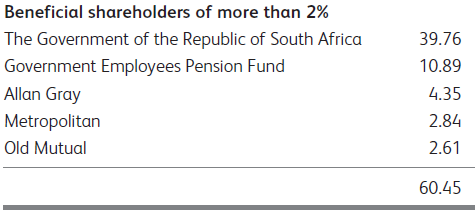
We closed near our highs here in Jozi, with most of the major sectors comfortably in the green, on exception was Sasol, which enjoys all almost all of the dominance in a sector called Oil & Gas producers. The oil price actually went in the opposite direction of stocks, which is the old theory, not the new one. Session end the Jozi all share index closed 0.71 percent better to 33855, a gain of 238 points. Telkom caught a giant bid, and added 3.19 percent on the day. I was chatting to a journalist yesterday and it suddenly occurred to me that this little table might actually hold a few twists:

Now, this is old. This is over a year old, but I suspect that not too much has changed here. Remember that all pension funds have obligations to their beneficiaries, the pension holders. If you were managing a pension fund and you owned any company's stock that indicated that they were not paying a dividend for three years at least, what would you do? Sell it, because it would not matter if the business was sound and in expansion mode (Telkom are one of those things, IMO), but if you are uncertain of the future, then get out. BUT, this then leaves the government short, IF (big if) the government pension fund sells out. Because then there is no 50 percent plus, provided that this shareholder register is still correct.

At the same time however, government is less than a 14 percent shareholder (13.91 percent) of Vodacom, that stake is worth 20.3 billion Rand. Government owns nearly 207 million Vodacom shares, with a handsome payment date coming up on the 25th of June, 450 cents a share, that is roughly 931.384 million ZAR, and this is only for the second half. The first half dividend from Vodacom was 260 ZA cents, which meant government benefitted to the tune of 538 million ZAR. So, whilst the dividend payments from Telkom are zilch, nothing, zip, niks, luto, you can definitely see that the Vodacom holding rakes in nearly one and a half billion ZAR in dividends. Does government pay dividend tax? Perhaps the economic impact of selling state owned enterprises and remaining big shareholders thereafter is an easier and more compelling way of making money out of these assets. But of course I would say that, that suits me to say that. What would you do? You could raise an enormous amount of money this way, not so? What is Eskom worth? What is Transnet worth?

South Africa, according to this table from Wiki -> List of countries by electricity consumption, we are the 16th biggest consumers of electricity. In the measurement of consuming MW per hour. The biggest users of electricity on a per capita basis unsurprisingly is Iceland, then Norway, Canada, Finland and then Sweden. We fall much further down the ranking tables on a per capita basis, rubbing shoulders with Portugal, Hungary and Croatia. But we are half of that of New Zealand and Bahrain, where it is cold in the one, heaters, and hotter in the other, lots of aircon required. But, do you think we have problems?

From Wiki I found this: "In terms of fuel, coal-fired plants account for 55% of India's installed electricity capacity, compared to South Africa's 92%; China's 77%; and Australia's 76%." Wow. 92 percent here locally. But for India it is terrible, there are 300 million people who have no electricity in that country, which make up a large portion of the 1.4 billion people globally who have no access to switches and plugs. Most of those people are rural folks, nearly 90 percent, living by sunrise and sunset. I think all I am trying to say that whilst our power problems seem insurmountable, there are bigger problems elsewhere in the world. But still, make sure you switch off your non essential items during the peak periods.

Privatising the government owned entities would make it a whole lot easier for the economy to work in the long run, but would it make it good for jobs? I have no answer anymore as to what will create jobs, we have free markets types feeling like they are head butting stone walls trying to make a breakthrough, whilst the fellows on the left feel like business is still killing it and exploiting workers and workers need a bigger say in the way that businesses are managed. I am all for empowering employees, the more that own equity stakes in businesses the better, but these stakes are worth something and need to be paid for. Time to look forward. But again, that is very easy for me to say.

Byron's beats is a continuation of my thought processes above, for better or for worse. Great minds and fools, you know how it goes.

    I'm getting really worried about the South African mining industry. Three announcements this week have suggested that the sector is getting worse, firstly, and Sasha mentioned this in his note yesterday, we had an announcement from Aquarius which suggests that the Marikana Pooling & Sharing Agreement is to be placed on hold because the current platinum price is not high enough to meet the costs to mine it.

    The second announcement involved Gold One and dismissals due to illegal strikes. The last one was news of a possible rise in mining taxes which could reach 55%. Here is an extract from a MONEYWEB article, titled SA mining tax rate could rise to 55%: "The ANC is due to discuss policy changes at a conference later this month. While an ANC-commissioned study found after a more than two-year debate that seizing mines would be an unmitigated economic disaster, it recommended imposing a 50 percent tax on the profits of mining companies earning returns in excess of 15 percent, levies on the sale of prospecting rights and more taxes on companies based in offshore tax havens."

    In the 1970's mining contributed 21% to our GDP, today it is around 6%. That is not necessarily because it has fallen. Our economy has shifted to services. It is however still responsible for 60% of our exports and very important for our deficit. It is responsible for nearly 1 million jobs, 30% of capital inflows into the economy and between 10%-20% of corporate taxes.

    In other words it is absolutely vital for the success of our fragile economy and right now current policies are killing it. Labour laws are too strict and unions are bringing our mining sector to its knees. We cannot afford to lose jobs, especially from illegal strikes. And you can bet your bottom dollar that miners are going to do everything in their power to mechanise as much as possible.

    Then we have electricity. This is out of our control and if tariffs do not increase Eskom will not be able to supply electricity. There are options however and the government should be a lot more open minded about opening up the grid to the private sector. I do not understand why the government feels they need to do everything themselves. Outsource it, teamwork is a lot more efficient than going it alone.

    If these taxes are implemented it could be the final nail. This is similar to what is being implemented in Australia yet there, the mines have been thriving. Remember that article I wrote about Kumba at the beginning of the year, titled Kumba Iron ore trading update, looks good? It looked at how a successful mine was benefitting the community and its employees. This way is also a lot more sustainable. I beg the policy makers to please give the miners a break. A tax like this could break them and cost a lot of jobs and money for all of us.

New York, New York. 40o 43' 0" N, 74o 0' 0" W. Markets absolutely rocketed from about midday onwards, with folks wondering whether or not something big is going to happen, the rumour mill. And this was in the face of rising bond yields in both Spain and Italy, with the Austrian finance minister suggesting that the Italians might need funding at some stage, extraordinary funding from the outside. And let us face it, Italy is not ...... errr ...... Italy is not Cyprus, that is also looking for money. Europe needs to find a path towards growth as well as cut to the bone on public spending, the socialist route is the one that they have chosen, but you have to be able to comply. Like the Scandinavians, not like the Southern Europeans. I thought that this piece was supposed to be about the New York markets? But that is just it, the worries that the Americans are having is all about Europe. Even though many professional Americans cannot tell you what the capital of Slovakia is. And yes, Slovakia is a full blown Eurozone member. Which differs from the European Union. Yes, try and ask most smart people you know what the answer is to that, what is the capital of Slovakia? Slovakia's economy is similar in size to that of New Zealand, and on a per capita basis equal to Portugal.

I loved this from Jim Cramer last evening: "It's like the whole world is one big stock with a bad balance sheet that trades with its headquarters in Madrid or Rome." I understand what he is saying, and in fact out of character I went to a results presentation yesterday, and the European question was asked: "What is it like on the ground" or something to that effect. And the answer was, well, people are waiting before they make any decisions, and you have seen that echoed time and again. Waiting for something or other in the form of a solution to the European debt crisis. And strangely, that is why Jim Cramer is telling all the people on his show to buy American companies with American exposure, 100 percent. Wow, that seems like a U turn from a few years ago, where countries wanted diversification at all costs. I suspect Jim is just going for comfort out of the same fear that is gripping everyone else.

So what will change this? What will make the cautious turn to buyers? What levels of comfort do you think people need to have? Greek staying and proceeding down a path of austerity and looking for a new growth path? Eurobonds? Guaranteeing bank deposits? I suspect we might have to jumble our way through this until the grand plan is released from those folks yesterday. In the interim the impact is being felt by multinationals, there was a weaker than anticipated McDonald's sales number on Friday last week, both European and mainland China sales were slower and lower than anticipated, and expect currency issues from those regions too, and I see that McDonald's had a broker downgrade as a result of a stronger Dollar versus the Euro, but also using central banker speak, McDonald's are going to face "headwinds". Happy to hold, happy to add at these levels.

Currencies and commodities corner. Dr. Copper last traded at 336 US cents per pound. The gold price is higher, last at 1612 Dollars per fine ounce, the platinum price is 1451 Dollars per fine ounce, marginally better on the day. The oil price is last at 83.36 Dollars per barrel, up on the day. The Rand is last at 8.38 to the US dollar, 13.05 to the Pound Sterling and 10.56 to the Euro. We are about flat here on the session.

Parting shot. Of course that is going to happen, Greek people withdrawing money from their banking accounts heavily ahead of the weekend elections. Because humans are engineered that way, we are a cautious bunch by nature. Greek cash withdrawals could be capped, I laughed when I saw the Telegraph suggest this could impact on British tourists. WHAT? Poor (not so poor) British tourists will have to watch out when they spend their cash. Err... what about credit cards and debit cards, surely those work? My recent experience in Italy is that almost everyone except the hotels preferred cash. Hmmm.... via the Business Insider to Bloomberg, this story tells it like it is: Greek Bank Deposit Outflows Said To Rise Before Elections. And that would just make matters worse and not better. Unless the Europeans guaranteed all Euro deposits, because then regardless of where you are, a Euro deposited in a Euro bank is a Euro. Most exciting of all is that Joe Weisenthal is heading to Athens, follow him on Twitter here -> @TheStalwart. Should be fun, he is there until elections time!

Sasha Naryshkine and Byron Lotter

Email us

Follow Sasha and Byron on Twitter

011 022 5440
Tuesday, 12 June 2012

Spain is not Rafa

"The fact that the Dutch and Finns want collateral does not necessarily mean that they will get it, if the loan from "Europe" is given through the ESM (the European Stability Mechanism) and NOT the EFSF. Man, just don't ask, but the ESM requires all members to contribute, and as such be on the hook."

Jozi, Jozi. 26o 12' 16" S, 28o 2' 44" E. Lost in translation, or was it actually Spanglish? That is what it felt like, we were waiting for more information around the Spanish funds that were specifically going to be used. I honestly think that the Rajoy text to his finance minister was in poor taste, you know the one where he was purported to have said that "Spain was not Uganda", basically implying that the powers that be (the IMF and the rest of the Europeans) were not going to leave them hanging. Well, forgive me for thinking that your labour laws are a bit banana republic and the banking sector having given wild loans to property developers to build like there was no tomorrow, well that seems a bit banana republic too. The subtle racism (or blatant) drives me nuts. {Sigh} Spanish yields and Italian yields started to rise later in the day as the same talking heads asked the question, does this solve the real problems, or is this just to stop a leak. I suspect that the answer is somewhere in the middle there.

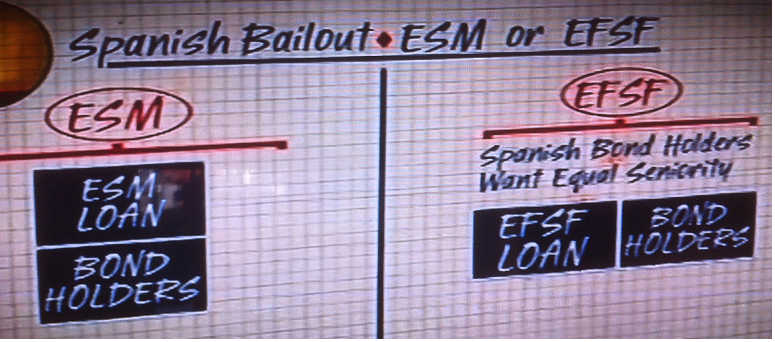
The fact that the Dutch and Finns want collateral does not necessarily mean that they will get it, if the loan from "Europe" is given through the ESM (the European Stability Mechanism) and NOT the EFSF. Man, just don't ask, but the ESM requires all members to contribute, and as such be on the hook. The main issue probably was that bond holders of Spanish debt were left worrying whether or not they would be subordinated. This question, not answered, left Spanish yields to rise beyond six and a half percent, and probably, along with rising Italian yields, saw the equity markets sell off. Again, using either the ESM and the EFSF is the question everyone wants answered. This Bloomberg TV graphic sums it up, I think, check it out:

So whilst the collective Mr. Market started to ask more questions and not fewer, and the answers of course were not immediately forthcoming, the collective does what it knows best, sell first and ask questions later. Correct. After opening comfortably above 34 thousand points on the Jozi all share, and being nearly a percent higher at the open, the market closed in the red, down 0.15 percent, or 49 points to the bad at 33616. Banks were particularly hard hit, down over a percent and three quarters. Poor Telkom was absolutely trashed again, the stock was down at 1911, down 5.86 percent on the day on about average volumes, so nothing too sinister as far as I could tell. Just the lack of clarity (what a twist) and lack of direction, perhaps most importantly, no dividend payment for the foreseeable future. Whilst the company attempts to roll out infrastructure aggressively, with enormous capex plans. Errr, you need a lot of money for that. Either government should sell the stake or they should take the business over and run it themselves and buy out the rest of the shareholders. This double message is plain strange.

We have always maintained that there is nothing like a good old fashioned crisis to make the European project work properly, after all, only the Europeans are aware of the war in their back yard and not across the shores. They are the ones that wear the scars. Fiscal integration is a must, at least we should have a public roadmap that each state votes on, a referendum. There is a wonderful article in Der Spiegel titled A Sneak Peek at Tomorrow's Europe which is well worth a read. The fact that the piece replaces the headlines that would suggest the opposite of what was being thrown out there, you know, the abyss and the edge of the cliff, etc, is actually refreshing. See that the task of coming up with a plan has fallen to Mario Draghi (ECB head), Jean-Claude Juncker (Euro-Group leader), Durao (Jose Manuel) Barroso (President of the European Commision) and Herman Van Rompuy (EC council president).

Van Rompuy is a politician, but was an economics lecturer pre his political career, his father was an economics professor! And he was the Belgian Prime Minister, so he has some pedigree. Barroso is a lawyer by trade, and was also Prime Minister of Portugal, and was someone always involved in politics, from an early age. Juncker is the current Luxembourg Prime Minister, and whilst he is a qualified lawyer, he never practiced. So, it is fair to say that he is a lifer politician. Draghi has a doctorate in economics, and has worked for various organisations both in the public and private sectors. So, I guess it is fair to say that we have two lawyers and two economists working on a plan to integrate Europe, fiscally and perhaps politically too. So, perhaps the United States of Europe would see colourful governors and senators, with the president being the collective representative, having a far more important role. The language thing worries one, at least in the US, English (and Spanish) is spoken by everyone. I guess seeing this headline, over some of the others leads me to believe that the grand plan is being fast tracked.

It had to happen at some stage. Byron wrote a piece last week that compared the platinum and oil prices and found that they are actually a dead ringer for one another when you place a graph over each other. And the oil price, although still historically high, is weaker if your measure is over the last 18 months. I am not going to deviate away from what I want to talk about, the platinum sector and costs. Yesterday there was a statement from Aquarius Platinum: "Aquarius Platinum Limited advises that the partners in the Marikana Pooling & Sharing Agreement ("P&SA2") have agreed in principle to place the P&SA2 operations on care and maintenance, due to the enduring low PGM basket price environment." This pooling and sharing agreement is with Amplats. In their last operational review, Amplats had this to say: "Cash operating cost per equivalent refined platinum ounce increased by 20% to R16,384. Similar to the situation at Kroondal Platinum Mine, the current mining contract has a high fixed-cost element resulting in increased unit costs when production decreases."

16,384 Rands per refined platinum ounce? Wow, that sounds "high". The current Rand platinum price is 12029 Rands per fine ounce. And, as Forrest Gump would say, and that's all I have to say about that. Check this out, a miningmx story that suggests this is not actually enough to make any meaningful impact to the platinum price: Aquarius cutback 'too small to notice'. I am a bit confused with the operational costs issue, presented in this story and presented on the Amplats website. All that I know is that this is not very good and we should be outraged. Instead, like Cees Bruggemans says in his latest piece, we just shrug our shoulders. Read it: Shrugged Fatalism.

New York, New York. 40o 43' 0" N, 74o 0' 0" W. A great big Spain fade on Wall Street last evening, the Dow Jones futures were indicating a one and a half percent to the good open when I walked in the office here yesterday morning, but the end results all those hours later when the markets had actually closed in New York was the exact opposite of that. Markets fell hard in the last half an hour after having trended downwards for most of the day. The NASDAQ dropped 1.7 percent, the Dow fell 1.14 percent whilst the broader market S&P dropped just over a percent and a half.

Byron's beats The big news of the day besides the usual Europe stuff was that Apple were announcing some new products. Always exciting, Byron covers it below.

    When Apple makes announcements everyone gets very excited about what new life changing products will be introduced to the world. Yesterday they had a Worldwide Developers conference which included introductions of both new hardware and software. They started it off with some interesting facts about the App store. There are now over 400 million iTunes App store accounts with access to over 650 000 apps. These have been downloaded over 30 billion times. In the last quarter over $5 billion was paid out to app developers. That is an industry that did not exist a few years ago.

    So what's new from Apple's production line? A new MacBook Pro was introduced which has a higher resolution retina display similar to the iPad. It has a lower pixel density than any of the mobile gadgets but it is the highest resolution for any PC ever. With further adjustments it's even thinner than before.

    That was the hardware side of the announcement followed by 2 software introductions. Firstly we had the new OS X Mountain Lion which is an operating system for the Mac. Interestingly Mac only has 66 million users which means penetration is low. This is a good thing for potential growth as Apple fans shift to the Mac, keeping all their devices under one umbrella after being sold by the iPhone and iPad. The numbers suggest that this is happening.

    Then IOS 6 was announced which is the new operating system used on the iPhone and the iPad. There are 365 million devices which use this platform, roughly 220 million iPhones and 65 million iPads. With IOS 6, Siri has various upgrades and will be available to the iPad.

    For me however the most exciting development was a feature called Flyover which are 3-D models of Cities and Landmarks much like Google maps. It sounds cliché but you would always expect Apple to make this type of thing cooler and better. Taking nothing away from Google maps, that is awesome! This will also be used as the navigating systems for Apple devices replacing Google. The rivalry continues.

    We remain confident in Apple's ability to remain leaders in pretty much everything they are involved in, post Steve Jobs. There were rumours that an Apple TV was to be announced which obviously did not happen but I'm sure Apple are working on something amazing. The options are endless for this company that only trades on a forward PE of 13 for 2012 earnings estimates. We see this recent pull back as a fantastic buying opportunity for the stock.

Currencies and commodities corner. Dr. Copper is lower at 333 US cents per pound, the gold price is also off its best, down at 1587 Dollars per fine ounce, whilst the platinum price is also off the best levels, down at 1432 Dollars per fine ounce. The oil price is last at 82.19 Dollars per barrel. The Rand is weaker at 8.43 to the US Dollar, 13.07 to the Pound Sterling and 10.54 to the Euro. We are marginally higher here today. Crisis, what crisis?

Sasha Naryshkine and Byron Lotter

Email us

Follow Sasha and Byron on Twitter

011 022 5440

Monday, 11 June 2012

Rajoy Frobs them off

"The Eurogroup is confident that Spain will honour its commitments under the excessive deficit procedure and with regard to structural reforms, with a view to correcting macroeconomic imbalances in the framework of the European semester. Progress in these areas will be closely and regularly reviewed also in parallel with the financial assistance."

Jozi, Jozi. 26o 12' 16" S, 28o 2' 44" E. It was a big weekend for data and for Spain, and as such I was reading on my twitter feed that some people were sitting this one out. What? Yes, I heard that a lot, and sure it might have worked for some, but we can see today that it was the wrong thing to do. Resources sold off heavily, eerily the Jozi all share closed at 33666, off around 0.7 percent on the day. Locally there was a strange interpretation of a Reserve Bank speech from Thursday evening, which you can read (if you want) here -> Monetary Policy and Inflationary Challenges in the Face of the Global Economic Crisis. The suggestion is that if pushed, the Reserve Bank will act.

It was expected I guess. The news Friday that kept coming was that Spain was going to engage the rest of the union and ask them for funding for their banking sector. Someone said something interesting on the weekend, I think it was the FT which pointed out that the three countries which have taken funds from the European Union, Ireland, Portugal and Greece collectively are half the size of the Spanish economy. So, Spain are in the category of too big to fail, most definitely. Mariano Rajoy, who when campaigning that they, Spain, would not be taking any money. Read my lips, no bailouts. So, how did this go down politically? Victory of course, announced Rajoy, because this proves that Spain's finances are in order and their banks just need the money. Politicians, I swear to you, victory at all corners. It doesn't matter Mariano, it is like saying that Torres should have scored and Spain should have won three – one. Yes, Balotelli should have buried one too, but was pretty Harry casual.

OK, into the nitty gritty, Spain has "asked" for 100 billion Euros to recapitalise their banking system, more than the fellows at Fitch suggested. So how is it going to work? Well, there is that fund that the Spanish have setup already, called Frob. Sorry, Fund for Orderly Bank Restructuring, or just Frob as before. What the Frob is that about? OK, that is and was rude, let me not get involved in that. The Frob, as Felix Salmon explains in this article over the weekend, is the Spanish version of the US TARP, if one wants to look at it in the crudest sense, the TARP is the Troubled Asset Relief Program, check it out if you need a refresher. Felix asks the question, surely the Europeans could have lent the money directly to the Spanish banks? But again, this is about sovereignty and with that a certain amount of dignity for the citizens. Begging (?) bowls and dignity, how does that work?

So, simply, Spanish banks will be recapitalised via the Frob by the Spanish authorities, who are in turn borrowing the money from the European Union. You can read the very brief announcement: Eurogroup statement on Spain. That one line is supposed to calm the markets: "The Eurogroup notes that Spain has already implemented significant fiscal and labour market reforms and measures to strengthen the capital base of the Spanish banks. The Eurogroup is confident that Spain will honour its commitments under the excessive deficit procedure and with regard to structural reforms, with a view to correcting macroeconomic imbalances in the framework of the European semester. Progress in these areas will be closely and regularly reviewed also in parallel with the financial assistance."

The real questions to be asking are, what are the terms and conditions of the line of credit? Fabrizio Goria, an Italian financial journalist, who you can follow on Twitter, has had the following to say:
"EU spokesman says interest rate of 3-4% is reasonable in regards to the loan to Spain from the EU"
"EU spokesman says EU loan shouldn’t affect Spanish deficit"
"EU spokesman says EU loan to have strict conditions on Spanish bank overhaul"
"EU spokesman says EU loan to Spain may not reach EUR 100bln, average loan rate depends on the market conditions"

OK, thanks Fabulous Fabrizio, for letting us know what we can expect. I am thinking that the next steps will be for the Spanish banks to let the Frob know of how much money they think they need to be OK. At the same time, another independent audit, stress tests of the local banks. Just to see how bad the books actually are. In other words, how much money the Spanish banks will actually need in order to meet capital requirements. But this is a really good graph, via Fab again (I follow him on Twitter, he MUST be my friend), which shows one how good and or otherwise the capital market structures are inside of the European economies. Because you would imagine that German pension funds would own mostly German debt. But this graphic shows how loads of people are keen to own German and French debt, but it seems that locals don't want to own their own debt in the smaller markets. There is little appetite for local Fins to own Finnish debt, or so it seems. Ditto Greece and Austria. Portugal and Ireland too. Check it out and see if you can understand it.

See. Austrians are more likely to own German debt it seems. So much for that school of Economics. That is meant to make you laugh. I suspect what the Europeans want to do here, and Felix Salmon deals with it in his conclusion, the Spanish must decide how they deal with the fund flow, maintaining some sort of control, even though in theory this is a defeat. A Spailout. And remind me, Rafa did not completely take it away from Novak (first names basis, you know, like people pretend to know actors) yesterday. And the rain is expected to keep them away again today.

So, what do we think here? Well, Europe in their slow and bureaucratic manner are dealing with each problem, one at a time. Spains borrowing costs would be reduced. And as you can imagine, the next time that any Spanish property developer asks for money to build 250 units on the Galician or Andalucian coastline the answer from banks is going to be a resounding no in a double negative way, as one does in Spanish. Spanglish. Oh, and whilst we speak, there is a little detail, collateral is wanted by some of the smaller Northern European economies. The anchors of the CNBC program in London said that perhaps Rafa could be used, handed over to the Netherlands or the like.

Byron's beats deals with the other big issue this weekend, the one that everyone was "scared" of, the Dragon of the East.

    We had lots of Chinese data this weekend so let's jump straight into it. Firstly we had industrial production which came in slightly below consensus. Consensus was for a 9.8% increase and the actual number was 9.6%. This is a very important number because industrial production represents 40% of Chinese GDP. It is also a number which has been slowing because of higher wages and of course slower demand from Europe. 9.6% still sounds strong to me but I feel production will become less significant over time which is good for long term sustainability.

    Consumer prices (CPI) fell by more than expected which is a good thing. This gives policymakers more room for stimulus like we saw on Friday. Inflation is a threat to the Chinese economy so numbers like this are very good news. The recent fall in commodity prices should help maintain this control.

    Retail sales also missed consensus. This is not good because this is where the next phase of China's growth is going to come from. Consensus called for 14.2% growth while the actual number came in at 13.8%. Growth is never linear. There are so many moving parts and there will be pull backs in the economy. This is what we feel has just happened. A slump in economic activity. We see it time and time again. We expect data to start improving again and all the naysayers will start quieting down. They have been very loud lately. Even so 13.8% is a strong number.

    Fixed Asset Investment managed to beat with a 19.9% increase compared to May last year. Here is the breakdown of the data thanks to The BusinessInsider. Property FAI growth rebounded to 18.0 percent in May, from 9.2 percent in April. Railway investment growth was -35.2 percent, compared with -46.9 percent the previous month. Manufacturing FAI jumped to 28.2 percent in May, from 22.7 percent the previous month. The leading indicators of FAI growth, total planned investment in newly started projects jumped to 28.2 percent, from 191.9 percent in April. "The pickup of FAI growth in May suggests that the govt was ramping up infrastructure and social housing investment to bolster the economy on the weak economic data in April."

    So overall a mixed bag but following Fridays rate cut and proof of fiscal stimulus from this Data you would have to say that the Chinese economy, with a little help, will remain healthy

Currencies and commodities corner. Dr. Copper is last at 336 US cents per pound, the platinum price is slightly higher at 1443 Dollars per fine ounce. The gold price is last at 1591 Dollars per fine ounce. The oil price is better at 85.05 Dollars per barrel. The Rand is a little here and there, 8.32 to the US Dollar, 12.94 to the Pound Sterling and 10.46 to the Euro. We are better here today, but off the best levels so far.

Sasha Naryshkine and Byron Lotter

Email us

Follow Sasha and Byron on Twitter

011 022 5440

Friday, 8 June 2012

Spain. Good at football and tennis.

"An old timer trader once said, trading gold makes you old. I suspect that Bernanke testimony and lack of clarity on extra stimulus saw the precious metals (and oil price) go a whole lot lower in a flash."

Jozi, Jozi. 26o 12' 16" S, 28o 2' 44" E. We rushed through 34 thousand points on the Jozi all share index, for the first time in four weeks. We certainly have had a stunning two day rally on the speculation that policy makers will do whatever necessary if they need to. Well, the European Central Bank did not cut rates, the theory is that they are waiting post the Greek elections before they use their silver bullet. But, the Chinese cut rates for the first time since 2008, possibly in a sign that we are in a softer patch now in the second quarter than in the first quarter. In fact there is no doubt that is the case, the recent data from across the globe suggests as much. Byron covers that in detail, ahead of major data releases from the Chinese later tonight and in the wee hours of tomorrow and Sunday. Data on a weekend? Wiki suggests that economic activity, like in Jozi here, takes place every day of the week, so I guess data releases on a Saturday are just fine in a Chinese context.

The mood is about as glum as I have seen in a little while, business confidence locally is at a ten year low. In fact, this is the worst number since the South African Chamber of Commerce has been releasing these numbers. So, you might well be forgiven for thinking that it looks quite cloudy out there. This time reminds me a little of the beginning of 2009, where the solutions around the banks and their liquidity in America related to the subprime mortgage melt down were starting to become clearer. This is the same sort of issues, remodelled in a different way.

All major sectors gained yesterday, other than the gold miners who were carried out on a stretcher, down nearly five percent. What is that about? An old timer trader once said, trading gold makes you old. I suspect that Bernanke testimony and lack of clarity on extra stimulus saw the precious metals (and oil price) go a whole lot lower in a flash. Remember that the Aussies earlier in the week also cut rates. So, I am guessing that Asia is feeling the heat of the cold and stodgy looking Europe. For the record, my homemade pasta (I roll and cut myself) last evening was overcooked. Overcooked pasta is not great.

Perspective. Sometimes you need it badly. Paul sent me a chart last evening, the chart this courtesy of TradingEconomics.com. Check it out:

OK, so these are Spain's borrowing costs, the yield on the 10 year government bonds, the current "scary" six percent plus is nothing compared to the 12 percent rates that the country had to borrow money at, pre the Euro area. But of course this is much worse than the close to three percent back in 2006. So perhaps on a more normalised basis, if you draw a graph from the top left to where we are now, the graph looks good for Spain. The rates are not what they (the Spanish treasury) WANT it to be, but this is FAR BETTER than where it was.

So why do we bring this up? Well, Spanish banks are stuck with stinky looking mortgage books, problems with loans to property developers, a softer economy that was too geared to construction, high unemployment rates not dissimilar to what we have here. And just last evening the fellows over at Fitch decided to cut Spain's credit rating to BBB, down a whopping three notches in one go. The ratings agencies, grrrr.... my theory is that they (the ratings agencies) went from a time of not paying attention at all to perhaps being too aggressive, not wanting to get it wrong again. That is our general view here. There were some no you know what Sherlock observations from Fitch around the Spanish banking sector.

Just yesterday Spain managed to raise government debt at just over 6 percent for the 10 year debt, which of course is nearly 25 basis points more than 7 weeks ago. The Economist (yes, I read the electronic version) article titled Slouching towards a banking union, in which Credit Suisse reckon that Spanish Banks will still have to raise around 60 billion Euros, as they might still have to write down 150 billion Euros worth of debt associated with loans to property developers. Further down there is a link to a graph which suggests that Spanish banks may need close to 100 billion Euros, as a results of NPL's rising significantly in the coming quarters. Reuters is reporting this morning that Spain is expected to make an aid request for their BANKS and not the central treasury, which I guess is very different from the Greek situation.

Now there are three charts that you need to see. Also courtesy of TradingEconomics.com, who are absolutely fabulous for all info graphic that you are looking for with regards to economic activity. First thing, to illustrate how the construction boom sucked up a lot of unemployed folks, check this 15 year graph:

So, unemployment rates 15 years ago were also at these same levels, perhaps nothing too new. But away from what was the recent norm. We all suffer from recency bias. Next graph, Spain has a problem at government level, right, too much spending, the people of Spain get too many benefits, is that right? So Government spend as a percentage of GDP must be higher now than ever before? Well, no. Notwithstanding the fact that the Spanish GDP is lower now than a few years ago. Check this out, this is government budget as a percentage of GDP:

So, according to Fitch the far right of the graph is going to look worse and not head in the right direction. And to recap the banking sector, worst guess would be as much as 9 percent of GDP, that is Fitch's worst case scenario. Next graph, perhaps the most troublesome of all of them, because of the downturn on the right there, Spain's growth rate.

The only way to solve the budget deficit problem is to make sure that growth picks up and treasury collects more taxes. Well, growth is more important in the long run, you can put a cap on government spend right now and stimulate the private sector. But how? Spain has pretty restrictive labour laws, the worst of the lot in Europe. What is the incentive to get to Spain and start investing there? Well, the Invest in Spain website in this section, which I took a look at, Why Spain? tries to make a fist of it. I suspect that they will be OK. But it is time to act and stop thumb twiddling in the typical European bureaucratic way. I guess we do not have to wait that long.

Byron's beats is always upbeat about life, and takes a slightly different view to the one being offered out there about why the Chinese cut rates.

    We don't talk about China enough. Yes we refer to it all the time when talking about growth and where it's coming from but how much detail do analysts really cover? It is understandable. It's a foreign economy in a foreign language so it would be difficult to watch their news channels like we watch coverage of the US and Europe. Yesterday my screens were showing the Bank of England's decision to hold rates whilst China were also making some important monetary decisions at the same.

    Yes the Chinese news was covered but not nearly to the extent of the UK decision. Yet the Chinese economy creates the equivalent of the UK economy every three years. This is where I think we are getting it wrong at the moment when it comes to sentiment about global growth. And it's not as if Europe is going to fall off the face of the earth. People forget how resilient we are. When times get tough the will to survive will bring out the extraordinary. Europe has proven they have the grit many times before throughout their history.

    So what actually happened in China yesterday? Well rates were cut by 0.25 percent. This was unexpected and of course good news. This is part because of inflation reads coming in lower than expected. But there were some other policy changes announced. Banks are now allowed to offer a 10% premium to the benchmark deposit rate compared to 0% previously. This means that money deposited will actually earn more. Very good for a country with such a high savings rate. A higher yield will also take some pressure off the inflated property market.

    On top of that banks are now allowed to offer a 20% lending discount to the benchmark compared to 10% previously. So this will make money even cheaper. At this stage none of the big 5 banks have offered anything less but if you did Economics 101 you will know that the prisoner's dilemma will force banks to cut at some stage in order to be competitive.

    So you see, a deeper look shows that this was actually a rate cut on steroids. There have been calls for the liberalization of the Chinese banking system for ages now. This is a step in the right direction. It makes you realize that we are all on the same side here, pushing in the same direction for a better world and a bigger pie for all.

Telkom. Why do I even cover the company, is it a certain smugness about them having woefully underperformed their two market "peers"? We were told years ago that the yield on our preferred investment MTN was not up to scratch with regards to their dividend payments. Well, the shocker this morning is that Telkom has suspended their dividend payment. And at current trading levels, MTN has a historic dividend yield of 5.55 percent, Vodacom currently at 7.17 percent. Telkom have suspended paying dividends. Yes. So their historical yield, from the last full set of numbers is zero percent. {Sigh} With exceptional items becoming the norm rather than the exception, that exposes management weaknesses. At the results presentation this morning a customer was heckling the CEO. I have nothing else to say, I will absorb everything this morning. I did a piece which I will talk about next week. Government should just buy the rest of the business that they don't own already if it is of national importance. Really. The price is dirt cheap now.

Currencies and commodities corner. Dr. Copper is last at 3.30 Dollars per pound, the gold price is off the best levels at 1577 Dollars per fine ounce. The Platinum price is also lower at 1420 Dollars per fine ounce. The oil price is much lower, down at 82.31 Dollars per barrel. The Rand is weaker as Mr. Risk-Off tugs his Friday strings ahead of a very important weekend for Spain and China bulls. Currently the Rand is trading at 8.47 to the US Dollar, 13.08 to the Pound Sterling and 10.60 to the Euro. If only Spain had a better looking economy than their tennis stars and football team.

Sasha Naryshkine and Byron Lotter

Email us

Follow Sasha and Byron on Twitter

011 022 5440