Wednesday, 18 February 2015

Twenty one hundred


"Jack Bogle, the founder of Vanguard advocates investing in Exchange traded funds that will replicate the index over a long period of time. That is probably the smart thing to do for retail investors with no interest in the equities market, your chance of finding that one business is small. But by selecting a group of quality companies who operate in sectors that are guaranteed to be around in the next 30 years and holding them for a long, long time. Those opportunities exist. The better those businesses do as a constituents, the better you would do as a very passive investor. But you won't get all them right all of the time"


To market, to market to buy a fat pig. 2100. Pencil that in as your new high on the S&P 500, February 17, 2015. The 1000 point mark was passed for the first time in early February of 1998, that seems like a long time ago, and I guess it is. The levels of 2000 were only breached for the first time in August of last year. What's in a level though? Remembering that market constituents change all of the time, the index however is the enduring part. The bigger the companies become and the more relevant they become, the more of an influence they have on the overall index. The opposite is also true, companies go out of business or become less popular and fade away, becoming shadows of their former selves. Eastman Kodak used to be a Dow constituent, one of the most important companies in representing industrial America, right up until April 8, 2004, a little over a decade ago. At the same time as Kodak was ejected, so was international paper. Since then we have devices to both read and take photos, the same one fits into your pocket.

As digital photography and online content replaced physical film and paper, new businesses became more relevant and other businesses less relevant. So much so that Kodak filed for bankruptcy in 2013, International Paper is alive and kicking, paper is just as relevant in all sorts of other forms. The shape of the Dow Jones is shaped on how the pickers see the future to some extent. Of the original 12, only GE has managed to survive, which gives the company some enduring qualities as an investment I guess. And just as important, shows how the company has been able to evolve through the ages. There are not too many businesses like that around the world. The oldest businesses as a collective mostly reside in Japan, the oldest being a construction firm by the name of Kongō Gumi, in operation since 578. Or should we say, was, until 2006 when it was bought. You can stay in the Nishiyama Onsen Keiunkan, a hotel in Hayakawa, Japan. The oldest hotel and oldest company still around, founded in 705 AD. 1310 years old. Yowsers. I wonder what the guest book looks like? I am more interested in this place, this hotel and construction company in Japan and their history (and staying power) than I am with the levels of indices.

So should you. Although Jack Bogle, the founder of Vanguard advocates investing in Exchange traded funds that will replicate the index over a long period of time. That is probably the smart thing to do for retail investors with no interest in the equities market, your chance of finding that one business is small. But by selecting a group of quality companies who operate in sectors that are guaranteed to be around in the next 30 years and holding them for a long, long time. Those opportunities exist. The better those businesses do as a constituents, the better you would do as a very passive investor. But you won't get all them right all of the time. The index and the associated constituents give you all exposure, good and bad. Stock pickers get to choose. So whilst the levels of the equities market and specifically the setting of new highs is fun to see and pleasing at one level, we do not own indices for clients, we own equities, single companies with different businesses. I think that I have covered that as best as I can, I do hope that it makes sense.

Talking of markets and market levels, the reason why the indices touched fresh all time highs is that the hopes of a Greek deal have risen, it seems that money talks and you know what walks. It is OK to go cold turkey. Well, it turns out that, and we have said this all along, it is better to be inside of the Eurozone than outside of the Eurozone. You can read both the WSJ story on the matter titled: Greece to Seek Extension on Loan Agreement, Officials Say or the FT piece: Greece to request bailout extension.

Michael and Byron are skeptics and share more of the German sentiment on the matter, at least the hardline that we see openly. If you read the NYT piece, Greek Bureaucracy, Not Just Austerity, Is an Economic Drag, you will see that the Greek government has introduced 2200 new tax regulations in the last 2 years. That in itself is very taxing. If you read lower in the article, the opinion is that the new Greek government suggest more labour flexibility would "perpetuate hardship". Tell that to the 25 percent unemployed folks. Anyhow, each and every country has their problems "challenges", we certainly have our fair share here. There were sideswipes galore last evening in parliament yesterday afternoon. The president responds on Thursday, that is what I understand. This is not an episode of survivor, this is more real than it gets.


Things that we are reading, you should too

Drone legislation is changing, not to a level that Amazon wants it though - Five things you need to know about the FAA's new rules for flying drones. At least there is progress in drone laws and some clarity on what is allowed.

Stats are relative and can paint funny pictures sometimes - Retail Spending Stumbled Again In January. The main sentence from the article is "Stripping out gasoline reveals that retail spending jumped 6.6% last month vs. the year-earlier level. That's the strongest annual increase in four years."

Another look at how stats are relative, not all jobs are created equal - Why the Jobs Report Means Diddly. The piece highlights the gap growing between skilled and unskilled workers, it is only going to get worse from here. "with the most recent numbers showing those with a bachelor's degree having an unemployment rate of 2.8 percent, high-school grads at 5.4 percent,and those without a high-school degree (about 11 million people) at 9.9 percent"

Apple continues to keep their patent filing numbers up - Apple wins patent for a virtual reality headset that works with the iPhone. Apart from all of the other things that your iPhone currently does, it could now be used as the screen for virtual reality.


Home again, home again, jiggety-jog. The market is up 0.5% this morning following a record close in the US last night. Gold miners are having another red day, down 1.1% and the Rand is a bit weaker back to the R11.70 level to the US dollar. CPI news from Stats SA this morning is that CPI is at its lowest level since 2011, sitting at 4.4% for January 2015. A couple months ago the forecast for this year was sitting at above 6%; it will be interesting to see what wage demands will look like this year given the low inflation number. The low inflation number also means that the SARB is less likely to raise interest rates anytime soon which is a good thing for all of our pockets.


Sasha Naryshkine, Byron Lotter and Michael Treherne

Email us Follow Sasha, Byron and Michael on Twitter 087 985 0939

Tuesday, 17 February 2015

Too much churn is not better nor butter


"I do not think that any investment thesis is far superior to another, I have seen many investment managers advocate that their path is the only path. As Byron and I discussed last week, the reason why a companies price trades at a certain level is that all of the buyers and sellers collectively agree on a certain price. Ultimately the buy and sell side have different time frames and objectives, some need to generate revenue for their firms at different levels. I still find it absurd that a company the size and scale of IBM corp. (to use that as an example) can trade 3.71 million shares on average on any given day, bearing in mind that there are 989 million shares in issue. What is wrong with that you say? Divide the one by the other and you get to 266 days."


To market, to market to buy a fat pig. Byron had some interesting observations yesterday, he said (sarcastically) that Woolies was empty, not a soul there as a result of finance ministers in Europe meeting on Greece's debt woes. Not true. Ordinary people care less about Greece and their debt, our TV's have enormous amounts of news about contagion, the fact that believable politicians think this could be a disaster, if Greece were to leave the Euro zone. My base case scenario is for a late deal, one that is neither favourable for either party involved, there are two stories that you can read (both subscriptions sadly) from the WSJ: Greek Financing Talks Break Down Amid Deep Divisions Over Bailout and the FT: Greece bailout talks collapse in acrimony.

If everyone sells their companies today as a result of this, you should be buying. It hardly seems to have nudged markets in either one way or another. The futures market is not in the toilet. This means that the market is indifferent to both sides and their inability to meet and compromise. I suspect that the prospects of a Greek debt tragedy evolving to an exit is something that the hyperactive market is factoring in. And seemingly people are OK with that. I suspect that saying my base case is still for the Greeks to want to continue to be in the Eurozone, Byron retweeted Ed Conway last evening, here is the link here: Greece's depression.

I guess that Germany and the UK depressions created by the war were as a result of human tragedies, the US and Greek ones were as a result of too much leverage. The US spent their way out of that depression, they had the opportunity to. There were many hardships, bank failures, life savings wiped out, soup kitchens, poverty, Hoovervilles, I am not sure, I have not been to Greece recently but does the Greece resemble those hardships? Is it the same as Germany, the UK and the US back then, or is it relative to their standard of living before? Perhaps the latter and not the former. Anyhow, like I said yesterday, we went through 53 thousand points, obviously the expectations are for the Greeks to talk tough, that is what their electorate want. The Europeans, the rest of them, want the Greeks to comply. We will see.


There is something that I have been thinking a lot about lately, the whole idea of long term investments and what that means for me or for you, for your kids or for your parents. Obviously the time horizons differ dramatically, depending on where you are in life at any given point. If you are investing for your children, then they are the ones likely to benefit hugely from the 8th wonder of the world, compounding interest. It also struck me that human nature is a major contributor to how we go about structuring our investments. I have seen people sell as a result of over information presented via all the numerous channels that we have today. The financial world never ends, we never go back to the stone age, yet the same mistakes are made, selling right at the bottom of the market. As well as chasing the pot at the end of the rainbow, chasing the small/medium cap that could be the next x or y or z. The reason why company xyz is at that size and scale is as a result of hard work and dedication from all the "stakeholders". Quality attracts quality.

Equally I do not think that any investment thesis is far superior to another, I have seen many investment managers advocate that their path is the only path. As Byron and I discussed last week, the reason why a companies price trades at a certain level is that all of the buyers and sellers collectively agree on a certain price. Ultimately the buy and sell side have different time frames and objectives, some need to generate revenue for their firms at different levels. I still find it absurd that a company the size and scale of IBM corp. (to use that as an example) can trade 3.71 million shares on average on any given day, bearing in mind that there are 989 million shares in issue. What is wrong with that you say? Divide the one by the other and you get to 266 days.

Now, according to this document -> Trading days: 2015 NYSE, there are 252 days of the year that you can buy or sell equities. How is it possible that the balance of buyers and sellers can almost trade the entire issued securities of one business, IBM (103 years old) in nearly one year? It makes the churn of prepaid customers on Vodacom Mozambique network look tame. How can so many people in one industry churn the market cap of one of the oldest blue chips? According to the International Business Machines Corporation Ownership Summary on the NASDAQ website, there are big shareholders like Berkshire Hathaway and Vanguard, collectively they hold 125 million shares, or roughly 12.6 percent of the share in issue. You would think that those shareholders are not buying and selling each and every day. They are actually owners of the business. In the case of Vanguard, the shares are held for their various index trackers. I suspect that many of the holders are either holders for a couple seconds or holders "forever".

Buffett said in the chairmans letter in the annual report in 1988, "our favourite holding period is forever", is fleshed out more with the sentences before and after: "In fact, when we own portions of outstanding businesses with outstanding managements, our favorite holding period is forever. We are just the opposite of those who hurry to sell and book profits when companies perform well but who tenaciously hang on to businesses that disappoint. Peter Lynch aptly likens such behavior to cutting the flowers and watering the weeds." I suspect that those three lines are self explanatory. Trust the business, provided you can see that the management and the industry are good.

Lastly, there are so many inventions to come that we could not possibly fathom, be adaptable. I thought about the industry of flight, how as humans we have not yet cracked supersonic flight, it would be so much more fun to get to Europe or North America or Asia from Johannesburg in four or five hours, rather than more than double or three times that currently. How will that look in 20 or 30 years? Ultimately it depends on the economics of flight, whether or not the engines will become more and more efficient and at the same time be quicker. I suspect that it will improve, to what level, your guess is as good as mine. Would that make airlines more favourable as investments? Possibly not, perhaps never, they are one of those industries that we desperately need.

I said to a friend of mine the other day, and this sounds rather counterintuitive, as an investor over a period of twenty years, you should hope that the share prices of the companies that you are buying stay as low for as long as possible. i.e. so that you can buy more and more shares of the same quality company. Of course this would not happen, in order to attract more money to equities, ironically the value of your equities need to increase more than inflation. Human nature then dictates to the investor psyche that this must be a good one. Better than every other possible investment. However, you would not continue to invest if the prices went down and down, even if you were convinced that this was a good business. This would not happen.

I think the conclusion is the same each and every time. Every investor makes mistakes. Make sure that the mistake is a learning process and that it never happens again. Even Buffett admitted that he messed up with Tesco. It happens. Find the best businesses that have are better than their peers in all regards, management, product, longevity. There are many valuation metrics; many different investment managers use different ones to suit their models. Owning quality, that is universal.


Michael's musings

Tesla, the car company that makes the best looking electric cars in the world, released their Fourth Quarter & Full Year 2014 results on Wednesday night last week. Elon Musk, the founder and CEO went to Pretoria Boys, so this company has a soft spot with us in the office, seeing as both Paul and Byron went to that fine establishment. The results were not as great as the market were expecting, they had pencilled in a profit compared to the 4Q loss of $0.13 a share, resulting in a drop around 7% in the share price.

Starting with the reason for the miss; the logistics of delivering cars. Tesla had production delays and then they struggled to get the cars to their customers due to, them being on vacation, weather and shipping. Tesla can only book the revenue and profits once a car has been delivered, in 4Q they delivered 9834 cars out of an expected 11 200. The good news is that there is a waiting list for the cars so the delayed cars were delivered int the 1Q of this year.

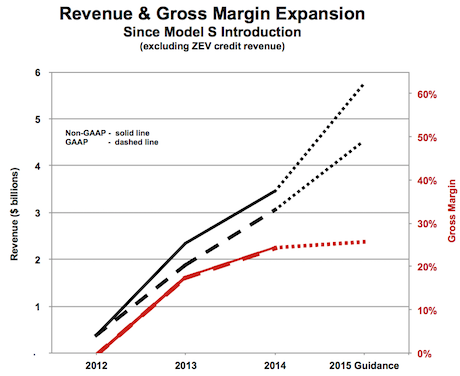
In 2014 they only produced 35 000 cars, which compared to Ford who sold 220 000 cars for December in the US alone; Tesla is still very small. For 2015 Tesla plans to deliver 55 000 cars, which is still relatively small but and increase of around 70% from 2014 figures. Along with the sales growth, Tesla is focusing on growing their margins as well, from the current 26.7% to around 30% in the 4Q in 2015. The industry average margin is the low teens, so their margin numbers are spectacular! Part of their revenue and by extension their margins is the sale of ZEV (Zero Emission Vehicle) credits. They get the credits due to their cars not having emissions and they sell them on to other car companies, who need a certain amount of credits based on the number of cars that they sell. Margins drop to 22% if you strip out the sale of credits, which you cant rely on due to regulations being able to change down the road.

Here is a look at the staggering growth they have had and the forecast growth.


Going forward they expect to launch their Model X, which is an off road vehicle, in the 3Q. There are currently 20 000 reservations for the Model X and 10 000 reservations for the Model S, no problems with demand. They are also spending a "staggering" amount of money on Capex going forward to improve their production and to add to their Supercharge network (fuel stations for Tesla's).

As far as shares go they are very expensive, they dont make a profit, so we cant use P/E. Having a look at their market cap of around $25 billion, on production of 35 000 for the last year, compared to Ford who have a market cap of $61 billion, on sales of 220 000 just for December. You can quickly see that the market has high expectations for the company. Granted Tesla is growing at a rapid pace, have super high margins and is the technology of the future, they still have a lot to live up to.

A big thing for me and something that tips the scales in Tesla's favour as an investment is their battery technology. They plan to launch a battery in the middle of this year that you could use in your house as back up power or to store solar power. A bigger battery play is through their Gigafactory, which will bring down their battery production cost by 30% and have the capacity to supply 500 000 Tesla's a year. I think the battery aspect will go further though because as the world become more green, green energy needs somewhere to put its energy until you need it. Tesla will have the technology and the production capacity to supply you with long lasting batteries. They are not just a car company.

This is a company that I really like and if you are brave, can consider adding a small position to your portfolio. There is no doubt it will be a bumpy ride until the company is mature but in the end I think it will be worth it.


Things that we are reading, you should too

Streaming is nothing new, when Apple launches Beats as a built in app it will be a milestone for the music industry - Apple's new premium music service reportedly launching by this summer. Given the number of people who are part of the Apple ecosystem and the customer experience that Apple focuses on, you would have to say that Beats will be one of the main streaming applications around.

The power of compounding and low fees - The Big Lesson From a Bet With Warren Buffett.


Home again, home again, jiggety-jog. Darn it, our lines are out again. You know where to get us, on this email or Twitter or our cell phones if you have them. It is driving us crazy! Sorry, sometimes these "things" are out of our hands, we cannot do anything about it. Markets are marginally lower here at the get go. US markets, which were closed yesterday are set to open weaker later this afternoon.


Sasha Naryshkine, Byron Lotter and Michael Treherne

Email us Follow Sasha, Byron and Michael on Twitter 087 985 0939
Monday, 16 February 2015

Miller, Miller on the wall, who is the cheapest beer of them all?

"Word on the street (the streets of London) say that 3G Capital (the Brazilian Private Equity crowd) and another consortium of investors, including Anheuser-Busch InBev are involved. The rumoured price is 75 billion Pounds, which is a full 20 billion Pounds above the current market capitalisation. That is a fair bit higher and sounds like too much. Perhaps as massive a premium (excuse the pun) would be the only thing that would entice SABMiller shareholders, remembering that Altria (through their sale of their Miller stake) are the biggest shareholder."


To market, to market to buy a fat pig. Another ripping day higher for oil, a huge gap has opened up between Brent and WTI, nearly 9 Dollars a barrel. Friday was a little more about "hope" for a Greek deal, today the finance ministers meet again. Let me be clear here, surveys amongst Greek people indicate that they DO NOT want to leave the Eurozone. Read that line over and over again. Once you are out of the Eurozone, all the benefits associated with free trade and labour movement are gone. As well as access to capital at lower rates, that is the theory at least. The rest of the Europeans might not be as excited about the Greeks wanting more and more favourable terms, in fact an objection was raised over the weekend on Ireland's behalf. Ireland coincidentally (that is all of Ireland, not just the European part) beat the West Indies this morning in the sprawling metropolis of Nelson, the "middle" of New Zealand this morning. Nowhere near middle earth.

OK, the Greeks will resolve their problems. Perhaps the loan will be interest free, or closer to current rates and be extended over a longer time frame. In the end the Greeks need growth, their own people need to trust the banking system, reforms of all sorts need to take place to become more competitive. I think that all the solutions "offered" by people with nothing to lose or gain should be ignored. These problems are for Greek people. With growth this all changes, Ireland attracted business with lower tax rates and ease of doing business, there might be a completely different language in Greece, it is however not stable.

Hey, we popped above the 53 thousand mark here for the first time. Thanks to a relatively sharp move northwards in the SABMiller price this morning. Word on the street (the streets of London) say that 3G Capital (the Brazilian Private Equity crowd) and another consortium of investors, including Anheuser-Busch InBev are involved. The rumoured price is 75 billion Pounds, which is a full 20 billion Pounds above the current market capitalisation. That is a fair bit higher and sounds like too much. Perhaps as massive a premium (excuse the pun) would be the only thing that would entice SABMiller shareholders, remembering that Altria (through their sale of their Miller stake) are the biggest shareholder.

They (Altria) have a (according to Wikipedia): "28.7% economic and voting interest" in SABMiller. I looked inside of the last annual report under Substantial Shareholders (page 87) and it says that Altria have 430 million shares, or 26.99 percent of shares in issue. The next biggest shareholder is BevCo, who own 14 percent of the business. Those folks are represented by the Santo Domingo family, the richest people in South America through their Bavaria business, which they sold in 2005 to SABMiller. The other assets of that business are media interests, this is possibly their most valuable asset. So whilst you and I might think that this is a preposterous idea, a monster premium over the current share price, it only matters to the shareholders of size and scale. Anyhow, I just think that it is an old story resurfacing, the share price is up in London less than 2 percent.


Company corner snippets

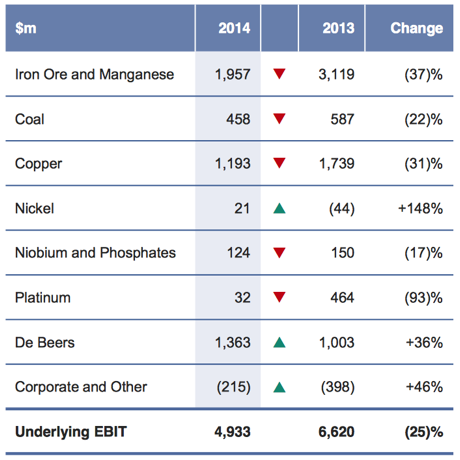
Anglo American released their results on Friday. Iron Ore, predictably falling sharply, still very profitable for the group however, diamonds were an investors best friend, De Beers being the most profitable unit for the commodities company. I guess I could have used the word giant, perhaps Anglo once were the biggest and most talked about company here in South Africa, that bias definitely still exists. With a market capitalisation of 305 billion Rand, it is still a huge company by South African standards, in London the market cap is 16.69 billion Pound Sterling. It is enough to make the FTSE 100, in terms of market capitalisation however it has a weighting of about 1.1 percent. They are currently in 32nd place, BHP Billiton Plc are twice the size (add in the other Ltd. and then it is roughly four), Rio Tinto are two and three quarter times bigger, Glencore Xstrata are a little over two times bigger. The mighty, which once was a contemporary of the others and in most cases superior to the others has slipped in size and scale. Management? Bad decisions associated with management? Assets relative to their peers? Perhaps all of those things. Here is a quick snapshot of their underlying EBIT


If you download the results presentation and the associated graph next to this table above. You will see that in the last year, according to Anglo, their mix was a lot better. My observations are simple, if you like diamonds as your favourite commodity, it is far easier and the margins are better to own a manufacturer of jewellery (who uses the raw products) than to own the people that mine it. For the time being. That may change, for me however it seems that if you are buying Anglo to benefit from a later consumer cycle, I think that there are far better consumer businesses to buy. If you are looking for a commodities business, equally I think that there are better businesses to own, two of them locally here. I suspect that there is locally a need that you MUST look at the company as an investment for historic reasons. I wish the company only the best, what they do is very hard, Mark Cutifani has done a good job so far in repair work, let us hope that him and his team are right about their commodity price predictions, which look very bullish.


Things that we are reading, you should too

Bill Gates is an editor on The Verg for this month, so he is getting a good amount of media time - Bill Gates: how online courses can radically improve education by 2030. As education levels the playing field and opens doors for people, so economies will grow and companies customer base gets bigger.

A look at where education may be heading. Given the explosion in population numbers and new technology available to us, education is in need of a shake up - Degrees don't matter anymore, skills do

I think Uber is a great company and adds value to any city that they come to - I drove for Uber for a week, and here's what it was like. There are many great points made by the blogger, the one that sums up Uber the best: "There is a good reason why Uber does not have a problem with harassment, while taxis do. The reason is the app...This creates a very safe system, and is in my view the reason why there's been almost zero incidents with 150,000 drivers. This system is far better than any permit system and is the secret sauce behind the great experience that is Uber."

Interesting look at what commodity prices did in general since 2005 - The Periodic Table of Commodity Returns Interesting to note is how gold miners have performed worse than the gold price. The price of gold is up 270% in the period, where AngloGold through their ADR in dollar terms is down 75% and Gold Fields, also through their ADR, is down 63%.


Home again, home again, jiggety-jog. We are down slightly today as short termers keep their eyes fixed on Greece. Many of our stocks hitting solid highs. Seems like people are still buying Woolies groceries despite the Greek negotiations.


Sasha Naryshkine, Byron Lotter and Michael Treherne

Email us

Follow Sasha, Byron and Michael on Twitter

087 985 0939
Friday, 13 February 2015

Apple up 2700 percent, NASDAQ flat


"The point I am trying to make is that without Apple, where would the NASDAQ be now? Would it be around 10 percent lower or more? More actually, Apple has a market cap of 736 billion Rand as of last evening, the company in the 50th place has a market cap of less than 25 billion. In other words, back then in March 2000 when Cisco was the business that was going to 1 trillion Dollars market cap, Apple was tiny comparatively."


To market, to market to buy a fat pig. SONA this and that. There is plenty better analysis than I would ever do, seeing as I only watched part of it. Some part of it was spent reading "One Fish, Two Fish, Red Fish, Blue Fish" to my youngest, that is a fabulous story. Dr. Seuss had some good stories to tell. I will not go into it, you can read all of the analysis around. You can read the speech, in fact you can read many politicians speeches on the matter in years gone past about their brilliance and the ability to change the future. In the end it is humans that overcome human obstacles, not organisations. Charlie Munger, who is of course Warren Buffett's right hand man, has one of the best quotes on this: "I believe Costco does more for civilization than the Rockefeller Foundation. I think it's a better place. You get a bunch of very intelligent people sitting around trying to do good, I immediately get kind of suspicious and squirm in my seat."

Who is Costco? What? You don't know? They are the third largest retailer on the planet, who sell bulk goods at cheap prices. For the betterment of consumers. Yes, capitalism does that, not organisations. People with profit motives drive prices lower, the irony of it all! If the company believes that the prices are too high for their clientele, they will not stock the goods. And hence their goods will be reached by fewer people, given that Costco reach so many folks. Price controls, which the powers that be implement to protect the most vulnerable in society, never work. I cannot dictate what the price should or should not be, the market, real people decide that. That has been the case for millennia. Unfortunately we always as a collective look for guidance from someone else, not sensing that the opportunities are all ours to take and more especially to make.

That aside, our job is the job of searching for good businesses that are likely to capture market shares, likely to engineer better products at better margins than their peers. It sounds so easy. This morning the equities market is up some more. The local market is trading at an all time high. I guess the weaker currency has something to do with it, this is just another reminder that regardless of politicians, the markets evolve and companies have the ability to work inside of parameters. Fear not, the markets sort this out each and every time. For the record the nerds of NASDAQ also traded at the best levels since March 2000, that is nearly a 15 years that the earnings have taken to catch up with prices, you could argue.

Although everything in-between has been choppy, there are newer entrants in the form of the obvious ones like Facebook, Alibaba and even Google which were not even listed back then, the biggest constituent of the index (overall) Apple was a bunch of nerds selling products for nerds back then. Admittedly amazing product for nerds, the iPod and the iPhone (the iPad even), iTunes and the App store (all of which were not around when the NASDAQ was last at these levels) changed the way that we think about everything. OK, not everything, in March of 2000 Apple had a share price (adjusted) of 4.95 Dollars. Apple is up 2732 percent in the same time that the NASDAQ is down 1.16 percent, since March 24 2000.

The point I am trying to make is that without Apple, where would the NASDAQ be now? Would it be around 10 percent lower or more? More actually, Apple has a market cap of 736 billion Rand as of last evening, the company in the 50th place has a market cap of less than 25 billion. In other words, back then in March 2000 when Cisco was the business that was going to 1 trillion Dollars market cap, Apple was tiny comparatively, if you add in for the falls in the others and the growth in Apple, I am sure that it is a lot more. Nice.

One last parting shot here with regards to the market today, the companies in the JSE All Share index do not reflect the economy or the country, they are listed here. Many of the majors derive a large portion if not most of it from outside of the borders of South Africa. Do not get confused or even confuse the market and the economy and the respective prospects, they are of course two different things entirely. The bad news for consumers is that the recent move northwards in the oil price and the weakening currency (that is on the local front) means that the petrol price is going to increase significantly next month. Listen in closely to the commentary from ordinary South Africans after this, those are always entertaining.


Company corner snippets

L'Oreal reported results last evening: 2014 ANNUAL RESULTS. Remembering that these are in Euro's, the ADR price is one fifth in Dollars, i.e. the ADR price that you see (closing at 37.35 Dollars last evening) is one-fifth of the Paris price. In simplest English, for each five ADR's (American depositary receipt) that you hold, that is the equivalent of one share of L'Oreal in Pairs. Got that? First things first, this company is controlled by Lilliane Bettecourt's historic shareholding and Nestle, the Swiss giant who have the shares historically too. Recently Nestle have been a seller, they sold a stake back to the company. In fact, there are 23 million shares less in issue, shares in issue have fallen from 608 million to 585 million, average over the period, there are NOW 561 million shares. Fewer shares always equals higher earnings.

The second half of the year has boosted the full year numbers, the end of the year in the US was better, the company has grown their market share in Europe. They want to continue to take market share, this year is going to (according to the country) be a little better than last year. The CEO cited lower energy prices as being a positive for their core consumer in Europe and North America, they should have more money in their pockets, feel better about the year ahead and all in all more spending power. The consumer is in better shape across the globe.

The L'Oreal share price is trading at a 52 week high in Paris as we speak this morning, earnings of 5.34 Euros on a share price of 161.35 Euros means that the stock is hardly cheap on 30 times historic earnings. The dividend is expected to be 2.7 Euros (the French government take a whack out of that), which means that the company is pretty generous pre the tax, roughly 1.9 times cover. Why own this company then if the price is pretty aggressively priced, at face value? This is a growth company, they have been going through a pretty poor patch, the Euro moving all over the show does not help the Dollar price. The company is growing strongly in their existing markets, much faster in their emerging markets (which are smaller in terms of sales), up 13,5 percent in Asia and up a whopping 20.3 percent here in Africa and the Middle East. Both those juiced up by worse currencies relative to the Euro. Asia is going to continue to be key for the short term growth prospects, as is Latin America (less than 9 percent). Good business, luxury is a fabulous investment, richer middle income people across the globe boosted their sales, we continue to buy the business.


Byron beats the streets

On Tuesday we received full year and fourth quarter results from Cerner, one of our favoured healthcare stocks listed in New York. I have explained what these guys do before but this video clip titled What is Cerner Health does a great job. It's short and paints a good picture of what this business does. For a local example think of Discovery's Vitality product. But it goes further, it integrates all this info with doctors, nurses, chemists and medical devices. Tracking ones healthcare history, their fitness and wellness as well as their finances concerning healthcare spend. Their catch phrase "Health care is too important to stay the same" certainly inspires. The company services 18 000 facilities in 30 countries.

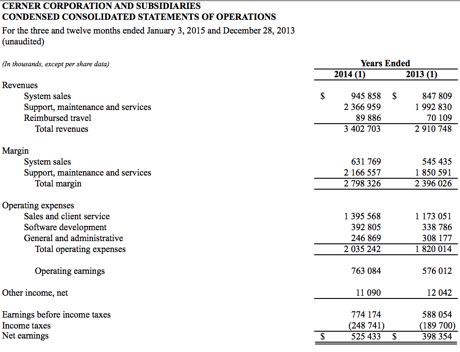
Numbers. Bookings in the fourth quarter were up 5 percent to $1.16bn. Bookings for the full year were up 13% to $4.25bn. Bookings represent the order book. Revenues for the full year came in at $3.4bn which is up 17% from 2013. Net earnings for the full year came in $576 million which equated to $1.65 per share. Below I have hacked their income statement from the presentation just to give you a feel of where the business makes and spends their money.


Earnings for 2015 are expected to come in at $2.13 which would mean growth of 29%. They did make an acquisition of Siemens health which will be earnings enhancing. More on that later. The share trades at $67.7 or 31 times 2015 earnings. It's expensive but it's growing fast. They bought that Siemens business for $1.3bn cash and have almost zero debt. You'd expect more earnings enhancing acquisitions as the sector consolidates.

The business sits in a sweet spot and I can only imagine the blue sky for selling their product globally. The potential efficiencies they can create in such a vital service is huge. And I am pretty sure governments around the world will take notice. Take the UK's NHS for example. So many publicised inefficiencies within this system could be sorted by implementing Cerners products. Locally I'd love for Mediclinic, LifeHealth and Netcare to take these products on. Filling in forms is a huge mission, imagine how difficult it is for a doctor to get hold of your history, all on paper.

The Siemens acquisition was also well received. The business focuses more on labs and imaging. This will synchronise the information gathered at the testing labs directly with the doctor who needs that info. How many lives can be saved because of a speedy response time to a diagnosis. The options are endless. We continue to add.


Things that we are reading, you should too

How big is the global financial asset base? According to Deutsche Bank it is $294 trillion - Here's what the $294 trillion market of global financial assets looks like. The number that stands out to me is the unsecured debt, which is almost as big as the global stock market capitalisation. A chunk of it will be student loans; there are definitely worse things to go into debt for.

Gold! The one commodity that everyone likes to talk about. When it comes to investing, you either love it or hate it - Gold bar and coin demand continues to slip!. Not a pretty picture from the supply and demand side of things, supply slightly up, demand is down 4%. The only people buying gold at the moment are central banks and as the global outlook improves, people are going to be less inclined to hold the "safe haven" gold.

Adapting to change is always better than fighting it - UK gives thumbs-up to driverless cars - but first come the driverless pods. Glad to see they are making provisions for driverless cars, creating more certainty around the sector which will result in more investment.

A light hearted map of what lies across the ocean - If you're on the beach, this map shows you what's across the ocean


Home again, home again, jiggety-jog. Markets are higher across the globe, a few records here and there. The Ukraine peace deal from yesterday is certainly a big deal, Greece, that situation bumbles along. Anglo American released results, they are up sharply. The Dax is through 11 thousand points for the first time ever. The World Cup starts shortly. We are up against our northern neighbours, bring your best.


Sasha Naryshkine, Byron Lotter and Michael Treherne

Email us

Follow Sasha, Byron and Michael on Twitter

087 985 0939
Thursday, 12 February 2015

Woolies Chow Down


"The big contributor here locally was the food division, sales up 14.1 percent and operating profits increasing by a whopping 24.3 percent. Wow. The supermarket strategy is working well, customers have been receptive to the new format. I must say that as a user, the supermarkets are certainly a cut above the rest of the competition, the prices are too! "


To market, to market to buy a fat pig. Double sigh. In fact, double thick Greek yogurt sigh. The Greeks and the rest of their European brothers are once again involved in a stand off around the loans that were extended to the country after they extended themselves too much. As we pointed out earlier in the week, the Greek government spent too much, collected too little by way of taxes and the economy did not grow fast enough through that period. Greek debt to GDP during the restructuring was reduced by 40 percentage points on a debt to GDP basis. If that sort of thing were to happen here in South Africa, our interest bill that we currently service would be nearly wiped out. Let us just say that this was very generous, at the time.

Still, the country has a heavy debt burden, having piled on over 200 billion Dollars in debt in 11 years from 1999 to 2010. This is relative to an economy that doubled in that same time. Nominal GDP was 45 billion Euros in 1990 (public debt was 31.2 billion Euros), fast forward to 2007, before the financial crisis and nominal GDP in Greece was 232.8 billion Euros, the debt pile had increased to 240 billion Euros. It was far easier and cheaper to access Euro debt than it was to issue debt in Drachmas, this led to the economy having grown like gangbusters. Shipping and tourism was particularly hard hit in the crisis, these are two major industries in Greece, that compounded the problem. The other northern Europeans, who regard themselves as harder working would point to too many benefits, too early a retirement age, too little work and productivity being too low. In other words, too much of the good life and not enough hard work.

How do you unwind all of this? Quickly? No. It is far easier to rack the debt up than it is to pay it off. Ask anyone who had to cut up a credit card, they will tell you it was fun spending the money and getting things, it was far less fun, painful in fact, having to pay the folks back (at a pretty high interest rate) that actually lent you the money. Under the current programs the large loan relative to GDP (110 billion Euros is to 207 billion Euro GDP) with maturities of more than 15 years and interest rates of 3,5 percent, that sounds really favourable. And lest we forget, over 100 billion Euro haircut was shunted through, the bond holders were spanked. Perhaps their belief that the ECB would always backstop this at the higher rates meant they "deserved" to take the haircut, if ever there was such a thing.

Each and every Greek citizen, around 10.816 million in total, was given a reprieve of 9245 Euros on their collective debts. So, forgive me for being a cynic of sorts, it seemed like Greece went from being a really poor country that benefitted hugely from being inside the Eurozone with low rates, more funders, fudged their numbers (so it is said) and generally skirted many of the rules. I cannot recall anyone suggesting that they were the benefactor of too many benefits. I get what Christine Lagarde said, when she suggested she had more sympathy for victims of poverty in sub Saharan Africa than Greeks hit by the economic crisis. GDP per capita in many places across the continent are less than 1000 Dollars per person, each Greek person was pardoned around 10-11 years worth of GDP contribution per capita per Kenyan person. You get what I am trying to say, there are rich people problems and poor people problems, it depends ultimately what your reference point is.

The new government in Greece failed to reach a solution with European finance ministers last evening, another summit is planned for Monday. Sigh. Another summit, more time. I think that there will be a solution, one that will not favour any side. Both sides will feel like they failed to meet their objectives. The new Greek government are refusing to sell 25 billion Euros of infrastructure calling it national capital. Perhaps it is time to use that capital. If the Greeks are too combative, the upshot will be no more lifeline, the reason why they think they have leverage is that more than 80 percent of external debt is owned externally. We have leverage. No funding however from the bailout program means no ability to meet your obligations. Anyhow, everyone will meet and reconvene on Monday. In the meantime Mr. and Mrs. (and Ms.) Market will continue to be anxious, you know, about contagion.

After all was said and done here locally, market had ended the session marginally down, after being marginally up for most of the day. We pretty much traded in a very narrow band around 100 points up or down, which is not much when you are at 52 thousand points. A much weaker currency, as a result of a stronger Dollar and weaker Euro translated through to all of us in the developing world having to deal with the flows.

In times of stress, the flows are back towards what people know (i.e. the Dollar) rather than developing or emerging market currencies. In some ways the currencies being weaker are a reflection of the fortunes (or lack thereof) of the domestic economies, the relative strength of the Indian Rupee relative to the Russian Rouble or Brazilian Real, or even the Rand. Of those four currencies, we are the second best, only India is better than us, the Brazilian Real and in particular the Russian Rouble have been absolutely smoked. Most of the divergence comes last year and begins as commodity prices weaken. Around the time oil prices and other commodities fell. Stronger Dollar = weaker commodities prices, for that four pairing it is best for India, second best for us, and worst for Russia. It should not be a coincidence.

Darn, one major mistake yesterday. Whilst I explained that Glencore was going to unbundle their Lonmin stake to their shareholders, I unwittingly said that they were selling it, which is wrong. We did some quick math and unfortunately what you are receiving from Glencore (if you are a shareholder) is next to nothing. Let me explain. 23.9 percent (is what Glencore own of Lonmin) of 17.1 billion Rand market cap is 4.08 billion Rand. Which is not chump change. However, Glencore has a market cap of 646 billion Rand. Their stake in Lonmin is 0.63 percent of the overall value. Meaning that for every 10 thousand Rand of value of Glencore that you have, you are likely to get around 63 Rand in value. For every 200 Glencore shares that you have, you are likely to get around 2 Lonmin shares. Phew, it is not exactly a kings ransom now, is it?


Woolworths have released their results for the first half this morning. This is the first half that includes David Jones from 1 August 2014, there are however no comparable figures. So we have to look at the group as a whole, which integrates David Jones, it does not have a comparable period however. This makes this period of adjustment hard for those who love comparisons and patterns to appear and then to measure that against your expectations. Here goes, for the 26 weeks to end December the 28th 2014. Revenue grew to 30.3 billion Rand (excluding David Jones, an increase of 12.5 percent), pre tax profits were 2.9 billion Rand. Clothing sales in South Africa grew 9.4 percent, add merchandise and that is lower at 8 percent with profits in this division growing only 2.7 percent. Children clothing, footwear and accessories having a rough time of it.

The big contributor here locally was the food division, sales up 14.1 percent and operating profits increasing by a whopping 24.3 percent. Wow. The supermarket strategy is working well, customers have been receptive to the new format. I must say that as a user, the supermarkets are certainly a cut above the rest of the competition, the prices are too! David Jones, which is again recent and is going to take a fair amount of time to "get right" recorded sales growth of 2 percent. Country Road delivered sparkling results, up 9.2 percent, a lot of that in Rand terms juiced up. Australian sales growth was better than here locally.

Diluted HEPS for the six months clocked 192.4 cents per share, the dividend (interim) declared was 96.5 cents. Remember that there are 928 million shares in issue, dividend cover at the half year stage is 1.9 times as it was last year. At the full year stage it was 1.4 times, remembering now however that there is a small matter of the debt outstanding, raised to pay for the David Jones transaction. The rights issue itself cost 399 million Rand, good work if you can get it, right?

It is not all roses and champagne, to use a valentines analogy, load shedding and the prospect of higher taxes is going to impact their core market no doubt. Woolies have suggested that they are trading comfortably ahead of the market and the first six weeks of the second half of the year has been positive. I am never quite sure what that means, better is always good. Down Under, ahead of the beginning of the World Cup, both their major businesses David Jones and Country Road continue to trade ahead of the rest of the market. Talking the market, the equities market is really pleased with this result, the share price is up around four percent mid morning here in Jozi. Good work, we continue to favour Woolies as the best entry into what is now Southern Hemisphere retail.


Things that we are reading, you should too

Moving away from winning and manufacturing has a big impact on labour dynamics - SA trade unions in dramatic 'decline' says new survey. One of the interesting points made in the article was that unions were struggling to attract younger members.

Wall street doesn't understand the "Law of large numbers" - Cook Doesn't Believe This Made-Up Math Law Will Limit Apple's Growth.

Some scary numbers from the worlds biggest economy - Here are the facts:. Having a strong and growing US is good for the rest of the world. The number that stood out to me is "US household net worth hit $81.5 trillion. This includes all stocks, bonds, properties and business values, minus any debts or liabilities. This is a new all-time record.". Not to shabby hey Nige!

Is it safe to say that we have put 2008 behind us? - The "Misery" Index Falls to an 8 Year Low


Home again, home again, jiggety-jog.The Rand was weaker (more strong dollar) but has changed direction during the course of the morning. It looks like Russia and Ukraine have reached some sort agreement and a cease fire. At last look, the Russian market was up over 6% on the news. Glad to see that things are moving forward, war never benefits anyone.


Sasha Naryshkine, Byron Lotter and Michael Treherne

Email us

Follow Sasha, Byron and Michael on Twitter

087 985 0939

Wednesday, 11 February 2015

Glencore jettison Lonmin stake


"Glencore inherited this stake when they bought Xstrata in May 2013. Xstrata wanted to buy the entire Lonmin, that was back in 2008. Imagine if that had happened. On the 7th of August 2008, whilst the US subprime crisis was spreading and about to really get real, Lonmin rejected the Xstrata offer as wholly inadequate. The price apparently failed to adequately reflect the true price of the company. The chairman, Sir John Craven added that this was opportunistic and unwelcome. Xstrata wanted to buy all of Lonmin, back then, for 33 pounds a share. In December that year, the share price of Lonmin was at 5.50 pounds a share, the middle of the financial crisis. Just this morning the stock is trading in London at 163.4 pence. Since then, thanks Sir John, the share price in Pound terms is down 93 percent."


To market, to market to buy a fat pig. I have Greek fatigue. I love Greek food. I have Greek friends and family. Ancient Greece fascinates me, I think that my mother actually took that subject at university. Ancient Greek. The Greeks laid the foundations for democracy and most importantly for me laid the foundations for merchants, modern day business folk. As merchants were not from the upper classes they may have enjoyed wealth beyond the imagination of most, they did however not attract the class status that they desired, hence the saying money cannot buy class. Of course that takes on a new meaning as each generation goes by.

The current Greek tragedy is that the country has too much debt, the plan to pay it back is too hard and going to take too long for most ordinary citizens. That is the long and the short of it all for the Greek people. For the Germans and the rest of the Europeans that used their tax payer money in order to cast the country a lifeline, with (let us not fool ourselves) the interests of keeping the Eurozone together, the onus is on the Greeks to make good on their promises made in tough times. People change their minds, most especially when it does not seem to be going your way. I often say that when people are impacted in their pockets, their head takes over from their heart. Or their heart takes over from their head.

Either way, it is far easier to change your mind quickly relative to your personal circumstances than it is for governments to repair public finances. Most especially when the state has made promises to the electorate who may, or may not understand how government finances work, and suddenly they are not possible. It is easy to get elected on the basis that I make promises, implementing them always falls back to the same common denominator, do I have the funds in order to do this? The long and the short of it is that Greece are on a deadline, if they think that the Russians or the Chinese have their best interests at heart, I would think again. The debt is real, there has been a sizeable write off already. Sigh. It is going to hang over our head like an obnoxious uninvited guest. You can move away and talk to someone else, it is still however there. For me it represents an opportunity to buy the same companies potentially at cheaper prices. As long as it is quality, the price is determined by the collective in the market.

25 years ago today, where were you? I was at school, it was a Sunday afternoon and I was sailing a little one man boat on Settlers dam, just outside Grahamstown. I docked the "boat", we were told in the afternoon to expect the release of Nelson Mandela and we all went closer to a radio and listened in to reports. If you think 25 years was a long time ago, think about this for a bit. He was in jail for 27 years. This is 25 years later, a long time ago. In two years time when we get the opportunity to recognise and celebrate this day, Mandela would have been released from jail for as long as he spent in jail. In terms of years, the exact dates obviously would differ. 25 years is a long, long time ago if you enjoyed personal freedoms to do what whatever it is that you want to do, imagine spending exactly the same time in an oppressive place where you have no freedoms of any sort. Truly a great man, the father of the nation, a man that all folks that can be proud of. Where were you, were you there, I would like to hear your story. Paul was there, 25 years ago today.

Markets in New York were up and away, the broader market up over a percent, tech stocks were up nearly a percent and one third. Locally markets were flat, as flat as a pancake on Shrove Tuesday, which is next Tuesday. The day before Ash Wednesday, the start of Lent. Yes, that is how flat markets were. We were however above 52 thousand points on the local market. Earnings were strong form Coca Cola (a sigh of relief for many), in the end the equities market rallied to be only a percent or so away from the all time high. I have seen several suggestions that with energy being such a big part of the S&P earnings, the trajectory for collective earnings in the short term has been heading down.


Company corner snippets

Apple passed through the 700 billion Dollar market capitalisation last evening, by the close that is. At 122.02 Dollars a share, 5.843082 billion shares in issue = 712.97 billion by my calculation, the WSJ suggests that it is 710.74 billion Dollars. I must have something wrong then, perhaps the number of shares in issue which was reported at the last set of results is a little less. i.e. They (Apple treasury) must have bought more shares back over the last two weeks. The WSJ article that points out the "first", titled Apple: $710 Billion and Counting, that as a result of a fast growing customer base in China, Tim Cook reckons that the law of large numbers does not apply. If you think about it, whilst Apple has the smartphone profits share (remember yesterday), they certainly do not sell the most phones. Quality over everything else. I jotted down a few points for an interview: Apple through 700 billion Dollars as a market cap, that is pretty interesting. = (at current exchange rates) 8.343 trillion Rands. What Apple pays in dividends is about what we (South Africa) pay annually in interest on outstanding government debt. That is astonishing.

Glencore have announced that they are selling their 23.9 percent stake in Lonmin during the first half of this year. As they point out, they (Glencore) inherited this stake when they bought Xstrata in May 2013. Xstrata wanted to buy the entire Lonmin, that was back in 2008. Imagine if that had happened. On the 7th of August 2008, whilst the US subprime crisis was spreading and about to really get real, Lonmin rejected the Xstrata offer as wholly inadequate. The price apparently failed to adequately reflect the true price of the company. The chairman, Sir John Craven added that this was opportunistic and unwelcome. Xstrata wanted to buy all of Lonmin, back then, for 33 pounds a share. In December that year, the share price of Lonmin was at 5.50 pounds a share, the middle of the financial crisis. Just this morning the stock is trading in London at 163.4 pence. Since then, thanks Sir John, the share price in Pound terms is down 93 percent.

The horrors and the tragedy of the events at Marikana in August 2012 were followed with a rights issue, in which again shareholders were urged to follow their rights at 140 pence, a discount to where the price is today, over two years on. Glencore shareholders will vote on whether they plan to distribute the shares to their shareholders. i.e. if you have Glencore shares on either share register, you can then decide whether or not you want to continue to be a shareholder of Lonmin or not. What this does do is create an overhang, potential sellers of the shares, hence that is why the Lonmin share price is down. Secondly, it removes an asset that is non core for Glencore, it is up marginally and solves what is a problem.

How do you feel about this? Sin stocks pay as alcohol and cigarettes beat sober rivals is the FT headline, it is a subscription only piece. The suggestion is that if you had (your great grandfather) invested 1 Dollar in tobacco companies in 1900, according to a study done by London Business School, it would be worth 6.28 million Dollars, counting dividends invested. I can remember a conversation with a client who is more than a little older than me, being told in the late 1960's by industry types that the tobacco industry as an investment was a poor one. The health concerns for the users are well documented, to the point where the packets say, use this and you will get x or y or z.

Equally eating too much bad food leads to the same result, we all die, it is a matter of how. Sorry for ruining your day, it was not the intention. I for one would rather allocate capital in the direction of a business that has the ability to cure cancer, rather than a business that has a product that causes cancer. Anyhow, I believe firmly that the next 115 years are NOT going to be like the last 115 years for these businesses, volumes globally are declining, eventually cost cutting and less usage of your products is the start of a bad downward spiral. I would still continue to advocate to sell tobacco companies as an investment, allocate your own capital towards businesses that advance human technology. I know that investing is supposed to not be emotional, i.e. separate emotion from numbers, I just however cannot see how a business that sells a product that is harmful for you and addictive has good long term perspectives. I struggle.


Things that we are reading, you should too

The best news for the middle class, things are getting cheaper - Six Things Technology Has Made Insanely Cheap. The power of technology and the power of human innovation to make more with less! It is great to see!

Another move from Google in the direction of healthcare - Google adds fact-checked medical advice to search.

Technology disruption the status quo is a regular feature in our reading pieces - New York City hotel rooms are getting cheaper thanks to Airbnb. This a great way to better use the resources available to us, when you have excess capacity (a free room/ apartment) you list it on Airbnb and get some compensation for it. Increased efficiency and more money (resources) to go around.

This is a very cool dynamic graph showing the change in city population numbers - Bright lights, big cities. Urbanisation and the rise of the megacity. I was amazed to see how few urbanised people there were in 1950.


Home again, home again, jiggety-jog. We were trounced in the cricket against the hosts in the land of the long white cloud. Long fern. Cricket people, we are talking about cricket. I say that you must get your losing over with now. It does little for confidence however. Sigh, Sunday is another story, against our neighbours to the north who managed to smash Sri Lanka, true story. Markets are about flat here too.


Sasha Naryshkine, Byron Lotter and Michael Treherne

Email us

Follow Sasha, Byron and Michael on Twitter

087 985 0939

Tuesday, 10 February 2015

Kumba mined ore. Less profitably


"The company cites weaker demand from their main customer, China and more supply. Classic part of the mining cycle is when more supply comes on stream as a result of the higher prices. In the market overview segment, Kumba says: Global seaborne iron ore supply rose 11% in 2014 led by a 24% increase in Australian exports as well as a 4% increase in exports from Brazil and 2% from South Africa."


To market, to market to buy a fat pig. Greece continues to dominate headlines and selling takes place on the heightened prospect of Greece leaving the Euro zone. I was particularly pleased with a question directed at a Greek politician, which went along these lines: What does Europe have to lose if Greece leaves the Eurozone? He kind of stumbled through the question and spoke of high unemployment across Europe and in particular Greece. I think too much is made of Greece, their blackmail and so on. I do realise that their woes are other peoples woes too, the problems however in terms of how it was created was not someone elses doing. i.e. The debt was not imposed upon the Greek people, you cannot consume and use so much and expect the problem to go away.

In fairness to all concerned, the Greek economy was the fastest growing in the region, even the Reinhart and Rogoff book suggested that perhaps Greece had transcended to a different bracket, out of serial defaulters. It seems that even they, as sceptical as they were, got it wrong. The only solution to the Greek woes is to return to high growth in order to repay what will no doubt be a restructured debt, with common ground found. If the economy manages to grow quicker than the rest of the zone, return to primary surpluses (on track for the first in 25 years next year), then perhaps all of this is achievable. Nobody likes hardships, I get that. Greeks are however European. Perhaps this proves that all and sundry should keep a closer eye on one another budgets. And then what, in times of stress, act sooner? Labour reforms are required, perhaps Greece can attract a whole lot of investment by being a lower tax (company) environment for all multinationals, one knows that they need it.

Another losing day for stocks over the seas and far away, although nothing dramatic really from the indicated start. What I mean by that is that futures trade through the day, indicate what the market could open at, as a function of earnings and in this case the mood on the day, indices trade whilst the market is open. Stocks in the US closed the normal spot session around where the futures markets indicated that they would open, hence no big moves here locally overnight. At the end of the day, and I cannot stress this enough, markets move as a function of earnings and the collective stock prices. You own shares of real companies and not indices, therefore if the index does X or Y or Z, what really matters in the P&L column and from a cash flow point of view (dividends) is whether or not the company/companies you own made progress last year. More importantly, if you own them today you want to be sure that their prospects are improving and not dimming.


Company corner snippets

It is so easy to sit here in an aircon office and critique other peoples businesses. Remembering that the power has not always been reliable, so we have not always had aircon, our working conditions need to be improved. The point I am trying to make is that we have choices and it certainly makes it easier. For instance, if you are a miner of a certain precious metal, your choices are far fewer, you cannot move the deposit to escape illegal miners, average electricity supply and a demanding set of regulations. I saw results yesterday from Amplats and Harmony, it is incredibly tough out there. Costs continue to rise above inflation, I saw Amplats said that they managed to keep their inflation slightly lower than South African mining inflation. Paul noted that the open cast mining of Amplats made all the money, the deep underground mines were as a collective not profitable. Another person on Twitter noted that underground mines are hugely energy intensive. It makes sense to focus all of the companies best efforts on the profitable ounces from the (unfortunately for labour) more mechanised open pits.

Another mining company to report full year numbers is Kumba Iron Ore, ahead of parents company Anglo American's results on Friday. Kumba is of course more than two thirds owned by Anglo American. You can read all of the highlights, in what was a very tough second half, here: Results highlights - 2014. It is important to note that the average price for Iron Ore over the period was 97 Dollars a ton, currently we are a little above 61 Dollars a ton. The company cites weaker demand from their main customer, China and more supply. Classic part of the mining cycle is when more supply comes on stream as a result of the higher prices. In the market overview segment, Kumba says: "Global seaborne iron ore supply rose 11% in 2014 led by a 24% increase in Australian exports as well as a 4% increase in exports from Brazil and 2% from South Africa."

Headline earnings was lower than the year prior at 11 billion Rand, headline earnings per share for the full year shrank 29 percent to 34.32 Rand per share. Revenues were lower (as a result of lower commodity prices) at 47.6 billion Rand. A final cash dividend of 7.73 Rand was declared, on top of the 15.61 declared at the interim stage. This is the lowest final dividend declared since 2010 and reflects the current environment. The company has lowered their dividend cover from 1.3 to 1.7 times, as the company "recognises the impact of lower iron ore prices on the company's cash generation amidst the continued uncertain market environment." For the first half, the company made 20.30, the second half you can see that it falls to 14 Rand. At a market price of somewhere around 237 Rand a share, with expectations of somewhere in the region of 23 Rand for the full year (a dividend cover of 1.7 times equals 13.50 Rand) which seems that the market has got it right.

If you buy them today and you are in some way "sure" that the iron ore price cannot go any lower (Andy Xie, he is bearish, he says it may go to 40 Dollars a ton), that yield seems attractive. Phew, it is tough, the company will continue to push volumes and try to keep costs under control, that is what they can do. The price of the product that they produce will be determined by the steel market, growing demand and consumption should see levels elevated to a new floor level. Your guess is as good as mine as to what is going to happen. The share price is down 3.3 percent, we continue to avoid single commodity stocks.

Talking single commodity stock, there has been a deal announcement from (I am sure that it is fair to say this) two mid tier platinum producers. Northam are acquiring the platinum assets, Everest, from Aquarius Platinum. Price? 450 million Rand. Why? It is next to Northam's other asset, Booysendaal. Where? Near the town of Mashishing on the Eastern Limb. Mashishing is the new name of the town Lydenburg, people love catching trout out there, not so? I remember spending time as a kid on a commercial trout farm there, my best mate in junior school, his dad was involved in the industry. It was cold during winter, that was for sure.

Everest has been on care and maintenance since June of 2012, Aquarius was the first mover in cash conservation back then. 60 million ounces is what Northam suggest, Aquarius view this as an opportunity to strengthen their balance sheet in challenging times and focus on Kroondal (50:50 pool and share agreement with Amplats) and Mimosa (50:50 ownership with Implats). Remembering that the Zim government are putting pressure on mining companies to build smelting capacity in Zim, it can't be easy there. Aquarius may well end up with their flagship mine, Kroondal, and question marks around Mimosa. Wow, that mine may be closed as a result of a benefaction tax making it unprofitable. Aquarius has been a train wreck for investors, sadly, such high hopes have turned to little more than despair. Northam has not been so bad. I expect that within the South African landscape the smaller producers will continue to become more fragmented.

Tiger Brands released a trading update yesterday that Mr(s). Market definitely did not like. This was for their first quarter to end 31 December 2014. There was only a 7 percent increase in turnover to 8.2 billion Rand, the company suggested that tough trading conditions persist locally here in South Africa, as well as across the continent in terms of their business operations. Higher pricing, having to pass on the costs to the consumer, has impacted sales. The weaker Rand has not helped, many prices of raw commodities are set in US Dollars. The company has however still maintained their market share. There is a conference call at midday today, we can get a sense of how the weaker Nigerian market has been impacting the group, that no doubt will be one of the talking points. As the company points out in the trading update, currency issues (as a result of lower oil prices) have created liquidity issues with the currency in Nigeria.

Expectations of an immediate reprieve in Nigeria are a little too early to call, the falling oil price is having a negative impact on the Nigerian budget, equally a dodgy looking political landscape. If you did not hear, Nigerian elections were postponed for 6 weeks yesterday. And the Boko Haram insurgency has been well documented, for the time being there seems to be no winning there for the Nigerian government. More will be revealed on the conference call today no doubt, I would say that perhaps the Nigerian focus has been too much in this trading update. The stock slumped five and one quarter percent, the share price is about flat this year and again flat this morning as folks wait for more information around midday.

Imperial Holdings released a trading update yesterday, not great, the market was less than pleased. For the half year, core EPS is expected to be 13 to 16 percent lower. Operating income is expected to be between 8 and 11 percent lower than the prior reporting period. The reason for the lower earnings is that this is comparing the business to a time when there was a) a gain on the sale of a business, and more importantly b) Rand weakness coupled with a weaker consumer has meant that the vehicle import, distribution and dealership divisions have been under pressure. The full update for the year is expected to be provided when the company releases their interim numbers, two weeks today in fact. Yip, it has certainly been more than a little tough out there for consumers, it shows through company consumer patterns.

Did you see that Apple are basically the most or only really profitable company that manufactures smartphones. Check this BusinessInsider article out: Apple is taking 93% of the profits in the smartphone industry now. As you can see, there is no information for private phone maker Xiaomi. That is amazing, Apple has 93 percent of all the industry profits, their phones are clearly too expensive. Then again, according to a WSJ article that I read the other day, there are only two distinct kinds of phones, expensive ones that are high end and cheaper ones that are lower end. Apple does not want to really make a cheaper phone, for what? You can either afford one, or you cannot, they do not want to be a mass product, the price is part of the allure. Talking of cheaper, Apple are raising money in Switzerland, where the government there enjoys low rates. No, the Swiss government gets people to pay them (negative rates) for their debt. Retail demand should be strong, so says a credit strategist at UBS, when quoted in this WSJ article: Apple Plans Debut Swiss Franc Bond Sale. The mind still boggles how Nestle and the Swiss government are able to raise money at such low rates, Apple has noticed this too.


Things that we are reading, you should too

It is great when you have other companies advertising your product and in this case it is the big brand of American Express punting Apple pay - American Express launches vintage-themed ad starring Jerry Seinfeld, John Cleese, Jackie Chan and Tina Fey to promote Apple Pay

Another South African making waves, Mark Shuttleworth's Ubuntu has launched a smartphone - Ubuntu smartphone offers alternative to apps. It will be interesting to see if their approach of not having an app interface works or not, you never know if you don't try though.

This may sound easy enough but when you think about the complexity of having a robot understand what it is watching , it's not a small feat - Robots Learning to Cook by Watching YouTube Videos. Think about how different our world will be when robots can learn by just watching and then implement what they have learned.

Maybe we can buy one - Want to Buy a Used German Power Plant? Shipping Is Included. It is interesting to see the dramatic effect renewable energy is having on their electricity price. You have to think that the trend will spread to other countries in time.


Home again, home again, jiggety-jog. Stocks are a little lower, the focus should hopefully return to earnings pretty soon, we are certainly by no stretch of the imagination through earnings season. We continue to be excited by human innovation, new inventions, progress and fabulous new products from businesses that we have access to. We continue to back strong management teams with positive energy in sectors that have good growth prospects. Make sense? Easy enough?


Sasha Naryshkine, Byron Lotter and Michael Treherne

Email us

Follow Sasha, Byron and Michael on Twitter  

087 985 0939