Friday, 9 June 2017

DisMAY. Hung, drawn and slaughtered

"The voters have cast their ballots in this way, whether or not you or I have British electoral fatigue (From the Scottish referendum through to the Brexit vote, through to this election), it is the will of the people. And by implying that the people are wrong, shows a certain ignorance in itself."


To market to market to buy a fat pig British politics and their little colourful rosettes. It looks like a primary school athletics day event, first, second and third place for the under 8, 60 metre dash, well done you! There are actually rules about these rosettes, I couldn't believe it. The only people permitted to wear political rosettes are the candidates and their polling agents (observers?). Ordinary voters cannot do that, which is darn hilarious. What would one of my favourite childhood "comic" book characters, Captain Archibald Haddock (from the Tintin series) have to say about this, the fact that the UK election (which was a certainty for the conservatives at the polls), now looks like another hung parliament? According to Wikipedia (and distant memories), he (Captain Haddock) may start something like this:

    Ten Thousand Thundering Typhoons! Billions of blue blistering boiled and barbecued barnacles! Great flat-footed grizzly bear! Flaming Jack-in-the-Box! You bashi-bazouks, freshwater swabs, miserable slugs, blundering bazookas, you sea gherkins!"


OK, that is plain mean and downright insensitive. I apologise. The voters have cast their ballots in this way, whether or not you or I have British electoral fatigue (From the Scottish referendum through to the Brexit vote, through to this election), it is the will of the people. And by implying that the people are wrong, shows a certain ignorance in itself. My mother always said, don't speak politics and religion with first timers at dinner events. It is not physics or math (politics that is) and whether or not (to quote Haddock), you think that the candidates are a "Dictatorial duck-billed diplodocus", the die is cast. To quote another politician, Julius Caesar .... who would have used the Latin "Alea iacta est".

Most of us reading this newsletter do not live there, or live where Trump is YUGE, we live here and have our fair share and larger slice of political "issues". Or in the world where Dr. Seuss and the internet collide, "We live here and there and everywhere." It does impact on us and our investing lives, it casts uncertainty around the Brexit process, it casts doubts on the ability for a proper negotiation of the British people to muscle any sort of pressure in looking for a favourable outcome for their home base. It actually falls onto the laps of the European people and their strengths in the negotiating process. Sigh.

As to what happens next, your guess is as good as mine, the WSJ leads with U.K. Voters Deliver Stunning Setback to Theresa May's Conservatives. "Theresa DisMay" is being thrown around. Some are suggesting that there may be another election in the second half of this year. All this is creating an environment of uncertainty. Hung, drawn and slaughtered. Amazingly, the Scottish National Party and UKIP have been slaughtered too. Oh dear, for them that is!

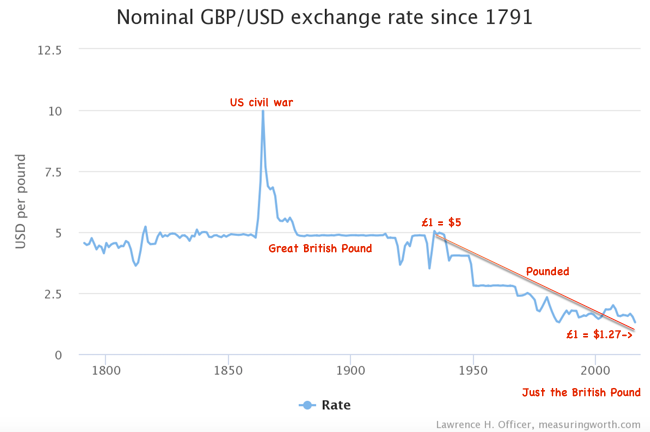
The ramifications for investors suggest that a weaker Pound and more uncertainty means lower asset prices. It has to. And that is not good for our investments in the UK. Less confidence in the UK economy means less spend, which leads to a lower growth trajectory. We managed to find a long term graph of the Pound to the US Dollar. You be the judge of whether the Great British Pound should just be the Pound or the Dollar should be called the Great Dollar:


Quick look at stocks and their performance locally yesterday, after this "stunning" outcome. Locally, the JSE slid around one-third of a percent by the close, the currency also slipped which lent a hand to the resource stocks. There were new twelve month lows aplenty, it certainly looks iffy for SA Inc., Brait, Arcelor Mittal, MMI Holdings, Sun International, Pick n Pay, Tsogo Sun and Pioneer Foods, as well as EOH. Amongst the majors, only the big dual listed resource stocks made any progress, BHP Billiton, Anglo American, Glencore and Bidcorp (food is always in fashion) all in the up column. Sasol and Bidvest were much lower, for different reasons.


Across the oceans wide and vast, stocks ended an up and down session in the green, eyes turned to testimony and Q&A of the old FBI chief. No smoking gun = OK outcome for stocks. As such, the end of the session saw the Dow Jones up a few points, which is 0.04 percent (an intraday all time high earlier in the session), as was the broader market S&P 500 (up 0.03 percent by the close). The real story of the day however was another big all time high for the nerds of NASDAQ, up nearly four-tenths of a percent by the close. Big moves north from the likes of NVIDIA, over seven and one-quarter of a percent, Alibaba added 13 and one-quarter of a percent. Alibaba was the company that moved tech stocks higher as a result of a really bullish guidance, suggesting revenue growth of 45 to 49 percent. So there goes! All Chinese related stocks getting a big lift.


Linkfest, lap it up

Apple has now officially joined the ranks of companies creating TV shows, the idea is not original but they have some very big hitters in the show - How to watch the first episode of Apple's 'Shark Tank' for apps reality show. Look out Netflix, Amazon and HBO?

As Cullen points out, even if we had 1 000 years of historical financial market data we still would not be able to predict the future. There are broad long term trends that we can be fairly certain will happen, over the short term (less than 5 years) we have no idea - 1 000 Years Worth of Market Data.

Here is why you shouldn't buy a stock for its dividend yield, dividends are at the mercy of the business environment along with all other business metrics - Don't Be Fooled By High Dividend Yields. Part of the discussion looks at the huge change facing US retailers at the moment, which means it is only a matter of time before South African retailers face the same headwinds.

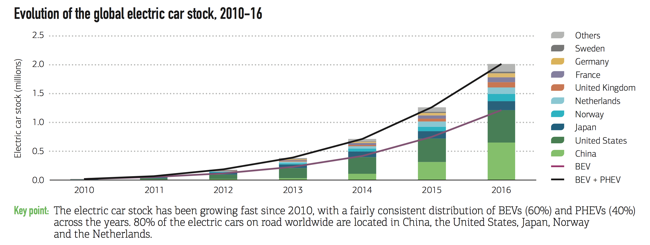
Absolutely incredible! There were 460 registered electric vehicles in the world in 2007. We found via the via, this .pdf download from the international energy agency - Global EV Outlook 2017. What is important is that in ten years, the number of electric vehicles as a percentage of globally registered new cars has gone from a few hundred to hundreds of thousands to perhaps a million by the end of this year. EVs are now 1.1 percent of all cars sold, and growing like gangbusters. Stay long Tesla for the next 1000 (binary for 8) years.


Home again, home again, jiggety-jog. Righto. Listen carefully here all peoples of the newsletter. Our database and website is moving to Amazon Web Services this weekend. As such, there will be limited accessibility in parts, hopefully a MUCH faster experience. Feel free to email us if there are any queries that you have!


Sent to you by Sasha, Byron and Michael on behalf of team Vestact.

Email us

Follow Sasha, Michael, Byron, Bright and Paul on Twitter

078 533 1063

Thursday, 8 June 2017

Capital goes on Strike

"In his opinion, and Tim must talk to a lot of leaders of business, the removal of "hope" (call it confidence) has led us down this path. There is almost a strike by those with capital. And as we discussed in the office yesterday, when the wireless and the TV start talking about the downturn, you then know that people are likely to change their spending patterns and unfortunately (for the economy and perhaps not their personal finances), the outcome is likely to reveal even softer demand."


To market to market to buy a fat pig Stocks in the city founded on a monster pile of gold fell as a collective again, down one-quarter of a percent on the day. The R word is doing the rounds, colloquially it is all pointing to a lack of confidence. Paul retweeted an answer from veteran journalist Tim Cohen (Editor of Business Day) when challenged by a BBC journalist as follows: "Here's a challenge to journalists - explain the recession, without the financial jargon." I left out some hashtags there. Tim's answer was pretty on point: "An economy is built on the creativity, confidence, and sheer audacity of its wealth creators. Take that away, hope melts into recession."

In his opinion, and Tim must talk to a lot of leaders of business, the removal of "hope" (call it confidence) has led us down this path. There is almost a strike by those with capital. And as we discussed in the office yesterday, when the wireless and the TV start talking about the downturn, you then know that people are likely to change their spending patterns and unfortunately (for the economy and perhaps not their personal finances), the outcome is likely to reveal even softer demand. With soft demand comes lower tax receipts as a result of weak economic activity. Ironically the SARB could stimulate the economy, they are watching politics impact the levels of the currency, flows to the market (as a result of the downgrades) and understandably are reluctant to budge. Until demand sees inflation much lower, that may be when the MPC move.

Just to give you perspective on how investors are starting to react, there were multiple new 12 month lows than before, MMI, Brait, Sun International, Sasfin, Spar, Pioneer Foods and another whole host of smaller businesses. To add insult to injury was the fact that there was not a single 12 month high from any listed business out there. Amongst the majors that were lower were the likes of Amplats, Steinhoff, Nedbank, FirstRand and Standard Bank. There were an equal amount of winners as there were losers, the likes of Glencore, Hammerson, NEPI and South32 .... The UK elections are today. Yip, that may have an outcome on how markets react over the coming days.

There are Steinhoff results that we are also looking at and will revert shortly. Hopefully tomorrow. The market didn't like it, there were gains in the local market with PEP, indicating that the consumer is perhaps shopping down a little. Relative to some of the other retailers, this is a better performance. Some of the international investors must be less than pleased in this evolving business, as usual there are many moving parts.


Stocks in New York, New York ended the session higher after political worries abated a little, Barron's writes The Market Shows Relief Over Comey Testimony. Comey actually testifies today. It is expected to be an epic event. Session end the Dow added 0.18 percent, the broader market S&P 500 a little less than that, whilst the nerds of NASDAQ ended the session with gains of just over one-third of a percent. Energy stocks and commodities in general went off the boil as the Dollar gained some ground. The moves are ever so marginal. Oil prices sank as a result of an unexpected rise in inventories ......

Apple stock seems to have caught another bid post their fairly sizeable announcements, as we know, it is more about the release of the new phones and whether their customers continue to refresh to the newer models. The next phone release is going to be massive. Without a doubt, this will be the biggest moment for the company in their history. In their 4 decade odd history. Whilst investors may be calling for tons of new products, we can be holders of an inventive company and a perfecter. They certainly have the resources. We will stay long on a "until then" basis, whilst others worry about what the share price is likely to be in the coming months!


Linkfest, lap it up

A huge positive for diabetics! Wow, I found this pretty amazing - Medtronic's long-awaited 'artificial pancreas' makes U.S. debut. As the article points out, this is the ONLY "FDA-approved insulin pump that automatically delivers basal insulin to control blood glucose levels in people with Type 1 diabetes." We remain long and committed to our investment in JNJ and Stryker, diagnostics and devices businesses that change the world incrementally!

This is an epic read, it really is very long. Well worth the read though, a stunning article and some more insight into one of the entrepreneurial geniuses of our time - The Real Story Behind Elon Musk's $2.6 Billion Acquisition Of SolarCity And What It Means For Tesla's Future-Not To Mention The Planet's. We remain invested in Tesla. I am as surprised as Musk by the share price performance. BTW, Musk posted on Instagram that they have been listed now for 1000 years, which is 8 in binary. A nerd's nerd!

This is certainly a huge step in autonomous controlled transportation. It makes sense too. BHP Billiton are working on technology that will see bulk commodities delivered without the help of humans, by ship. - Robot Ghost Ships to Extend Miner's Technology Drive to Seas. Crewless ships, according to the article, could save miners 86 billion Dollars a year in the iron ore industry alone. It points to cheaper mining costs and cheaper commodity prices!

Just for fun, we love his music! And what is not to love? Ed Sheeran went for a drive in LA with James Corden. Ed reveals that he doesn't actually have a phone anymore. He only does email - Ed Sheeran Carpool Karaoke. #2nd trending YouTube video at the time. This is a little PG, brilliant though! Thank us later. If that doesn't make you feel better, nothing will!


Home again, home again, jiggety-jog. Spare a thought for all the souls who are impacted by horrid weather conditions, be it the wind, storm surge of the Western Cape or the rain and cold, equally the fires in Knysna! Whilst there is little you can do about these events, know that you live in a place that does have resources to deal with the disasters. Stay safe out there sports lovers. Stocks are mixed across Asia.


Sent to you by Sasha, Byron and Michael on behalf of team Vestact.

Email us

Follow Sasha, Michael, Byron, Bright and Paul on Twitter

078 533 1063
Wednesday, 7 June 2017

Howzit Recession

"So what next? More debt to GDP (as a result of lower GDP and more borrowing) and unfortunately less spend means lower tax collections. Which means lower revenues. Which leads to lower government spend. The other unfortunate part is, as Michael pointed out whilst he was listening to the wireless, is that radio stations are saying to Mr. and Ms. Consumer: "so now that we are in recession, what are you going to cut back on"? No, we were in it already, this was just the confirmation from all the way back to last October to now."


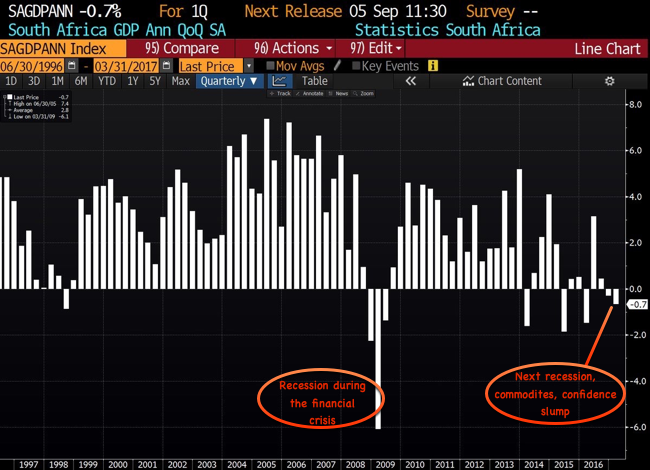
To market to market to buy a fat pig Whoa! That was ..... not good! A surprise read from StatsSA (who themselves have seen their budget slashed and may have less resources), has seen GDP for a second quarter in a row register contraction. Negative growth? That means the R word, R is for recession. There are a whole host of graphs that we need to pull out, including some really good ones from StatsSA, for historical context. So let us start with a Bloomberg graph that I managed to get via the Twitter thingie, that shows quarterly growth (and contraction). Here goes:


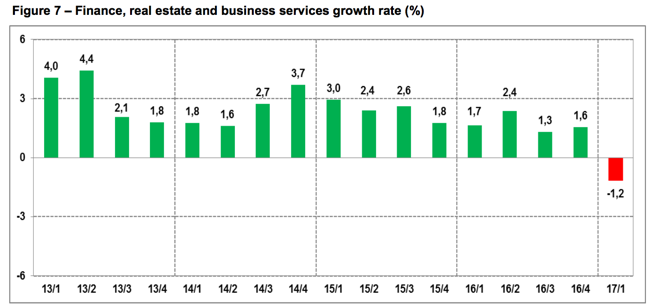
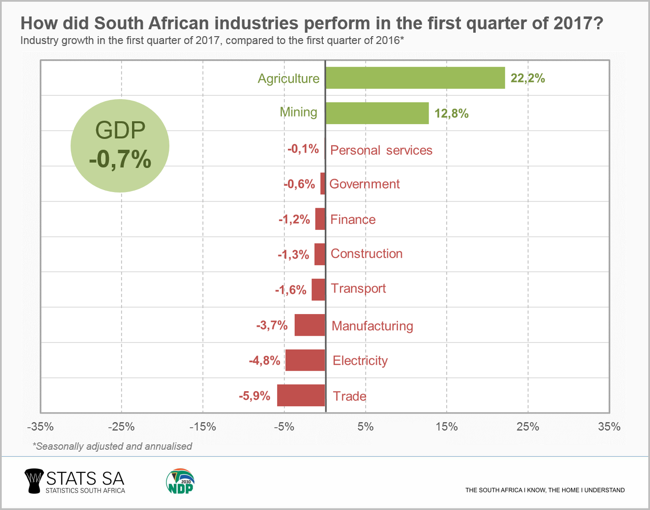
OK, so it is official. You can see the StatsSA release - Gross domestic product - First quarter 2017. Here is confirmation of "things are bad out there", in the form of the services sector, Finance, real estate and business services growth rate.


This is clearly a sign that people are "pulling back" and battening down the hatches. Another sign of lower activity is lower electricity usage, and there is no coincidence that manufacturing was lower. Whilst there are bright spots in the form of Agriculture and Mining, see below in what the major contributors are, the truth is that these sectors are both small, relative to the rest of the economy. Secondly, mining and agriculture are at the same levels (more or less) that they were back in 2012/2013. They have been going nowhere slowly for a while.


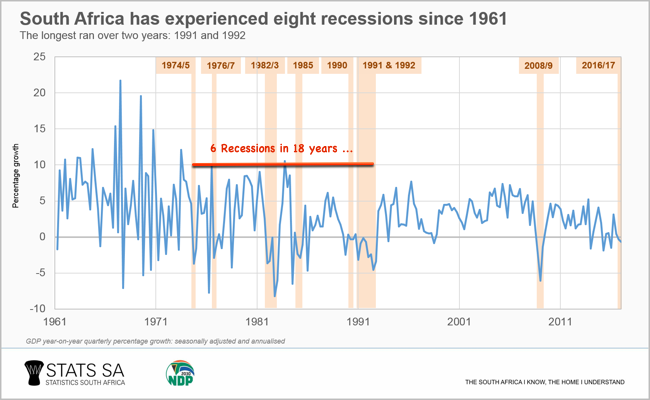
Insert sad face emoji. Before however you lose historical context, StatsSa had published a LONG dated graph, just to remind all of us that we had forgotten that this was a more regular occurrence than we think. We had forgotten. If you finished school over thirty years ago (OK, let us say 40), you would have lived through many of these recessions, thanks to StatsSA for all of these amazing graphs (and job well done, notwithstanding the pending job cuts there):


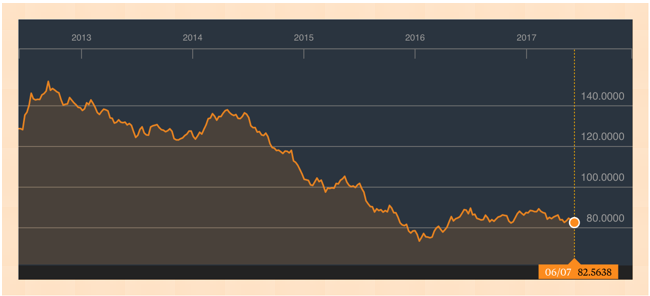
Through the end of the oppressive days of Apartheid, recessions were a regular thing. It turns out that attracting capital when you are a pariah state is nigh impossible (ask North Korea). As Paul mentioned yesterday, some of this is related to the lower commodity prices, this is confirmed with a five year DOLLAR commodities index from Bloomberg:


So what next? More debt to GDP (as a result of lower GDP and more borrowing) and unfortunately less spend means lower tax collections. Which means lower revenues. Which leads to lower government spend. The other unfortunate part is, as Michael pointed out whilst he was listening to the wireless, is that radio stations are saying to Mr. and Ms. Consumer: "so now that we are in recession, what are you going to cut back on"? No, we were in it already, this was just the confirmation from all the way back to last October to now. That is kind of reactionary. And with a very high unemployment rate (as per the release last week), we are unfortunately in a very sticky situation.

The ratings agencies will no doubt re-look their recent adjustments. The market locally reacted as you may have thought, the Rand was a whole heap weaker in a hurry, the SA inc. stocks were sold off too. Retailers and banks. Bidvest (local services business) sank nearly four percent, Standard Bank lost three and a half percent, Barclays Africa three and a half percent and Woolies sank three and one-quarter of a percent. At the other end of the spectrum were the likes of AngloGold Ashanti, South32 and Anglo America, all benefitting from a weaker Rand AND stronger commodity prices. By session end the story looked pretty one-sided, the Jozi all share down nearly one and two-tenths of a percent.

What should you as a holder of stocks do? Nothing. As you can see from past dips, these moments come and go. Revert to the ownership model, you own the company, and not their share prices. Whilst the political clouds resemble the Cape Town weather today, it brightens eventually.


Stocks in New York, New York ended the session lower after having been better earlier in the morning, and earlier in the afternoon. It isn't the best time, in-between company earnings and "eyes on the Fed" who are expected to raise interest rates next week. Yesterday was, believe it or not, D-Day, the Normandy landings that ended the second world war in Europe. 73 years ago yesterday, nowadays we have a relatively united Europe. Apart from the simple fact that we have UK elections tomorrow, right? The conservative's grasp on "things" may not be as wide as earlier suggested, we shall see. Apple had a decent enough day, after the multiple releases of products and software updates.

Session end the Dow Jones Industrial Average sank one-quarter of a percent, the broader market S&P 500 sold off by just over one-quarter of a percent, whilst the nerds of NASDAQ sold off one-third by the close. Energy stocks rose, as did basic materials, largely in response to a weaker Dollar.


Linkfest, lap it up

Byron found this great link, showing the top 10 success stories for SA tech start ups - Are these the 10 all-time biggest exit deals for SA startups? [Digital All Stars].

If you want to understand why Economics can be irrelevant in a normal world, this story about doughnuts will help explain why - The Doughnut Dilemma: What The Office Pastry Teaches About Behavioral Economics. The link also gives a hint as to why you struggle to stick to that new years diet you promised.

This is good news for Tencent and Naspers. - Alibaba Falters in Bid to Take Mobile Phone Control From Tencent. As we spoke about on Monday, Tencent's WeChat dominates Chinese smartphones which allows the company to divert shoppers to their shopping sites and away from Alibaba sites.

My goodness me! These fellows, you would think, have more exciting stuff to do. The truth is, they are just regular fellows. Around the Berkshire AGM, Buffett takes his mate Bill gates around the Nebraska Furniture Mart, where they get to experience "stuff" - Testing Mattresses with Warren Buffett. Lovely. This will make you feel warm and fuzzy inside, especially the part when they talk about their friendship and Bill's credit score.

You must have seen this before, here goes - The $35 Nike Logo and the Woman Who Designed It. According to the article though: "She was also given a generous amount of stock in the company (estimated to be worth upwards of $1,000,000), as well as a diamond and gold ring featuring the Swoosh design."


Home again, home again, jiggety-jog. Stocks are mixed here, there are results from Steinhoff that looked OK, perhaps not meeting market expectations. We will review those shortly.


Sent to you by Sasha, Byron and Michael on behalf of team Vestact.

Email us

Follow Sasha, Michael, Byron, Bright and Paul on Twitter

078 533 1063
Tuesday, 6 June 2017

Hey Siri, play me some Beats

"Apple started their annual World Wide Developers Conference in San Jose with a bang yesterday - Apple Special Event. June 5, 2017. A whole host of new products. The opening is hilarious. It takes place in a world without the luxuries of the apps and the iPhone. A world too wild to remember, yet that was a little over ten years ago. The first three minutes intro of the opening note is what I am talking about."


To market to market to buy a fat pig Stocks in Jozi recovered off their worst levels, nearly ending the day flat, a marginal decline on the day. Down 0.04 percent by the close, around 20 points worse off. Financials, retailers (SA inc.) were the only stocks that managed to get ahead of the pack, in large part due to the improving currency. The Rand strengthened to within two percent, said Bright, since the laying off of the last finance minister and a cabinet reshuffle the last time around in March. Session end the stocks in the red, at the bottom of the board so to speak, were the likes of Glencore, Sasol and Intu, at the top of the boards, comfortably in the green, were the likes of Amplats, PSG and Redefine. No real patterns there! Humans love pattern recognition, which is why they love looking at charts and predicting what is going to happen next. Lines on a graph do not represent reality.

Telkom released results yesterday, they are in transitional mode (still) where they are moving away from their legacy businesses, fixed lines and even ADSL now (true story, going backwards there) towards fibre to the home and mobile data. And of course cloud storage etc., Telkom have been pretty aggressive on the pricing of these packages. They have the installed infrastructure in order to achieve this, there is just one caveat, this time there is a whole lot more competition. Vumatel and "friends". Many do collaborate and piggyback off each others infrastructure, the pricing power as a result of the monopoly (that Telkom had in the past) has meant that the business has had to evolve quickly. Shareholders who have gone the distance from the day of listing way back, and the subsequent unbundling of Vodacom. You would have done well to go to sleep and just hang in there.


Across the seas and oceans, stocks in New York, New York bounced in and out of positive territory, ending in the red on the day. And by extension, no new record. I suppose that we have become so used to new records, that we may be in for a quiet period ahead of the next round of earnings season. Which is July. Northern hemisphere summers are always a little lazy for the markets in terms of volumes, in many territories, school is out there! Some places differ more than others, refer to this list - Summer vacation. Two to three months in the US. No wonder you can get a steady and awesome job as a kid. Six to seven weeks in the UK. Germany, as the Germans do, exactly six and a half weeks according to Wikipedia. In Greece, as a kid, you get three months to drive your parents nuts. June 15 to September 11! Yowsers, that is a long stretch, I suspect that there is nothing else during the year.

Session end the Dow Jones Industrial Average shed one-tenth of a percent. The broader market S&P 500 lost 0.12 percent, whilst the nerds of NASDAQ gave up 0.16 percent by the end of the session. A slide in the Apple share price impacted on these indices, see below. Alphabet (Google) cranked through 1000 Dollars a share, as a result earlier share splits (in which you got two separate share classes), the stock been there before. The correct statement is Alphabet Class A shares (with the ticker GOOGL) passes 1000 Dollars a share for the first time. The other share code, GOOG, has passed 1000 bucks a share before, before the split to C class (reserved for compensation) and the A class shares, that have 10 times more votes per share. It is complicated, I know.


Company corner

Apple started their annual World Wide Developers Conference in San Jose with a bang yesterday - Apple Special Event. June 5, 2017. A whole host of new products. The opening is hilarious. It takes place in a world without the luxuries of the apps and the iPhone. A world too wild to remember, yet that was a little over ten years ago. The first three minutes intro of the opening note is what I am talking about.

No music on your iPhone, no maps, no ability to share anything, nobody to tell that you just ate a whole pizza by yourself (many people do not care too much about that). It is quite cool that Tim Cook introduces a 10 year old developer from Australia, who started coding when he was only six. He had made the effort to be at the WWDC. Five apps on the App store already, Cook met him the day before! Another app developer clocked in at 82 years of age, she hails from Japan and has published an app already on the app store.

Tim Cook announced a whole host of products, tvOS (TV operating system, Amazon coming to the TV app, Amazon Prime Video), a new iPad Pro, a new operating system across their devices, iOS 11, a new iMac, a new MacBook pro and MacBook (and a new macOS), an iMac Pro (for business and gamers), watchOS 4 (more relevant information shown to you, a dynamically changing during the day watch as well as big changes to the activity segment), an upgrade to the App store and most importantly (it seems to be attracting the most attention) the HomePod. The HomePod is a device that sits in your home and enables you to use Siri a whole lot better. This is a speaker system with Siri, not too dissimilar to the Amazon Echo. Amazon have sold around 11 million units of Echo (with Alexa), they are very popular for shouting and asking questions. Siri, for reference point, is used by 375 million devices.

The HomePod is double the price of the Amazon Echo, starting around 349 Dollars per unit. The WSJ goes with - Apple Unveils Smart Speaker Called HomePod. Barron's goes with Apple's 'HomePod' a Winner, Says Loup's Munster; Major Siri Update Later This Year?

Gene of course worked at Piper Jaffray for years and years and covered Apple. He had the following to say about the Augmented Reality - "That was a huge deal; I think the demo was better than any AR demo I've ever seen. I think it just shows they are putting the hammer down around AR." Recall that we suggested that Apple would get to Augmented Reality in a big way. Apple is a perfection of existing products.

CNet had some cool reviews - Apple already controls your life, now HomePod wants your home

Ironically this release of all these new products and software updates was on the same day that the stock received a downgrade from Pacific Crest, an analyst there, Andy Hargreaves downgraded the stock to a sector-weight holding and lowered his share price to 145 Dollars. There is, as you may expect, an analyst rating website, TipRanks. You can check Andy Hargreaves's Stock Coverage.

Andy has been really good and very accurate. So what do you do as an owner of the business? Nothing. We plan to own this business for a long, long time. Tim Cook is right, when he left off at the end of the presentation, he said "all is good at Apple". He is right. We continue to own what is a dynamic business, there are going to be tons of products in the future, without a doubt. Very pleased with these software and hardware updates, as well as the "new product(s)". Remember that the iPhone is still there king of sales here, the much anticipated new release must hit the mark for the users.


Linkfest, lap it up

Did you know that more retail jobs have been lost in the US (formal jobs at Macy's and the like) since October last year, than there are in the WHOLE of the coal industry in the US. Food for thought, I know. How about this angle though - Eliminating coal could save more lives per year than the entire coal industry employs.

China have a weird energy problem too, and it has to do with renewables, times of year and unable to use all of it. China has made massive strides in climate change technologies - Why China's wasting huge amounts of cleanly-produced electricity and how to fix it.

This .... "Patience, a long-term focus, and avoiding the fads are key for successful investing. Some of the most successful stock investors of the last few decades in the United States aren't known for finding the latest and greatest" - Best Habits of Highly Successful Investors.

Talking about those retail jobs that are being lost - America's Dying Malls Weigh On Retailers. Those few lines in there: "Millennial consumers are more attracted than their elders to cooking at home, ordering delivery from restaurants and eating quickly, in fast casual or quick-serve restaurants. Mall traffic has slowed."


Home again, home again, jiggety-jog. Stocks are lower to begin with here in Jozi. A marginally weaker Rand, new 12 month low for Tsogo Sun I see.


Sent to you by Sasha, Byron and Michael on behalf of team Vestact.

Email us

Follow Sasha, Michael, Byron, Bright and Paul on Twitter

078 533 1063
Monday, 5 June 2017

Why we Write

"And that is the number one reason we write this daily message. To stay as close as possible to the news flow. To make sure that we continue to share the news with everyone. Investing is a little like running the Comrades, although the finish line is never really in sight. At some points you feel so tired mentally and physically that you want to give up. At other stages you feel strong and must keep going either at this pace or a little faster."


To market to market to buy a fat pig Friday was jobs day. The day that the whole financial world turns to their screens for direction. Even though the number is notoriously volatile and equally unpredictable, as the Department of Labor (no u in that labour) revise this number in the coming months. I often ask, when someone places supreme importance on this number is to ask them what the number was three months ago, whether it was a "beat" or "miss" relative to the market predictions given. Sadly, very smart people are asked to predict what is a volatile number. It may be just as easy as guessing who is going to win the football on the weekend. Which is not too impossible .....

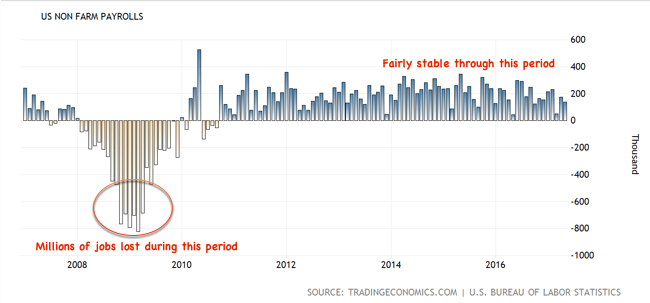
Anyhows, here is the last release of the Employment Situation Summary. The headline number of 138 thousand jobs was a miss (relative to expectations of course), the unemployment rate was the lowest in 16 years. Back when George Bush was president, remember him? If not, here is a reminder -> Bush GOOFS. Talking Goofs, the shrinking labour force and the lacklustre wage growth was the concerns that still remain. That aside, Mr. Market clearly liked the "trend" which is all that matters here for the time being. Few recall the labour force been sliced and diced as it was post the financial crisis. In case you forgot, courtesy of Trading Economics:


The graph above looks boring. And that is a very, very good thing for all of us. I suspect that for many years, those wanting a normalisation of rates have failed to see that wages, as a result of productivity gains and immense pressures from technology have meant no inflation. Recall that graph that Michael stuck in links last week, where the likelihood of each segment being replaced by a computer related technology depends on your skillsets - Visualising the Jobs Lost to Automation. Nurses and Teachers! Police Officers and Counselors. See it all there my friends.

OK, quick market wrap. Stocks in New York, New York reached a record high. For all three sets of indices. The nerds of NASDAQ added nearly a percent, the broader market added nearly four-tenths of a percent, whilst the blue chip Dow Jones industrial average added nearly three-tenths of a percent. Energy stocks taking a bit of a whack, today oil prices are on the up and up as a result of heightened tensions in the middle east. Qatar versus the rest! Saudi, the UAE, Bahrain and Egypt have given Qatari diplomats 48 hours to leave. And they have cut off all ties, no sea, air and land travel. Jeepers, that sounds serious.


Why write this daily news brief? We often champion the idea of owning companies, paying attention, at the same time trying to be as sticky as possible. Not getting spooked. Making sure that the initial purchases and subsequent purchases of stock are done at the "right" levels and most importantly, owning the quality. The best of the best, the best that money can buy. So why then report back daily? Investing is a multi decade affair. Investing is something that happens over your lifetime, in the same way that you choose someone to spend your whole life with, in the same way that you choose to live in a particular house. You don't buy and sell houses as the result of the market for houses feeling high or low. You buy a house to live in and to enjoy.

We write this letter in order to educate, both for ourselves and for all the readers. The daily routine of making sure that we turn up (no golf days, no conferences, few meetings) and pay attention. There is a fabulous fellow to follow, his name is Samuel Arbesman, see his website for more. He referred and coined a term Mesofacts, that I love to think about. The slow and incremental changes that compound to eventually become reality for all. Arbesman suggests that they are like this: "Mesofacts are the facts that change neither too quickly nor too slowly, that lie in this difficult-to-comprehend middle .... "

A bit like where we are now with Virtual Reality headsets and Autonomous driving and Artificial Intelligence. At least from my reading, anyhow. Not everyone is an adopter of these technologies, at least they don't think that they are. Not everyone has an Amazon Echo, an Oculus headset and a Tesla Model S. Some people no doubt do. If you use a smart assistant (like Siri, I sometimes tell her to set a timer), or browse online for goods (Amazon and the like predict what you may like), read simple news (AI writes some news from reports), listen to online music (AI plays you "music you may like") or even have a home smart device that learns your patterns, you are there already. Plus of course your web searches are being optimised.

As the world changes around us, so do the businesses that afford us services and products. They must, in order to stay relevant with the times. Inside of that, the slow and incremental changes that allow you the possibility to stay relevant with all that goes on around you, are investment opportunities. There are some industries that we bet will be around for centuries, food production, food eating, medical care, clothes production and fashion, housing, transportation, heating and cooling, we can have a fair sense of what will not go out of fashion. Technology is one that you have to keep a finger on constantly. Without the paying attention part, you can easily find yourself less relevant in your investments.

And that is the number one reason we write this daily message. To stay as close as possible to the news flow. To make sure that we continue to share the news with everyone. Investing is a little like running the Comrades, although the finish line is never really in sight. At some points you feel so tired mentally and physically that you want to give up. At other stages you feel strong and must keep going either at this pace or a little faster. The disciplines learnt in investing stand you in good stead, the experiences of the past help put the current into perspective, remembering however that no two times in history are the same. Other than that Bruce Fordyce once won the Comrades with identical times ('85 and '87 up runs), I am sure that he'll tell you that they were different, other than on paper.

The overriding message from our investment style is to be patient. Which is increasingly difficult in a world when news is available on the little device in your pocket that has more processing power than the entire US military from over three decades back. The same is likely to apply in three decades time. You should still find yourself invested then too. Be an owner of a company and not the share price. That is a difficult and essential investing characteristic. Share prices will change today, perhaps not much, perhaps a lot, the company hardly undergoes 2 percent changes in their makeup daily. To finish off with a Buffettism, be prepared to own these companies on the basis that the stock market should and could close for five years tomorrow.


Linkfest, lap it up

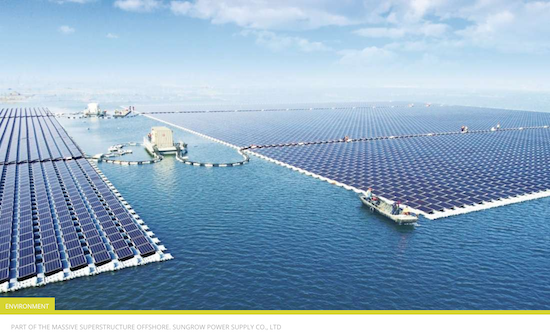
I have never considered the possibility of placing solar farms on the water. In a South African context, areas of the Northern Cape would still be better than off our coast I would assume - China Is Now Home To The World's Largest Floating Solar Power Plant


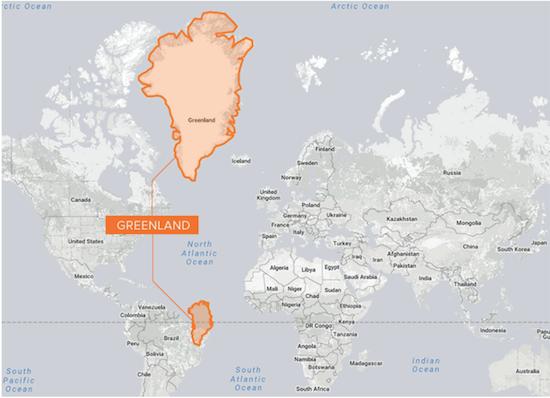
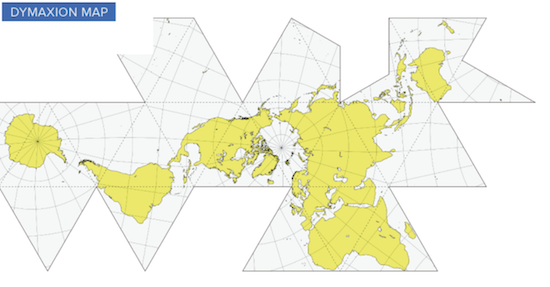
The problem with taking a globe and making it flat is that you will have some sort of distortion. Here is another interesting look at the maps out there trying to solve the distortion problem - The Problem With Our Maps


With most people in China using Tencent's QQ chat or WeChat, they have a fairly sizable moat between them and their competition. This means that Tencent is able to continue selling/ pushing products to their users - While the rest of the world tries to "kill email," in China, it's always been dead.


Home again, home again, jiggety-jog. Stocks in Jozi are lower, thanks in large part to the much stronger Rand to the US Dollar. The last time we saw such a level was August 2015. Which as you can imagine is good for inflation, which is good for the outlook for banks and retailers (as this may mean lower interest rates), this is good news. Not for the dual listed businesses though!


Sent to you by Sasha, Byron and Michael on behalf of team Vestact.

Email us

Follow Sasha, Michael, Byron, Bright and Paul on Twitter

078 533 1063
Friday, 2 June 2017

Bank Shank

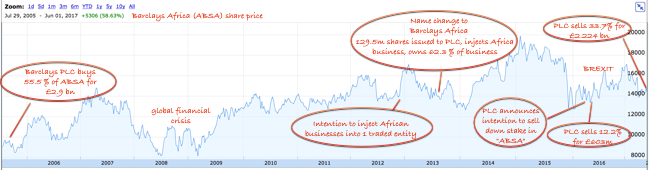
"A 12 year expedition for Barclays PLC. (the Breetesh) is almost finish. Perhaps they will remain a shareholder of the smaller stake. The history is as follows - in 2005, Barclays Plc. bought a 55.5 percent stake in ABSA, at the time, there were 666.8 million shares in issue. At a purchase price of 82.5 Rand per share, that equals around 30.5 billion Rand."


To market to market to buy a fat pig There was a lot going on yesterday. As usual .... really. It was a bad day for stocks (sticking to the basic adjectives for now, right?) locally, resource stocks down over two percent by the close (disappointing Chinese PMI data), industrials off a percent and one-fifth, banks slipping by a little more than that. At an individual stock level, inside of the majors, there were three in the green. One, up a lot, being Barclays Africa, following the success of the bookbuild (and then some), up nearly 4 percent by the close. Question here ...... if Barclays only owns 16 odd percent of the business, can they think up a name change that may stick across the continent? Or may it be a reversion to The Amalgamated Banks of South Africa Limited - ABSA. That was a rather complicated bashing together of the likes of United, Allied, Volkskas, Sage and Bankorp.

A 12 year expedition for Barclays PLC. (the Breetesh) is almost finish. Perhaps they will remain a shareholder of the smaller stake. The history is as follows - in 2005, Barclays Plc. bought a 55.5 percent stake in ABSA, at the time, there were 666.8 million shares in issue. At a purchase price of 82.5 Rand per share, that equals around 30.5 billion Rand. Around 2.9 billion Pound Sterling. I thought that I would put my old graphics skills to use and present a graphical representation of their holding of the Barclays PLC relationship with ABSA and the Barclays Africa Group. Let me know if you find this acceptable, this has been a wonderful collaboration between Google finance, my Mac notebook, the internet and my low level graphics package, Pixelmator. And of course, many thanks to the old SENS archive, where I had to find some of the information. Back of the matchbox, some of the lines drawn are to "roundabout" dates, ok!


Other than the very handsome dividend flow over the years (from ABSA to their shareholders, including PLC), this has not been the best investment for Barclays PLC shareholders. This you can tell, from the funds that they have extracted over the last 13 months. Oh well. If you are thinking that is bad, and somehow would feel "bad" for PLC, fear not, that may be the least of concerns for the shareholders of Barclays PLC. Since the middle of July 2005, Barclays has returned negative 62 percent. The US ADR is down 72 percent since then. So let us just say that even without this wonderful investment that is a South African bank (and the rest of the continent), shareholders of PLC have been sucking wind. And if you think that the outlook is better, earnings are going to have to do some heavy lifting here in order to justify the PLC share price. In a low interest rate environment, the uncertainties of their home market, the tide and wind is going to have to change for them in order to make material progress. Continue to give this sector a wide berth.


You have this strange thing happening here. The Rand is stronger because Fitch kept our debt rating on hold. S&P is expected to do the same today. That is good. StatsSA said that the unemployment rate is at a nearly decade and a half high. High and unemployment in the same sentence are a toxic mix. I heard a journalist, well known to all here no doubt, suggest that economic policy (or lack thereof) is to blame. I guess at some level yes, lower commodity prices also have something to do with it. If the platinum price was 50 percent higher, as was the whole commodities complex, this would be helpful for South Africa.

So against this backdrop, a stuttering and sputtering economy, you would not want to be owning South African debt, right? Well, that is true of locals and local pension funds. Check out this story from yesterday, from Reuters - Political turmoil prompts South African pensions to offload government debt. Foreign ownership of South African government bonds has risen to nearly 40 percent (39.4 percent), whilst local ownership has dropped to 27.2 percent. The foreign ownership is at a record high. The domestic ownership is at the lowest level since December 2012.

You would hardly suggest that against the backdrop of the "bad" (sticking to the low level adjectives) environment that we would see record international ownership, right? Yet that is the case, there are people who are hungrier for yield, in the global environment where rates are still low. Provided that you can make sure that you keep your currency hedges "cheap". Does anyone want to venture to suggest who is right and who is wrong? Is local ownership right, or are the foreigners unwashed by the "noise"?


Stocks in New York, New York, rallied to new highs for the broader market S&P 500 (up over three-quarters of a percent) and the nerds of NASDAQ (up just over three-quarters of a percent). The blue chip industrials America, the Dow Jones, added just short of two-thirds of a percent. All the major sectors rallied sharply, in anticipation of a good read on non-farm payrolls today. Remember that happens today, and the expectations are for around 185 thousand jobs. The unemployment rate is expected to stay at 4.4 percent. We wish. Average earnings are expected to rise 0.2 percent. We wish too. Standby for a little later in the session sportslovers!


Linkfest, lap it up

Did you know that this was happening? The transformation of agricultural land in KZN to more macadamia farming areas. I didn't. Nice story - Banana Farmers Go Nuts in South Africa Over Macadamia Boom.

This is important. The stock market is not the economy, the economy is not the stock market, a country is not a person or household or corporation, there is no expiry date on a country. Unless of course something dreadful happens, war and treaties gobbling up land and the like. Here goes an important post from our old pal Cullen Roche - Chart of the Day - The USA is not a Corporation.


Remember the chart of the stock market in 1929 looking a lot like the stock market chart in 2014? I do. It turns out that if you sold, you missed out on another 30 percent rally since then. Sigh. The Unfortunate Rise Of The Misleading 'Scary Chart' Comparisons Again. When you see graphs and comparisons, remember that no two times are the same in history. Ask yourself, how many radios were sold in 2014 (in making the 1929 comparison) and more importantly, how many smartphones were sold in 1929? The answer to the second question is none, of course.


Home again, home again, jiggety-jog. Stocks locally have started a little better here. The Rand is weaker than yesterday afternoon, stronger than two days ago.


Sent to you by Sasha, Byron and Michael on behalf of team Vestact.

Email us

Follow Sasha, Michael, Byron, Bright and Paul on Twitter

078 533 1063
Thursday, 1 June 2017

SA Sink

"We did come up with a new line, SA inc. sinks or SA(s)inc.'s, get it? SAsinks. Which is what you can now refer to when there is a sell off of local banks and retailers. Talking of which, there were results from Spar yesterday"


To market to market to buy a fat pig Stocks were dealt a blow yesterday, not all, and some worse than others. The JSE all share index gave up 1.1 percent, financials sank heavily, banks were wounded, down over three percent on the day as a collective. Standard Bank lost three and two-thirds of a percent, FirstRand lost nearly three percent, Naspers gave up three percent (not a bank). The worst hurt on the day was Barclays Africa (Mr. Market still cannot shake the ABSA label), down four and three-quarters of a percent. Other than the last cabinet shuffle knee jerk (in April), this is the lowest level for the stock since July last year.

Over five years Barclays Africa stock is down 8 percent. They have been rather generous with the dividend, if you have held the stock since the beginning of 2012, the dividends you have received after the taxes (was 15 percent, now 20 percent) is nearly 47 Rand a share. Add that to the current share price of 139 Rand, and the five year return looks a little better than the share price return. What is with the sell off? Earlier in the session there had been a Sky news report that Barclays Plc. were selling a stake in Barclays Africa, this was confirmed later in the afternoon by Barclays Africa. And not a small amount either, 22 percent of the entire issued share capital (187 million shares) of the South African bank. Whoa, that is a rather large sum of money. Remember that Barclays sold 12.2 percent of Barclays Africa last May.

If you think it is hard to find a buyer, you are wrong, the bookbuild is complete already. And it is a WHOLE lot bigger than announced. Due to "strong investor demand", Barclays Plc. sold more shares than they would have initially, 285,691,979 shares to be exact. At 132 Rand a share. Or a total price of 37.711 billion Rand (2.224 billion Pound Sterling). After this, Barclays Plc. will own 16.4 percent of the South African bank. That was quick, right? Remember yesterday's announcement was that the PIC committed to 59 million shares (or another 7 percent of the issues shares), this morning suggests that they want more. They do however require regulatory approval.

Is this good or bad news? I suspect you could view the divestment of a large bank (not without their own sets of issues and problems) as a negative. And I suppose that you could view the PIC (and other investors) stepping up and making a longer dated investment (at five year low prices) to invest more, not only here, across the continent, as a positive. Remembering that Barclays Plc. swapped shares in a tradable territory (South Africa) with lots of liquidity (relative) for more Barclays Africa shares. What I find particularly pleasing is that investors recognise that banks are profitable machines, and are willing to take a longer dated view, perhaps beyond the next five years. As negative as this was for the banks yesterday, I suspect that the market will view this favourably today, it will mean that an overhang of some sorts has been removed.

We did come up with a new line, SA inc. sinks or SA(s)inc.'s, get it? SAsinks. Which is what you can now refer to when there is a sell off of local banks and retailers. Talking of which, there were results from Spar yesterday. Yes, Spar at a global level has been around for 80 years, there are 12,545 Spars across the globe in 44 countries, as of the end of the year. Nothing in South or North America. Saudi Arabia, the UAE, India, Thailand, Russia, even China. Russia, Australia and Norway. And of course here in Southern Africa, Northwards to Zambia. Nigeria and Cameroon have a handful of stores.

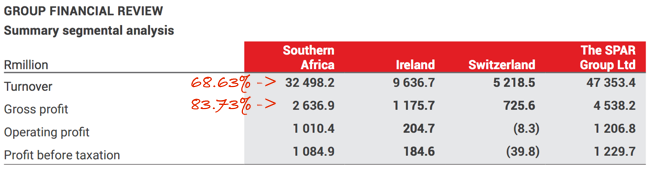
The company is now roughly, in revenues, two-thirds South Africa, 20 percent Ireland and 10 percent Switzerland, give or take a few percentage points. From a profitability point of view, South Africa is the bulk contributor to the group operating profit, Switzerland made a loss, see the summary below:


Switzerland? It is tough out there, the place looks lovely (great cheese, chocolate and watches, plus some tennis players of note!), Spar made a loss: "This was largely attributable to the declining sales performance which impacted all divisions, and the disappointing trading performance of the corporate retail stores." The stock price is down in Rand terms around 16 percent over the last year. I guess that reflects at some level the disappointment of the purchases abroad, or possibly more likely the outlook in their major market, South Africa: " ... the tough trading environment is likely to persist for the balance of this year, particularly with the political uncertainty undermining consumer and business confidence." Quite .....


Serge Belamant is set to get a huge payout after the company announced that he would retire a year early (he turns 65 next year), after having been at a business that he founded over three decades ago. The chair, Chris Seabrooke, describes Serge as a "visionary technologist". Perhaps he really is, having engineered a system that is not really able to be replicated, we all found that out, right?

Before tax last year, according to the proxy statement 2016, Serge Belamant was paid 3.6 million Dollars (including stock compensation of over 2 million Dollars). Before tax. As of the end of the last financial year for Net 1, Belamant owned 1.839 million shares, or 3.46 percent of the company. The largest shareholders include Allan Gray (at 16.38 percent, back then) and IFC Investors own 19.01 percent. The other significant shareholder is International Value Advisers, at 14.15 percent of the overall business. Add those all together, those three shareholders own just short of half of the business.

It would have been the shareholders that approve and approved various stock awards and executive compensation in the past (and in the future). The business and the profitability of the business belongs to the shareholders. Those are the people that share the losses. Those are the people that share the losses and the upside and vote on who gets to run the business by appointing the board, and are ultimately the owners. Forget the fact that they can transact over time (by selling their shares to other willing buyers in the market), that aside for a moment. Shareholders own the business, they suck up losses and equally share the spoils. It is called capitalism.

Allan Gray in this Bloomberg article express their dismay at the golden handshake - Net1 to Pay Departing CEO Belamant $8 Million, Share Premium. I recognise the name of the Allan Gray director here .... it could be from a long, long time ago in Grahamstown days. I suspect, that given that the tone is as such, the owners of the business may not be that happy. South African politicians will also have a field day .... see what happens in business? You see? I suspect that this is not finished by a long shot and this does leave a bad taste in the mouth.


Stocks across the oceans and seas, in New York, New York, had a tough old trading session, but managed to gain back most of the losses by the end of the session. The Dow Jones Industrial Average sank one-tenth of a percent (after being down over one-third of a percent at the start). The broader market S&P 500 sank 0.05 percent, the nerds of NASDAQ a little more than that. Tesla touched another all time high. Energy and basic materials gave up some more ground, tech stocks also gave back a little, Alphabet was amongst the majors that are lower. Healthcare stocks were particularly "good", Michael Kors, ummmmm .... those were not. The stock sank over eight percent, closing stores for days. You would categorise this business as "soft luxury". They are opening stores in China. You can buy a Michael Kors handbag for between 100 to 200 Dollars, there are many people who operate in that space.

Hermes, Chanel, Louis Vuitton (of course), those are at a whole new level. And there are of course, many, many different brands that I haven't explored. On Net-a-porter, in a high to low bag search, the most expensive bag was a 17 thousand Pound Sterling MarK Cross shoulder bag. At more than half the price comes a Dolce & Gabbana leather trimmed painted wood clutch, that I think is downright awful. Yet people will part way with 7410 Pounds. See here - Leather-trimmed painted wood clutch. Lovely, right?

Call me a prude, I prefer some of the older styles, more classic (and wearable for a while). All our ladies out there, who would have a better idea of what bags are stylish and not (I will also ask my wife), please let me know of your favourite brands and styles, for market research purposes. And then also ..... if money were no object, what would be the best bag money could buy for you?


Linkfest, lap it up

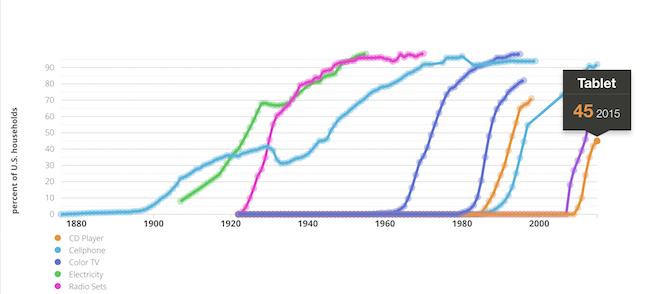
It is amazing how quickly some technologies are adopted. In 5 years the US went from 0% to 45% of the population having a tablet - Adoption of new technologies.


In 2014, Google (now Alphabet) paid $3.2 billion for Nest. Here is Nest's latest product, helping Alphabet make back their initial investment - Nest Cam IQ. As AI technology improves so will the functionality of this camera.

If this jet sounds cheap it is because it has no engines and needs large amounts of TLC - Elvis Presley's Private Jet Just Sold for Nearly $500,000.

    "custom designed for the King including gold-tone hardware, red velvet seats and a red carpet"


Home again, home again, jiggety-jog. Stocks are mixed across the globe, down in Shanghai, up in Japan and Hong Kong. And here? Stocks are lower, down nearly two-thirds of a percent. The ratings agencies are getting ready to deliver some updates about South Africa. Standby!


Sent to you by Sasha, Byron and Michael on behalf of team Vestact.

Email us

Follow Sasha, Michael, Byron, Bright and Paul on Twitter

078 533 1063