Tuesday, 10 March 2015

Watching Apple


"What is important to note is that the phone is huge, the business is still the phone. Not the Macbook, not the iPad and for now, not the watch. These are just early stage entry into wearables. Not everyone will want one, Apple fans will have to get used to new functionality, different tapping and scrolling"


To market, to market to buy a fat pig. A rout of sorts for the local market, commodity stocks were hammered. Perhaps the 7 percent hangover in China and the US better than anticipated jobs situation. Most importantly the stronger Dollar is as a result of the Fed possibly to raise rates sooner, rather than later. Personally I do not care, the Fed and the ECB will do what they need to in order to meet their respective mandates. What can I or you do about it? Nothing. There are some things worth getting excited about in life, the ones that you have no control over, like how the Proteas, Bafana or the Boks go about their business are high energy and high emotion, in the end the result has no bearing on how hard you shout at the TV. The Fed will raise rates when they think it is appropriate. It does not make any of the companies that you own any worse or better if interest rates go up, obviously the more indebted that they are, the higher their interest costs.

Those commodity stocks, yowsers, down over 2 percent as a collective on the day. Gold shares were down over 5 percent, my word, a stronger Dollar is certainly not very good for gold. I still cannot work out why you would want to hold the metal as an investment. It is never going to pay you a dividend. Even a property, which I do not think is the best investment (with all the added and unseen costs) pays you a rental income. The only reason you buy a gold coin or a gold tracking instrument is that you think the price is going up. There is absolutely no cash flow associated with a gold coin. When faced with a choice of buying a bond with a negative yield right now, or a gold coin, you can almost be sure that the one will yield an income in the coming years, the other one never. Anyhow, my prejudices aside, the industry is still very important in South Africa. After all was said and done, the overall market had sunk 1.37 percent. Which is around 700 odd points nowadays.

Over the seas and far away markets recovered a little off their heavy handed sell off Friday, the Dow Jones comfortably outperformed the rest of the other indices, up nearly four-fifths of a percent, the broader market S&P 500 and the nerds of NASDAQ added 0.39 and 0.31 percent respectively. Energy slumping again as prices continue to wax and wane in a new area for the oil and gas producers. As I look across Asia, the markets there are in the red, around two-thirds of a percent lower across the board. The emerging market currency rout is spread across the globe. Be thankful that in the last six months you are not Brazilian or Russian. Or Turkish. Or earning money in that area and buying goods in Dollars. Or the inflation outlook which must be worsening. This is a graph that tells the story from September the 2nd to present, courtesy of Google finance.
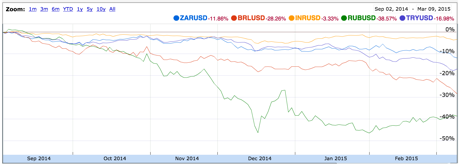


It doesn't tell the whole story, I have enlarged the portion above (a bit fuzzy) to show you how terrible it has been, we have been relatively shielded against the stronger Dollar, down 11 percent, spare a thought for the users of the Brazilian Real buying stuff in Dollars, equally ordinary Russians and Turks. Slammed:



Obviously each country has a different story, Dilma Rousseff has her back to the wall, check this FT story about Brazil and their woes: Brazilian real falls to 11-year low over risk to austerity plan. Socialism, bribes, pals, it turns out that eventually it comes back to bite you in the bum when politicians try and manage the economy, it does not work. The only reason why I point this out is that many people are "thinking insular", meaning that they view the weakness of the Rand as a result of the local economy rather than Dollar strength. Make no mistake, "things" could be a lot better here, we are however not Turkey, not Brazil and not Russia.


Apple fleshed out the watch last evening and for us Mac lovers (the electronic kind) released what looks like an amazing new sleek model, in the air category. I switched over to the business channel whilst Tim Cook was delivering his piece and my eldest daughter expressed a desire to get one. In her world the company makes excellent products, they are better than anything else she knows. In the same way for her search is associated with Google and online videos are associated with YouTube. I am not too sure how powerful that is, I am guessing that if I was paying more attention when I was growing up I would have associated pictures with the Kodak brand, we all know how that turned out.

OK, check out the watch and let me know whether or not this device is for you: Watch gallery. Which one would you get? Is it good or bad that there are loads of choices? Stainless Steel casing all the way through to 18 Karat Gold casing in more classic designs. Pricing? That varies substantially, all the way from a 38mm silver aluminium case for the sports edition at 349 Dollars, to the 42mm stainless steel case at 599 Dollars, to the 38mm 18 Karat Rose Gold case for a whopping 17 thousand Dollars.

Check that one out, the most expensive one: 38mm 18-Karat Rose Gold Case with Rose Gray Modern Buckle. Is that the kind of thing that you order online? I guess it is. There are of course multiple bands and accessories, a magnetic charging cable costs 29-39 Dollars, that itself is the cost of a cheap phone. Personally, this is my choice: 42mm Stainless Steel Case with Light Brown Leather Loop. Not too much, functional and classic looking.

So what does the new watch do? Battery life is around 18 hours. Your timeless piece, the classic kind (I tell you, a Cartier classic gold watch is around 43 thousand Dollars) last all day and all year and all decade. How long does the watch take to charge, if there are 18 hours of charge in it? That is a key questions I guess. Here is a piece from Scott Stein at Cnet: Apple Watch hands-on. Gene Munster, one of the most recognisable Apple analysts and perhaps a rockstar analyst as a result of his "correct" calls on the company was suggesting that even if 10 percent of iPhone owners get the device it moves the needle a little (4 percent to numbers is his best guess), check out this video: Apple Smartwatch Is Priced in 'Sweet Spot': Munster. Worth a watch, that Bloomberg video.

What is important to note is that the phone is huge, the business is still the phone. Not the Macbook, not the iPad and for now, not the watch. These are just early stage entry into wearables. Not everyone will want one, Apple fans will have to get used to new functionality, different tapping and scrolling. I suspect that it will be a hit, the middle end range watches, for sports folks it might be a nice way of integrating with multiple Apple devices. The health function I think has amazing prospects, think of all the positive reinforcements on diet and exercise. Siri can tell you how well or how badly you are doing.


We're reading this, you should too.

The hardest thing in investing is knowing when to stick to your guns and when to move on - Why It's So Hard to Change Your Mind About the Markets

Here is a look at some of the reasons that you should stick to your guns - 6 bad reasons to make changes to your portfolio. When you have a long term view, all of the reasons listed are not applicable, the hard part is remembering to keep focussed on the long term.

Here are a few graphs showing how household debt in the US is shifting - Household Debt and Post-Recession Auto Lending. Increased debt is good over the short run because it increases consumption.


Home again, home again, jiggety-jog. Another wicked commodities sell off, the gold shares have turned negative for the year after being up 30 percent in January. It is almost like deja vu (sans the accents), the same happened last year. Spare a thought for the construction shares down over twenty percent this year, down 20 percent last year. Down 3 percent the year prior. They almost have to double just to get back to the same levels that they were in 2012. Since the World Cup euphoria peak in October 2007, the construction index had gone from 93 points to 27 points, down nearly 70 percent in that time. Investing in cyclical industries I guess is not for sissies. Wow.


Sasha Naryshkine, Byron Lotter and Michael Treherne

Email us

Follow Sasha, Byron and Michael on Twitter

087 985 0939

Monday, 9 March 2015

AmaCost-Cutting


"The important take away from these results are that cost savings are going to be more aggressive, the company needs to conserve a lot going into 2017 (80 percent of the money for the ethane cracker at Lake Charles in Louisiana has been secured thus far), in what will effectively be a company transforming investment. In order for the company to take advantage of much lower gas prices in North America, as feedstock to the ethane cracker, they have to have that North American investment."


To market, to market to buy a fat pig. Oh boy, is it going to be like that? Good news should be good news. What am I talking about? Jobs, non-farm payrolls, the most widely anticipated number on the planet, as far as markets are concerned. Why? Well, if you have maximum employment in the biggest economy on the planet that is consumer driven, the better for the rest of the globe. The Federal Reserve actually has three key objectives, even though people often talk about the dual mandate. Quite simply, it is as follows: Maximum employment, stable prices, and moderate long-term interest rates. I guess the first one is the one that is possibly not open to too much interpretation, the third one is linked to the second one.

So what happened next? The markets in New York sold off aggressively. Why? Well, the actual numbers were 295 thousand new jobs created for the month of February, more importantly the unemployment rate in the US fell to 5.5 percent. Back in October 2009, a year after the firestorm broke out in the US with a 176 year old, over-leveraged investment bank being the main victim, the unemployment rate had ballooned to 10 percent. "Things" got worse before they got better. Low interest rates or ZIRP then followed. I have read countless articles on when interest rates in the US will go up next. I have no way of knowing. That was the reason for the percent and a half sell off on the Dow Jones Industrial Average, interest rates are going up sooner than anticipated is the markets best guess.

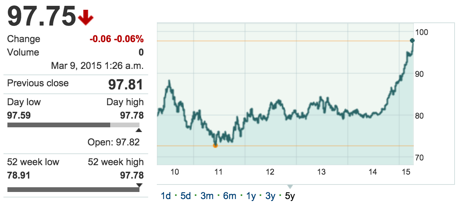
What is not in favour of interest rates going up sooner than anticipated is the stronger Dollar, dragging back company earnings, they earn the money offshore and then convert it back to Dollars. For importers it is great and is excellent for the US trade numbers. As you can see from the graph below the Dollar index has had an astonishing 6 months period. As per Wiki -> Euro (EUR), 57.6% weight, Japanese yen (JPY) 13.6% weight, Pound sterling (GBP), 11.9% weight, Canadian dollar (CAD), 9.1% weight, Swedish krona (SEK), 4.2% weight, Swiss franc (CHF) 3.6% weight. The Dollar index is at an 11 year high.


As a consequence of course the Rand weakened to the US Dollar, all major currencies weakened against the Dollar. For the Euro, which obviously is the biggest constituent of the Dollar index, this is the "worst level" since August of 2003. In November of 2000, 83 US cents could buy you a Euro. In July of 2008 the level flirted with 1.6 Dollars to the Euro. For two such enormous economies that is a pretty dramatic swing one way or another. Right now the US Fed will be mindful of a stronger Dollar, particularly as the ECB start their own bond buying program, it has just started. As in tomorrow. The US finished theirs an age ago now, in market terms at least. October last year.

Would the Fed raise rates any time soon? I guess if inflation was a problem, the strong dollar is the one reason they won't, the weaker than anticipated wage growth is another reason they will not. With Walmart raising minimum wage and many set to follow suit, this trend could change. All I am going to say and repeat, central banks will do what they have to. They will raise rates to keep prices stable. They will raise rates to cool the economy if it gets ahead of its self. Must you worry? No. We are not invested in any fixed income products of any sort. Companies adjust accordingly.

I suspect that we are for the better part of the next half of the decade still in a phase where inflation is going to be low, wage growth not as fast as anyone would like, Europe still in repair mode and as a consequence low rates. Equities will still be the most attractive option, you should pay attention, not let the Fed or any other central bank make or break your decision to own companies. If you did, you would never own anything.


Company corner snippets.

Sasol released their results for the six months to end December this morning. At face value they look OK. If you make sure that you exclude the impact of re-measurement items, earnings attributable to shareholders decreased 23 percent from the period prior. That is probably a better measure. The Rand was 9 percent weaker when measured against the corresponding period, 10.99 when compared against 10.08 Rand to the US Dollar. Reminder, this morning it is in the region of 12 to the Dollar, see above with the strong Dollar. The dividend, which was a large anxiety point after Sasol had made a supplementary SENS telling everyone about the cash conservation policy, was possibly better than expected at 7 Rand a share, 12.5 percent lower than the prior period. Not bad I guess, obviously the much weaker crude prices in the first half of their second half (partially offset by a weakening Rand) means that earnings are likely to be far lower in the second half of their financial year.

The interim dividend cover was lowered to 4.6 times from 3.8 times (in percentage terms that is over 20 percent lower), the full year dividend cover is in the region of 2.3 times. Meaning that if the analyst community are expecting around 35 Rand in earnings this year, less than 30 Rand next year (who knows where the oil price is going to next) then the stock at 410 Rand is about right. Presuming that next years number could match this years number of around 35 Rand a share, the dividend for the full year might be around 15 to 16 Rand. Meaning that forward the stock trades currently on a less than 12 times earnings, with the dividend yield of somewhere in the region of 3.6 percent before tax. That is not exactly dirt cheap, nor is it wildly expensive. The price will move as a function of the oil price in Rands, in other words, the stronger the oil price and the weaker the Rand, the better it is for Sasol's earnings prospects, the reverse is also true.

The important take away from these results are that cost savings are going to be more aggressive, the company needs to conserve a lot going into 2017 (80 percent of the money for the ethane cracker at Lake Charles in Louisiana has been secured thus far), in what will effectively be a company transforming investment. In order for the company to take advantage of much lower gas prices in North America, as feedstock to the ethane cracker, they have to have that North American investment. Equally, between now and then, the company is at the mercy of factors beyond their control, they can control capex on other projects and save costs. They are in typical Sasol style, being conservative and making sure that they can ride whatever the market throws at them. Under the circumstances, not a bad set of results, the future is a little clouded like their outlook. Of course, the future is always clouded.

Apple inc. joins the Dow Jones Industrial average. iDow is what they are calling it. AT&T gets booted out on the 18th of March this year, the telecommunications company has been a part of the Dow since November of 1999. General Electric has been part of the index since 1907, that is continuity for you. There are five other companies that have been part of the index for a lifetime, they are in chronological order (first to last) ExxonMobil (as Standard oil) from 1928, Procter & Gamble from 1932, DuPont from 1935 and United Technologies (previously United Aircraft) from 1939. The most recent entries are Nike, Goldman Sachs and Visa, all from September 2013. Apple is the sole new entrant, see the release: Apple Set to Join the Dow Jones Industrial Average.

The reason is twofold as you can see: The index change was prompted by Visa Inc.'s (NYSE:V) 4:1 stock split which is scheduled to be effective at the same time. The post-split adjusted lower price of Visa will reduce the weighting of the Information Technology sector in the index. Adding Apple to the index will help to partially offset this reduction. And As the largest corporation in the world and a leader in technology, Apple is the clear choice for the Dow Jones Industrial Average, the most recognized stock market measure. Most recognised, chosen however. The S&P 500 is a Market-value weighted index, which means that the higher your market cap, the more important you are. Even though S&P Dow Jones Indices (part of McGraw Hill Financial) may think the Dow is the most important, surely the weighting and voting machine (the broader market S&P 500) is a better measure. In the end it actually makes very little difference, it is another tick of a box I guess. You could argue that they, the folks who set the constituents, are woefully late.


We're reading this, you should too.

A question that many people have been wondering - Scientists think it's no coincidence earthquakes spike after an oil company starts fracking. There still has to be a lot more research done and make no mistake, there will be other reports that say there is no link.

Amazon are the biggest player in the cloud market at the moment but the margins are dropping as many more people enter the space - Alibaba is going head-to-head with Amazon in the cloud

An interesting look at the shifting landscape for jobs - Map: The Most Common Job In Every State.


Home again, home again, jiggety-jog. We are off sharply here to start with, I suppose the need to catch up to the sell off on Friday.


Sasha Naryshkine, Byron Lotter and Michael Treherne

Email us

Follow Sasha, Byron and Michael on Twitter

087 985 0939
Friday, 6 March 2015

Aspen rolls on

"On a 30 multiple forward, with expected EPS of around 14 Rand a share, the stock is by no means cheap. It is however never cheap, I remember when the company traded at 30 Rand a share, which was when we first started buying them, the PEG ratio (PE over Growth) was at the same level as it is now. There may always be a time of consolidation, that is a great time to continue to acquire what we think is a fabulous company with great prospects."


To market, to market to buy a fat pig. Depending on what side of the divide you were sitting the market was treating you well or terribly yesterday. If you simply were owning an index, or the index, you would have said to me, three quarters of a percent gain on the day sounds like a good outcome, not so? If you were wanting resource exposure it was being gavaged to you. The term gavage normally refers to the force feeding of a goose or a duck, for the purposes of fattening up the bird so that the liver can be much larger. You know, for foie gras (fat liver).

The selling was force feeding the people stuck on the bid who have been telling you that resource stocks are cheap, unfortunately the platinum stocks have turned negative for the year, and as I look longer as a collective they are down now in the past four years consecutively and again for this year. Impala Platinum fell over 4.5 percent yesterday, Amplats fell over three percent. The collective market capitalisation of the platinum stocks listed on this local market is 167 billion Rand this morning. At the prevailing exchange rate that is equal to 14.2 billion Dollars.

Now you will recall when Citigroup in 2010 wrote about South Africa ex energy being the richest country in the world. I dredged up an old piece that I wrote back in October last year:

    I often curse that Citigroup report from 2010 in which the research arm of the bank suggested that we, South Africa, were the richest country in the world ex energy. Ex energy of course means no oil, coal, uranium, any energy of any sort. And what was it made up of? 91 percent PGM's, 6 percent gold, 2 percent nickel and 1 percent iron ore. Years of production back then, 184 years


Assets in the ground at those commodity prices were a whopping 2.494 trillion Dollars. The platinum price back then? In 2010? Bearing in mind that this report said that we (South Africa) had, at current production levels of PGM's, 229 years worth of mine life. 91 percent of 2.494 trillion? 2.26 trillion Dollars. Or nearly 27 trillion Rand. The mind boggles, the number is so huge. The assets in the ground are worth so much more than the market capitalisation of the current businesses, why? I guess the market just thinks what everyone thinks currently, too expensive to get it out the ground. The same point I made last year, What happens to all the supply above ground that can be recycled?

    What happens if a large component of usage, auto-catalytic convertors are redundant? How would that happen? If Tesla wins, that is how. Even if Tesla doesn't "win" the amount of platinum being used is less and less, more importantly, there is more stock above ground in older autocats than ever before. I have no idea of knowing what the eventual outcome is for the platinum miners as a whole, it looks more and more precarious with lower metal prices. The weaker platinum price in the face of a more constrained supply environment certainly tells some story and not necessarily a pretty one.


We will continue to avoid the sector entirely. Yet, the fundamentals might all be in the favour of the metal, not necessarily the producers, if you believe the following: Brighter Platinum Future as Auto Sales Cut Reserves: Commodities. I suspect that if the platinum companies become more profitable, you will start to see labour/government demanding a bigger share. I have heard from a little birdie that Impala, if Zimbabwe push ahead with the 15 percent export tax, may just want to close their business there, as it would be unprofitable. That sounds crazy, if the shafts are unprofitable as a result of costs being too high, why would it be outside the realms of possibility?

Sectors that we won't avoid are healthcare, technology, consumer related businesses. Some of the companies that are our core holdings registered incredible gains yesterday, I simply could not believe that Discovery was up nearly 6 percent. Mediclinic was up over two and a half percent. Aspen, which we will deal with now, was up nearly two and a half percent on the day.


Well done Byron, last week he had a pretty forward headline in the daily message which was less than subtle, it said buy Aspen. And quite a few of you responded, this was in response to us covering the trading update, which was not favourably received by the market. They were trading at R413 that day, today we are back at R435 a share. The results themselves once again underscore why in this phase of high growth the company is tricky to value. The stock is up over 50 percent in twelve months. Why? For the half year the company grew revenues by 51 percent, thanks to all the acquisitions that the company has done. Gross profits grew by 52 percent. The strong Dollar globally has actually had quite an impact on Aspen. As much as 343 million rand for the half year or 67 cents of earnings per share can be attributed to foreign exchange losses. The Russian Rouble and the Venezuelan Bolivar performed poorly.

As a result of all these acquisitions, the funding costs have increased by a factor of three, not small. Aspen is however a very profitable business, and are able to service debt quicker than most. Net borrowings at the end of the period was 28.6 billion Rand, 34 percent of that here in South Africa, 15 percent in Asia Pacific and the balance in their "International" division. Profits after tax for the half year were 2.458 billion Rand on just over 18 billion Rand worth of revenue, this business is highly profitable. That translated to headline earnings per share of 541.7 cents, an increase of 28 percent on the half year results.

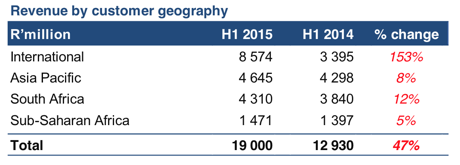
Where has most of the growth come from? In terms of revenues it is all of the acquisitions that they have made in Europe mostly, Western Europe at that and mostly commercial sale, which is all anticoagulants (which is also in Eastern Europe). The other big driver has been the infant formula in Latin American, which saw sales in that geography more than double. Here are a series of slides which explains it, taken from the presentation. First things first, revenue by geography, International is North America, Europe, Latin America and then Middle East/North Africa.


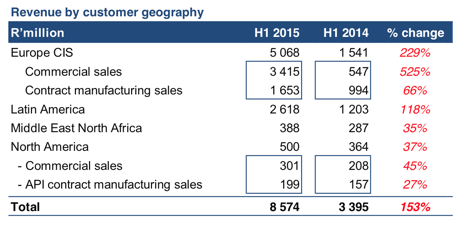
And then drilling down into the international segment (all the stuff that they have bought), reveals what we had spoken about above, the wide spread business in Europe.


The aforementioned ugly twins of Aspen's growth markets have hit the skids, when the company talks about the international segment in the prospects column: This segment is, however, also exposed to political and economic instability in Venezuela and Russia, two countries in which Aspen had been expecting material growth. Remittance of funds to pay for products supplied to Venezuela has become significantly constrained. The sharp devaluation of the Ruble in recent months has significantly diminished the value of the business undertaken in Russia. I guess until those two territories are sorted (who knows when that will be) they won't be solved. One thing is for certain, people always need pharma products.

Notwithstanding that at all, the last paragraph of the results tells you that Stephen Saad and his team are ALWAYS on the lookout for new opportunities. See: "The restructuring and consolidation which is currently prevalent in the global pharmaceutical industry is creating a number of acquisitive opportunities as businesses are re-sized and re-shaped. Aspen is well placed to participate in this process and executive management is actively engaged in assessing possibilities. The Group has a proven capability to successfully execute complex multiterritory transactions, which makes it a strong candidate for such opportunities."

They are going to nail down the recent acquisitions across Europe, which is starting to look more and more favourable. They are going to continue to sweat smaller assets harder, Stephen Saad is extremely energetic and a big personal shareholder in the business too. The risk is of course that he decides to spend more time with the Sharks rugby team or his conservation efforts, I can tell you that he never seems to lose his energy with this business. The company is not only in great hands, is growing fast, attracting new talent and new drugs and formulas, it is also a truly international one, as you could tell from the rather large currency impairment they took. Hey, it is going to happen that way if you have many international businesses.

Growth in their Asian business (which is only 4 odd percent) is key to the prospects of Aspen, they no doubt will work really hard there. Ironically their biggest sales region in their Asia division is Japan, you will recall the deal: Japan rises with GSK! See that, Japan is the second biggest pharma market in the world.

On a 30 multiple forward, with expected EPS of around 14 Rand a share, the stock is by no means cheap. It is however never cheap, I remember when the company traded at 30 Rand a share, which was when we first started buying them, the PEG ratio (PE over Growth) was at the same level as it is now. There may always be a time of consolidation, that is a great time to continue to acquire what we think is a fabulous company with great prospects. Buy.


Home again, home again, jiggety-jog. Jobs Friday. This is a favourite of the market. If we see a number above 200 thousand in total, that would signal 12 straight months. The Challenger job cuts report (that exists) from earlier in the week indicated that nearly 40 percent of all layoffs (and there were over 50 thousand in total) were directly linked to the oil price. The other main reason was company "restructuring". 40 percent of the layoffs in January were also as a result of low prices, over 34 thousand folks in total out of a job in that sector. It is another reminder that whilst the consumer might have received a windfall from lower oil prices, not everyone thinks it is a good idea. The report, if you are keen as beans to see the excitement is at 15:30 local time. The expected number is around 240 thousand. Sounds a little high, we will see!


Sasha Naryshkine, Byron Lotter and Michael Treherne

Email us

Follow Sasha, Byron and Michael on Twitter

087 985 0939
Thursday, 5 March 2015

Yello Dividends


"Voice is still a large part of revenue. If you were looking from the US you may scratch your head. Obviously lots has to do with the quality of the subscriber and the quality of the handsets that the subscribers have. MTN spend over 7.5 billion Rand a year on superior handsets, subsidising them so that their users and customers can pay more and more over time for a "better" phone. We not only want to be richer and better looking, we want a better handset for faster internet speeds."


To market, to market to buy a fat pig. That value thing yesterday seems to have captured some of you, the conversation never has a conclusion and I suspect that if you buy good companies at what seem to be stretched valuations at that point in history, in 6 odd years nobody remembers, provided that the company management have executed properly. That depends on what consumers want at any point in time, you can have the best business systems (and plans) in the world, the best management and the best execution, if consumers do not want to use your service or buy your product, you are dead in the water.

An old friend of the newsletter had this to say in response to yesterday's message: "I think you have put your finger on the dilemma in investing - how to evaluate value at a point in time. There are any number of systems touted around, some ostensibly more successful than others. But in the end it still comes down to "buy cheap and sell dear". The trick seems to be able to evaluate cheap and dear at any given moment." I have no secret sauce and I believe that not many investors have the perfect formula.

Even some of the most impressive money managers in the world have made mistakes from time to time. Tesco and Buffett. Bill Ackman and JC Penney. You cannot get it right. We have had our fair share too, we have been wrong and we will be wrong in the future. As long as you can be consistently less wrong than the market, as well as pick the better businesses, you are always going to do better. Companies are bought, they diversify, they unbundle, they go bankrupt, their products are replaced with newer technologies, it just all changes at a snails pace in front of your eyes. In the case of Moores law, technology changes a little quicker. And that is where I guess you must pay a little more attention.


Stop it. Immediately. At once. Be careful either as a young professional or advising your children when they get their first job and then think that they "deserve" a brand new fancy motor vehicle. The costs of that, having heard and caught the end of an interview with Niel Fourie, from the Actuarial Society of South Africa with Bruce Whitfield on the Money Show on 702. Those of you not from 702land will be familiar with Cape Talk 567, the same platform. I am not too sure that down in KZN you get 702, other than on the DSTV platforms. I guess that is available, who wants to listen to the radio on your TV though?

Anyhow, the long and the short of it all is that based on a five year replacement cycle (that is probably conservative) over a 40 year period, folks will spend 9 million Rand on that shiny new car with an awesome smell. 9 million rand over 40 years. That obviously factors in inflation, I am presuming running costs and insurance. The more expensive the motor vehicle, the more expensive the insurance, particularly for your professionals. The younger you are, the greater the likelihood of you being an insurance risk. I did eventually find the press release from the actuarial society of South Africa, you can read through it here: How your choice of first car can make or break your retirement.

The argument could however be taken further. If you are prepared to rebuff your colleagues and own something very modest (to get you to and from work) and more importantly save that money. I bought a second hand Polo Vivo that gets me to and from work for a little over 110 thousand Rand. It has a radio, an aircon, as well as a heater for winter. The services are cheap. It is good on fuel. If someone thinks that I am not doing well based on my motor vehicle, it is time to have your reality updated.

OK, so let us presume that you keep your first cheap car and then save 5500 Rand a month in a fund to buy a 125,000 Rand car, that would take 22 months. You then buy that car cash, and then you save the 10 thousand Rand a month in a spread portfolio that delivers around 12 percent per annum, avoiding unit trusts as they suggest, too expensive and in fact the compounding effect of the 3-5 percent drawdown leaves you comfortably behind. Let us presume that you make monthly contributions of 10 thousand Rand for ten years and then repeat the cycle.

Using this simple calculator - > Compound Interest Calculator, I end up at 2,35 million Rand after ten years. Based on a dividend yield of 2.5 percent per annum, you can draw down on 62 thousand Rand after tax. You can then continue along your merry way, another 15 years later (25 in total) with the same 12 percent per annum returns you get to nearly 18 million Rand. A 2.5 percent yield will be 450 thousand Rand a year, more than enough to buy a motor vehicle every year on an inflation adjusted basis (6 percent).

The thing that you have to prime yourself to do is be patient and be prepared to be modest. You will be far richer than your big spending colleagues. And the argument that if the world ended tomorrow? Your world? I guess then you leave the earth with more assets and less debt for those left behind to deal with. If you push to 40 years, the returns (assuming you still only contribute 120 thousand Rand a year) are 12 percent per annum, you end up with over 103 million Rand. Tell that to your friend with the swanky car.


You will recall that we introduced the MTN results yesterday, just to recap a little with the numbers that are most important, we wrote this in the message yesterday:

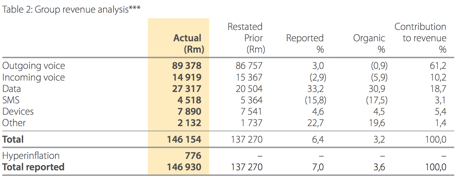
    Revenue for the full year is up only 6.4 percent to 146 billion Rand, EBITDA margins increased by 150 basis points, EBITDA increased by 10.2 percent to 65.5 billion Rand. Astonishing. HEPS clocked 1536 cents, up 8.9 percent. The dividend was a record 1245 cents for the year, 800 cents in the second half. Subject of course to a 15 percent withholding tax, that is 680 cents. For the full year that amounts to 1058 cents per share. At a current share price of 211.74 Rand the company trades on 13.78 times price to earnings multiple with a post tax dividend yield of 5 percent. Or just shy, 4.99 percent. We will flesh these out over the coming days.


So the company looks cheap? Is that as a result of declining revenues in their home market South Africa? Or is it that the company is continuing to see pressures on their voice revenues, a price war has seen a race to the bottom. There have been casualties in this, word on the street is that Cell C are creaking, the ship is taking some serious water. A plan is underway to determine what can be done there, whether or not the business is for sale. Not in a good way.

Data is definitely growing like gangbusters. Here is the opening paragraph across all of their networks across all of their countries: Data services remain the key driver of the Group's revenue growth and increased their contribution by 3,8 percentage points to 18,7% of total revenue in 2014. In the year, the number of data users increased by 22,8% to 101,2 million as we expanded our 3G and LTE networks and stimulated the adoption and usage of data-enabled devices and smartphones. At the end of December, we had 51,9 million 3G-enabled devices on our network, an increase of 30,4% on the previous year.

There are a few interesting things from this table of revenue contributors across the group. First of all, what is an SMS? Kidding, I SMS my wife a lot, WhatsApp does not always work if you do not have a reliable and steady connection. Plus sometimes you are stuck in groups that you may (or may not) want to be on. Here goes:


Voice is still a large part of revenue. If you were looking from the US you may scratch your head. Obviously lots has to do with the quality of the subscriber and the quality of the handsets that the subscribers have. MTN spend over 7.5 billion Rand a year on superior handsets, subsidising them so that their users and customers can pay more and more over time for a "better" phone. We not only want to be richer and better looking, we want a better handset for faster internet speeds.

The growth segments (if you look in the AT&T 2013 Annual report) in the US are the same as here, data. Yet data represents an astonishing 83 percent of revenues, MTN have a long, long way to go before they are remotely close to maturing. More importantly, if you believe that growth in Sub Saharan Africa will improve at a much faster pace than before, this company is for you. We continue to recommend this company as a buy.


Things we are reading

When I saw this I really could not believe it. How is that possible? The headline says it all: In January, spending at bars and restaurants topped grocery stores for the first time.

Do we secretly all want to be hipsters? Beards, style, retro goods, flat white drinkers and generally far away from mainstream. Could this be a sign of peak hipster however, Etsy, the online crafts marketplace filed for IPO, the story from the WSJ.

Instagram is the fastest growing social network on the planet. Guess what, Facebook owns it. A picture tells 1000 words (or more), if you are looking to market your goods on the platform, then read this article: 4 Key Advantages for Video Marketing on Instagram vs. Vine.

Buffett has been investing heavily in his energy business as well as his railway business, giving him an unexpected favourable "problem" to deal with, this article via the FT: The $62bn secret of Warren Buffett's success.

Whoa! This company has seen their share price eaten by termites in a hurry. It is also a reminder that good old fashioned snooping can lead to both a government enquiry, as well as profiteering for many short sellers: How a 25-Year-Old Sparked Lumber Liquidators' Stock Plunge


Home again, home again, jiggety-jog. Lots of results locally here this morning. And generally pretty good. Sanlam, Standard Bank and RMI reminding us that financial services in South Africa as well as the rest of the continent is still lucrative. MTN and Discovery are again surging, commodity stocks still taking a beating.


Sasha Naryshkine, Byron Lotter and Michael Treherne

Email us

Follow Sasha, Byron and Michael on Twitter

087 985 0939
Wednesday, 4 March 2015

Value. Stuck on the bid. Good luck with that.


"So let us rewind. 5 years ago, SABMiller was trading at an average price through the year of 190 odd Rand, earnings per share for the year were just over 9 Rand a share, hardly a bargain at 22 times earnings. Fast forward to last year, 2014, where the stock traded at an average price of 500 Rand a share on earnings per share of 21.45 Rand, again an average rating of 24 times earnings, ten percent more expensive than 5 years prior."


To market, to market to buy a fat pig. Thanks y'all for the support last evening on the SSO final, close but no cigar for me. I was just grateful for the opportunity in the end, thanks to everyone. My problems pale into insignificance, the fires in the Cape, although part of mother nature and part of a cycle do little for the residents immediate concerns, we are all thinking of those impacted and wish them well.

Cape Town was the hottest city in the world yesterday as the mother city clocked the hottest day in 100 years according to the records. The low to mid forties, that temperature is nuts! In celcius of course, convert that to Fahrenheit and you are pushing somewhere around 110. I guess the damage could have been far more severe if it had been closer to buildings and more densely populated areas.

Race day for the Cape Town Cycle Race (previously the Argus) is Sunday, I am guessing that many will get to see the devastation and power of nature up close and personal. The Argus website does not seem to suggest that the race is anything but going ahead, I certainly hope that it cools significantly over the next couple of days. Sunday looks like around 28 degrees, good luck to all participants, I think that health and wellness as an investment theme is in its infancy.

That is what we do here in this daily piece, discuss interesting new events from companies, prickly outcomes from others and continue to try and identify new investment themes as well as keeping a handle on the existing ones. We try and make the business of investments practical, enjoyable and try to educate all and sundry.


One thing I still cannot get a handle on is why some folks feel it necessary to tell you that your thesis is wrong. I have said many times that I do not think that any specific investment style is wrong or right, in the recent interview, Warren Buffett argued that you cannot have growth without value. When people tell me that today I am paying x or y for a company and that is too expensive, the question to them should be, how long do you intend to own this company for? If the answer is forever, for instance, they would have told me the same on Aspen (which we do own for clients), or SABMiller (which we don't own for clients) 5 years ago.

So let us rewind. 5 years ago, SABMiller was trading at an average price through the year of 190 odd Rand, earnings per share for the year were just over 9 Rand a share, hardly a bargain at 22 times earnings. Fast forward to last year, 2014, where the stock traded at an average price of 500 Rand a share on earnings per share of 21.45 Rand, again an average rating of 24 times earnings, ten percent more expensive than 5 years prior.

The thing that struck me however when wanting to do this exercise is that if you had bought Breweries (as it is commonly known) at 190 Rand, five years later the earnings would have been less than 8 times what you would have paid back then. In fact the dividends, all added up over the five year period from 2010 through 2014 is closer to 38 Rand in total, you would have got back one fifth of your money already in distributions from the company. Obviously less the 15 percent in recent years.

So whilst not knowing what the future holds and whether or not SABMiller will grow at the same rate in the past, as well as a weakening Rand juicing up the Rand returns, all these factors are unknown to the broader investment community. What I do know about the company is that in years to come their product will be seen as increasingly easy target to tax, let us face it, their product used in excess is hardly good for social cohesion.

Another example that we can use right now, today, seeing as we are about to cover the results of MTN is that the company is paying an annual dividend of more than some of our first clients paid for the stock around 12 odd years ago. That is right, if you paid around 12 Rand all those years ago, you are rewarded with getting that amount back today from the company, by way of dividends.

I remember the company being so expensive, it was trading on 30 years worth of earnings back then, paid a pittance (less than one percent yield) and was going to run into problems in Nigeria. It was just too risky and when the share price got closer to 25, I remember reading an extremely detailed analyst report that suggested that MTN was grossly overpriced and was definitely a sell. The value people would not touch it with a barge pole, too expensive.

And that is my conclusion, I cannot understand that if you say your time frames are very long, 10 years plus, and in the same breath say that you have no desire whatsoever to pay 25 years worth of historic earnings, the math does not always add up. I have no way of knowing when a crisis will come along and whether or not we, or anyone else would have the foresight to recognise that is the cheapest price that we are going to get.

Events like late 2008 and early 2009 in equities markets do not come along very often, a 50 percent draw down in equities markets happens twice in your investment life, on average. A 20 percent draw down happens once every few (three) years and 30 to 50 percent about once a decade. If you are going to sit on the bid and wait for that opportunity whilst the market might double from here and then halve, I am happy to get paid dividends and not get anxious about the price paid in the time being. Your investment thesis is no more superior to anyone else.

To leave off, here is a quote from Charlie Munger that explains just how far and few between these "things" are:

"You can argue that if you're not willing to react with equanimity to a market price decline of 50% two or three times a century, you're not fit to be a common shareholder, and you deserve the mediocre result you're going to get compared to the people who do have the temperament to be more philosophical about these market fluctuations."


MTN results today. This is for the full year to end 2014. They supply a mobile phone service, something that has become essential to our lives and the 223 million people who use their networks. Revenue for the full year is up only 6.4 percent to 146 billion Rand, EBITDA margins increased by 150 basis points, EBITDA increased by 10.2 percent to 65.5 billion Rand. Astonishing. HEPS clocked 1536 cents, up 8.9 percent. The dividend was a record 1245 cents for the year, 800 cents in the second half. Subject of course to a 15 percent withholding tax, that is 680 cents. For the full year that amounts to 1058 cents per share. At a current share price of 211.74 Rand the company trades on 13.78 times price to earnings multiple with a post tax dividend yield of 5 percent. Or just shy, 4.99 percent. We will flesh these out over the coming days.


Things we are reading

It feels like the turn of the last century, where flight was still new and people were coming up with the most efficient and safe ways to fly - Solar plane set for record-breaking world tour

A look at where natural gas has come and where the industry may be heading - Golden scenarios: A promised golden age of gas is arriving but consumers are cashing in well before producers do.

A look at the next generation finger print scanner - Qualcomm's new fingerprint sensor should be better than Touch ID. Having a better scanner is also the next step in data security and a move away from having to remember passwords.


Home again, home again, jiggety-jog. We've had a decent start today amongst our recommended stocks. MTN is up nicely on the solid numbers while Discovery continues to surge post their results a few weeks back. The overall bourse is being dragged by the resource stocks as that sector remains volatile along with the underlying commodities. Solid retail numbers just came through from Europe, thats always a good sign.


Sasha Naryshkine, Byron Lotter and Michael Treherne

Email us

Follow Sasha, Byron and Michael on Twitter

087 985 0939
Tuesday, 3 March 2015

NASDAQ 5000. NASDAQ 23 and not 120 actually


Thanks for getting me through to the finals with all your tweets and all your retweeting. One level up now chaps, I have made the finals and they are tonight. I need your love just one last time and in this case, it needs to be timeously at 20:30 tonight, Tuesday the 3rd of March. Here is what you need to do, in order for me to win the title and the opportunity to donate the funds to charity. So. Watch the show live, there is a twenty minute period in which to vote, that is all. Copy and paste the following in your Twitter status and tweet it, if you feel I deserve to win:

    @ssoleague #Bucks for the win


As simple as that, a copy and paste and a tweet, it has to be between 20:30 and 20:50 tonight, Central African Time, that is the Joburg time zone so as to not confuse you. Again, thanks in advance for all the support, it has been a very long "season".


"Yip, whilst the NASDAQ is back at 5000 points (and around 4 odd percent away from the intraday highs), the earnings relative to the prices are one-fifth roughly of where it was back then. If the NASDAQ at current levels, on historic earnings was trading at 120 times, then the level would be 26000 points. In reverse, if the NASDAQ back then was trading at the same earnings today, the level would have been 958 points. Yes, it seems very different this time."


To market, to market to buy a fat pig. Yesterday we had the opportunity to listen to Joe Kernan, the man who does not know that Ireland uses the Euro as a currency and is part of the Eurozone. No, I am kidding, we had the CNBC interview by Becky Quick of arguably the best investor of all time, Warren Buffett, an extended one at that. There are of course always awesome pieces of titbits to pick up, we had a laugh in the office when Warren Buffett, when asked about Greece compared them (Greece) to a dog that kept peeing on the carpet, and rewarded for it. I am not too sure that the Greek people will like the dog analogy with the owner being the rest of their European brothers, I guess Buffett meant no harm to anyone when using that analogy of the dog. He just meant naughty behaviour.

Here is what else he said: "What Greece has done is exposed the weakness of the original concept. And the idea that you're going to link currency in lock step among a large group of countries that had different fiscal policies, different cultures, different labor laws and everything. It has a structural weakness to it." I guess what he means is that if Greece asked for entry today the answer would be a definite no. No thanks, go away and fix your problems, come back in ten years time and try again. What is done is done.

Buffett expanded on that, talking about what he thinks will happen in the Eurozone: "I think it will be modified. Listen, the first time around, we've had amendments to our constitution, right? We thought we wrote a pretty good document. And we did. But we still have to amend it occasionally. And there was probably a burst of enthusiasm that they really got - they did half the job, and they will have to do the other half of the job." When I read that it suggests to me that Buffett thinks that the Eurozone will change the rules to avoid further entrants, he however believes that in theory the rest of the participants in the Eurozone will get it right.

For me however the biggest one was a follow up from the Buffett letter over the weekend, the whole argument between value investors and growth investors. I suspect that there is no one argument, there is no one style that is superior to another. Being too rigid and not flexible means that you miss many opportunities. Although not conclusive. Here goes, great quote: "I always say if you aren't investing for value, what are you investing for? And the idea that value and growth are two different things makes no sense. I mean, growth is part of the value equation and a company that grows and uses little capital in doing it gets high returns on incremental capital is obviously worth more money than one that doesn't grow. That doesn't make the one that doesn't grow valueless though." Growth and value, you need to make sure that the company that you buy offers good value, for the growth prospects it offers.

The difference between Buffett and everyone else is that his time horizons tend to be far longer. I have seen the Berkshire Energy business (hat tap our old colleague Gareth) building many solar farms and selling Exxon Mobil at the same time. He is happy if IBM, a position that the company holds, goes nowhere price wise for the next 5 years because he is going to carry on buying it on the cheap. Buffett is actually hoping that the price goes nowhere. Now, in the interim, Berkshire has lots of other investments that are doing better than even and are going forwards at a faster pace than the rest of the market. Meaning that Berkshire can be patient on a business that is in a bit of a funk and has the market shunning it. That is when they buy it. Others do not have five years. Great bunch of material to get through, the Buffett interview, you can pick up the highlights via CNBC: Buffett: Greece shows weakness of 'shared currency' concept

Meanwhile the NASDAQ topped 5000 in last evenings trade. It has happened before, back in March of 2000, when the NASDAQ as a collective traded at 120 times earnings. Now that number is close to 23 times. Just for comparisons sake, the S&P 500 was close to 30 times earnings back then. A high price to earnings multiple is cause for concern, when earnings grow quickly that unwinds in a tick. I have seen expensive companies look cheaper than "cheap" companies after the company earnings catch up to the share price. Obviously at 120 times earnings you are expecting earnings to be nothing short of explosive. Many businesses didn't even have earnings of any sort.

So yes, to suggest that this is the same as last time is not right, it really is different. You might think that 23 times earnings is stretched, some of the majors seem to have relatively modest valuations when compared to the index. Apple for instance is trading on 17.4 times earnings. Forward that unwinds to around 15 times, according to the expectations of the current year earnings relative to where the share price is trading now. Google trades on 28 times historic earnings, that unwinds to just less than 20 times based on current year expectations. Microsoft trades on 17.7 times earnings, again that unwinds to 15 times in the current year. Facebook trades on 74 times earnings, against expectations of nearly 2 Dollars means that Facebook trades forward on 40 times earnings. 30 to the next years earnings.

Alibaba? 46 times current earnings, less than 30 times forward. Oracle, 18.4 times historical, 15.2 times forward. IBM, 10.2 times current earnings, that is actually expected to stay the same, at exactly that. I guess the point that I am trying to make is that the high priced stocks like Alibaba and Facebook are growing fast, they will catch up and unwind, the others are all cheaper than the rest of the market currently. Yip, whilst the NASDAQ is back at 5000 points (and around 4 odd percent away from the intraday highs), the earnings relative to the prices are one-fifth roughly of where it was back then. If the NASDAQ at current levels, on historic earnings was trading at 120 times, then the level would be 26000 points. In reverse, if the NASDAQ back then was trading at the same earnings today, the level would have been 958 points. Yes, it seems very different this time. Last point worth making, the dividend yield on the NASDAQ now is better than the 10 year treasury.


Things we are reading

A 5 min video of what can be done in a lab - The Process of Growing Bones From Scratch. It is amazing how healthcare is evolving.

An icon goes green - The Eiffel Tower has new wind turbines, and they're beautiful. If a landmark like the Eiffel tower is modified to have green energy, you have to think that as a society green energy is inevitable. Great news for alternate energy companies and less so for commodity companies.

Connecting the world will go along way to putting everyone on the same playing field - Google says its Titan drones will make their first flight in a few months.

There is a common misconception that having foreigners in your country is bad for the local population - Romanian and Bulgarian workers are flooding the UK, but are actually no threat to the job market. What normally happens though is that the foreigners add extra demand for consumption (good thing) and they tend to be more qualified and/or work harder, which makes local companies more profitable.


Home again, home again, jiggety-jog. Markets here are higher to begin with, the precious metals companies are getting smoked however, both down over two and half percent. Hey. You must not at any stage forget to follow the instructions for watching me on CNBC tonight, that is channel 410 at 20:30, for a live version of Share Shootout. Tune in early at 20:00, watch the new Hot Stocks with Paul, and then you are going to have to be on your best tweeting form in order to make me the winner, and then ultimately the winner for a charitable cause. It takes a few moments of your time, once again I need your help here!!


Sasha Naryshkine, Byron Lotter and Michael Treherne

Email us

Follow Sasha, Byron and Michael on Twitter

087 985 0939
Monday, 2 March 2015

Bidvest, Buffett and capital


"Bidvest almost never looks cheap. There were moments in time when the stock was cheap, so was the market. If you are in the business of owning quality and looking for superior returns over time, this is a business that you have to own. Sometimes steady is the way forward. I am looking for 2 numbers soon, one is 200 billion Rand in turnover and 10 billion Rand worth of trading profit, they might get really close on the second one this financial year. An achievement that the board and company (nearly 150 thousand employees) can be proud of."


To market, to market to buy a fat pig. I think I can, I think I can. We managed to just push through on Friday in the local markets, if we had been the Proteas captain we would have closed up 20 percent on the day, that guy is incredible. What is nicest about him however is that he just goes out there and does the business in a way that would have seemed impossible a mere two decades ago. In the same way that the rest of life evolves, so does sport, in front of our eyes. Impressive, as ever, let us try not get ahead of ourselves here. Back to the stuff that matters in these newsletters, as we well know sport takes place in a stadium between two teams and 50 thousand experts watching live with millions of experts on TV who all think that the ref is rubbish if the decision goes against them. One eyed fans.


Bidvest results today. I guess that it is not a coincidence that Brian Joffe of Bidvest and Warren Buffett of Berkshire report on and around the first weekend of March, that is the nature of the reporting cycles. I am pretty sure that Joffe would be humbled with the comparison, he is after all only human (both of them) and being compared to the best allocator of capital over time is flattering. Joffe is however one of the greatest allocators of capital that this country has ever seen, taking the business in 1988 with the acquisition of Chipkins (when he was 41 years old) to a business with an annual turnover that might just top 200 billion Rand for the first time this financial year. Astonishing what one can achieve in a relatively short period of time when you put your mind to it.

For Bidvest these are the half year results, they include a fair value impairment of 118.1 million Rand on Adcock (the mark to market price) and a reversal of a previous Comair impairment of 33.3 million Rand. When you own listed companies as part of your investments, you have to accept the market price at the end of the reporting period. Comair, all things being equal should benefit from lower oil prices for longer, Adcock seems to be in turnaround mode.

The Foodservices business which is reported as a collective is more than half the business. It truly is an international business, the South African business is less than half of the whole thing put together now. The South African business however accounts for more than half the profits which means that the margins are better here in part and the costs associated with expanding internationally. The company continues to grow in all the right regions with the right services and products for the markets, of most interest (to me) is their Chinese and Latin American businesses, those are both high growth regions.

These results have been received a little negatively, Mr. Market not really impressed so much. That is always an opportunity for me. There are few businesses that can or could be viewed as bulletproof (I use that term sparingly), this is one of them. Bidvest almost never looks cheap. There were moments in time when the stock was cheap, so was the market. If you are in the business of owning quality and looking for superior returns over time, this is a business that you have to own. Sometimes steady is the way forward. I am looking for 2 numbers soon, one is 200 billion Rand in turnover and 10 billion Rand worth of trading profit, they might get really close on the second one this financial year. An achievement that the board and company (nearly 150 thousand employees) can be proud of.


OK, sport-lovers. We were trying to make the point about how the structure of Berkshire Hathaway had changed over the years. The fact that they had moved away from looking for value in the market to looking to be more private equity like. Look no further than the 50th anniversary of Charlie and Warren working together and possibly the most eagerly awaited piece the financial world has to offer, the letter from the Chairman, Warren Buffett:

    In our early decades, the relationship between book value and intrinsic value was much closer than it is now. That was true because Berkshire's assets were then largely securities whose values were continuously restated to reflect their current market prices. In Wall Street parlance, most of the assets involved in the calculation of book value were "marked to market."

    Today, our emphasis has shifted in a major way to owning and operating large businesses. Many of these are worth far more than their cost-based carrying value. But that amount is never revalued upward no matter how much the value of these companies has increased. Consequently, the gap between Berkshire's intrinsic value and its book value has materially widened.


I want to try and explain, eloquently, what that means. Or what I think that means. As Buffett himself is the best explainer of these things, why interpret it? I think many try and use the Buffett model in the market, in the equities market, I suspect that this is trying to replicate the past. The best place to find misplaced businesses is no longer in the market, which is far more crowded than in the days of Benjamin Graham and the early days of Warren Buffett. The best place is basically buying unlisted businesses. Private transactions, and of course Buffett has been finding solid partners like that 3G Capital crowd. Charlie Munger remains his friend and advisor, a 56 year relationship in which they have never had a fight. Choose your business partners wisely.

Whilst many try and replicate the returns of the favourite billionaire next door (he has lived in the same house since 1958, he reckons a home is for living, not speculating), many do not have the patience to be in the market. We live in a society that has credit card returns mentality, I bought the shares, I need them to go up by a factor of two, and I want that yesterday.

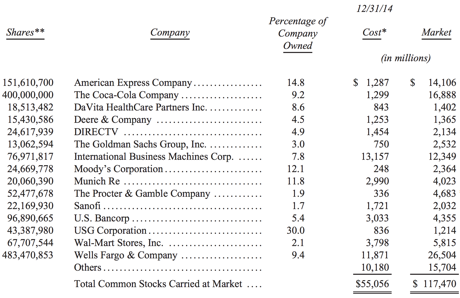
My point about Buffett and Berkshire being away from the market is given further vooma by him suggesting that their core insurance businesses, their powerhouse five delivered X (not listed), as well as the big 4 listed assets Coke, Wells Fargo, American Express and IBM which are the cornerstone. They did add to their listed entities by not increasing their stakes, but rather with buybacks of their own shares. The only one they added to was IBM. As you can see from the updated version (we have the new letter of course), IBM is the only company of their listed assets where they are in the red:


What is missing on this list is the option to buy Bank of America by 2021, it would effectively be the fourth largest holding. Who knows, he is only human and might actually be wrong on IBM in the long run. He makes mistakes, admits them, moves on. I suspect a business as large as IBM will take a little time to adapt and evolve. In fact Buffett even says that he is embarrassed to say that he dawdled on Tesco: Attentive readers will notice that Tesco, which last year appeared in the list of our largest common stock investments, is now absent. An attentive investor, I'm embarrassed to report, would have sold Tesco shares earlier. I made a big mistake with this investment by dawdling

We all make mistakes, it is the manner in which we approach them that is important. He said that he had soured to the management. Lastly, a number of juicy Warren quotes, I am pretty sure they are going to be all over the media today and in the coming days with his multiple interviews: "For the great majority of investors, however, who can – and should – invest with a multi-decade horizon, quotational declines are unimportant. Their focus should remain fixed on attaining significant gains in purchasing power over their investing lifetime. For them, a diversified equity portfolio, bought over time, will prove far less risky than dollar-based securities. If the investor, instead, fears price volatility, erroneously viewing it as a measure of risk, he may, ironically, end up doing some very risky things."

Lastly, and this sits well with me: Investors, of course, can, by their own behavior, make stock ownership highly risky. And many do. Active trading, attempts to "time" market movements, inadequate diversification, the payment of high and unnecessary fees to managers and advisors, and the use of borrowed money can destroy the decent returns that a life-long owner of equities would otherwise enjoy. Indeed, borrowed money has no place in the investor's tool kit: Anything can happen anytime in markets. And no advisor, economist, or TV commentator – and definitely not Charlie nor I – can tell you when chaos will occur. Market forecasters will fill your ear but will never fill your wallet.

Ha ha, thanks Warren, market forecasters will fill your ear but never fill your wallet! The AGM this year has been planned already, a huge affair starting on the 2nd of May. Michael wanted to go I recall, he has settled for his honeymoon instead. Which makes far better sense really, the Berkshire AGM will always be there, on honeymoon (the first) we hope it will be the one and only one.


Things we are reading

A reminder that it does not always go your own way, it certainly is not one way traffic. Mxit: the rise and collapse of 'Africa's largest social network'

Along the same theme as last week, doing nothing can result in the best performance - The Problem With Intuitive Investing. Our approach is to be "actively passive", which has worked well for our clients. Keeping our eye on the long term.

Following the Buffett frenzy at the moment - Berkshire Hathaway's Willingness to Kill. Allocation of capital is a key component of Buffetts success. I am reading his chairman letters starting in 1965 and the first bold move was to move out of their textile business and into the insurance business.

Changing the way the music industry works will hopefully lead to more money for artists not at the pinnacle - Google's latest, fascinating bet on the future of music is called Kobalt. Google have their fingers in many pies at the moment, hoping that down the line they will start to have significant earnings.


Home again, home again, jiggety-jog. Thanks to all of you for voting for me for a crack through to the finals of Share Shootout, I will find out a little later today whether or not I made it. And then I shall advise as to what next from there, the finals are live and are tomorrow night. That is where I am really going to need your help, live tweeting during the show will be the best way to go about it. First things first, let me advise about the finals! Thanks again sports lovers I really appreciate your votes.

On a sad note, the actor that played Spock in Star Wars passed away on the weekend, he had a good innings. Less so (in years) the former AIG CEO, Bob Benmosche also passed away. Benmosche is the guy who moved the company from a point where nobody knew anything to a period where the business was profitable and stable. He trashed around half a trillion dollars in assets and slimmed down the workforce aggressively, by around 40 percent.

The market is flat here heading towards midday. The shooting dead of the opposition leader in Russia is certainly no accident and a reminder that whilst we think the political debate here is robust and we can say all sorts of things about parliament, at least this doesn't happen. Sigh.


Sasha Naryshkine, Byron Lotter and Michael Treherne

Email us

Follow Sasha, Byron and Michael on Twitter

087 985 0939