Thursday, 6 June 2013

Apple crisp again

"Basically, because of strong demand for the iPhone 5 they are actually gaining market share in the US. This is important to note because the US market is the most sophisticated when it comes to smartphones so their opinion matters. Although the platform IOS is well behind Android, the iPhone is comfortably the most popular phone in The States and that market share is growing."


To market, to market to buy a fat pig. All fall down. Locally we actually recovered off our worst levels for the day to end the session off one quarter of a percent, resource stocks which were backed by a weaker currency helped prop up some tired looking industrial stocks. The Rand, after a brief surge through 9.70 has weakened all the way out to 10 to the US Dollar again. We are currently without our TV's at the moment, we have shuffled the offices up a little and have engineered the TV's to hang in the middle of the office. Pictures to follow when it is all working, hopefully later today.

So we did not see the ADP employment number come in yesterday, which was lighter than anticipated. The number clocked 135 thousand additional jobs added for the month of May, the full report is available here: ADP National Employment Report May 2013. Oh, and the other sort of important thing that happened was that the 30 year average mortgage rate went above 4 percent last evening. The expectations in the coming 12 to 18 months is for the rate to settle anywhere between 4 and 5, but historically that is still pretty cheap. This time in 2011 we were at and around 4.5 percent, so anyone who has been working hard to pay down their mortgage in North America has been doing themselves a huge favour lately.

Although, no one that I read is quite sure where rates will settle next, they will go higher, but how much and at what pace? Remembering that the Fed meets every 45 days, so 8 meetings a year, if you want to diarise the 2014 dates, you can already: 2014 FOMC Meetings. It could be the case that come the middle of next year we could see rates in the US start to tick up. If of course the FOMC was happy with the outlook for growth and in particular the outlook for employment. Last evening's Fed beige book I saw was described as particularly beige. Dour. Boring. Although to be fair, beige is not too intrusive either, is a good colour for pants and fishing wear, if that is your sort of thing. Catching fish that is, I presume you all wear pants!

What is the Fed beige book? Surely not a scrapbook! No, in fact it is a summary of the districts, so each section of the country gives their assessment of economic conditions: Beige Book - June 5, 2013. So what did Mr. Market draw out from this? I am not sure, but the sell off mode actually continued and in New York the market had given back a lot of the last few weeks hard work. The S&P 500 is off nearly 80 points from the highs, or nearly 5 percent. So I guess you could argue that is "kind of" a big sell off, but the market is up 12.81 percent year to date. So it is still big you see, the market is still comfortably up for the year. Lukewarm beige book, if there is such a thing. I saw the love him or hate him Jim Cramer say that he was lining his charitable trust up for some purchases.


What? What is this about? The IMF say in their recent report that Greece Makes Progress, But More Effort Needed to Restore Growth. Well that is like telling your peers that they can't do anything without permission and then suddenly telling them to try harder and take initiative. The complete report is available here: GREECE 2013 ARTICLE IV CONSULTATION.

The sad truth is that this has possibly been one of the worst economic contractions in modern times, of that sort of size and scale. The paper lays it out: "Overall, the economy contracted by 22 percent between 2008 and 2012 and unemployment rose to 27 percent; youth unemployment now exceeds 60 percent. As domestic demand shrank across all categories, net exports provided support largely through shrinking imports." Was Greece punished unnecessarily, or were they made to take their medicine that they deferred during the happy days? The percentage of nonperforming loans has reached crisis levels, 25 percent. For some perspective, Spain is around 5 percent.

But, there is light at the end of the dark, dark road that the Greeks have travelled. Unit labour costs are coming back into line, even though not at competitive levels just as of yet. But more work still needs to be done: "The labor market has traditionally suffered from a closed and inflexible system of collective bargaining, very high firing costs (severance payments and redundancy notification periods), a high national minimum wage relative to competitors, and high non-wage labor costs." Sounds familiar, no?

I do not know if there are lessons from this, too much state intervention, too many benefits, not enough compliance, too much government involvement in business, corruption becoming ingrained into society and I suspect that the list could go on. The Greeks have learned the very hard way and perhaps living standards will not return to those of six/seven years ago until the end of this decade. At least they have the Euro zone, as weird as that might sound to some. Without the Euro zone the countries savings base would be decimated, pensions would halve overnight, but somehow people seemed to think that the adoption of the Drachma would be "good" for Greece. A real life sad example, which impacts on ordinary people.


Byron beats the streets

    Apple are always in the news but over the last few days they have hit the headlines slightly more than usual. Sasha did mention it yesterday but I found a WSJ article which explained the implications of the Samsung Court ruling very well. In case you missed it, Apple lost a legal ruling which has banned them from selling certain models in the US.

    The article titled Ruling Won't Break Apple's Skin explains it better than I ever could.

    "Yet only devices using AT&T's network fall under the ruling. And only a handful of older models are affected. What's more, only two of the affected models, the iPhone 4 and the "3G version" of the iPad 2, are still being sold. Slightly more than a third of Apple's overall sales are in the U.S. And, according to a survey by Consumer Intelligence Research Partners, half of iPhone 4s and two-thirds of 3G iPad 2s sold in the U.S. are on AT&T's network. Respectively, they generate 13% and 14% of U.S. iPhone and iPad sales, according to CIRP.

    Putting all those numbers together suggests that, at most, the ban impacts roughly 2% of Apple's sales, based on March-quarter numbers."

    The stock was only down 0.93% yesterday which was probably more to do with a weaker market than the news itself. If you saw the headlines and felt a bit anxious I hope this explanation has sorted that out.

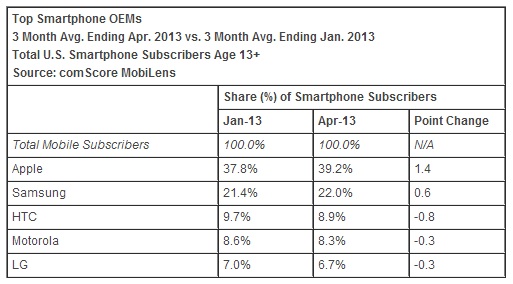
    The other news I saw with regards to Apple was positive and related to market share in the US. comScore who are the leaders in measuring smartphone data released the following table on their website. Click here if you want to read the full release.

    Basically, because of strong demand for the iPhone 5 they are actually gaining market share in the US. This is important to note because the US market is the most sophisticated when it comes to smartphones so their opinion matters. Although the platform IOS is well behind Android, the iPhone is comfortably the most popular phone in The States and that market share is growing.

    What I also found interesting was that smartphone penetration in the US was only 58%. If there is still a lot of room to grow in this market, the potential in developing markets must be mind blowing. If you remember Sasha covered all of this yesterday with that Ericsson report.

    Yes, there are huge market share wars between the smartphone manufacturers but people forget that there is still a lot of room out there for these players to grow. This town is still big enough for the two of them.


Home again, home again, jiggety-jog. Markets are lower here again today. Retail shares have been hit quite hard over the last few days. People are still worried about the credit cycle here locally, and we are starting to hear noises about indebted mine workers. And unfortunately it is getting closer to "strike season". Weekly jobless claims today might actually determine where we end up, and then of course tomorrow, the nonfarm payrolls number! That is always huge.


Sasha Naryshkine and Byron Lotter

Email us

Follow Sasha and Byron on Twitter

011 022 5440

Wednesday, 5 June 2013

Video "machine" in your pocket

"Just yesterday Byron was telling me about the cost per gigabyte when he was at varsity, and we could see now that the cost had plummeted. I remember this graph and blog: A History of Storage Cost, that showed that per gig, the cost had decreased from 193 thousand Dollars in 1980 to less than 7 US cents in 2009. And I will have it as a guess that it might even be half of that now. And this is ironically in a world where the demand for storage grows exponentially. How were we to know that storage space now was a necessity and not a luxury any longer? "


To market, to market to buy a fat pig. At face value the scorecard at the end showed that local markets barely budged, after having enjoyed gains for most of the day. Resources and in particular the gold stocks lagged the broader market, industrials were flat whilst the banks and financials led us higher. I saw some technical analyst on the box suggest that the industrial companies were locally based, quite clearly that person had not seen the list of companies by market capitalisation lately. Or ever. By my count 6 of the top ten companies in the index are industrial in nature (not financial or resource), and make up around 38 percent of total overall market capitalisation. The market as ever is led by a few majors, that is the way it will work.

Over in the US it was a good start and then slip sliding through the session, ending off the lows. There was some sort of strange ruling in the ongoing patent wars against Apple, see here: Apple Import Ban on Old IPhones Stokes Samsung Patent War. So, it is what it is, Apple for the time being cannot sell those products, but can of course sell the latest iPhone (the 5) and the latest iPad, which I suspect that most people want. Where this ends is anyones guess.

Also guessing are those people who are waiting for the sign that the Fed will back off. We think that is a great moment, the Fed thinking that they can step away, the rest of the market, well, they are not so sure. I have seen a couple of articles concerned about the Bond market: Hatzius: Explaining the Risk of Disorderly Unwind in the Bond Market. Jan Hatzius, a Goldman Sachs chief economist, who is both a German and American national, suggests that the Fed could announce their taper in September, with action by the end of the year. I for one am pretty relieved when I will be able to read that the Fed are no longer in the market. The few times that I have seen Hatzius, and it is mostly Bloomberg and mostly for the non-farm payrolls, I like him a lot. Him and Abby Joseph Cohen are my two favourites. The most unfortunate part of their job however is to predict the levels of the S&P 500.

Predictors. And the other prediction that I saw was that of "the Nouriel" and the levels of the gold price. Sigh. As if he needed some more haters. His words were that the gold price was going to sink back to 1000 Dollars per fine ounce in the next few years, and the yellow metal was basically an outdated investment. His predictions are poor at best, but perhaps I am just noticing the ones that all went wrong. I still think that crediting him with predicting the financial crisis is a little rich. I mean, nice to predict something over and over, better really to monetize it for you and your clients, not so? So, in my world, John Paulson, Michael Burry, Charles Ledley and James Mai, those guys monetized the financial crisis. For both themselves and their clients. In my world, they were the real predictors, how did they do subsequent to that, well, on that again they will be judged.


When humans motivate a new purchase or venture to their colleagues, their spouses, their parents, their kids, their extended family, their friends, there almost always is an element of economics involved. And it will differ, depending on where we are in history. Just yesterday Byron was telling me about the cost per gigabyte when he was at varsity, and we could see now that the cost had plummeted. I remember this graph and blog: A History of Storage Cost, that showed that per gig, the cost had decreased from 193 thousand Dollars in 1980 to less than 7 US cents in 2009. And I will have it as a guess that it might even be half of that now. And this is ironically in a world where the demand for storage grows exponentially. How were we to know that storage space now was a necessity and not a luxury any longer?

Just yesterday, well that was when I saw the report, Ericsson released their Mobility Report, which gave an overview of the mobile handset trends. I am still amazed that we are able to grow at the same rate that we still are off the increased base. The biggest change is the number of mobile broadband connections. It grew by an astonishing 45 percent year on year to 1.7 billion folks. And to cement the trend, more than half the handsets sold globally in the first quarter of 2013 were smartphones.

BUT......the amount of data per subscription continued to slow, indicating that as much as you use your handheld "friend" there is seemingly a limit to how much you can use it now. Part of it is cost, part of it is the service. If we all had amazing handsets that were all LTE enabled and data cost peanuts, we would use them a whole lot more, right? Well this report offers some useful insights into how that is going to look in half a decade or so, where the suggestion is that LTE coverage will be available for 60 percent of the globes population. Wow. That is pretty amazing. Now to think that 25 years ago, almost nobody had a mobile handset. Really. Now, according to this report it is not uncommon for people to have two subscriptions, one for your phone and one for your tablet. I am pretty sure that the new motor vehicles, fridges, washing machines, electric meters and so on will be fitted with sim cards enabling the smart devices to tell the network what is wrong, if indeed there is a problem.

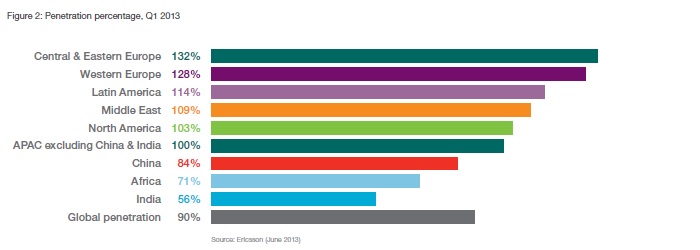
I was also amazed by the growth, and in particular the growth that still exists for our continents population, check this graph from the report:

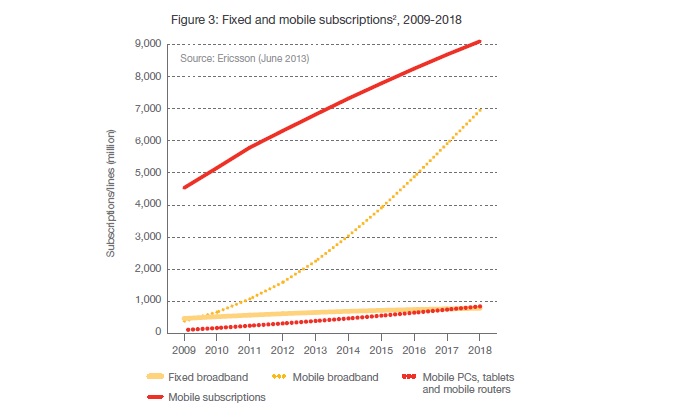
See how low connections are to population size in Africa and India? There is still a whole lot more room for growth, in terms of absolute subscribers AND the number. Remembering that it is possible for one customer to have multiple subscriptions, tablets, dongles and smartphones. This next graph is also a prediction of exactly what is going to unfold:

And then lastly, all the growth that we have talked about, this is where it is going to come from, according to this Ericsson report:

Amazing. And that is why we will continue to stay invested in MTN, because whilst margins will continue to come under pressure, the data usage will continue to grow strongly. Who knows, in ten years time we might all wear glasses or contact lenses, or helmets of have watches or implants, I don't know. All I do know is that it makes for a world that is more intrusive and for the purposes of corporate governance, that is good.

Last point I want to make is one about who will and who won't in our opinion, benefit. MTN is taking some heat today as people worry about how much they could potentially pay if they are recipients of a Myanmar mobile licence. But I suspect it would be great in the long run. Telkom on the other hand, well, you can read the statement yourself: Updated Trading Statement. Yech. "Telkom, in line with other fixed line incumbents globally, has for more than a decade, faced technology changes, competition from mobile operators and an evolving regulatory landscape which have contributed to lower investment returns from its legacy network assets." Yes, I see, so you mean people want more mobile phones and less rubbish service from a fixed line operator? Well, it sounds a bit like a sad admission of sorts, but they go on to say that they are investing heavily in changing that. Trying to keep up. Late? Time will tell, but if the Ericsson report is anything to go by, we could continue to see headcount fall at Telkom and fewer customers. We continue to avoid.


Home again, home again, jiggety-jog. Today is the day that D-Day, the Normandy invasions were actually set for. The fifth of June. But because of the foul weather, it was delayed to the 6th of June 1944. I am pretty sure that "things" in Europe were much worse than they are today, even though high unemployment and policy freeze seem like there is no progress. Mario Draghi was able to stand there last July, the 26th of July to be exact, and talk about doing everything to save the Euro. And that doing everything lowered the borrowing costs for the Italians and the Spaniards. No, no exit. Not from anyone. In fact........ just this morning the ECB Cautiously Says Latvia Can Join Euro Zone, according to the WSJ. So, stick that in your pipe and smoke it all you Euro haters. Where are the people now talking about exit this and that?


Sasha Naryshkine and Byron Lotter

Email us

Follow Sasha and Byron on Twitter

011 022 5440

Tuesday, 4 June 2013

Istanbul. Far away from here.

"Istanbul, as the crow flies, is 7469.51 km from Johannesburg according to the mapcrow.info website. The distance from Wall Street, OK, New York to Istanbul is 8062.30 km's according to the same website. Roughly, New York is closer to Istanbul by about the distance from Johannesburg to Durban (just shy of 500km). But tell that to the people that sold off emerging markets yesterday."


To market, to market to buy a fat pig. Yesterday was PMI day, a day that clocks around every month and is supposed to reveal the health of the globes companies. PMI is known as the Purchasing Managers Index, in the US the Institute for Supply Management (founded nearly 100 years ago in 1915) conducts these surveys on private companies. HSBC have one in China, as well as the official one by government, the BoJ does one called the tankan, but perhaps the best one known globally is Markit.

Now the calculation is quite simple, that is of course if you like mathematics equations. The Index equals (P1*1) + (P2*0.5) + (P3*0). Easy. P1 is the number of respondents that report an improvement, P2 is the number of respondents that report no change and P3 is the number of respondents that report a deterioration. I found this formula and explanation at Wikipedia. Now in the world of surveys of this sort, not all questions carry the same weighting, for instance a question about new orders carries a higher weighting than a question about suppliers delivery times, even if both can tell you something about the current strength of the economy. And that I guess is what these PMI reads are supposed to do.

There is actually a great explanation of the definitions on the Bureau for Economic Research South Africa website:

  • SA PMI = 0.25 Business activity +
  • 0.30 New sales orders +
  • 0.20 Employment +
  • 0.15 Supplier deliveries +
  • 0.10 Inventories

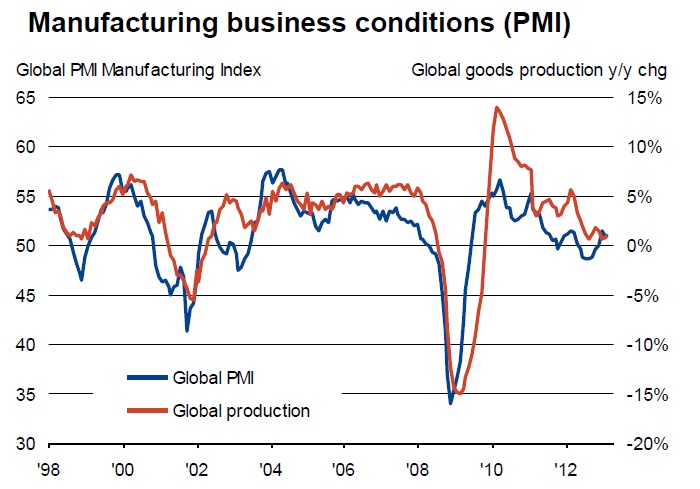
In a South African context we managed to just squeak above 50 and remain slightly unchanged at 50.4 points in May, according to the Kagiso Purchasing Managers' Index (PMI). Locally the suggestion is that we are indeed recovering off the depressed levels of the first quarter, but the recovery is slow and very stodgy. Globally the people at Markit suggest Manufacturing remains stuck near stagnation in May. See the global picture:

Is all of this important? Well...... I suppose yes, companies answering surveys without committed and pointed answers with a better, no change and worse. If I presented you with the same questionnaire each and every month, I am not too sure how much differently my answer would appear on a month by month basis. Yes, important, very important, I guess so until next month!


Istanbul, as the crow flies, is 7469.51 km from Johannesburg according to the mapcrow.info website. The distance from Wall Street, OK, New York to Istanbul is 8062.30 km's according to the same website. Roughly, New York is closer to Istanbul by about the distance from Johannesburg to Durban (just shy of 500km). But tell that to the people that sold off emerging markets yesterday. The Turkish stock exchange ended the session down 10 and a half percent! Nobody likes to see burning buildings and If you had an emerging market flavour, you were punished yesterday and that included the local bourse. The Rand ironically bounced hard from the pasting Friday, and that did little to help keep the bears at bay, the feasting continued through the day as the sell button was pressed harder and harder through the course of the day. After all was said and done the Jozi all share index had shed two and a half percent to close below 41 thousand points. Goodbye 1000 points and some change, that is not something that happens too often.

Banks were bashed down three percent, but unfortunately the real action was with the platinum stocks that sank another 5 percent and some change as news started to filter through that a NUM shop steward had been shot dead on the Lonmin Western Platinum mine. And this morning, driving into work I heard on the wireless that John (other name Robbie) Robbie said that over 60 people had been killed in violence on the Impala and Lonmin mines and nobody had been prosecuted for these crimes. No wonder they seem to happen, life is seemingly cheap and there are few consequences when there are such actions. Sad. Very sad. Lonmin stock sank over 7 percent yesterday. Union recognition is seemingly more important than building new mines and new jobs.

The worst news is that Glencore Xstrata have laid off 1000 folks who embarked on illegal strikes over the last week. AMCU workers, who probably are not too fond of NUM. And I suspect the NUM fellows are not too fond of AMCU chaps either, that much is evident. Coal of Africa have in a press release yesterday announced that they are going to place Mooiplaats Colliery on care and maintenance. Not profitable and losing 20 million ZAR a month at these current coal prices. Poor operational performance and "challenging" geographical conditions were cited. Over 500 people are set to be affected, half of them contractors and the other half full time staff. The unfortunate truth is that when prices go against you, both the commodity price as well as fixed costs, you can have as many union turf wars as you want, there are just no jobs left for anybody after a while. And that is the stark reality.

Thermal coal (like the stuff produced at Mooiplaats) prices are roughly 85 US Dollars per ton. In July of 2008 prices were roughly double, around 167 Dollars per ton. Ten years ago prices were around 23-25 Dollars a ton, those prices were the average for the prior twenty years to that. In fact just below. So thermal coal prices are better than 10 years ago, a lot better, but a whole lot worse than even two years ago, where the price was roughly 50 percent higher than now. Now if you know your geography, you will know that Camden coal power station is right there, and was re-commissioned from 2006 through to 2008.

It, Camden, is 35 years old and was refurbished at a considerable cost Paul tells me, and now the closest coal mine, with thermal coal is closing. I wonder where Camden gets their coal from? I could not find it on the Eskom website, but finally through some digging and scratching found that in March of this year, Eskom signed a contract with Ichorcoal subsidiary, Vunene mining to supply coal to Camden. So I guess that is how it works. A German coal company, Ichorcoal, a listed entity, new it seems! The little that I read of the annual report suggests that Ichorcoal seem to think that thermal coal prices have bottomed, so perhaps the closures are fairly short lived:

    "Coal prices fell in 2012 about 16 %, compared with the peak in 2011 prices fell by nearly 50 %. One reason was the weak economy in the West and slowing demand growth in the East. Another reason was the boom in shale gas in the United States."

Oh dear, but fear not!

    "We are convinced that coal prices have reached the bottom in the beginning of 2013 - the long term positive trend is intact. Coal is the most accessible source for the production of electricity worldwide. Coal has the most transparent, most effective and most stable world market of all energy resources."

I remember that NOT long ago, in December when I dug up the archives, Byron had written a piece about BHP Billiton not that bullish long term on thermal coal. I guess that is what ultimately makes a market. What we should also factor into the equation is that we continue to need to supply the local market (approximately 90 million tons per annum), Eskom, but the external market won't necessarily disappear, but will not grow at the same rate. The reason being that current build is focused on wind, solar, tides, renewable are all the rage. Still, the one that amazes me is the three gorges dam, that at full installed capacity (not sure it ever gets there) is roughly 55 percent of our entire grid. One dam. Three gorges. Chinese engineering. Where to next? Well, I guess we continue to be held sway by the international commodity prices. Gas turbines? Well, we have existing capacity, with only one future one suggested in Durban.


Byron beats the streets

    One of the greatest debates in our industry is whether to invest passively or actively. Although we stock pick like an active investor, once we hold the shares we do not try and sell them at the peaks and buy back in the troughs. In other words we hold the stocks passively. Having analysed the retail sector very closely this year I can almost guarantee that sales are going to be slow. The retail stocks which have been quite expensive over the last few years are going to pull further back in my opinion, equally that might not happen at all. Does that mean sell the shares and buy later? Certainly not.

    This article by my favourite finance blogger Josh Brown explains it well. It is titled Smart and Stupid Arguments for Active Management. If you are interested in asset management it is a great read.

    "The passive investor absolutely does not see "clear skies ahead" at all times. Rather, this investor recognizes that most managers will not be able to detect and react to the thunderclouds in a timely, consistent way. In addition, many of them will be so hyperactive that every gray cloud will appear to be a hurricane, and so a lot of buying and selling (churn) will be the result - leading to higher taxes, trading costs and potential for missed opportunities."

    I think that statement is important to note when looking at our investment style. We are not eternally bullish, we are just confident that the stocks we have picked, in sectors that we like, will be able to navigate through both good and tough times and give you superior returns over the long run. This piece also reminds me of an important lesson I have just learnt when it comes to managing portfolios. It involves African Bank and the power of compound growth versus compound deterioration.

    Let's use a real life example. Almost exactly 2 years ago in March 2011 we had client who brought in R5mil which we put into our recommended portfolio. The timing was good and with no extra additions, reinvesting dividends and after fees the portfolio is now worth R8.58 million. When we bought the portfolio we put R600 000 into Aspen and R500 000 into African Bank. Today the Aspen position is worth R1.6 million, nearly 19% of that portfolio and African Bank is worth R222 000, 2.6% of that portfolio. With that allocation, when African Bank drops 15%, a 2% increase in Aspen will cancel that out.

    What is my point here? I have a few. Firstly, you cannot get them right all the time but having a good diversified mix means that the good performers easily carry the bad ones because they become more significant over time. Secondly, had we been active we would have cut back on our Aspen position to rebalance. Instead we prefer to allocate dividends to underrepresented stocks rather than create unnecessary trading costs and tax implications from churning. Thirdly, it is important to look at this portfolio as a whole. Yes, each individual stock is important to analyze so as to get the best possible return but when looking at return, you need to look at the return of the entire portfolio. Sometimes the transparency of it all makes it difficult to do this.

    Lastly, it emphasises the importance of patience and sticking the course. It is easy to bring up this example because Aspen is at the top and African Bank is at the bottom. But this may change. Just like we have been sticking to the Aspen position, we will keep the course with African Bank. Because doing nothing is most often the best call at times like these.


Home again, home again, jiggety-jog. Mixed markets here, in part the Rand is finding buyers and has strengthened significantly over the last two to three days! Commodity prices are lower though, that is not good news for us. We are moving our TV's here, it is quiet without the noise, other than the !


Sasha Naryshkine and Byron Lotter

Email us

Follow Sasha and Byron on Twitter

011 022 5440

Monday, 3 June 2013

Talking Turkey

"Hundreds arrested and over a thousand injured in what are called anti-government protests. The government has indicated that these protests by tens of thousands of essentially secular middle class Turks are protests by minorities. The state has tried to maintain a degree of separation from religion, with the military strangely making sure that is the case. So, from my reading and understanding of the country Turkey, it is a tough old balancing act over there."


To market, to market to buy a fat pig. Friday we saw the all share index crest the 42 thousand points mark and close there for the first time. All thanks (or no thanks) to a weakening currency. Now there has been a lot of talk, and perhaps much of the attention being given to one individual and their specific comments, I don't buy all of that. You will remember a couple of weeks ago, we have a post titled: Cooked. Wonky. In that post there was a specific image, a Google finance image of the Rand, Rupee and Real and over a five year period they pretty much all looked the same. So perhaps the Rand rout was a little overdue and that we had performed a bit better in the medium term.

But the rout has been recent, in the Rand that is. And that is why it has been attributed to the president, oh, he talks and guess what, the currency tanks. Not all true. Part truth. The first and possibly most important truth is that the Federal Reserve has indicated that they are going to be pulling back when they think the time is right, bring an end to quantitative easing. Their programs would be wound in, as they see the economy strengthen in the US. That is a good thing in my mind, because that means that the US economy can stand on their own two feet without the necessary support. And that all points towards a stronger Dollar. And normally, a stronger Dollar equals lower commodity prices. And also more importantly, at least for me, some folks are worried about the demand side for commodities.

Infrastructural development in China has been a key driver of commodity demand and prices over the last decade. Recently the fears about commodity demand has led to prices having settled lower. This impacts our exports, and it was clear in the April trade numbers released on Friday: South African Trade Statistics. Now if you look at that table, you can quickly tell that the solution for South Africa is to trade more aggressively with the rest of the continent. And we are heavily reliant on machinery and electrical appliances imports from Europe and Asia. So arguably a much firmer Rand is beneficial here for businesses of that nature. But the truth is, the perception is that a weak currency is good for local manufacturing, I am not too sure that is all true. Local manufacturers source their equipment from offshore, of which they have to pay more Rands for, as the Dollar firms.

And that is what is happening. Part Rand weakening as a result of poor fundamentals locally, and part Dollar strength against emerging markets, AND commodity export economies. Check: Global portfolio rebalancing hits emerging markets. Because we have a whole lot of Rand hedges as some of the majors here in our equity markets, we have to some extent been protected against the falling equity markets in other developing countries. The first sentence of that piece: "Brazil's Bovespa for example is down 14.5% year-to-date (vs. S&P500 up 15% YTD). This level of dispersion is unusual and indicates fundamental concerns about growth in emerging markets."

When you drill into the sector specifics of our markets, that is when you get a slightly clearer picture of the local market. Retailers have lost ten percent plus this year, the ones that sell food, 12 percent down for the year to date. Platinum miners have rebounded from their lows, thanks to the weaker currency, but are off 25 percent year to date, that is a massive improvement actually. Gold miners, collectively are down 32 percent. Keeping the overall market afloat are the industrials, which are collectively up nearly 18 percent for the year. This has propped the broader market up a whole 7 percent for the year. It has certainly been a tale of many different cities this year and not all boats are docked at the same wharf. So, when trying to understand the selloff in the local currency, know that it is a number of factors that have come to a head lately, some local, some not local.


Another anxiety creeping into the broader markets is that one we mentioned earlier and the related question: "When will the Fed step away from the markets?" I quite liked a Jeff Miller piece from the weekend titled: WILL THE INTEREST RATE SURGE CONTINUE?

Maybe, but not likely any time soon, the Fed will still keep their foot on the gas and are probably not likely to raise rates for some time to come. The risk I guess is, for the folks trying to time the cycle is that the economic strength might be greater than they anticipate, causing the Fed to raise rates sooner than anticipated. And that would not be an altogether BAD thing to happen. Not really, a better and improving economy is good, not so? And we will get the information that we need for another stamp of improving conditions from the nonfarm payroll numbers on Friday. It pleases me that people continue to be nervous, because that means that we are far from any consensus.


What the .....? Turkey is normally a poultry dish (a big bird) that goes with Christmas pudding on a specific day, but is also an old empire and historical place that is on my list of places that I must visit. In the capital and biggest city in Turkey however, Ankara and Istanbul, there has been protests, sending the Turkish markets into the toilet this morning. Hundreds arrested and over a thousand injured in what are called anti-government protests. The government has indicated that these protests by tens of thousands of essentially secular middle class Turks are protests by minorities. The state has tried to maintain a degree of separation from religion, with the military strangely making sure that is the case. So, from my reading and understanding of the country Turkey, it is a tough old balancing act over there.

Is it really all about one little park in Istanbul? Gezi Park? Really? I suspect that this is, and was the straw that broke the proverbial camels back. If anything it is once again a reminder that the situation is less fluid than one thinks, and whilst Turkey might have all of the characteristics that emerging market exudes, there are still tensions that exist. Like in many other places. Still, notwithstanding the five percent fall off in that market this morning, it is up a whopping 55 odd percent over twelve months. For the time being it is not for me to try and decide what is right for Turkey, nor for anyone else for that matter.


I read somewhere the other day (they all blend into each other), that by 2030, one in eight people globally will live in a Chinese city. That is truly amazing. One in eight? How did we get there, or how are we going to get there, and where did the momentum start? Well, I suspect that it all comes from the privatisation and liberalisation of the economy of China. And it was not a coincidence that this article: Towards the end of poverty, prompted my thoughts on this issue. Whilst socialism might be a noble idea, everyone being the same, the fact is that it fails at the first hurdle. We are not all the same.

And capitalism, which is evil for the workers, might just be the best of the "evils" of economic policy. It allows flexibility and encourages entrepreneurs, risk taking. Strangely, the people who perfected that approach are the ones becoming more risk averse, check out this WSJ article: Risk-Averse Culture Infects U.S. Workers, Entrepreneurs. Older Americans who have been dented by economic hardships are looking for the safer options.

Staying with the subject of why capitalism is better, of the economic policies, see what the Bank of Spain recommends: Suspending minimum wage to tackle unemployment. Well I never, a complete 360. When in doubt, try something very different. It is no coincidence that the strictest labour laws in Europe are that of Spain and the highest unemployment rate is also that of Spain. But, tell that to the fellows that are wearing little black caps and are interested in a tried and failed economic model. Just remind me how well it turned out for the people of North and South Korea after adoption of various economic policies?


Byron beats the streets

    When you think of countries with huge growth potential, enough to uplift global growth, India is one of the first that comes to mind. Unfortunately, due to badly thought through government policies which created unnecessary red tape for business, the country has struggled, not nearly living up to its potential. The latest GDP number which came through was 5% growth in the year to March. That may sound quite good but that is the slowest pace in 10 years and when you consider the dynamics of the economy you can see why this is disappointing.

    According to a census conducted in 2011 the country had 1.2bn people. Nominal GDP comes in just short of $2 trillion. Per capita that is a measly $1592, ranking them 140th in the world. I gathered all of this from Wikipedia. As you can see things could get a lot better. To put things into perspective let's compare that to China. This info is also taken from Wikipedia. China has 1.35bn people but have a nominal GDP of $8.2 trillion, more than 4 times that of India. Per capita GDP comes in at $6075. Off this much higher base, China is growing between 7.5%-8%. This comfortably beats the 5% that India is growing at.

    What actually sparked this piece was an article from the WSJ which I read on Friday India Can Only Look Up. Is states that corporate investment had slumped to 10.6% of GDP, down from 17.3% in 2008 largely due to red tape been installed by policy makers. But, as you can see from the title of the article, it has a positive spin.

    "But there are signs of improvement. In December, New Delhi set up a high-level investment committee to fast-track approvals for major infrastructure projects. The committee has already cleared stalled projects worth around $20 billion, according to Citigroup. Regulators have also started to overhaul pricing in the energy sector, which should boost investment in the power sector.

    The government has also made progress on such other important overhauls as reducing subsidies for fuel and fertilizer, as well as liberalizing foreign investment in airlines and retail."

    It goes on to talk about lower inflation which could help drop interest rates. You see, falling commodity prices is net positive for the global economy in my opinion. Ironically a boost to the Indian economy due to lower inflation will eventually end up in higher demand for commodities.

    There seem to be quite a lot of parallels here with South Africa. Although, where the two economies make their money are very different. Lots of potential but not a very business friendly environment. It is also election year in 2014 for India which should be interesting. My point is that India is still a beast waiting to be woken and when it does, it will be great for global growth. With 17% of the world's population the size and scale is absolutely massive.


Home again, home again, jiggety-jog. Home again, home again, jiggety-jog. Markets are lower here today, quite a lot lower. The Japanese market closed out at a six week low after getting another thrashing. European PMI looks better than expected, but Chinese PMI looked worse than anticipated, at least the HSBC number. Not sure what to make of all this backwards and forwards.


Sasha Naryshkine and Byron Lotter

Email us

Follow Sasha and Byron on Twitter

011 022 5440

Thursday, 30 May 2013

Tiger meow, where is the growl?

"Headline earnings per share grew 4% to 818c, if you exclude the dilution from the Dangote acquisition earnings were up 14% to 897c. We have to include the dilution in our analysis however because we will happily include the growth in earnings when those start coming through. Group turnover increased 7% if you exclude the Dangote addition. The stock trades at R290 or 15.9 times consensus earnings of 1820c for the full year. I wouldn't be surprised if that comes down due to the dilution."


To market, to market to buy a fat pig. Some back to earth reality dished out by Mr. Market, there certainly was nobody asking for more when closing time came around. Unless you are a bruised bear that has been beating on a tired old drum for a while, there was a little respite for you on the day, if not too much over the last 12 months. No respite or quarter was given to MMI Holdings, the company slumping 9 and a bit percent and by my measurement falling out of the top 40 companies by market capitalisation. Early days here, perhaps we shouldn't jump the gun. Why did the company fall so much? Well, they warned, on the state of the consumer actually, in their nine month trading update: "Pressure on disposable income is increasing and the market remains highly competitive.". And their new business written, well, that was actually lower. I guess that indicates that either they are losing market share or margins are being put under pressure because the South African environment is becoming more competitive.

The company does point to that, as you see above. And if that was not enough, the fellows over at Santam, were also under pressure as a result of a high claims period, Limpopo floods, fire claims in their commercial businesses, hail damage to crops in the Eastern Cape, drought insurance claims in the Western and Central regions of the country, not good. However, as they point out in the AGM operational update, MiWay and Santam Re are still delivering good results. Santam said that "Gross written premium growth" were "satisfactory considering continued low industry growth." The company also announced that they had sold 500 million ZAR worth of equities and that they had taken out downside protection on a further 2 billion Rands to date.

Now, in the Santam annual report, the company said that they had "assets totaling almost R20 billion". So, that sounds like they are hedging at these levels, for roughly ten percent of assets. And plus, they have sold into a rising market. Are they too cautious? Not sure, time will tell. The stock (-2.1 percent) sank with the rest of the sector, but not much more than the rest of the market, which was down 1.76 percent.

So, in a sense, fewer problems seemingly than MMI, but that is not fair. Including the big drop yesterday by MMI, the stock is up 43 percent plus over 12 months. Santam is up only 11 percent in that time. Discovery is up a whopping 61 percent over the same 12 months, Sanlam is up 42 and a half percent. The ALSI is up 23.3 percent over the same time. To be fair, Santam do not operate in the life business, and as such have not seen the same returns as the others, hence the underperformance. Over ten years however, Santam has crushed the index. And still, South Africans are underinsured. So whilst I suspect there is caution currently, insurance is a good business when well managed.


As ever, we appreciate your feedback. In response to the Famous Brands piece from yesterday in which Byron did a fabulous write up, in case you missed it, here it is: Famous Brands results are great. Sorry, that lame heading was mine, not enough coffee! Well, here is a great piece sent to us from a friend of Vestact!

    "Interesting. After all costs and taxes Famous Brands seems to earn nett R150,000 per store; Wendy's $9,600; Burger King $18,000; Yum Brands (KFC, Pizza Hut & Taco Bell) $43,000; Tim Horton's $94,500; and McDonald's $158,000.

    So McDonald's ultra efficient, Tim Horton's is probably the stock with the best growth potential on the TSX, YUM is big in China where it is not all plain sailing, and Burger King and Wendy's probably both have good recovery potential, both having emerged recently from major surgery and reconfigurations.

    But profitability all over the place - quite an unusual scenario for an industry.

    Subway with its 35,000+ outlets is still private (Fred de Luca and his medical doctor partner - so holding company Doctor's Associates) so no figures available. Let me guess $25,000 per outlet to give annual profits of $875m.; Wendy's $63m; Burger King $235m; Tim Horton's $403m; Yum $1,54bn and McDonald's $5.5bn.

    And Famous Brands R332m from R11m just 11 years ago. Compound nett profit growth per annum of 36% compared to McDonald's 13% and Spur also 13%. Quite an achievement."

Byron answered the piece almost straight away, with a great set of observations about the market in general:

    "I have 2 interesting observations here.

    The first one is first world, my friend went to Paris in December. He said that the entire front end of the McDonalds was mechanised. You basically placed your order and paid at what looked like a big ATM machine. I think this is a thing for the future, not good for employment however.

    The second is third world. I heard the MD of Yum! Brands Africa on the radio the other day. He said that the KFC in Lagos had already hosted a few weddings! It is such an aspirational privilege to eat out and there is a huge lack of choice in many developing countries. What we consider a normal way of life is another man's aspiration."

Thanks everybody. Comments like these make it easier to understand the businesses that we are buying, what is fast food and convenience for one person is luxury for another, I think that we can be in agreement on that!


Byron beats the streets on Tiger Brands today. The company that was founded seemingly in 1896, well according to their website anyhow. Tiger Oats, the company that renamed to Tiger Brands in the year 2000. Fifteen years ago the share price low was 21.13 ZAR. Before you say, well, it is not even 300 now, remember that the company unbundled Astral in April 2001, Spar in August 2004 and Adcock Ingram in late August 2008. If you had continue to hold those, notwithstanding recent underperformance by Astral and Adcock, you would have done fabulously well. For the record, you got 1 Spar and 1 Adcock for every 1 Tiger you held, and 0.25 shares of Astral for every 1 Tiger Brands shares. The collective value of those companies is close to 500 bucks, 495.6 ZAR as of this morning.

And add in the dividend flow over the last 15 years from those four stocks, you get a far bigger number. I did the math. It was not as easy as I thought, but eventually I came out with a number of 118.5125 ZAR for all your collective shares. If you had gone to sleep in 1998 with 4 Tiger shares worth 20 odd Rands apiece, you could have returned today to see your value worth nearly 500 ZAR and be owning 4 Adcock shares, 4 Tiger shares, 4 Spar shares and 1 Astral share, plus nearly 119 Rands worth of dividends. That I guess would have earned some interest. What a great return! And now for the results, thanks Byron!

    This morning we received results for the 6 months ended 31 March 2013 from Tiger Brands which looked slow as was expected. Before we delve into the numbers lets remind ourselves what these guys do and where they make their money.

    As you can see from the image above which I hacked from their latest annual report, the company is split up into three divisions. Amongst the consumer brands includes Purity, Energade, Oros, All Gold, Black Cat, Koo, Crosse & Blackwell, Fatti's & Moni's, Doom, Peaceful Sleep, Kair, Ingram's, Beacon, Jungle and Maynards to name just a few. I am sure you have heard of a few of those.

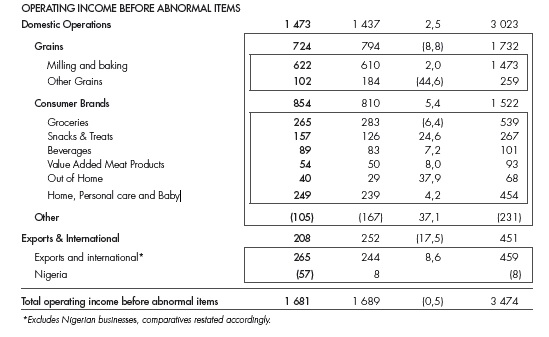
    So where do they make the money? Below I cropped the segmental operating income from the latest numbers. As you can see, grains contribute nearly 40% of profits, consumer brands close to half and exports the rest. The exports business is basically their African growth story. Nigeria includes the recent acquisition of the Dangote Flour Mill, we will cover that later.

    The Numbers. Headline earnings per share grew 4% to 818c, if you exclude the dilution from the Dangote acquisition earnings were up 14% to 897c. We have to include the dilution in our analysis however because we will happily include the growth in earnings when those start coming through. Group turnover increased 7% if you exclude the Dangote addition. The stock trades at R290 or 15.9 times consensus earnings of 1820c for the full year. I wouldn't be surprised if that comes down due to the dilution.

    The grains division grew 6.7% but operating income decreased due to price differentials arising in the rice market. The company has embarked on many capital projects so far this year in order to grow this division.

    Consumer brands turnover was flat due to raw material cost pressures which increased prices and decreased volumes. As you know the consumer is under pressure and these price increases are taking its toll. Again a lot of capital projects are being embarked on in this division in order to improve manufacturing efficiencies. The Mrs Balls acquisition was also completed in the period.

    Exports grew 13% and operating income grew 9%. This is where the excitement is coming from. The Dangote acquisition in Nigeria is only expected to start contributing after two to three years. There is a lot of work to be done there but you can see why milling and processing grains in a poor country with 162 million people sounds attractive. As long term investors we are more than happy to wait for this to bear fruit.

    Yes the numbers are not exciting but the South African economy is slow at the moment. I do not believe this will be forever. On top of that they have strong relations with businesses such as Shoprite and Massmart who are planning on massive expansions into Africa. They will bring Tiger products with them without Tiger having to worry about building shopping centres and other infrastructure. We are very happy to buy into the biggest food producer on this hungry continent of ours.


Home again, home again, jiggety-jog. Another savage Japanese sell off hasn't really rattled the market here, Europe seems just fine too. Perhaps the Buffett buying is boosting sentiment a little. The president gave a speech, not really that inspiring and is now off to Japan. Sayonara Zuma-san.


Sasha Naryshkine and Byron Lotter

Email us

Follow Sasha and Byron on Twitter

011 022 5440

Wednesday, 29 May 2013

Nampak. No Marshall. Africa plan.

"And coupled with earnings not meeting expectations was perhaps the one announcement that shareholders did not want to hear at all, that the chief responsible for the turnaround, Andrew Marshall, was looking to end his short stint at Nampak. I suppose that he could say that it was job done, but still, shareholders would have wanted more of him, not less. The retirement date is set for March 2014, after which Marshall would have completed his five year contract with the company."


To market, to market to buy a fat pig. Holy smokes. Records here there and everywhere. Well, not quite, but nearly. The local equities market zoned in on 42 thousand points, finishing a mere 29 points away from that mark for the first time. The main reasons were twofold, one, a movement higher in commodity prices which were spurred on by better economic data out of the US (and Europe), and two, worse than anticipated data out locally led to a slide in the Rand to the US Dollar to the worst level in four and some change years.

That is good for the equities that are listed abroad and priced in ZAR, but not so great for the local economy. Imported inflation is creeping in here locally. We will discuss all of that data today, we will look at Nampak, which disappointed the market and we will look at the commentary from the MTN AGM, Byron will look at those. There was also some really useful feedback on Famous Brands, we will publish that too. Some good stuff, some bad stuff, and some real, real ugly stuff emerging yesterday.

But first, let us deal with the good stuff. The WSJ has the headline: Home Sales Power Optimism. And this is true, the more optimistic that there is a value underpin in the price of your property, the greater the chance of you spending or even renovating on that asset. Or acquiring that furniture, or a new wardrobe. That sort of thing. So I guess then it wasn't surprising that at the same time that The S&P/Case-Shiller Home Price index rose by 10.87 percent over 12 months that the consumer confidence number would also bash expectations.

What is important to note, from the 20 city download is that prices are nowhere near the highs of 2006, check it out when you download the .pdf via the above link. I had fiddled with a wonderful image, and then was reminded that it was a copyright piece. But the point I wanted to make was that the highs of 2006 were around 210 on the index. Years to go before that particular high is reached again, that is my sense. The other release that got everyone excited as well was this one: Conference Board Consumer Confidence Index. Now what I find quite funny though, that the base for the index, 100, was back in 1985. What? Does that mean that confidence has trended lower since then? What happened back in 1985 that it is better in 2013?

In 1985 Reagan was sworn in for a second term, the song "we are the world" was recorded, the worlds first autofocus lens was released by Minolta (remember them?), Gorbachev became the leader of the USSR, South Africa ended their ban on interracial marriages (no really), we discovered that the ozone layer had a hole in it, president of South Africa at the time, P.W. Botha declared a state of emergency, Tertis was released and DNA was used in a criminal case for the first time. The world population was less than 5 billion back then. So, what was so great about 1985? I can't see it. Oh, and Justin Bieber would not be born for another 9 years, isn't that astonishing!

Well, this one from yesterday showed that US consumers confidence was at a five year high. Expectations for an improved labor market had risen too, those expecting the economy to improve were more, those expecting the economy to worsen were fewer. I am ordinarily wary of surveys, because one event can change everything, change the way that people react in the short term. But it meant record highs for the Dow Jones Industrial, and a strange metric that everyone seems to be keeping an eye on, the 20th consecutive Tuesday of gains for blue chips. That is weird. Why would you care which day stocks went up or down? Seemingly some people do care. They ("those" people you know) have also measured that the Dow Jones has not yet been down three days in a row, this year that is. So what? Do I care? Not really. What matters is what you own, not what the index does. Pfff...... Markets are indicated lower today after closing off the best levels for US stocks. Better luck next time.


Local GDP. What went wrong? Why was the miss much worse than consensus? Consensus, as far as I could understand was for quarter on quarter growth of somewhere in the region of 1.7 percent, yet the actual print was around 0.9 percent. Which isn't pedestrian. It is crawling. Well, the single biggest industry going backwards is the manufacturing sector. Too expensive. Fixed costs have risen at an alarming rate over the last four to five years and finally these are the consequences. The manufacturing industry, which used to be a massive contributor to the economy is only 12.6 percent now. I suppose that can be viewed two ways, first the contributors to overall GDP: "Finance, real estate and business services - 22,4 per cent", "General government services - 16,8 per cent" with "The wholesale, retail and motor trade and catering and accommodation industry - 16,0 per cent".

And then I guess a rewind to the past, when manufacturing was a far bigger contributor. But a fall of seven percent plus? Well, there were a few public holidays in the first quarter that normally fell into the second quarter, obviously losing some steam. Newsflash, I guess the weaker Rand does not help manufacturing minister Davies. Pfff... I guess the fact that the labour minister, Mildred Oliphant, who said yesterday that illegal strikes had cost the country 17,290,552 hours last year, that could be a factor of sorts. That is 720,439.66 days. Or 1973 years. That is quite a lot of time lost there! Most of that was in the mining and quarrying sector.

And what is the state response? Well, the Mines Minister tabled her budget speech yesterday, you can find it at the Department of Mineral Resources website. I was particularly struck with this one line, that seems to go around and around (a lot): "It is the truth that South Africa has the world's largest mineral endowment, with an estimated value of US $3.8 trillion dollars. These endowments, if properly exploited using the combination of appropriate policies and regulatory framework such as we have, we are more than capable of breaking the back of the triple evils of poverty, unemployment and inequality."

Meanwhile just this morning there is an announcement from Sibanye Gold, that they could cut 1100 jobs. So much for that. But if you read the speech further you will see that under the heading titled Shale gas, there is a little interesting paragraph: "We are engaging legal processes to finalise the establishment of a State Owned Mining Company." Do you know what that sounds like to me? It sounds like the state are saying, OK, there is this reserve under the Karoo that we are going to exploit, currently no private companies do this in South Africa, so let the state get rolling here. The worst possible idea if I think about it. Hopefully I am dead wrong. And the whole idea that a relationship with the Russians could lead to something great, I am not sure that the Russians have anything but their own agenda. Again, hopefully I am wrong with that!

GDP not good, Mines Minister incredibly upbeat against what is the backdrop of poor, poor news, seemingly. I hope she is right.


Results from Nampak yesterday that Mr. Market did not like at all. I am not too sure why there was such a large overreaction, but a miss of the markets estimates is often met with aggressive selling, IF of course the stock has been up sharply over the last twelve months. And all of those things happened yesterday. Nampak stock, before yesterday's open and the number release was at 37.30 ZAR per share. A year ago the stock was at 22.34 ZAR, so you can quite clearly see the absolutely fabulous return that shareholders have enjoyed. Yesterday the enjoyment was nowhere to be found. The stock fell hard, down 4.77 ZAR, or 12.79 percent to end at 32.53 ZAR. I guess you could still say that the 12 month return has been fabulous, but clearly more was expected on the earnings front.

And coupled with earnings not meeting expectations was perhaps the one announcement that shareholders did not want to hear at all, that the chief responsible for the turnaround, Andrew Marshall, was looking to end his short stint at Nampak. I suppose that he could say that it was job done, but still, shareholders would have wanted more of him, not less. The retirement date is set for March 2014, after which Marshall would have completed his five year contract with the company. The board appreciates the man for the work that he did: "The board wishes to thank Mr Marshall for his valuable contribution to the group. During his tenure the groups expansion into the rest of Africa was accelerated, under-performing businesses were closed or sold and profitability improved significantly." Spending more time with family and also time for new and fresh management, says Marshall. Well, good for him, and jolly well done!

The main anxiety was over margins, and I guess costs. Locally the business struggled with imports (cheaper) and lower demand, which we can see in some of the GDP numbers. Plus, big expansions in their glass and cans businesses saw them accepting lower prices for longer term contracts. I suppose that makes sense at some levels, lock in the customer for longer in order for less volatile sales numbers.

Essentially, as Marshall said in his interview on CNBC's closing bell with Samantha Loring: Nampak’s Interim Results with CEO, a short term knock for a 6 to 10 year lock in! That adjustment accounted for 150 basis points, whilst the weaker South African economy accounted for a 100 basis point reduction. So there you go, the margin decline essentially explained. Marshall says that by taking the knock now, and securing the longer term contracts with multi-nationals, investors should in essence be happy. Yes. I suspect that he is very right, these investments take a long time to bear fruit, these businesses are run for the longer term.

Check out the geographical split in the graphic below, taken from their report: Interim report and dividend declaration for the six months ended 31 March 2013. What is quite amazing is that the UK business, which essentially sells plastic bottles to the dairy industry in the UK, has similar margins to the local business. And that is where the disappointment came through, as Paul said, this sounds like the old Nampak, making excuses for the South African businesses. Check it out:
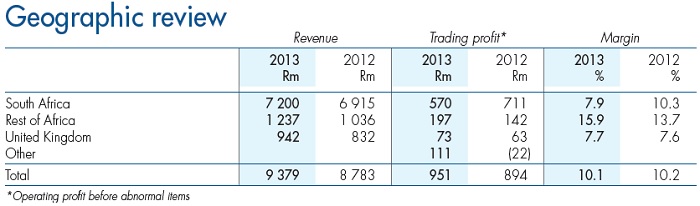
Nampak has traditionally always been a good measure of the South African economy. You could and can get a sense of what the local consumer is up to. It is interesting to note that in their cans business that people are eating more fish, but less fruit and vegetables. And the paint and aerosol cans business was a little lower in terms of volumes. Plastics, flat, lower drum sales, crate demand "moderate". We haven't run out of tissue paper, thanks to Nampak, remember the crazy story about Venezuela a few weeks back running out of the stuff.

The real growth however is going to come from the rest of our continent, where the margins are much higher, nearly double here locally, because there is of course a much higher barriers to entry in those places. The can factory in Angola is cooking, that was the example used. The African division grew profits 39 percent. That business, the rest of Africa portion, has quadrupled in five years. I am not suggesting that is going to continue. Not at all, but you can clearly see what is happening. But each country in Africa has a different set of businesses currently. Marshal said that the plan would be to replicate the model here in each territory. The major expansion territories will be Angola, Kenya and Nigeria for the time being, investing 175 million Dollars in the process. Those monies were actually raised in the US, and are 7 to 10 year dated, at what they call extremely competitive rates.

Best guess, trundle along here locally and grow rapidly through the rest of our continent in the coming years. It is not without execution risk however. And the stock hardly looks overwhelming cheap anymore, on a 15 multiple. Bidvest stepped away a long, long time ago, late 2008, before Andrew Marshall was there. However, with profit projections of 15 percent per annum, and a current yield of around 4 percent I would say that this is a steady eddy stock. One for those kind of portfolios that you can shelve the shareholding and wait.


    Byron beats the streets

    Yesterday we received a business update for the 4 months to 30 April 2013 from MTN. I am still constantly amazed by the subscriber growth of this business. Not because I think the numbers are not there but because off a constantly higher base the growth remains consistent. MTN are expecting to service 200 million people by the middle of the year. That is astounding.

    The exact number for this period came in at 197.4 million, a 4% growth for the period. To put things into perspective, in the last report ended 31 March 2013, MTN had 195.4 million subscribers. That means they have added 2 million subscribers in a Month! By the end of 2004 the business had just short of 9 million subscribers. The power of compound growth, 4% does not seem like much but when you put things into perspective you look at it differently. And that was only ten years ago.

    On the back of this subscriber growth revenues grew 5.6% year on year thanks to a good performance from MTN Nigeria. Of course the weaker rand has been beneficial for a business who report in Rands but get most of their income outside of the country. Rand reported revenues are up 15% year on year.

    There have been a few issues in Nigeria with regards to the quality of their network. This is cleared up in the update.

    "The main focus for the Nigerian operation is to improve network quality and capacity to enhance competitiveness and cater for higher usage. We have made good progress on our capital expenditure rollout programme and continue our constructive dialogue with the regulator, the Nigerian Communications Commission, regarding its recent determination that MTN Nigeria is a dominant operator in that country."

    I guess with more control and power comes more responsibility. They also talk about South African operations which remain fairly muted as earnings marginally declined. If it weren't for good data and SMS growth this would be even worse. Fortunately this business has huge geographic diversification.

    "The Group's operations in Iran, Ghana, Sudan and Uganda showed healthy growth in both revenue and subscriber for the period. Group data and SMS revenue continued to expand strongly in most markets, increasing its contribution to total group revenue to approximately 18%."

    That last sentence is key. 18% is huge when you consider that data was barely mentioned a few years ago. And we expect this to only get bigger.

    In a separate announcement the company announced that former CEO and the man who brought MTN to such great heights, Phuthuma Nhleko will be taking over as chairman from Cyril Ramaphosa. I take one positive and one negative from this turn of events. The positive is that over the years I am sure that Phuthuma has built quite a large share holding in MTN. This means that his interests are aligned with shareholders. The negative however is the temptation to take a more executive roll. It may be quite distracting for Sifiso Dabwengwa to have his former boss as chairman. Overall it is probably net neutral.


Crow's nest. Markets are much lower across the board here, searching for a reason is not hard. Markets were lower in the US when most of our time zone signed off, it was a matter of catch up in some senses. It seems like the currency is heading towards ten to the US Dollar, a level not seen since the financial crisis. And ironically the rest of the developing world is seemingly making progress. #Winning somewhere.


Sasha Naryshkine and Byron Lotter

Email us

Follow Sasha and Byron on Twitter

011 022 5440
Tuesday, 28 May 2013

Famously delicious

"For the year they opened up 140 new stores and revamped 136. According to CEO Kevin Hedderwick this was slower than normal because of a slowdown from their petrol depot clients. They look to open well north of 200 this year. These stores took the overall network to 2163 restaurants, 1881 in South Africa, 172 in the rest of Africa and 110 in the UK (these are all Wimpy's)."


To market, to market to buy a fat pig. With markets closed in New York and London, we were left to our own devices. Resources stocks rocked, mostly led by the diversified majors, Anglo American and BHP Billiton. But, industrials and financials also had a decent showing, the Rand continued to slide, that is not good for everyone. However, for the exporters and the Rand hedges, it is all good. For imported inflation, well it is not. And I guess that was and is the conundrum that is facing the SARB and the MPC, having to juggle imported inflationary concerns. And the other issue is that mineral exports are lower as a result of lower prices for one, and demand being lower too. Although, as we pointed out yesterday, green shoots seem to be emerging in Europe. So Europe is not finished. And you are starting to see more and more stories like this: Optimism returns as Greece sees light at the end of tunnel. What? So you mean no more Greek exit.

What about all those trolls that were 100 percent certain that this was going to happen? The Eurozone was going to fall apart in weeks/months and in same case hours. What about the spreads and the Credit default swap rates that anxious folks continually bombarded us with hourly. Default this and that, finished this and that, over and over again. And some platforms which attract an enormous following and have nothing positive EVER to say. EVER! Zero Hedge is always in the business of fear mongering. I saw a post quoting Dave Rosenberg in June 2009 saying that the Era Of Green Shoots Over. The unrelenting publishing of bearish (and very real) news over and over again can suck one into believing that there is an imminent collapse at any time. Calling markets lower. And seemingly the folks there are bullet proof. I guess we are no different, we are just the flip side of that agenda.


OK, that is interesting. The story that was doing the rounds yesterday, that the central bank locally is happy that unsecured lending is slowing in South Africa, is pleasing at some levels. Bloomberg ran a short piece yesterday: South Africa Banks Slow Unsecured Loan Growth After Intervention. The trajectory has slowed from 30 percent per annum to 25 percent per annum. But a cut away at the same time from a Reuters story at Engineering News to one of the Deputy Reserve Bank governors, Lesetja Kganyago suggesting that unsecured lending in South Africa is too small to pose a risk to the banking sector.

He (Kganyago) quantified that, as you can read in the story, SA not at risk from unsecured credit - Kganyago, by saying that unsecured loans totalled 453 billion Rands by March 2013, out of a total bank assets of 3.6 trillion ZAR in South Africa. Or, 12.5 percent of all bank assets are unsecured loans. Now, if ABIL have a book of close to 51 billion Rands, and Capitec have a book of nearly 28 billion Rands, that means the rest of the banking institutions amongst them have outstanding loan books collectively of 374 billion Rands. Unsecured sports lovers. Now of course, in the case of ABIL and Capitec, this is almost entirely their whole business. But for the big banks to muscle their way in to what is a lucrative business, they have all the channels, they know all their clients well.

You might recall in the Standard Bank results in March, that they had the following to say: "The impairment charge in personal unsecured lending (excluding card) increased to R2,3 billion (2011: R1,3 billion). This was a result of the increased incidence of default in the R3,7 billion domestic personal term loans book (loans to lower-income customers known as the inclusive banking book) and strong growth in the middle market segment in South Africa and workplace banking in the rest of Africa."

FNB suggested that their unsecured credit book grew by 27 percent, back when they released their results in March. It seems more "in control" over at FNB, or at least that is what I could read at the time. ABSA, well, they were under pressure, but it seemed that nobody was on the blower as much as in the other places. This is very lucrative money for banks, the business of making money by lending it to people, that is great business, provided you are able to manage "things" through the cycles.

Paul wrote a simple email to a concerned client last evening:

"African Bank has had a bad year, and an even worse last few weeks.

Their real problem is that the big four banks are also issuing lots of unsecured credit, which is making the space more competitive. Also, the furniture sector is looking bleak, which hampers the Ellerines results.

Did you see Byron's excellent review of the credit markets, a few days ago in the daily report? Here it is:

Unsecured lending market

Chances are that they will bounce back when public sector wage increases are negotiated or social grants are increased, or the economy picks up a bit.

We are keeping a close eye on it. Our normal inclination is to ride out the short-term ups and downs, but we will let you know if we change our minds!"

So what is the conclusion? Well, whilst the regulator and the central bank is clearly worried with the way that the unsecured market has boomed in South Africa, it is perhaps too far from what could be a bubble. And from time to time, these businesses go through tough times. But hold the line.


    Byron beats the streets

    Yesterday I went to the Famous Brands results presentation for the full year ending 28 February 2013. It's hard not to be impressed with a business that has managed to grow earnings on an average annual basis of 21% over the last five years. Of course the share price has followed suit, now trading at R94, up 482% from the R16 it was trading at 5 years ago.

    Let's see how they went over the last financial year. Revenues grew 17% to R2.5bn which resulted in headline earnings per share growth of 22%. This equated to 339c, of that 250c will be paid out to shareholders as a dividend. As mentioned above, the stock trades at R94 which puts it on a historic PE of 28 and a dividend yield of 2.7%. Now there is no doubt this is a good business, but is it a good investment at these levels? Let's delve deeper.

    For the year they opened up 140 new stores and revamped 136. According to CEO Kevin Hedderwick this was slower than normal because of a slowdown from their petrol depot clients. They look to open well north of 200 this year. These stores took the overall network to 2163 restaurants, 1881 in South Africa, 172 in the rest of Africa and 110 in the UK (these are all Wimpy's).

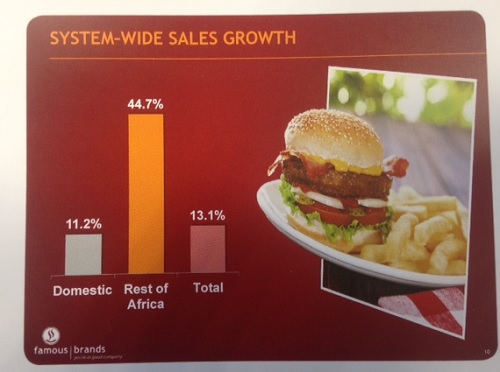
    The sales growth is interesting, as you can see from the table below the rest of Africa is flying and now compromises around 7% of overall sales. A lot of this growth is attributable to new stores but even same store sales were up 28.3% in the respective areas. Local same store sales were up 7.7%.

    That looks at the front end side of the business but what is so exciting about this model is that these stores are all locked in clients to their logistics and manufacturing business. This business has taken huge advantage of the economies of scope strategy. Basically they are trying to buy or replace any outsourced service which they can do themselves. Why pay an external supplier when you can buy the Coega Dairy factory and supply cheese to all your franchises yourself?

    Another good example of a benefit of economies of scope happened within the Steers franchise. People were complaining that the burgers were too expensive. So instead of margin compression for the Steers franchisees, they supplied the meat at a cheaper price which allowed Steers to become more competitive. Yes margins in the meat manufacturing division came down but the growth in sales as a result more than made up for it.

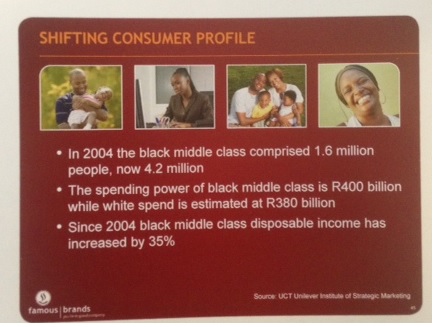
    What does the future look like? Here are some interesting stats from the presentation which explains a lot for all retail in South Africa. As you can see from the image below, things have been getting better for a lot of people and I expect this to continue.

    That is just locally, the prospects for the rest of Africa are huge. Kevin Hedderwick mentioned that he is in regular contact with Whitey Basson and they plan on following Shoprite into the shopping centres being built in places such as Lagos. The base in these places is so low and the choice of restaurants is extremely limited.

    Having been to the presentation and seen what they are up to behind the scenes I think the potential for this company is still in its infancy. It is competitive out there but these guys have the infrastructure and experience to dominate. They have low debt and are extremely cash generative, I am happy to buy at these levels.


Crow's nest. Markets are going up today, across the globe. Anxious about Japan? Maybe, but as someone on the Twitter thingie pointed out, Japanese stocks as an investment over 23 years have been shocking. Exactly. And talking about shocking, our local GDP read was more than a little awful and a shock to the system.


Sasha Naryshkine and Byron Lotter

Email us

Follow Sasha and Byron on Twitter

011 022 5440